A new boat in the 12-metre catamaran segment is always an event worthy of interest. The Lagoon 39', with its original technical and ergonomic arguments, stands out from the competition and also upsets the balance of positions which has set in in the range, between the ‘unbudgeable’ 380 and the recent 400.
Infos pratiques
- Le chantier : Lagoon 39
- La fiche technique
-
 Découvrez notre vidéo exclusive
- Financez votre Lagoon 39
- Assuez votre Lagoon 39
- Articles autour du Lagoon 39
1,400 hulls later!
Launched in 1999, the 380 has written a significant page in the history of Lagoon. At the rate of one per week throughout this period, the ‘biggest of the 12 metres’ will have marked the decade and influenced the whole of the category. 700 boats later, it is still in production as a totem which one would not dare to touch. The 100,000 euros difference which separates it from the 39’ could prolong this amazing success.
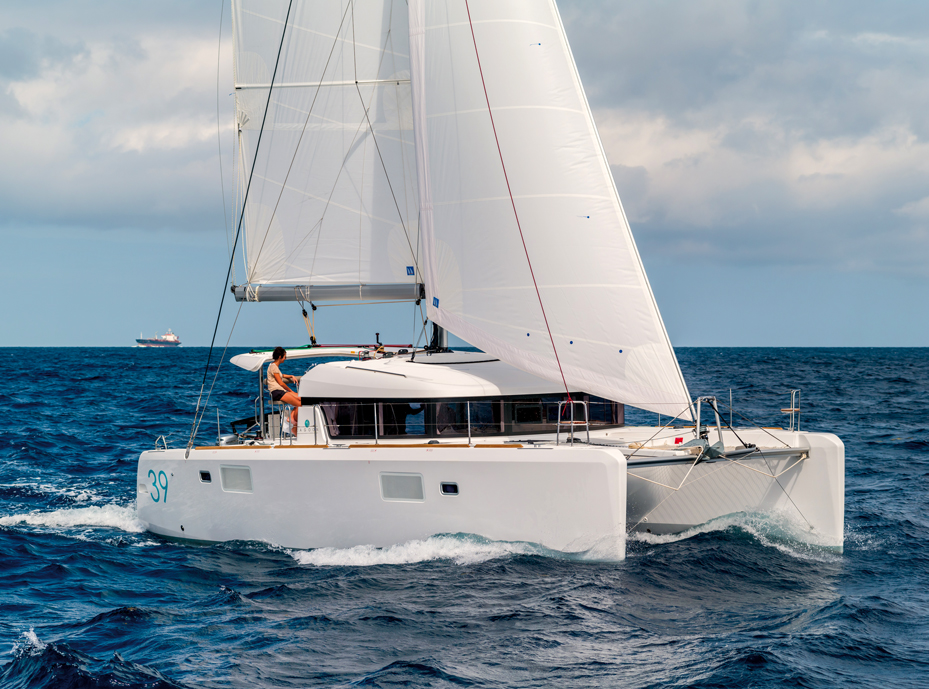
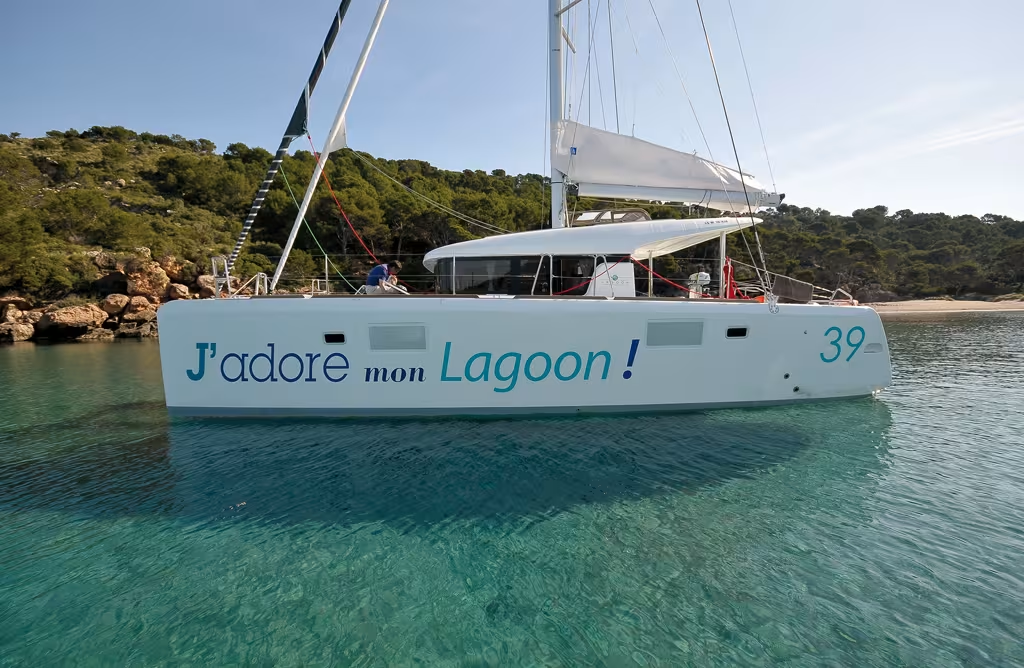
The 39 has retained the company’s characteristic silhouette, but work on the exterior design by VPLP/Patrick le Quément has developed many points.
For 1 foot more or less!
From the market positioning angle, it may seem curious to telescope three boats of between 38 and 40 feet! On examination, Lagoon’s choice is probably more strategic than it appears. The 38, a modest star, is the entry ticket into the Lagoon multihull brotherhood. The 40 is a more sophisticated catamaran, mature and spacious, which has opened up a new era in terms of build quality. Between the two, the 39' offers a creative interpretation of the concept by interposing a different vision of the accommodation space and the rig.
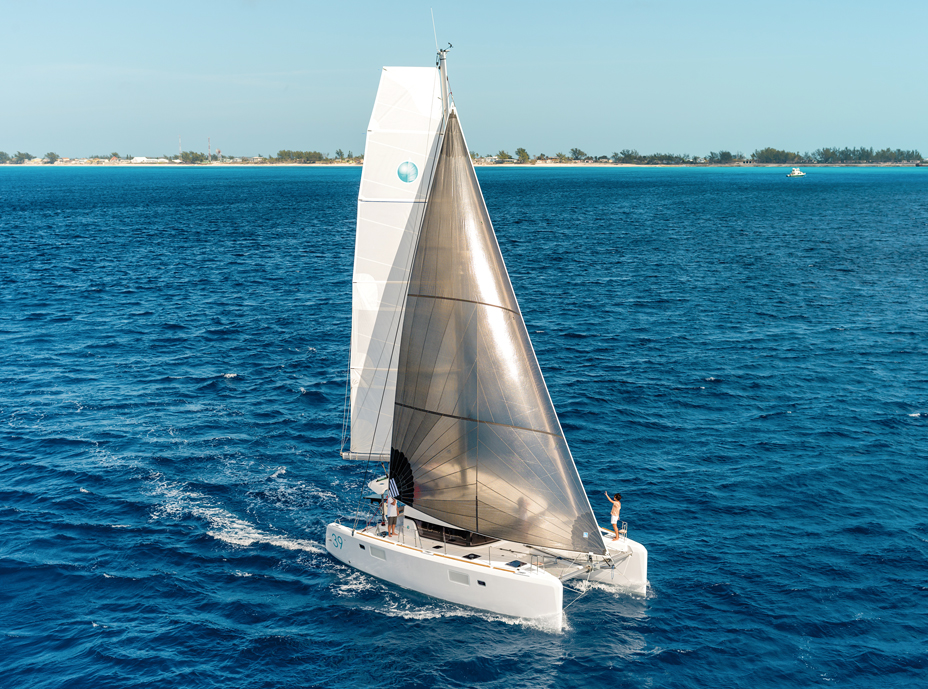
The new sail plan puts the emphasis on the headsails for light weather, but the mainsail’s output has not been forgotten, with a nice aspect ratio for the square-headed version.
The search for the magic formula
There was a time when multihull architects merged with their creations and customized their designs, as was the case at the heroic era of the motor car, with legends such as Bugatti, Lotus or Alpine. This vision now belongs partly to history; without forcing the comparison, Lagoon’s orientation appears to join the concerns of contemporary car manufacturers who now put consensual, responsible, family, non-aggressive, reassuring and easy to live with models on the market; the difference between a 2013 saloon and the 1970 Maserati-engined Citroen SM! Certain enthusiasts, attached to the ‘character’ of their machine, will regret this, others will adapt.
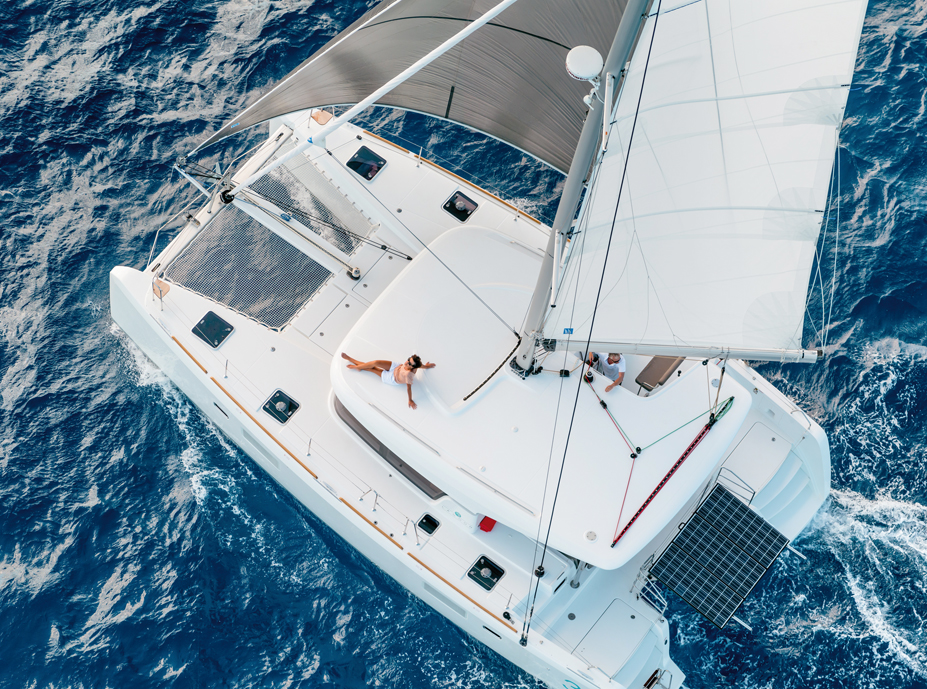
A nice, easy boat to sail.
Solution n°39
The 39' is not a small 40' or a reinterpreted 380, it is a brand-new boat which moves the boundaries in several fields. Style, first of all, as VPLP’s co-operation with Patrick Quément (a big name in this field, former manager of Renault design!) has allowed the Lagoon exterior design to be reinterpreted, by developing it in discreet but important touches, for the final perception of the silhouette. The functionality and ergonomics have also been affected by in-depth work, in order to subtly adapt the cat to the lifestyles and rhythms of the moments shared by the crews of these boats. The technical compartment has been the subject of voluntary choices, in order to optimize the ease of use and comfort at sea.
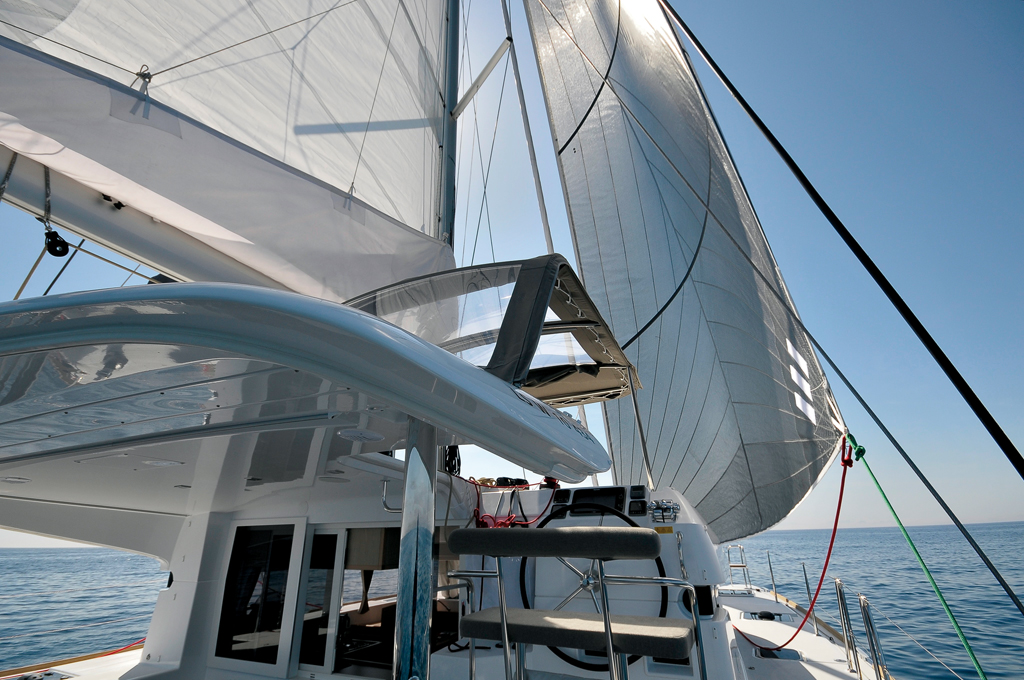
The 39’s new architecture favours the ergonomics and fluidity of the relationship between the various areas. The handling of the mainsail also benefits.
An innovative sail plan
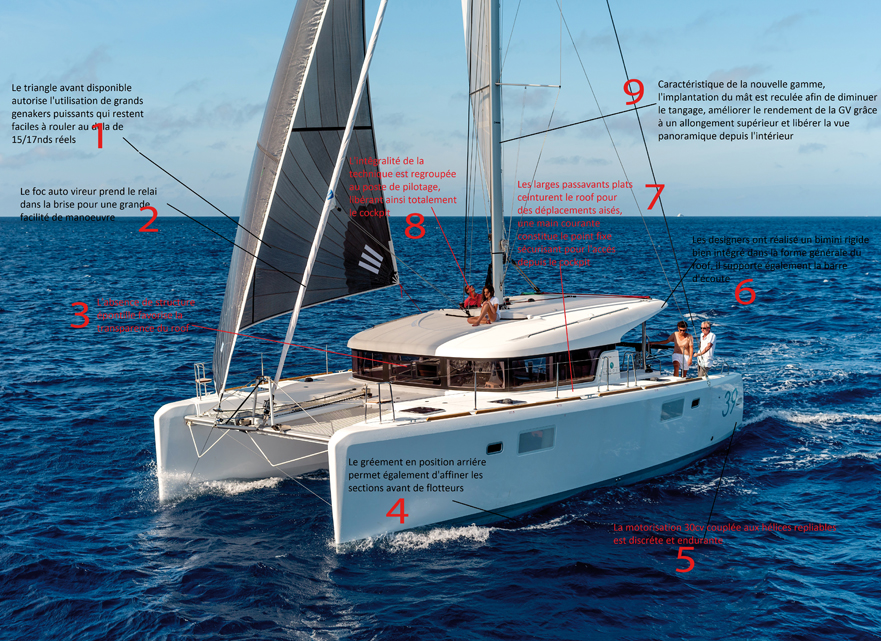
Moving the position of the mast back by 3m influences the whole of the boat’s design; the motivation must therefore be sound. This arrangement favours the transparency of the coachroof and frees up the forward facade, but requires the bilges to be reinforced with generous (and probably heavy) floors arranged in a fishbone pattern, supporting the tubular mast compression strut, which is now situated at the level of the galley. The main aim is to improve the position of the centre of gravity and to fight against pitching. A bonus of the decision is that the opening of the forestay angle allows a reduction in the tube’s inertia and improves its performance in the air: less weight aloft and better aerodynamics! The hulls’ forward sections also benefit from the development. They are slimmer and should improve passage through chop when sailing to windward and contribute to reducing the impacts under the bridgedeck.
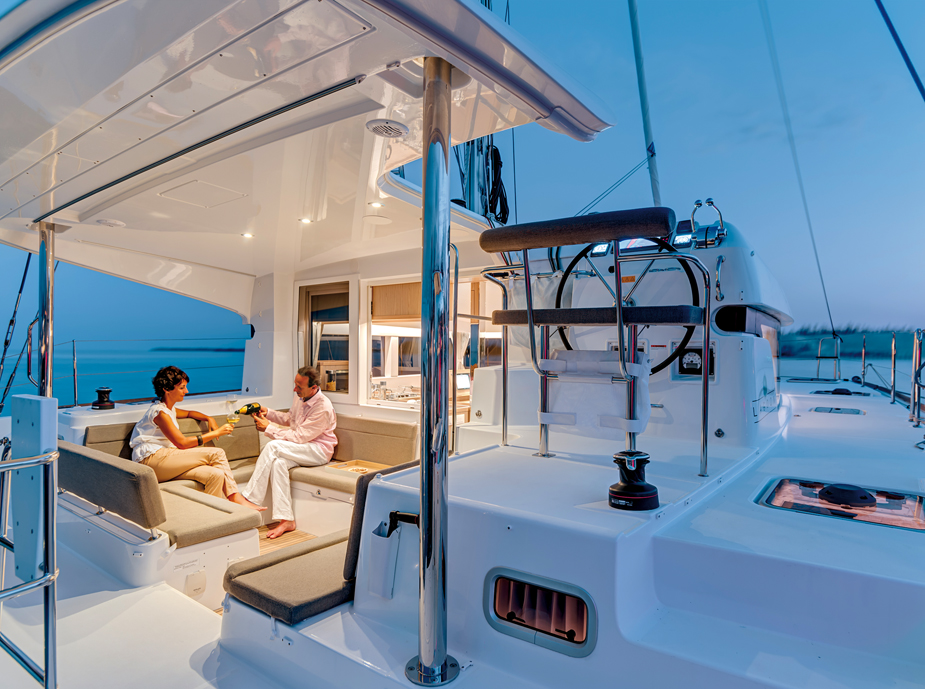
Cosy exterior saloon, comfortable steering position, wide side decks and welcoming interior...it will be a nice evening in the wild anchorage.
Aim: life aboard!
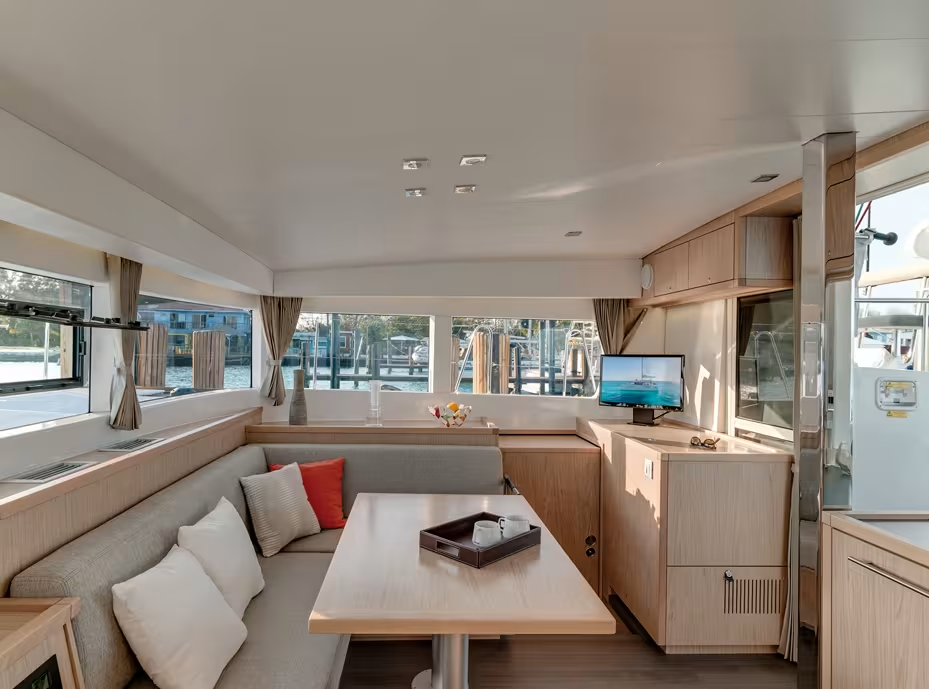
A secondary benefit of this architecture, is that the front face of the coachroof has large opening panels and the saloon’s backrest is moved forward and is plumb with the bulkhead, airing the saloon and galley volumes. Alpi (reconstituted wood facing of excellent standard) used in profusion is much more flattering than the gelcoated surfaces of the previous models. The perfectly fitted mouldings soften the angles and play the part of fiddles for the objects deposited. The chart table seat slides to convert into a bench seat at meal times (if you eat inside). Natural light penetrates abundantly in the saloon without dazzling, thanks to the vertical facades; the panoramic view of the water is real, with no blind spots. The rails for the sliding curtains are skilfully hidden by vertical bands. The dark floor contrasts cleverly with the light oak of the furniture. The general atmosphere is a success; the quality of assembly and manufacture has taken a leap forward. However the cooker calls for more effective pan clamps. The tubular stainless steel armrest in the saloon would benefit from a rounded shape instead of the present straight tube.
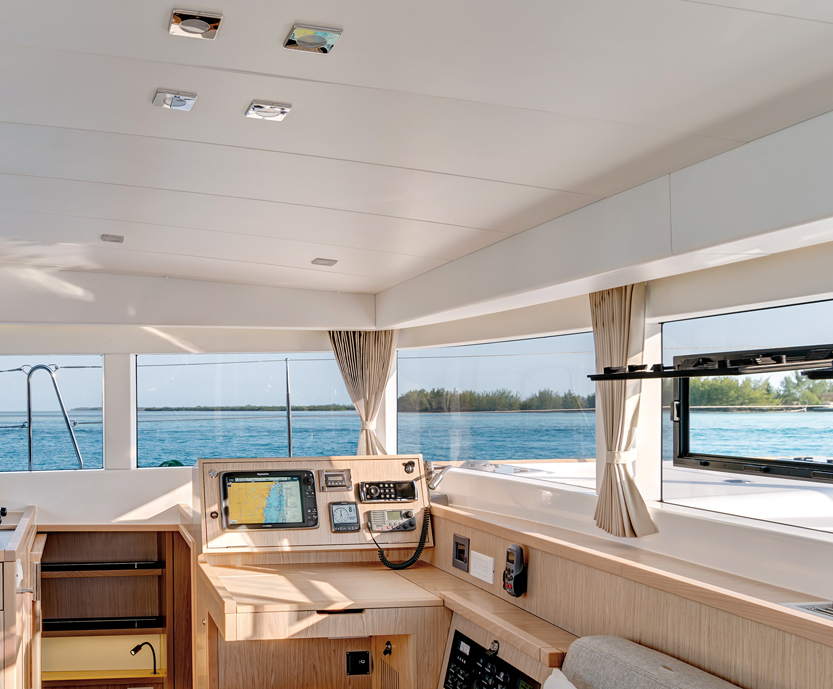
Abundant ventilation and adjustment of the light with curtains whose sliders are hidden.
Plumbing, electricity: a readable approach
‘Modern comfort’ aboard a cruising catamaran plays a part in the crew’s satisfaction, but maintenance or breakdowns should not represent a perpetual obligation for the skipper. On the 39', care has been taken with the plumbing and the seacocks are marked with plastic labels; most of them are fitted into independent housings above the floors. The double clips are accessible (tightening screw opposite the operator) and the parts which could potentially cause injury are covered by red protection caps, bravo! As the corrugated pipes with stainless steel wire don't go with bronze below the waterline (electrolysis), the majority of the seacocks are now in polyamide (oil type). The electrical wiring and the control or junction boxes deserve praise. Waterproof connections are generalized (very important!); the owner’s manual has also been developed (clear, precise and detailed, with colour photos). Maintenance has been made much easier; the prevention of risks and the readability of the functions will make the skipper smile.
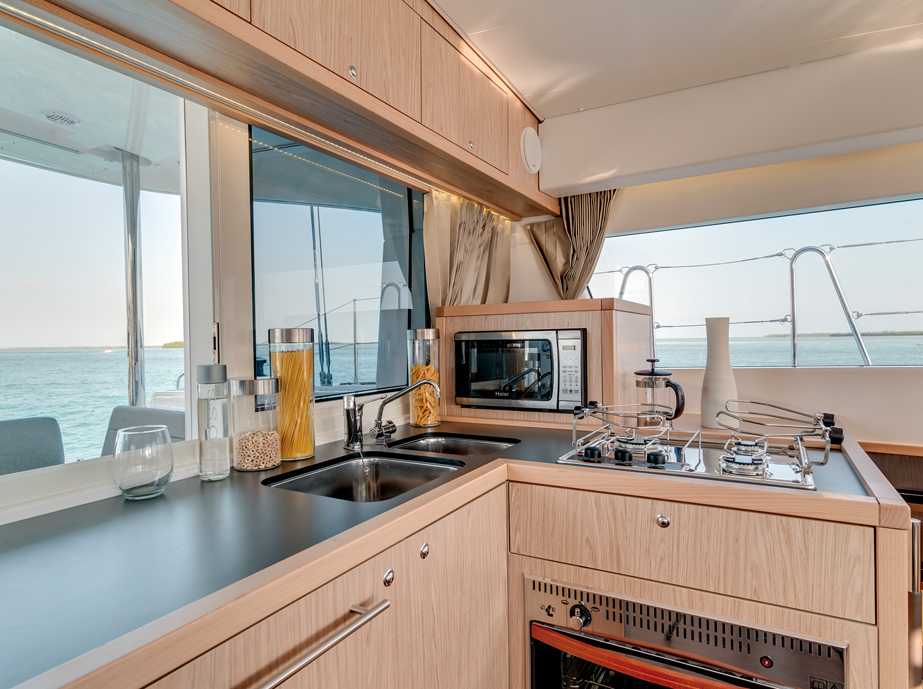
The galley doesn't isolate the cook; its installations favour involvement and make the galley the real crossroads for the crew.
A rational engine installation
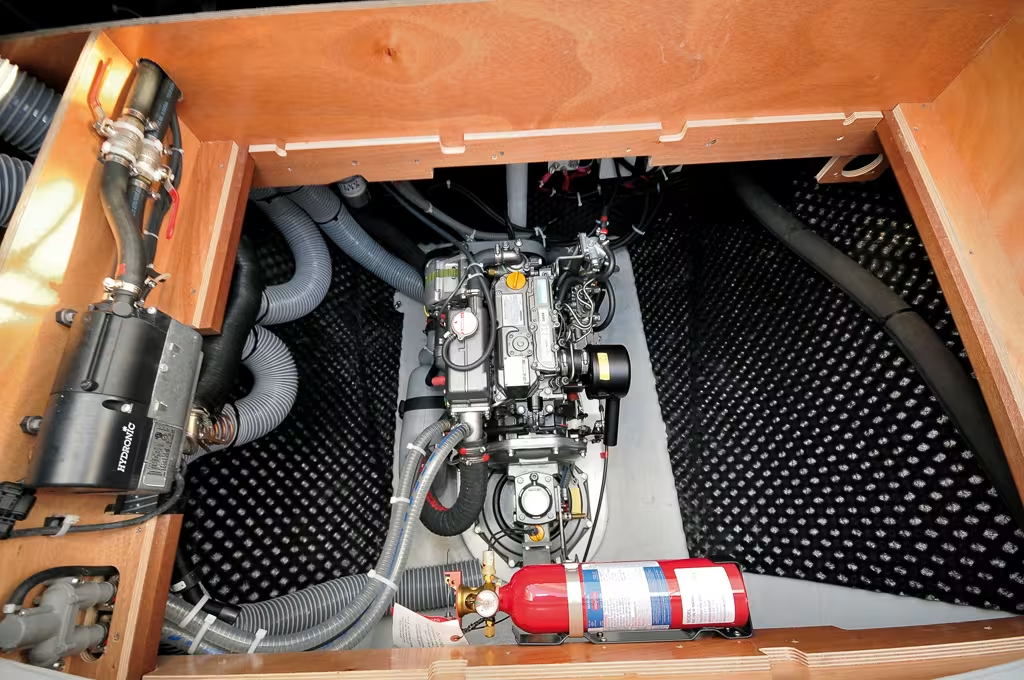
Access to the engines is in two parts; you first have to open the watertight hatches, then remove the 3 plywood panels of the sound insulation (their orientation is not marked). The opening has been widened; the path of the ventilation ducts is tidy and visibility of the generator and the peripherals is total. An intermediate step is still lacking to gain access to the bottom of the hull, and the plywood edges are not protected after being cut, but these remarks remain minor taking into consideration the efforts accomplished. The engine room is covered with insulation foam, an automatic extinguisher is fitted, double stainless steel clips are fitted everywhere, excellent!
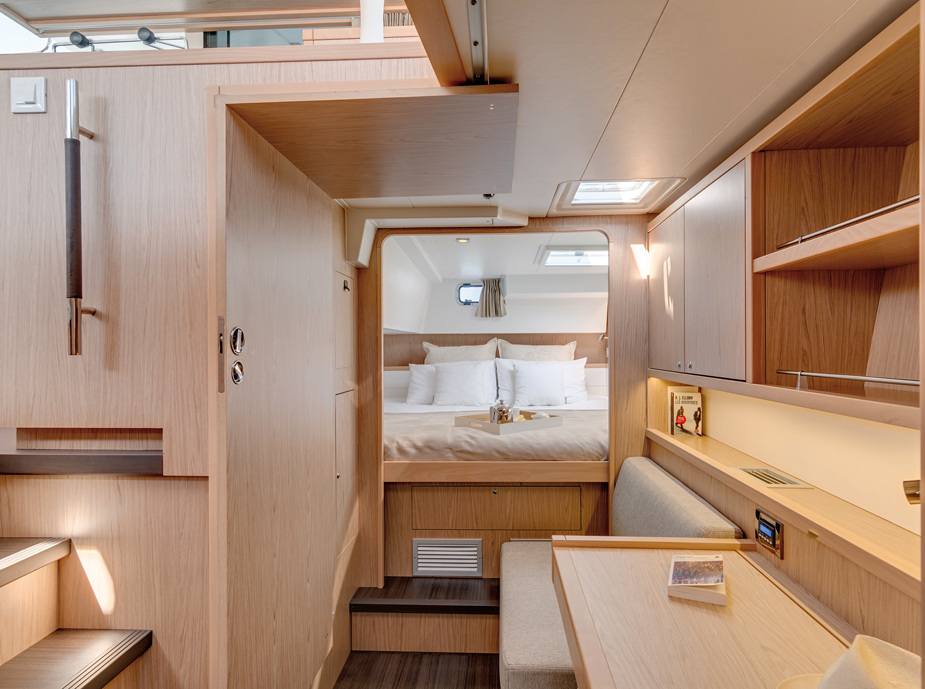
We really are aboard a 39-footer (the port cabin of the private owner’s version).
200 miles with the 39'
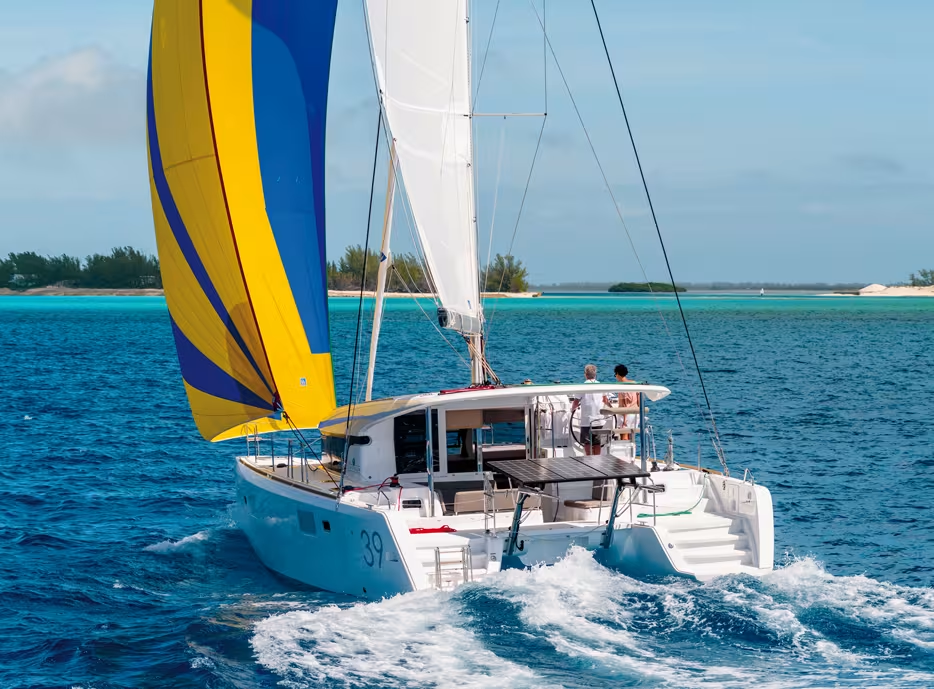
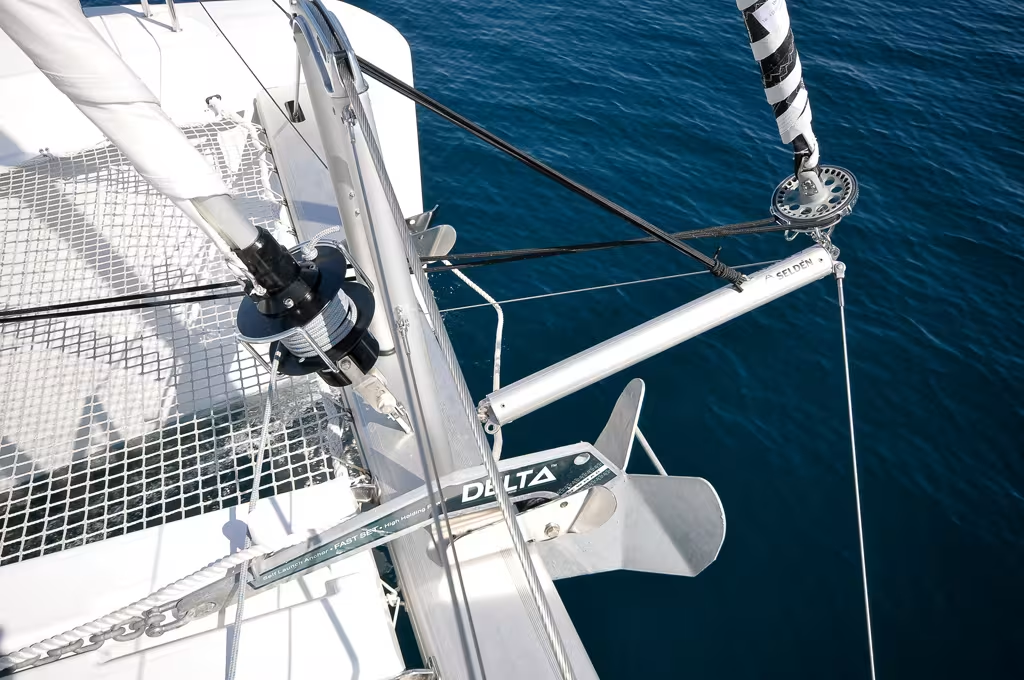
As the capricious weather this winter and the constraints of development meant that the tests of the 39 had been postponed, it was the beginning of April, after the La Grande Motte show, before we set off for the Balearics. The crew was prepared for a 35-knot Tramontane (frequent in this area at this time of year). We finally had a week of good weather! It is not always possible to spend 3 days aboard a test boat; during this delivery trip we were at leisure to enjoy life aboard, but the light wind conditions deprived us of excitement in rough seas. The appropriation of the cabins was facilitated by superb beds, remarkable bed linen and obvious comfort. The electric toilets, the quality of the sanitary installation (plumbing, showers, taps), as well as the soundproofing and ventilation played a part in the pleasure of the stay aboard. From the start, the conviviality organised itself, made easier by the essential meeting place, the exterior saloon. An epicurean collaboration in the galley was the pretext for an in-depth test of the installations. The rhythm of the watches was established; the light wind which reigned over the whole of the Western Mediterranean gave us a wonderful opportunity to rediscover the fabulous early-season skies. The 39’s deck plan is easy to get on with; setting the gennaker at 2 am was the opportunity to discover its use. We started calmly, with 5.4 knots in 9 knots of wind, at 50° to the apparent wind, which is not bad, despite hulls which were already dirty. Locking the folding propellers increased our speed by half a knot, and visibly cleaned up the boat’s wake! The gennaker furler line is returned to the starboard side deck, next to the helmsman’s seat, making the manoeuvre easy; the multi-function electric winch is a precious aid and is recommended. I liked the positioning of the traveller winch less: you can see what you are doing clearly, but biomechanically, it is not ideal. Motorization would be the solution. With two electric winches, replacement of the current solar panels with mono-crystalline models with a higher output will be essential. The boom extends beyond the bimini; its generous modulus allows the mainsheet straps (attached to the middle of the profile) to work correctly. Visibility in the mast foot area and the exits of the halyards, lines and jib sheet are good. The extension of the sail plan is served by the nice Selden mast, with two levels of swept back spreaders (we don’t regret the ugly tubular triangulations of the previous installations). The tube’s section gives an aerodynamic gain, and the whole thing is more flattering to the eye. The Incidences profiles of the self-tacking jib and the mainsail are perfectly adequate (why isn’t the foot of the mainsail adjustable?). The gennaker would benefit from being more generous in its volume and less like a Code 0, in the spirit of what has been realised for the 52'. The idea of a versatile asymmetric spinnaker which can be rolled up appeals to me on this type of multihull and rig. The time spent under engine was not a punishment on the 39’; the absence of vibration, the soundproofing of the 30 hp version tested, and the sobriety of modern diesel engines allows long economical passages at an average speed of 6.5 knots, at 2800 rpm to be envisaged. The 39’ is slightly lazy in very light weather, clearly comes to life in from 8 knots of true wind, and will reach 10 knots downwind at the maximum of the gennaker's range (25 knots of true wind). This catamaran is nimble and well-balanced; tacking and gybing are carried out without difficulty. The extension of the square-headed mainsail gives a very coherent shape and very easy adjustment; the modern solutions found by sailmakers for the forward profiles allow the crew to really make the most of this new configuration. An indentation in the coachroof to take an attachment point would allow the jib or the gennaker to be poled out; this goes with the idea of completely relaxed downwind sailing.
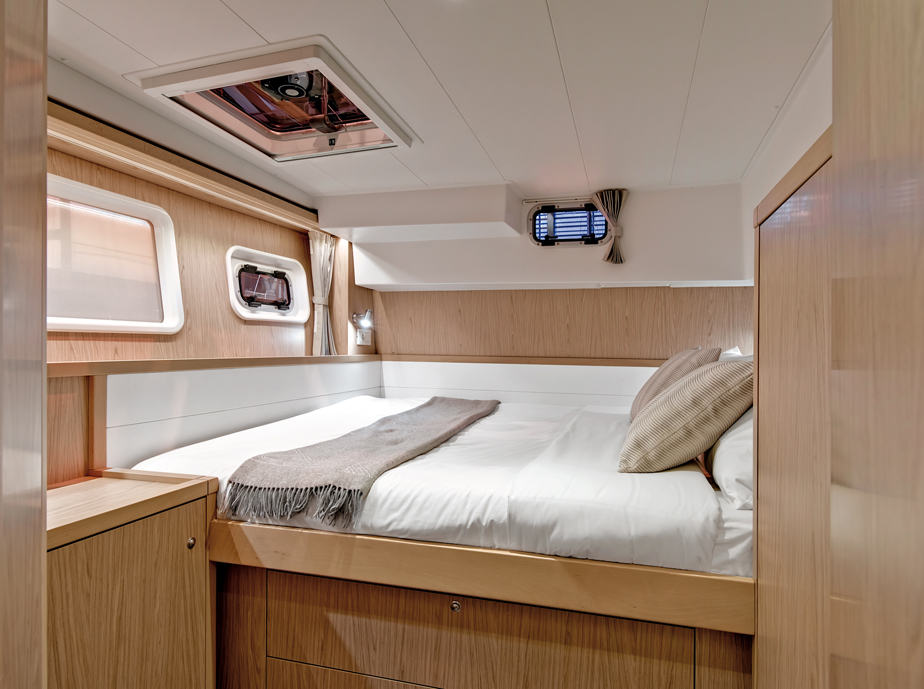
The starboard aft cabin has no cause to be envious of it.
CONCLUSION
It was a pleasure to live aboard this comfortable, well-built multihull for several days. Its charm was supported by the ease of use and the readability of the functions. The tested version’s Premium equipment pack offers all the options necessary except for the watermaker (essential to avoid overloading the boat). Performance in very light weather remains modest; it is respectable in moderate conditions. In strong winds, it's above all the ease of handling which is sought after. The essential is elsewhere, the overall coherence of this ‘big catamaran’ (just 11.7m!) should please cruising families.
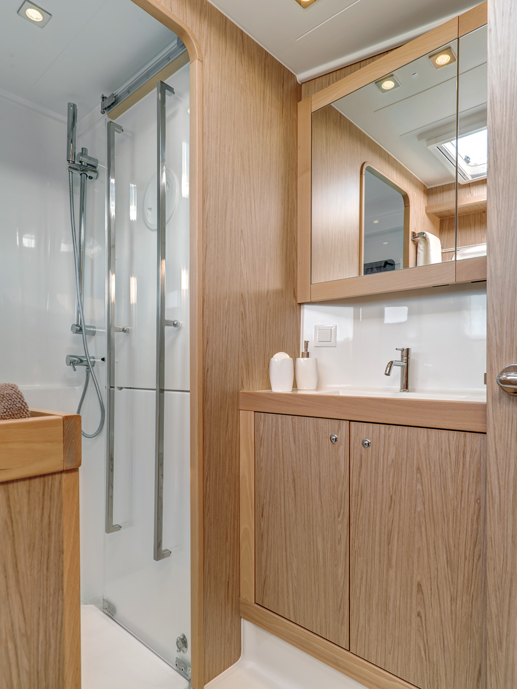
The quality and functionality of the sanitary installations contribute to the 39’s comfort.
The plusses:
• Successful ‘liveaboard’ concept • Quality product • Easy-to-use catamaran
The minuses:
• Jib sheet return in the mast • Fixing of trampoline shackles with bolts • Edges of plywood floors not protected
The competitors
Model Builder Windward sail area in m² Weight in t Basic price in € Leopard 39 Leopard 87 9.1 229,000 Lipari 41 Fountaine Pajot 96 10.3 255,000 Nautitech Open 40 Nautitech 91 7.8 297,800 Freydis 39 Croiseur Tournier Marine 102 6 308,000
Technical specifications
Architect: VPLP Exterior design: VPLP/Patrick le Quément Interior design: Nauta/Lagoon Length: 11.74m Beam: 6.79m Draft: 1.27m Air draft: 18.40m Bridgedeck height: 0.65m Unladen weight: 11.2t Engines: 2X20hp or 2X30hp (option) Windward sail area: 70m2 or 76m2 (square head) Mainsail area: 38m2 or 44m2 (square headed main option) Self-tacking jib: 32m2 Gennaker: 68m2 Material: monolithic bottom, hull sides and deck in balsa-polyester sandwich using infusion, anti osmosis resins. Price of tested version: Premium equipment pack, full electronics, video, sound, circulating water heating, folding propellers, electric WCs...: 344,500 euros exc. VAT
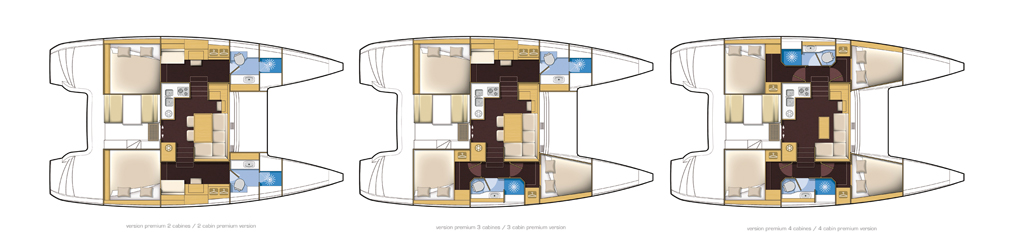
The 39 is offered with two, three or four double cabins: enough to find what you are looking for!
Marc Van Peteghem’s point of view (adapted from an interview with the architect)
For this generation of 39’ and 52’ we gave a lot of thought to the question: ‘What is a Lagoon in 2013?’ and re-examined the meaning that this takes on for future users. For this we went beyond what we normally do in the analysis of the ‘moments of life’ aboard, the essential actions of daily life. Sailing, sharing, resting, cooking, meeting, living as a crew, as well as enjoying moments alone... We have also reinterpreted the design of the ‘bodywork’ with Patrick le Quément, in a very collaborative spirit, and revised the silhouette to make the lines of the rigid bimini ‘fly’ and obtain a ‘stretched’ perception of the upper sections of the hulls. The leap forward, of course, is the aft-positioned rig; it should be efficient from an aerodynamic point of view, with a higher aspect ratio, and give greater propulsive force for a given area. The foretriangle will be powerful, whilst prioritizing easy of handling. Care has also been taken with the hydrodynamics, for better handling in rough seas and a reduction in pitching. The tests carried out aboard confirmed these points, the boat’s behaviour seemed to me to be comfortable, a kind of pleasant ‘moped’ with a better arrangement of the forward surfaces. The 39’ is well positioned in the range, with successful proportions between the interior and exterior volumes. I haven’t had the time to live aboard for several days; I hope to do so soon, with my family.
In figures
A few polars crossed with recorded speeds (full equipment, dinghy with engine on the davits, fuel and water ¼ full. With mainsail and gennaker True wind in knots Speed in knots Angle with respect to the wind 6.5 knots 4 Beam reach 15 knots 7.3 Close reach 20 knots 8.3 Quartering wind 20 knots 10 Broad reach With 1 reef and jib 25 7.1 Close reach 25 8 Beam reach
Caption
1 – The foretriangle available allows the use of big, powerful gennakers which remain easy to roll up in more than 15/17 knots of true wind 2 – The self-tacking jib takes over in strong winds, for easy manoeuvring. 3- The absence of a mast compression strut structure favours the coachroof’s transparency 4 – The aft-positioned rig also allows the forward sections of the hull to be slimmer 5- The 30 hp engines coupled to folding propellers are discrete and tough 6- The designers have realised a rigid bimini which is well integrated into the coachroof’s overall shape; it also supports the mainsheet track 7- The wide, flat side decks surround the coachroof, for easy movements; a handrail forms the fixed point for access from the cockpit 8 – All the control lines are grouped around the steering position, thus completely freeing up the cockpit 9 – Characteristic of the new range, the mast is positioned well aft, to reduce pitching, improve the mainsail’s efficiency thanks to a better aspect ratio, and free up the panoramic view from inside