With the 380, Lagoon reinvented the culture of space aboard medium-sized catamarans; this model was world champion in its category in production (600 boats), but its performance under sail lacked a little punch. The 400 has arrived in the middle of a crisis, and sent its two predecessors, the 380 and the 410, back to the drawing board! We spent three days aboard, to get to know it.
Infos pratiques
- Le chantier : Lagoon 400
- La fiche technique
- Découvrez notre vidéo exclusive
- Financez votre Lagoon 400
- Assuez votre Lagoon 400
- Articles autour du Lagoon 400
Clear positioning of the range
Lagoon’s maturity and the support of the Bénéteau group have allowed production strategies and relevant choices of range to be adopted, despite economic difficulties. Covering the greater part of the comfortable catamaran market with 3 models (400-500-600) rationalises manufacture and stimulates marketing, whilst clarifying the message sent to potential purchasers.
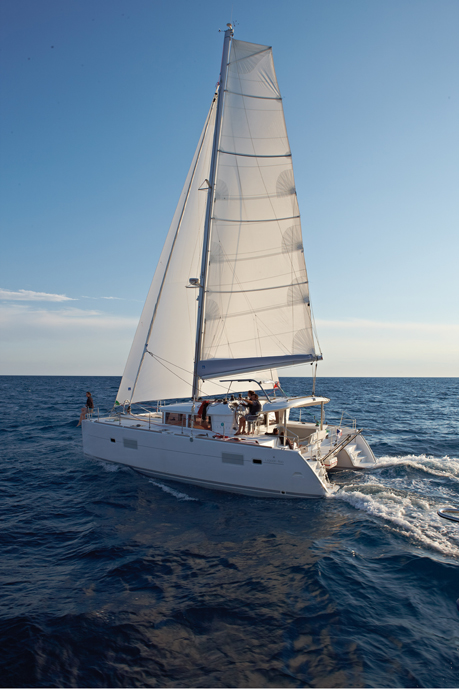
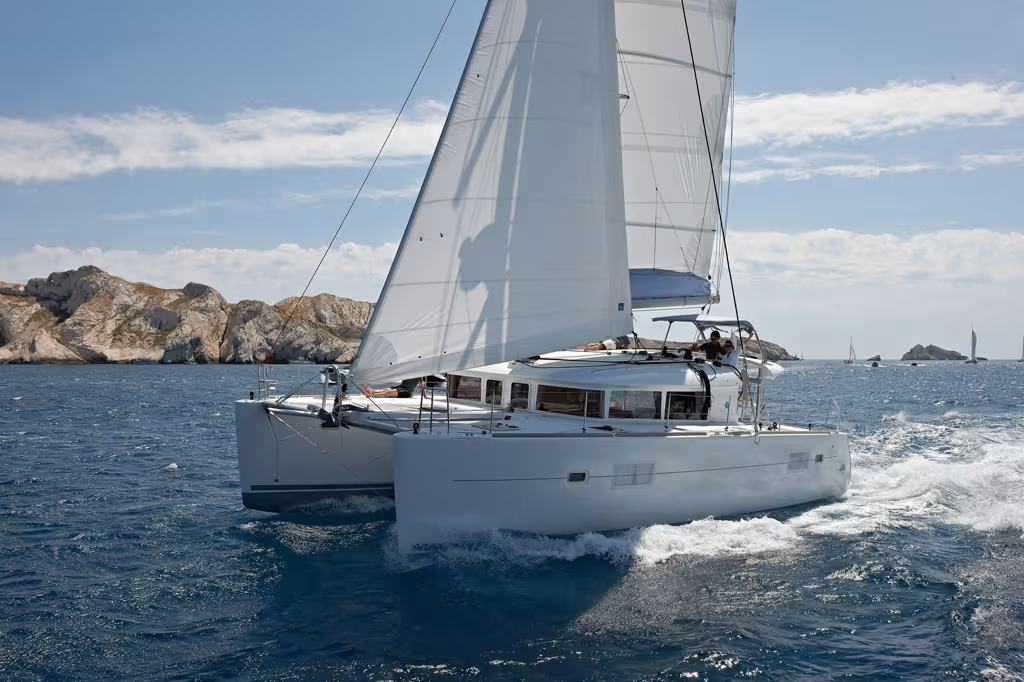
A streamlined sail plan and square-headed main complete the good work carried out on the hulls; the Lagoon is a lively catamaran.
A delicate succession
Taking over from two boats (380 and 410) which have been leaders for 10 years is a challenge fraught with consequences. The means must be found to appeal in a very competitive segment, and fix an attractive tariff, capable of appealing to those who liked the two previous versions, with just one offer!
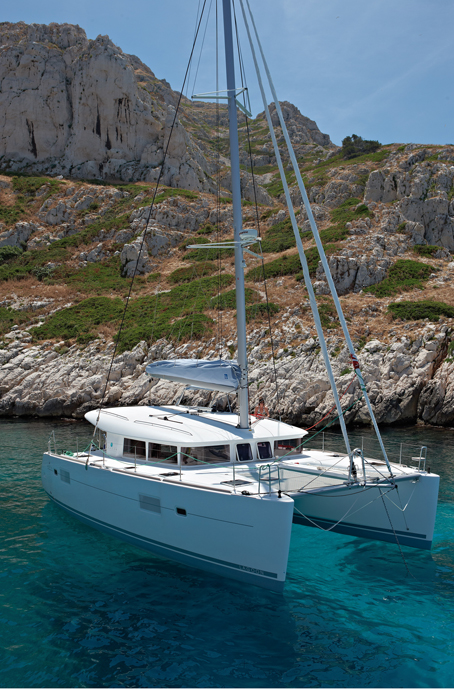
This 12m catamaran is full of clever features which make life pleasant, without trying to amaze us.
The search for balance
The 400’s designers display noble ambitions: to progress with the strong points and reduce the inadequacies! Liveable volume, ergonomics and light form the major arguments for the 380-410; pushing back the limits still further, whilst improving performance and remaining competitive represented the aim to be achieved.
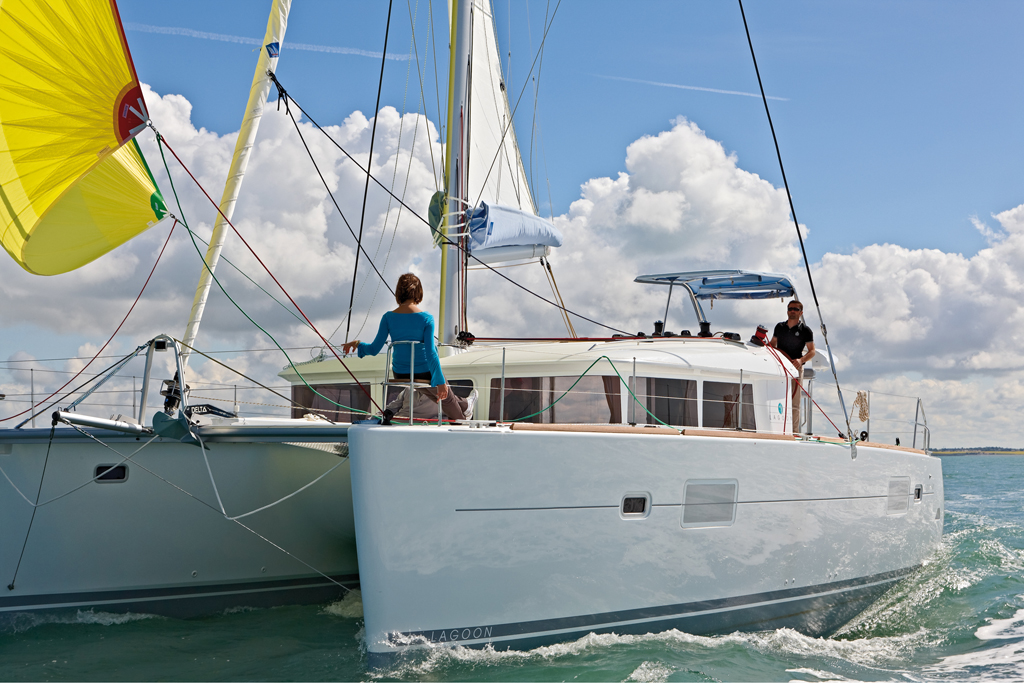
The 400 likes to plough its furrow downwind; its good balance will allow for good daily averages, without exhausting the autopilot.
A pleasing silhouette and successful ergonomics
This comfortable 40-footer’s complex-free look hides several interesting developments: the more vertical hull sides and the suppression of the rounded sheer line improve the overall perception. The perfectly flat decks, integration of opening hatches in the re-entrants, and the clever treatment of the coachroof-rigid bimini volumes support this first positive impression. Once aboard, the quality of the movement areas is almost amazing. To hit the bull’s eye in this segment, a form of priority has to be given to the conviviality of the saloon-galley-cockpit unit, without forgetting the navigation area. The 400’s steering position deserves praise in this regard; it succeeds in the difficult task of offering good visibility (forward, as well as of the sail plan), safety, manoeuvrability and comfort! Granted, its coherence owes much to electrical assistance, but the reliability and efficiency of the new generations of winch allow it. Use of the sunbathing area on top of the bimini is not normally advisable when under way, but it provides a fantastic relaxation area at anchor.
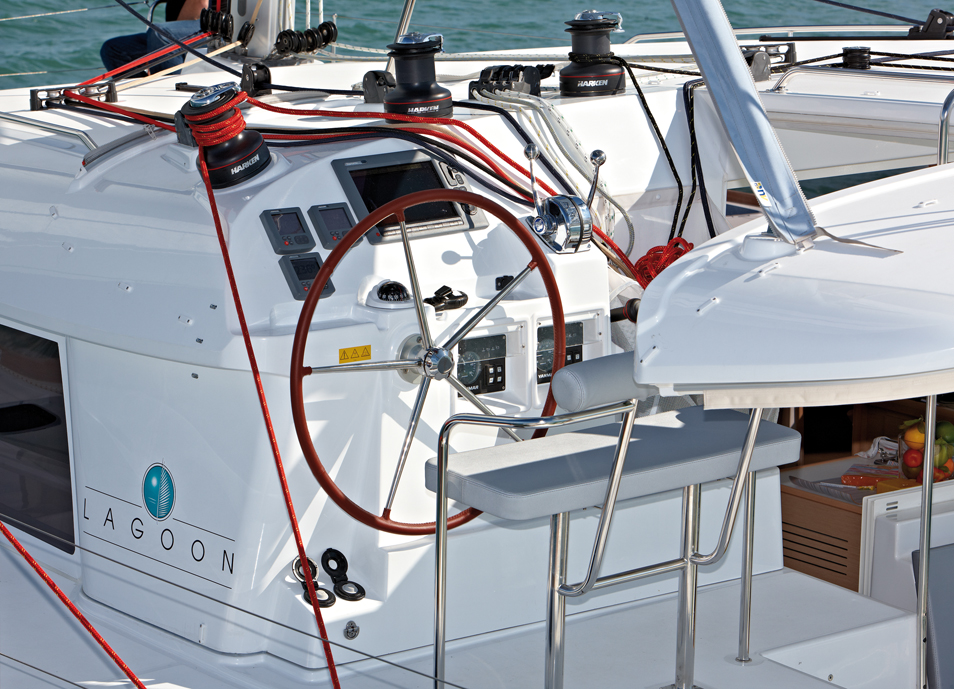
Accessible, reassuring and effective; the Lagoon’s navigation station is a success
Evolving architecture and a more respectful construction
With the idea of obtaining more playful handling and improving performance, the architects and the research and development department have worked on weight distribution, aerodynamics (notably the drag from the bimini), and the hull below the waterline. The underwater lines seem to be more stretched and the volumes more harmonious than on the predecessors, with slimmer forward and aft sections. The appendages have also been worked on, and the flow from the propellers moved behind the rudders to diminish the disturbed area. The underside of the bridgedeck is ribbed in a gull’s wing shape; its height is not great (55 – 70cm). The notable improvement in handling, the reduction of slamming and pitching are therefore the result of better overall dynamic efficiency, hulls which ‘swim’ better and ease through the waves. The construction now uses infusion techniques widely, for all the major parts. The hull below the waterline is built in monolithic vinylester; above the waterline, the coachroof and the deck are in balsa sandwich. This material possesses good mechanical qualities as a core, whilst being more virtuous than Airex foam. It even plays the role of a carbon sink if it comes from ethically-managed forests. Used in the infusion process, by the book, its ageing presents no problems. Efforts have been made to lighten the interior moulding and centre the weight. The laminated plywood bulkheads remain a safe option.
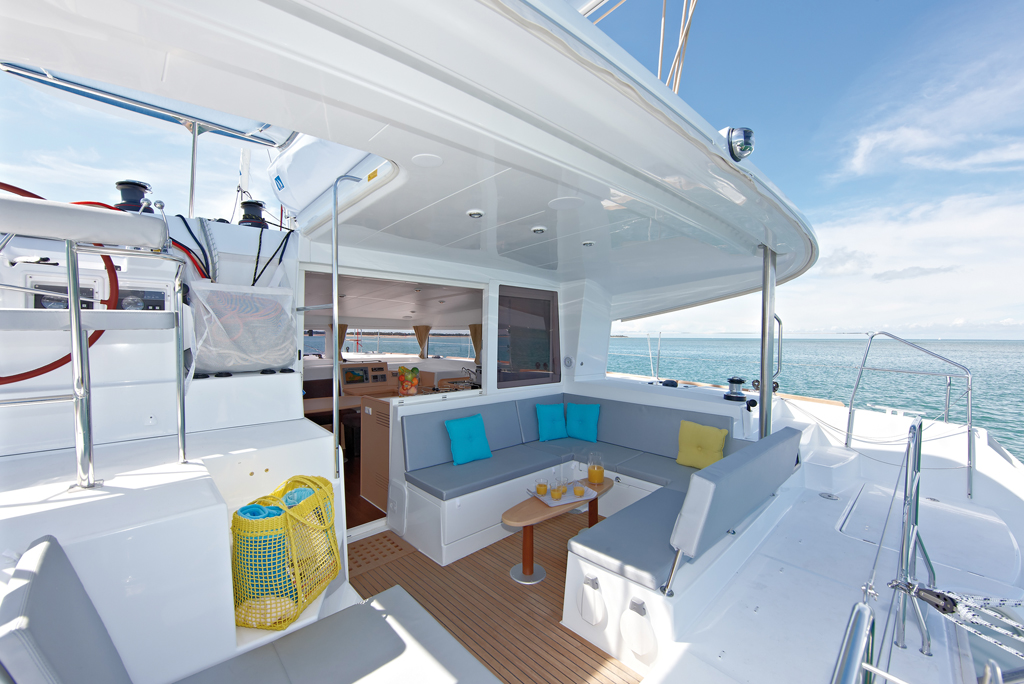
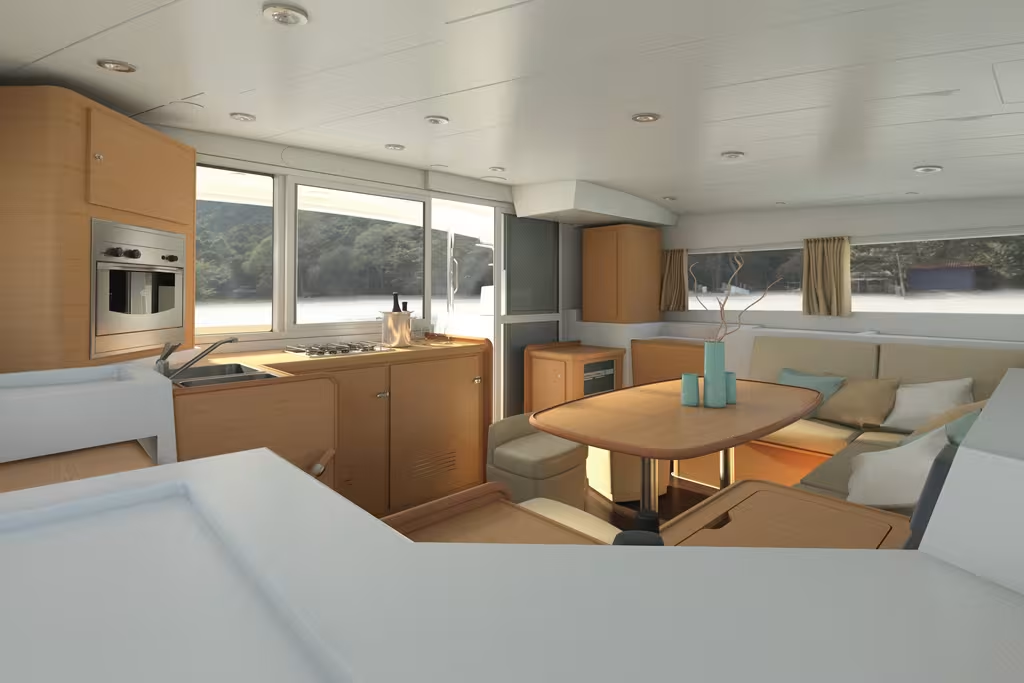
Top marks for the saloon-cockpit area
Welcome aboard a convivial 40’!
3D design, judicious choices, feedback? The fact is, this 12m catamaran is full of clever features which make life pleasant, without trying to amaze. Movement around the boat is excellent; fluid, with none of the usual traps that demand frequent use of arnica... the aft platform allows easy access to the dinghy, frees up the cockpit completely, and acts as a port-starboard gangway, made safe by stanchions and lifelines. The exterior saloon forms a perfect refuge from bad weather, the wind...or the tropical sunshine. The bimini is equipped with a flange ready to take the canvas kit which completely closes off the ‘patio’ out of season. A reclining chair is fitted opposite, under the navigation station, whose access has been particularly carefully designed (the deck side as well from the direction of the cockpit). The saloon, widely open to the exterior, brings together the galley, saloon and chart table functions. After two and a half days spent aboard, and several meals cooked at sea, the words which come to mind to define the functionality of the whole combination are ‘freedom and pleasure of movement’. Our test boat was the n°2, in its owner’s version; I appreciated the privacy and space in the starboard hull in general, and the bathroom in particular. Three small reservations concern the '"island bed" everyone speaks well of, but for which I don’t see the argument (small lateral access gangways), the insufficient volume of the washbasin and the chop which can be heard in the sugar scoops (I must mention that we were exposed to 20 knots of wind in an open anchorage). The wood decoration in oak veneer on laminated supports is nice, and well-finished, with very precise assemblies; the atmosphere will be pleasant in both hot and cold weather. The Lagoon 400 is quiet (there are no assembly noises at sea) and thermally insulated. The port hull contains two double cabins with comfortable adjoining heads. The forward berths are multi-purpose (double or two singles). The ventilation, the light (natural or electric) call for positive comments, but why did they not use LEDs?
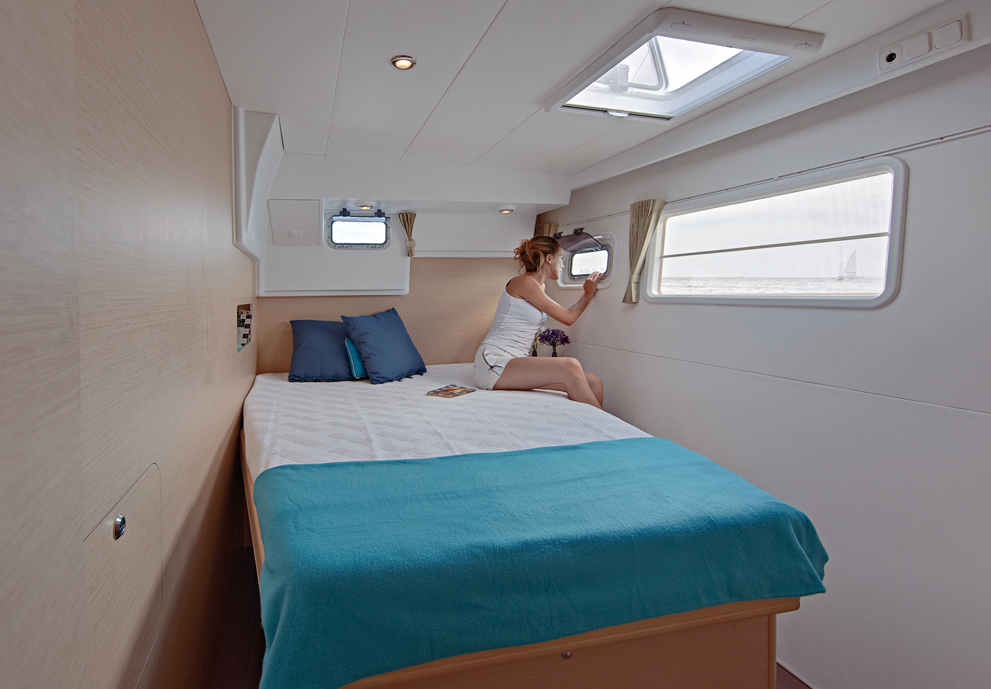
The famous "island bed"... But why impose such a bed with such small gangways?
Quiet engines
The mechanical installation is good and the access hatch in the false insulation floor encourages everyday maintenance. For a wider access, the surrounds must be dismantled; a glance is sufficient for regular monitoring. The rudder tubes, the autopilot, the swan’s neck in the cooling system, the linking rod between the rudders and the steering lines are also accessible. This two-storey ‘after-peak’ reinforces the mechanical discretion; it is separated from the cabins by a watertight bulkhead and the access hatch has a hydraulic ram.
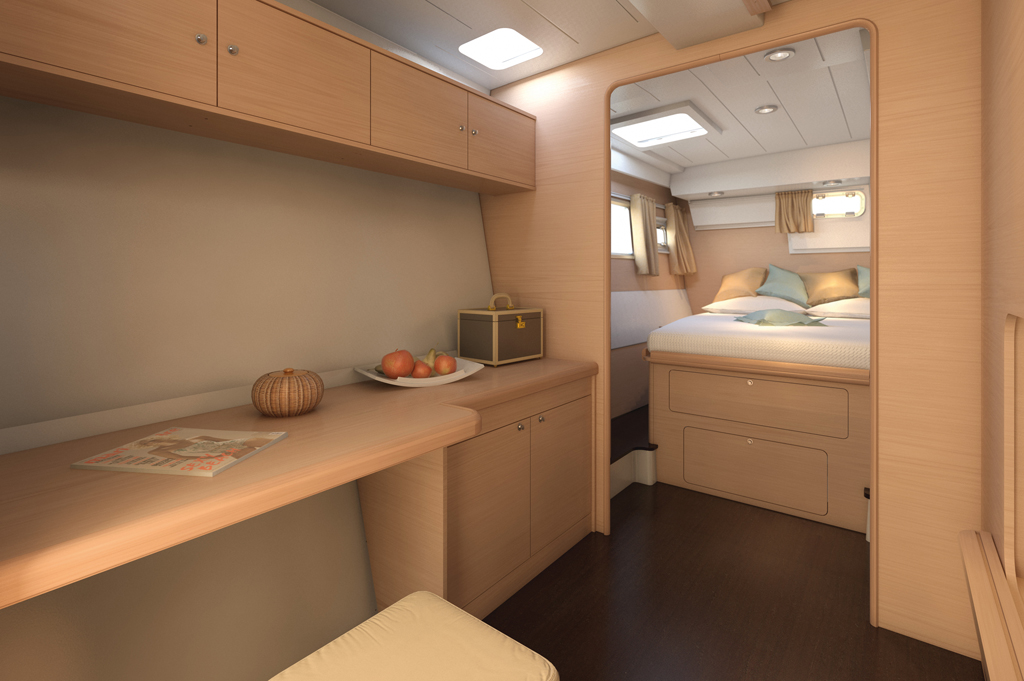
The owner’s suite... Not bad for a 40-footer!
Amazing behaviour!
The 400 is spacious, comfortable and clever, therefore heavy, but it sails well! It is a simple, entertaining boat, which proved to be agile on all points of sailing. Don’t expect exceptional performance, but it surprised us positively. The previous night’s small front had crossed our area, and we left La Rochelle with the rotation to the west. The 40hp engines coupled to folding, twin-bladed propellers have a generous amount of power; the 30hp version would prove to be sufficient in most cases. The 400 passed through the frontal chop in the channel easily, at 7.5 knots; the top speed was established as around 8.5 knots. The silence and the flexibility under way are remarkable. The nor’westerly breeze freshened around La Pallice; this was the first moment of truth, as the 400 set off to windward without batting an eyelid, towards the Pertuis Breton. The wind rapidly freshened from 15 to 20, then 25 knots, allowing us to note that the speed remained at a steady 8 to 9 knots, at 55° to the true wind, and the keels functioned perfectly. The 400 showed that it clearly tolerated being over-canvassed for a short while; after we had taken in the first reef, comfort was improved and we carried out a series of tacks along the east coast of the Ile de Ré. In these lively conditions, the 400 coped well, didn’t slam and sailed to windward correctly. The tacks were carried out singlehanded and showed up the excellence of the Harken fittings and the organisation of the deck plan. Visibility forward and observation of the mainsail volume are perfect, the speed of the turn and acceleration coming out of the tack, in the metre-high chop, were more surprising. The overall balance is a success; the dynamic support of the keels (whose aspect ratio is, however, only just acceptable) is satisfactory. The correctly-sized wheel is quite direct (but not very responsive), thanks to the transmission via lines. After 2 hours of this exercise, we reached Oléron. On a broad reach, with 1 reef in the main, the 400 scooted along at between 8.5 and 11 knots, in remarkable comfort; the autopilot had no trouble keeping the boat on the rails with a crossed, quite rough sea. Proud of having astonished its crew to windward and on a reach, the 400 decided to impress us on a close reach and take advantage of gusts at 20 knots on a flat sea to speed along at 9 – 10.5 knots! We waited for the tide at the entrance to Boyardville, before picking up the last buoy to the south-west of the Ile d’Aix. In the morning, the robust breeze of the day before had died away, and we got under way in 4 knots of north-easterly. The boat succeeded in surprising me again; we were going to test its abilities in very light weather by entering the Charente river. Under gennaker and main, the 400 gave us all the magic of the estuary, as far as Soubise. After lunch (almost on the grass) at a mooring buoy, we tacked as far as Aix, Fort Boyard and Ré in the afternoon, to gain ground to windward (7 knots speed with 11 knots of wind at 50°) before hoisting our big tri-radial spinnaker. On a reach, we sped along at 8.5 – 9 knots in 13 knots of true wind, with perfect directional stability. I appreciated this versatility on all points of sailing.
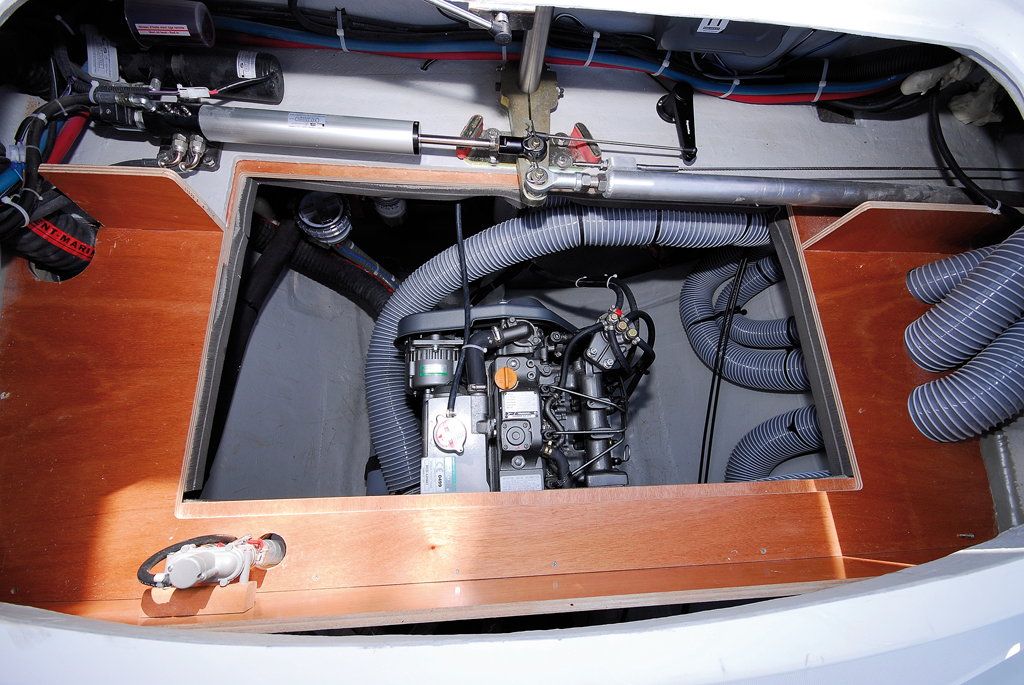
The engine locker is sound insulated by a false floor; access to the autopilot and the transmission has been carefully thought out.
CONCLUSION
Nice sails from Incidences, optimisation of the square-headed mainsail, work on the hulls and appendages, and suitable fittings have transformed the 400. The Lagoon is comfortable, practical and easy to sail, as well as being fun and seaworthy! The deck plan gives priority to the electric winches and solar panels must be chosen over a thermal generator. The boat’s seakeeping qualities will reduce the use of the engines. Charter, voyage or family cruising – this catamaran seems ready to take up the challenges which open up to it and satisfy the various levels of demands.
THE PLUSSES:
- Complementarity of the areas on a 40-footer
- Ergonomics and pleasure in use
- Improved performance
THE MINUSES:
- Still a bit heavy
- Choppy seas resonate in a rough anchorage
- Starboard heads washbasin too small
The square-headed mainsail: an option to be recommended without reservation
Mastery of these new volumes by the sailmakers is recent, but corresponds to a real advantage, with no negative side effects: • The sail keeps its shape (at least) as well as a classic roach. • The gain in propulsion is real, a small increase in area in the right place (15m high, where the wind is more constant and slightly freer!). • Reefing and gybing are almost easier. • Well trimmed (suitable sheet tension), the square head acts like a safety valve, by opening the volume of the mainsail in a gust. • The problem of the upper batten coming unfastened is solved by a simple lashing which reduces the stacking height at rest.
TECHNICAL SPECIFICATIONS
- Builder: Lagoon
- Architects: Van Peteghem/Lauriot-Prévost
- Length: 11.97m
- Beam: 7.25m
- Waterline length: 11.45m
- Draft: 1.21m
- Air draft: 20.30m
- Bridgedeck height: from 0.55 to 0.70m
- Empty weight: 10t
- Unladen weight: 10.35t
- Average displacement: 12t/max 15t
- Mainsail area: 56m²/60m², square headed
- Roller genoa: 28m²
- Gennaker: 70m²
- Engines: 2 x 29hp/ option 2 x 40hp
- Transmissions: saildrive
- Diesel: 2 x 200 l
- Water: 300 l
- Price: owner’s version: 225,000 euros exc. tax – 269,100 euros inc. tax ‘Essential’ pack: 13,400 euros exc. tax, cruising 22,700 euros, comfort 33,800 euros
THE COMPETITORS
| Model | Builder | Architect | Price in euros, inc. |
| Lipari 41 Maëstro | Fountaine Pajot | Joubert/Nivelt | 277,412 |
| Phisa | Phisa | C. Barreau | 459,145 |
| Banana 40 | Prometa Boat System | PBS | 436,500 |
| Hélios 42 | Cruiser ADN | B. Lelièvre | 377,338 |
| Nautitech 40 | Nautitech | Mortain/Mavrikios | 318,428 |
| Lavezzi 40 (maestro) | Fountaine Pajot | Joubert/Nivelt | 304,400 |
| Lagoon 380 version propriétaire (base) | Lagoon | Van Peteghem/Lauriot Prévost | 215,280 |