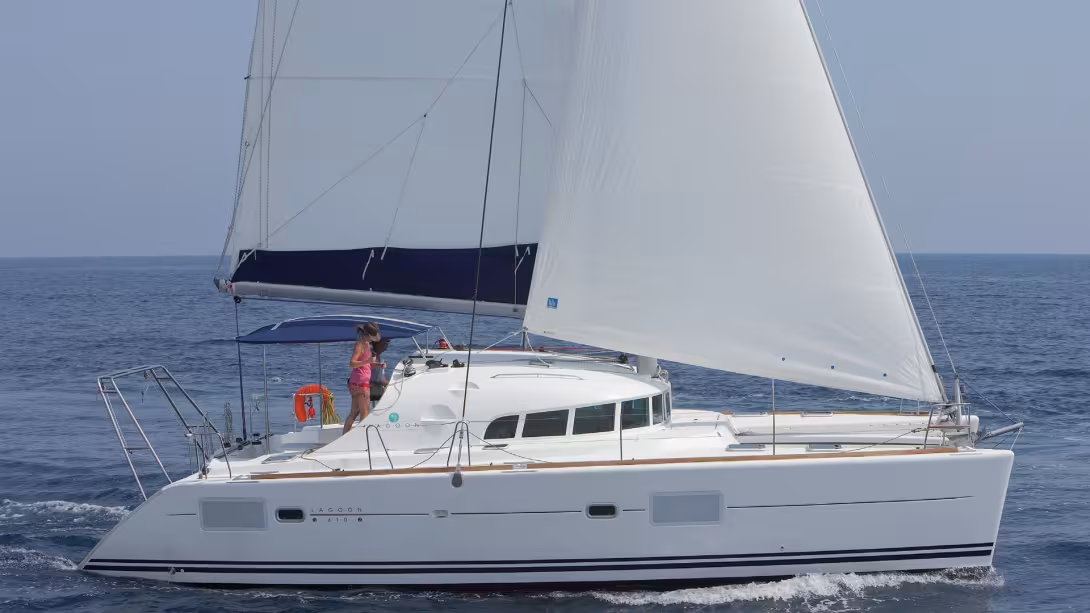
This is the first of the current generation of Lagoons. Innovative, with its imposing coachroof flanked by a battery of vertical portlights, like a rotunda, it remains a reference amongst ocean cruising catamarans, after having won over the charter companies.
Infos pratiques
- Le chantier : Lagoon 410
- La fiche technique
- Découvrez notre vidéo exclusive
- Financez votre Lagoon 410
- Assuez votre Lagoon 410
- Articles autour du Lagoon 410
The sea breeze finally started to blow. We could cut the engines and start sailing. Perched at the steering position, offset to port, we enjoyed a good view of Kristin's bows, but the feel of the helm was not that of a Tornado... And the speed? We had to believe the GPS, which showed over 8 knots off the wind, in a breeze which was no stronger than a force 4. The rather slim hulls slipped smoothly through the chop; the high bridgedeck didn't slam in the seas... Not bad for a pure cruising boat. "The boat is quite light; it sails well in light weather," explained Harry Blazeby, skipper of this 410 for four months, with his partner, Fraya. Indeed: weighing seven tonnes unladen, the 410 seems like a hightech machine compared to the 400 – 10.35 tonnes – and the 421 – 12.17 tonnes. Obviously, a configuration with folding propellers and a gennaker will further boost this cat's performance. At Lagoon, there are even reports of top speeds of over 20 knots. The only weak point is sailing close-hauled, when the very short fin keels (the draft is limited to 1.2m) don't allow you to sail too close to the wind. "I settle at around 50 degrees," Harry explains. This summer, the skipper was surprised by a violent storm: "there was 40 knots of wind! I rolled up the genoa completely, took two reefs in the main, and the 410 remained safe and manoeuvrable. We were doing 10 knots and nobody aboard was frightened. The only thing is that the mainsheet is a long way from the helmsman, in the case of an emergency."
New generation Lagoon
Launched in 1997 – two years before the 380 came out – the 410 prefigured the current generation of Lagoons. The priority is on comfort, with a voluminous bridgedeck and above all, the vertical 'windows'. This model was the first to be launched after the takeover of Jeanneau – and therefore Lagoon – by Beneteau, in 1995. The teams in place had their projects, but Annette Roux, the company's CEO, asked for a cheaper, more accessible boat, in the spirit of the Oceanis. Two years later, the Lagoon team, surrounded by the same architects – we no longer need to introduce the VPLP office – launched the 410. It was therefore this model which confirmed the builder's growth, to become today the no.1 catamaran builder in the world. In September 2002, 120 boats had been built, and the builder decided to revise the deck plan. Under the name Lagoon 410 S2, the halyards and reefing pendants now returned to the steering position - which itself was redesigned for easier access – with an electric winch as a bonus. Production, far from dropping (as was the case with all the models launched over five years ago), accelerated again, as in August 2006, 283 Lagoon 410s had come out of the yard. Note: the very last boats benefited from large hull portlights. We also note that for a long time, the builder relied on its little sister – a reduction of almost 7% on the 410 – before launching its real replacement, the 400, in 2009.
Be caeful with the load
So, is this 410 a best-seller? "The boat is very strong," Yann Masselot, the company's marketing director maintains. "Even the boats which have been used for charter at Sunsail and Switch – the 410s cover 400 miles per week, 45 weeks of the year! – have never had any structural problems. The 410 has nevertheless aged, compared with today's standards. There are differences in level, half levels, and above all no aft passage behind the cockpit. Another problem is the engines under the aft berths. And although the boat is fast, thanks to its fairly narrow hulls, it is logically sensitive to load, especially forward: be careful not to give in to the 'all options' syndrome and over-equipping; it is not the right boat for that." Harry, the skipper, is often confronted with packed anchorages in August, and tiny fuel pontoons. He appreciates the ease of manoeuvring under power. "The two aft cabins are really nice, with big beds. I like the fact that there is just one trampoline rather than two small ones. It remains a simple boat, with no generator, no air conditioning; it is easy to maintain and equipped with very economical engines. It is ideal for a family on a long-term cruise, but not big enough for charter." The skipper, like Yann, regrets the access to the engines and the batteries under the aft berths. "It's not easy to strip the bed and move the bags when chartering. With regard to energy: the boat lacked a bit of independence. Adding solar panels solved this problem. All boats should be equipped with them!" The Lagoon 410 therefore holds few surprises. But many boats, after years of intensive use, may have tired peripheral elements. Sails, engines, electronics, plumbing and electricity are the main areas concerned, as well as certain elements such as the steering transmission and the gooseneck. No worries about the fittings, which can generally cope with 10 to 15 years of cruising use. The price? Reckon on around 200,000 euros for a clean, well-equipped boat. You can even choose: Yann has counted 9 Lagoon 410s for sale in Europe, at from 190,000 to 215,000 euros. Place your bets!
The points to check
There is almost nothing to worry about on this particularly robust boat: the structure and rig seem to be without problems; even the models which have had the hardest charter use remain sound and safe. As for the accommodation: the same pleasant surprise, on condition that the boat has been well maintained – a shower which drips, or a leaky deck hatch, give the woodwork no chance. Take an interest in the number of engine hours: at 10,000 hours, the mechanics have exceeded their life expectancy, and you will have to plan for a standard replacement in the short or medium term – to be taken account of in the negotiations!
The Pluses:
+ Excellent compromise between speed and comfort
+ Particularly well suited to cruising in the tropics
+ Robust structure
The Minuses:
- Movement is not fluid everywhere on deck and in the cockpit
- Narrow forward berths
- Engines under the aft berths
TECHNICAL SPECIFICATIONS
Builder: Lagoon
Architect: Van Peteghem/Lauriot Prévost
Hull length: 12.37 m
Waterline length: 11.67 m
Beam: 7.09 m
Draft: 1.2 m
Unladen weight: 7,200 kg
Mainsail area: 53 m2
Genoa area: 36 m
Engines: 2 x 28 hp
Production: 283 examples, from 1997 to 2006
Second-hand price: 200,000 euros