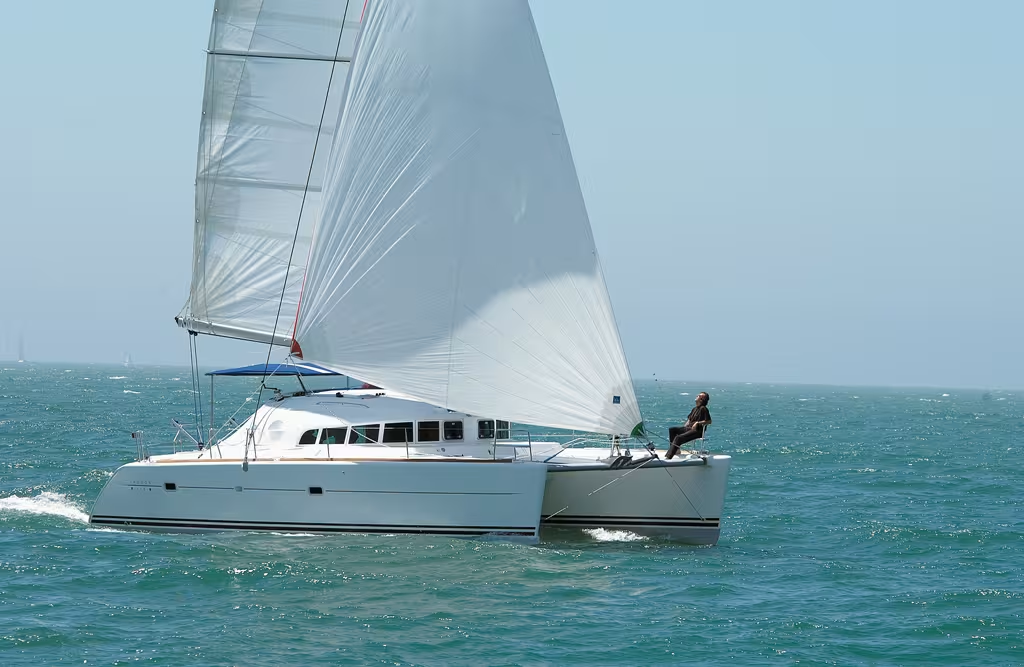
We conducted our test of the new version of the Lagoon 410 in the first days of September. The convoy from Hyères to the Cannes Boat Show at this time of the year usually requires having the accessories to deal with lull: gennaker and light sheets! The unexpected swelling of a major “Cévenol phenomenon” with its high winds presented completely different conditions and, while all that hot air was causing unprecedented catastrophic flooding in the Gard département, we were fighting the 30-knot spots of an unpleasant easterly wind accompanied by choppy seas with a contrary current at 2 knots. This tough unforeseen sailing provided a full-scale test of what many owners and renters of multihulls experience when they are required to reach a destination against the local winds and weather!
Infos pratiques
- Le chantier : Lagoon 410 S2
- La fiche technique
- Découvrez notre vidéo exclusive
- Financez votre Lagoon 410 S2
- Assuez votre Lagoon 410 S2
- Articles autour du Lagoon 410 S2
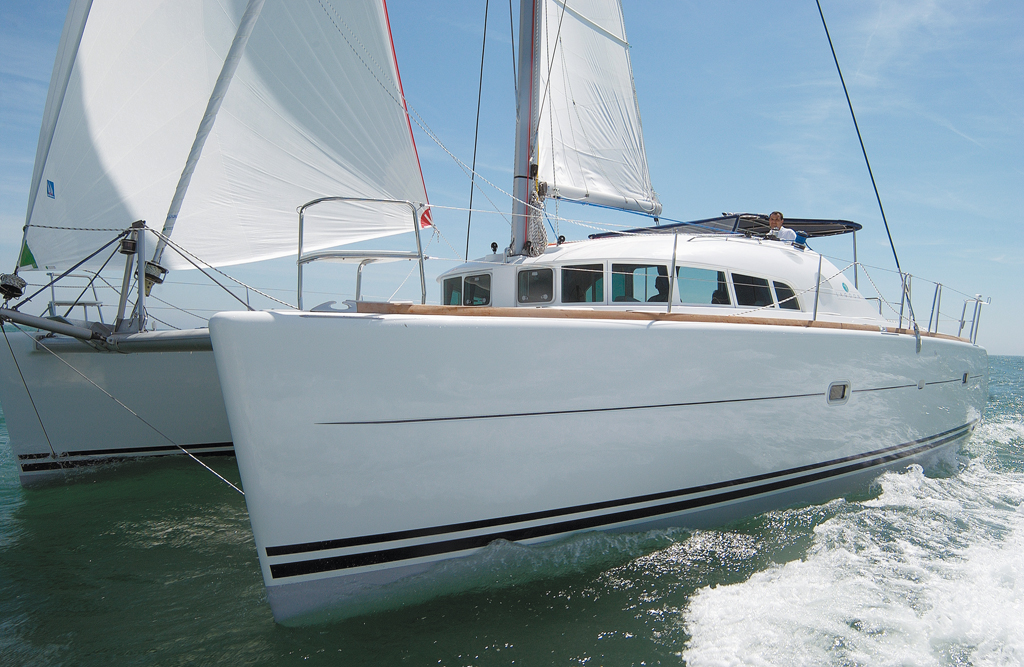
The new version of the 410S2 has all the 410’s sailing qualities…
Introduction
When production first began, the Lagoon 410 appealed to over 100 buyers! Very much present in rental fleets, this model was also greatly appreciated by many owners who view her as a simple reliable boat on a human scale. Produced by a well-known shipyard and resulting from prestigious designers, the 410’s 12 meters provide the arguments necessary to convince a family of travelers. The restyling in the S2 version of this commercial success was, for us, an opportunity to test the 410 in her maturity.
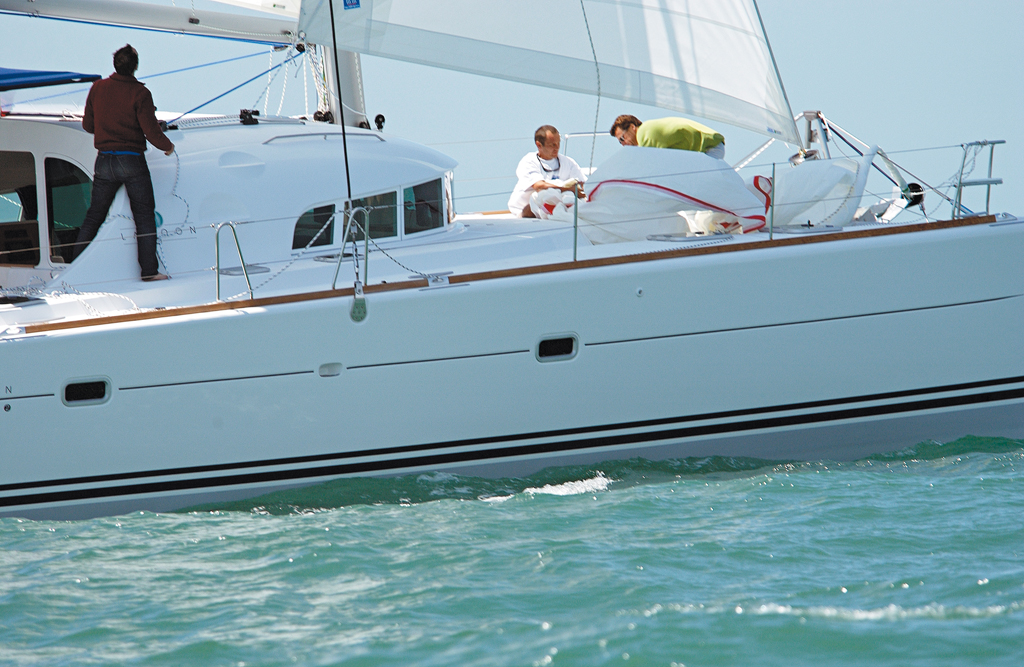
The 410 S2, a versatile catamaran, as pleasant for rental as for longer cruises…
What’s new onboard the 410 S2?
Most of the changes concern the features and the deck layout. Thus, the transoms were redesigned with trunks providing access to the helm transmissions. In the starboard hull, the companionway was advanced and the galley block reworked (it now opens onto the cockpit with a sliding partition). In the owner’s version, the starboard hull is a real private apartment, closed with a door, which completely separates it from life onboard. The organization of the fittings was restructured, with priority to the managing the running rigging grouped on the roof and assisted by an electric winch. Other changes are more discreet, like the suppression of the boom plates and the textile straps of the tack of the mainsail clew. The rudder spindles of glass/vinylester composite also eliminate a lot of poorly positioned weight.
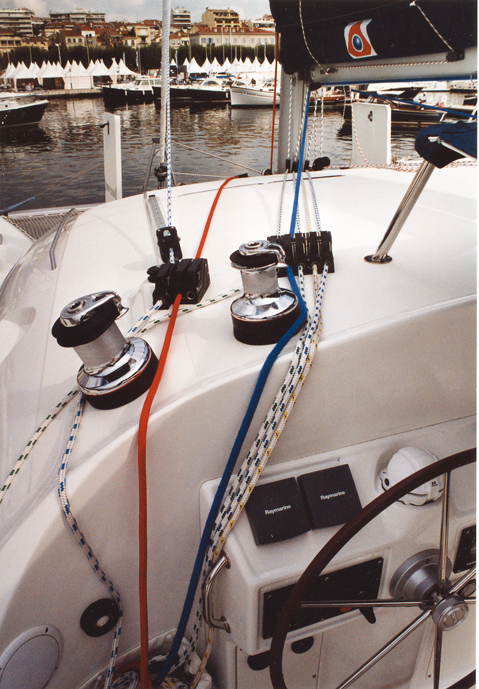
To hoist the mainsail (red halyard), you first have to make a round turn around the classic winch (on the left), before taking it up on the electric winch (on the right)…
The 410 within the range
The Lagoon’s silhouette has not become commonplace; the debate aroused when she first appeared have never ceased, but these catamarans are successfully positioned in the market for “comfortable” boats for the 380 and 410, and “prestige” boats for the 470, 570 and 67. The philosophy behind these super structures seems even to have been adopted by other makers, who willingly respond to their clientele’s demand for a hypertrophy of nets. The size of the 410 makes her versatile and gives her a twofold vocation for rental and cruising. Until the launch of an intermediate 43’-45’ model, she is the starting model for the maker’s “travel” range.
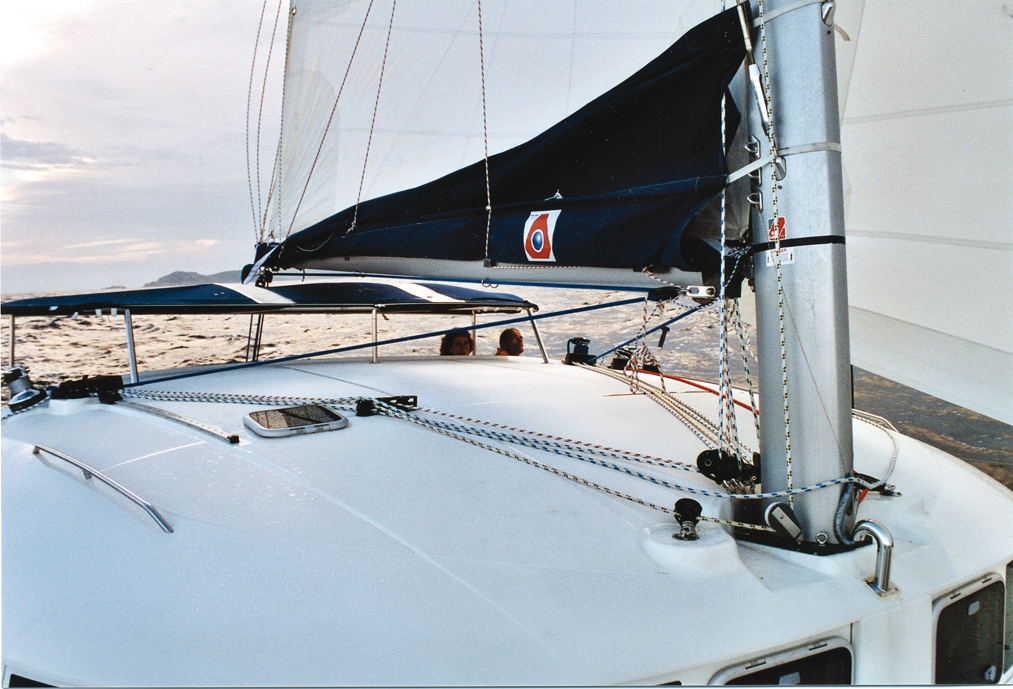
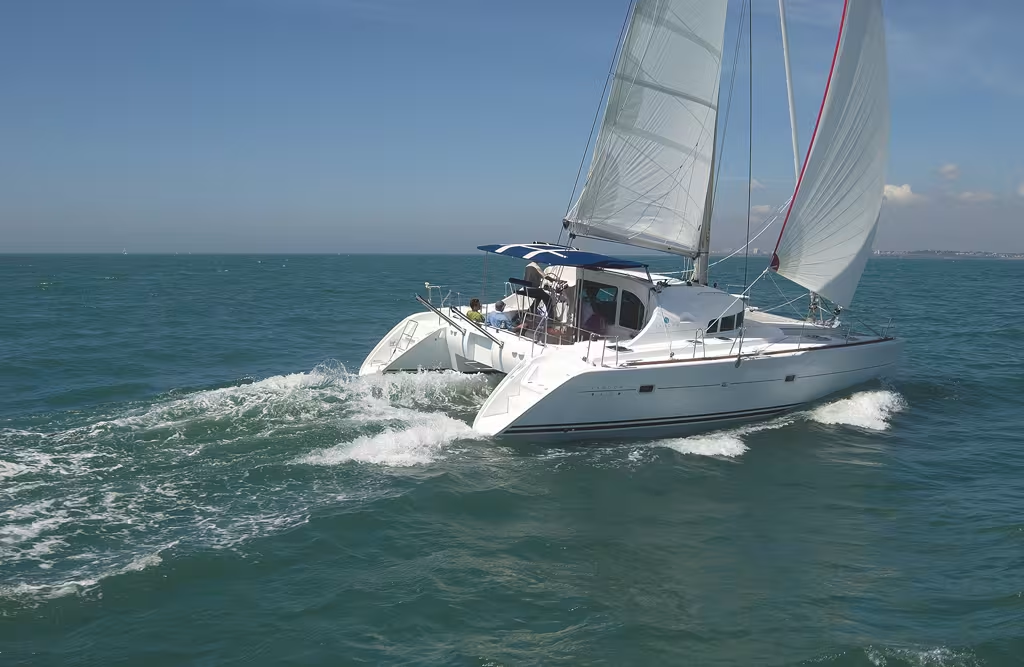
This new version’s great asset: all the running rigging returns to the cockpit
Life onboard the 410 S2
“Que reste-il aux grands ?” (What more do the big ones have?), the paraphrase of this ad perfectly suits the 410 S2. This 41’ offers the appointments of a 50’ of a decade ago. The chartering version with four “true” double cabins will delight large crews and the owner’s version amazes visitors with her appointments. This is the one we’re about to discover. The 410’s exterior is pleasant: access to the sea on the transoms is a boulevard, the cockpit is a nice living area; the link with the net is reinforced by the opening of a second mobile partition. The anchor station is easy to use and its tenders made up of very large trunks can hold rationally the usual stuff. The chain line layout is reliable and reassuring, it runs inside the longitudinal stiffener and leads to a well dimensioned welded davit. During sailing, the anchor can easily be returned to the beam. The trampolines are well fixed and tense, their rather broad mesh requires wearing shoes, but they evacuate green water perfectly.
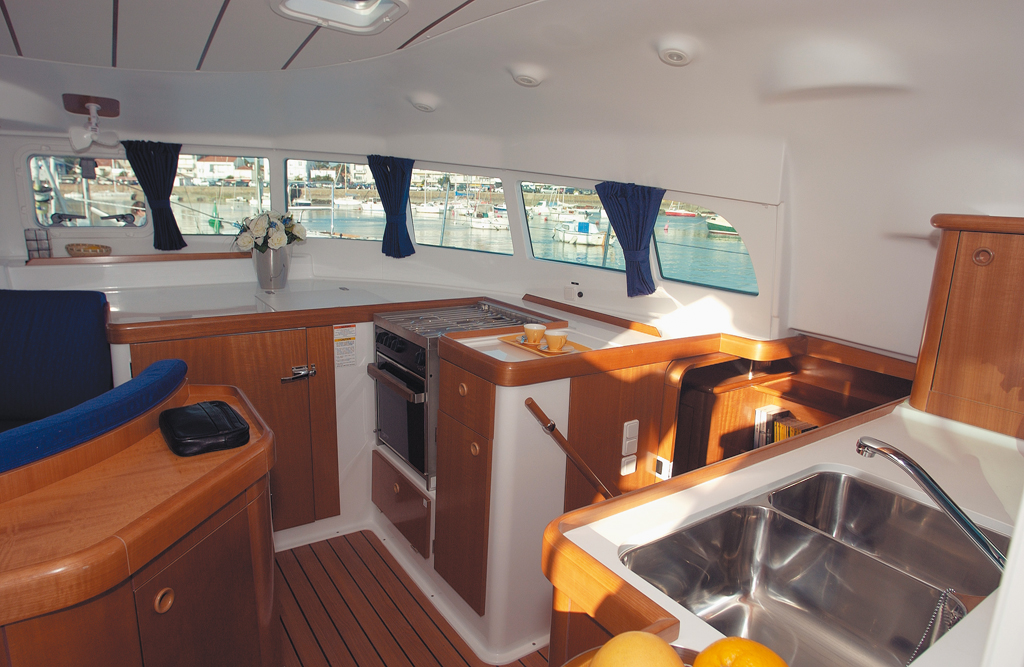
The new interior is particularly well designed…
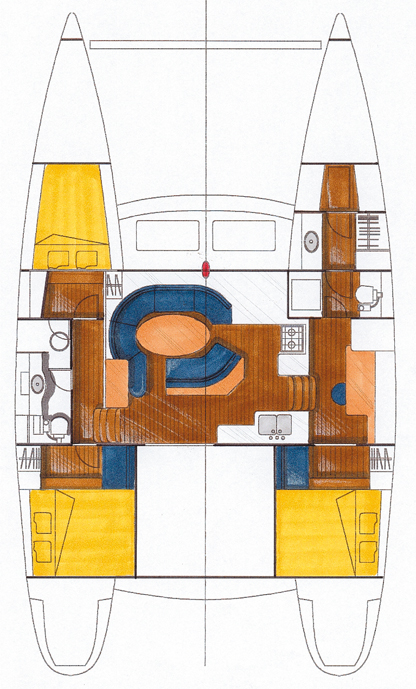
The inside of our 410 is a real home, practical and comfortable. The net is well-lit, very spacious and I’m sure users will love the new galley: sink, serving hatch, counter and cupboards are all grouped in a single console that opens on the cockpit, while the “cooking” area and refrigerator are to the left of the companionway. The over table in the saloon can accommodate 8 people and circulation is through two separate entrances on either side of the central bar console. The chart table is modest enough but sufficient considering the presence of a read desk in the owner’s hull. The starboard companionway gives access to the “pasha’s studio” which can be cut off from the rest by closing a sliding door. These “apartments” are very pleasant and the quality of life they ensure will surely contribute further to the 410 S2’s fine image: the bed is transversal with abundant light. There is a desk for the now essential laptop and printer. The gallery is broad and clear, and access to the head is easy, even when the sea is rough. Separate toilet, washbasin with dressing table and large shower stall are found only exceptionally in this size craft. The port hull is more classic, with two double cabins, gallery and head with toilet in the central module. The 410 S2’s features are remarkable for their volumes, functionality, general ergonomics and the great care in finishing of the woodwork and countermoldings.
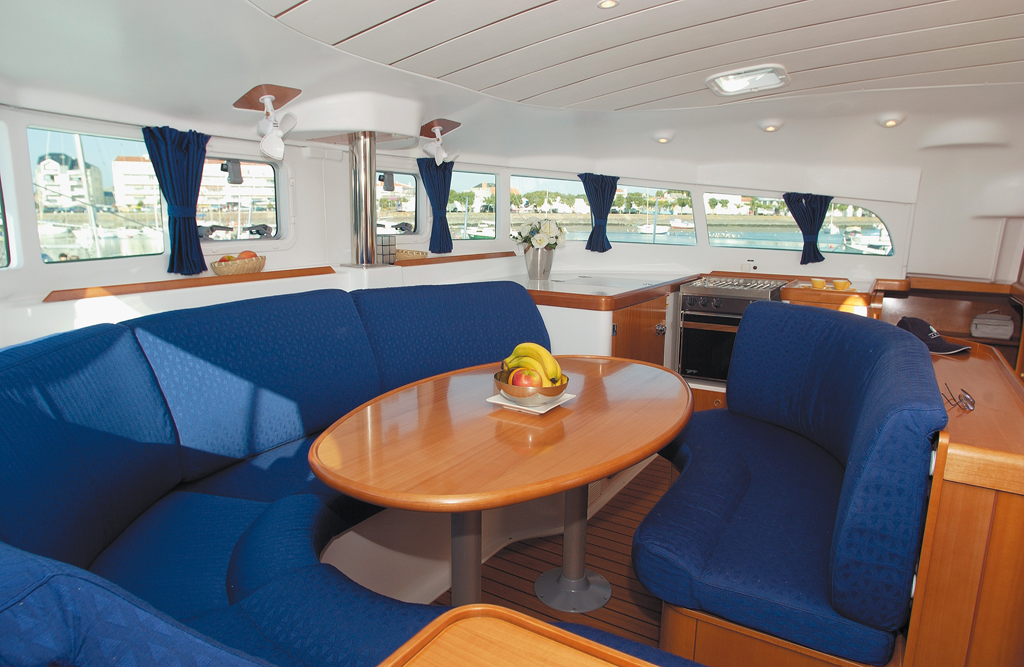
Her unbelievable habitability is surely of the Lagoon 410 S2’s best assets
Test at sea
The east wind we had to do with during this test simply made our sailing unpleasant. It would have been easy to wait at the anchorage on Porquerolles Island the shift foreseen and that would have been my preference without the requirement of the Cannes Boat Show. After having stiffened the backstays, we set off from the Port of Hyères at approximately 4pm, with the gusts of east wing shaking the palm trees of the deserted Promenade. The low ceiling and the swell caught as we sailed out of the pierhead. To respect the schedule, we chose to position ourselves by motor at the eastern tip of Île du Levant! Sounds simple enough! But the two 40 HP motors on our 410 were required to produce 2/3 of their power to get there… Those who know these waters or the Bay of Quiberon in 30 knots of SW wind en route for Houat will understand; the other can just imagine! This two-hour struggle revealed the 410’s very fine agility in crossing the choppy waters and the Yanmar motors’ perfect suitability for the boat. The strategy adopted was to block the diesel motors at 2800/3000 rpm to have the necessary power and speed to get out of this mire! I won’t claim the pace was comfortable, but I did find that the 410 S2 came out very well from this formidable challenge. At that relatively high motor speed, there were no perceptible vibrations and the noise remained limited to a relatively low level. I would give an excellence grade to all the motor sub plates, Saildrive and the installation and soundproofing. In the late afternoon, we managed be position ourselves sufficiently off the coast of the Var to hoist the sail. With one reef, we headed for the Bay of St-Raphaël with some 20 nautical miles windward. Once again, the Lagoon performed very well in this ‘cauldron’ and bearing away slightly we found an acceptable compromise between speed and heading. The conditions somewhat abating, we hoisted all the sails: with 20-25 knot winds, we needed all that power to squelch that nasty contrary choppy water. The fins hung on well and our speed oscillated between 7 and 9 knots, the 2-knot current made things difficult particularly since the proximity of the mountains caused major variations in the breeze, both in force and direction. The boat was reactive and responded frankly to the helm. The twisted profile sail contribute to their power. At nightfall, the wind increased, the 410 accelerated while shaking mightily but without banging and continuing her progression. At this pace, the piloting station remained pleasant and I appreciated the double seat, the tiller rope and rod transmission is an excellent choice. The spray became annoying and moving around the cockpit, which feels perfectly safe, required precautions. The rise of a squall at 35 knots would but an end to the cavalcade under a spectacular display of lightning. After those 25 nautical miles covered under sail, we completed the convoy by motor…
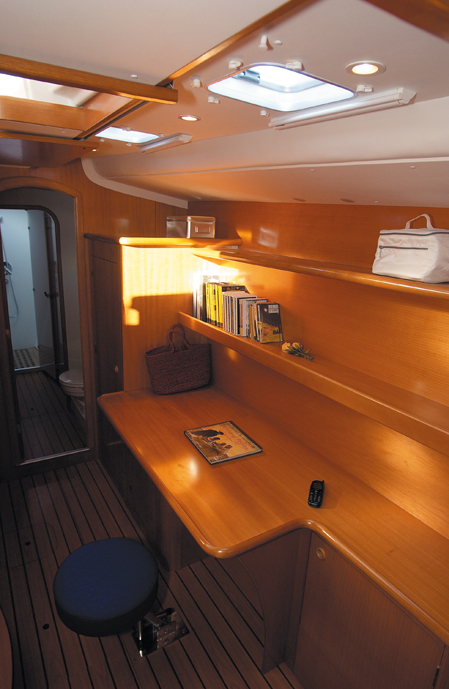
The starboard hull, dedicated to the owner in the version we tested, is a real success
True, the conditions of this test were neither usual, nor ideal, but they revealed the boat’s potential. The 410 S2 runs well and can face a delicate situation with strong wind; her behavior upwind is sound; the fins perfectly fill their antileeway role without causing any noticeable slowdown, you just have to avoid pitching the stems. For a good half-hour, we were clearly oversailed (30 knots and over) without the boat manifesting any discomfort; the speed was then some 10 knots at 60° off the wind on a rough sea… So there’s quite a margin in the context of more normal use. As is the case today for most multihulls, the (Harken-Spinlock) fittings chosen are functional and of excellent quality! Having an electric winch for the piano is interesting (mainly for hoisting the mainsail). I would have some changes to recommend, however: the current layout of the running rigging requires a round turn with the mainsail halyard on the manual winch for the genoa jib sheet before reaching the electric 40 ST. The return of the mainsail sheet on the roof involves additional lengths to the quantity of ropes already supplied. So it’s necessary to rationalize and increase the size and number of rope sacks to avoid the unpleasantness of the formation of a messy pile of lines!
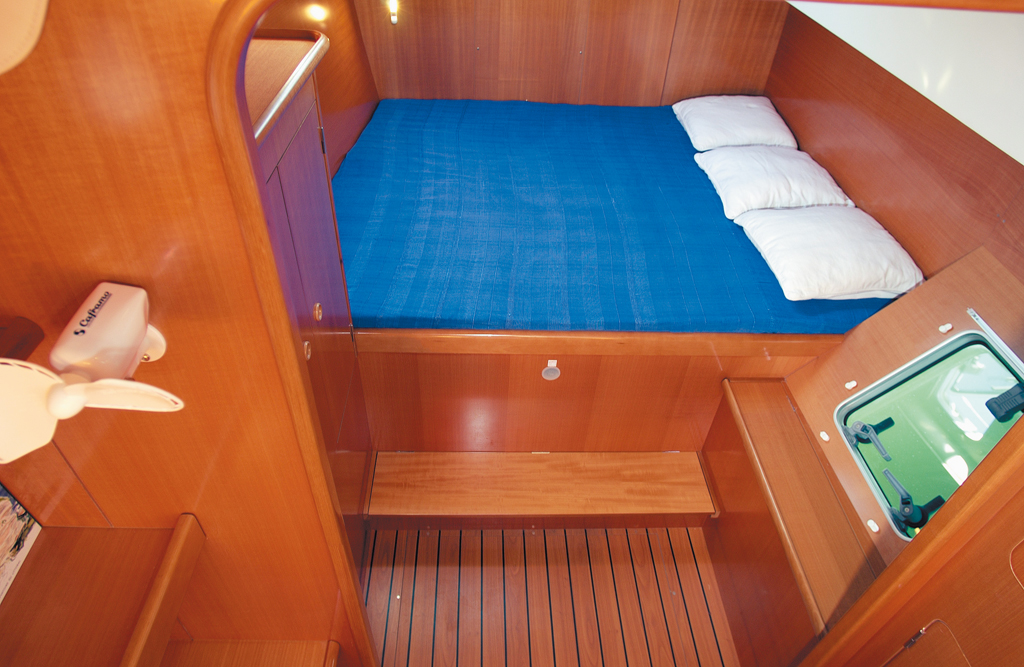
We appreciated the quality of the countermoulds and woodwork
Conclusion
The 410 S2 is a good, safe, comfortable boat; well designed and on the condition of having a gennaker and a good spinnaker with a sock, she performs very well. Very maneuverable and compact, her interior layout is remarkable. Reassuring and consistent, her 12-meter length enables her to confront the high seas while remaining a family cruiser that is easy to handle. The only change I have trouble accepting is the control of the mainsail sheets on the roof. I had rather control the mainsail and mainsheet track from the cockpit, which would involve reducing the rear overlap of the bimini top to have a good view on the mainsail roach. Since I was told this bridle layout is requested by the clientele, I leave that to the users’ judgment.
MULTIHULLS WORLD’s choice
We had fun, after this test, customizing a 410 S2 up to specifications for family cruising. The options were all selected from the Lagoon catalog, and we did not select the bimini top on a tubular frame, preferring the simpler model on standard curved bars. Here is the result: 410 S2 owner’s version with 2 x 27HP, price: Euro 285,246 Mosquito nets: 804 Spinnaker rigging: 1,121 Gennaker: 4,200 Gennaker rigging + pole: 3,474 Cockpit shower: 187 Max Prop propellers: 4,336 Desalinator: 12,427 Basic electronics: 1,719 Automatic pilot: 4,205 Anchorage: 635 Mooring ropes: 486 Antifouling with epoxy primer: 1,991 Launch: 6,327 For a total of Euro 46,200 (including VAT) Total: Euro 331,446 (including VAT) Extras, in addition to Lagoon options: Custom bimini: Euro 3,000 approx Spinnaker + sock: Euro 4,000 approx
I really liked
The tremendous habitability and the concept of the owner’s hull in the version we tested The maneuverability under sail and with the motor The quality of the counter-molds and woodwork Appropriateness for family cruising
Possible improvements
Too much overlap of the bimini top aft Distribution of the ropes in the cockpit
LAGOON 410 S2: TECHNICAL SPECIFICATIONS
Overall length: 12.37m Waterline length: 11.67m Beam: 7.09m Mast height: 16.10m Height clearance: 18.29m Light displacement: 7.24 T Upwind sail area: 89m2 Draft: 1.2m Mainsail area: 53m2 Genoa jib area: 36m2 Spinnaker: 108m2 Gennaker + pole possible Motors: 2 x 28HP or 2 x 40HP Fuel: 2 x 100 L Freshwater: 390L Category: A for 10 people Material: sandwich foam/glass/vinylester for the hulls sandwich balsa/glass/vinylester for the roof and deck Designers: Marc Van Peteghem & Vincent Lauriot Prévost Price: owner’s version without options ex works 2 x 27HP: Euro 285,246 (including VAT) - Euro 238,500 (excluding VAT)