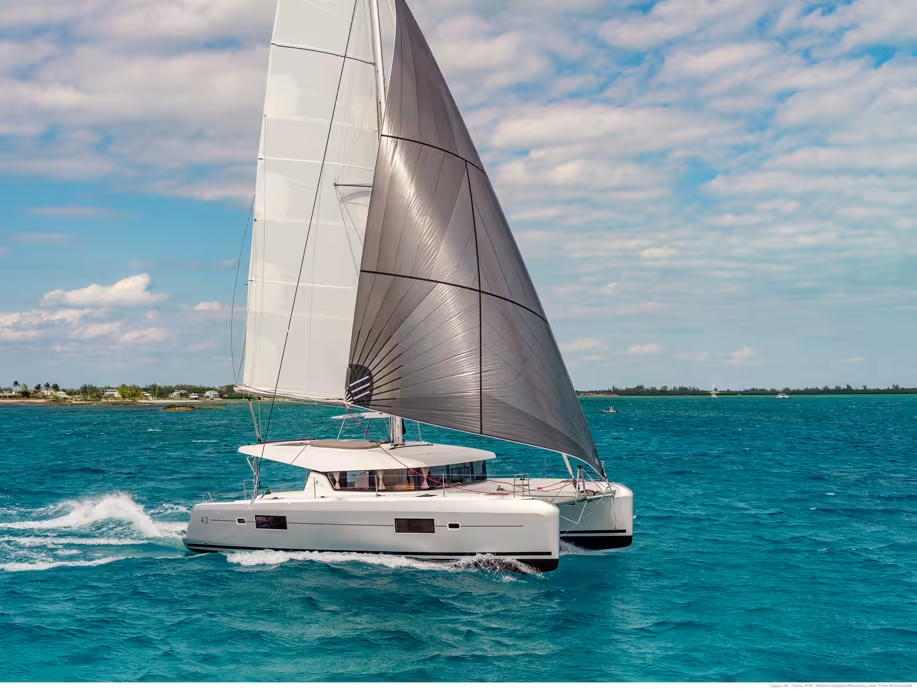
Lagoon is continuing the redevelopment of its range with a model whose new rig is at the heart of a significant evolution in style, ergonomics and performance. We have just spent two days on board the 42.
Infos pratiques
- Le chantier : Lagoon 42 (2016)
- La fiche technique
-
 Découvrez notre vidéo exclusive
- Financez votre Lagoon 42
- Assuez votre Lagoon 42
- Articles autour du Lagoon 42
A highly effective 42 foot craft.
Building on experience
The previous model (the 420) was an experimental boat, but the ambition of building a hybrid catamaran was without doubt pioneering when one considers the technology available at the time. However, this didn't necessarily correspond with a multi-use multihull for the general public. The increased wetted area caused by the additional weight of a very heavy battery bank, positioned aft, penalized performance, and also required the powerful motors to be alternatively mounted. This attempt did not meet with the success which had been envisaged. Things have moved on since 2006: engines have evolved significantly (fuel consumption, noise, reliability, absence of vibration, clean running) as has sailcloth technology, sail design software and also that of rigging, not forgetting developments in interior design and the digital fabrication of the interior fittings. Barely perceptible individually, these developments today allow Lagoon to remain loyal, with this 42 footer, to their image of spacious multihulls while concentrating on their – sailing” values and reaffirming the position of motor yachts, notably that of the MY40.
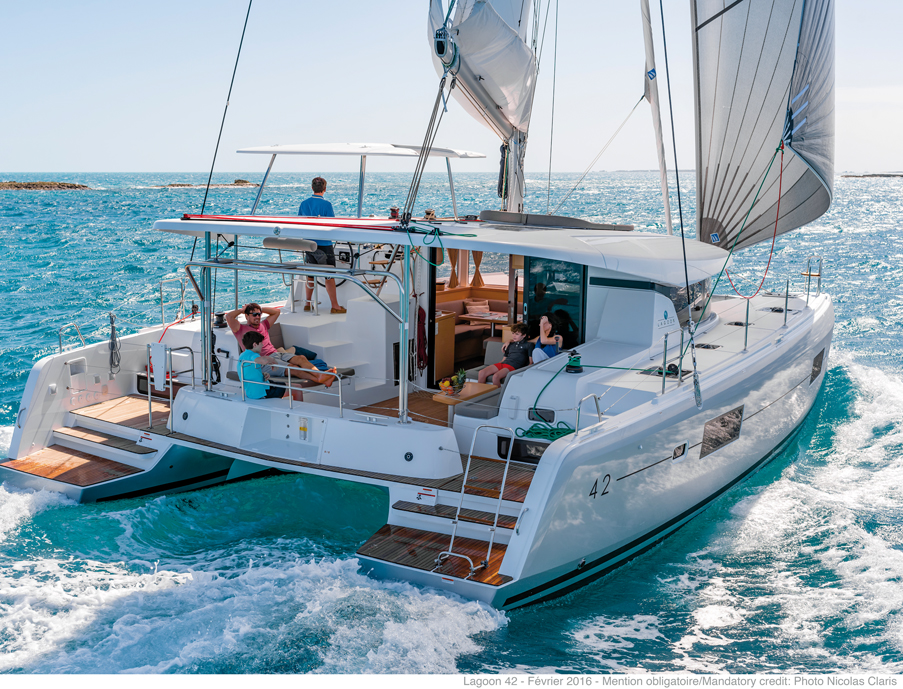
Transparent and fluid planning mean a performance rig with considerable ease of use
A –target” size
In the meantime, the builder has made the most of it, entering more ambitious ranges, and with the 42 they have come back with an interesting balance between safety, volume and handling. Financial access, both for new and secondhand should also be easier in the future.
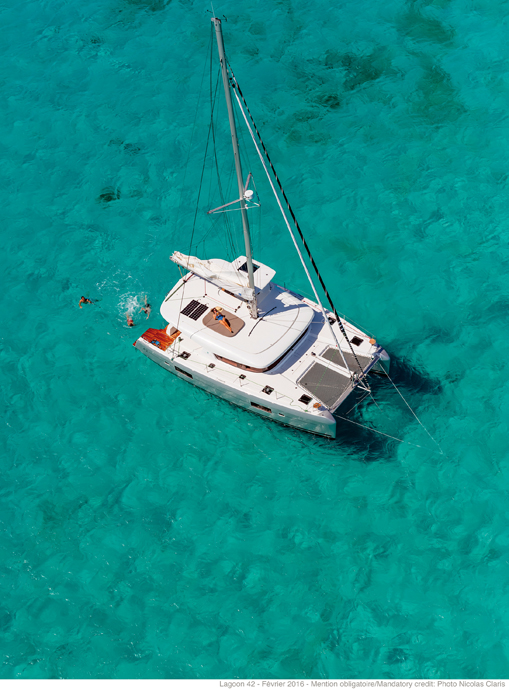
The Lagoon 42 makes for a good watersports base for all the family
Evolving lines
A transition has been underway since the arrival of the 39 and the 52, but it is even more apparent with the 42. The earlier models paved the way for a new position for the mast, with the –S” versions of the 450 and 52 offering pertinent alternatives to flybridges. The 42 really seems to have achieved this in a remarkable way. The lines have evolved in a really noticeable manner, with the freeboard being slightly reduced, and the vertical effect of the panels is nicely softened by the effect of the top edge being slanted, running from the bows all the way aft. This design success lengthens the overall line of the hulls and makes the dome of the coach roof and the bimini feel higher. The color system, using a covering enhances the evolution of a style which is more attractive than white gelcoat. The forward glazed area has been increased though this isn't obvious, and the all-new helm station integrates perfectly into the volume of the coachroof. The sugarscoops are also cleverly designed and practical for getting aboard. The collaboration between Patrick Le Quelmet and VPLP has been especially fruitful! The aft-set rig seems naturally destined for the 42, so successful is it. Only the bimini over the helm station shows a hint of the past, but I must admit I am not a fan of these being brought back.
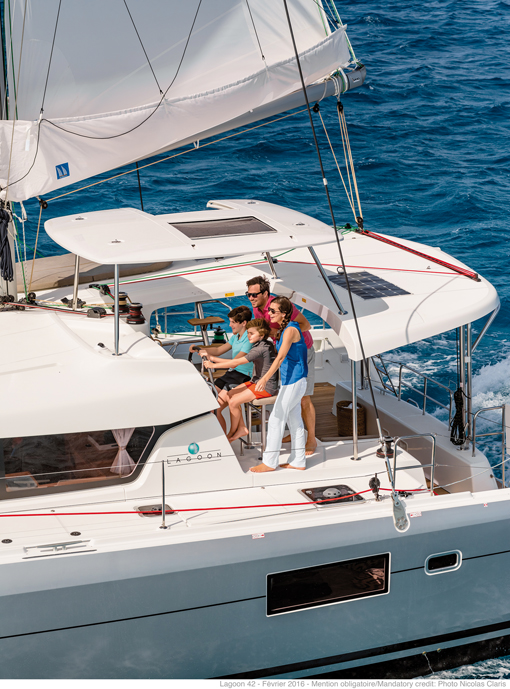
The helm station comprises the helm and the sail handling station at the mast foot: this works really well
A successful attempt at weight reduction
It is extremely difficult to get below a certain weight when constructing a cruising catamaran without using techniques and materials that are not normally found in a series production, with the budget or living space or volume required. However, Lagoon's strategy for the 42 is effective, as can be seen by the results on the water. Of course the design has contributed (reduced panel surfaces, inertia lower down in the mast, optimized hull sections), but it's principally the build where the biggest steps forward have been made. Reducing the weight demands rigorous effort, with small gains having to be sought from every area of the build. If this is done properly, it will have a positive effect on the balance and handling at sea: the distribution of weight being equally as important as the weight itself. For the 42, the yard has achieved several things. The interior modules (assembled off the boat and put in place before the deck is fitted) are transportable and are all uniform, since their design is of no structural interest after they are installed on board! This leads to some large surface areas of plywood and so significant weight savings with the trim. The floors have also been subjected to a hunt for kilos. Weight aloft is even more harmful in terms of the moment of inertia (10 kg at 10 m = 100 kg at one meter!). The large surface areas located up above the coachroof and the bimini are of particular concern. The parts are now fabricated using injection for the 42, with much weight being saved in the molding and also the headlining in the nacelle is made with a stretched fabric! The systematic removal of areas where monolithic resin is used further reduces the weight: Only the areas around the keels and the through-hulls are maintained, with the use of infusion allowing for good impregnation of the balsa (used as a core for its mechanical qualities) by the resin. Add to all of this, a reduction with the mast tube as well, brought about with the new geometry of the rig, and a chain of events is set in motion which can be seen in the handling.
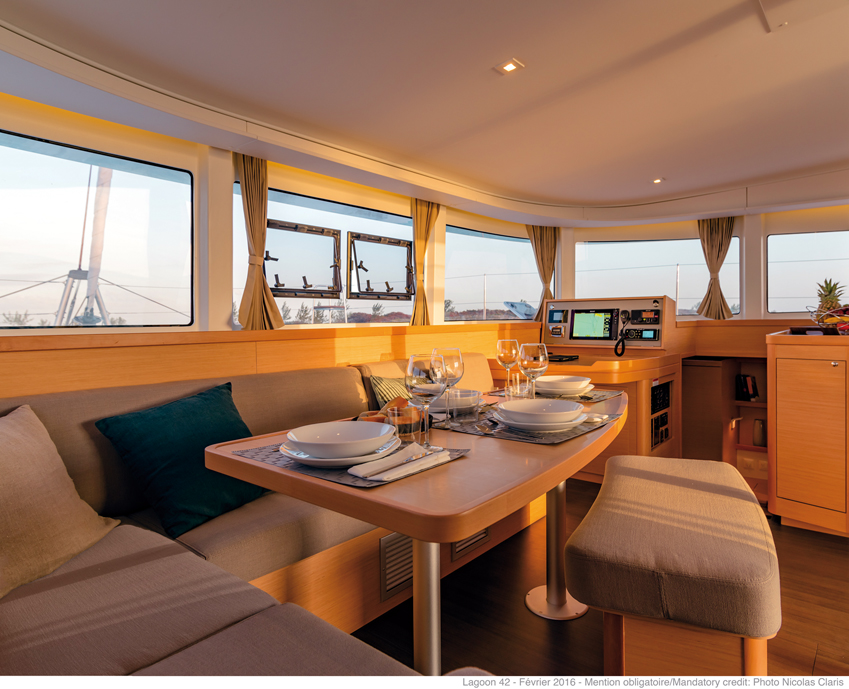
Headlining in stretched fabric, decorative as well as being feather-light
Spot On Ergonomics!
There have been many recent innovative attempts with the layout of catamarans (flybridges, forward doors, opening windshields, folding aft bulkheads, decks instead of trampolines, forward cockpits...) For the 42, Lagoon has not gone for any of these options and has looked in a different direction. The geometry of the rigging on its own constitutes a significant technical advance, and also a lot of effort has been concentrated on the helm station, sail handling console, ergonomics and communication with the cockpit. Nothing revolutionary, but lots of focused attention. The spacious helm station is perfectly integrated into the overall lines: Its optimized center of gravity clearly contributes to comfort and safety, accommodating two or three people no problem! The passage behind the helm seat is clever, and the liaison with the cockpit by 4 small steps alongside the lounger is very fluid. There are plenty of handholds and there has clearly been a comprehensive analysis of the layout to prevent knocks or falls, and this area, where there is a lot of moving around is particularly successful.
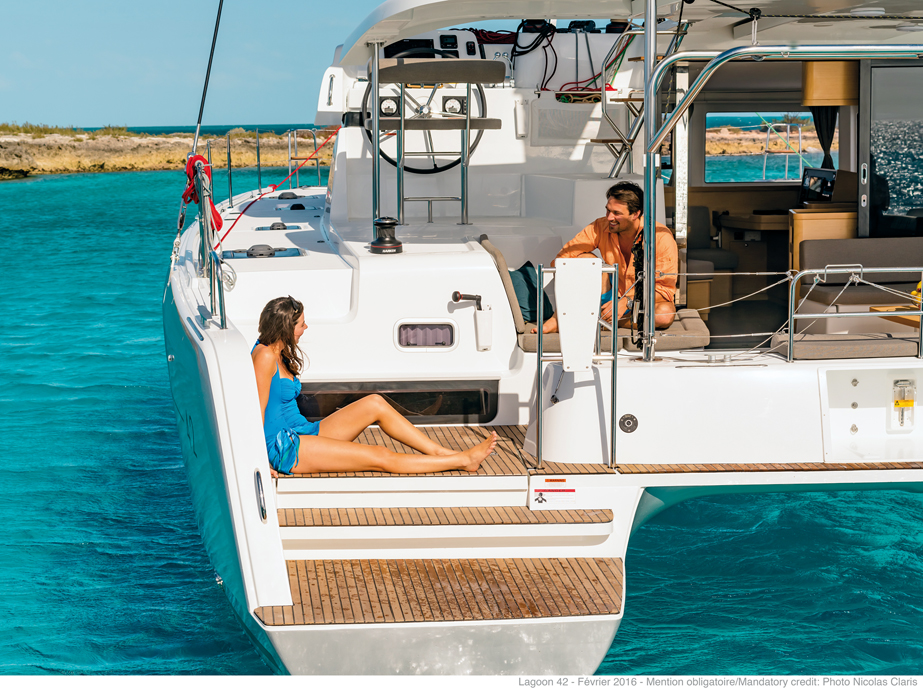
Without drawing too much on all the –latest solutions” such as forward cockpits or opening aft bulkheads, the 42 offers accessibility and ergonomics which are bang up to date
A performance rig
Setting the mast 2 m further aft has allowed for a taller mainsail and for maintaining an efficient sailplan without needing to resort to over-expensive materials. The self-tacking solent has increased in area, yet handling it is easier. Interesting! The new VMG Soromap spar seems well suited to its central role. Another clever point, the interaction between the two sails is very good even in light airs and the reduction in slamming is a great additional benefit. The profiles, being more stable, are more efficient, and the improvements of comfort and trim can be felt beneath your feet. The essential addition to this geometry is the code 0, though this is an expensive option as it includes a large area lightweight sail (so a technical one) and all the necessary hardware (bowsprit, winches, halyard, etc), but it is manifestly important.
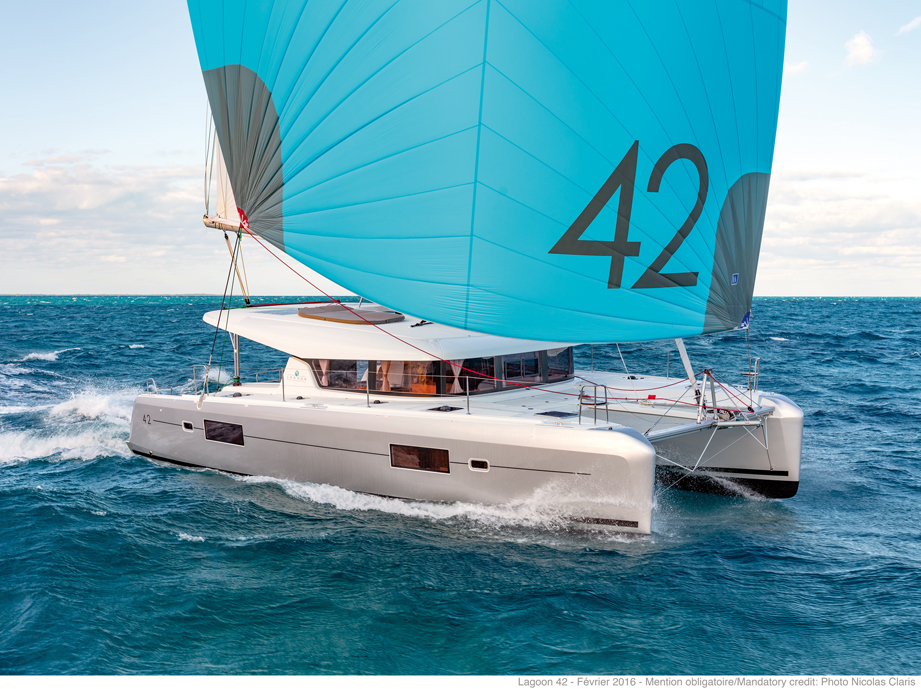
The 42's potential in light conditions is remarkable for such a well-fitted out model
Interior: light, volume and quality in evidence
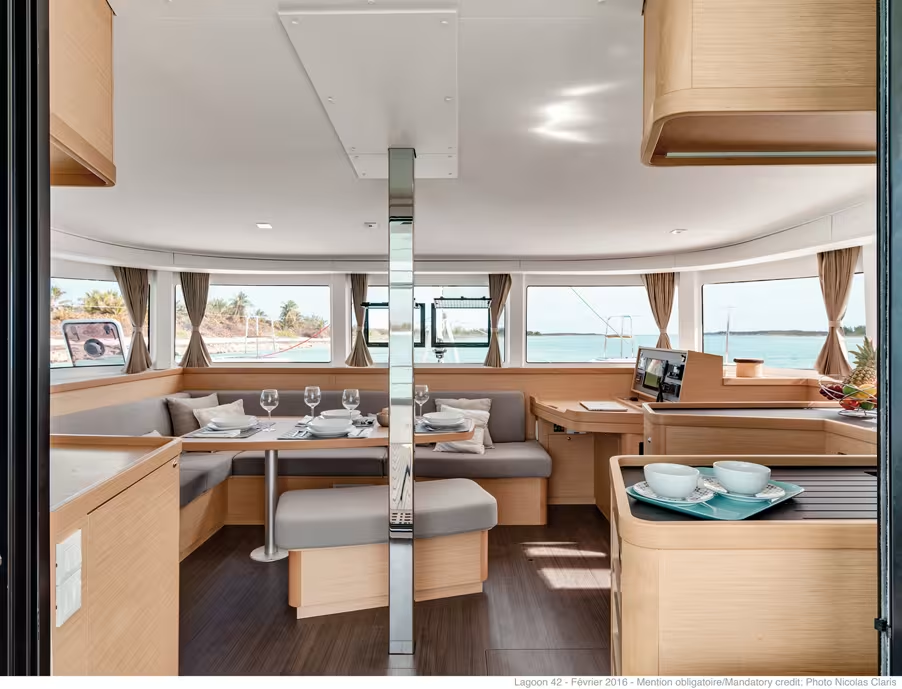
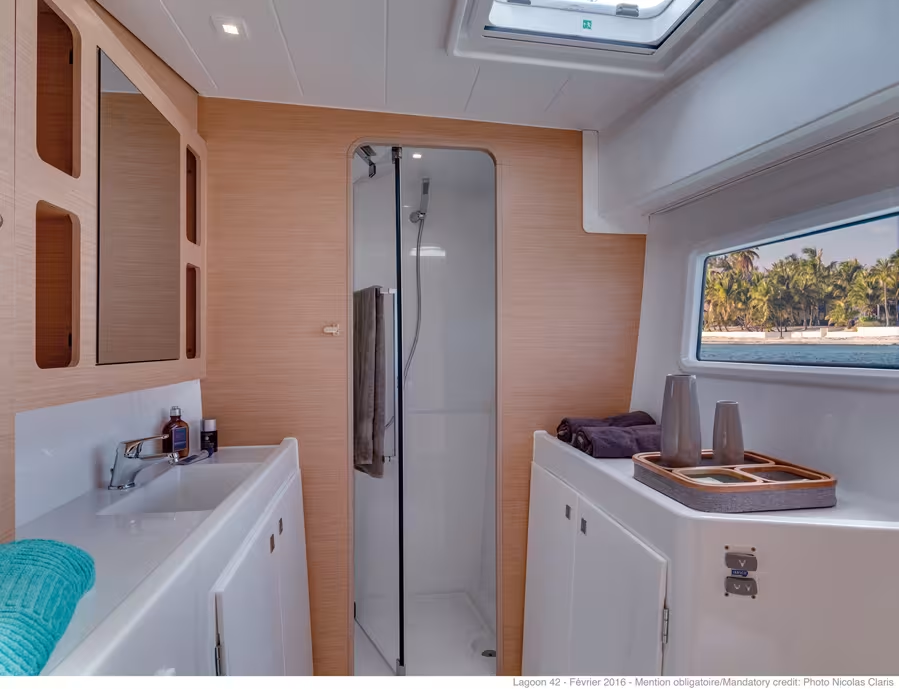
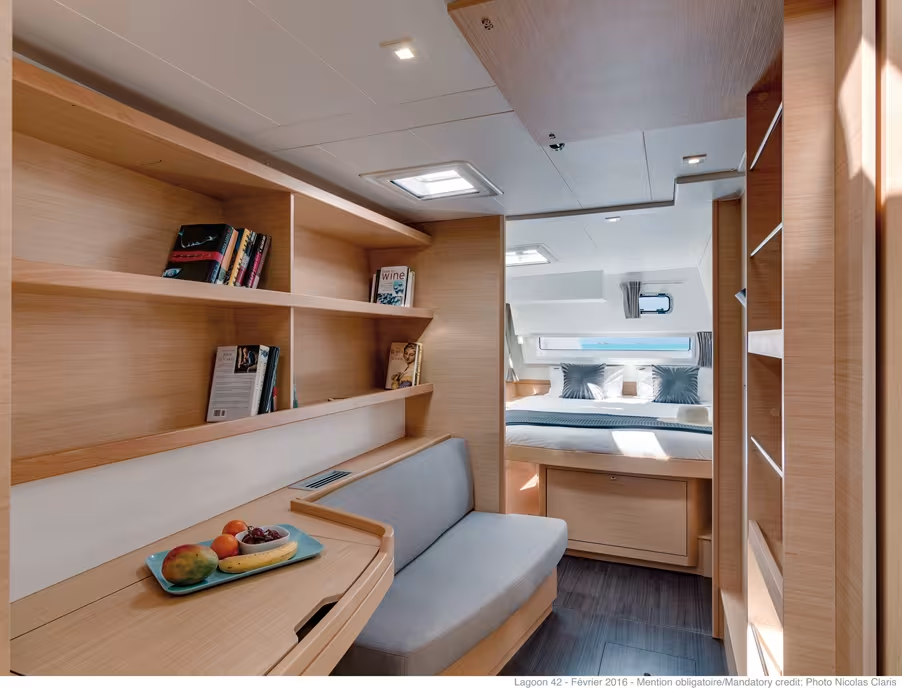
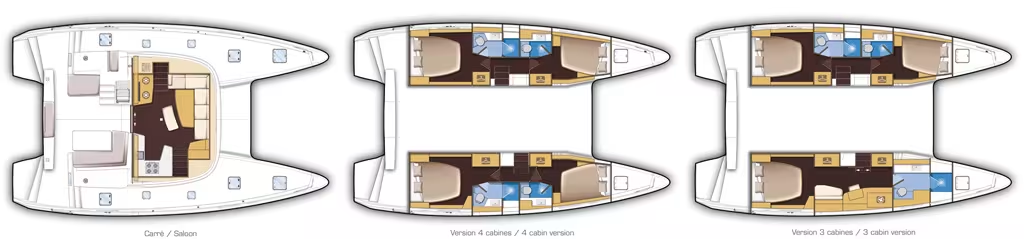
The sliding door divides into three panels on the 42, which separate well and allow efficient ventilation of the galley, where the hatch has been done away with (there are two large opening windows in the windshield). The effect of the stretched fabric on the coachroof ceiling is pleasing on the eye (its longevity remains to be seen). The shape of the saloon table is elegant and practical and there is an attractive U shaped layout of the galley to starboard. The new, non-slip coating on the worktops nicely replaces the Corian, which can become worn. The electrical panel is set back in the starboard companionway and access to the electronics is easy via a door below the chart table. The horizontally opening refrigerator and the freezer (with vertical access) are neatly fitted to port. There is lots of clever stowage, all with fiddle rails. The absence of gel-coated surfaces makes for a warmer atmosphere. The upholstery is attractive and the cabinetry well-made (with Light oak Alpi veneer). In the hulls, the aft cabins are welcoming (perfect light, ventilation and blackout blinds), and access to the island beds is easy (there is a large sliding drawer below the bed to stow travel bags). On the owner's version we tested, the bathroom is enormous, comfortable, clear and well-ventilated. The hot water feed was fast even in cold weather (which avoids wasting 15 l of water to reach the desired temperature). With the new stepped hull inboard, the cabins enjoy lateral access to the bunks.
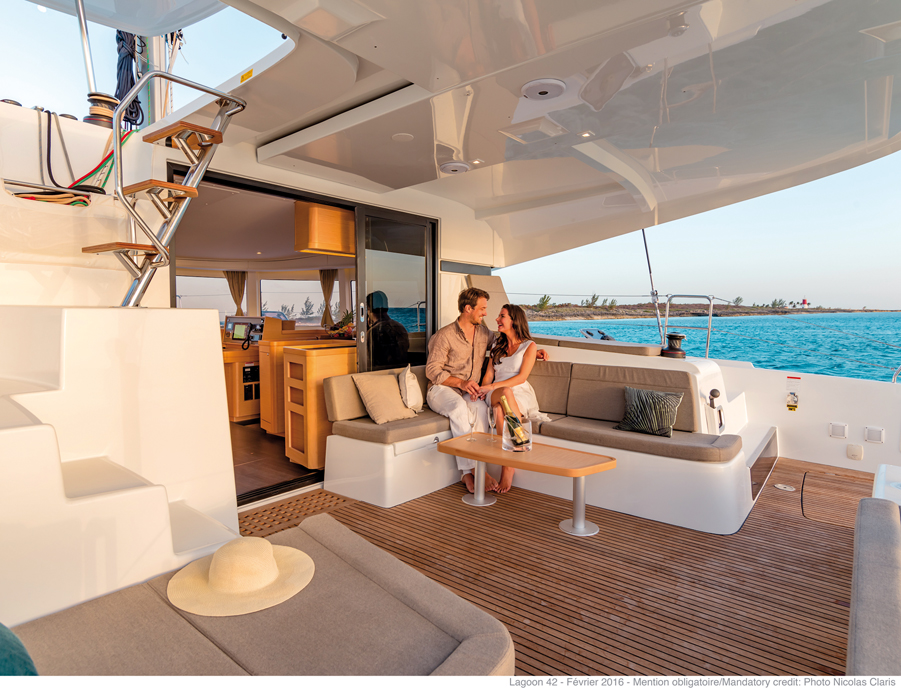
The outside salon (shown here with the low table, but also available with a table to seat eight) is equipped with a neat bench seat aft and a lounger, all perfectly linked to the helm station
Engine and battery compartments
The engine rooms are clear and well set up, and generally easy to understand. The cylinder heads are topped with a plate which can be stood on (neat idea), LED lighting and an integral fuel shut off (which is part of the latest generation of equipment on common-rail injection systems).The battery switches and starter shut offs to port and starboard are solidly fixed and protected in a locker. The house battery bank is located to starboard on both sides of the motor. The engine room bilges are painted, and there is good access to the autopilot motor, the rudder link bar and adjustable joints. Foam insulation and the double floor system has disappeared, in favor of a sandwich-built hatch. The resulting sound insulation is equally as good as previously with several kilos being saved, and engine access improved.
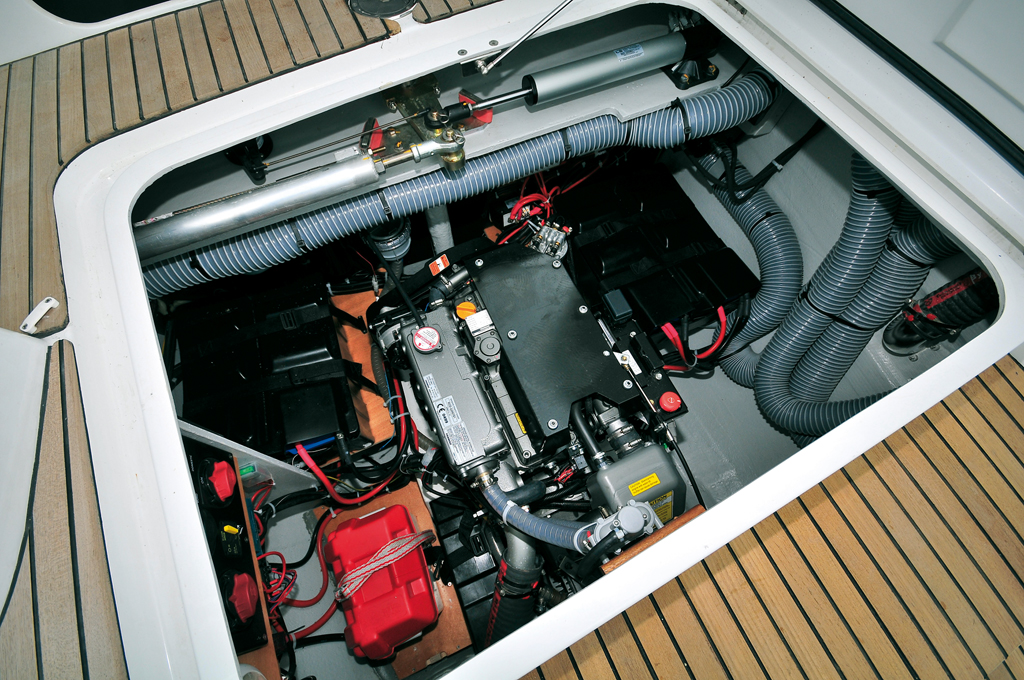
The starboard engine compartment houses the service battery bank. Note the engine shut-off seen on the latest generation common-rail motors, and the black step on top. The sandwich hatch cover has allowed for removal of the false floor for insulation
Sea trial
The 2 x 57hp motors suit the 42 perfectly: fitted with a three bladed folding propellers, these 2.2 l motors with common rail injection weigh 264 kg each with their saildrive transmission. Fuel consumption is 4 l per hour at 2000 RPM, giving a cruising speed of 7.3 knots, against 11 l per hour flat out at nine knots. During our two days around the islands off La Rochelle, on France's Atlantic coast, the wind did not exceed 12 knots, but it was lovely and consistent the entire first day. The mainsail was hoisted with the aid of the electric winch. We manually pulled up the first 2/3 from the mast foot, but it would run easier with ball bearing batten cars instead of sliders. With the wind on the beam we hoisted the code 0 and unfurled it using the excellent Facnor furler. The sail plan is a pleasure to see, the sheeting angles and the shape of the black mainsail are perfect, the tri-radial profile flies like a racing sail. The surface area of 68m_ has been carefully chosen to provide a good balance between volume and use. The slenderness and form of the mainsail are remarkable. As soon as the code 0 was set, there was an increase in power which was noticeably easy to adjust. The profile of the mainsail is also very intuitive and it has been optimally made, with the full height of the sail and the square top working well in this favorable wind. The work of a traveler is reduced to a minimum: if the car is positioned correctly, it works perfectly! The same goes for the foresail, But be aware you will lose speed if you've got it sheeted in too tight (it's easier to spot if it's the opposite situation!). The interaction between the two sails is great and you never get the impression that one is disturbing the other. Without any noticeable effect from the current (1 hour either side of high water), the speeds we recorded off Ile de R_ with a consistent 11-12 knot northerly breeze were commendable. They confirmed the feeling and dynamic attitude of the boat. With the true wind on the beam, and heading into a long residual swell, the trim was perfect, and the GPS speed built to between eight and nine knots (we had to check our Navionics track to believe it) and several times hitting 10 knots. The 42 really slips through the water and is nicely trimmed in these conditions. The rudder blades are linked with a strong aluminum tube mounted on joints which can be adjusted to ensure they are parallel. The linkage with the large diameter wheel is via cables and articulated pulleys. The geometry is as direct as it could possibly be, and the result is remarkable. The directional effect is precise and sensitive without requiring much effort. It's simply a pleasure. In our test conditions, the balance of the helm was amazing, with the catamaran maintaining its course under code 0 on its own for quite long periods and accelerating every time the breeze picked up. The 42 was great to adjust and trim. To reach the Pointe des Baleines to the NW of the Ile de Ré, we needed to come hard on the wind so we chose to use the solent. To neatly roll up the code 0, it is advised to come off the wind and furl it in the lee of the main: This way you are guaranteed to have it rolled up neatly and quickly, without any effort or problems. The 42 is swift upwind, without making much leeway. In these conditions the speed ranged between 6.5 and 7.6 knots at 42-45° to the apparent wind (still 11-12 knots true). The rig also tacked nicely, with the increased size of the solent making the 42 visibly more agile on this point of sail. Even without a spinnaker, going downwind under the Code 0 was still excellent, with the sailplan handling very –open” angles. Taking in a reef (the first reefing line is continuous in Dyneema) can be done very easily by one crewmember.
Conclusion
The two days we spent aboard the Lagoon 42, and the 60 miles we covered in light to medium conditions, were really enjoyable. The sea-keeping qualities are great, making the boat really fun to use. The ergonomics (particularly of the helm station) are a great leap forward, and the performance is genuinely improved. Tests under spinnaker in a breeze (25 knots with full main and asymmetric spi) would show excellent passage through the water, with scores consistently over 16 knots! Incredible for a 42-footer as comfortable as this one.
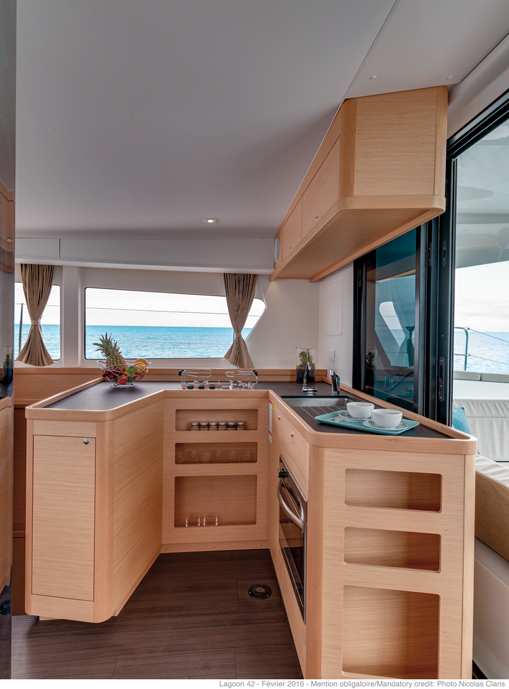
The new galley design which is very user friendly
Technical Specifications:
- Architect: VPLP Exterior Style
- Design: Patrick Le Quément
- Interior Design: Nauta Design
- Length: 12.80m
- Beam: 7.70m
- Draft: 1.25m
- Air draft: 20.65m
- Laden Displacement: 12t
- Upwind sail area: 90 or 94m2 (with square-topped mainsail option)
- Mainsail: 55 or 59m2 Self-tacking jib on furler: 35m2 Code 0: 68m2
- Motors: 2x45 or 2x57hp Yanmar with saildrive transmissions
- Fresh water: 300l
- Fuel: 300l or 2x300l option
- CE Certification: 12 persons in category A
- Price ex-tax Owner's version: —292,000 (—298,000 in charter version)
- Principal options in euros ex-tax: Essential Pack: 21,438 (Charger, 2 additional batteries, Brookes and Gatehouse electronics with autopilot, dinghy lifting...) Carpeted cabin soles: 1,805 Code 0 + hardware: 14,245 Rigging for asymmetric spi: 3,176 Reinforced sails and square-topped main: 3,593 Bimini + roof access steps: 11,250 3x120W solar panels: 4,229 Folding propellers: 2,252 2x57hp motors: 1,147 Heating by hot water: 8,603 Launching + antifouling with epoxy primer: 12,818
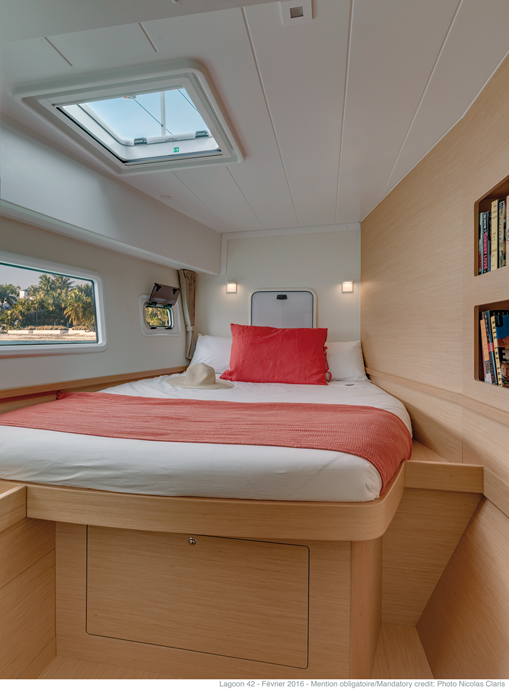
The forward cabin of the 42. Note lateral access to the bunk, possible tanks to the step in the interior hull
A word from the architect, Marc Van Peteghem
The L42 has benefitted from a real reduction in weight made by the yard and from a lot of work which has gone into the balance of the hulls and the sailplan. The position of the mast set further aft is really used to its potential because this helps create a boat which is reactive and which accelerates well. Obsession with weight is part of our racing DNA, but we had to look at this within the context of designing a cruising boat, where comfort is of paramount importance. It is interesting to note that the level of amenities can combine with an agility and performance that allow the boat to lengthen its stride with ease. We are very pleased with this boat, not just because of its design and its comfort, but also because it represents an important stage in the new design work we are doing with Patrick Le Quément.
Plusses
- Silhouette sympathique
- Conception du poste de barre
- Plaisir d’utilisation à la voile
- Pertinence et performance du gréement
- Confort lié à la réduction du tangage
Minuses
- Positionnement des martyrs d’amarres à optimiser
- Pas de panneau ouvrant de cuisine
- Console instruments exigeant d’avoir le bras long
- Pas d’accoudoir extérieur de sécurité sur la banquette de barre
- Cinématique de porte de douche
The competition
| Builder | Model | Upwind sail area in m2 | Weight in tonnes | Basic Price ex-tax |
| SEAWIND | SEAWIND 1260 | 90 | 8,2 | US$ 485 775 |
| BALI | 4.3 | 91,5 | 11,5 | 340 625 |
| CATANA | 42 | 112 | 8,9 | 379 000 |
| LEOPARD | LEOPARD 44 | 123 | 12.6 | 369,000 |
Caption
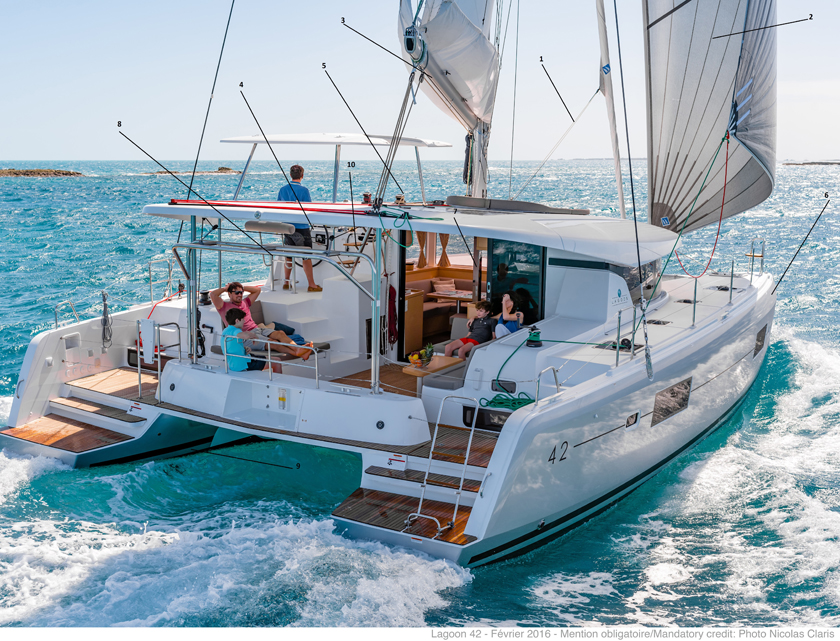
- : With the new position of the mast set further aft, the self-tacking solent is larger in area. It is more efficient whilst being easier to handle
- : The effective and indispensable addition to this type of rig, the Code 0 is the must-have sail when at 90-140° off the true wind. Sailmakers Incidences have cut the perfect sail for this use.
- : The boom, noticeably shorter compared to traditional sailplans, is much lighter, and supports a much taller, square-topped, mainsail (suggested option), which works well in a fresh wind and is easy to trim
- : The helm station is close to the center of gravity, so the helmsman and trimmer are comfortably positioned. The option to be able to walk around the watchkeeper's seat is a neat idea
- : The sail-handling station is well-designed being close to the mast foot, the lines have good leads, and there is space to trim the sails without disturbing the helmsman.
- : The vertical effect of the topsides is minimized nicely by the slanted effect of the upper edge
- : The mast support is set well aft, with the load taken on a metal chassis which spreads the compression across the base of the nacelle. This geometry considerably reduces pitching, while making the mainsail easier to use
- : The stainless cradle for the dinghy neatly replaces the davits
- : There is no break from the architectural design of the previous generation, but the synergy between the geometry of the new rig and the work that has been done to center and reduce weight, has increased the hydrodynamic potential and optimized the glide through the water
- : Access to the coachroof and to the cockpit has been carefully designed