Launched in preview at boot Düsseldorf back in 2016, the 42 was the last model in the fourth generation of catamarans from the world’s largest catamaran manufacturer. This Lagoon holds a very special record: it is the most widely sold cruising multihull in the world!
Infos pratiques
- Le chantier : Lagoon 42
- La fiche technique
-
 Découvrez notre vidéo exclusive
- Financez votre Lagoon 42
- Assuez votre Lagoon 42
- Articles autour du Lagoon 42
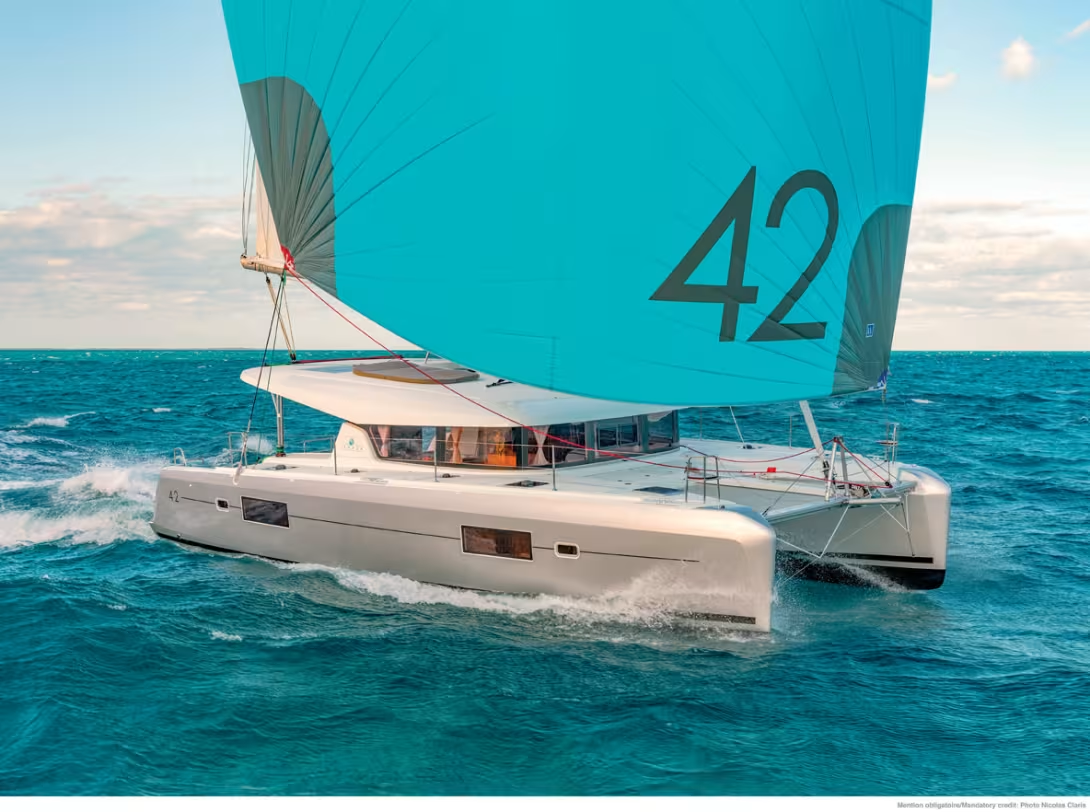
The fourth generation of Lagoons was launched in 2013 with the Lagoon 39 and the 52. They were distinguishable above all by their rig being steeped almost at the after end of the coachroof, their famous diamond-shaped bows, and a more “airborne” coachroof design. The 42 therefore incorporated the same characteristics. This model made quite an impression on the boating public - but also on all the professionals in the industry - thanks to the magnificent images taken by Nicolas and Romain Claris in the Bimini Islands (Bahamas): at sunset, the Lagoon 42 could be seen racing at over 16 knots under an asymmetrical spinnaker. On the videos, some people believed they detected an acceleration of the film during the editing - which was simply not true. The new Lagoon seemed to be enjoying the breeze, and that was a good thing! And yet, this model, being significantly wider than its competitors, is also the most voluminous...
The Replacement for the Lagoon 421
The direct predecessor of the 42 was the 421, itself closely derived from the 420. This latter model, born in 2006, was incredibly avant-garde with its hybrid powertrain, but it also symbolized maximum comfort - obviously at the expense of performance. Starting with the 42, Lagoon decided to return to a design that (slightly) tips the balance in favor of the speed potential of its catamarans. The stated objective was even to gain just a few points on the performance/comfort ratio – a compromise that is always difficult to achieve given the wishes of customers, who clearly prioritize living spaces on board above all else. The architects at VPLP were called upon to reduce the surface area of the panels used, lower the mast inertia and optimize the sections of the floats, but the yard didn’t stop there: Lagoon implemented a discreet but effective process to shed a few pounds here and there and optimize the centering of the weights, all while remaining compatible with the imperatives of industrial production. Thus, once in place, the large plywood panels that form the accommodation modules had sections cut out, the floors were lightened, the counter molds replaced by infusion-made parts, and the nacelle ceiling was even made of a stretched headlining material! The widespread adoption of sandwich construction – only the hull bottoms around the keels and the through-hulls retained monolithic GRP.
Proven Deck Plan and Rig Stepped Further Aft
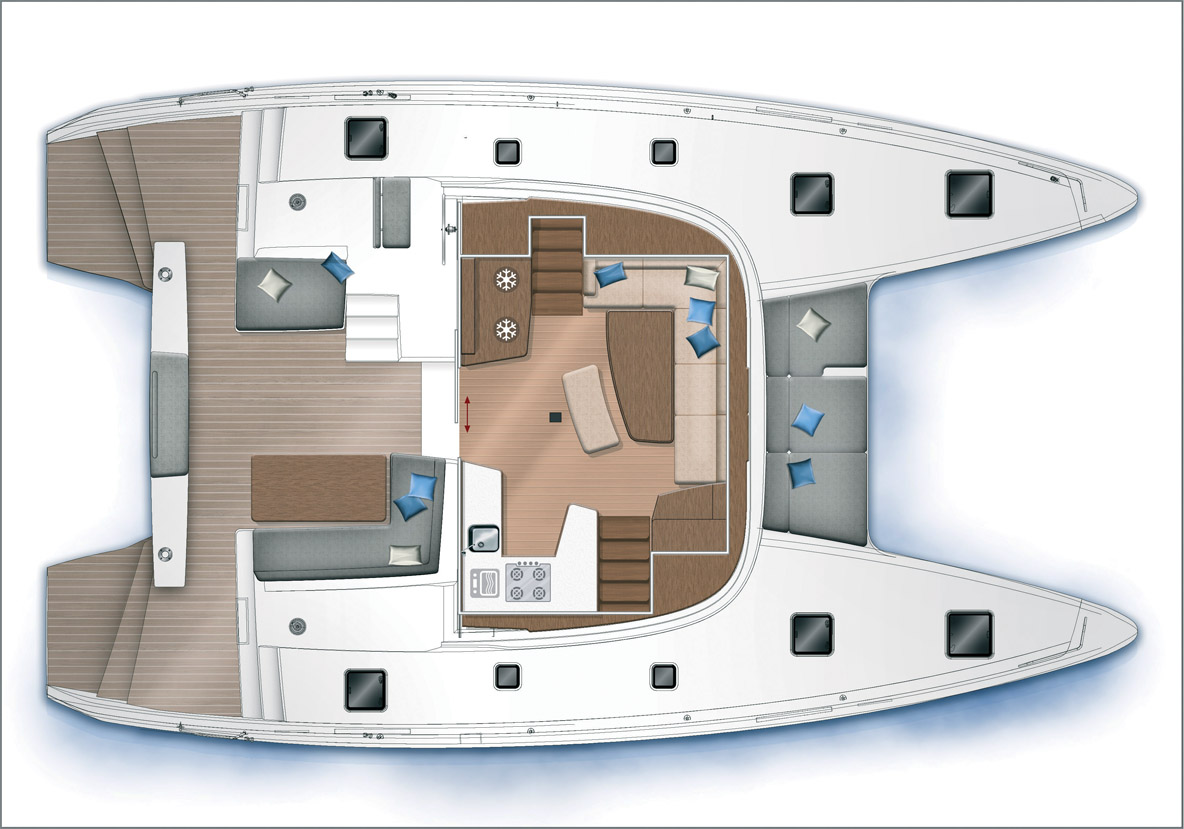
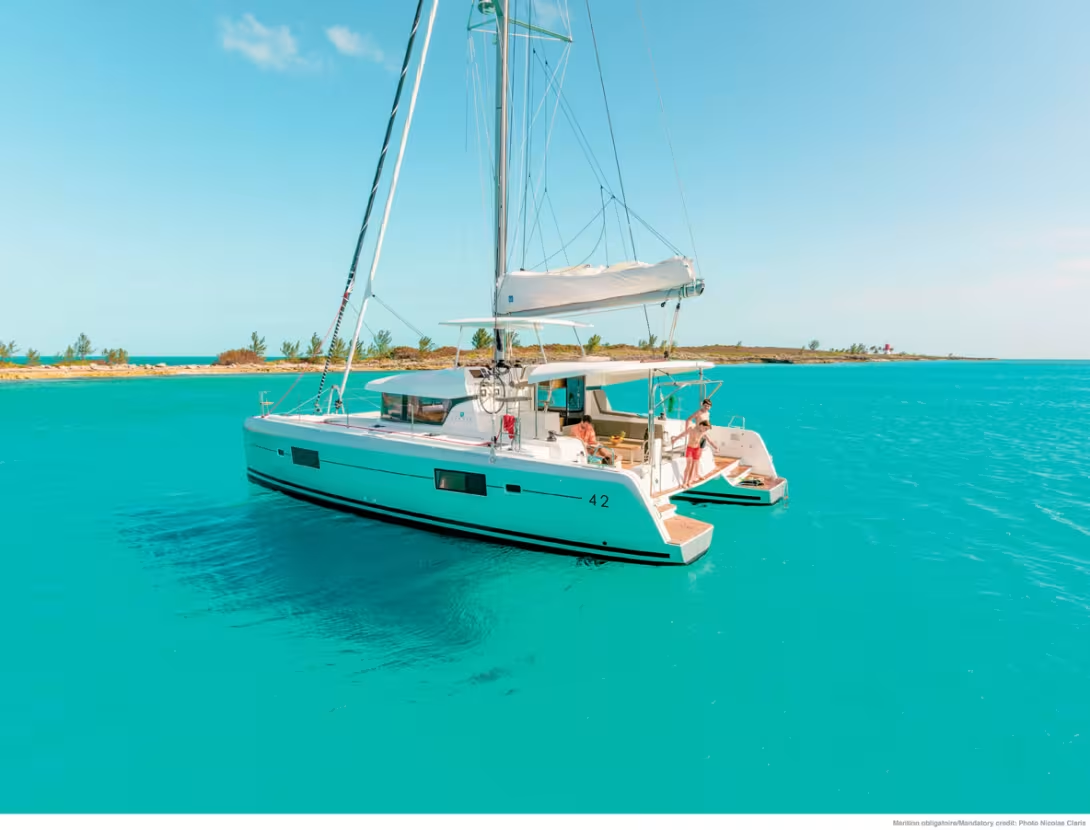
In 2016, features such as flybridges and forward doors had already become established aboard many 45-foot production catamarans: Lagoon wasn’t seeking to imitate its larger models but instead to optimize the tried and tested solutions. One cannot fail to be charmed by the wide sugarscoops, the well-protected cockpit that opens generously onto the nacelle, the outdoor table that can seat eight, and the easily accessible and easy-to-use sail maneuvering and helm station. Leading up to the bows are wide side-decks and once there, you’ll find large lockers and a pair of trampolines.
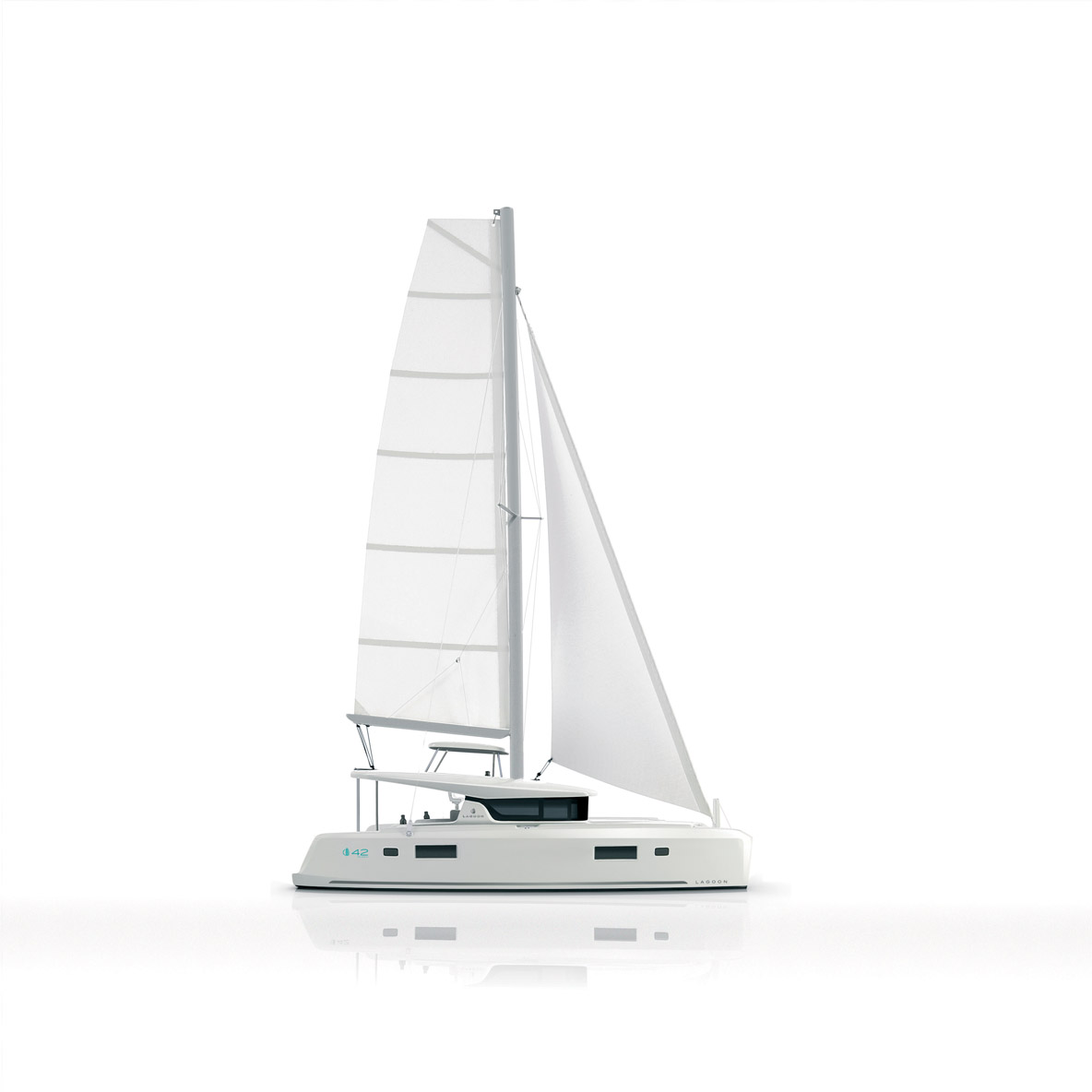
The rig, compared to that of an Astrea 42 for example, is set back by a whopping two meters (6½ feet). In theory, the formula promises many advantages: a sleeker rig, a large self-tacking jib and improved weight centering. All racing multihulls have adopted this type of sail plan, though retaining a little overlap for the headsail. In real cruising life, there is room for discussion: the Lagoon 42 is almost unmanageable under mainsail alone and the support of the gennaker is almost obligatory to achieve interesting performance in less than 12 knots. It’s easy to understand why the yard revised its design from the Lagoon 51 onwards, reverting to a traditional rig, i.e. stepped further forward and equipped with an overlapping genoa. And then there’s the forthcoming 38... the next entry-level model seems to be resisting with a sail plan that looks pretty similar to that of the 42.
Far from Being Ridiculous Under Sail
There are those who criticize modern cruising catamarans, considering them incapable of sailing comfortably in heavy seas and even less capable of sailing upwind, but they were to be proven wrong: from the very first tests, the Lagoon 42 surprised all the experts – including us, first and foremost – with its good sailing qualities. The sail area/displacement ratio of 7.79 m²/t with the square-topped mainsail (this offering a significant advantage with an additional 4 m² or 43 square feet) is, however, not very favorable on paper. It is undoubtedly the work carried out on the hulls that paid off, with the possibility of reaching interesting speeds relatively easily. Obviously, with the rig stepped further aft back and the non-overlapping jib, the potential of the catamaran is largely determined by whether or not a gennaker is available.
During our test sail off La Rochelle with a 12-knot wind, we recorded a good average speed of 8 knots across under gennaker - with a few peaks at 10 knots. Our tester appreciated the ease of setting the sails and trimming them. Only the jib requires some attention - you can overpower it without realizing it. The rudders are linked by a sturdy aluminum link rod mounted on ball joints and equipped with parallelism adjustments. As for the connection with the large diameter wheel, this is made via cables and articulated pulleys. This assembly, as efficient as it is direct, results in an excellent balance of the helm and even provides some good sensations for the helmsman.
When sailing close-hauled, the keels allow a course at 42-45° to the apparent wind. This value is no match for a catamaran with daggerboards but it’s quite respectable nonetheless. The Lagoon 42 proves to be rather agile when tacking with its self-tacking jib. Still with 12 knots of wind, the speed we had noted fluctuated between 6.5 and 7.6 knots.
In the engine compartments - which are well soundproofed and accessible thanks to the steps – you’ll find two 57 HP diesels. These are 2.2-liter blocks with a common rail injection system, and they weigh 264 kg (582 lbs) each including their saildrives. Our consumption readings were 4 liters/hour (1.05 US gallons/h) at 2,000 rpm giving a cruising speed of 7.3 knots, while at full throttle, the speed rose to 9 knots for a consumption of 11 l/h (2.9 g/h).
3 or 4 Cabins
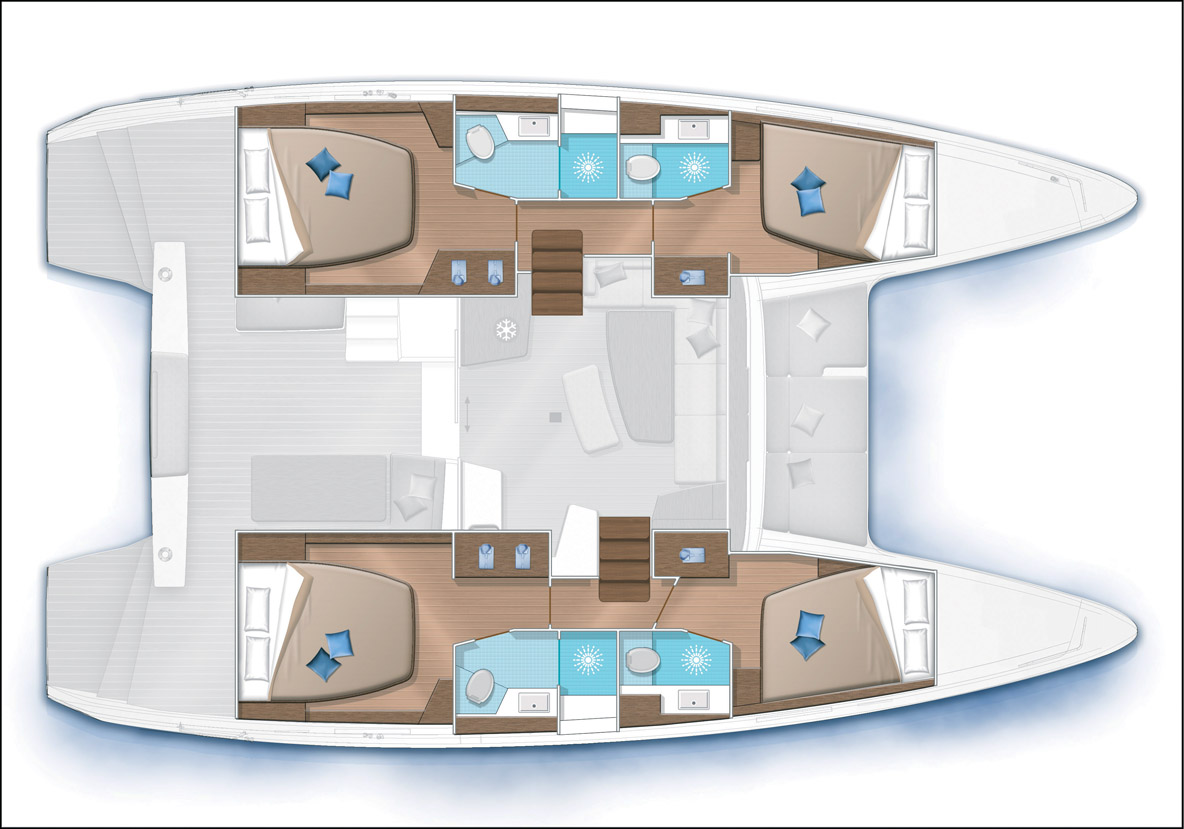
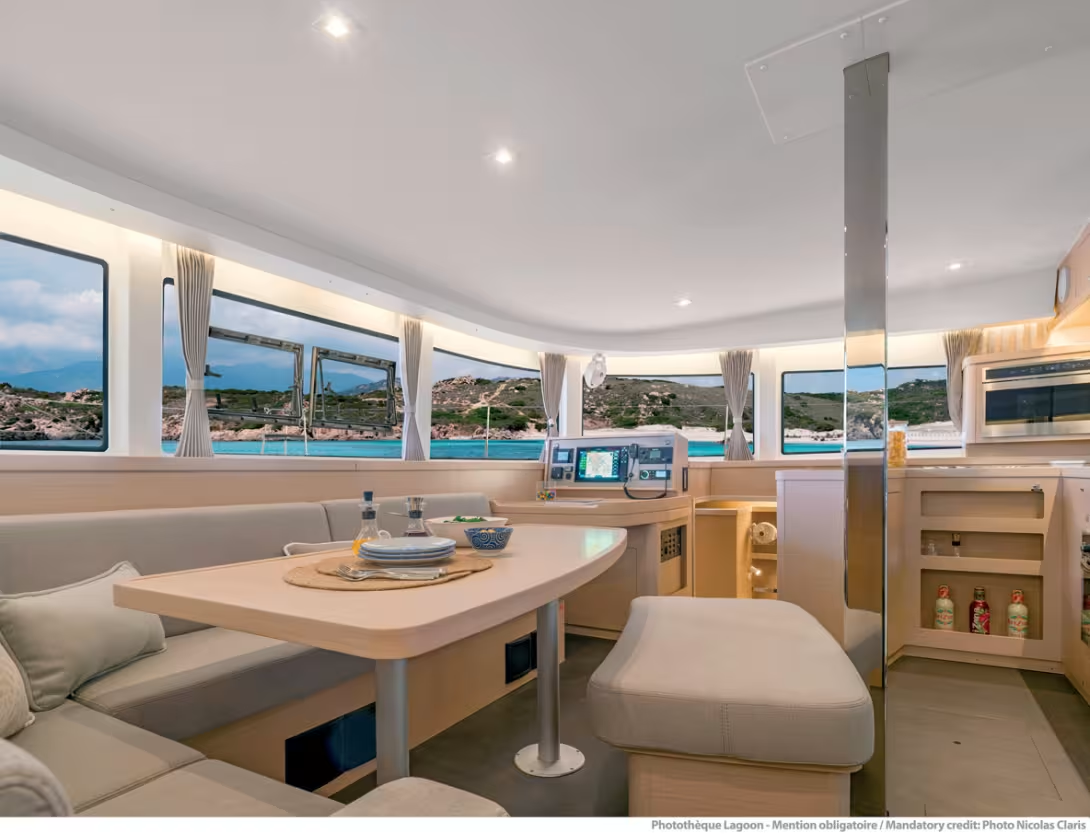
The rounded front section of the nacelle features Lagoon’s essential vertical panoramic windows; these, together with the overhang of the coachroof, ensure excellent visibility without being affected by the sun’s most vertical, and therefore hottest, rays. Inside, toward the cockpit, there is a unit on the port side that incorporates the refrigerator. Opposite this, a U-shaped galley is installed, which includes high-level cupboards. The opening to the cockpit is provided by a three-section sliding door. At the back of the nacelle, the saloon is arranged on the port side, while an athwartships chart table manages to find a small space on the starboard side. There is plenty of storage space equipped with fiddles throughout. The Lagoon 42 is available with 3 or 4 cabins; the first version is the most sought-after on the second-hand market - even if the 4-cabin version has seen longer lasting success as new...
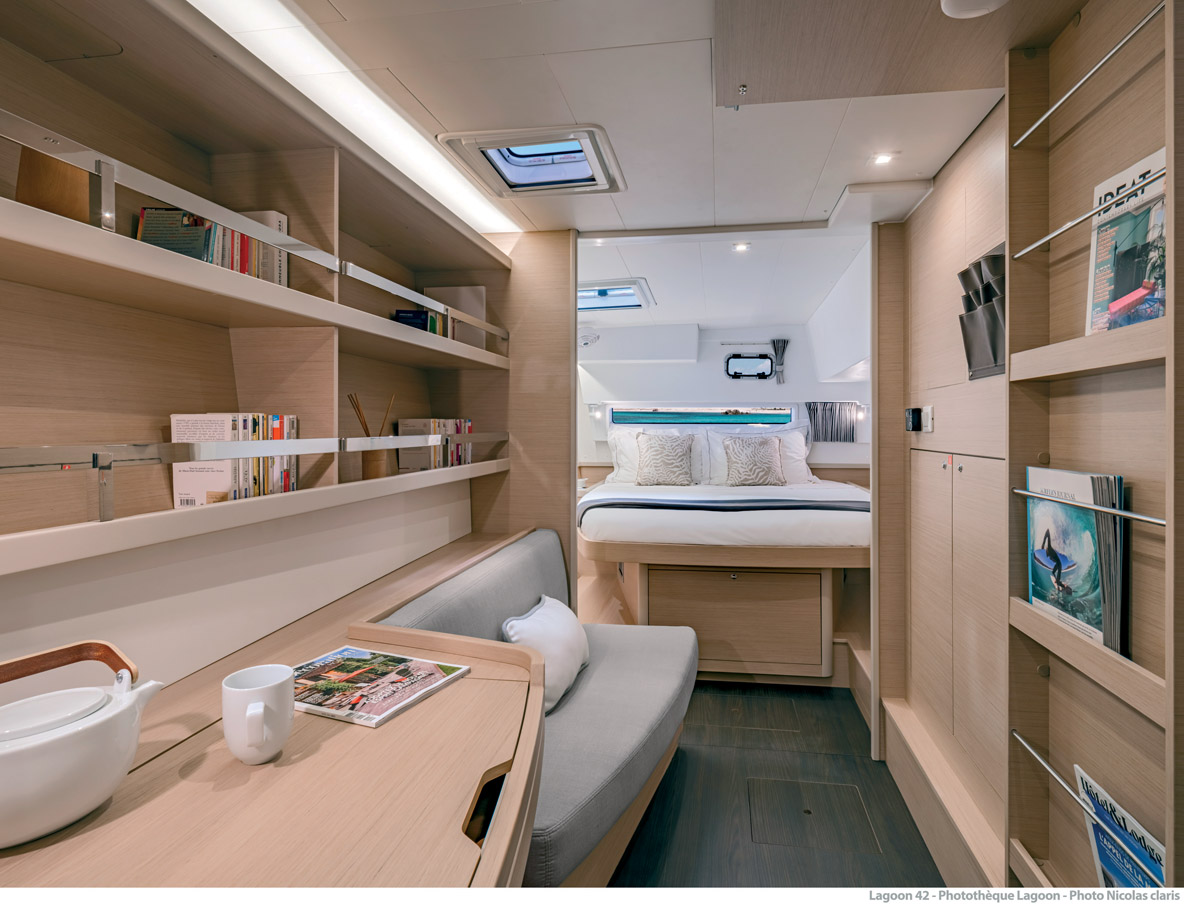
Generally speaking, the finish is fairly neat, and the atmosphere is warm. The island beds in the aft cabins are equipped with a large sliding drawer under the bed base. Forward, thanks to the inboard chine, side access to the bed has been provided.
Conclusion
It is certainly no coincidence that over 1,100 examples of this model have been sold. The Lagoon 42 is without doubt the cruising catamaran of recent times that has most closely met the requirements of owners and charterers. Despite the presen- tation of its successor (the Lagoon 43) at Cannes back in September, the 42 is holding its own, as production continues into 2025. This is a classic example of a safe bet in the cruising multihull category!
Points to check
“With these very large productions runs, it is relatively rare to have a serial defect,” notes Bruno Belmont. Mr. Lagoon is right: even after scouring the web and talking to charter companies and dealers, no really troublesome problem has been mentioned. After poring over the after-sales service history, Bruno did mention a sliding window that took some time to be made reliable, a few issues with the first saildrives – issues resolved a long time ago now – and finally cracks in the gelcoat observed on the decks of very early models - a defect resolved as of hull #17.
Very wide range of programs
Safe investment - good resale value
The compression post of the aft-stepped mast slightly hinders movement in the saloon
Technical Specifications
Architects: VPLP
Material: GRP/balsa sandwich
Length overall: 43’4” (13.22 m)
Hull length: 42’ (12.79 m)
Beam: 25’2” (7.68 m)
Draft: 4’2” (1.26 m)
Air draft: 67’7” (20.6 m)
Displacement 26,680 lbs (12.1 t)
Mainsail: 592/635 sq ft (55/59 m²)
Genoa: 377 sq ft (35 m²)
Code 0: 839 sq ft (78 m²)
Engines: 2 x 57 HP
Fuel: 151 US gal (570 l)
Water: 79 US gal (300 l)
Cabins: 3 or 4
Berths: 6 to 12
CE Category: A12
B14
C20
D30
Total production: 1,105 units since 2016
Second-hand price: from €300,000 ex-tax