Take the flying bridge, which is an innovation on any boat less than 45 ft long. Add a ‘gull’s wing’ shape to the underside of the bridge deck. Mix in enough volume for really comfortable accommodation, a different way of arranging the external living space and decent performance for a cruising boat, and you have the Lagoon 440, a revolution in the small world of cruising multihulls.
Infos pratiques
- Le chantier : Lagoon 440
- La fiche technique
- Découvrez notre vidéo exclusive
- Financez votre Lagoon 440
- Assuez votre Lagoon 440
- Articles autour du Lagoon 440
Right from the start, the Lagoon 440’s lines struck a familiar chord. The general shape of the hulls and superstructure reminded me of something that I could not quite put my finger on. The 440 undeniably resembles the other boats in the Lagoon range, but there was something else… I was thinking about what it was when a ‘Lagoon Power’ pulled in to tie up behind, and I could see the resemblance straight away. Certainly, the 440’s bows are less flared than on the ‘Power’, and it is above all the cabin roof which is similar, but it probably owes more to the motor boat than to previous sailing boats in the range. When I first discovered the Lagoon Power 43 with its gigantic aft cabin, I commented that the day would come when the accommodation on sailing catamarans would also be fitted out as a ‘suite’; the 440 is not quite there yet, but one day…..
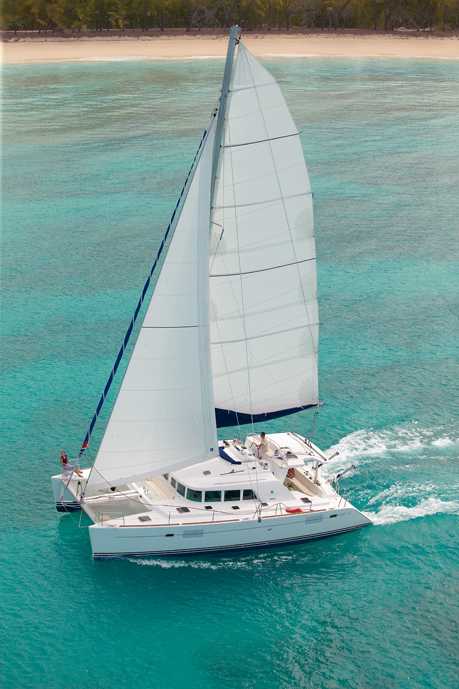
The latest born in the Lagoon range offers exceptional habitability and very interesting innovations
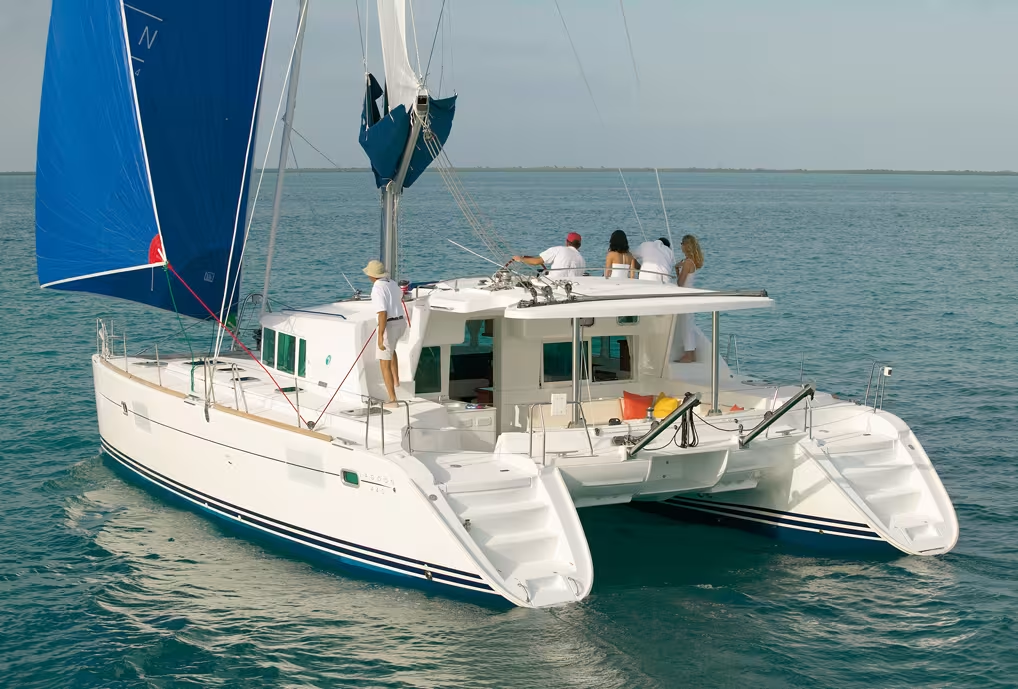
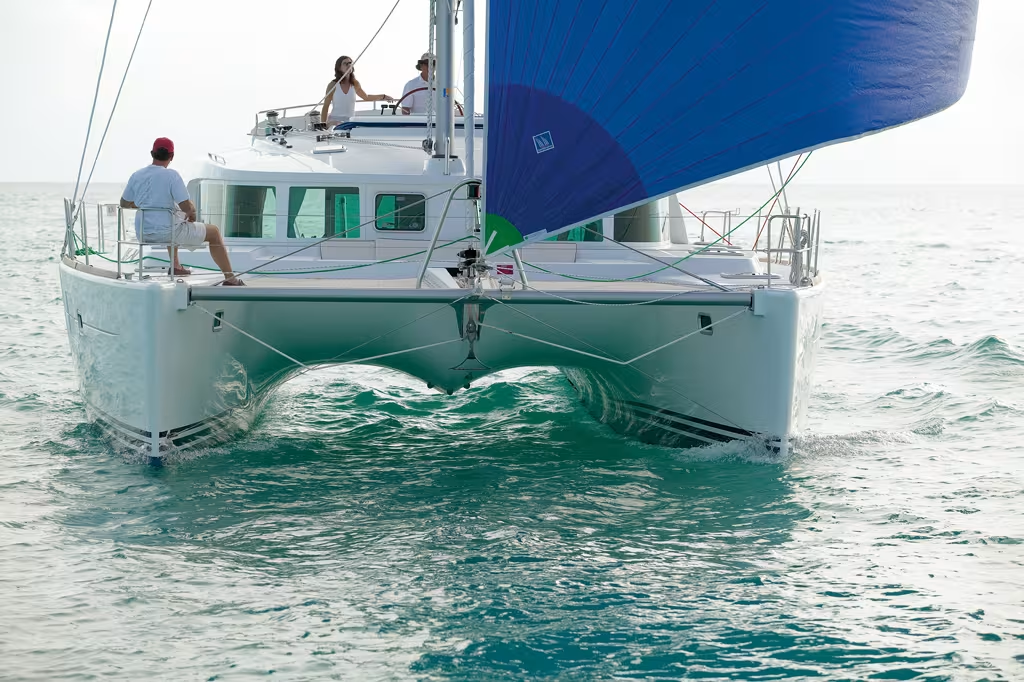
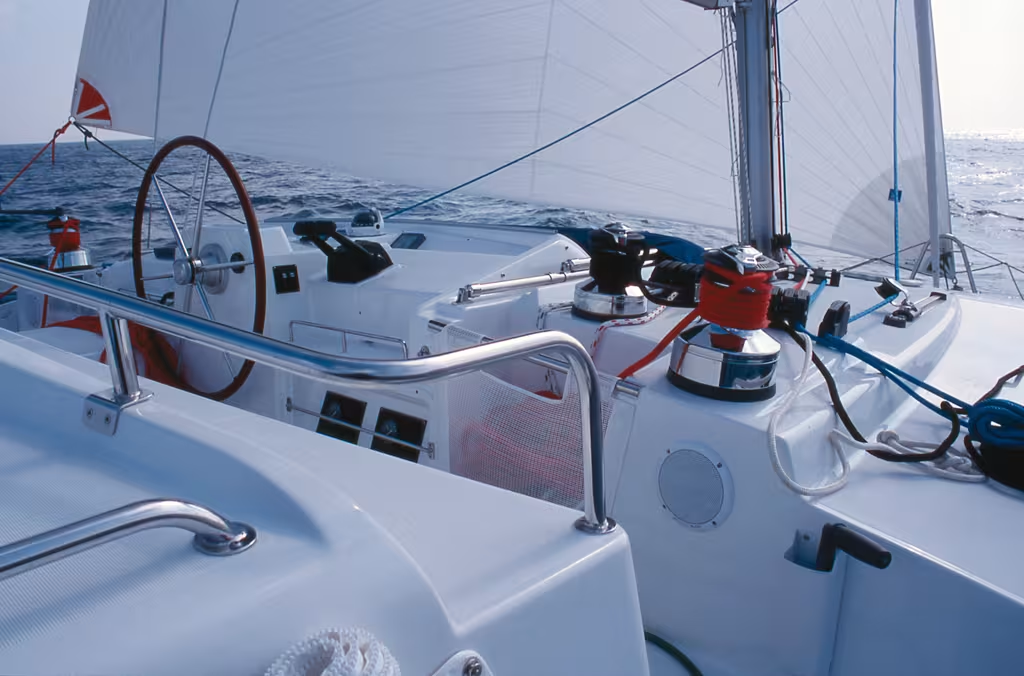
This is probably due to the flying bridge, as the helm is on top of the cabin roof, with access via steps either side. Seen from forward, the considerable volume of the hulls hints at the amount of accommodation I would discover later. The shape of the underside of the bridgedeck is as revolutionary as the flying bridge; the builder describes it as a ‘gull’s wing’, and it is designed to reduce the impact of waves hitting the underside. Generally, the noise of this impact is loud and always unpleasant for the crew. We would see later if this really worked at sea. In the meantime I was at last aboard this boat, which was being presented in Europe for the first time after having been one of the main attractions of the Strictly Sail show in Miami. She was leaving on a delivery trip to the Balearics and I was to accompany her as far as La Corogne, on the other side of the Bay of Biscay. Aboard, everything was surprising; Lagoon have excelled themselves. I had never seen anything like it and did not know quite what to think. Words came into my head to describe what I was looking at, but they were from a vocabulary that I associate more with houses and flats, such as ‘first floor’, ‘patio’, ‘maisonette’… I forgot that I was aboard a catamaran. The boat has been designed around the flying bridge, access to the steering position up here is by two ‘staircases’, one from either side of the cockpit. All halyards and sheets, even those for the gennaker, are controlled from up here. However, in the interests of safety, one end of the mainsheet is led underneath the rigid bimini in case it has to be released quickly.
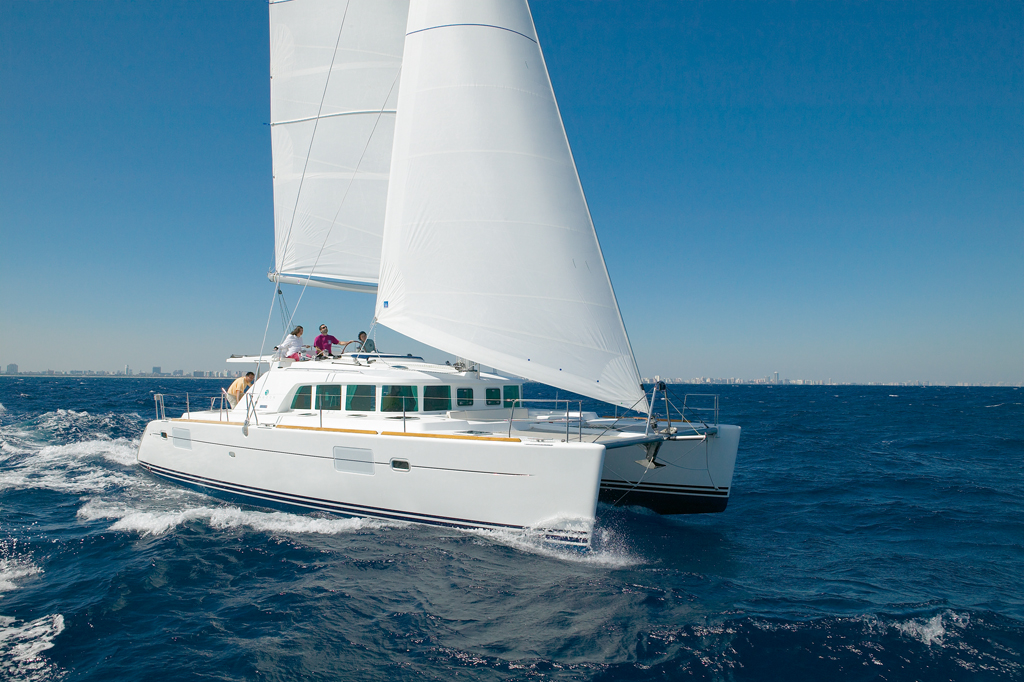
Under sail, the 440 remains very comfortable and achieved a perfectly respectable average during convoying
Offshore
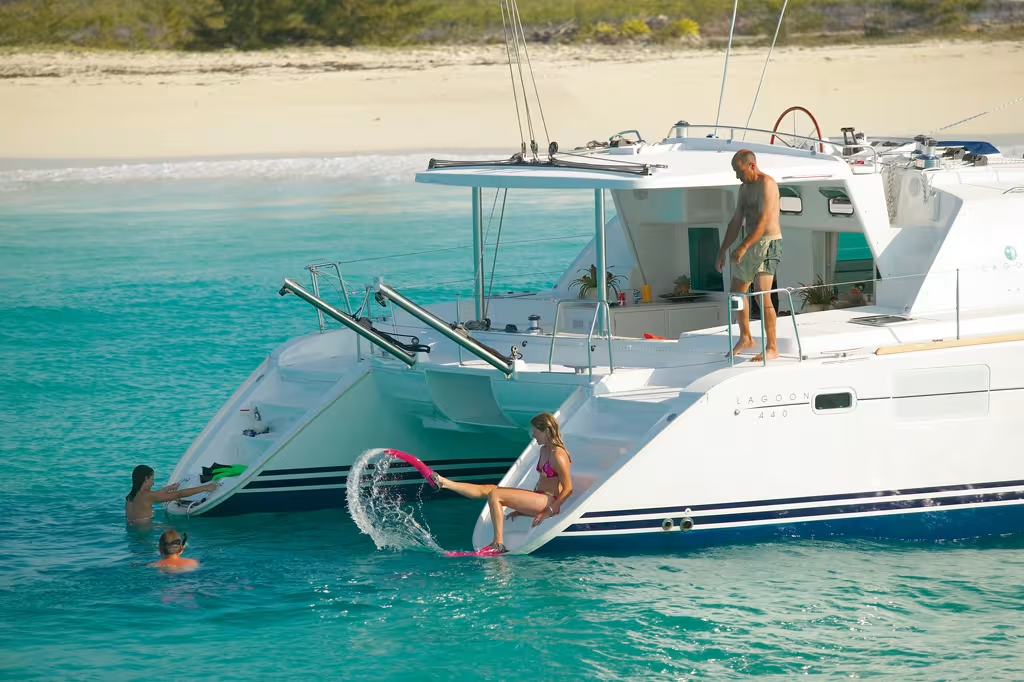
Friday morning was turning into a beautiful spring day, with a cool north-easterly breeze. The weather forecast promised a strong anticyclone and winds aft of the beam for the following days – ideal conditions for our delivery trip. We were five crew, so the night watches would be easy. Manoeuvring in the port was easy, perched high up at the helm, as there are no blind spots. We quit the pontoon and left Les Minimes, in La Rochelle. The boat is the private owner’s version and has all the options, among which are the numerous electric winches. Thus hoisting the mainsail is child’s play, however Alain preferred the exercise and hoisted it by hand from the mastfoot. The last few feet were sweated up on the electric winch; the sheet winches are also electric. The boom is very high above the cabin roof as a result of the flying bridge. Next it was the turn of the gennaker and once it was unrolled, the 440 picked up to five knots at 140° to about 10-12 knots of wind. We did not use the roller reefing jib during the delivery, but I noticed that its reefing line followed a curious route via the after end of the cockpit to join the other lines on the flying bridge. Walking movement along the cabin roof is easy and safe, thanks to the numerous handrails. There are guardwires all around the boat, including the often-forgotten area up forward. They are tripled at the access to the sugar-scoop sterns; a plus especially if you sail with children. In the cockpit, we find a barbecue, an ice-making machine and a fridge ; there is another fridge in the galley, along with a freezer and a dishwasher. The cockpit table also serves in the saloon and when not in use can be stowed in the rigid bimini and replaced with a small coffee table. In the past, the cockpit was the only exterior space on a cruising boat, but now with the Lagoon 440, there are no less than three separate areas. There is the traditional cockpit, of course, but forward of the cabin roof there is another, smaller cockpit, an idea adopted by Chris White on the ‘Bongers’, notably. Here on the Lagoon, this is a space that can be used at anchor, or with the wind aft of the beam. The anchor chain is stowed in a locker just forward of this cockpit and runs along the longitudinal beam to the anchor on the forward crossbeam. Weight distribution is thus optimised. The third space is on the summit of the pyramid, at the steering position. Dividing the space in this way has the advantage for families that children can be kept well away from sheets and other potentially dangerous ropes; on the other hand, it means that the person at the helm is isolated from the rest of the crew. However, a catamaran like this is not much fun to steer, and this has been borne in mind at the conception stage; the flying bridge is just for manoeuvres, once the boat is trimmed the autopilot is set, leaving the helms(wo)man free to join the others ‘downstairs’, unless, of course, they like showing off…..! I watched from the saloon as the Île de Ré slid by; visibility is practically 360°. Ventilation is taken care of by four hatches plus a serving hatch between the galley and the cockpit. This particular boat has many options which seem to be adapted to the American market. The engines are much more powerful than standard (2 x 75hp, as opposed to 2 x 40hp as standard). The chart table is really an interior wheelhouse, equipped with controls for the engines and a joy-stick acting directly on the autopilot rams.
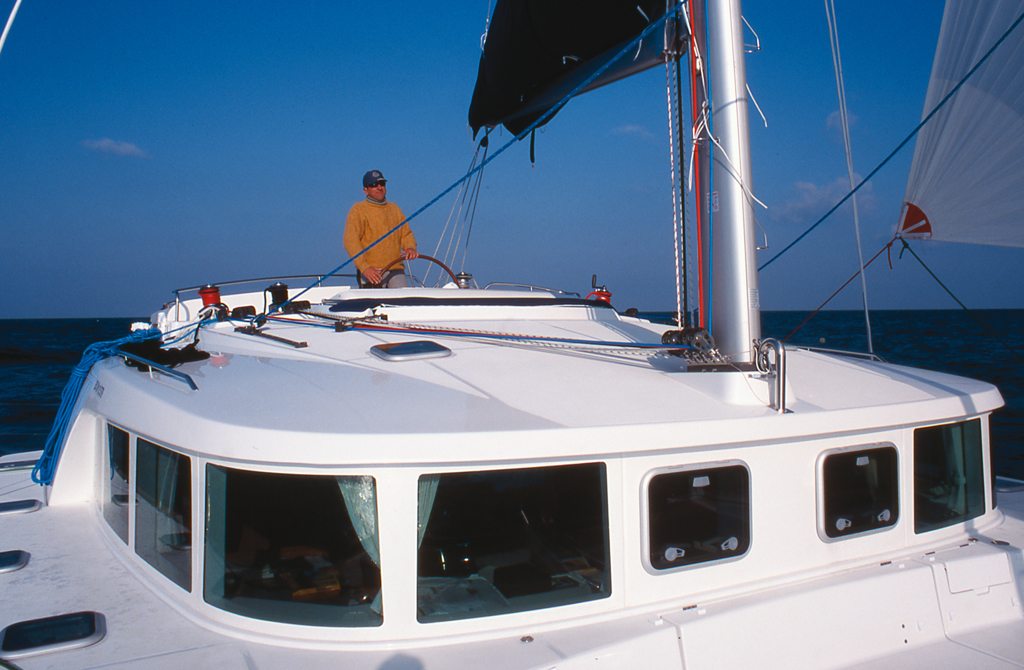
Alone on the fly-bridge, the helmsman is somewhat isolated, but the view is sublime…
Fine weather, calm sea.
The day’s weather forecast: fine weather with a calm sea, becoming rougher with the increasing wind. The famous ‘gull’s wing’ seemed to work, absorbing the shock of the waves on the underside of the bridgedeck, but we would see later if this worked in a rougher sea. With 13 knots of wind, we were at 6 knots. The imposing superstructure suggests that the boat could be predisposed to pitching. Unladen weight, given as 10.5 tonnes seemed a bit on the light side, especially as for this delivery trip we were well laden, carrying nearly a ton of water and a full diesel tank as well as a 10 kVa generator and all the other equipment. It was my turn in the galley (on the menu : chicken curry with rice), and I would have appreciated an extra porthole above the cooker. We were now in the Atlantic Ocean, there was very little swell, but the slight chop on the nose, leftover from the moderate gale in the Mer d’Iroise, made us dance about a bit. The breeze soon dropped and our speed fell off. As with all comfortable cruising catamarans, the 440 needs at least fifteen to twenty knots of breeze to come to life. Under these conditions, cruising speed is an effortless 8-9 knots, to exceed 10 knots needs more wind. We were (almost) all round the saloon table for the second meal ; certain stomachs seemed to have problems becoming accustomed to life at sea and there were only three of us. A broad reach under gennaker on this perfect sea was just like being in the trade winds, but without the warmth! As the sun set, the breeze freshened to 20 knots; at 130° to the true wind our speed was 9 knots and we could feel that the boat was heavy. I climbed up to the flying bridge and took the wheel. It was difficult to find a comfortable position either sitting or standing, but this was not a problem, as the boat was more often than not on autopilot. At around 10 knots, the helm feels quite dead. I had fun playing with the waves, but could not persuade the boat to surf ; it would have taken more wind and we were too heavy. Perched up on the flying bridge was certainly a superb position from which to admire the sunset. I had expected it to be very exposed, but on a reach it is less so than in the cockpit, which is actually quite windy. Translucent curtains can be erected round the cockpit, turning it into a protected exterior saloon. Night was not far away and our skipper, Jean-Pierre gave me the 1 – 3 am watch. In the 11 hours we had been at sea, we had already covered 75 miles – not bad, considering the fluky winds we had had up until now. We were on a broad reach with a force 4 – 5, carried along by the waves formed by the wind.
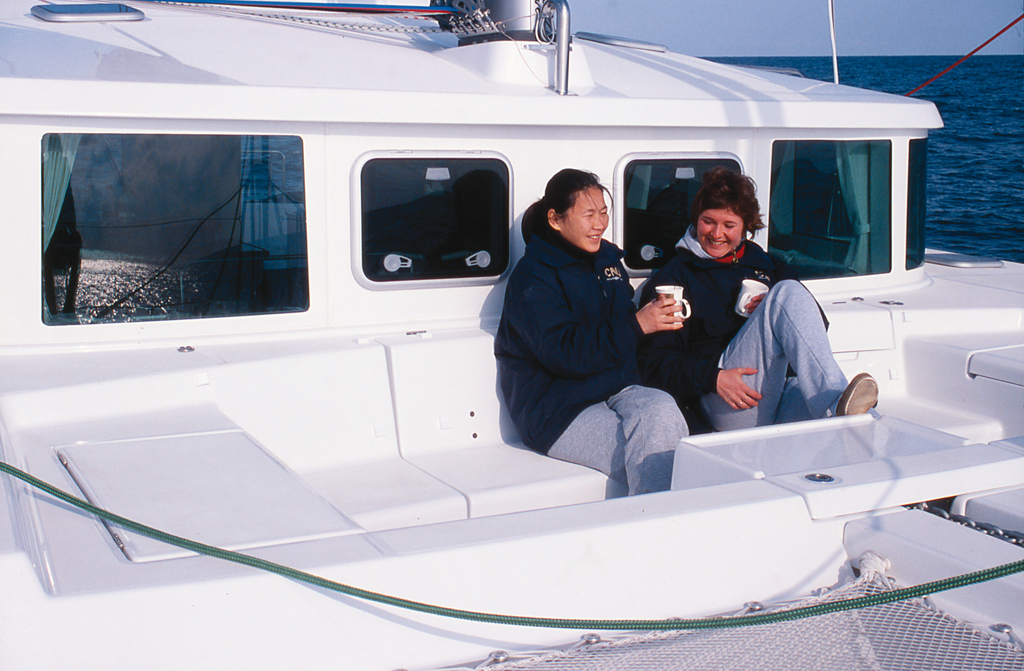
The small cockpit in front of the roof is pleasant at anchorage, and during sailing
Particularly voluminous interior.
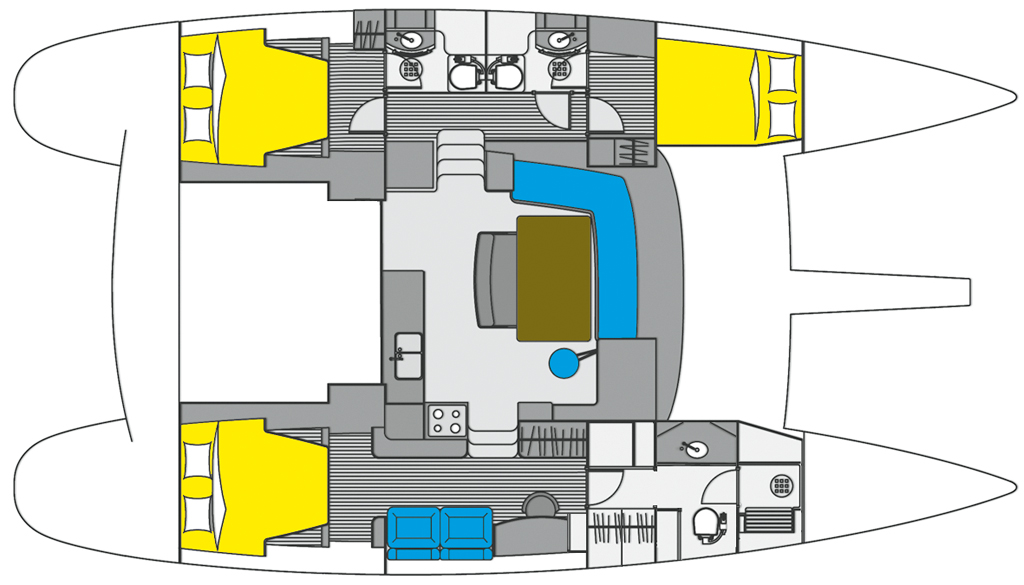
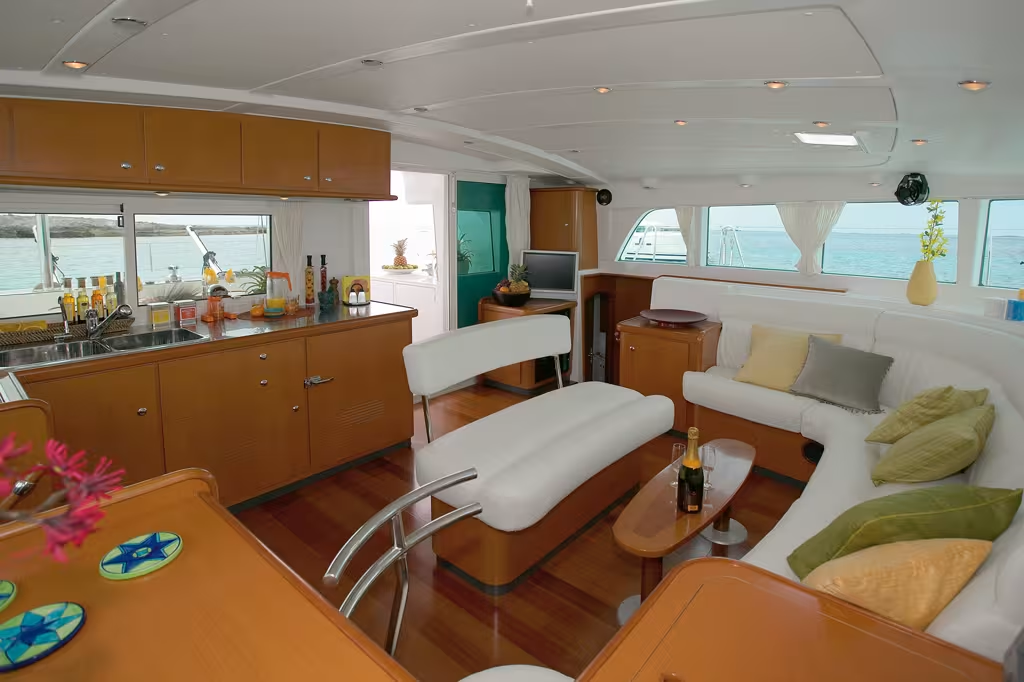
This was the private owner’s version of the Lagoon 440, so the whole of the starboard hull was given over to his accommodation. The large volume means that the double berths can be partly accessed from the sides. Ventilation is excellent throughout and of course there is (more than) adequate headroom. The ‘owner’s’ hull contains a vast settee and a small desk, which although practical, would be second choice to the saloon table or the chart table with their panoramic view. Further forward we find the heads with a separate shower. In the port hull, there are two cabins ; the aft one is similar to its twin in the owner’s hull and in the forward cabin, a mirror cleverly increases the impression of space. My cabin (port aft) was well finished with quality fittings. Visibility is superb through the perfectly integrated ‘picture window’ and I just had to turn my head to have an unobstructed view of the ocean. I fell asleep…for a moment, I thought that the wind had dropped and the skipper had started the engines. I was just starting to congratulate the builder on the quality of the sound insulation, when I realised that it was actually the generator which was running! After a few hours of fitful sleep, it was my turn on watch. The sea was rougher than earlier and the impacts of the waves hitting the underside of the bridgedeck, were deadened, but had not completely disappeared. The ‘gull’s wing’ definitely works, giving the waves less surface to impact on directly than if the underside of the bridgedeck was flat. The wind was variable, between 15 and 25 knots, and the boat’s speed between 6 and 8. Lightning lit up the distant horizon, whilst an unlikely fluorescent plankton coloured our twin wakes ; in the distance, a continuous quick flashing light indicated a fishing boat. I missed a discreet light, both at the chart table and above the galley, red for preference so as not to dazzle the watchkeeper. With the gennaker set, the blind spot to leeward is quite extensive, so I was obliged to go outside regularly to check the horizon.
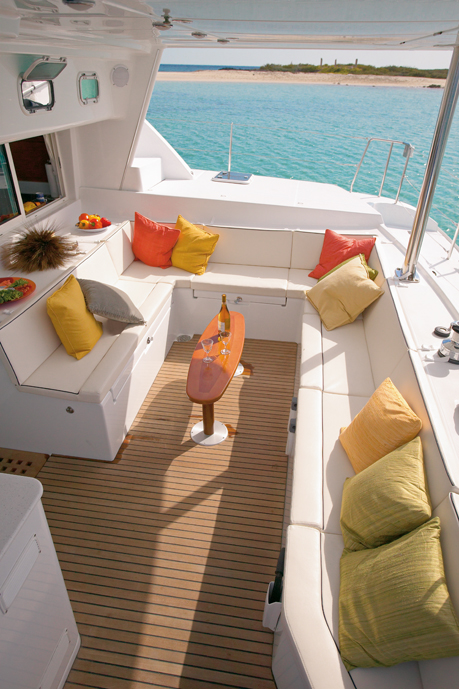
The cockpit cleared of its running rigging is a (fine) space dedicated exclusively to life onboard
Breakfast at 8 knots.
We had covered a hundred and seventy-seven miles since leaving La Rochelle, on a reach with a calm sea and in great comfort…We ate breakfast in the saloon, at 8 knots, with a sea view. Cap Ortégal was 140 miles away, the sun was trying to break through the clouds and the Lagoon picked up to 8 knots again, after slowing down in a lull. Late on Saturday afternoon the wind dropped again to less than 10 knots. As we were on a delivery trip, the gennaker was rolled up, the main sheeted in hard and the port engine started. The engines on this boat are bigger than standard, 2 x 75hp at 2000rpm, and just the one engine pushed us along at 7.5 knots. Sound insulation could be improved. I spent a second and final night on board, and when Jean-Pierre woke me for my watch, the lights of the Spanish coast were in sight. At two o’clock in the morning, the rest of the crew were asleep whilst I spent my watch sitting comfortably at the chart table with its joystick, in the interior wheelhouse. We arrived in La Corogne on the north-west tip of Spain in the early morning. Jean-Pierre told me later about the rest of the trip : "We had from 10 to 30 knots of wind and made Palma in 8 days from La Rochelle. We were often at 11 to 13 knots (in 25 – 30 knots of wind, under main and gennaker) with a record of 17.6 knots)".
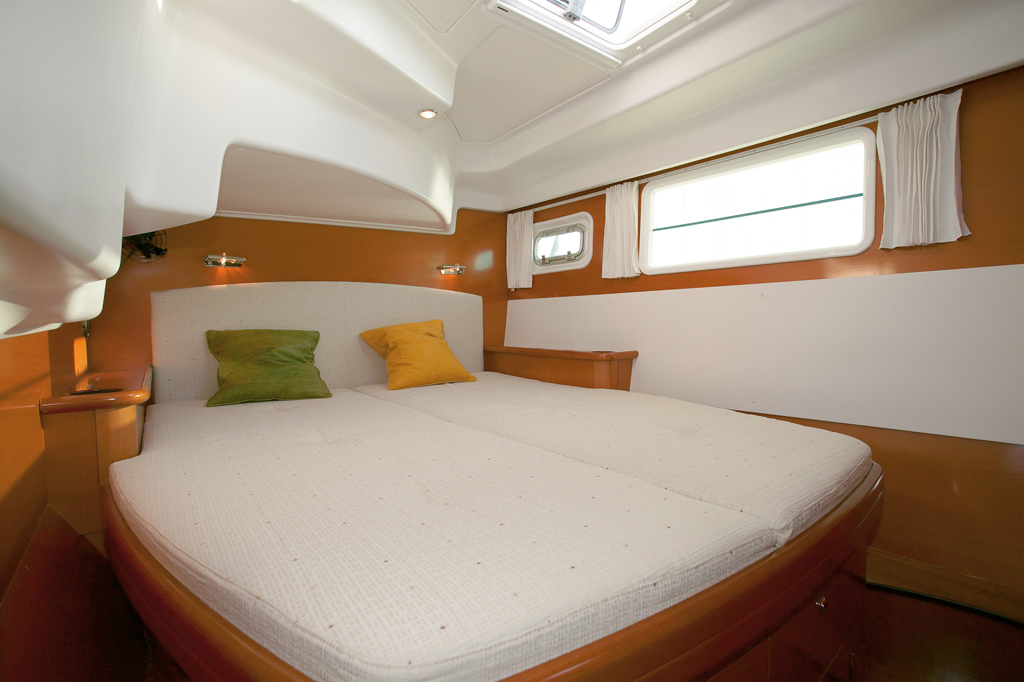
This boat doesn’t have cabins, it has rooms... And that’s something new on a 45-footer
La Corogne.
After spending 48 hours aboard and covering more than 300 miles across the Bay of Biscay, the Lagoon 440 seems to be a very pleasant boat to sail and, above all, to live aboard. It is comfortable (as the boat we tested was very well equipped, it was very comfortable) but relatively heavy. Even with the gennaker, it needs a good breeze, at least 12 knots, before it comes alive. An undeniable success.
I liked :
The exceptional view from the helm. The three exterior living spaces. The guardwires around the whole boat, especially forward.
I liked less :
The table in the cockpit ‘roof’. The height of the boom above the cabin roof. The fact that all controls are up on the flying bridge…
Specifications
Overall length : 13,63 m Waterline length : 12,75 m Overall beam : 7,70 m Draught : 1,30 m Unladen displacement (builder’s figures) : 10,50 tonnes Sail area (windward) : 114,9 m2 Fully battened mainsail : 71,3 m2 Roller reefing genoa : 43,6 m2 Gennaker : 106 m2 The basic version of the 440 costs: 300.000 euros (excl. of tax) The boat we sailed aboard, with options, cost : 444.653 euros (excl. of tax).