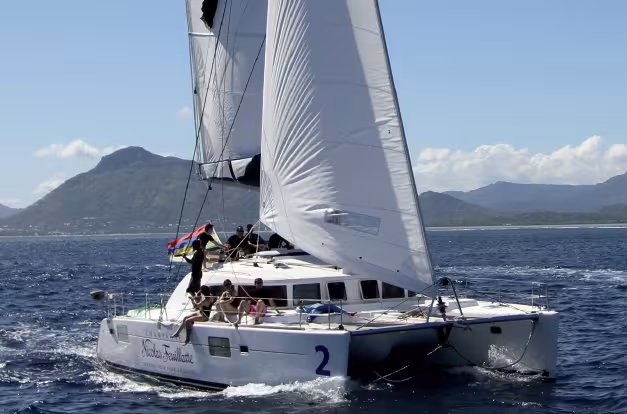
In 2004, it caused a big stir with its flybridge... For or against, the debate was heated. Nearly 10 years later, we have to admit that this 440 is a success, a clever compromise between volume, performance and pleasure when manoeuvring.
Infos pratiques
- Le chantier : Lagoon 440
- La fiche technique
- Découvrez notre vidéo exclusive
- Financez votre Lagoon 440
- Assuez votre Lagoon 440
- Articles autour du Lagoon 440
For this second-hand test, we took advantage of the exceptional conditions and above all, of an exceptional skipper... So, we went to island of Mauritius, for the Mauritius Regatta. This event’s ambition is to have crews confront each other aboard cruising catamarans – most participants sleep aboard, which explains this – under the leadership of the most well-known sailors. We therefore embarked Michel Desjoyeaux, no less, aboard our Lagoon 440. To be honest, I expected the 'Professeur’, as he is known in the ocean racing world, would grimace a bit, just a few days from crossing the start line of the first stage of his 12th Figaro. It’s true that Mich’ helming a 12-tonne 440 is a bit like Schumacher at the foot of the 17 bends of the Alpe d’Huez climb...at the wheel of a camper van! Contrary to expectations, our skipper made a good impression, and tried brilliantly to get the best out of our cat... A little history... Let’s go back to 2004. In February, the 440 was presented for its world premiere at the Miami Boat Show – a strong sign that Lagoon felt capable of convincing a very demanding clientele where comfort was concerned, with this model. A few months later, in France, comment was rife. The 440 in fact is one of those much-discussed multihulls, you only have to consult the specialised forums to convince yourself. The main subject brought up: the famous steering position perched on the coachroof... Directly inherited from motor boating, this configuration was rejected as a whole, or praised to the skies... But the innovations don’t stop there. Although the 440 fully respects the Lagoon charter, with its vertical portlights, its rigid bimini and its XXL volume, it has a gullwing bridgedeck, large hull portlights – almost invisible from the exterior – and a forward cockpit. And all that, 9 years ago, was really new!
In 2004, an innovative cat with a steering position on the flybridge
The famous flybridge? This is where Mich’ was to spend most of the week! From up there, there is a perfect view of the bows, the sail plan and...our competitors. Yes, we were racing against another 440, a Catana 471, a Nautitech 475... Access is very easy, thanks to two staircases. The helm sits prominently in the middle of the seating – you can stand or sit. And the control lines return to three winches, within reach, or almost. When cruising, just one crew member is enough. Not for us: a man – or a woman—on the mainsheet, another on the genoa. And thus the flybridge, designed to free up the cockpit 100%, becomes a remarkable position for getting the best out of the boat! Let’s say a bit more about the cockpit: Once the meal is over, the table (it can also be fitted in the saloon) and its supports disappear into a housing integrated into the rigid bimini... If your neighbours in the anchorage aren’t too close, turn up the sounds and party on a superb dance floor, with obligatory midnight bathing! Because the two sugar scoops are well-designed, with wide steps and a good non-slip surface. The side decks offer fluid movement around the boat, and lead to a forward cockpit – for our champion, this was stowage for the gennaker and the spinnaker – and of course to the double trampoline. A very successful deck plan, apart from the very high boom, which can cause a few problems. Cold water cruisers note: being perched up on the flybridge is not wet - unless it is raining - but it is windy, and much ‘livelier’ than in the cockpit in rough seas. With the leeward bow weighted to lighten the sterns and improve the efficiency of the anti-leeway surfaces, our cat almost succeeded in containing the Catana 471, which was equipped with deep daggerboards and skippered by...Fran ois Gabart. The 440 quickly exceeded 5 knots – from a force 2/3 upwards. In very light weather, the boat is slightly lazy... Wind, and more wind, this is what our 440 liked. From 15/20 knots upwards, it speeds up to over 9 knots. In these conditions - with the spinnaker - Michel recorded a top speed of 12 knots in a surf. The Lagoon delivery skippers have recorded top speeds of 18 to 20 knots. And all of them emphasise the boat’s excellent behaviour at sea: it has no tendency to bury a bow, the impacts under the bridgedeck are damped, and pitching is moderate.
You can't get more confortable
The vertical portlights, in addition to protecting you from the greenhouse effect when the sun is shining, give the coachroof maximum volume; it would be hard to do better on a 44-footer! This nice living area offers an L-shaped galley which adjoins the cockpit – plates can be passed directly – a large saloon and a forward-facing navigation area. Ventilation is taken care of by four opening hatches: more than enough to remain cool, even in the tropics! The cabins are of course down below. Unsurprisingly, the builder offered two options: the private owner’s version dedicated the whole of the starboard hull to the latter, with as a bonus a desk, a settee and XXL heads. To port, two more classic cabins, with shower and WC, share the available volume. The four-cabin version has an identical layout in each hull. Moving around the boat is easy, there are no obstacles, even when the sea is rough; the stowage possibilities are extensive and the loadcarrying capacity is well over two tonnes, giving a good margin for those who live aboard. So many characteristic which justify the keen interest in this model from candidates for a long voyage. “A great boat for cruising,” our skipper concluded... Just one reservation, for us: the famous flybridge is a blessing in the hot season in the Mediterranean or in warm waters, but a punishment in the Channel or in high latitudes...
The Pluses:
+ The flybridge offers an excellent view of the water and the sails.
+ The boat’s behaviour in rough seas is very good.
+ Very satisfactory performance, given the comfort and volume offered.
The Minuses:
- Gennaker essential to sail properly in light weather.
- Model not very suitable for cruising in cool or cold areas.
- Very high boom, in the case of a recalcitrant reef pendant.
The points to be checked
Honestly, not much! Of course, the models used intensively for charter will show signs of fatigue – malfunctioning water circuits, engines that have had hard use – however the overall structure and the rig remain foolproof. One minor point to be raised: certain elements of the fittings, which were however selected from the biggest manufacturers, seemed to us to be under-sized - for example the blocks on the mainsheet traveller.
Technical specifications
Builder: Lagoon
Architect: VPLP
Material: balsa/polyester sandwich
Hull length: 13.61 m
Waterline length: 12.75 m
Beam: 7.7 m Draft: 1.3 m
Unladen weight: 12.15 t
Mainsail area: 74 m
Genoa area: 42 m
Number of cabins: 3 or 4
Engines: 2 x 40 hp
Water: 600 l
Diesel: 750 l
Production: 423 examples from 2004 to 2009
Second-hand price: from 300,000 euros