The test of the Lagoon 400 allowed us to appreciate a comfortable, agile catamaran, more playful than its predecessors. The renewal of the range today concerns the 450 and 560, presented at the autumn Boat Shows, and seems to be inspired by the same values. I invite you to a discovery test aboard the 450.
Infos pratiques
- Le chantier : Lagoon 450F
- La fiche technique
- Découvrez notre vidéo exclusive
- Financez votre Lagoon 450
- Assuez votre Lagoon 450
- Articles autour du Lagoon 450
The inheritance of a breakaway model
In 2004, the concept defended by the 440 dared to stand out clearly from the dominant culture, and completely rid itself of the dogma in force. Off the beaten track, it opened up its own route, going out to meet a developing family clientele. Not really obsessed by aerodynamics, over-engined as an option, this iconoclast with the slightly clumsy looks, joyfully trampled the classic references underfoot, and sent the helm and manoeuvring ‘upstairs’! This breakaway positioned the guests, the wife, and the children at the centre of the preoccupations. Ulysses wavered! The heroic posture of the skipper, dripping wet in front of a curled up crew took a step in the direction of happy memories! 400 orders later, the adventure illustrates the relevance of the market study and the company’s strength. Not having been one of the first to be full of praise, left with the memory of unwanted windage, and laborious performance in moderate conditions, I was impatient to see how the VPLP-Lagoon-Nauta trio had reinterpreted this ambitious and difficult specification. Would the magic potion used for the 400 still be effective?
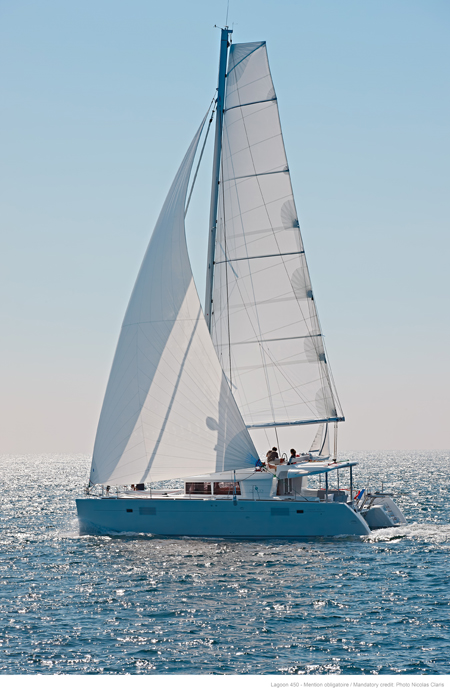
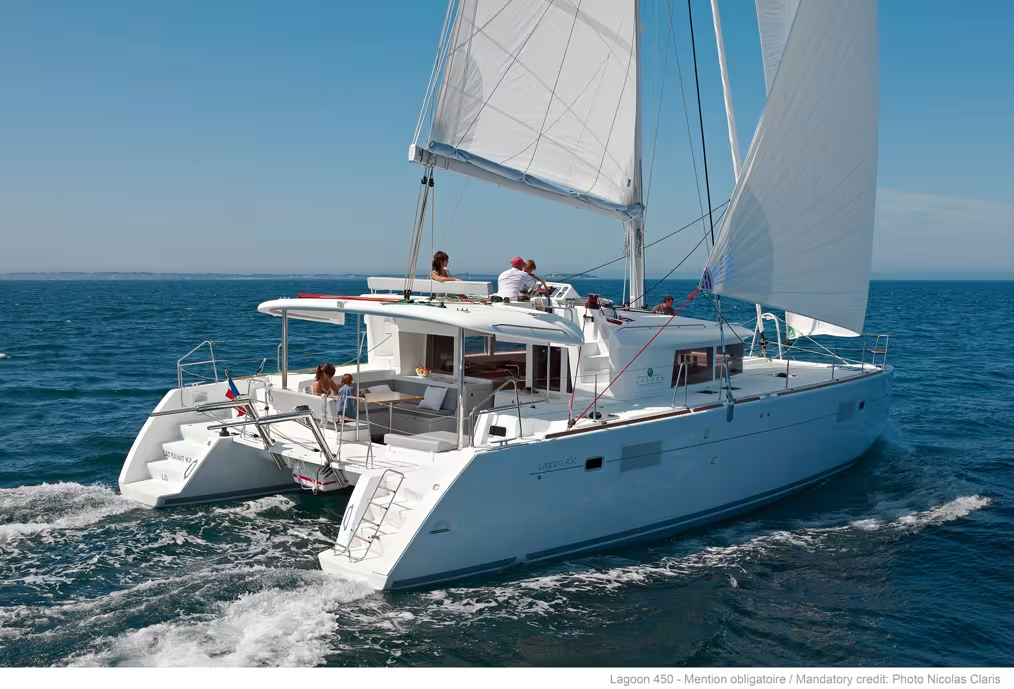
A bright, attractive catamaran, with an efficient sail plan for really pleasant sailing.
A more consensual silhouette
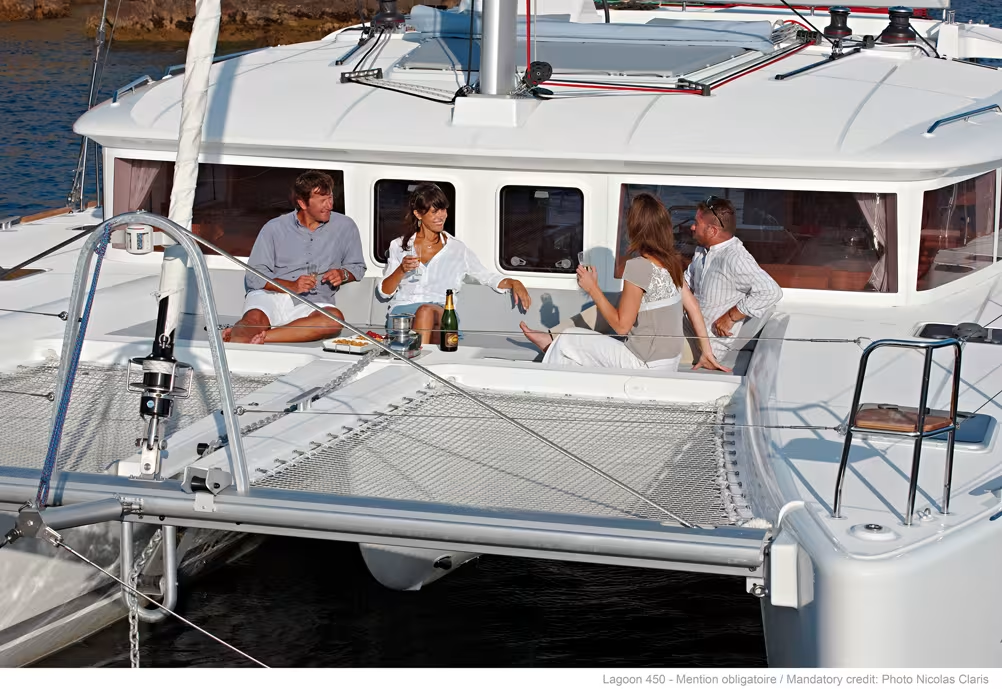
Our test 450 was waiting for us quietly in the port of La Rochelle, ready for a full day’s sail. The general lines really benefit from the effects of new in-house designs: the curve of the rigid bimini and the lip around the coachroof soften the lines of the superstructure. The extension of the hull’s sheer line associated with the cut out of the almost vertical sugar scoops generates a more stretched line. The deck area is identical to that of the 440, but the 450, 35cm longer, comes out of it better. This appreciation is reinforced by the cut out work of the Perspex and access to the coachroof, which hints at a welcoming, well-lit internal area.
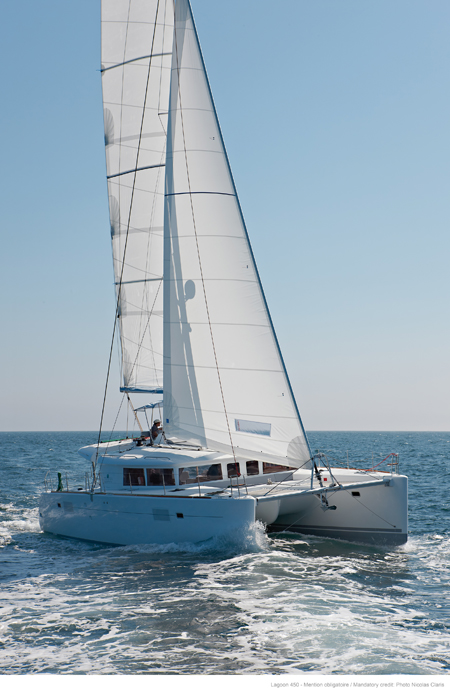
A high-performance suit of sails, a well-designed hull, and here is a cat which is both comfortable and seaworthy.
Accommodation: better style and quality
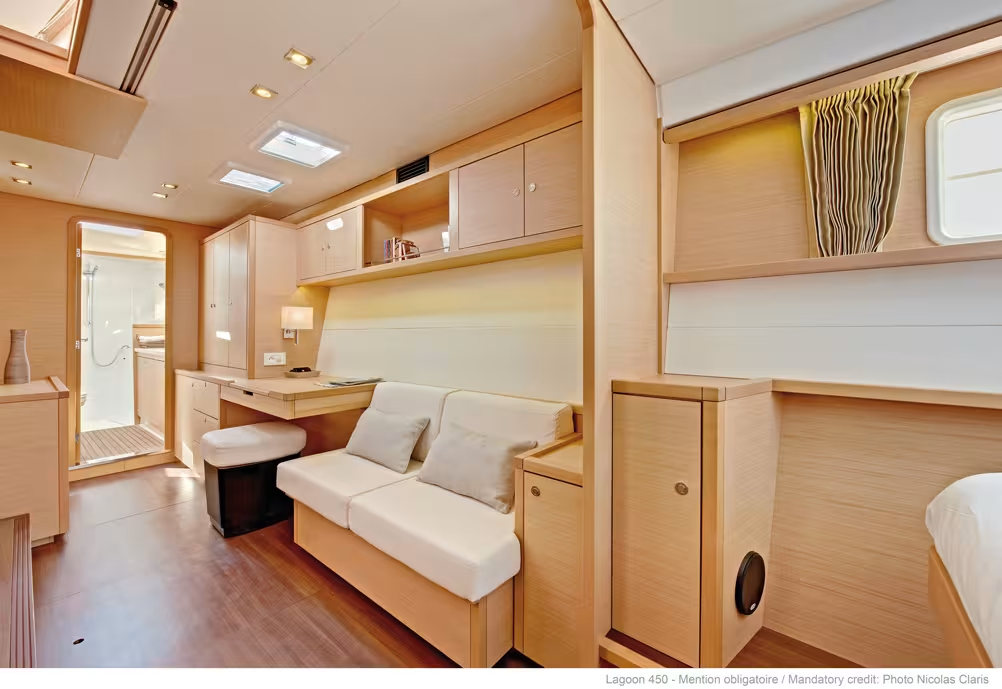
The collaboration with one of the reference interior design offices, Nauta Yacht, has borne fruit; the 450 offers clean volumes, and trendy but not annoying architecture. The furniture is rich with numerous imaginative solutions and practical stowage, and never saturates the space. The choice of Alpi (lamination of wood reconstituted from species selected according to environmental criteria) allows superb grain and finishing to be obtained. The flattering appearance of the panels, the presence of decorative filets and the harmony of the shades used create an appealing atmosphere, which visitors to the recent Boat Shows noticed. The irreproachable assemblies and a real sense of detail (damped automatic cupboard and door closures) participate in a renewed perception of the company’s interiors. The absence of added visible interior mouldings, the quality of the floors, the presence of carpet in the gangways, the choice and taste of the decorative elements seem to have put ‘made to measure’ within reach of production boats. The solidity of the moving parts (drawers, table leaves and doors) is reassuring. After having spent 36 hours aboard, I can also testify to the real comfort of all the services: insulation, light (natural and electric), the ergonomics of the bathrooms and toilets and the beds will find favour. Nauta’s imagination and artistic expertise, Lagoon’s reinforced requirements and the talent of the craftsmen has allowed the 450 to take a decisive step. Grab hold of a handle, close a cabin door, and you will immediately understand the results of this development!
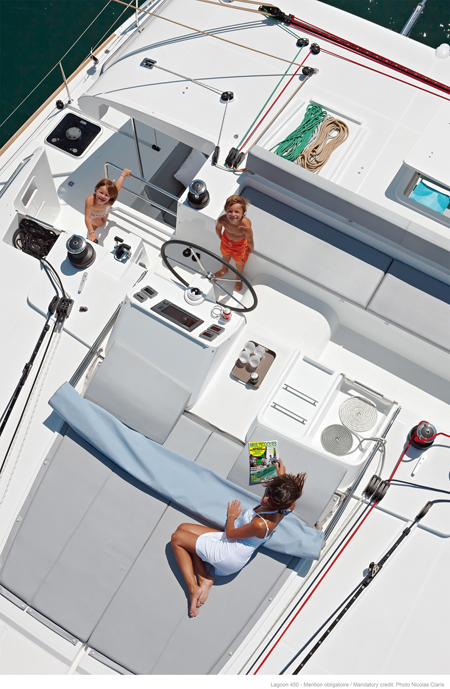
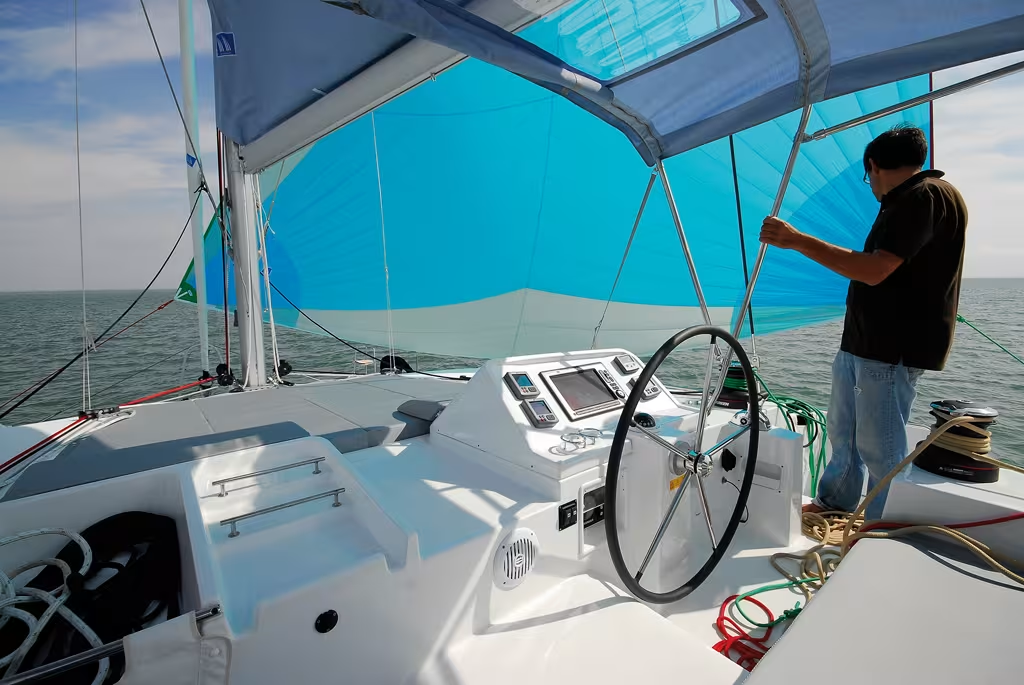
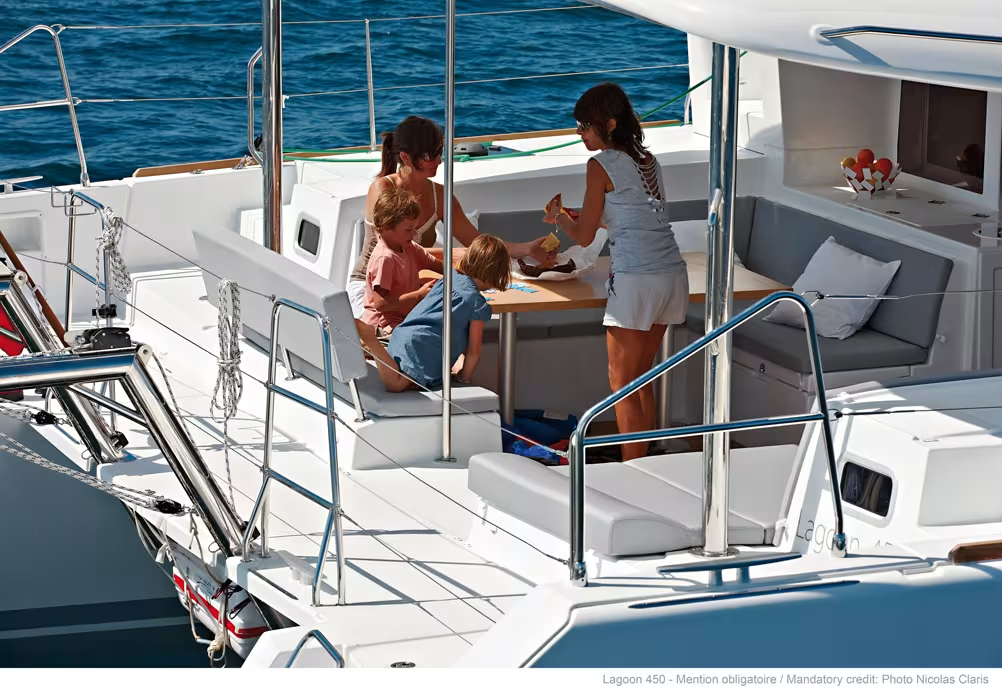
A flybridge packed with clever features, and pleasant for everyone to live with; the concept has reached maturity.
Performance and manoeuvrability: a generational leap
Access to the circuit breakers (general and engine) is easy and protected (in a housing with a hinged cover at the foot of the berth in the aft cabin), the electricity switch panel is intuitive and simple to use, the realisation is serious, but a protective cover for the electronic charts would be advisable. Our test boat was equipped with dual electric engine controls at the flybridge/chart table, potentially attractive for certain winter sailing conditions, but its price is dissuasive (11,000 euros). 7.3 knots at 2,500 rpm, 8.8 at 3,200; both cruising speed and top speed are satisfactory with the 2 x 54hp Yanmars and the folding three-bladed propellers (Flexofold 17/14). There were 6 of us aboard, grouped around the manoeuvring area, each of us immediately got our bearings; the mainsail was hoisted by hand at the mast foot by one of the two reader-racers invited to join us. This manoeuvre allowed us to check that the Harken cars, the 2:1 halyard, the jammers, the positioning of the winch and the work carried out on friction were perfect, only the access to the lazy jacks and the headboard remain athletic. The power and winching speed of the Harken electric winches we had were remarkable, their conviviality is the essential complement to the pleasure of using this type of flybridge deck plan. Bearing away to fill the main, the 450 got under way gently at 4.5 knots under main alone in 7 – 8 knots of true wind! This simple test (ease, speed of hoisting, understanding of the control lines, manoeuvrability under mainsail) is essential; the 450 scores a point. Unrolling the genoa, we applied ourselves to finding the right adjustments for these superb Incidences sails. The cut and the construction deserve praise; the realisation of the volumes and their harmony are superb. Of course Dacron will perhaps not be exceptionally long-lasting, but careful use will preserve their qualities. These profiles correspond perfectly to the spirit of a heavy cruising catamaran; the slender sailplan gives it the necessary power to remain dynamic and swift in less than 10 knots of breeze. To windward ‘a la catamaran’, with 110° between tacks, we preferred to trim for ‘volume’, with the extrados pennants on the genoa about to flutter and the mainsail twisted for power. The 450 rewarded us with pleasant, lively behaviour in the light to moderate conditions; it jogged along with a spring in its step at 6.5 knots in 8 – 10 knots of true wind. Beyond the speed itself, the pace was sustained, regular and allowed us to eat in the cockpit with an appreciable impression of the nautical scenery passing before our eyes. Bearing off in the Charente estuary, we entered the river with the flood; on the trampolines, the lads were enjoying manoeuvring and hoisted, easily, a superb sky-blue asymmetric spinnaker. The 200m² of sail got the advantage back downwind and we were sailing at 7 knots (9 knots of wind), and luffing. With the 2.5 knots of favourable current, we quickly crossed the plateau north of Fort Boyard (soundings of less than 1m at low tide!) then gybed in the middle of the current to play at rock-hopping under sail off the beaches of the Ile d’Aix. Our racers got well into it, and played with the boat, positively amazed by its behaviour in such conditions. In four tacks, we escaped from the tricky area, close to the poles, and left behind a 12m monohull which was trying to keep up. To keep the speed, it is advisable to come out of the tacks well off the wind and be sure the keels are doing their job before luffing. Remaining on the best course/speed compromise is then a question of attention and reactivity at the helm, whose feel and directional effect deserve praise (the steel cables are so much more sensitive than the awful hydraulic transmissions!). The attitude of these experienced sailors illustrates the distance travelled, the 450 is coming to meet more demanding sailors and is allowing them to appreciate a kind of boat which has already won over their families: the new 450 is doing brilliantly!
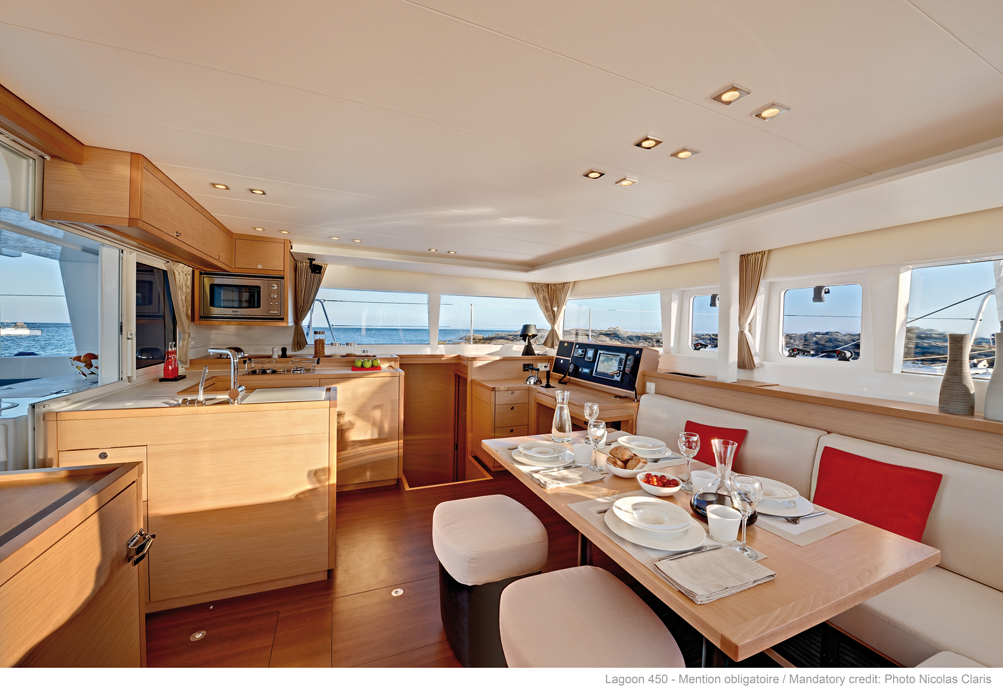
The internal atmosphere reinterpreted by Lagoon-Nauta allows the 450 to express its ambitions and reveal the real care taken with quality...
Conclusion
The 450 outstrips its predecessor in all respects and joins its younger sister (the 400) in terms of general pleasure. Well-finished, comfortable and suited to its programme, it will appeal to family crews. The nautical qualities are good, the boat is coherent, manoeuvrable, thanks to a generous sail plan, served by a choice of modern high-performance sails and an efficient deck plan. The 450 has a fun temperament in moderate conditions; there is no doubt it will behave well in strong winds.
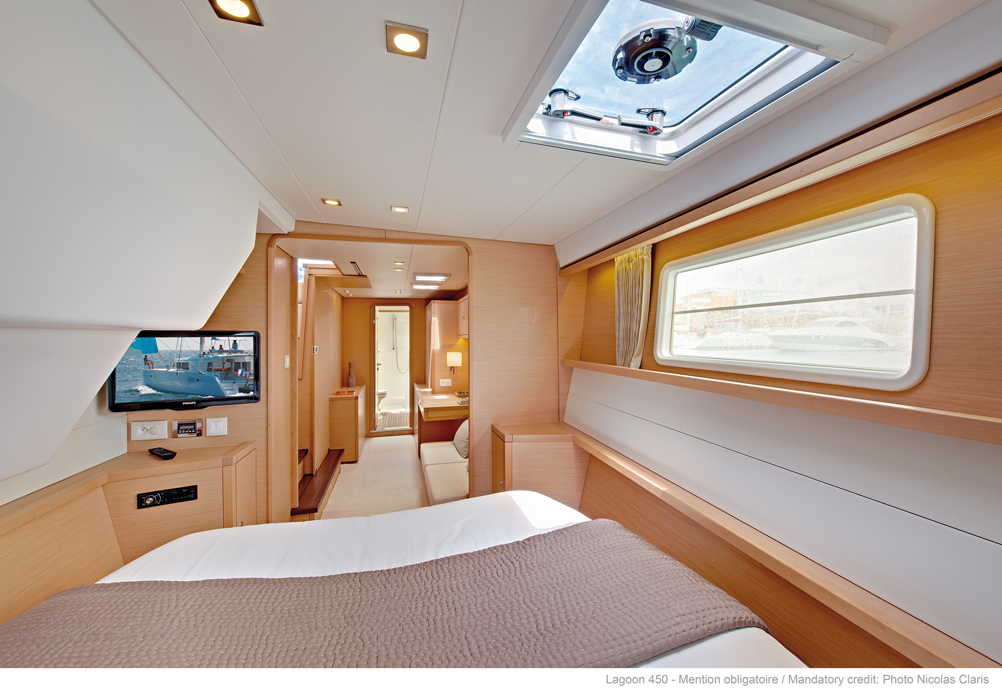
View from the bed in the owner’s cabin: brilliant!
The plusses
- pleasant to live with and sail - successful general ergonomics (deck plan, interior) - quality product
The minuses
- the flybridge in 30 knots of wind? - a few assembly imperfections in the less accessible areas - obligation to resort to numerous options
THE COMPETITORS
Model Builder Windward sail area in m² Weight in t Price in € exc. VAT Orana 44' Fountaine Pajot 109 8 322,000 Nautitech 441 Nautitech 95 9 372,000 Dean 441 Dean 123 13 375,000 Privilège 445 Alliaura 114 10 488,000
TECHNICAL SPECIFICATIONS
Architects: Van Peteghem/Lauriot-Prevost Builder: Lagoon Accommodation design: Nauta Length: 13.96m Beam: 7.84m Draft: 1.3m Keels/daggerboards: keels Equipped weight: 15.5t Bridgedeck height: 50 to 67cm Mainsail area: 85m² (option: square-headed mainsail) Genoa: 52m² Gennaker: 105m² Engines: 2 x 40 or 55hp sail-drive Water: 350L (option: 700L) Fuel: 2 x 500L Price: Charter: 360,000 euros exc. VAT. Owner: 355,000 euros exc. VAT A few essential options, exc. VAT: Square-headed mainsail: 438 euros Carpet in saloon and cabins: 1,150 euros Bowsprit, gennaker, spinnaker rigging: 7,000 euros Cockpit cushions: 2,525 euros Electric mainsail and genoa winches: 8,800 euros Equipment levels: - essential: 19,700 euros - cruising : 24,400 euros - comfort : 26,550 euros