In 2010, the Lagoon 450 picked up on the general concept of the 440 with its raised cockpit. The model was an immediately and impressive success, so much so that it even resisted (in the SportTop version) for a few years with the Lagoon 46.
Infos pratiques
- Le chantier : Lagoon 450F
- La fiche technique
-
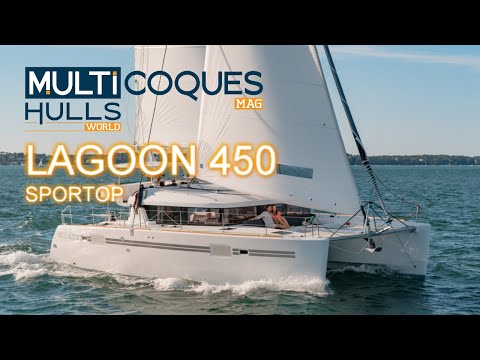 Découvrez notre vidéo exclusive
- Financez votre Lagoon 450
- Assuez votre Lagoon 450
- Articles autour du Lagoon 450
The Lagoon 450 became the most successful catamaran in the history of sailing on more than one hull. The original version with the flybridge and helm/maneuvering station “upstairs” was complemented by the SporTop evolution featuring a raised helm station. The Lagoon 450 was the last model in the range to have the mast forward of the nacelle and have an overlapping genoa... or rather the first model of the next generation, since the manufacturer, starting with the 51, returned to this configuration! In short, with a record production of nearly 1,000 units and a sail plan finally (re)validated 12 years later, it could be tempting to describe the 450 as Lagoon’s most noteworthy catamaran ever...
We can always argue about the merits of going to sea with a plasma screen, an internet connection, a washing machine and a dishwasher – basically, taking all the conveniences of home with you on the water. But that translates into a lot of extra weight, as well as significant daily energy expenditure, necessitating specific equipment to produce more electricity.
But the facts are there: the Lagoon shipyard, by then a specialist in comfortable catamarans for more than 20 years, sold 430 Lagoon 440s in 6 years, twice as many as its closest competitors. And that was already 15 years ago! Today, the demand for comfort is even greater. On the second-hand market, the Lagoon 450 perfectly meets the expectations: panoramic nacelle, raised helm station with maneuvering control, clear cockpits, galley and huge cabins... It was up to the naval architects to make sure that the catamaran moved forward correctly!
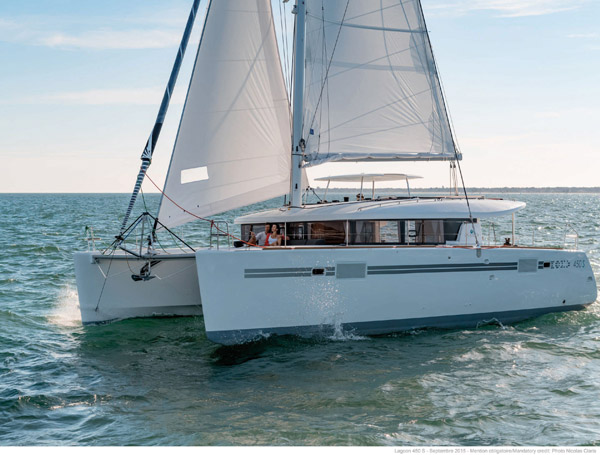
The SporTop version, launched in 2015, abandoned the flybridge for a mid-height helm station.
Overlapping genoa
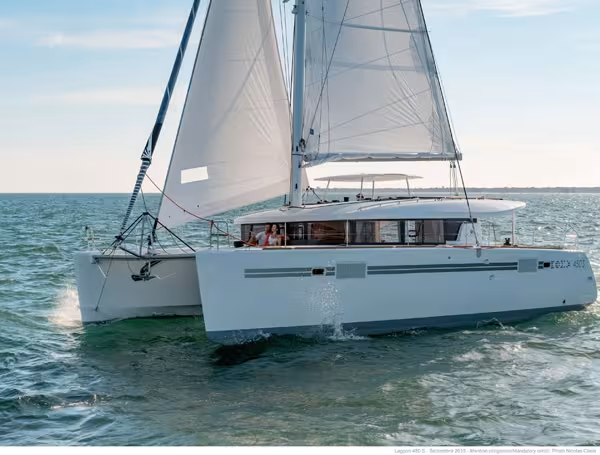
Marc Van Peteghem and Vincent Lauriot Prevost had to deal with the demands of interior comfort: this meant making the hulls relatively beamy at the waterline (which is detrimental to speed obviously) but rounded to reduce the wetted surface as much as possible. The nacelle, up high, was only to slam in big seas from ahead. To propel the 15 tons this catamaran displaces when empty, the designers didn’t hesitate to generously canvas the 450 with 1,445 sq ft (134.30 m²) of upwind sail area, compared to 1,236 sq ft (114.90 m²) for the Lagoon 440. But that was enough to compensate for those three extra tons! With its overlapping genoa and its relatively short, fixed skegs keels, the Lagoon 450 shows very good performance - though not exciting sensations. Downwind in a good breeze, the 450 will even average 9 to 10 knots. As standard, Lagoon fitted 40 HP Yanmar engines, which were sometimes insufficient. The twin 54 HP engine option is preferable. The two 132- US gal (500-liter) tanks ensure a very good range - 1,000 nautical miles, or even almost double that when running on a single engine. An obvious advantage when sailing far offshore... and the guarantee of producing that energy.
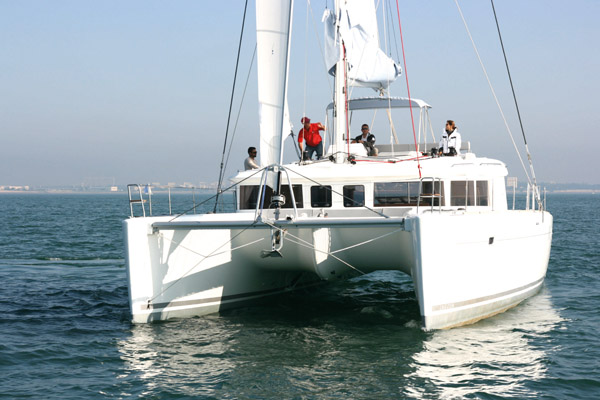
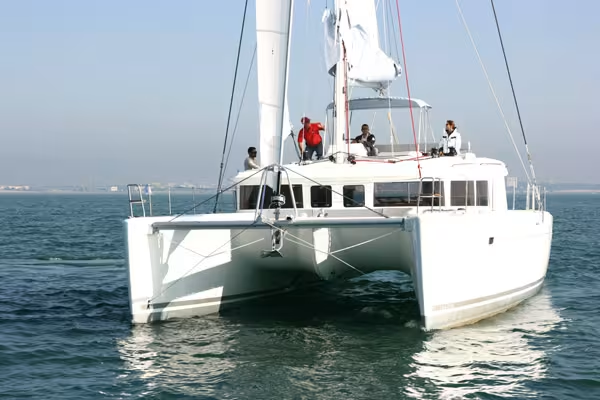
The original Lagoon 450 with its forward-stepped rig and flybridge foreshadowed... the new 51!
Flybridge or SporTop?
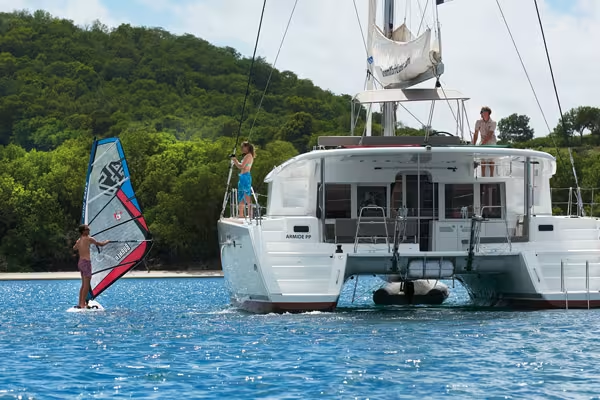
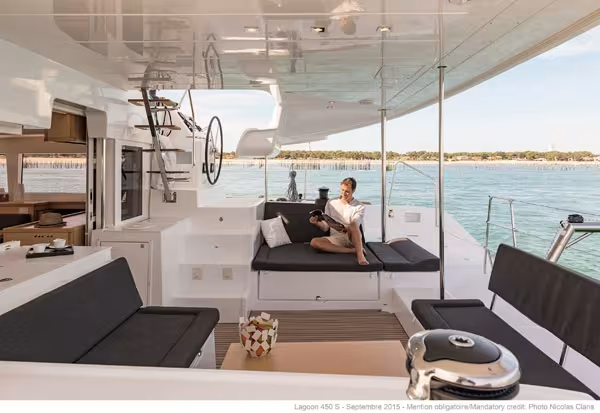
Perched on the upper deck of the original version, the helmsman enjoys an excellent view over the bows. And you can keep the captain company, since the bench seat is 9½ feet (2.9 m) long and there is a large sunbathing area under the boom. On the other hand, when docking, you could really do with one or more crew available to manage mooring lines and fenders, given the distance between the hulls. In 2015, the SporTop version offered a helm and sail maneuvering station at mid-height. This 450S was lighter than the F version and its more traditional layout allowed the helmsman to communicate directly with the crew in the large U-shaped cockpit, which is big enough to accommodate 10 adults. To reduce noise and vibration, the generator was moved forward. A 1,700 W vertical axis windlass deals with anchoring maneuvers. The anchor itself is housed under the forward beam. As for tying up in port, you can count on eight well-positioned cleats. The sugarscoops are equipped with steps and a small bathing platform, flush with the water. Ideal for boarding the tender. The technical aspects are well taken care of, with a technical room, two large lockers, space for an extra refrigerator, trash can, etc.
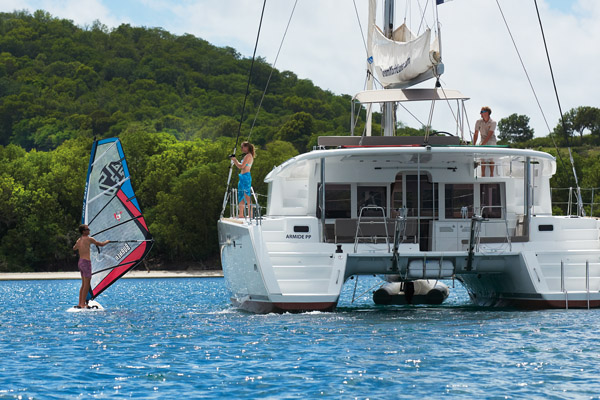
The hulls are relatively beamy, but the nacelle enjoys good bridgedeck clearance.
Plenty of volume
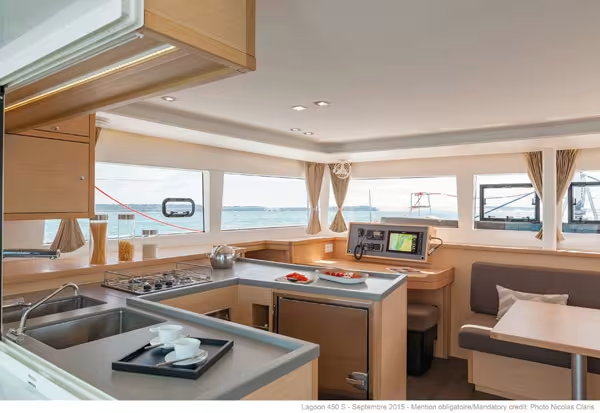
The vertical windows have numerous openings for maximum ventilation. Headroom of 6’8” (2.05 m) contributes to the feeling of comfort. Around the large table – 55” by 32” (1.41 x 0.81 m) - you can enjoy dinner with 5 or 6 people. Additional guests can be seated on stools. Note that the table in the saloon is interchangeable with the one in the cockpit. The galley is no longer L-shaped as on the 440, but U-shaped on the port side, meaning that cook doesn’t clash with the crew moving around in the nacelle.
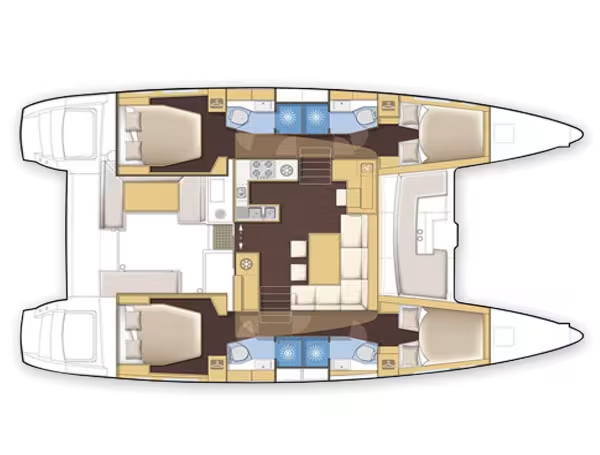
The bay window opens and acts as a serving hatch to the cockpit. There’s a three-burner stove, large refrigerator, double sink, plenty of storage space, and the whole setup is designed for the long-term liveaboard lifestyle. And at a time when the nav station was disappearing from many boats, the 450 maintained a vast L-shaped work surface measuring 58” by 22” (1.49 x 0.56 m). As a bonus, it is perfectly positioned, with a view over the bows, facing forward. Five steps down the companionways, and the hulls offer three or four cabins. Aft, there is a large berth of 6’6” x 5’3” (2 x 1.60 m), four windows, three of which are opening hatches, and numerous storage spaces. The starboard hull on the owner’s version does away with the forecabin in favor of a large desk and a proper bathroom up front.
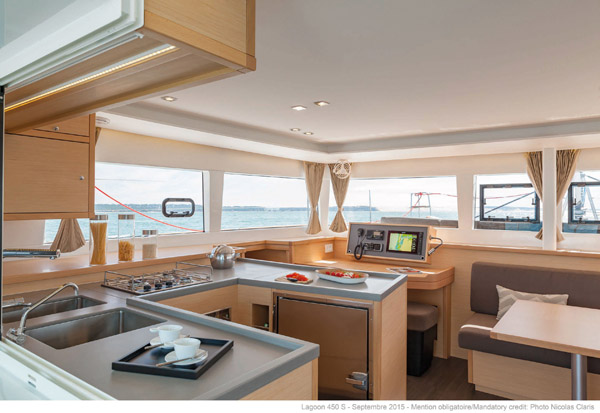
The layout features a U-shaped galley and a proper nav station.
Conclusion
Le Lagoon 450 est une sage – mais très réussie – évolution du 440. Il s’agit d’un catamaran de croisière taillé pour aller loin en famille. Sans se priver du confort terrestre : à bord, vous ne manquerez de rien ! Forte capacité de charge, confort exceptionnel en mer comme ou mouillage : pour ceux qui rêvent de passer un an sabbatique ou plus sur l’eau, ce sera le multicoque idéal. Dernier avantage ? Vous en trouverez partout ! Avec 746 exemplaires en version Fly construits et 200 déclinaisons S à l’eau, ce modèle est en effet particulièrement disponible sur tous les plans d’eau en occasion. A l’instant t, en considérant qu’un catamaran est à vendre tous les 7 ans et que cette disponibilité sur le marché est d’environ 4 mois, près de 45 exemplaires sont proposés à la vente.
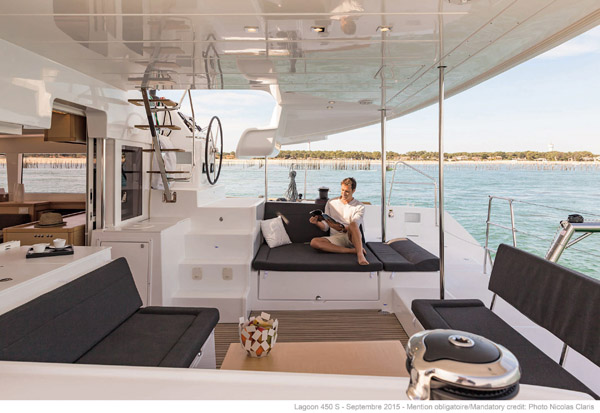
The cockpit, protected by an imposing rigid bimini, can be transformed, at anchor, into a deck saloon thanks to the removable enclosure. Another cockpit is located forward of the coachroof.
POINTS TO CHECK
The manufacturer chose a balsa polyester sandwich for the hull topsides, while beneath the waterline and under the nacelle is very strong monolithic construction. The same goes for the counter-moldings. The bulkheads, in plywood, are laminated or glued. While the overall boat is sturdy, there have been some examples of issues with the mast bulkhead. Being inadequately sampled in the event of heavy weather sailing, there is a risk of this bulkhead having sagged or even broken: Lagoon has taken responsibility for this (and continues to take responsibility) and is taking charge of providing bulkhead checks and any subsequently required reinforcements or repairs via their worldwide network of agents. The simplicity and the very moderate draft of the skeg keels limits the risk of damage due to grounding. In general, the Lagoon 450 is robust - and still very new. Ultimately, it is the more fragile peripherals such as the sails, plumbing, engines, electrical system or electronics that warrant more careful inspection. This model, in both F and S versions, remains an excellent base for a blue water project.
THE PLUSES:
+ Robust construction
+ Two versions available,
+ Fly or SporTop Significant carrying capacity
THE MINUSES:
- A somewhat heavy silhouette
- Lack of punch in light airs
- The 40 HP motors are insufficient
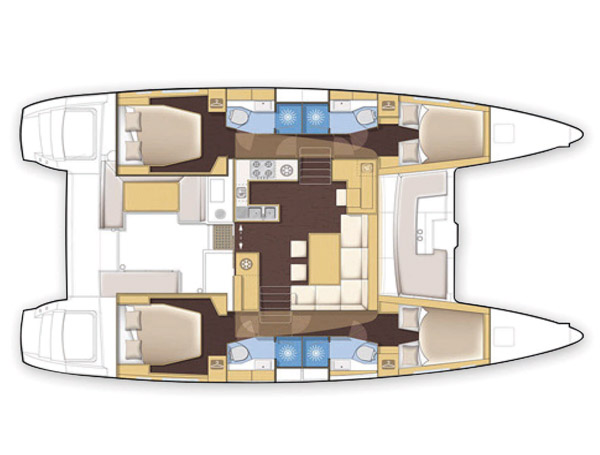
A 3 or 4-cabin option is available.
TECHNICAL SPECIFICATIONS
Builder: Lagoon
Architects: VPLP
Length overall: 45’10” (13.96 m)
Waterline length: 43’11” (13.38 m)
Beam: 25’9” (7.84 m)
Draft: 4’4” (1.31 m)
Displacement: 34,170 lbs (15.5 t)
Sail area: 1,445 sq ft (134.3 m²)
Mainsail: 888 sq ft (82.5 m²)
Genoa: 557 sq ft (51.8 m²)
Gennaker/spi: 1,130/2,045 sq ft (105/190 m²)
Engines: 2 x 40 or 54 HP
Fuel: 264 US gal (1,000 l)
Water: 92/185 US gal (350/700 l)
Material: polyester sandwich
Production: 950 units from 2010 to 2021
Second-hand price: from € 280,000 ex-tax