
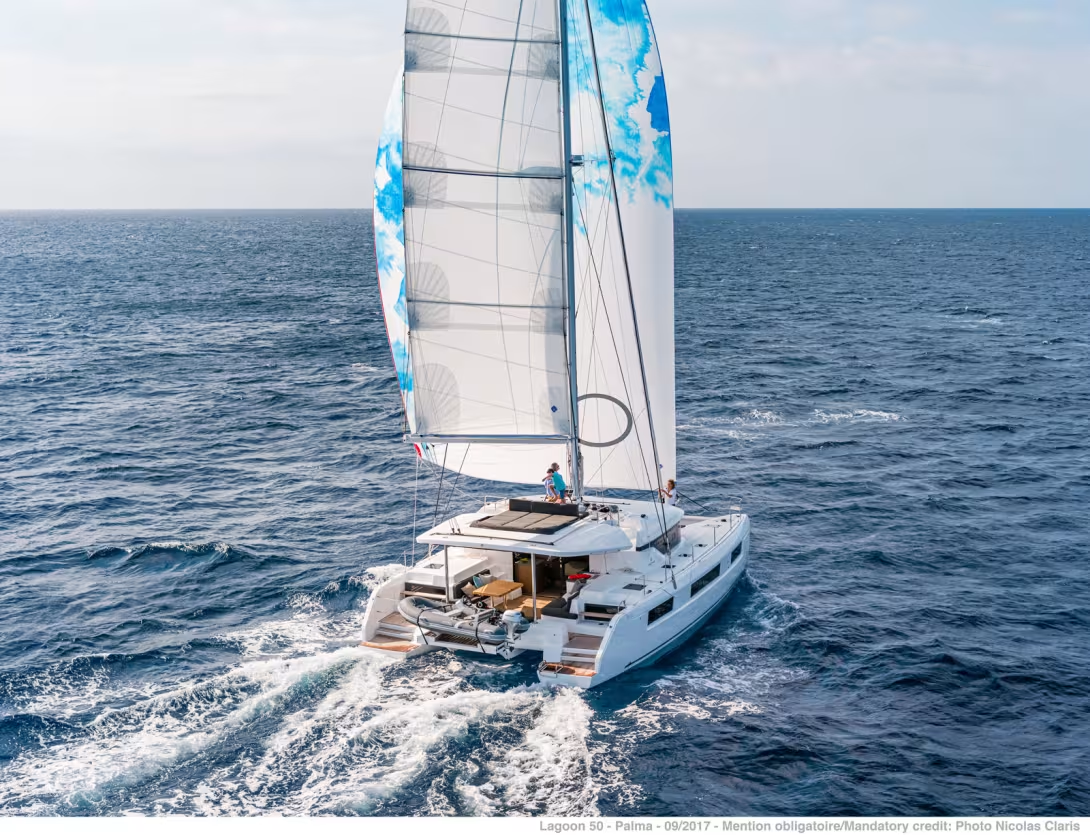
Lagoon 50 - Unveiled in 2017, the Lagoon 50, along with the 40, 42 and 46 represent the latest generation models designed by the world leader in cruising catamarans. When she was first launched, she fitted into the range between the best-selling Lagoon 450 and the 52. Her ambition was to remain accessible to a family crew and offer maximum comfort.
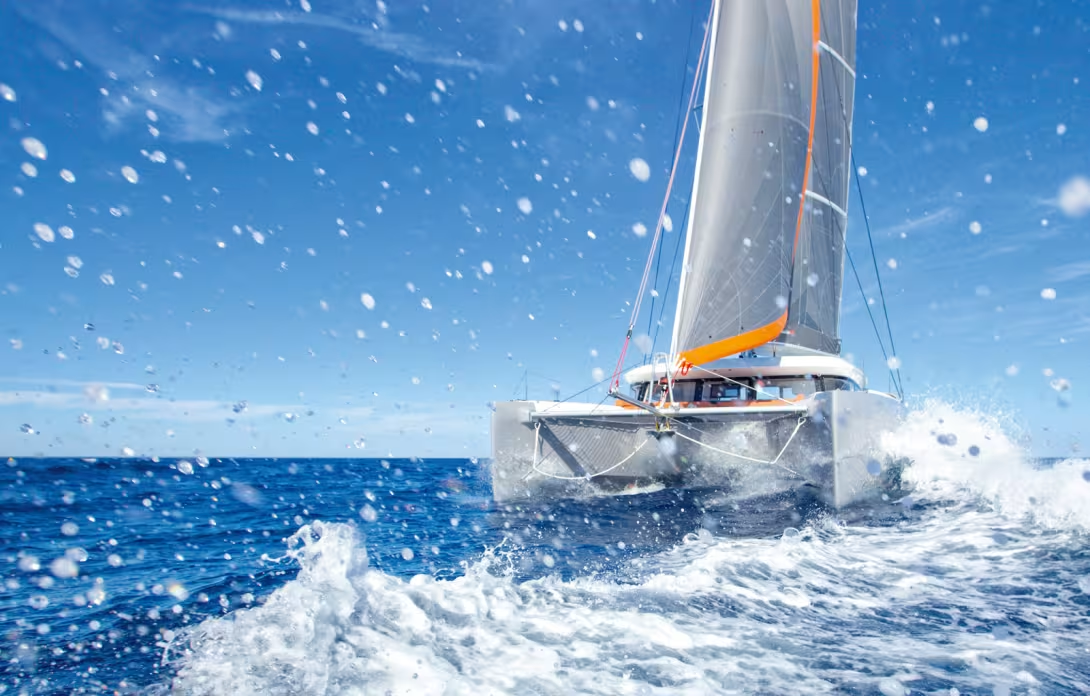
Excess 15 - The Excess range, launched by the Bénéteau Group just over a year ago, stands out from the Lagoon range by its improved performance and attention to the pleasure of sailing. The Excess 15 shares the same chassis as the Lagoon 50, and this allows us to make relevant comparisons between the two models.
Infos pratiques
- Le chantier : Excess 15
- La fiche technique
- Découvrez notre vidéo exclusive
- Financez votre Lagoon 50 vs Excess 15
- Assuez votre Lagoon 50 vs Excess 15
- Articles autour du Lagoon 50 vs Excess 15
LAGOON 50
50 feet - or almost - and nearly 8 tons of payload: the characteristics of the Lagoon 50 make it an ideal craft for blue water cruising with all the comforts. But is such a unit of more than 20 tons lightship weight still manageable by a family? This is indeed the objective set by the builder. While larger models are most often entrusted, in practice, to a professional skipper, the Lagoon 50 is well designed to be manageable for a family crew.
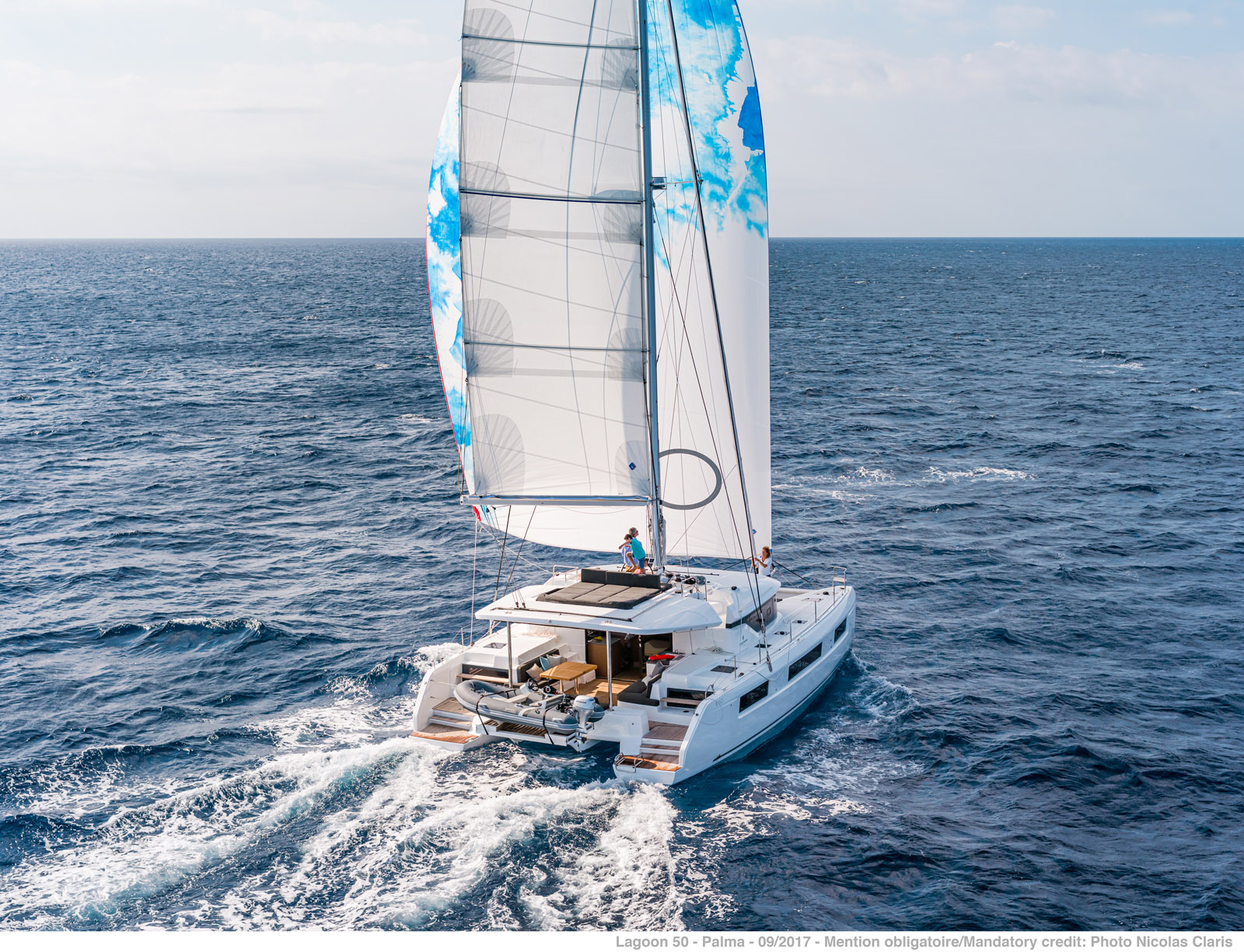
Test location: El Arenal, Majorca - Spain
Conditions: Southeast 5 to 10 knots, Sea state: slight
LATEST GENERATION LAGOON
Malgré un franc-bord et des surfaces Despite having significant freeboard and glazed surfaces, the overall style of the boat remains fluid. Longitudinal ribs, hull portlights integrated into reveals, chines, colored stripes between the coachroof windows and the bimini, the height of the plunging bows... so many small details that refine a voluminous catamaran. This design research is a direct result of the work carried out on the Lagoon 42, and it was applied with the same success on the 40 and the 50, a year later, then on the 46. If the Lagoon 39 and the 52 began the trend of the aft-set mast, back in 2013, it was the 42 that inaugurated the latest generation – which is characterized by new design codes, but also by an even more refined cockpit. You can see that the floor of the cockpit, which is of course flush-decked with the saloon, continues towards the after end of the hulls, almost all the way to the sugarscoops. Once again, the builders are validating their concept of a very slender, aftset rig - the mast is stepped on the coachroof, not forward of it. The idea is to optimize weight centering - and thus reduce pitching - while giving the self-tacking jib a respectable amount of sail area. Finally, the yard has opted for a helm station on the flybridge.
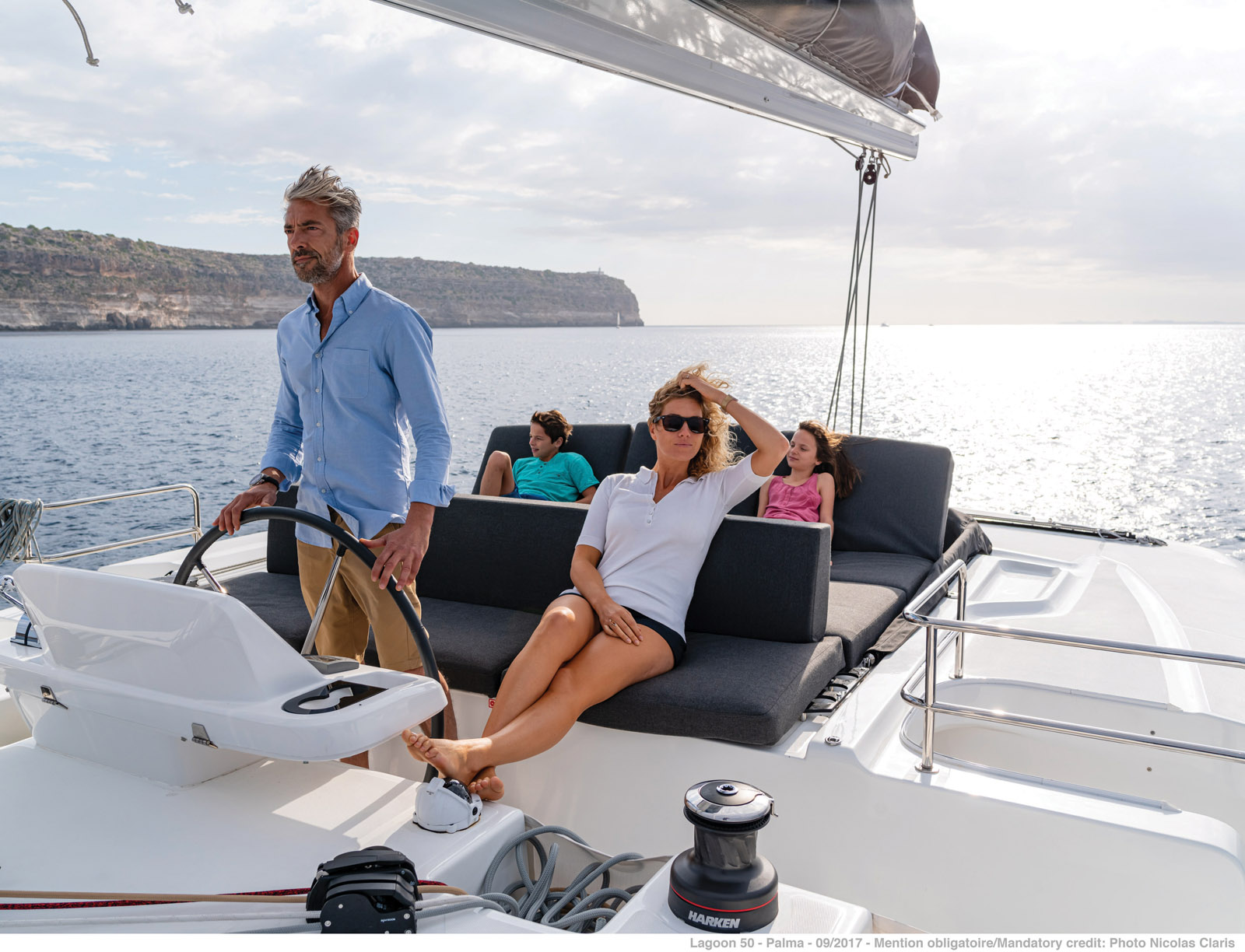
SUITED TO A SHORT-HANDED CREW
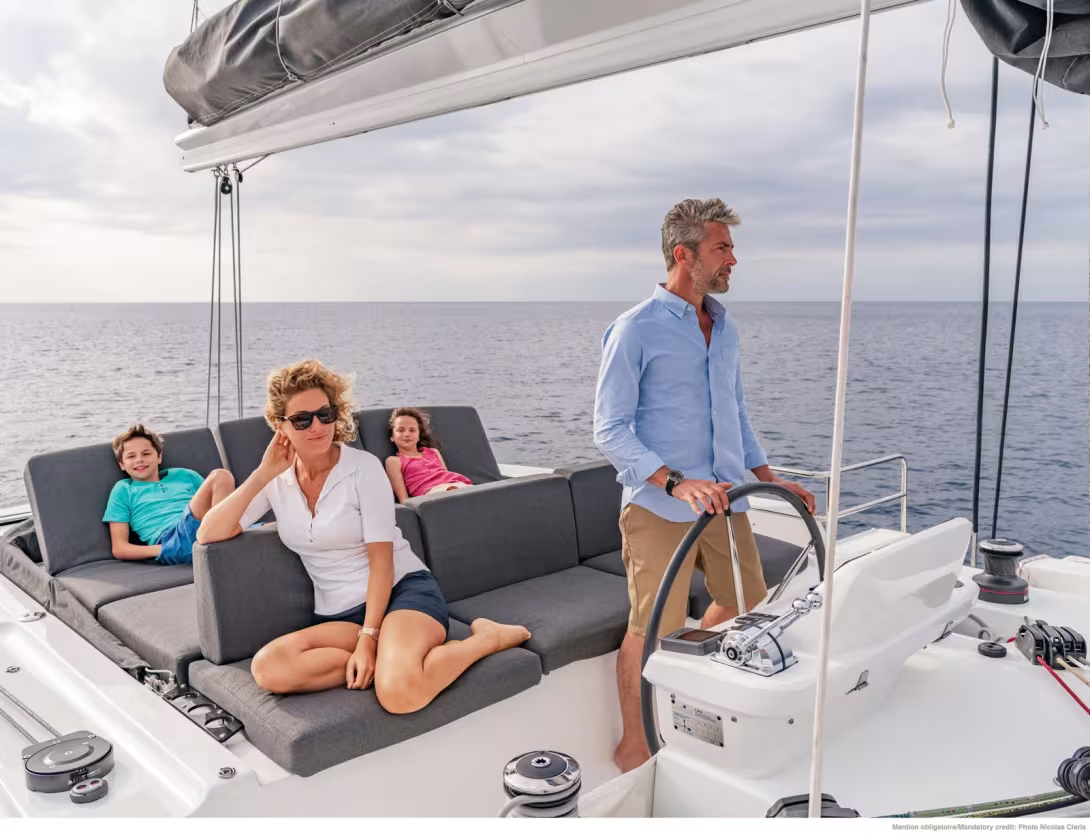
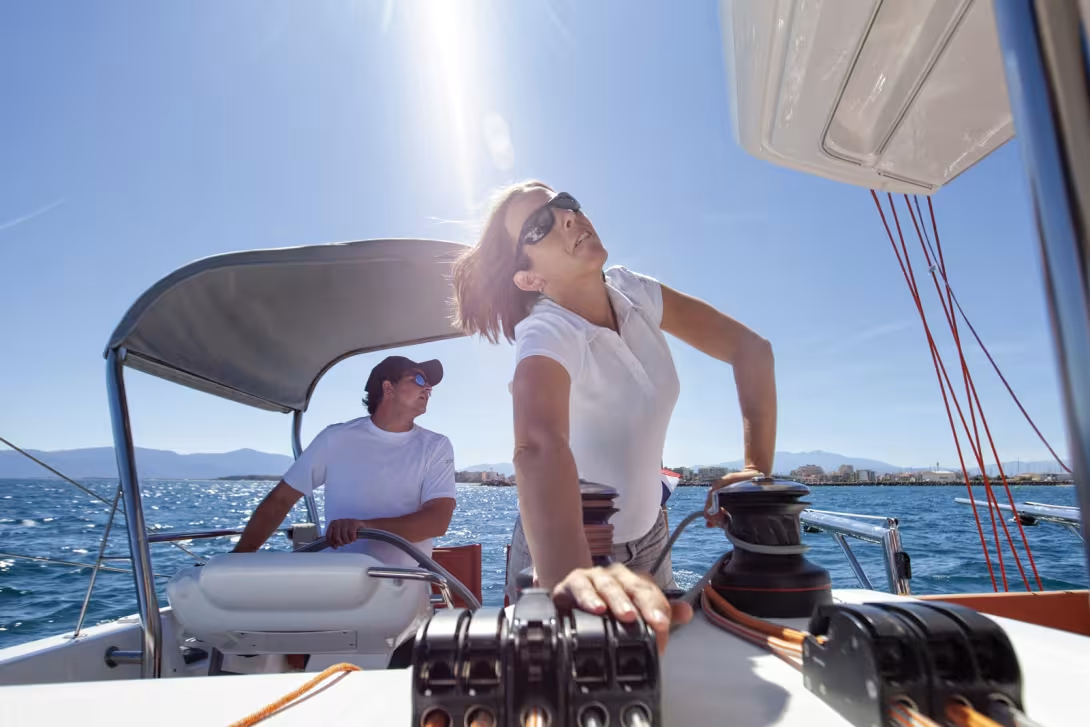
Thanks to the electric winch, setting the sails doesn’t require much effort. Almost all the maneuvers are controlled from the flybridge, spread across winches and clutches that are perfectly accessible for the helmsman. The helm is direct, the boat responds well and always goes through the wind, even without much way on. From up there, the view of the water, the bows and the sail plan are perfect. On the other hand, the bimini hides both sterns. Overall, the 50 is therefore well-suited for family use. The only downside is that for when checking a reefing line, or when flaking the mainsail: the height of the boom can demand some acrobatics - hence the interest of the canoe-boom option, which makes it easier to stow the sail... and any moving around while “aloft”. In light airs, the Lagoon 50 performs correctly, as long as the Code 0 is unfurled. The yard insists heavily on the interest of this sail, which is essential to get the log going when there’s less than 10 knots true wind. Cut flat, the sail can be carried up to 60° off the true wind in light airs - not far from the optimum heading. In 20 knots of wind and above, the Lagoon 50 is capable of averaging around 8 to 10 knots, but will require good waves to surf - and therefore reach higher speeds. As far as the engine is concerned, it is better to choose the 80 HPs offered as an option, rather than the 57 HPs delivered as standard.
SPACE ON THE FLYBRIDGE!
The deck layout gives pride of place to areas dedicated to relaxing: the cockpit, for starters, is perfectly protected by the bimini, and the table, to port, can be doubled in size, to seat up to 12 guests. A full galley allows meals to be prepared outside. The hydraulic platform allows the tender to be stored and offers, in addition to the sugarscoops, everything you need to enjoy a pleasant anchorage. General circulation on deck is particularly neat: wide steps and sidedecks (with a shortcut from the cockpit), and easy access from both sides to the flybridge. And as for seating, between the aft benches, the forward sunbathing area and the flybridge sunbeds, there’s plenty to choose from. Note that a large locker under the sunbathing area allows you to store all the cushions.
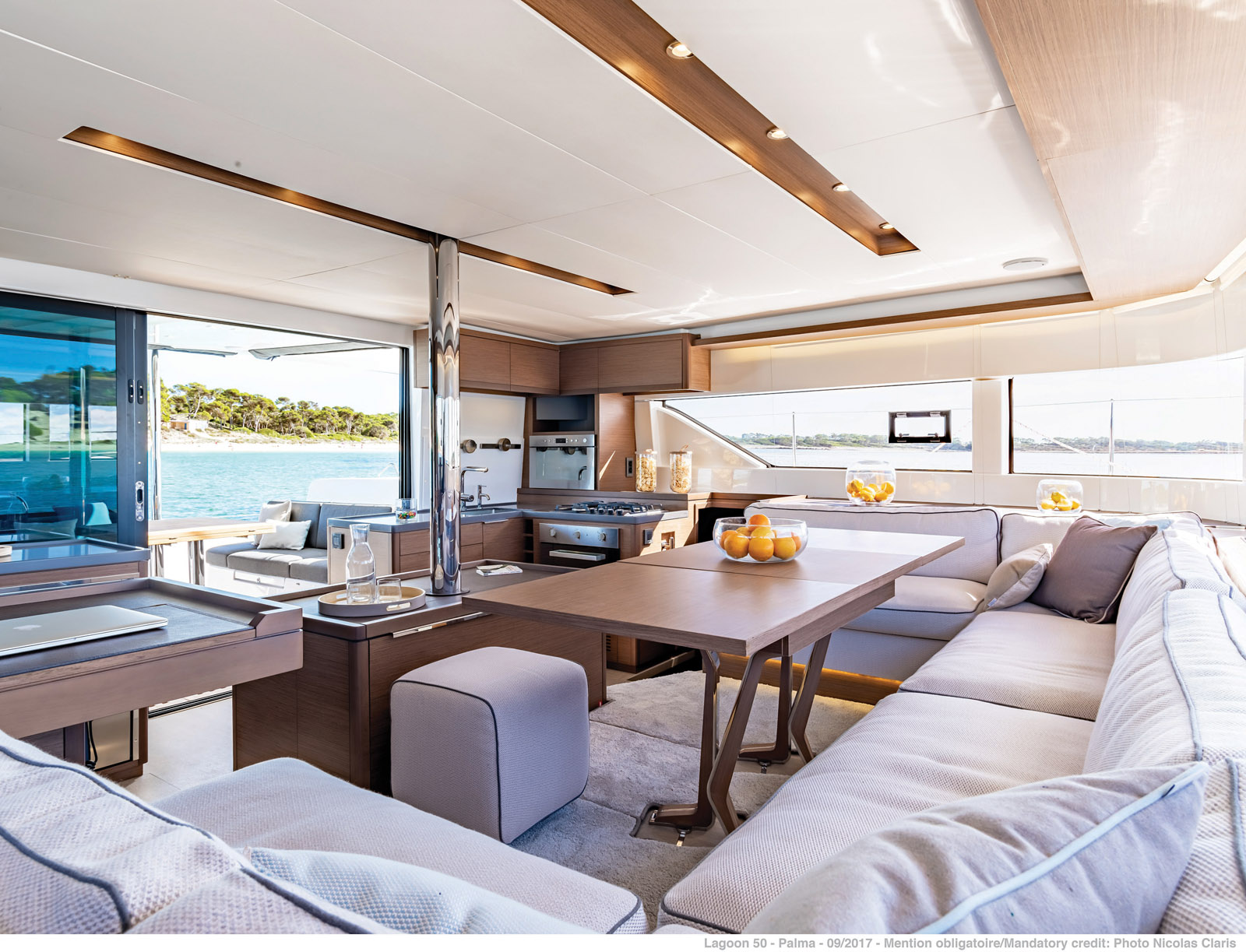
MAST SUPPORT STRUT AND CENTRAL MODULE IN THE SALOON
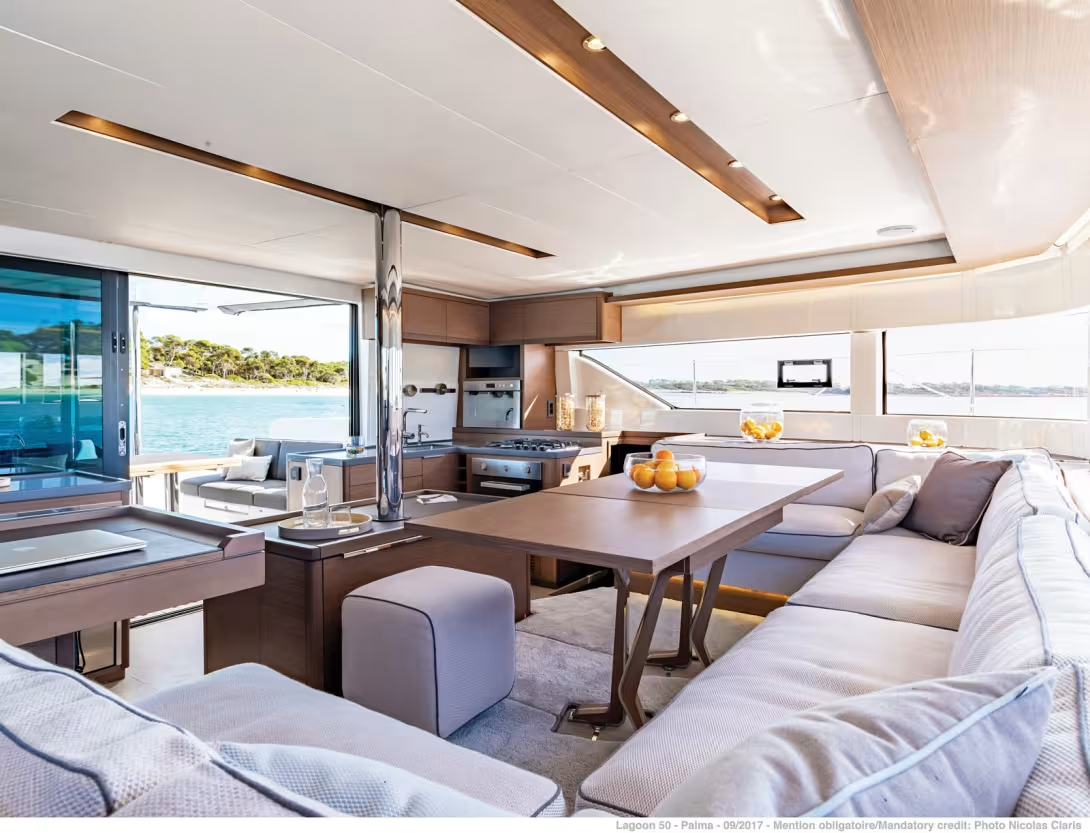
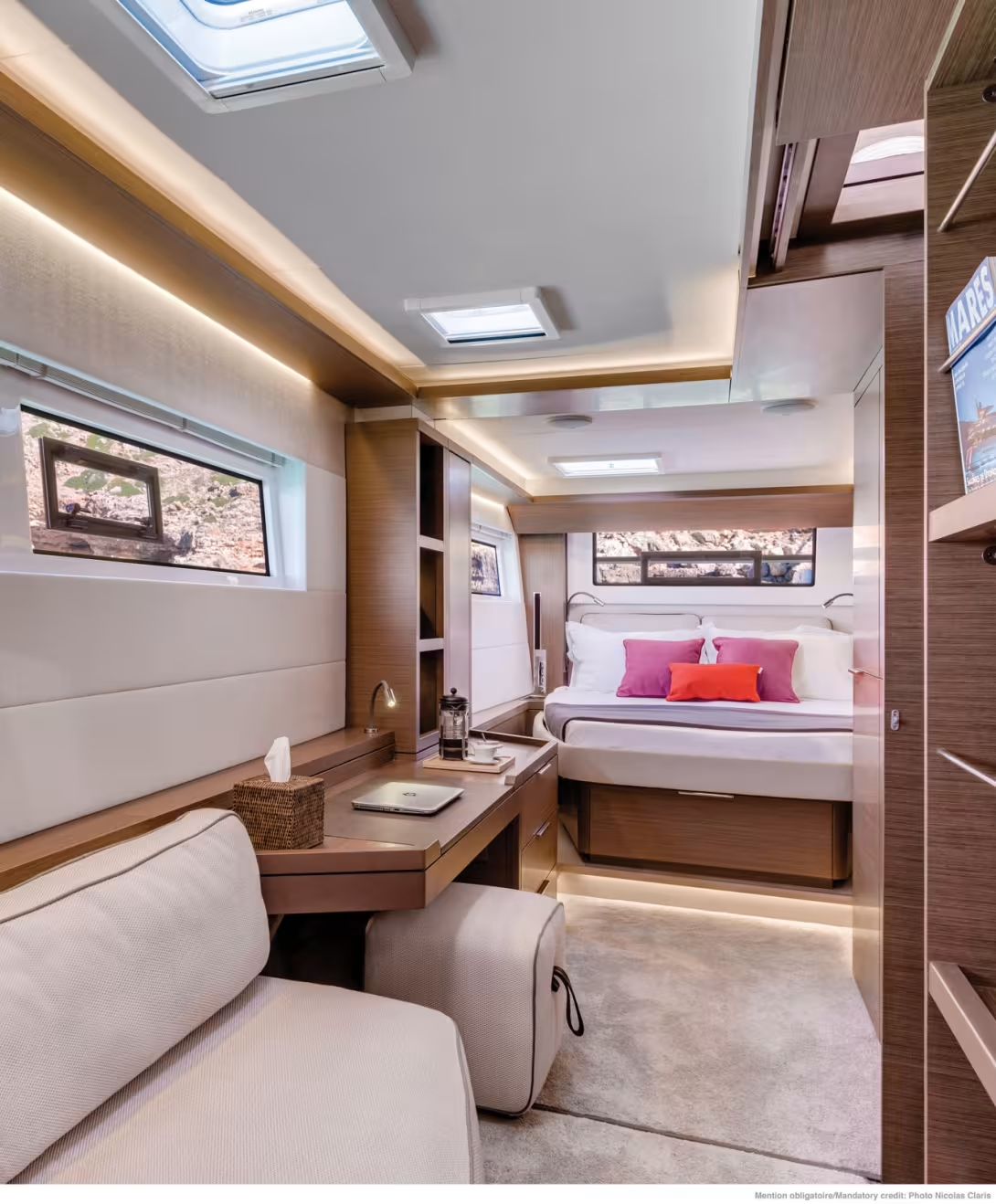
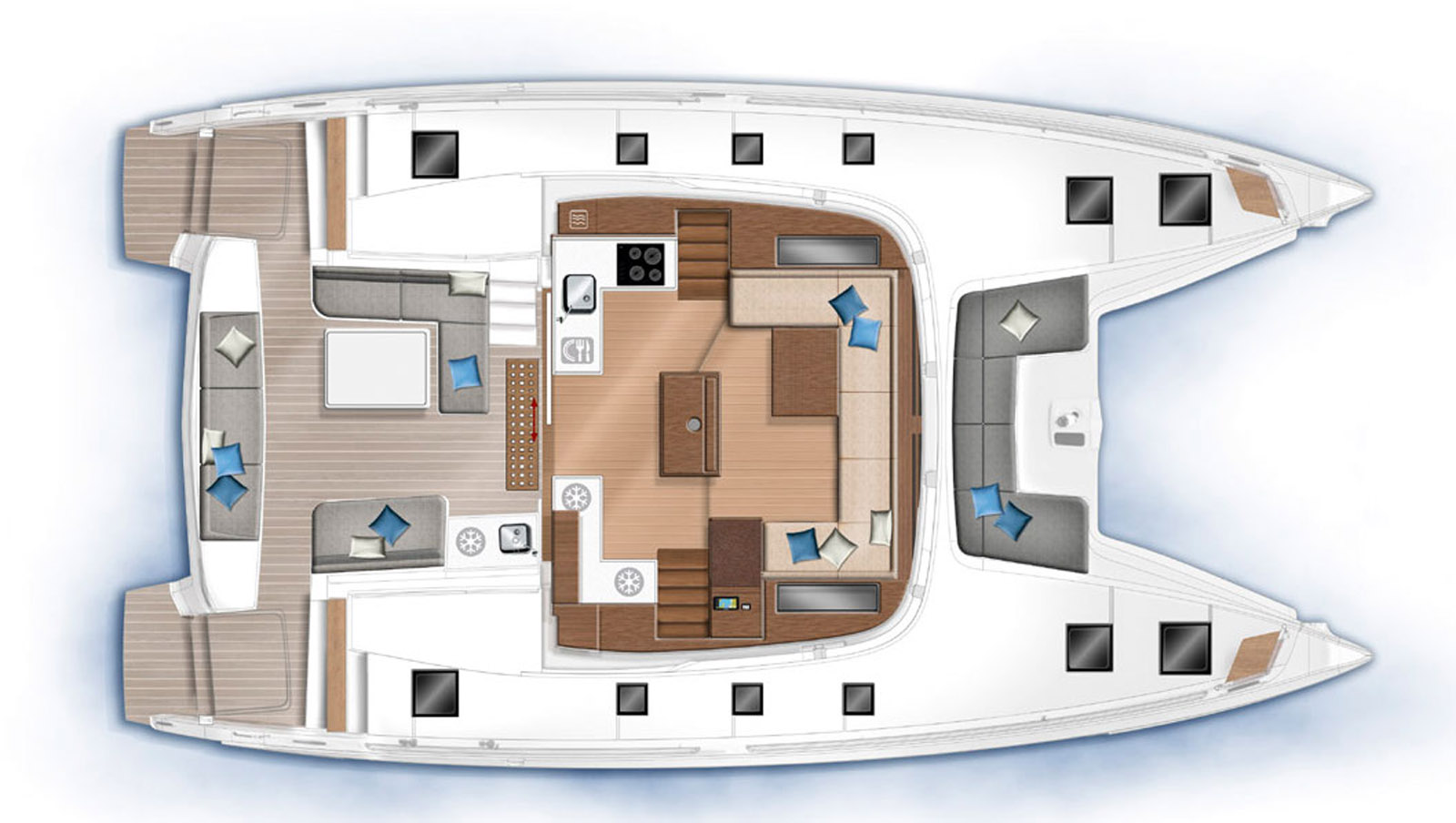
The nacelle, as on all Lagoons, provides maximum volume and excellent protection against solar radiation thanks to the vertical windows. You’re immediately won over by the amount of interior light, the almost panoramic view and the overall quality of the finish. On the other hand, contrary to current trends, the opening to the aft cockpit isn’t that wide: while the bay window offers 1.50 m (5’) in the open position (i.e. a total of 3 m (10’) of glazed area, aft), the useful passage width is limited to 89 cm (2’11”)- the fault lies with the two L-shaped galley units, whose returns “bite” into the opening. This configuration is undoubtedly a consequence of the mast support strut, itself affixed to a central unit of furniture. As a result, the U-shaped dining area (table 185 cm x 75 cm / 6’1” x 2’6”) is set well forward. To starboard, the chart table is a good size, at 75 cm x 62 cm (2’6” x 2’), but is oriented facing aft. And as for the cabins? The manufacturer offers 3, 4 or 6 cabins. The first version sees the entire starboard hull available to the owner with a queen size bed (1.60 m / 5‘3” wide at the head), plenty of storage space, a walk-in wardrobe like at home, a desk, and finally a magnificent bathroom with two basins.
 |
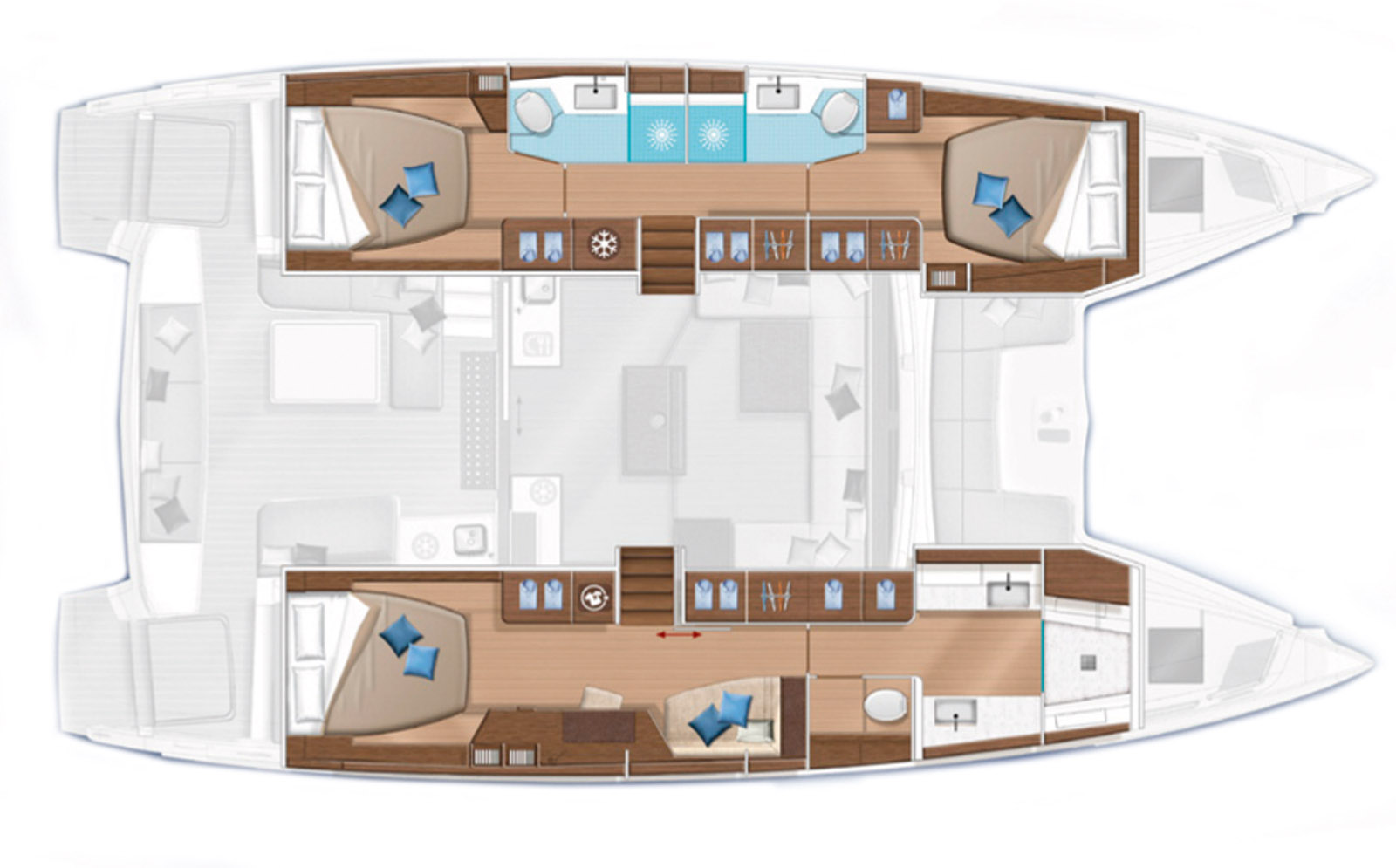 |
Layout plan of the Lagoon 50 in the 3-cabin version.
Builder: Lagoon
Architects: VPLP
Design: Nauta Design
Material: balsa/polyester sandwich
Construction: infusion
Overall length: 14.75 m (48’5”)
Waterline length: 14.31 m (46’11”)
Beam: 8.10 m (26’7”)
Air draft: 26.51 m (87’)
Draft: 1.40 m (4’7”)
Displacement: 20.83 t (45,920 lbs)
Sail area: 158.1 m² (1,702 sq ft)
Mainsail: 97.8 m² (1,053 sq ft)
Self-tacking jib: 60.3 m² (649 sq ft)
Gennaker: 114 m² (1,227 sq ft)
Asymmetric spinnaker: 240 m² (2,583 sq ft)
Engines: 2 x 57 or 80 hp Yanmars
Fuel capacity: 2 x 520 l (2 x 137 US gal)
Water tanks: 2 x 240 l (2 x 63 US gal)
CE Certification: A/B/C/D - 12/14/20/30 persons
Year of launch: 2017
Basic price: € 589,000 ex-tax
EXCESS 15
Why come up with a new brand when they’ve already got 45% of the cruising catamaran market? Because, according to Lagoon’s marketing managers, we’re reaching a sticking point, a maximum... and Excess is offering models that are a little more sporty, and above all which return to the essence of sailing - the idea is a little bit to take back the helm that we’ve handed over to the autopilot…
NEW BRAND, NEW VISUAL IDENTITY
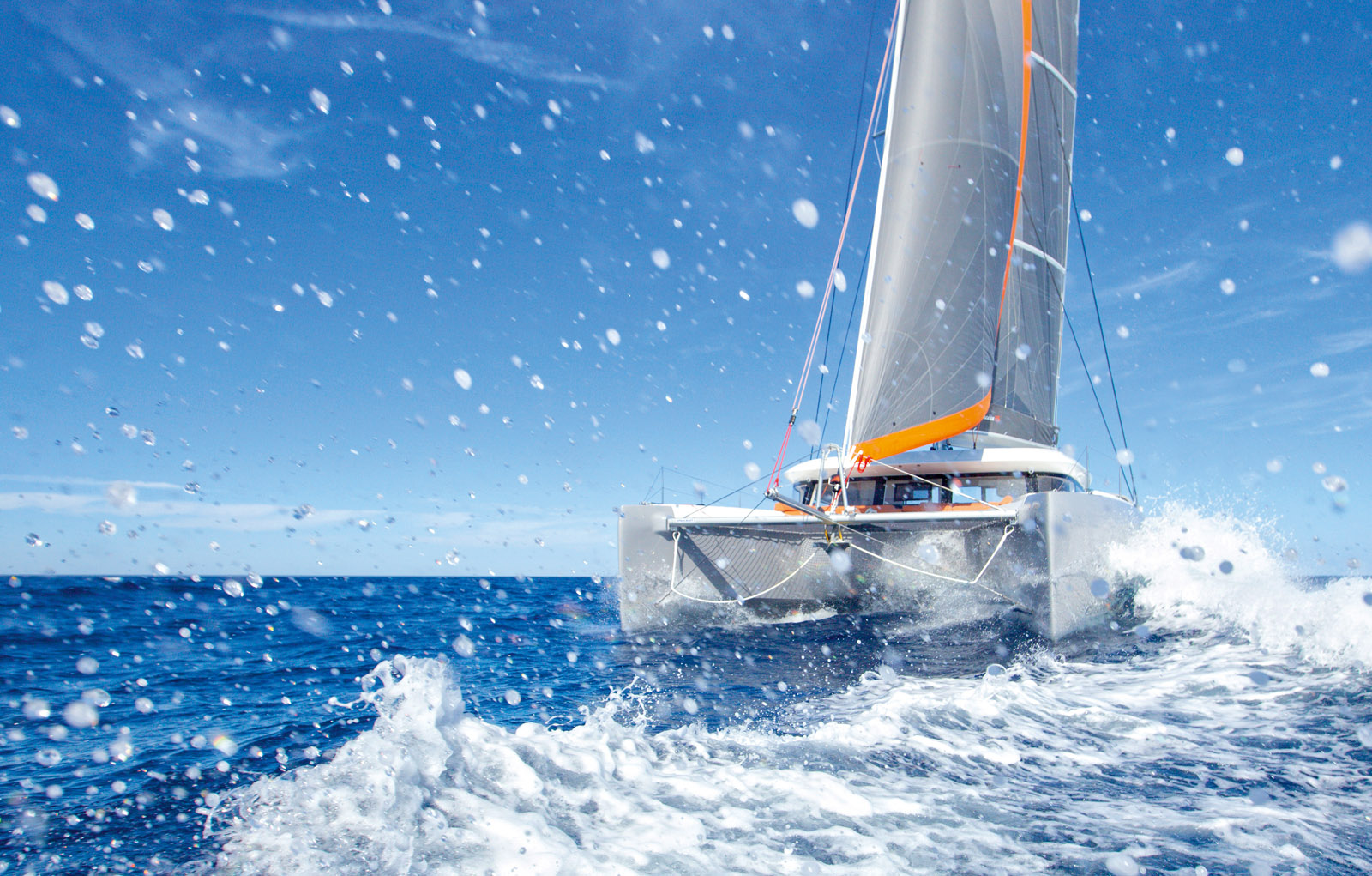
The Excess 15 therefore borrows many elements from the Lagoon 50, starting with a good part of the deck, the underside of the nacelle and the hulls. However, this catamaran has nevertheless been completely redesigned from stem to stern. To begin with, the gelcoat of the hulls is a deep grey instead of the traditional white of the Lagoons. The hull portlights adopt a rounder and more discreet design. On the outside, the ribbed sides of the hulls are a little less “chubby” than those of the Lagoon 50 - they lose 3.5 cm (1½”) on each side. Let’s move on to the coachroof: first off, it’s a little shorter - 15 cm (6”) aft and the same forward - and doesn’t need a flybridge. The design of the side windows is new. Forward, the windows are slightly tilted. The overall design undoubtedly evokes a more “sporty” atmosphere than that 5 55 of the Lagoon. Beyond the design effects, nearly two tons (almost 10% of the displacement) have been saved. A very clear effort which deserves to be underlined... and which will be even more accentuated on the future Excess models - at least for the ones that will free themselves from all or part of the Lagoon tooling, which is already the case of the Excess 11. As for the rig, it is very similar to the Lagoon’s. But can be upgraded.
BONUS SAIL AREA
With a catamaran significantly lighter than the 50, the architects have designed a boosted sail plan - or rather two. The mast has been lengthened, and the gooseneck for the boom is much lower in the absence of a flybridge. The self-tacking jib loses a few square feet, but the balance sheet remains up (159.5 m² / 1,717 sq ft upwind as opposed to 158.1 m² / 1,702 sq ft for the Lagoon 50). However, it’s the Pulse Line version that’s carrying the brand-new DNA of Excess. The mast is extended by 2.45 m (8’), to offer 8.5 m² (91.5 sq ft) more mainsail, a modest 0.4 m² (4.3 sq ft) to the jib and 10 m² (107 sq ft) more to the gennaker. All in all, the Excess 15 Pulse Line has a real racing rig: the air draft is twice the length of the hulls! The profile of the mast has moreover gained in lateral inertia - and retains the two sets of spreaders that were finally adopted on the Lagoon 50. Despite the impressive sail area, maneuvers present no problems. However, we still advise short-handed crews to go for the optional electric winches. Sail handling maneuvers are spread across three stations: the helm aft, halyard and gennaker sheet to port, and everything else to starboard. The polars leave no doubt about the speed: the Excess 15 is much faster than the Lagoon 50, especially on points of sail between 50 and 90° off the wind and in light airs. On the other hand, as the wind picks up and you bear away, the difference in speed gets smaller. The Pulse Line version offers an average performance gain of 7% compared to the standard Excess 15. Note: the fiery character of this version, which was apparent during the very first sea trials, has since been controlled by deeper, more compensated rudder blades. The connecting rods have been extended. As for the motors, there are twin Yanmars, either 57 or 80 hp.
HELM STATIONS ON THE HULLS AND OPENING BIMINI
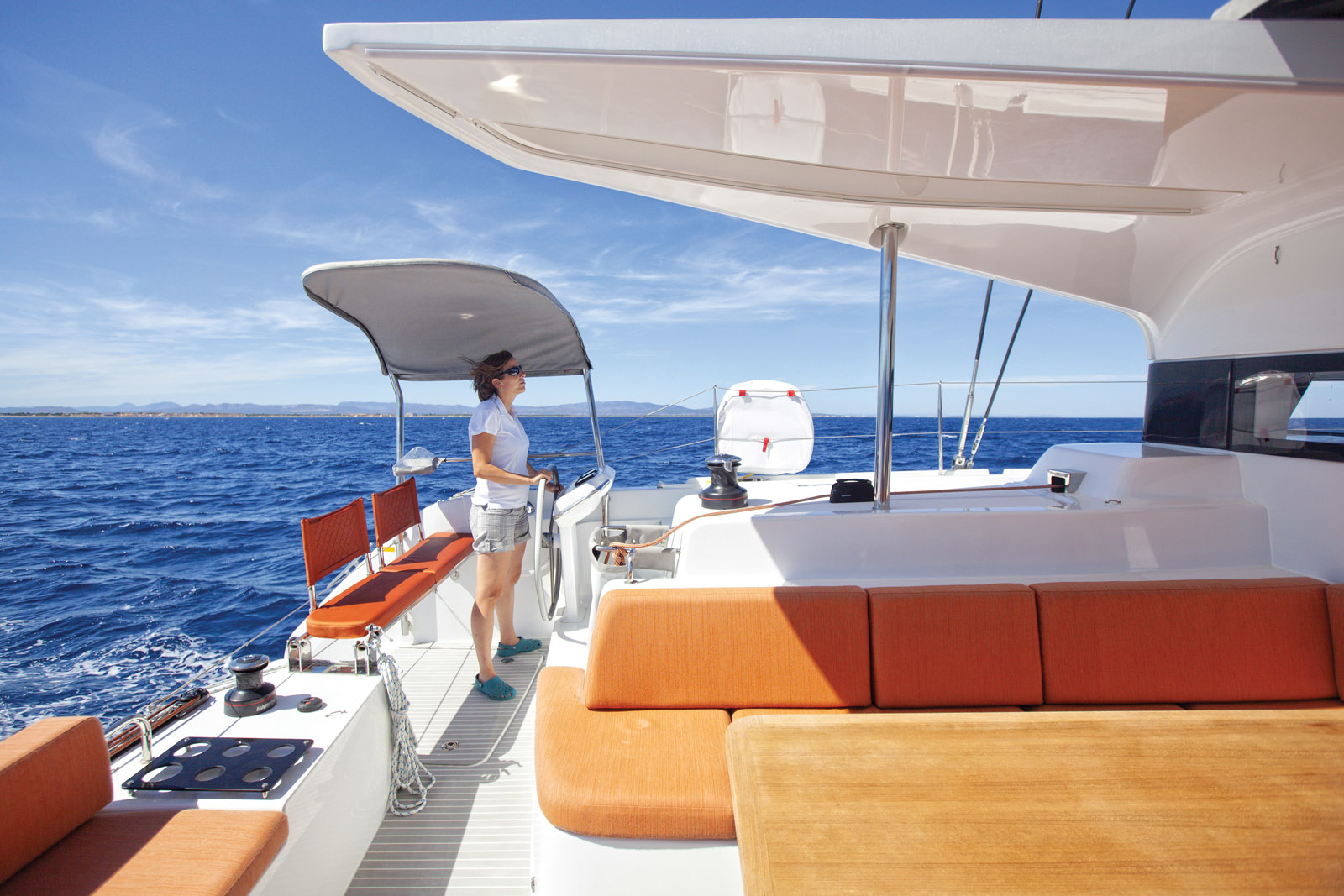
What differentiates the Excess 15 from the Lagoon 50 is the twin helm stations: the builder has installed a steering wheel at the back of each hull and a double folding seat (1.47 m / 4’10”) - whose finish could see a little more effort. The 15 is a real pleasure to helm, all the more so as she manages to offer real gliding sensations despite her still substantial displacement. The second new feature: the rigid bimini is ‘convertible’ right across its central part: a real pleasure! A good idea pinched from the Sense, a former range of Bénéteau monohulls. As for the rest of the deck layout, it’s more or less the same as that of the Lagoon 50: a large cockpit table (85 cm x 162 cm / 2’10” x 5’4”), a beautiful 2.40 m (7’10”) aft bench seat, wide side decks (82 cm /2’ 8” at the narrowest), and finally a foredeck and clear trampolines.
A SLEEKER, MORE MODERN FINISH
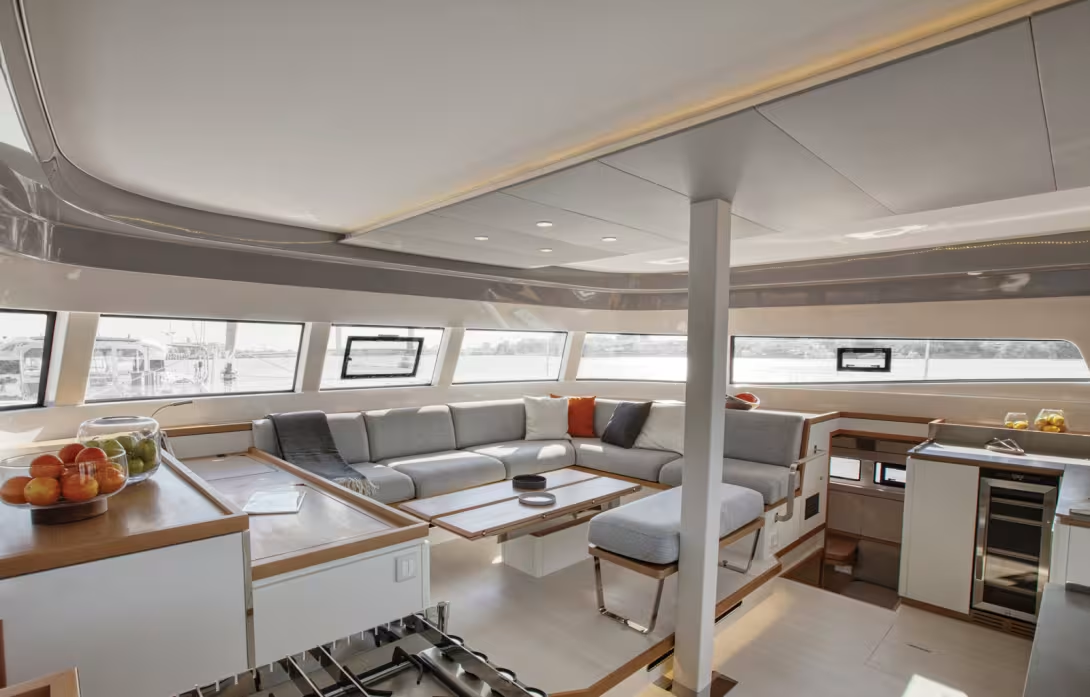
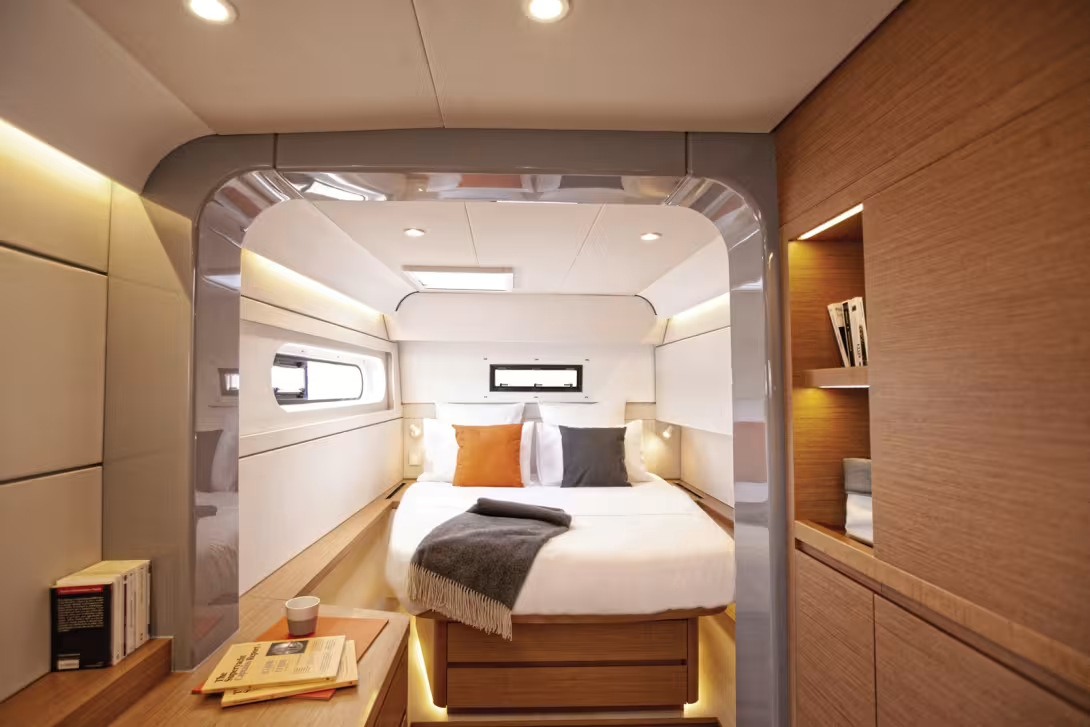
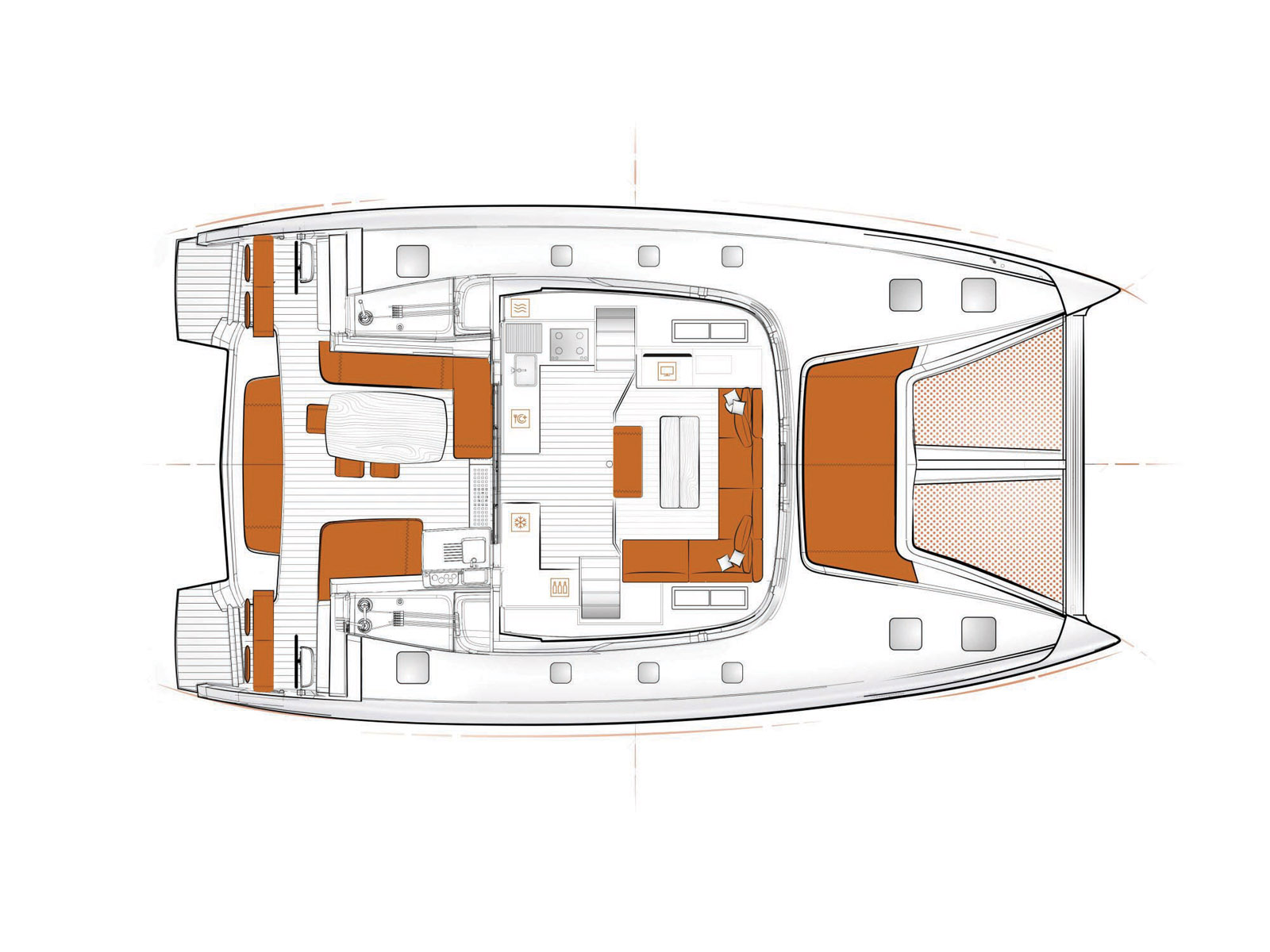
Here too, the interior layout is identical to that of the Lagoon 50, with the same relatively narrow entrance, the L-shaped galley and the raised saloon... except for one detail: the central cabinet has disappeared, in favor of a more forward saloon bench seat with a 140 cm by 60 cm (4’7” x 2’) table that can be doubled in size. The same goes for the port bench seat return, replaced by a storage cabinet. We prefer this new layout: it frees up the circulation in the saloon. The finish and décor are totally different. The noble materials - dark wood species, stainless steel and leather - as well as the soft upholstery, are replaced by lighter woodwork, white veneers and more sober cushions. A younger, more relaxed atmosphere... like or dislike it, it’s up to you! The cabins (from 3 to 6 in number) are identical. The hulls have the same eye for simplification - no more rails around the berths, for example - but all the beds remain 1.60 m (5’3”) wide.
 |
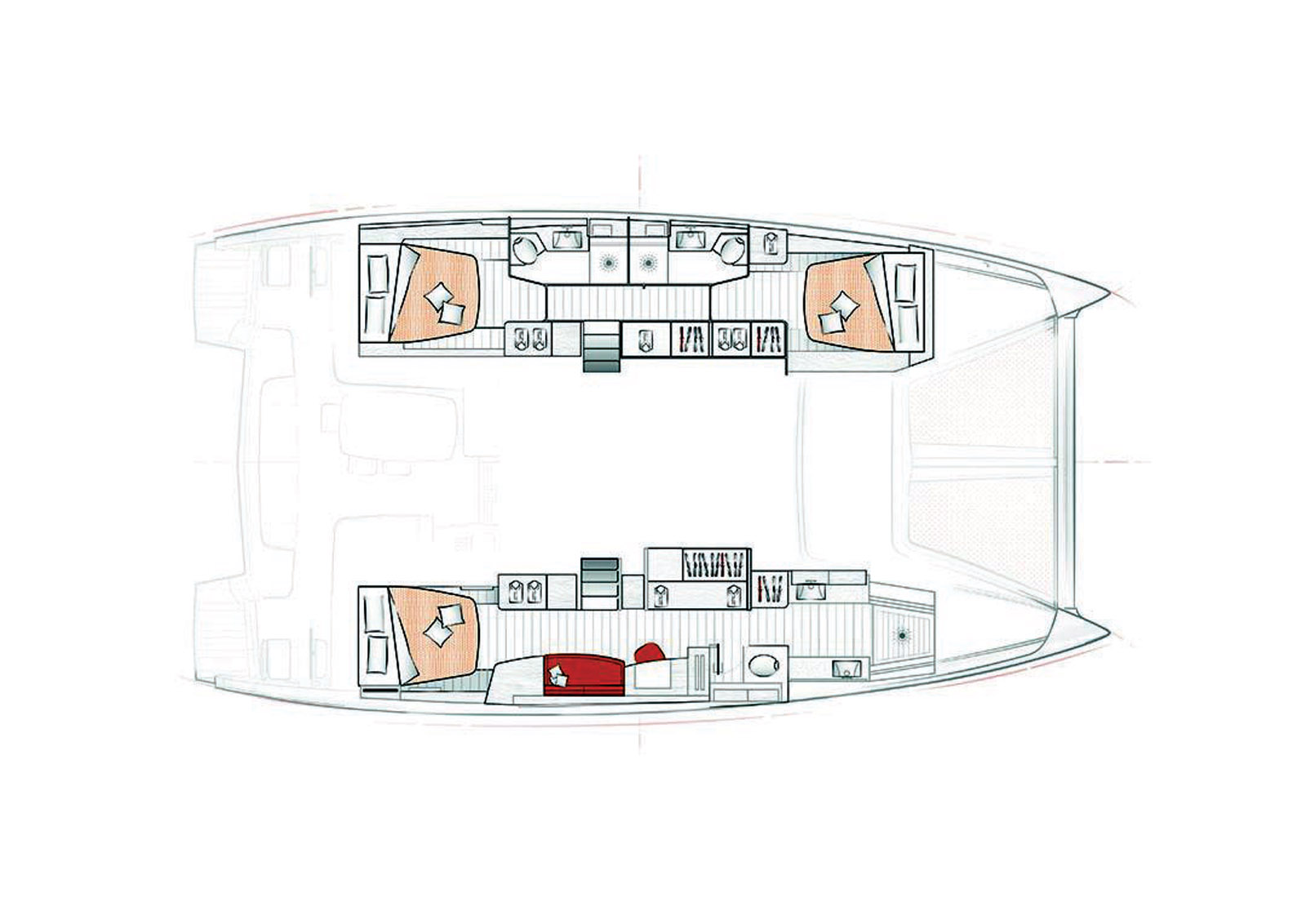 |
Layout plan of the Excess 15 in the 3-cabin version.
Builder: Excess Catamarans
Architects: VPLP
Design: Nauta Design
Material: balsa/polyester sandwich
Construction: infusion
Overall length: 14.76 m (48’5”)
Waterline length: 14.31 m (46’11”)
Beam: 8.03 m (26’4”)
Air draft: 27.90 / 30.35 m (91’6” / 99’7”)
Draft: 1.40 m (4’7”)
Displacement: 19.06 t (42,020 lbs)
Sail area: 159.5 m² (1,717 sq ft)
Mainsail: 104.5 /112 m² (1,125 / 1,206 sq ft)
Self-tacking jib: 55 / 55.4 m² (592 / 596 sq ft)
Gennaker: 117/127 m² (1,259 /1,367 sq ft)
Asymmetric spinnaker: 245 m² (2,637 sq ft)
Engines: 2 x 57 or 80 hp Yanmars
Fuel capacity: 2 x 520 l (2 x 137 US gal)
Water tanks: 2 x 240 l (2 x 63 US gal)
CE Certification: A/B/C/D - 14/14/20/30 persons
Year of launch: 2019
Basic price: € 605,000
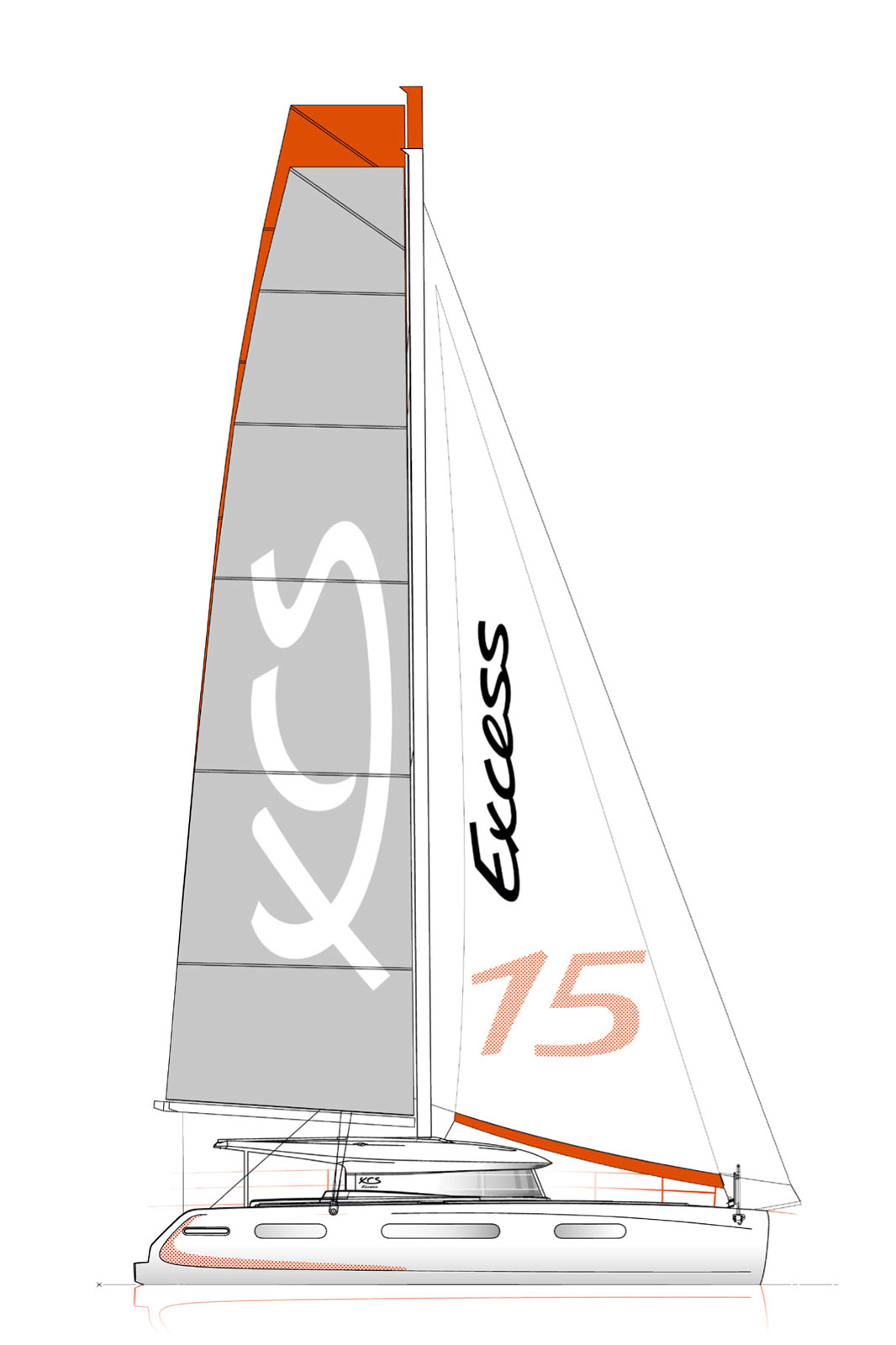
In the Pulse Line version, the Excess 15 gains 2.45 m (8 feet) of air draft compared to the standard version.
