With the 500, Lagoon unveils a bit more of its range of third-generation multihulls, which started with the 440. These voluminous catamarans offer an incredible amount of space and well above average performance…
Infos pratiques
- Le chantier : Lagoon 500
- La fiche technique
- Découvrez notre vidéo exclusive
- Financez votre Lagoon 500
- Assuez votre Lagoon 500
- Articles autour du Lagoon 500
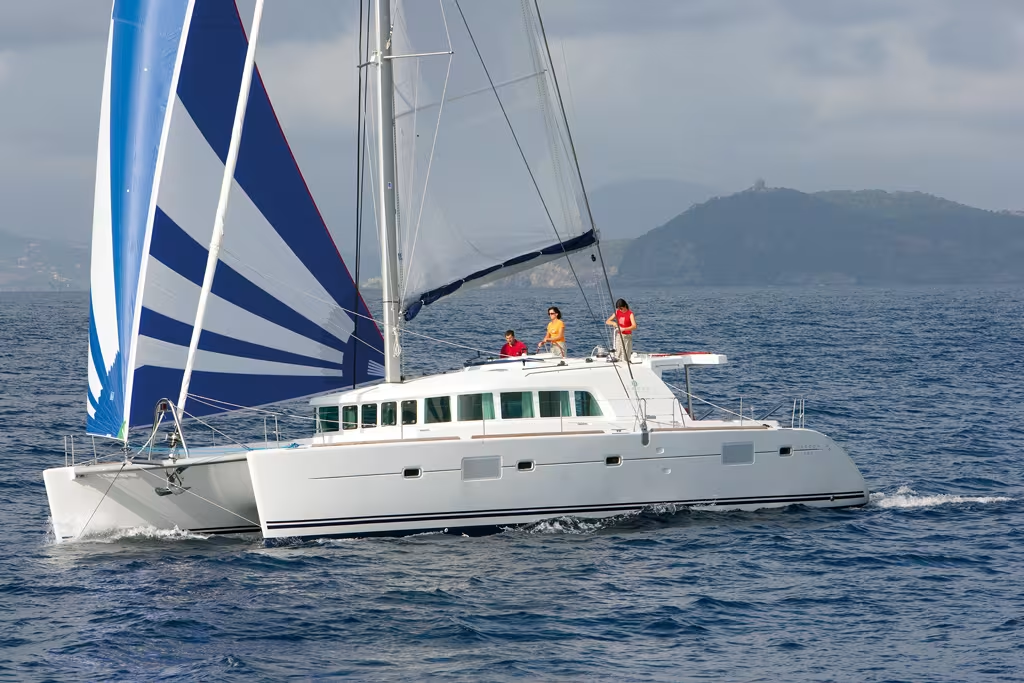
As the owner of a lively 28-foot trimaran, which performs well on all points of sailing, my first glimpse of the Lagoon 500 at the end of the pontoon impressed me; its immense 24m mast towers above all the others, including that of its famous big sister, the Lagoon 55. OK, I skippered a 60’ monohull for 5 years, but the Lagoon’s high freeboard is remarkable.
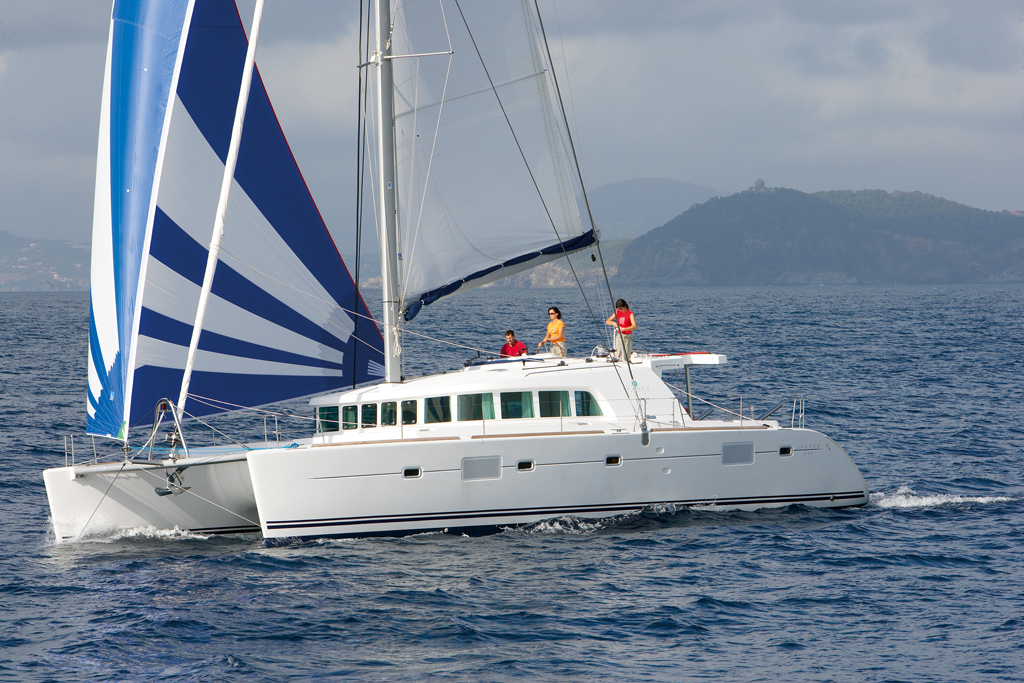
The Lagoon 500 gives new life to the ‘cruising catamaran’… A new standard is born!
A big ship
To climb aboard, two steps have been arranged in the side of the hull, which allows access for any able-bodied person. The flared sugar scoops are too far from the pontoon to be used for this purpose. From the first step onto the deck, the tone is set; the Lagoon dominates all the other boats. A coaming a few centimetres high around the nacelle roof makes moving around the deck easy. However, the ‘gangway’ between the sterns is a bit narrow. A small cockpit at the mastfoot welcomes the crew for an aperitif - at anchor, after a good day’s sailing or diving. The compressor, a generator, and the gas bottles are housed in a comfortably-sized locker hidden behind the seating. Two other, smaller lockers swallow up the fenders, mooring lines and hosepipe. Just forward of this cockpit is the windlass, which is controlled from the flying bridge. The bow area in each hull is accessible via deck hatches and vertical ladders. Despite their volume, care should be taken not to fill these two spaces with heavy or ‘could be useful’ equipment, as even on a catamaran of this size, weight distribution should be in the back of the owner’s mind, in order to sail comfortably and safely.
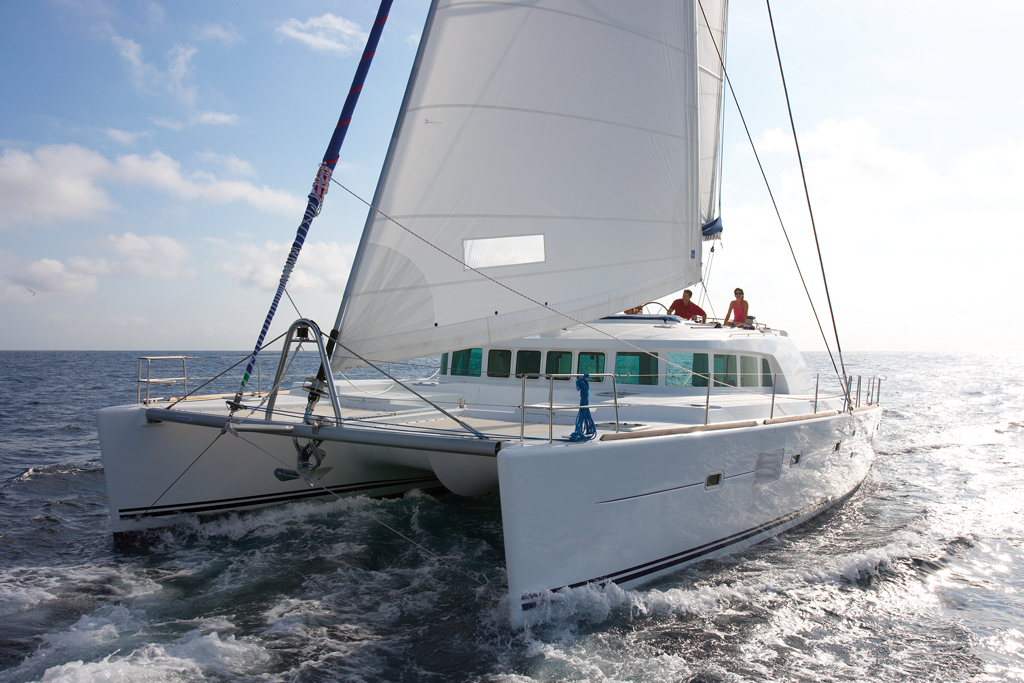
A catamaran which will allow you to travel far, at a good cruising speed and above all, with all the ‘home comforts’!
A permanent impression of space
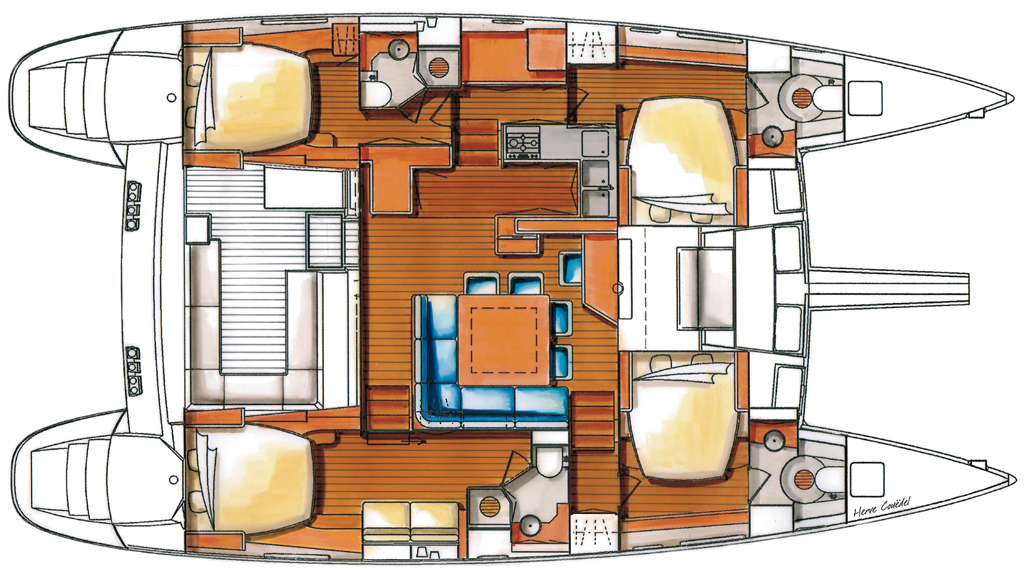
After having walked round the cabin roof, I was welcomed by the owner in the…, er, on the…; I was astonished! What is normally called a cockpit on a sailing catamaran has here become a vast ‘verandah’ which is covered by the flying bridge. There is a large, U-shaped seat to starboard, whilst to port a work surface with sink, running water and fridge provides a place for the fishermen to prepare their catch or the mistress of the house…sorry boat to prepare an aperitif for the guests. The mainsheet is split and one end is led behind the seat along a hardtop support so it can be released in an emergency from the nacelle. This ‘verandah’ opens on the same level into the immense deck saloon in the nacelle – magnificent! The interior is ‘outside’ and we are a long way from the ‘saloon-cellars’ aboard monohulls or the low nacelles in which you have to bend down to see outside. Here we are in the realm of light! There is no need to pick up your feet or lower your head to enter: you really are welcome aboard. The simple, warm interior decoration combines contemporary woodwork in pear wood with moulded headlining for easy maintenance. In the centre of this vast living area, at the foot of the mast, is the chart table, which is ideally positioned - well-sheltered whilst sailing and easily turned into an interior steering position with the addition of a joystick. To port and on a slightly lower level, the U-shaped galley would not be out of place in a restaurant, with a 60cm-deep professional work surface in stainless steel. There is room for two people to work without getting in each other’s way, whilst enjoying the sea view and all the equipment in this luxury kitchen: three-ring gas cooker with oven, microwave and optional dishwasher. Cold storage is more than adequate, with two fridges and a freezer, as are the stowage volumes! There is even space under the nacelle floor for food storage. To starboard, the saloon/dining room can welcome ten guests around a variable-geometry table: folded and lowered, it forms a coffee table; unfolded and raised it is a good-sized dining table
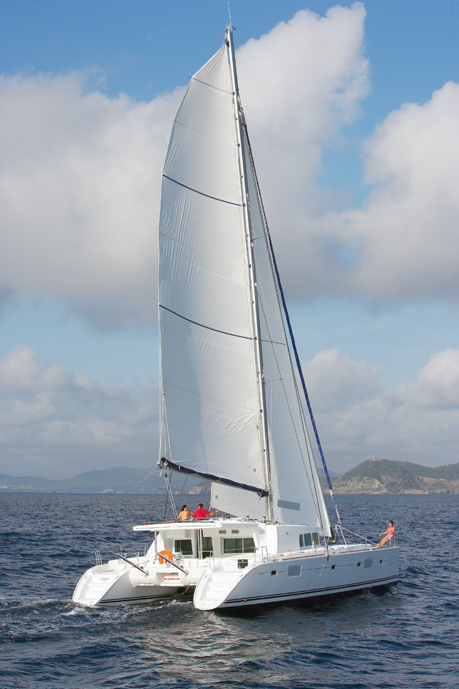
With its 500, Lagoon is offering a successful blue-water or charter catamaran…
Cosy cabins
My hosts had reserved the starboard forward cabin for me, which I reached via a wide independent companionway. Once through the entry, with its large cupboards, I entered the cabin which is very well-lit thanks to the numerous portholes and hatches. Included in these is the large fixed window overlooking the sea, which is characteristic of these 3rd generation Lagoons. Very pleasant! In all the versions of the Lagoon 500 (three, four or five-cabin), each cabin has a private heads or bathroom and at least two-metre headroom. Once I had stowed my gear in the drawers under the (double) bed, I had to test its quality: the slatted base and a thick, easy to manipulate two-section mattress gave irreproachable comfort; the nights would be very pleasant. Only the two rather narrow steps up to the bed reminded me I was aboard a sailing boat. Back in the nacelle, I climbed down a second ‘staircase’ to the starboard aft cabin, the owner’s domain in the 4-cabin version. This is a suite fit for a king; I felt like the small child who had longed for his own bedroom and found it: dressing table with a small settee, private bathroom and king-size bed with a sea view and, this time, two wide steps for access. I leave you to imagine what the owner’s cabin is like in the 3-cabin version, it occupies the whole of the starboard hull!
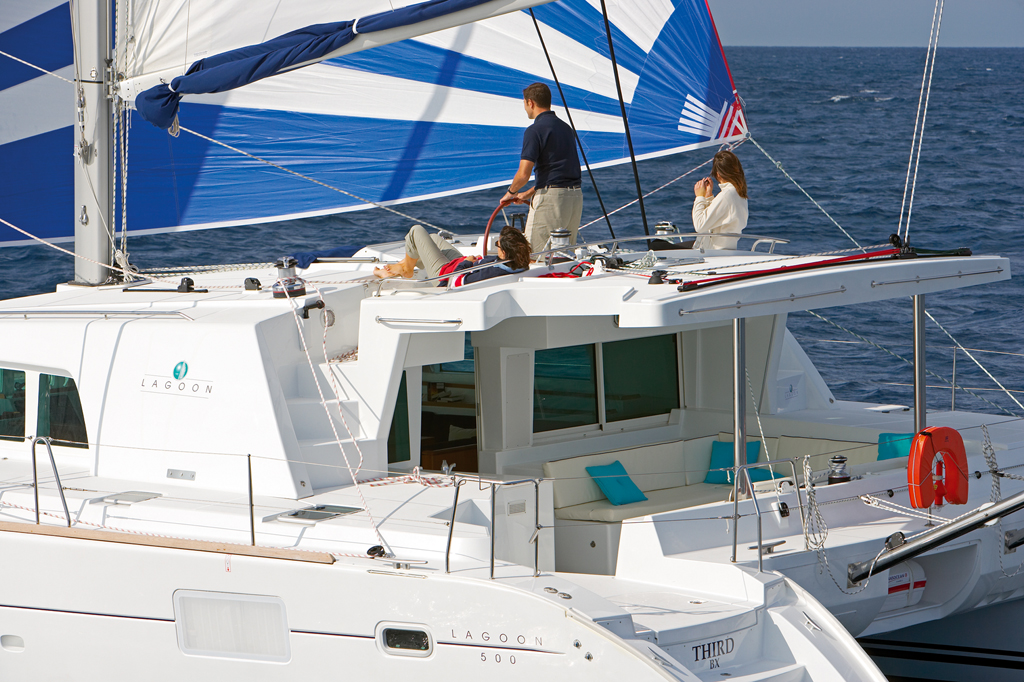
The famous flying bridge : some love it, some hate it. Try it before you decide for yourself!
In the port hull, the accommodation is the same, whatever version you choose. A single companionway leads to a gangway with the freezer, the dish washer and numerous cupboards. There is a cabin at each end of this gangway: the forward one is identical to the one I occupied, whilst the after cabin is the same as the owner’s cabin, but without the dressing table. In each cabin, the WCs have gravity-fed tanks which conform to modern standards. Here the owner had sensibly chosen electric pumps for the after cabins and manual for the forward ones. Leaving the verandah, sorry, the cockpit, there is direct access to the port sugar scoop, where a hatch opens into the port engine compartment and the aft crossbeam, which houses the steering system (cables on this model). Standard equipment is two 55hp diesel units, two 75hps are available as an option. The owner likes sailing and had installed Maxprop folding propellers. Having checked the oil levels, we climbed up to the flying bridge, which is accessible via a staircase from both sides. The forward-facing seat can take five or six persons around the helmsman or woman, who has the ideal central position. All the controls are within reach, from the levers and engine instrument panels to the four sheet and halyard winches, one of which on each side is electric. The view is excellent, there are no blind spots during port manoeuvres, but the tips of the sugar scoops are masked by the cockpit top.
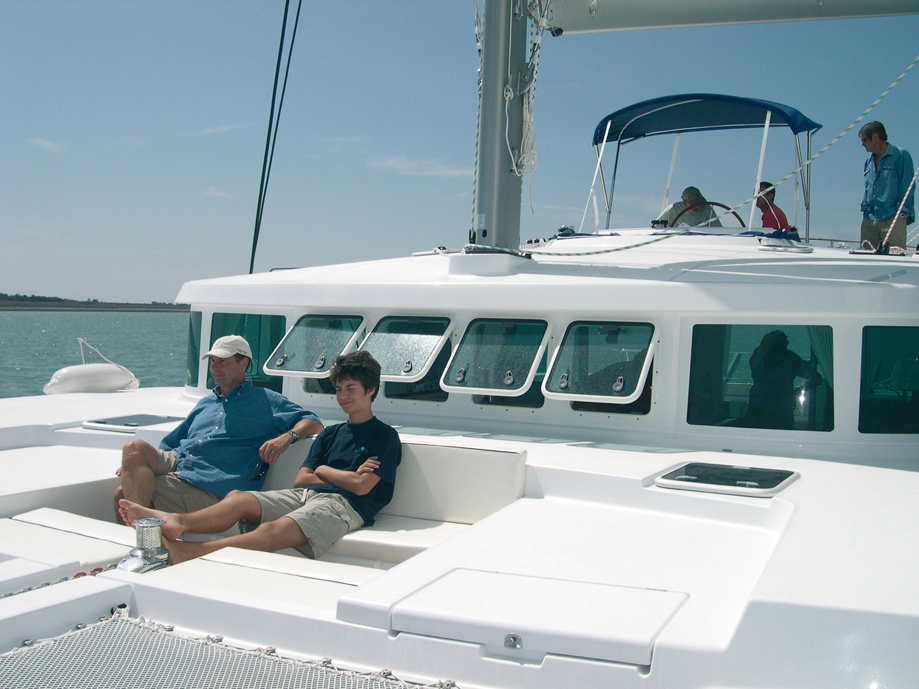
This small space quickly becomes the most sought-after place aboard, at anchor as well as under sail in warm seas…
Home comforts with the performance of a real sailing boat!
All the mooring lines were doubled up and we were ready to go. With the huge freeboard and 21 ton all-up displacement, pushing off by hand then jumping aboard is out of the question! Even though the ‘beast’ is easy to manoeuvre two-up, it is essential to be coordinated and rigorous. Thanks to the turning moment of two engines, whose props are 7m apart, we got away from the pontoon with no problems. We left the port ‘slow ahead both’ and looked for clear water to windward where we could hoist the main. This is child’s play, despite the 50m of halyard, thanks to the electric winch; it took us less than 5 minutes to hoist main and genoa, and get the Lagoon 500 moving. The winches are generously dimensioned and allow easy sheeting in strong winds, but it remained quite physical. There is space for both sport and idleness aboard this boat! To my surprise, even though I wouldn’t call it a lively boat, it is enjoyable to sail and accelerates well. After several days’ sailing aboard, I was particularly impressed by its performance in light airs: close-hauled, with just six knots of true wind, we were making 3 knots at a very respectable angle to the wind. It must be said that special care was taken with the underwater lines and the appendages, to guarantee good performance on all points of sailing, in any wind conditions. So, ‘what’s left for the monohulls’? The pleasure of sailing heeled over, perhaps..?
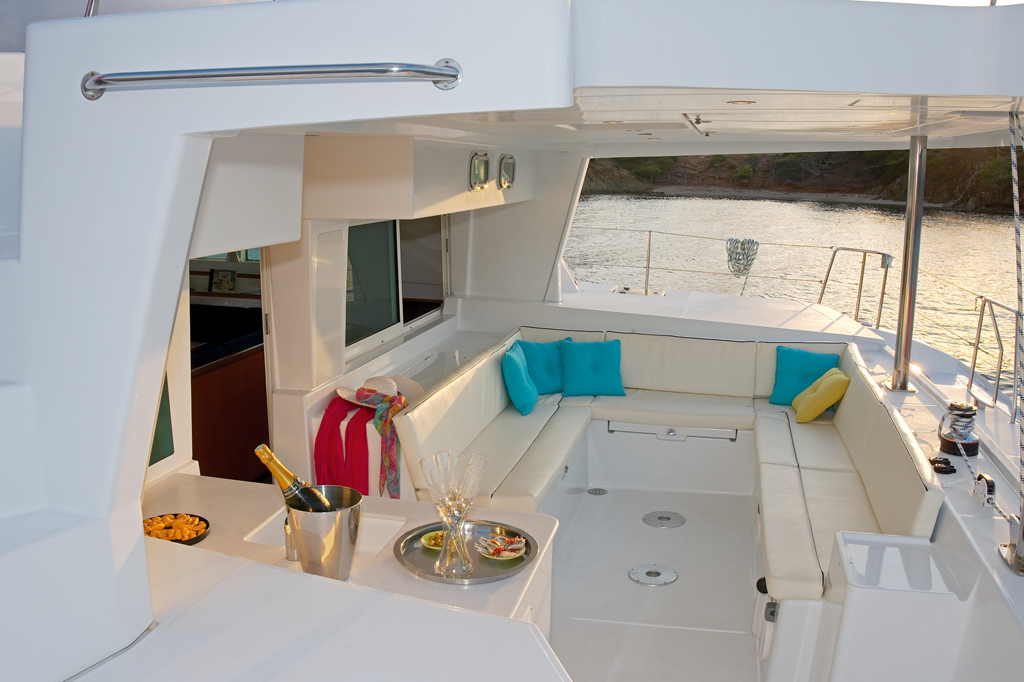
The U-shaped seating on the verandah… sorry, in the aft cockpit, can easily be turned into an exterior dining area, thanks to the removable table which is stowed in the ‘ceiling’!
As soon as the breeze freshened, the Lagoon got cheerfully into its stride to reach its cruising speed – between 7 and 10 knots, depending on the point of sailing and the wind strength. To windward, in up to 28 knots of breeze, we were sailing at an average of more than 9 knots and 100° to the wind under full sail, in amazing comfort. The gull-wing shaped bridgedeck has been designed to help the boat pass through the waves more smoothly; however the Lagoon remains a catamaran which slams in the waves. Downwind in light airs, the Lagoon, in common with all displacement boats, shows its limits. Yet even if you start the engines to maintain your averages, the careful soundproofing allows you to do so comfortably. Be that as it may, the Lagoon 500 is a genuine sailing boat whose standard engines are quite adequate. Even when manoeuvring in the port with a fresh breeze, there is sufficient power; however when short-handed, the manoeuvre must be carefully prepared. The Lagoon 500 will show what it is really capable of in a remote anchorage, where it is fairly easy to manoeuvre. Moreover, walkie-talkies should be part of this boat’s standard fittings, to avoid having to shout when manoeuvring! This is not a boat for the marinas.
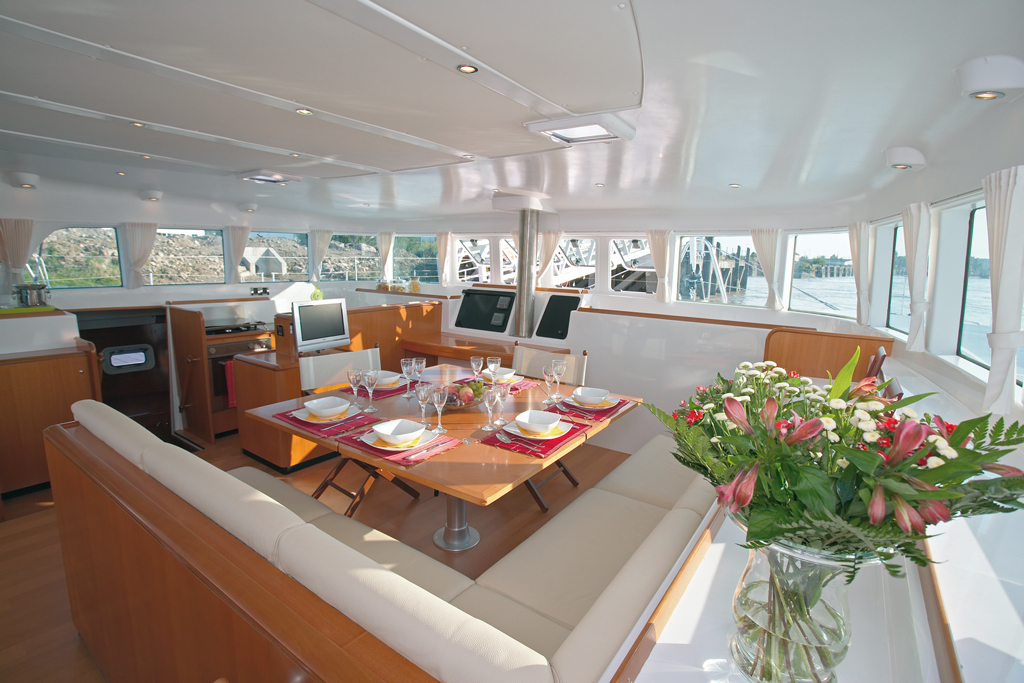
Welcome to your home… A bright interior which is very pleasant to live in.
Construction
Lagoon is the heir and successor to the famous ‘Jeanneau Techniques Avancées’, (JTA to their friends), and builds its catamarans with the expertise acquired from experience with ocean racing multihulls. (Florence Arthaud’s Pierre 1er, Philippe Poupon’s Fleury Michon). Its site at the ‘Chantier Naval de Bordeaux’ produces the big boats, such as the Lagoon 500. Infusion techniques allow lamination (even if this is no longer the right term) of light hulls, thanks to virtually ideal proportions of resin and fibres. In addition, the excellent mechanical qualities of vinylester resins, (superior to polyester but remaining compatible with a gel-coat finish) mean they are strong. The result can be seen: an exceptional compromise between weight, liveability and performance. As a naval designer confided to us “today, we know how to build catamarans that are liveable and fast”. Acknowledged! The Lagoon 500 would be a nearly perfect boat for someone wishing to keep their home comforts…
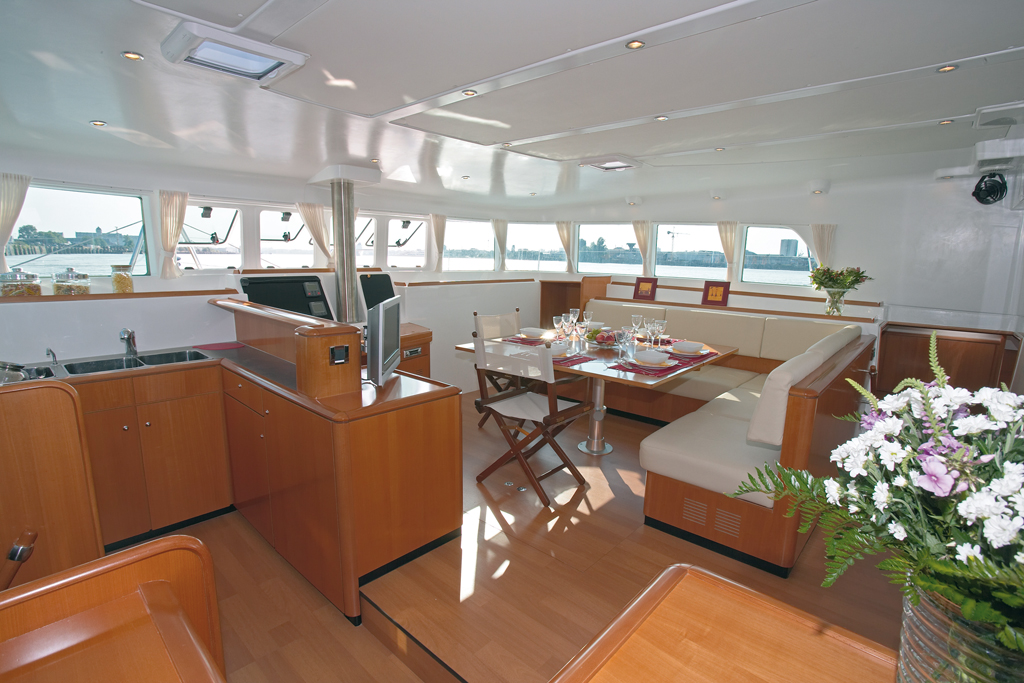
The U-shaped galley with an unobstructed view of the sea, and the saloon… The 500 offers an incredible amount of living space!
A few regrets about this first boat in the series…
From a safety point of view, firstly: Because of the deck coaming, the guard wires are too low for safety in rough seas. Taller stanchions with a third wire would be more reassuring. The handrails around the cabin roof are inadequate, notably round the hardtop where they are missing when coming down from the flying bridge or going round the after side of the nacelle (all being well, the builder has added these handrails). The automatic reefing system blocks are too small; we broke two in two days! They have since been changed by the builder. It is difficult to climb onto the classic type boom to furl the main, or for maintenance. A wide boom with ‘wings’ or a ‘granny bar’ type of protection would be welcome for working at the end of the boom. Since this first boat, the builder has fitted folding mast steps to give easy access to the boom. The absence of a removable forestay for a staysail or storm jib on an ocean-going boat surprised me, even though, thanks to modern textiles and furlers, it is possible to hoist these sails without a forestay. The cable steering guide system was not very pleasant. The only pleasure in helming was that of ‘driving’ a large, powerful catamaran. A new connecting rod has been made so the helm can regain its ‘feel’… The mast bend prohibits any adjustment of the lazy jacks; the circuit needs modifying. Here again, the builder has worked well, as the lazy jacks are now adjustable. Note that Lagoon is working at the moment with Incidences on the design of a specially adapted lazy-bag for these boats with high booms, to avoid the necessity for climbing on the boom…
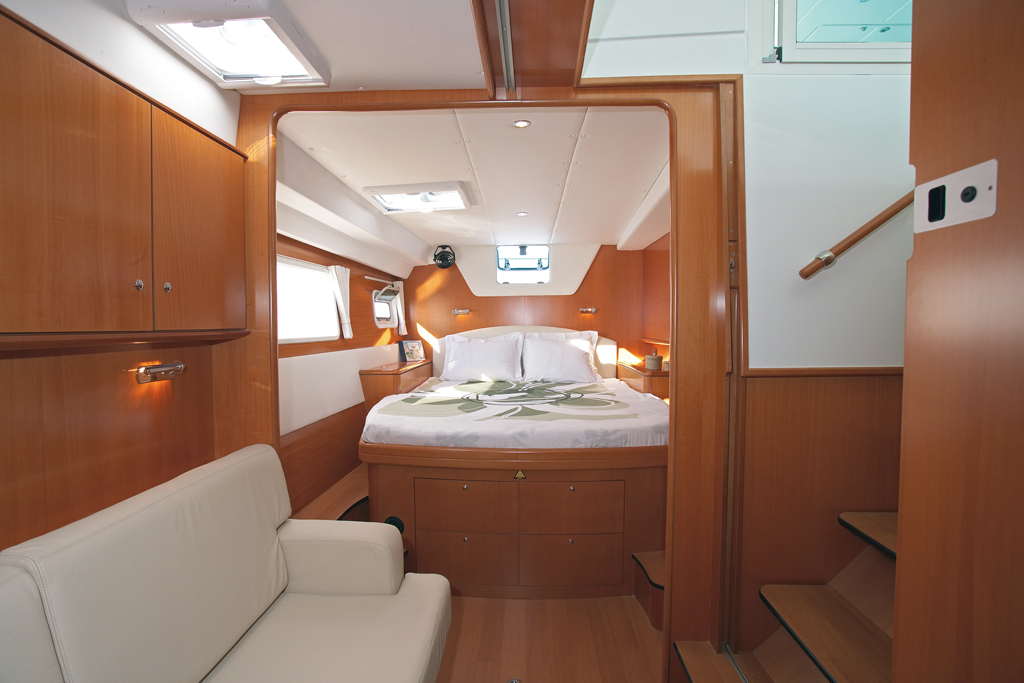
The owner’s cabin with its dressing table…fit for a king!
Flying bridge, for or against?
In common with many observers, I had a negative opinion of the flying bridge on both aesthetic and practical grounds. However, after several dozen miles aboard, its advantages when under sail are obvious. All the controls are centralised and well-positioned for working without undue back strain at the right height, whilst keeping an eye on the horizon and the sail plan; those who don’t want to participate can be kept out of the way of the control lines without feeling excluded from the pleasures of sailing. Granted, for charter use, the skipper would not be able to keep an eye on the people in the nacelle, but on this type of boat I would not imagine that he or she would be alone with the passengers. The assistance of a deckhand or hostess would be essential to safe operation of a vessel like this. This arrangement is obviously not ideal for a family where only one member is capable of sailing the boat, as the other will have to look after the children.
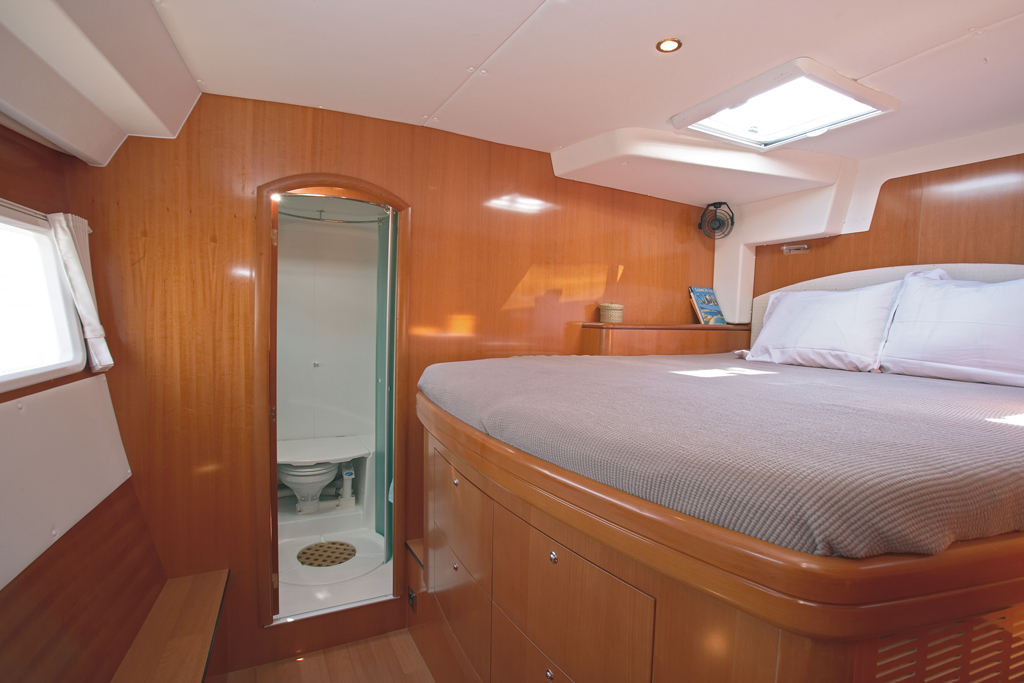
The cabins are really spacious, with excellent lighting and ventilation…
SPECIFICATIONS
Overall length: 15.54 m Waterline length: 14.93 m Beam: 8.52 m Draft: 1.40 m Air draft: 23.76 m Unladen displacement: 18.6 T Fully-battened mainsail: 93 m2 Roller genoa: 67 m2 Water: 4 x 240 l Diesel: 4 x 240 l Engines: 2 x 55hp Price : 509,796 euros ex. tax