Promising to be more ecological, more accessible and more connected, the Lagoon 51 announced by surprise - or almost - at the beginning of the year is full of promise. The doors of the International Multihull Show had barely closed when the pontoons opened up, releasing the new catamaran for a good day’s delivery trip from La Grande-Motte to Canet-en-Roussillon. And an exclusive test sail under the command of Bruno Belmont, aka Monsieur Lagoon!
Test location: La Grande-Motte to Canet-en-Roussillon
Conditions: 4-8 knots of wind, calm sea



Infos pratiques
- Le chantier : Lagoon 51
- La fiche technique
-
 Découvrez notre vidéo exclusive
- Financez votre Lagoon 51
- Assuez votre Lagoon 51
- Articles autour du Lagoon 51
While the milestone of the 6,000th Lagoon produced has already been passed, and the fact that the 600 new catamarans scheduled to leave the three dedicated factories this year won’t be enough to satisfy an extremely dynamic market, no one here is resting on their laurels. But the world leader has a tradition of constantly challenging itself. Did the positive response to the longanticipated arrival of the Aura 51 at its rival Fountaine Pajot push it to react faster? If the answer to the question is elusive, the rejuvenation is difficult to hide. The platform is indeed that of the Lagoon 50, whose mast position has been modified - which is not insignificant from a structural point of view. In order to understand these profound changes, we had the best possible guide in the person of the Bénéteau Group’s Sailing Product Development Manager.
 |
 |
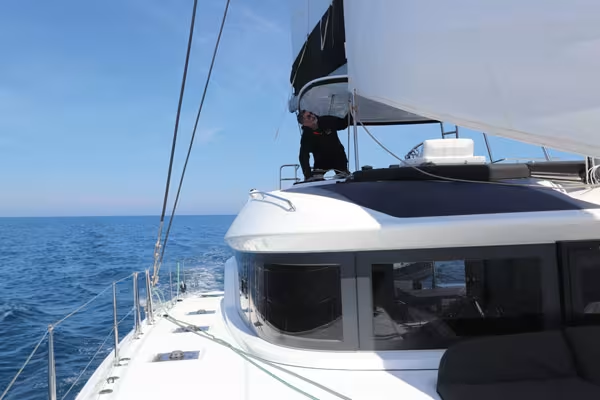
The boom is necessarily very high to accommodate the T-top - access is potentially complicated.
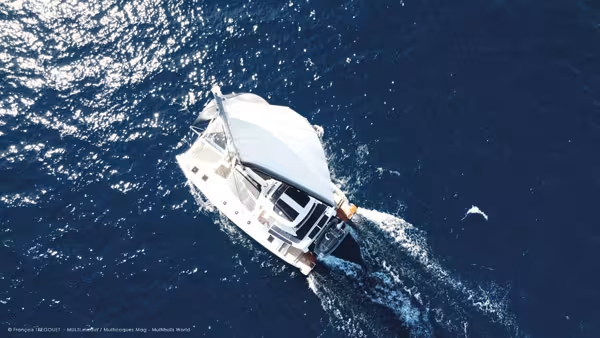
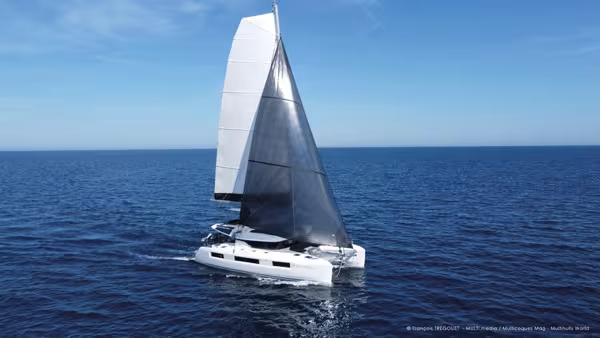
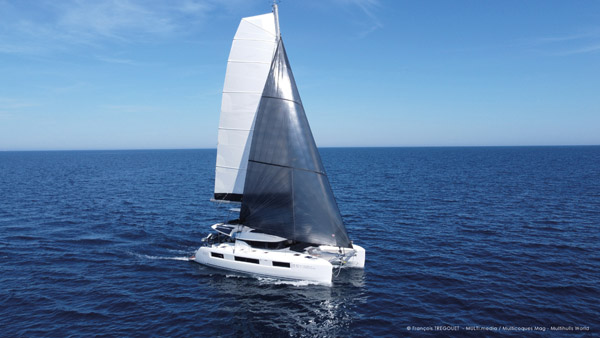
Under gennaker, the Lagoon manages to make the same speed as the wind, if there’s less than 10 knots and the sailing at 60° to the apparent.
Inventing the multihull that doesn’t yet exist
Discovering the Lagoon 51 during a crossing of the Golfe du Lion between La Grande-Motte and Canet-en-Roussillon, with Bruno Belmont as skipper, is a real privilege. Unknown to the general public, Bruno happens to be the spiritual father of the very first Lagoons - but also of Sense monohulls and Excess Catamarans. Physically, he bears a bit of a resemblance to famous French industrial designer Philippe Starck... Ultimately though, Bruno’s abundant (yet realistic) creativity, his ability to anticipate expectations, and analyze the evolution of uses make him more than just a designer – he is a true “visionary” according to naval architect Marc Van Peteghem. With Vincent Lauriot-Prevost, the trio first met at the School of Naval Architecture in Southampton. Inventing the boat that doesn’t yet exist, but that will be a great success tomorrow, is a real and rare talent, and an infinitely precious one for a group like Bénéteau. He says that “creativity is the experience you get out of it ”.
Though all shipyards are now trying, in a more or less convincing way, to move towards more eco-responsible boats, Bruno created a working group on the subject in 2006. A dozen people from the Bénéteau Group were working with conviction on their responsibility as yacht builders towards the planet. Unfortunately, the crisis of 2008 put a brutal stop to a project that, some fifteen years later, has once again become a burning issue. So he searches, finds, and is not satisfied with appearances. When he realized that a major supplier of fabrics made from recycled fiber was importing the so-called “green” textiles by airplane from the United States, he replaced it without delay, using a company that was more consistent in its processes.
 |
 |
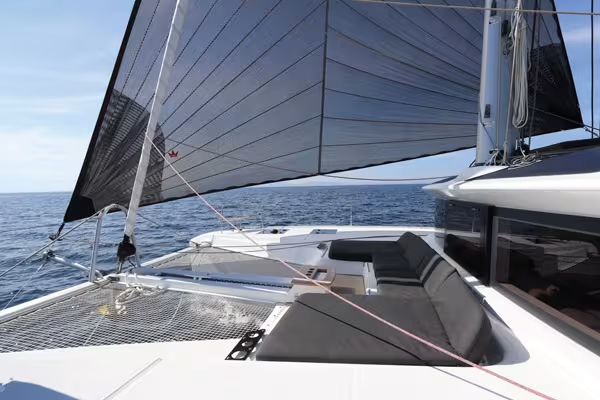
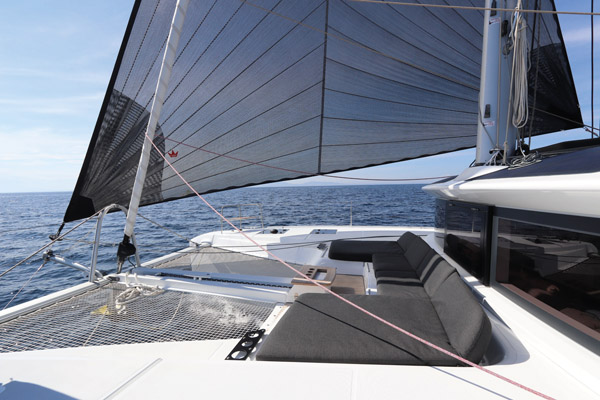
The forward cockpit is well integrated between deck and trampoline.
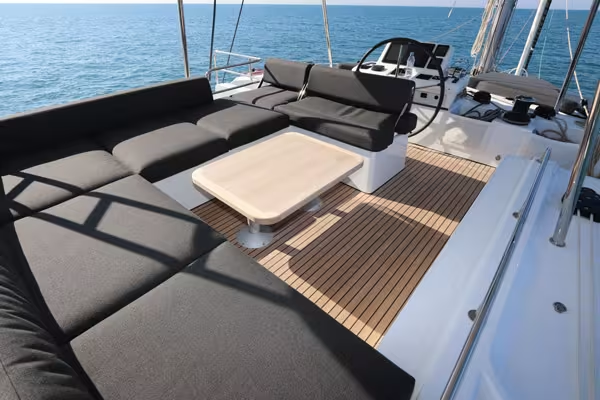
Three neat bench seats, an adjustable angle grill and a large table – you want for nothing in this cockpit.
More than 3,000 Wp of solar panels
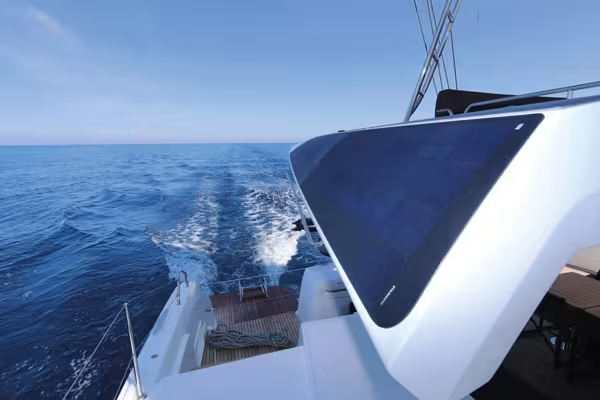
For the Lagoon 51, the whole process was just as radical. As a result, 3,020 Wp of solar panels can be integrated into the coachroof and on the bimini. Enough to supply all the electricity needed on board under way and at anchor... not counting air conditioning of course. The bonding of the Solbian flex panels has been meticulously executed, but while the panels are guaranteed for 5 years, their resistance over time on the most curved areas remains to be confirmed. The design of future models will have to take these new requirements into account. With even greater impact, an uncompromising assessment has been made of the choice taken some ten years ago to shift the mast aft to the center of the coachroof. The large self-tacking solent and the short boom had their advantages. But the only solution to increase the sail area and thus improve performance under sail was to go for a taller rig. This wasn’t particularly something in the direction of seakeeping behavior, for as we know, pitching is the enemy of multihulls. So, back to a mast stepped on the median beam, at 40% of the length back from the bow. On the scales, stamped CE, the light displacement has lost 1,000 kg (2,200 lbs), i.e. a reduction of 5%. With the structure lightened by 750 kg (1,650 lbs), a rig that’s over six feet (2 meters) shorter, and an overlapping genoa, the Lagoon 51 is lining up to be more lively on the water than her predecessor.
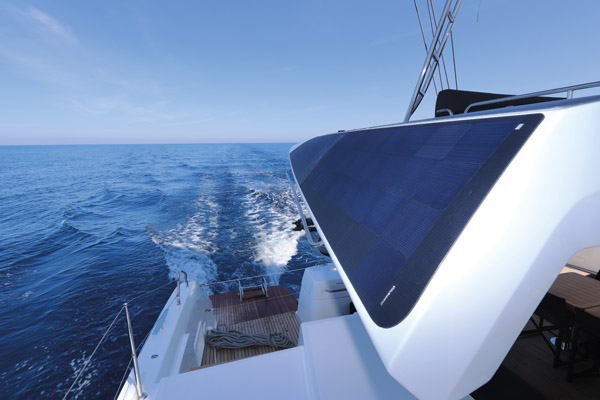
Just over 3,000 Wp of the latest generation solar panels have been glued to the coachroof.
An exclusive report!
The video of our boat test report has been widely shared by the builder on their website and social media.
Keeping a 360° watch from the flybridge
But despite the best laid plans, sailing requires wind! Following the stormy conditions endured through the boat show, the Mediterranean decided to play it piano subito: just 36 hours after the International Multihull Show had closed, the sea was like a millpond. So we set out, putting the twin 80 HP Yanmar engines to the test. As with the first Excess catamarans, the Lagoon 51 tries to offer original equipment that is more suitable for most uses than the traditional standards, whose “from” price is certainly attractive on paper but doesn’t correspond to anyone’s reality. Gone are the standard 57 HP motors of the Lagoon 50s and the almost obligatory option of the 80 HP version. The owner’s layout seen at La Grande Motte, which includes four cabins, a dressing area and three bathrooms, becomes the basic version. As we waited for the thermal breeze promised by the forecast for the early afternoon, we made a direct course at 8 knots, with the engines at 2,200 rpm consuming 1.37 to 1.45 US gallons (5.2 to 5.5 liters) per hour each – giving a range of over 750 nautical miles. From the flybridge, Bruno was enjoying a 360° view, so we took the opportunity to have a look over the boat.
 |
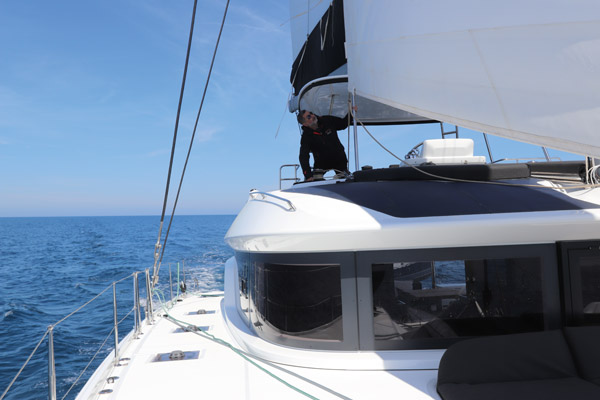 |
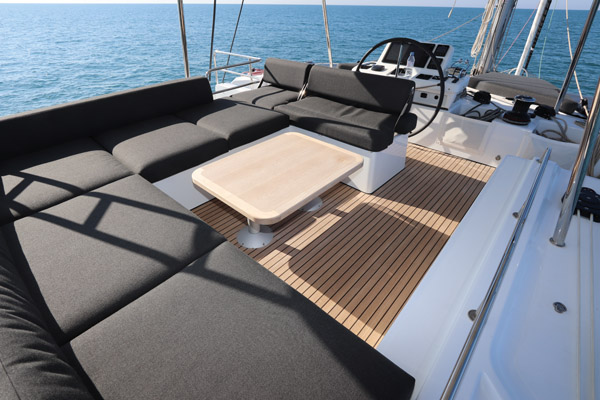
The double-access flybridge is as friendly as it is huge. The entire forward section is given over to helming and maneuvering, which is direct and easy - you can always have an eye on the sails.
A former automotive designer at the helm
Still as voluminous and as infatuated with interior comfort as ever, the Lagoon 51 design also focuses on its exterior look. Former car designer Patrick le Quément - now associated with VPLP for a new life in boating - works on every detail. A bow angle, a topside line, a bimini radius: nothing escapes him. With his very elaborate coachroof, it’s clear that under his impetus, the Lagoon range in general and this new 51 in particular has become yet more elegant. Our only reservation is the angle cut at the back of the side windows. Certainly, from the outside, the “eyeglass arms” effect refines the silhouette. But when you’re inside and going down the companionways, a piece of the landscape is missing, as if you were deprived of the credits at the end of a great movie. This is the only example we found where design seems to have taken precedence over function. Clearly, the concern for a more harmonious catamaran was something shared by all those involved in the project. For example, in cooperation with Lancelin rope manufacturers, the halyards, which used to be too brightly colored, are now of the same shade - but can be identified by a relevant number of strands of appropriate colors for each of the reefs - 1, 2 or 3, or in the axis for the halyards, for example.
 |
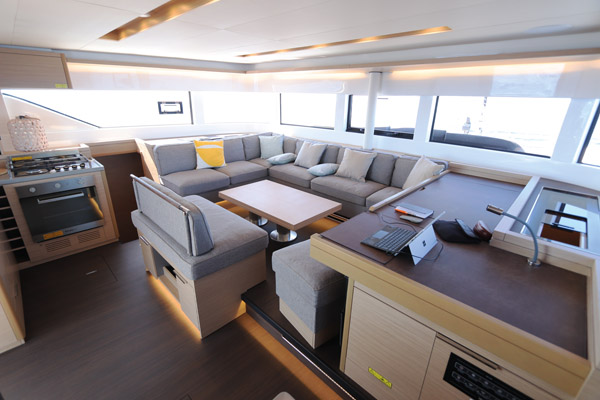 |
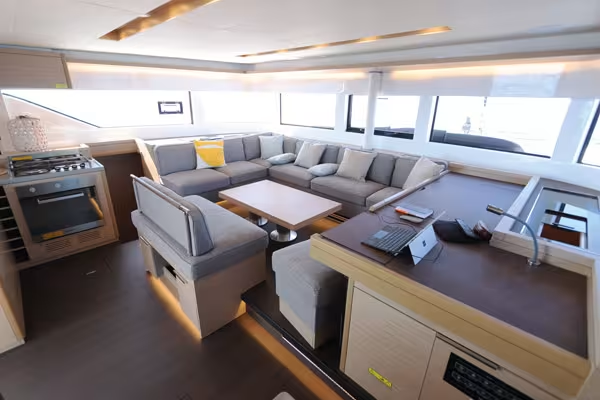
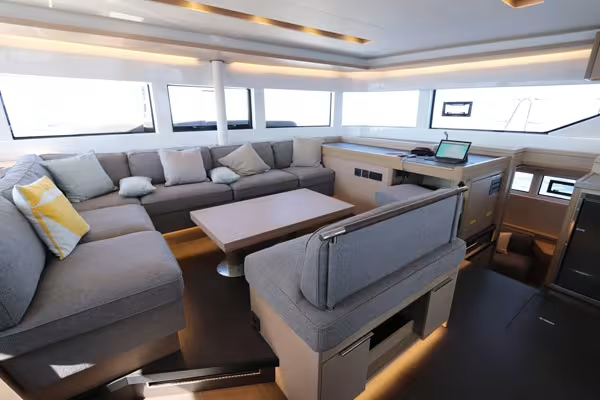
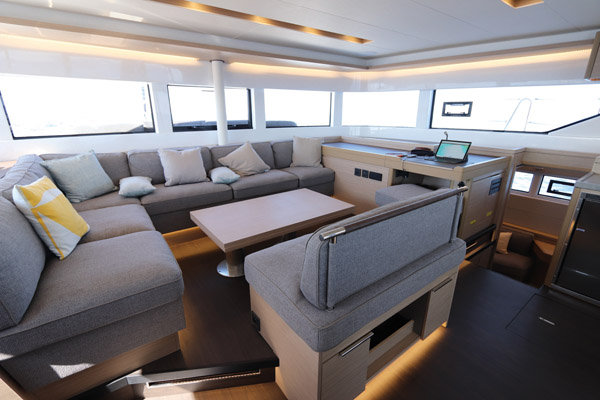
The interior - by Nauta Design - is as carefully designed as ever. Note the mast support strut at the front, now particularly discreet.
Easier access on board
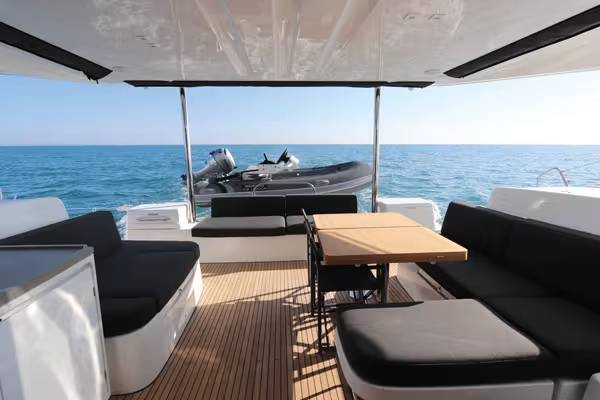
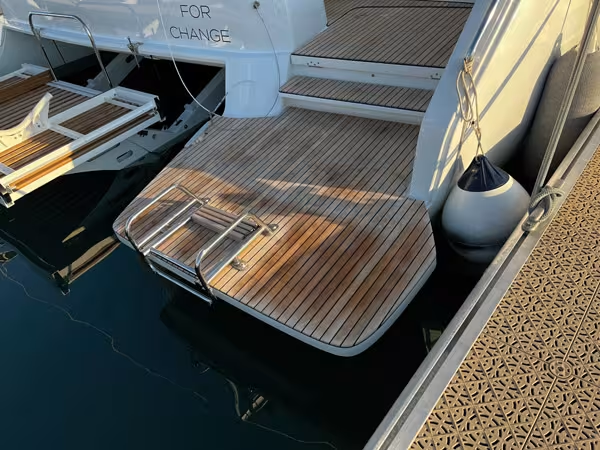
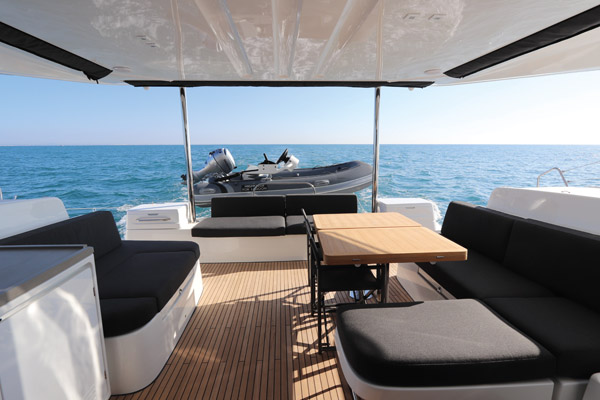
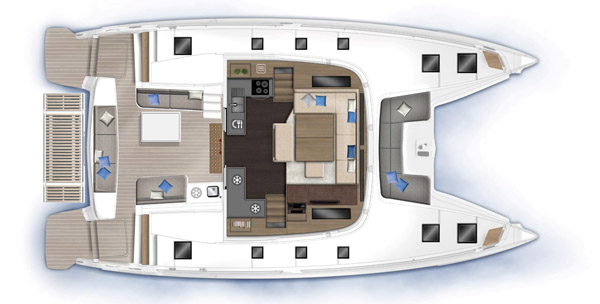
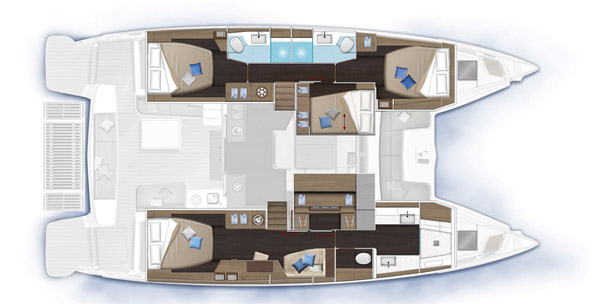
But these are mere details compared to the particular attention that has been paid to access on board the boat and circulation. This starts at the transoms, with easier access for stepping aboard thanks to their shape and positioning, which brings them closer to the dock. Their size is also more welcoming and there is no need to jostle when getting off the dinghy - three people can stand up simultaneously, without getting in each other’s way. Only two steps up, and the cockpit and the entire nacelle are immediately accessible. Two factors have made this linearity possible: the sugarscoops are slightly higher off the water and the thickness between the underside of the bridgedeck and the cockpit sole has been reduced to a minimum. This allows you to take full advantage of the cockpit, whose vast surface area is divided into three zones. An adjustable plancha grill is next to the aft bench seat, a lounger occupies the starboard side, and an L-shaped bench seat surrounds the table on the port side. Part of the seat can be shifted forward to enlarge the table when at anchor, for instance, but this hinders the direct access to the flybridge. Once inside, with the bay window closed, engine noise reduces, and everything is a luxury and a pleasure. One major difference compared to the 50 (see our comparative test Lagoon 50 vs Excess 15 in Multihulls World Special Edition #14): the cumbersome mast support strut near the entrance has obviously disappeared. Also, the Owner’s hull is even more luxurious with its vanity/dressing area fitted as standard. As for the port hull, it offers three berths in the basic version. The furniture, signed by Nauta Design, is as warm as ever, and the materials are plush. We really liked the large opening hatch by the mast foot. This will be an important source of natural ventilation at anchor.
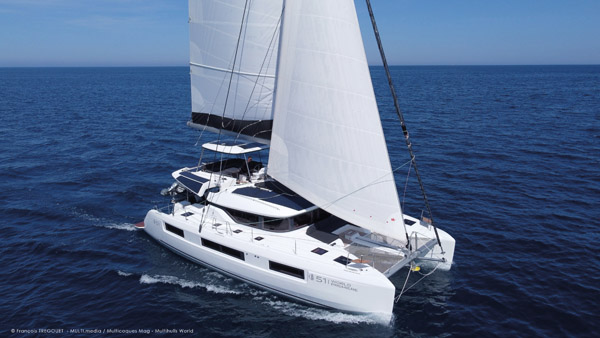
Eventually, the wind picked up as we got in sight of the Pyrenees, and it was time to hoist the sails. A little trip onto the bimini to help the battens clear the lazyjacks indicates that a less perilous solution needs to be found. Perhaps by doubling up the long straps used for shutting the lazybag? They could be used to spread it apart maybe. Busy taking pictures and flying the drone, I let Bruno do all the other maneuvers by himself. It appeared to be child’s play: halyards and sheets all come back to the central helm station with the optional electric winches. From up there, you have a perfect view of the sail plan. Under the Code 0, our speed was oscillating between 7.8 and 8 knots, which was the true wind speed. Admittedly, we were on a heading at 60 degrees off the apparent. But even under genoa, we were pleasantly surprised to exceed 7 knots at 55 degrees off the wind. The new sail plan distribution and the return to a more forward-set rig are certainly not unconnected. By involving its suppliers, and even seeking the expertise of an external design team, the Lagoon 51’s mast no longer has aggressive diamond stays for the genoas, but two sets of aft-swept spreaders. While being lighter, the profile of the mast divides the canvas better and thus offers more adjustment possibilities. As for the sails, they have been entrusted to Elvstrøm sailmakers. Beyond their know-how as master sailmakers, which needs no introduction, proposing sails made from recycled materials seemed very relevant to this new Lagoon’s design team.
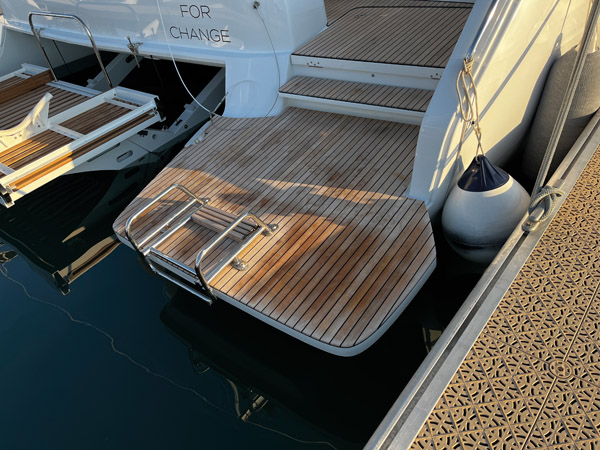
This shot of the Lagoon 51 shows the pertinence of the newly designed sugarscoops. Though they will need good protection during some port maneuvers where you might need to lean on the corners.
Conclusion
Undeniably, this Lagoon 51 is heading in the right direction. There is a real awareness of the ecological impact of leisure boating. 80% of the carbon footprint of a boat comes from its use. Sailing, natural ventilation rather than air conditioning, more solar panels and therefore no need for a generator, are all positive signals that this new model out sending, without taking anything away from the comfort and quality of finish offered. Quite the contrary in fact. The next major evolution will concern the engines, as we saw during this test. First hybrid then electric. They still have to address the question of energy storage, according to Bruno Belmont, who is more impatient than ever to see nanotechnologies revolutionize the battery market. In the meantime, this Lagoon pays attention to its weight, its lines, and the details of accessibility and life on board, creating an ever more refined cruising experience.
 |
 |
 |
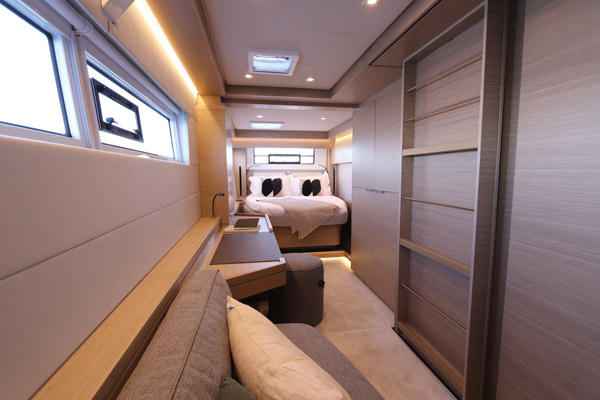
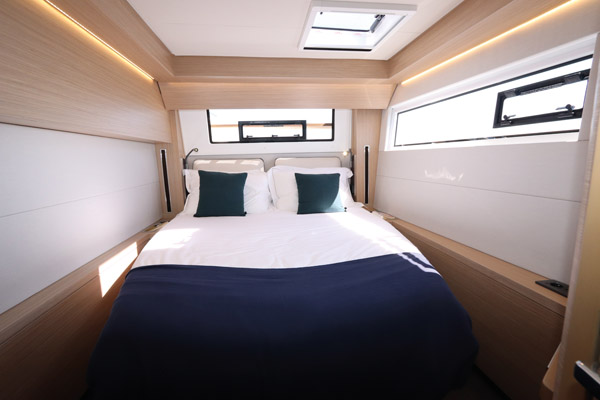
A proper sea view suite awaits the owners in the starboard hull.
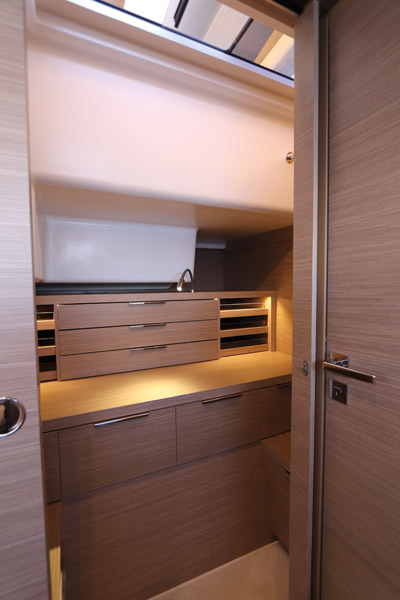
A proper vanity unit on the inboard side of the owner’s suite.
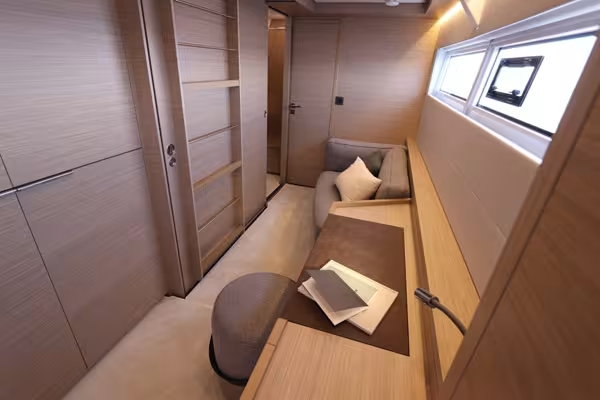
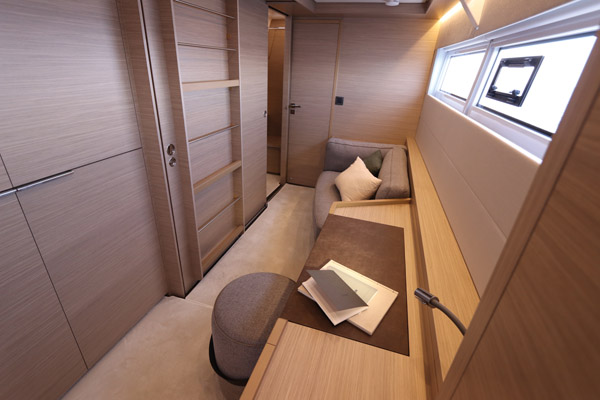
What could be better than this office for working from home (on the water)?
THE PLUSES :
+ Much easier access getting on board
+ More enjoyable under sail
+ Great comfort as always
THE MINUSES :
- Getting on and off the bimini requires acrobatic skill at times
- Winches on the flybridge too low, even if they are electric
- Tortuous access to the chain locker
 |
 |
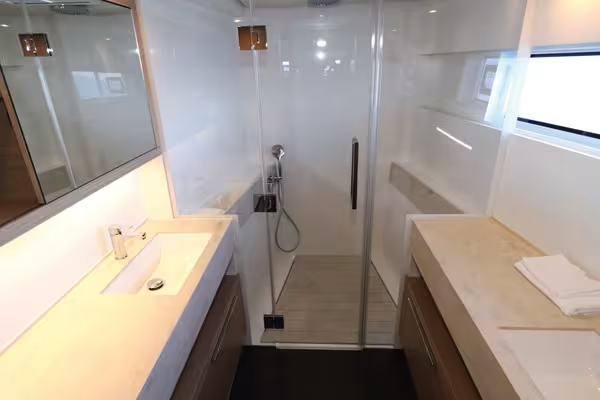
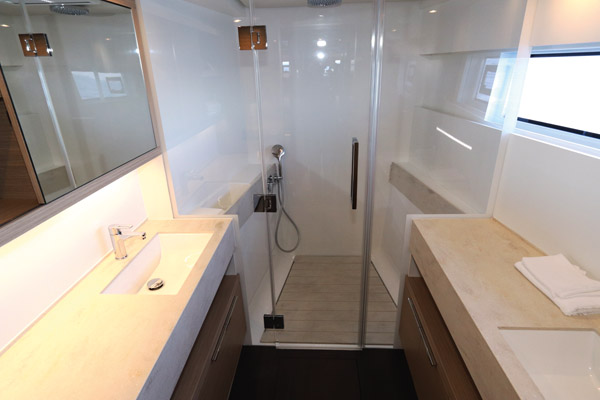
In the starboard bathroom, which is very well finished, having washbasins opposite one another avoids a corridor effect.
On the port side aft, guests enjoy the same beds as the owners
TECHNICAL SPECIFICATIONS
Builder: Lagoon
Architect: VPLP Design
Exterior design: Nauta Design
Interior design: Patrick le Quément
Length: 50’4” (15.35 m) Beam: 26’7” (8.10 m)
Draft: 4’6” (1.38 m) Air draft: 77’2” (23.53 m)
Light displacement: 43,910 lbs (19.91 t)
Sail area (standard): 1,615 sq ft (150 m²)
Sail area (square-topped main): 1,647 sq ft (153 m²)
Mainsail: 1,044 sq ft (97 m²)
Square-topped mainsail (option): 1,076 sq ft (100 m²)
Genoa: 570 sq ft (53 m²)
Code 0: 1,087 sq ft (101 m²)
Water: 219 US gal (830 l)
Fuel: 2 x 137 US gal (2 x 520 l)
Engines: 2 x 80 HP Berths: 6 to 14
CE Category: A: 12 - B: 14 - C: 20 - D: 30
Standard price (4 cabins, 1 vanity, 3 bathrooms, 2 x 80 HP Yanmar 4JH80): € 885,000 ex-tax
Main options ex-tax
Essential Pack: € 40,330
Comfort Pack: € 49,900
Aft cockpit cushions: € 4,250
Forward cockpit cushions: € 3,600
All electric Harken winches: € 9,900
Code 0, fittings and electric furler: € 16,670
Hydraulic Tenderlift: € 40,130
Rigid flybridge bimini: € 14,320
Electronic engine controls at the helm: € 8,750
Integrated solar panels on the roof and bimini (3,020 Wp): On request
26-gallon (100-liter)/hour watermaker: € 15,860
Raymarine electronic pack: € 14,850
Preparation, launching and mast stepping: € 18,150
 |
 |