The arrival of the Lagoon 400 in 2009 pushed the 410 towards the exit. The 450 and 560 generation inaugurated some very creative volumes and the appearance of the Nauta interior design did the same with the 500, trapped in a pincer movement by these two champions of life aboard. The Lagoon 52 replaces its elder sister, with an innovative sail plan. Revolution, or development?
Infos pratiques
- Le chantier : Lagoon 52F
- La fiche technique
-
 Découvrez notre vidéo exclusive
- Financez votre Lagoon 52
- Assuez votre Lagoon 52
- Articles autour du Lagoon 52
Back to the future
The IOR monohulls of the 70s flew enlarged genoas. The half and one-tonners and maxis thus paid their tribute to a rule which favoured this configuration, but they also understood that the area flown forward of the mast is not perturbed by the spar. Cruising monohulls plunged into the gap, despite dubious manoeuvrability, resulting from the inappropriate fittings of the time. The fashionable short (chord), deep keels, reinforced the unsuitability of these boats to the coastal cruising and beaching which are nevertheless practiced by the majority of users. The contemporary Snowgoose catamarans (from Prout) were a big hit amongst British sailors who didn’t stop praising their truncated mainsail (this is how it appeared in the 80s!), shallow draft and moderate beam, which allowed them to emigrate to the warmer latitudes of the Mediterranean by taking the gastronomic Canal du Midi. The message sent by Phil Weld winning the 1980 Ostar with the 50’ Newick MOXIE, equipped with a rig he himself described as ‘geriatric’ was even less well understood, as shortly afterwards the racing catamarans were flying mainsails with a huge area and acrobatic roaches, with Hobie Cat jibs! Hard to get one’s bearings... The transfer of racing solutions to cruising boats is not always relevant. And then development of the techniques and perfecting in competitions allowed construction of strong, reliable aluminium masts in large sizes, which were quickly adapted to cruising multihulls... ‘Charente Maritime’ had just won La Rochelle – New Orleans with a 150m² mainsail; the way therefore seemed to be marked out! 30 years later, the architect’s office which had won the America’s Cup and the leading builder of cruising catamarans re-examined this set of problems and on the 39’ and 52’ models opted for a new balance of the sail plan...
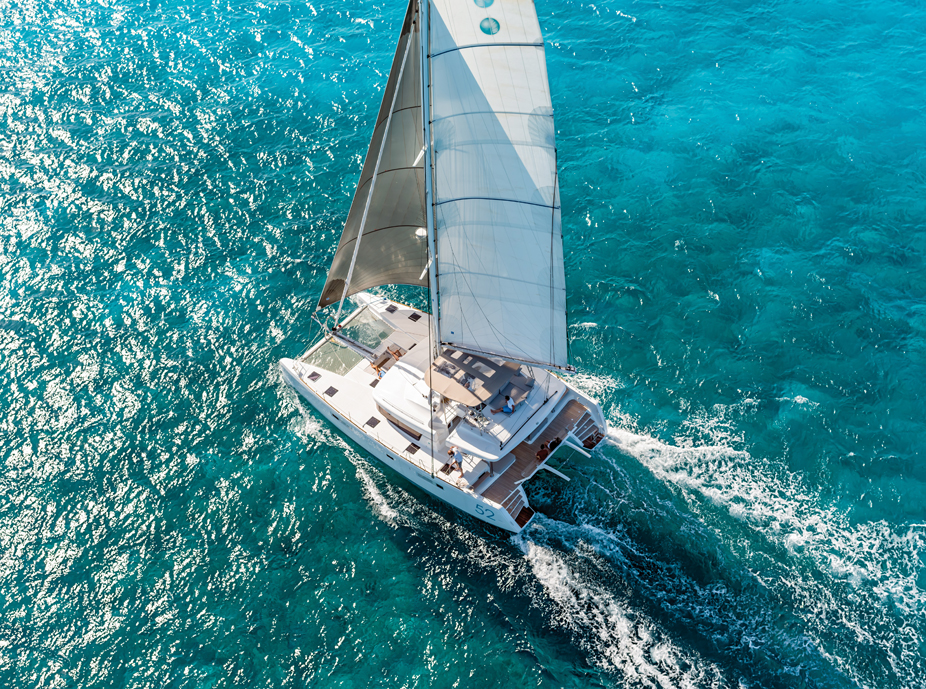
The 52' is aimed at those who want to sail far in amazing comfort; the successor to the 50’ meets the same programme, but in a different manner!
Less propulsion, more traction!
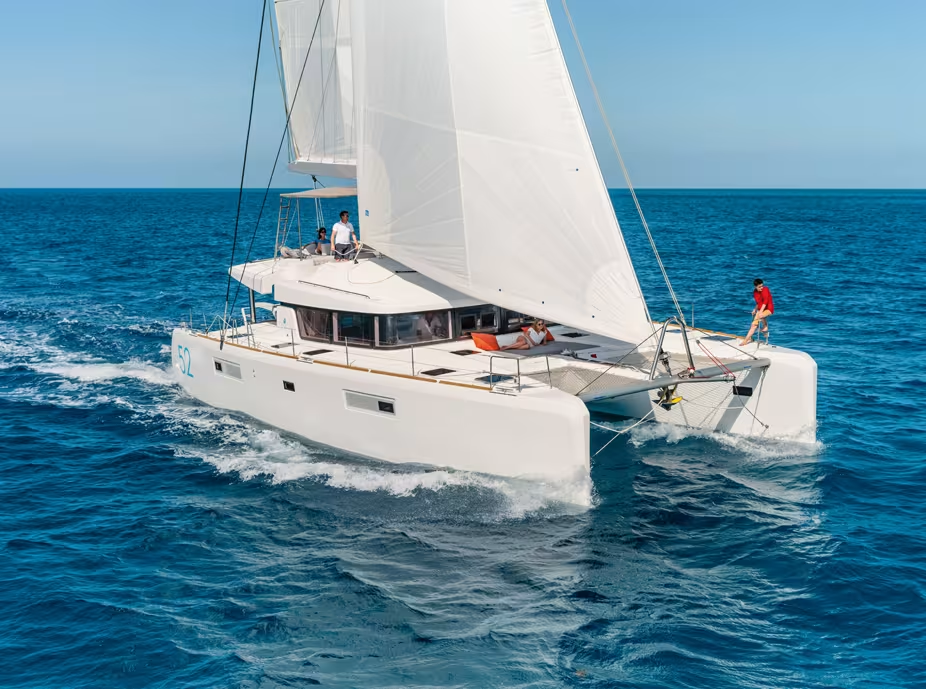
The architecture of the company’s new sail plans was unveiled during a lecture by Marc Van Peteghem at the Paris Boat Show, but we weren’t able to test them until the end of the Grande Motte boat show, as part of a delivery trip to the Balearics. Let’s quickly try to put into perspective the builder’s motivations, before going aboard. To return to the link with racing orientations, everyone has noticed that from the last generation of 60-footers onwards, masts moved aft (desirable development with the appearance of curved foils and canting rigs) so as to favour the boat ‘rearing up’ at high speed and avoid it ‘digging in’. This trend was confirmed with the ‘record-breaker’ trimarans (Idec, Sodebo, Groupama 3 and Banque Populaire V). The same logic applies on a cruising catamaran, but the advantages of the new sail plans above all offer benefits through its new position. From the point of view of the dynamic qualities, the movement aft of the rig’s mass is the target, to allow a reduction in pitching. Opening the forestay angle reduces compression and permits a slightly lower inertia tube to be used. The increase in the area of the foresails also contributes to the reduction of the mainsail area and the weight of the boom. In addition, this arrangement allows the use of the new cuts and materials used by sailmakers for light weather sails. We therefore end up with an elongated mainsail which works better aloft whilst remaining easier to use (tacks and gybes) and reefing is delayed with no loss in the total area. The advantages are considerable, as they allow the underwater sections of the hulls to be slimmed down, and improve the panoramic view from inside the coachroof, by doing away with the mast support strut’s casing from the forward bulkhead.
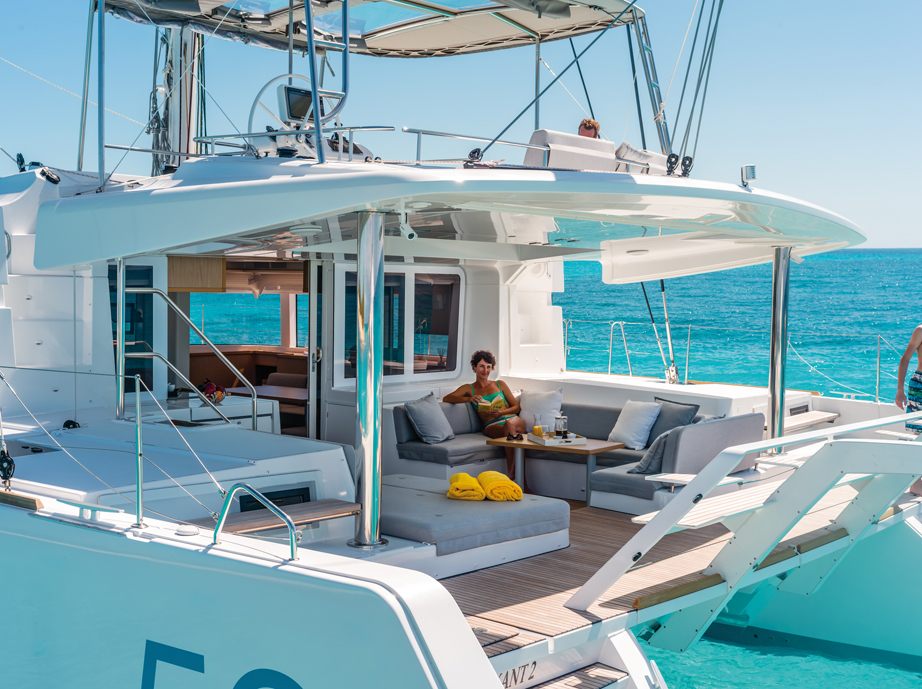
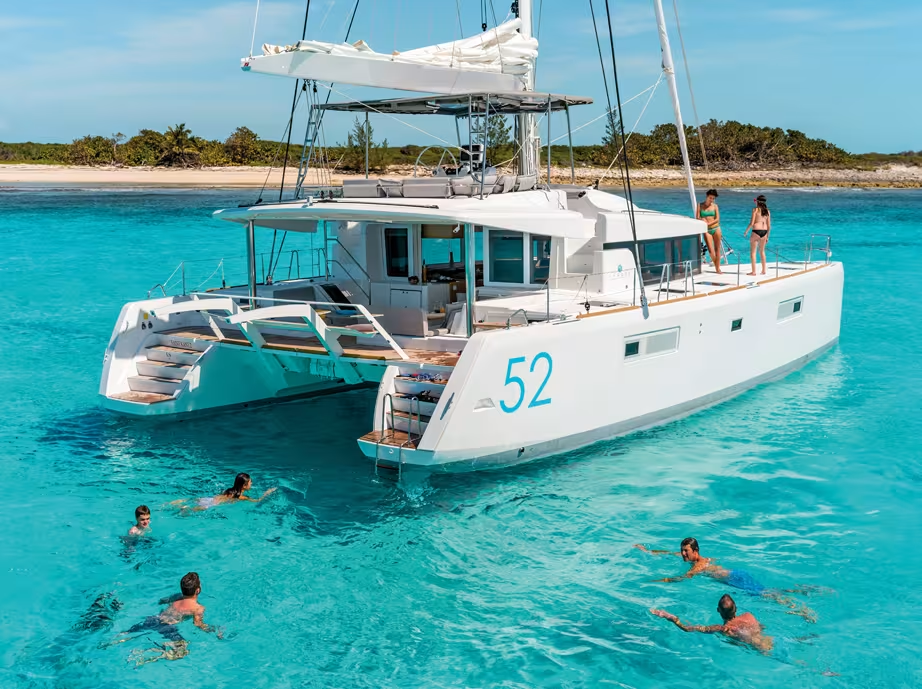
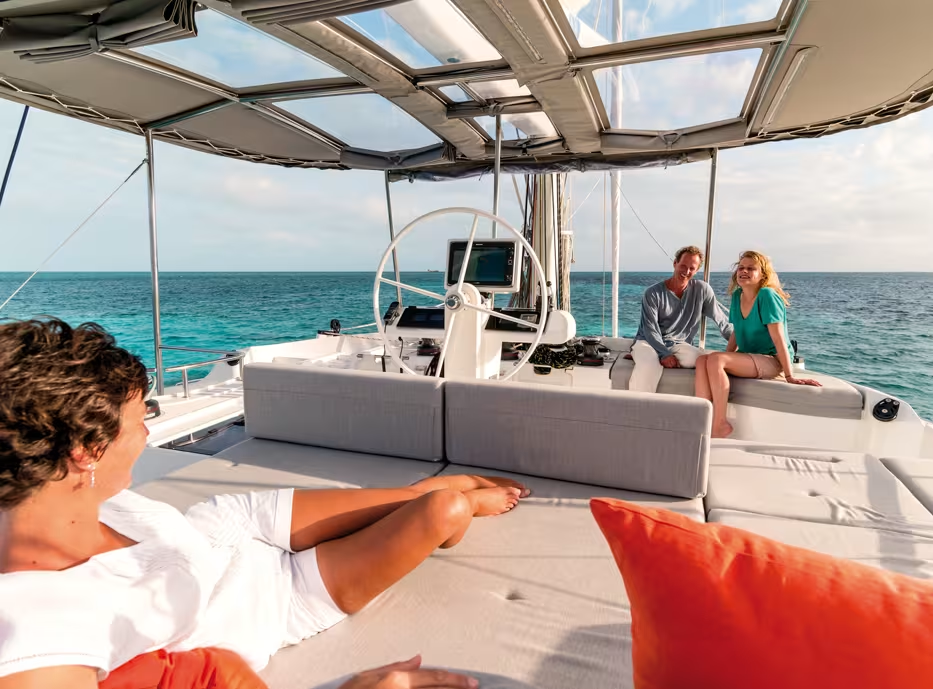
The superb exterior saloon. Relieved of all technical functions, this area is both reassuring and convivial…
What are the constraints?
Fixing the mast support strut on the bulkhead was very practical, despite the congestion of this area, which is already laden with technology (cables, battery bank, chart table...). A supporting structure therefore had to be created in the nacelle and the forces distributed laterally and above all longitudinally. The square-section tubular mast support strut, moved a few metres aft, is now supported by a stiffened and strongly-ribbed ‘fish bone’, which occupies the central area underneath the floors. The concept transfers new responsibilities to the foresails; their area is increased, their role in the overall efficiency becomes essential. The qualities of the cut and the fittings (bowsprit, spreaders, furlers, turning blocks…) also become more exacting.
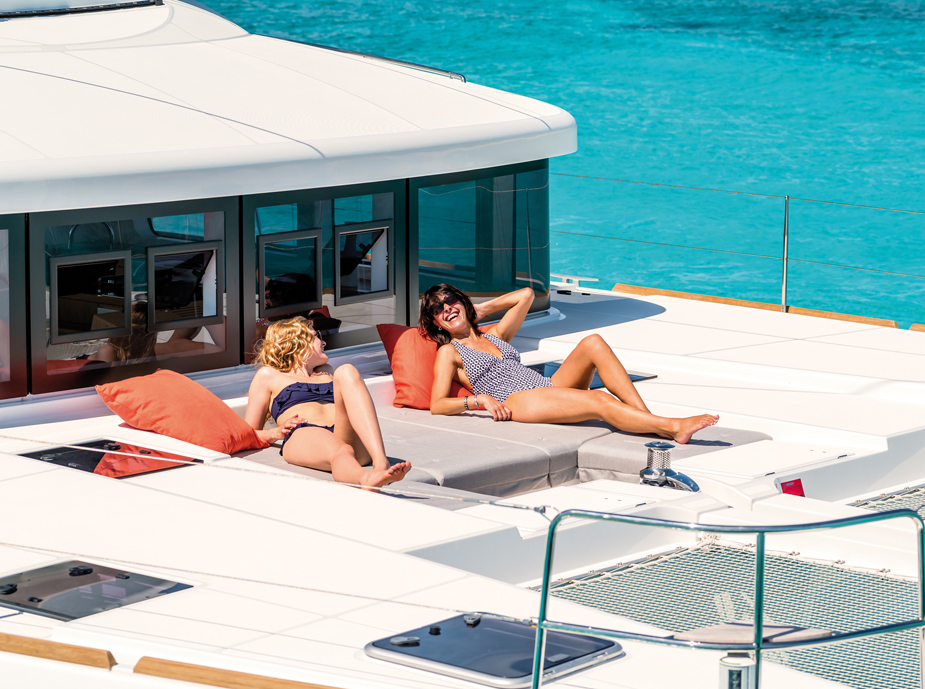
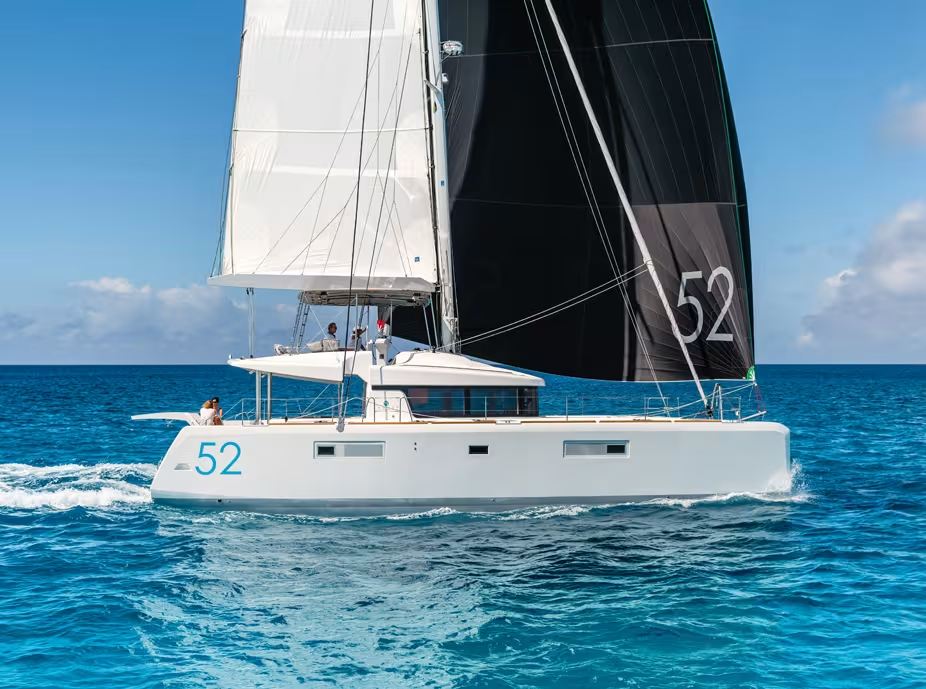
In light weather, the 52’ moves efficiently…and will be capable of good averages in moderate conditions.
Welcome aboard
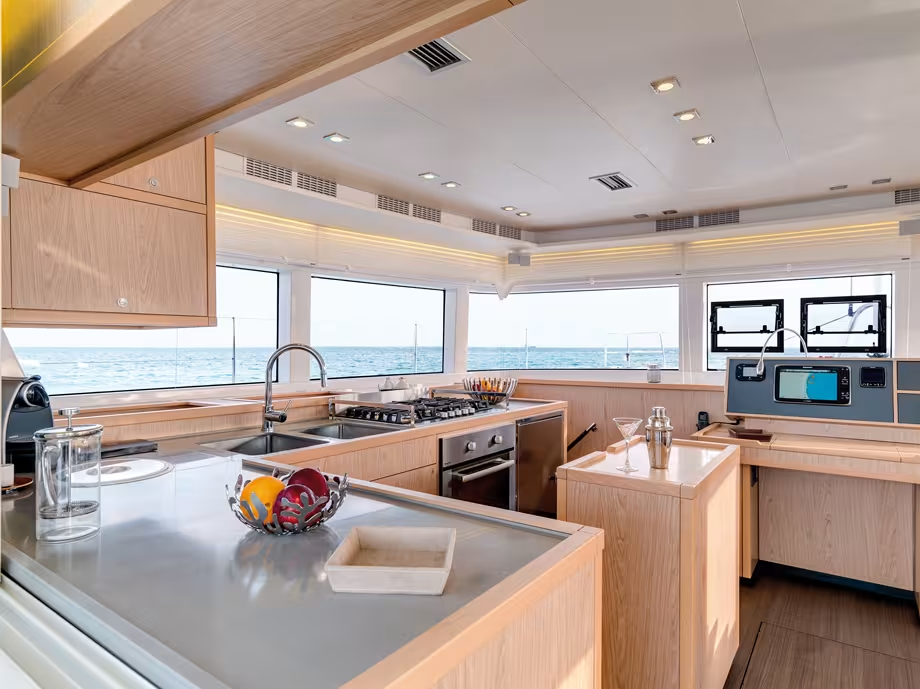
During our week-long test (delivery trip from La Grande Motte to Palma, in Majorca) with the two boats (39’ and 52’), the first occupants’ resistance when it came to leaving ‘their’ 52’ awoke my curiosity and showed the beginnings of an attachment, in short, they accepted grudgingly! We were considering a formal notice to quit, when they finally decided to disembark. It must be said that the 52’ offers a multitude of features calculated to appeal to even the most conservative skipper; as for the first mate, she has already embarked! The 560 is a big boat; the 52’ offers identical services on a different, immediately accessible scale. The charm worked from the moment we stepped aboard. The fixed folding boarding ladder, equipped with strong tubular handrails, sets the tone; the 52’ comes to meet you! The height of the sugar scoops’ steps, their depth and their width take into account the sometimes hesitant steps of an apprentice sailor, and assists disembarkation from a dinghy full of guests, in safety. The exterior lounge seems to display a huge ‘Welcome Aboard’. Relieved of all technical functions, this multifunctional ‘gazebo’ is both reassuring and convivial. The wide aft settee is supported by the elegant CNB davits; it is completed by a large sunbathing area/day bed, an exterior dining area for 8 people and a small outdoor kitchenette, practical for putting food on the plates, preparing cocktails or gutting the fish you have just caught. Each cabin’s privacy and comfort guarantee the success of the conviviality during the stay aboard. The port aft cabin has its own companionway, accessible via a very large hatch with stainless steel gas struts (a remarkable creation); this independent residence is full of charm. The panoramic lounge contains a settee and a removable table for 6 – 8 people; this is the perfect area for enjoying the superb video, sound and multimedia system, with its big screen stowed in its own unit. The chart table desk has a place of honour on the forward bulkhead; we just regretted the absence of a real navigator’s seat with reclining functions. The galley, with its independent stainless steel oven and 5-burner stove is perfectly functional; the big sinks, the top quality taps, the wide stainless steel work surfaces, the central stowage ‘island’ which can also be used for serving, all help the cook work efficiently. The whole area remains easy to clean and discreet. The port forward cabin has its own private entry; the starboard companionway gives access to a charming owner’s studio and a superb forward cabin. Whatever the results of the draw, everyone will be delighted with the accommodation allocated, which is amazing in this size of boat! Life is comfortable aboard the 52’; the quality has come on in leaps and bounds in the last few years. The digital precision of the assemblies, the perfection of the Alpi decoration in reconstituted wood help to show the quality of the construction and correspond to the use; they also encourage rational maintenance and good ageing.
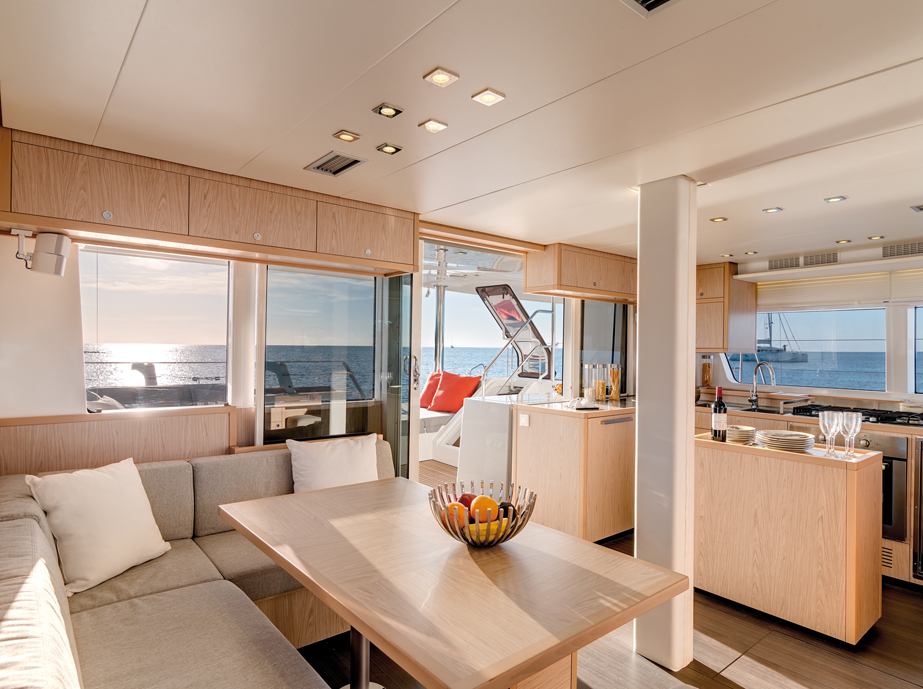
Life aboard the 52’ is really appealing! For our test, we literally had to evict the 52’s first crew, to take its place…
Accessible and understandable technical areas
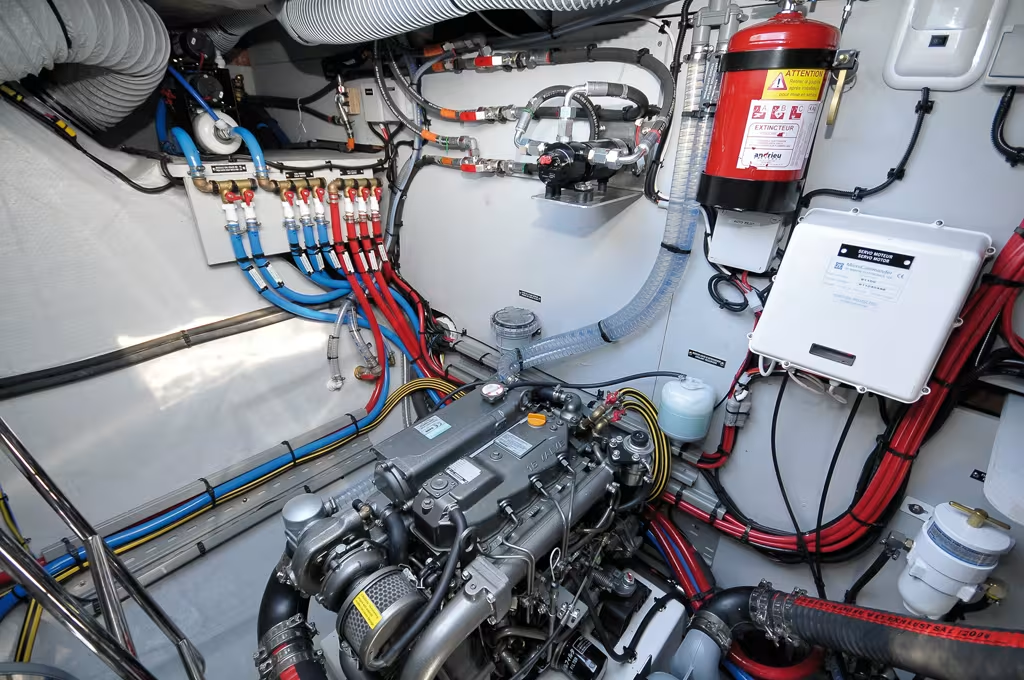
The engine lockers house the very modern 75hp, 4-cylinder, 16-valve Yanmar turbo diesels. The floor is clear; the cables, pipes, distribution manifolds, pump supports, ventilation ducts have all been carefully fitted (here again, there has been progress) and all the functions are labelled with engraved plates. The forward crossbeam compartment brings together the converter-chargers, the battery bank in lidded lockers, the high power cables, arriving on generously-sized copper bars, fitted with welded bolted terminals, and the Cummins-Onan generator. Access to the 12 and 220 volt circuit breakers, grouped together in watertight cupboards, is readable and instinctive. There is enough space for maintenance operations. Given the importance of this very sensitive, exposed area’s watertightness, a safety warning light for the single hatch and a water entry alarm would be relevant. And while we’re at it, the hatch fixing bolts should have blind nuts on them, as they can cause injury...
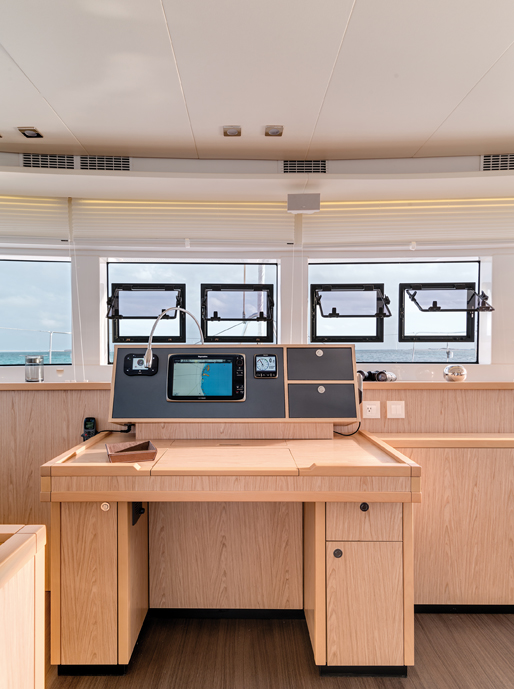
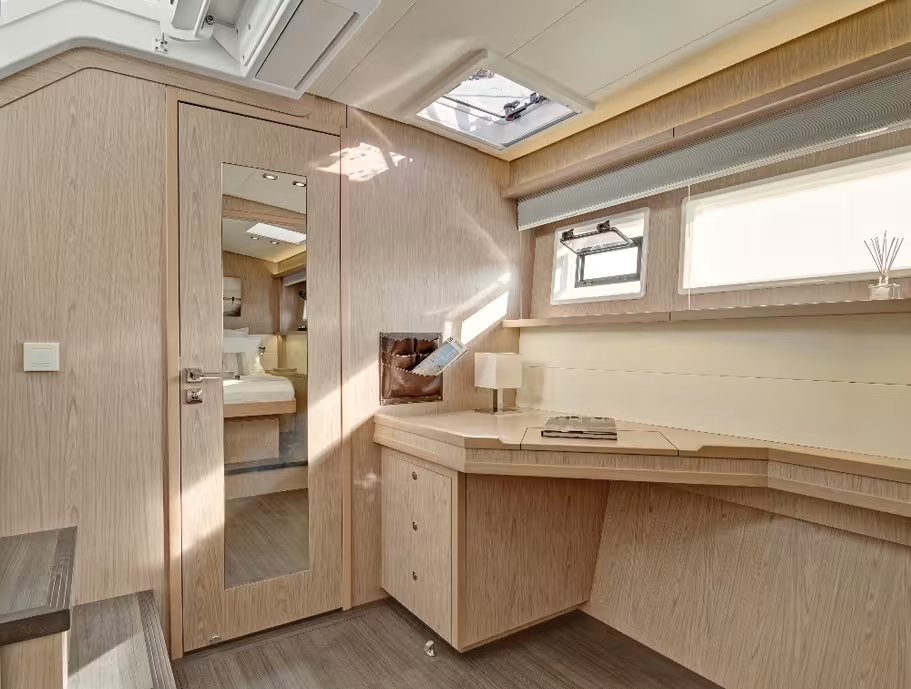
In the gangway, we find a nice office area, to write, update the blog…or work, during the cruise.
Good performance in light weather and a very popular flybridge
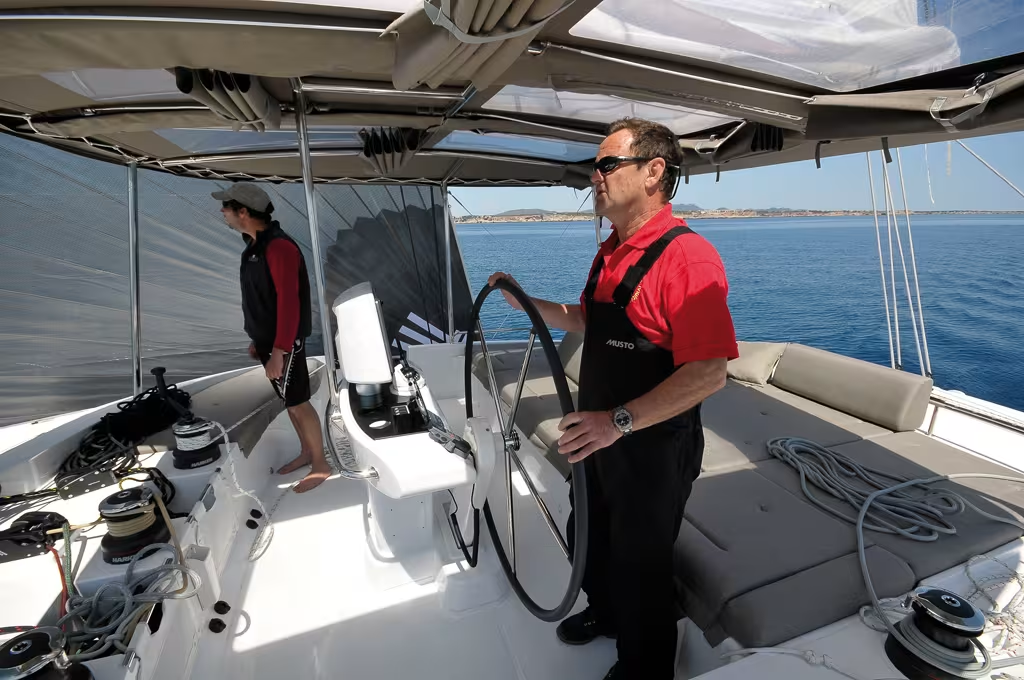
Engine operation remains really discreet in the cockpit, and inaudible on the flybridge! Access to the boom, which may appear acrobatic from the pontoon, is well thought-out; the solutions offered by the stainless steel ladder and the walking areas integrated into the canvas of the bimini are good. The huge sunbathing area, equipped with textile backrests, is wonderful and doesn’t interfere with manoeuvres at all; the deck plan deserves a special mention for the quality of its ergonomics and that of the fittings. This deck plan is sometimes complex (as is the genoa sheet path), and has been the subject of amazing precision in its set up (to the nearest degree for the turning blocks!). Its use is simple, the functions are readable, and the power of the electric Harkens facilitates manœuvres in an impressive way. The shape of the Incidences mainsail was superb, but it was above all the cut of the gennaker which impressed me: the stability of the leech and foot, and its volume, were absolutely sublime for a cruising sail; it is perfectly suited to this new kind of rig on a displacement boat. A pure code 0 would be a heresy; we expect power low down the scale (from 5 knots of wind), therefore a lot of volume, for a sail which flies well downwind. This big foresail’s profile remains superb when it is sheeted in to the maximum, which says a lot about the quality of its design and its stability ; it is therefore possible to sail to windward (50° from the apparent wind) – remarkable! The 54 takes off in a light breeze and even proves to be surprisingly fast in very light weather (5 – 7 knots of true wind). It accelerates in moderate breezes, making cruising under sail efficient, pleasant and interesting. Over the 60 miles we covered aboard, this feeling dominated on all points of sailing; the delivery crew had suffered almost constant bad weather in March around Spain, and confirmed that they had absolute confidence in the boat. This ‘Pullman’ is capable of good daily performances from 5 knots of wind; the log quickly displayed 6 to 8 knots in light to moderate breezes and 9 to 12 in strong winds. Surfing on the swell sent the needle into other areas, but it’s the average speed which counts. The balance at the helm was remarkable; the wheel on its tilting column is really relevant and offers nice observation angles without the congestion of a double installation.
Well situated forward, the chart table only lacks a real navigator’s seat with reclining functions for night watches…
CONCLUSION
A very good cruising and holiday catamaran for sailors who have the means and the wish to leave as a big crew, without giving up the usual comfort. Once settled aboard, it is hard to leave this boat, whose quality of services is superior to most homes ashore! The additional nice surprise was discovering a lively and reactive platform: the recent redefinition of the sail plan seems to be a success. To enjoy it to the full, a broad-shouldered asymmetric would complete the self-tacking jib as well as a gennaker absolutely identical to our test model. I would add a carbon spinnaker pole fixed to the coachroof, which would secure the jib, for sybaritic sailing downwind.
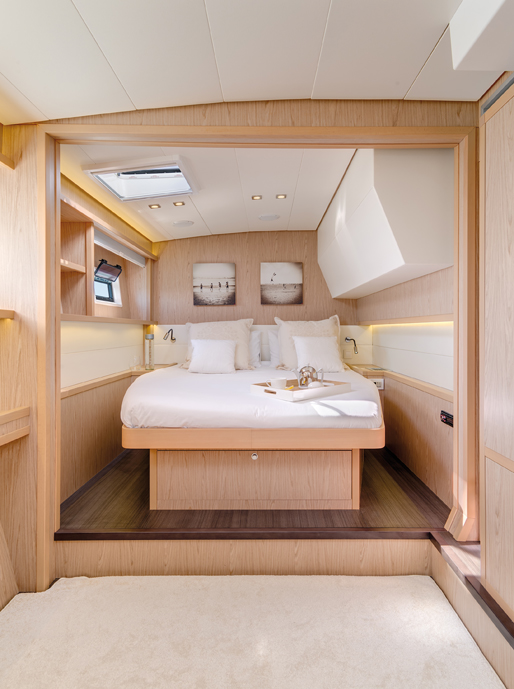
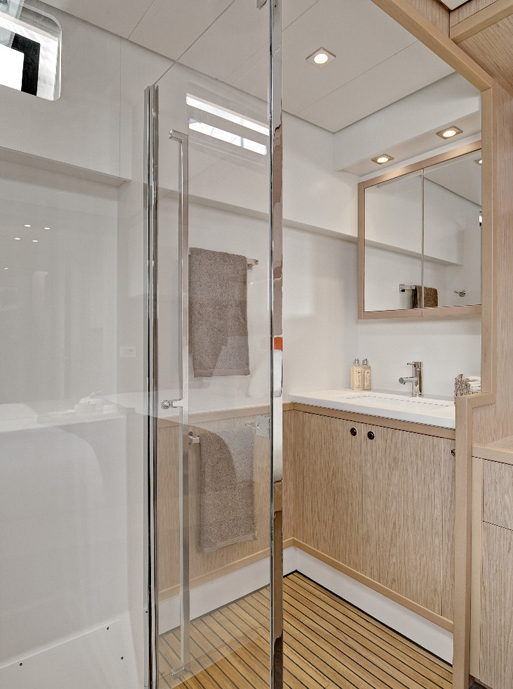
The bathrooms, just like all the accommodation, are extremely practical and ergonomic.
The plusses:
- Amazing comfort
- Balance between conviviality and privacy
- Good performance under sail
The minuses:
- Davit fixings to be reinforced
- The bows ‘push’ the water a bit
- No navigation seat at the chart table
The Competitors
| Model | Builder | Windward sail area in m² | Weight in t | Price exc. VAT in € |
| Privilège Série 5 | Privilège Marine | 141 | 16 | 840,000 |
| Catana 53 | Catana | 174 | 14 | 1,112,000 |
| Discovery 50 | Discovery Yachts | 138 | 14.5 | 1,112,000 |
| Nautitech 542 | Nautitech | 144 | 14.9 | 795,000 |
Technical specifications
Architect: Marc Van Peteghem and Vincent Lauriot Prévost Builder: Lagoon Length: 15.84m (waterline 15.60m) Beam: 8.60m Draft: 1.50m Air draft: 27.22m Tunnel height: 0,85m Unladen weight, equipped to EC standards: 26t Mainsail area: 101m² (107m² with the square-headed option) Self-tacking jib: 59m² Spinnaker: 255m² Gennaker: 150m² Engines: 2 x 54hp or 2 x75hp Transmissions: Saildrive Diesel: 2 x 496l Water: 4 x 240l Material: Polyester composite using the infusion process (Balsa/glass/polyester sandwich with anti-osmosis resins, for the hull sides and the deck. Monolithic polyester for the bottom of the hulls, with anti-osmosis resin). Price: Owner’s version with full luxury pack (ocean cruising equipment): 939,401euros exc. VAT.
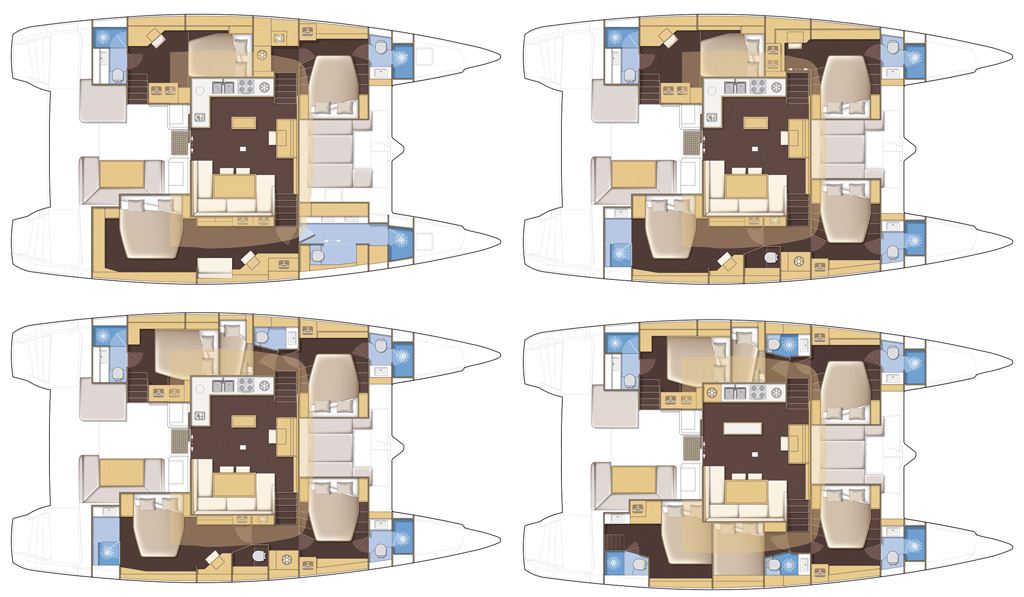
The builder is offering four accommodation versions, with from 3 to 6 double cabins.
Caption
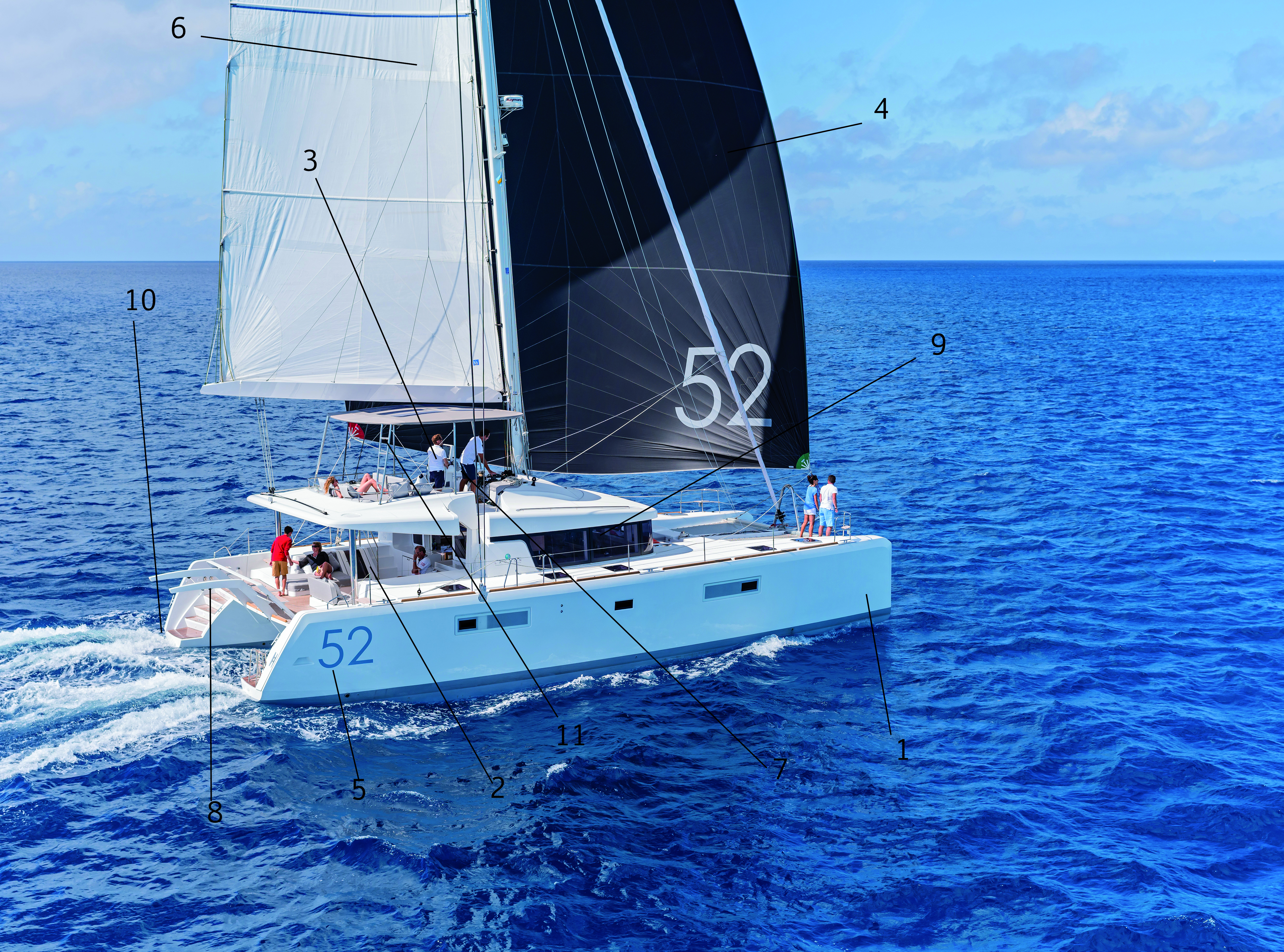
- : A consequence of moving the sail plan aft; slimmer hulls and bows, allowing a reduction in pitching.
- : The separate entry to the ‘magic house’, the superb aft cabin.
- : A generous and efficient flybridge, allowing very good contact with the sail plan.
- : A choice of foresails in large sizes (here, the asymmetric spinnaker), which give good performance in light weather
- : Generously-sized 75hp engines which are very discreet (cruising speed: 8 knots).
- : A sail plan moved aft, a shorter boom for easy manœuvres (100m² of mainsail, nevertheless)
- : The steering wheel on a movable column is an ergonomic advantage.
- : Elegant davits, made by CNB, into which a wide, forward-facing settee is integrated.
- : A panoramic coachroof with no mast support strut structure, better ventilation and forward view.
- : Delicate aft sections which convey good hydrodynamic qualities.
- : Access to the top of the bimini via a ladder, to give good access to the boom.