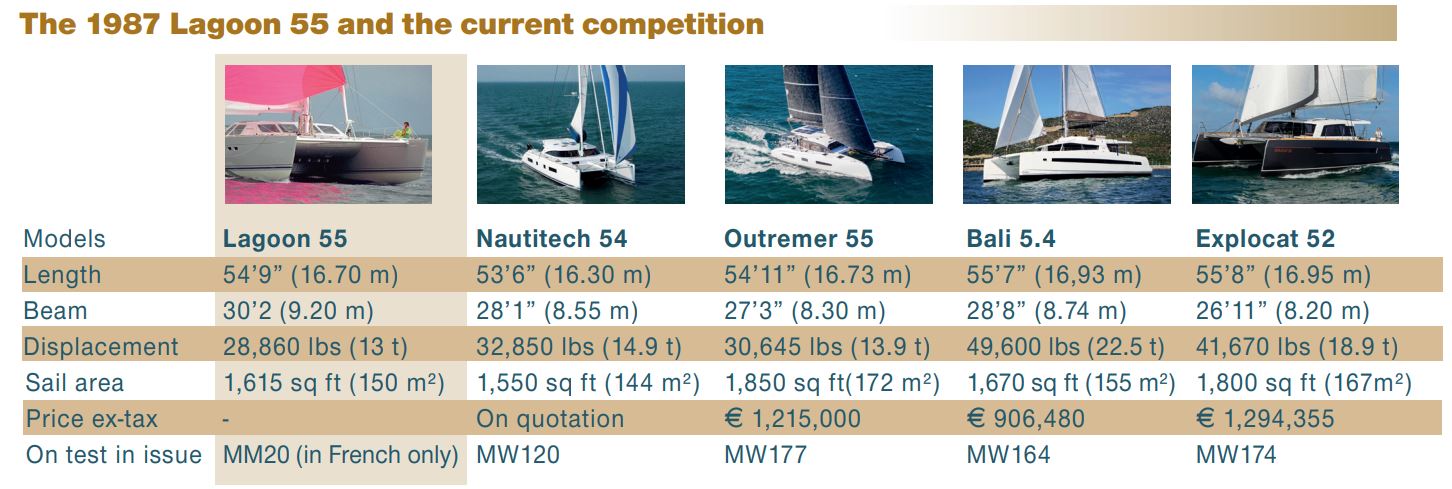
Way back in issue number 20, we tested the Lagoon 55 - the first ever Lagoon! And now, 34 years after the launch of this iconic model, of which only 20 units were sold, the manufacturer is daring to use the same name for a new model. A common practice in the automotive industry, but a little less so in the boating world. According to the shipyard, this new 55 has little in common with its ancestor, but both are a product of their time. With a good breeze, we were able to get a measure of the 2021 vintage of the Lagoon 55.
Infos pratiques
- Le chantier : Lagoon 55 (2021)
- La fiche technique
-
 Découvrez notre vidéo exclusive
- Financez votre Lagoon 55
- Assuez votre Lagoon 55
- Articles autour du Lagoon 55
Test location: La Rochelle, France
Conditions: ENE wind 17 to 33 knots, sea state slight
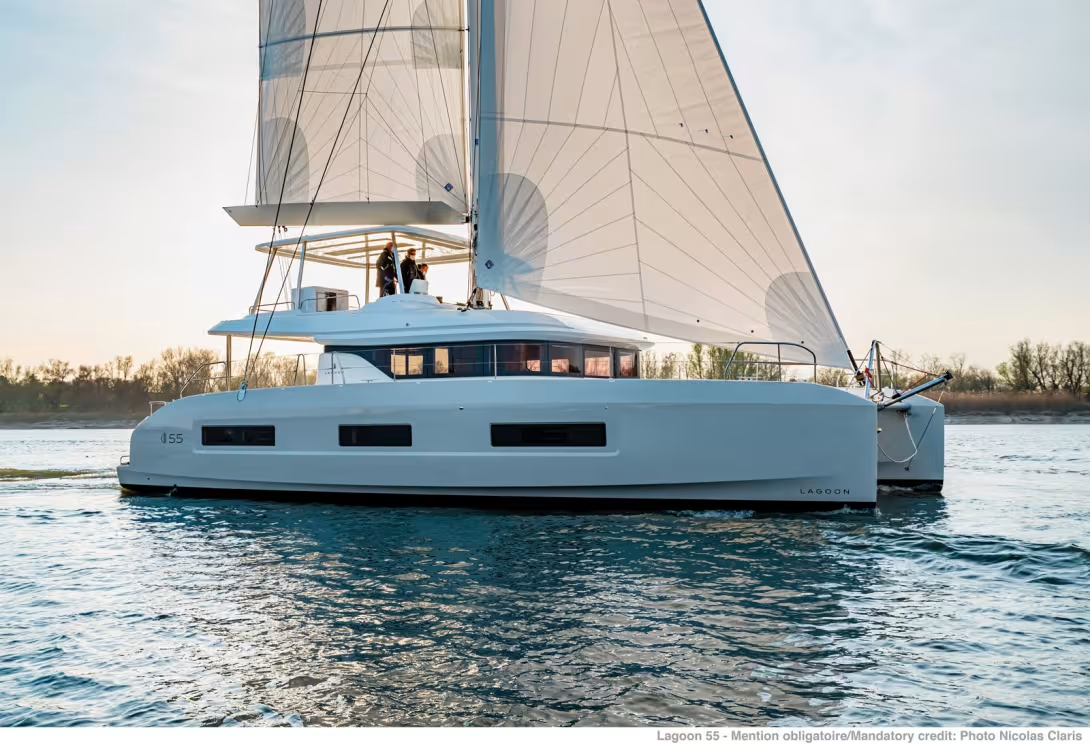
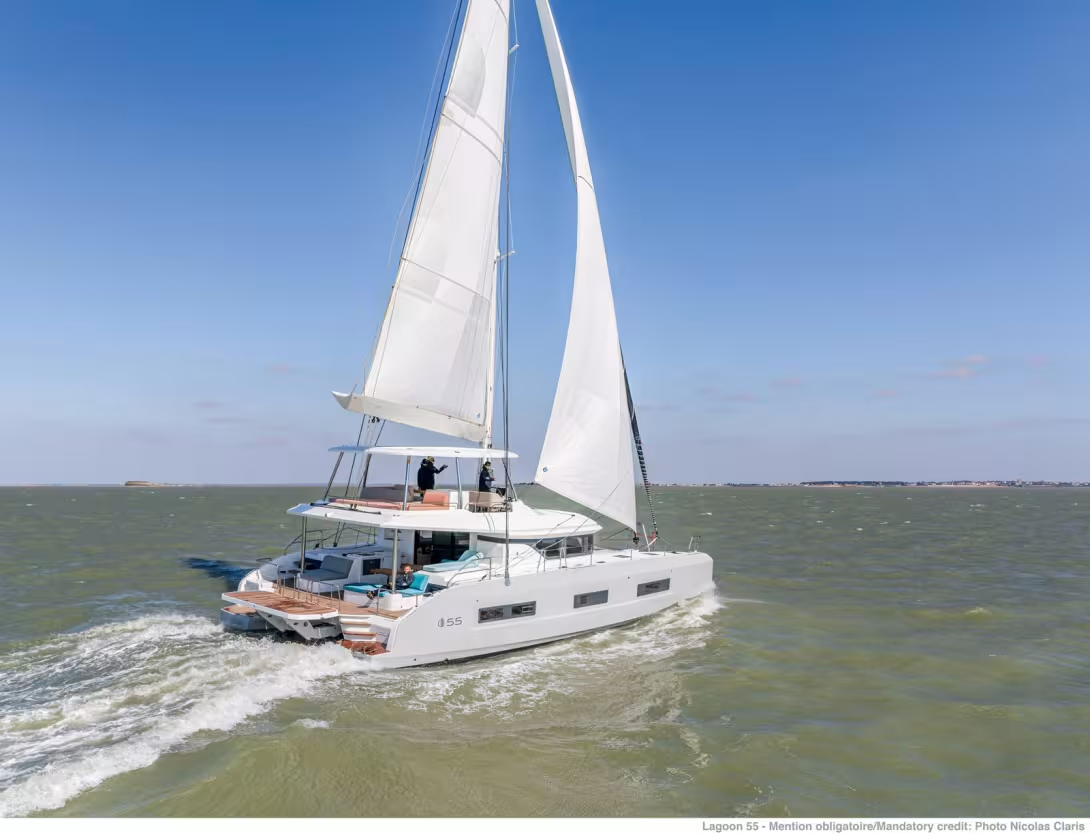
So much water has passed between the hulls since 1987! The very first Lagoon, with its aerodynamic coachroof, probably had less than half the volume of the new 55. But the latter weighs twice as much. However, the spectacular slenderness of the rig would suggest that Lagoon hasn’t ignored the performance aspect. It’s a good thing, because on the day of our test sail, it was windy. A month earlier in Bordeaux, on the manufacturer’s pontoon, the 55 had appeared following the same lines as the latest generation: mast set back and stepped on the coachroof, diamondshaped bows, etc. But there are a few innovations, however - new circulation at the back of the cockpit, additional openings in the coachroof and more longitudinal ribs - these are not there just to look pretty, as we shall see later. The 55 is cleverly positioned between the 50 and the SIXTY 5: not yet a luxury multiyacht, but far more polished than the “smaller” Lagoon. Stepping aboard in La Rochelle, it was the freeboard and the height of the rig that struck me most. I wasn’t surprised that the 55 was taken in hand by a couple of professional skippers: maneuvering a multihull weighing nearly 30 tons light weight is not something you can improvise...
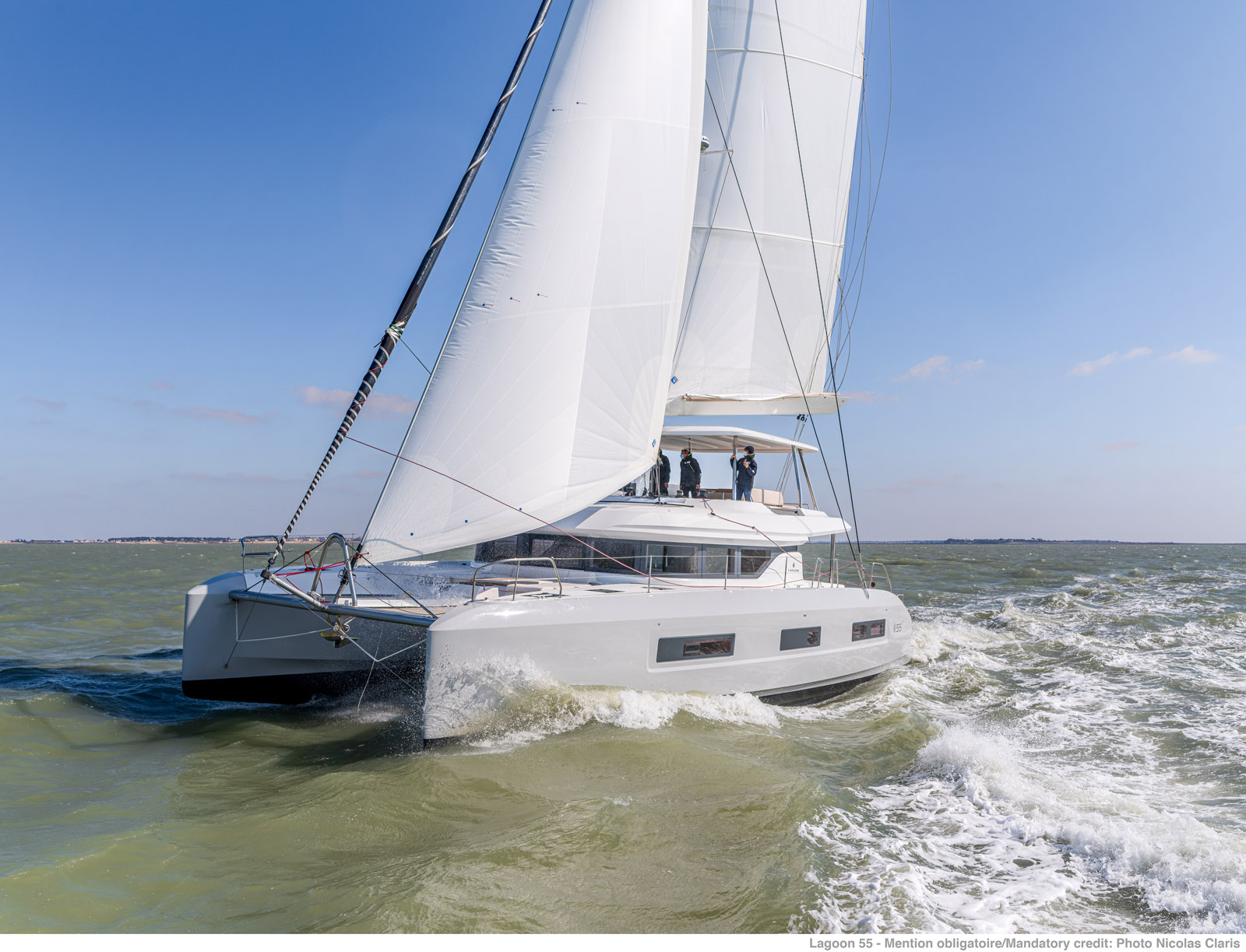
The Lagoon 55 is the first boat from the brand to take the name of a previous model - in this case the very first Lagoon!
Two cockpits, one flybridge
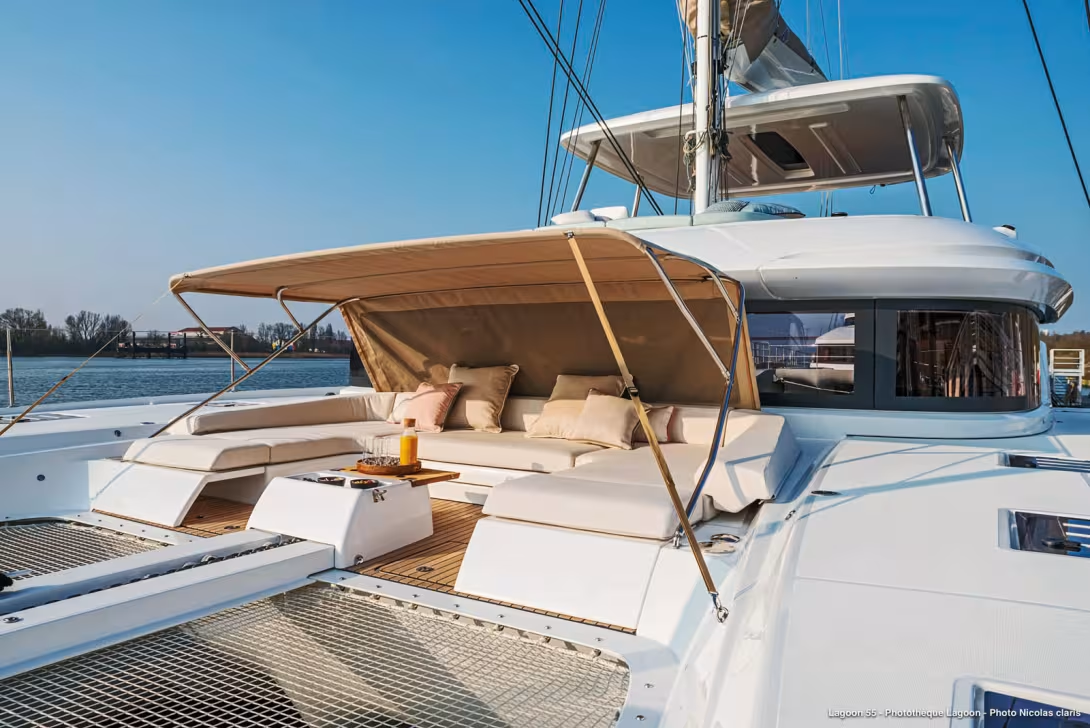
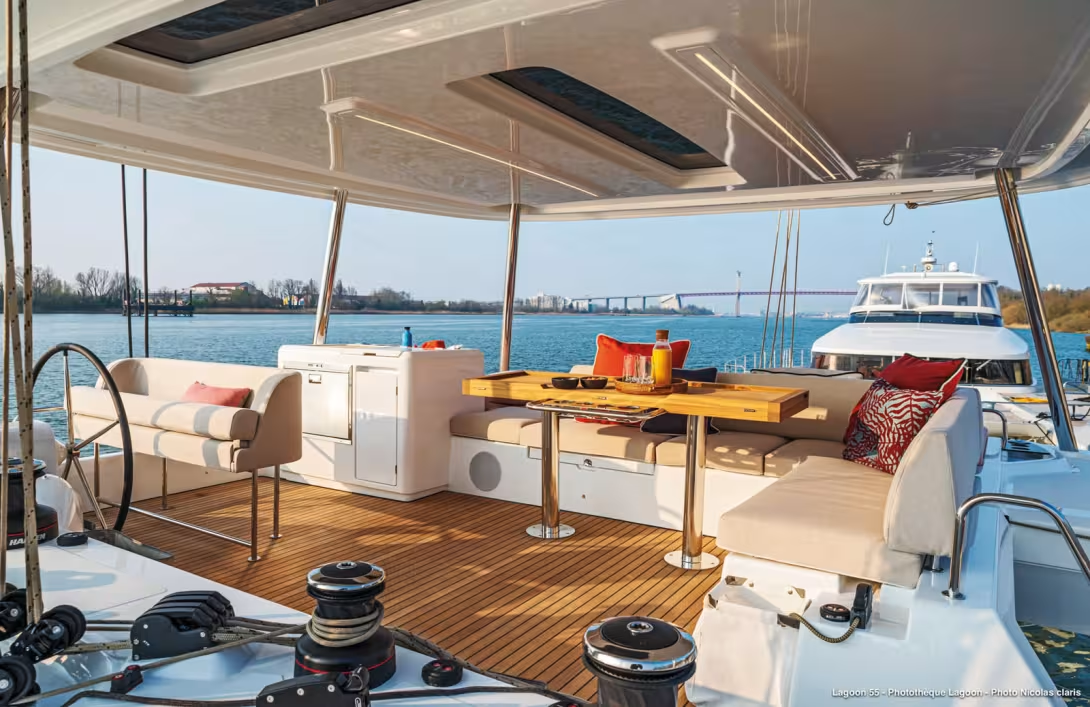
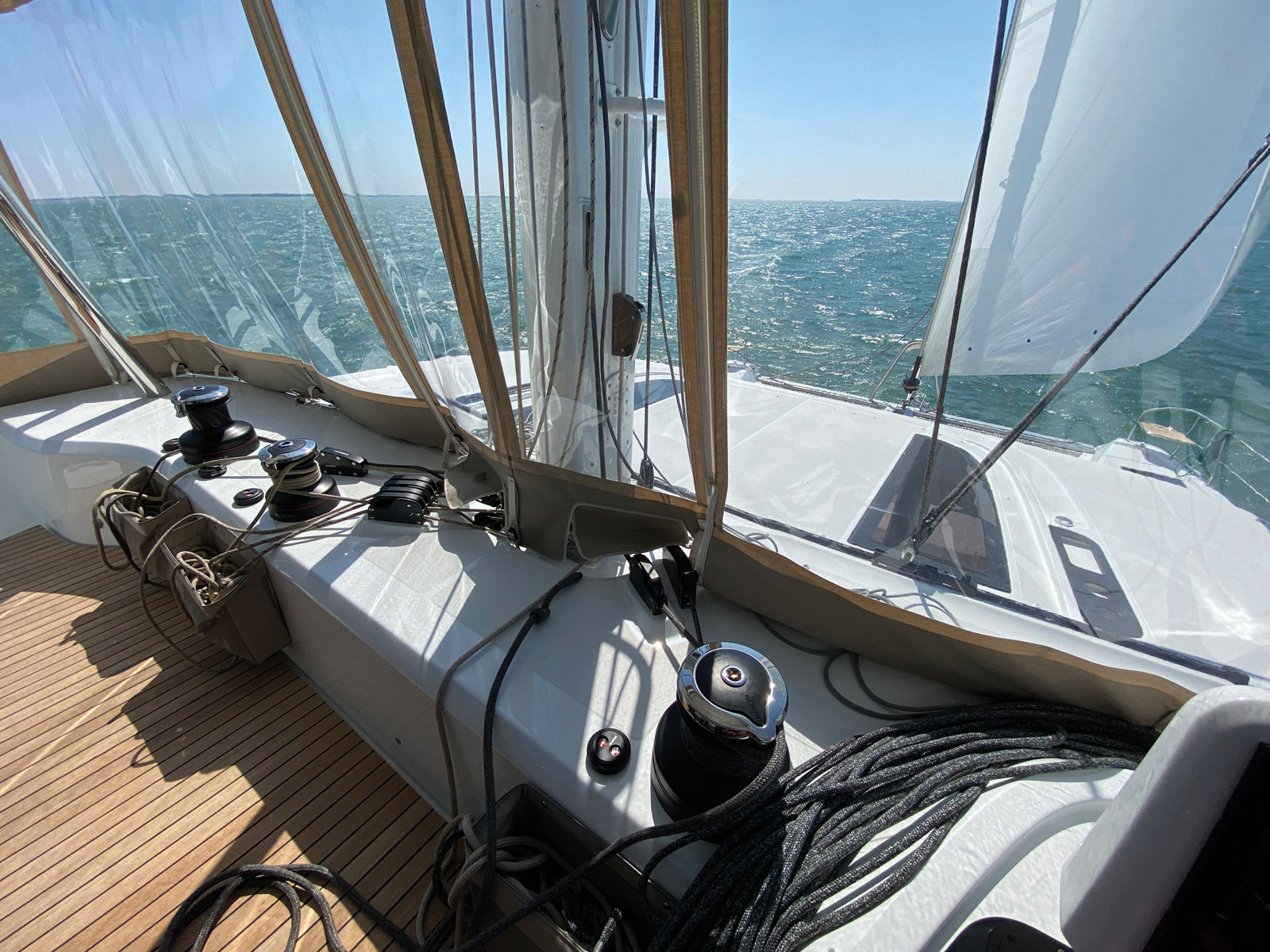
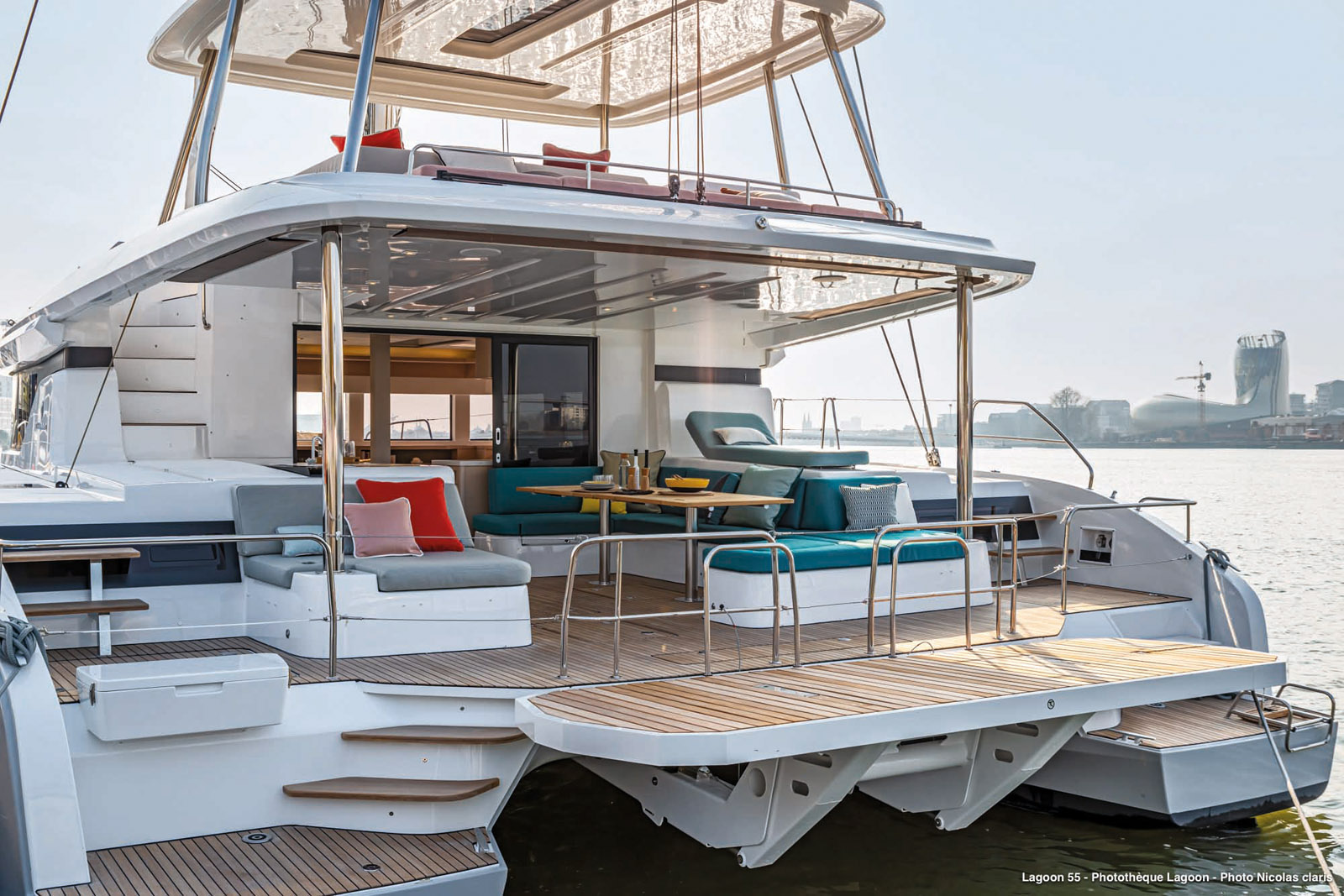
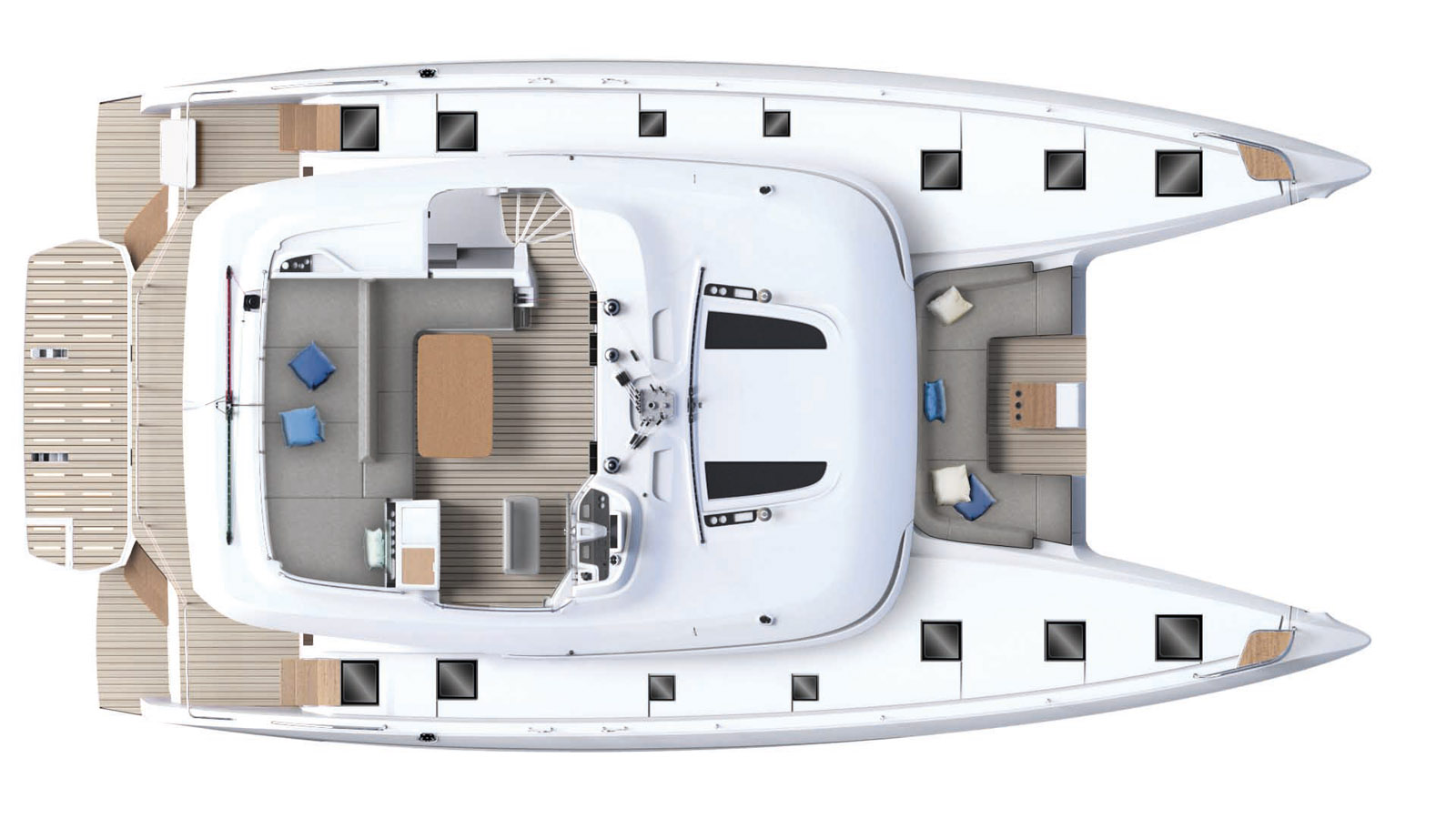
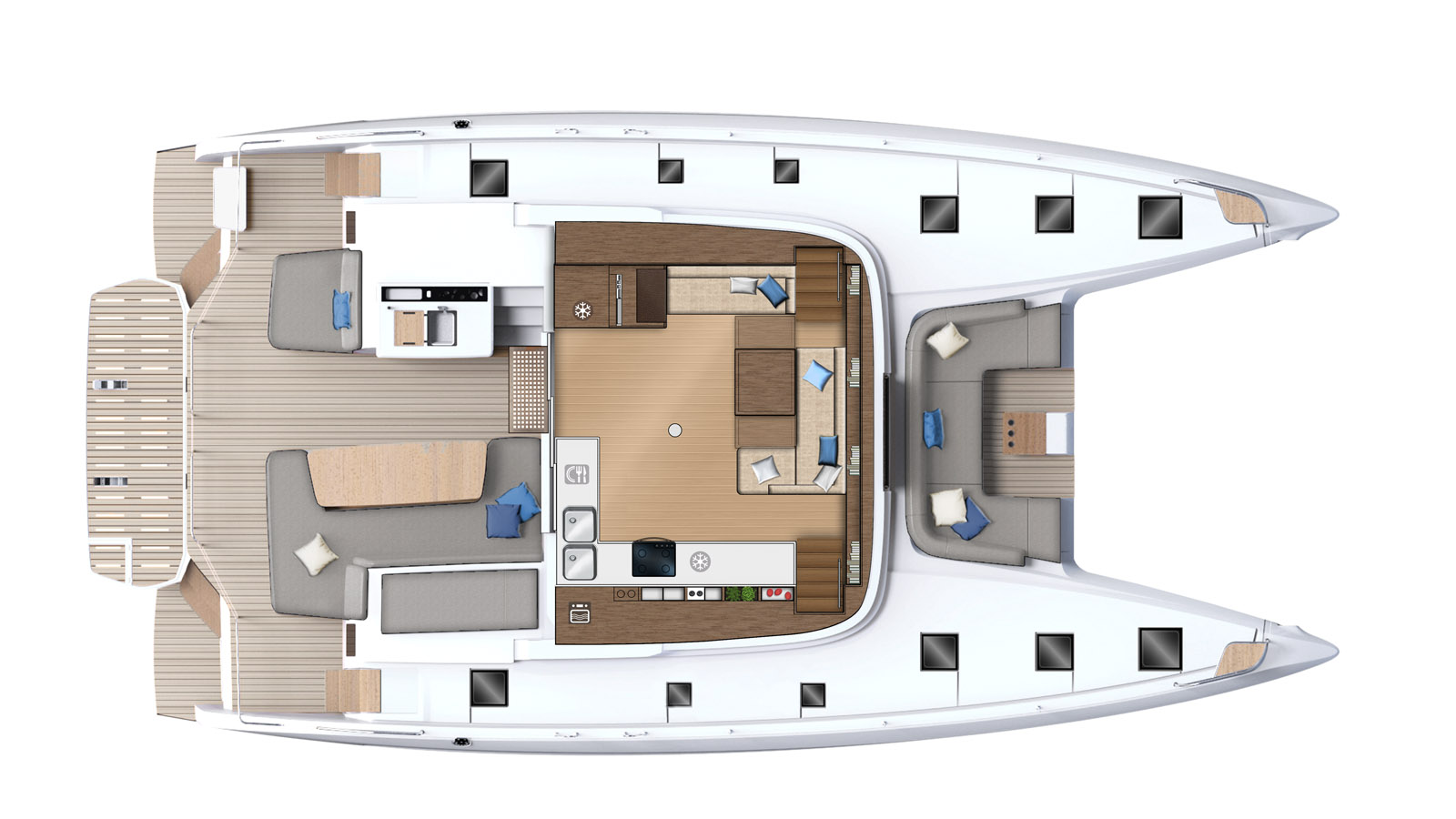
The aft cockpit is huge, with a total area of 270 square feet (25 m²); its two 37½” x 22” (95 x 56.5 cm) tables each double up, making one huge tabletop. There is plenty of seating - benches, a lounger - and an outside galley. The deck extends between the hulls to facilitate circulation, and as a result, the steps of the wide sugarscoops offer a diagonal trajectory. The (optional) hydraulic platform can support 1,650 lbs (750 kg) and is impressively dimensioned at 14’3” (4.35 m) in length and 4’9” (1.45 m) in width. Up front, a second cockpit of 97 square feet (9 m²) can accommodate 8 to 10 people. A shade sail supported on carbon poles are offered by the manufacturer. The side decks are wide - never less than 34” (88 cm), and the line of the coachroof turns out to be a clever handrail. A bit of water in the bottom of this might have justified a few more drainage points. The 235-square foot (22 m²) flybridge is accessed by stairs on the port side. A second access to starboard can be ordered as an option. Up on the flybridge, an L-shaped bench seat accompanies a modular table measuring 63” x 21½” (160 x 55 cm), a sunlounger, an outside galley and the helm station. The large steering wheel and a battery of winches allow the skipper to maintain a course and manage the 2,000 square feet (186 m²) of canvas. The helm seat is 4’3” (1.30 m) long, and the position offers an incredible view, though is also very exposed, requiring a protective enclosure.
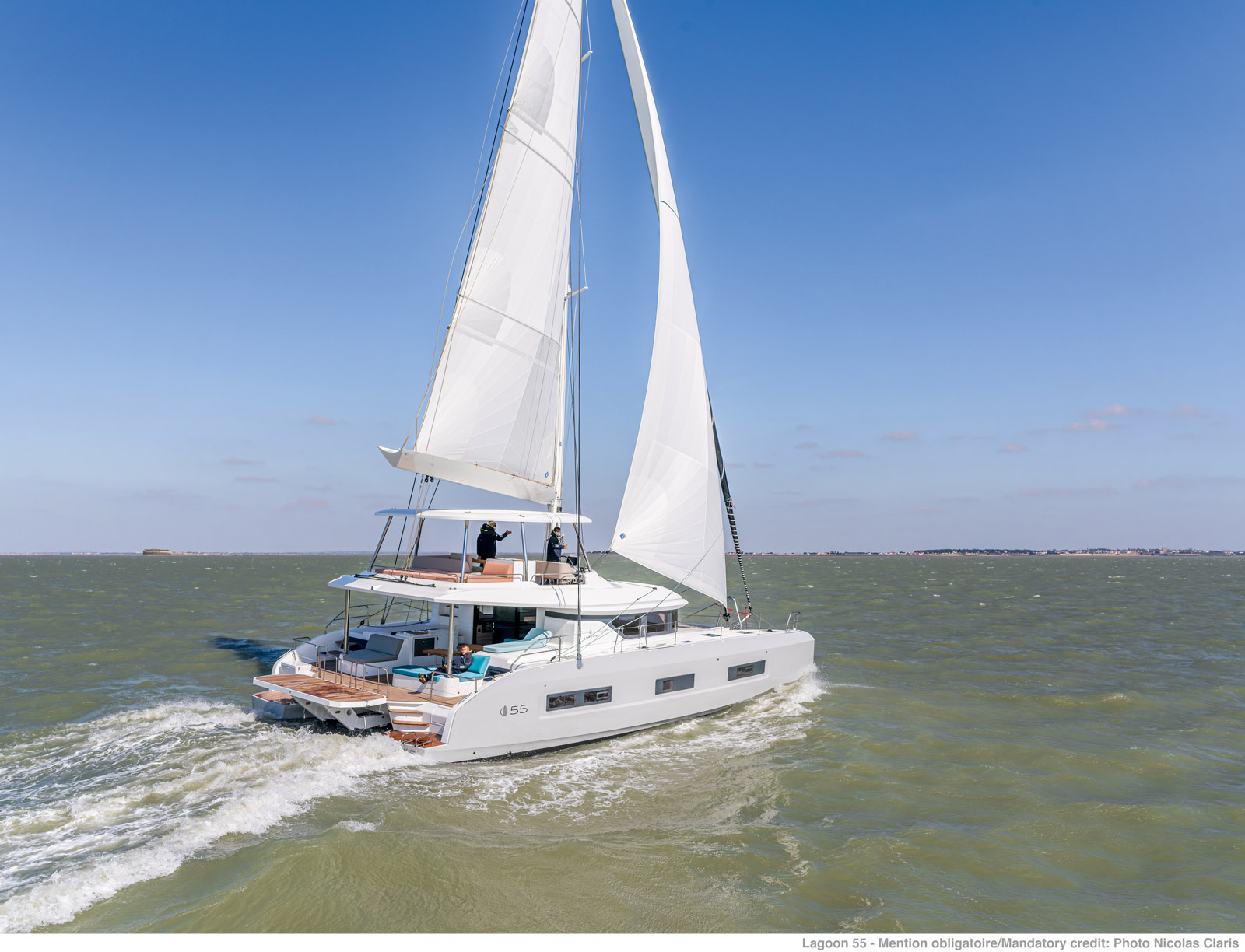
Numerous ribs, recesses, reveals and the new handrail integrated around the coachroof all help contribute to a lighter silhouette.
Not breaking any speed records, but good averages
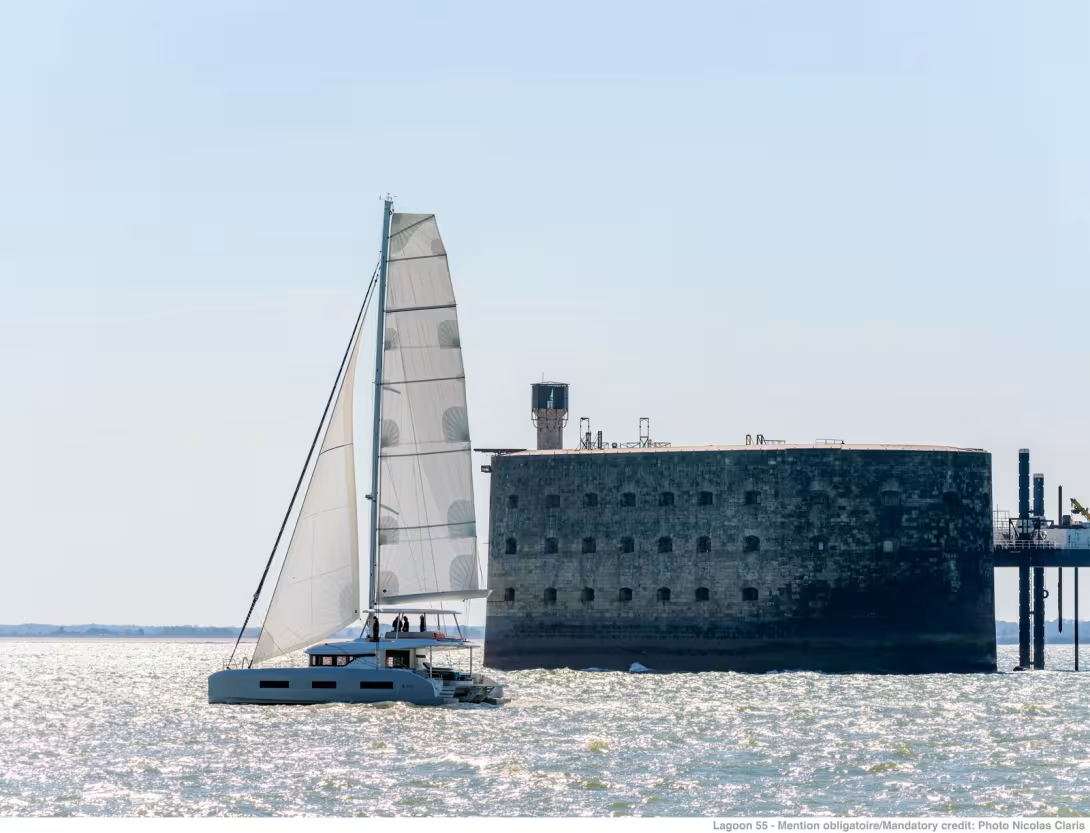
Maneuvering in port, given the isolation of the helmsman, requires at least two people. For Nicolas, our skipper, this kind of operation is part of his daily routine, which begins by testing the engines. Even though the standard twin 80 HP motors allow the Lagoon to reach hull speed - 9.83 knots according to the architects’ calculations - the 55’s displacement would encourage you to go for the option of the 110 HP Nanni motors, as on our test boat. And while you’re at it, you should treat yourself to folding propellers! With an offshore breeze blowing at 15/20 knots, we made a long tack on a close reach, under full main and the genoa. The helm was still to be adjusted - it remained a bit stiff, especially in the gusts. Our speed oscillated between 8 and 9 knots, with a few peaks at 10. Nicolas Boutteloup, this boat’s skipper, who had already been sailing for a month on board, notes that 7 knots is very quickly reached by the 55 with this sail configuration. But it’s under gennaker that the new Lagoon shows good speeds: 6 knots when on a fine reach in only 7 knots true, and some peaks of more than 11 knots in a good breeze. The large asymmetrical spinnaker allows for good downwind sailing: 5 to 6 knots with 7 to 8 knots of wind and two knots more with 10/12 knots of wind. While these speeds are not record-breaking, they guarantee good average under sail - remember that the Lagoon 55’s displacement is significant. On the other hand, even though the view is spectacular from the flybridge, steering this large catamaran doesn’t create an exciting feel to the helm. Trimming is easy, but it is important to be aware of the forces at work on the sheets. After a break at anchor off the island of Aix, the wind picked up a little more, at 20/ 22 knots. We close-reached with one reef in the main - the helm was softer and the GPS indicated 9 knots. The wind was still increasing, enough for us to take three rolls in the genoa. A sudden gust to 33 knots shook us up for a few seconds: the sea was smoking over the bows, the GPS topped 10 knots, a few squeaks could be heard but no-one on board stumbled. Pretty reassuring for a catamaran launched only four weeks previously. Before we headed to port, a monohull (admittedly a smaller boat - an Amel 50) was easily overtaken downwind.
A sudden gust to 33 knots shakes us up for a few seconds: the sea smokes over the bows, the GPS tops 10 knots, a few squeaks can be heard but no-one on board stumbles.
Pretty reassuring for a catamaran launched only four weeks previously.
A nacelle well-opened to the exterior
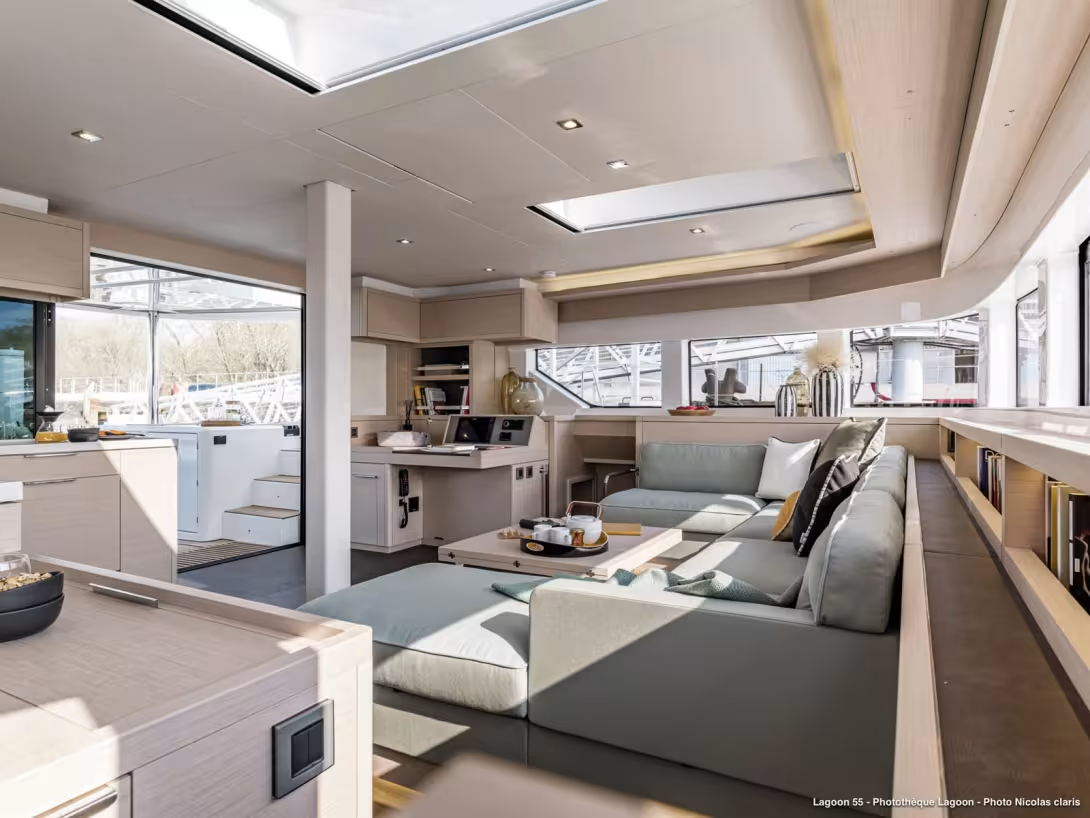
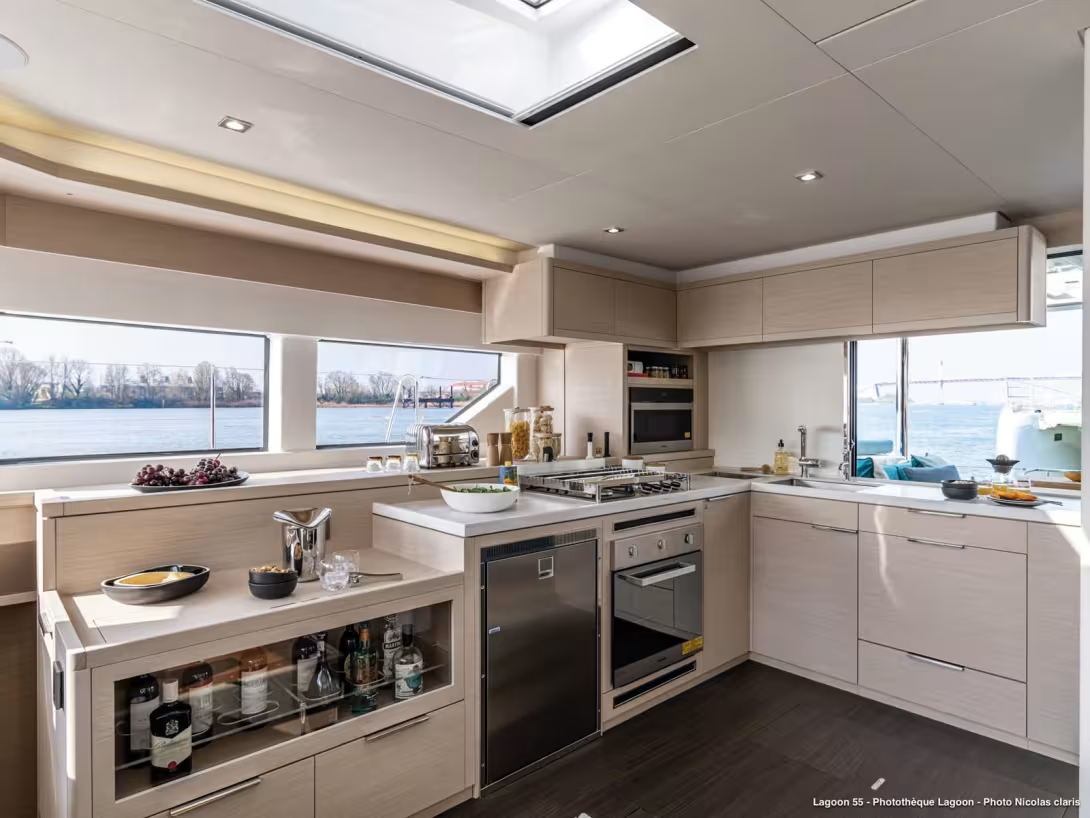
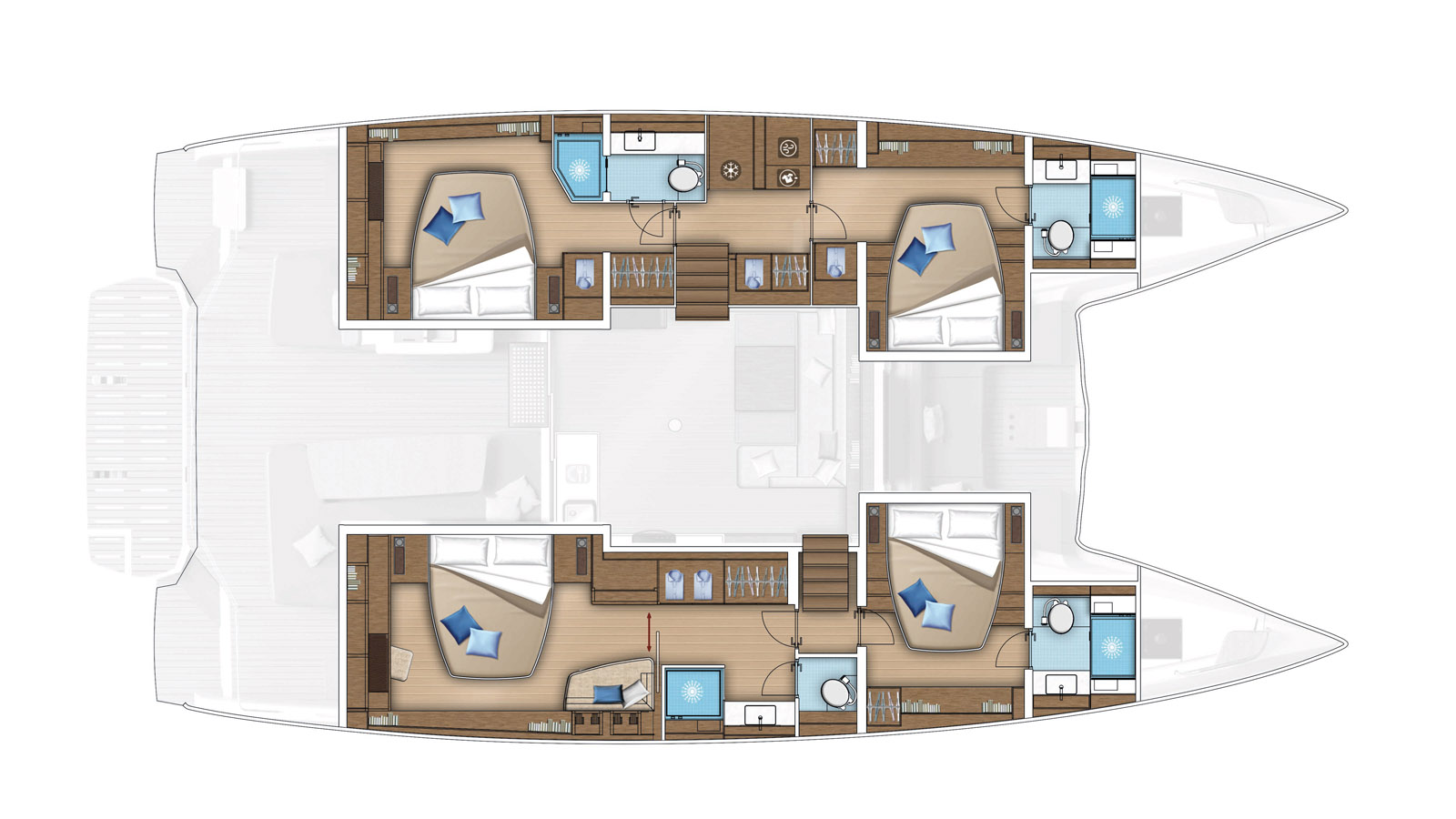
The nacelle totals 290 square feet (27 m²) in area; it opens out through a system of large windows – 5’7” (1.70 m) wide and 6’5” (1.97 m) high. The headroom is 6’11” (2.11 m). To port, the chart table measures 55” by 35” (139 by 88.5 cm), and has a fiddle rail to catch charts, pilot guides or smartphones, etc. A 55-foot catamaran does not heel, of course, but can still move a little... Be careful with the upper cabinet, likely to meet the scalp of the taller crewmember. Like the exterior, the table in the saloon doubles in size – 33½” x 37” x ¾” (85 x 95 cm x 2). Eight or even ten people can dine together here. Two large overhead windows are cut into the coachroof: you can see the sail plan, and the light is even more generous. On the other hand, with the sun at its zenith, closing these hatches will be essential, unless you’re running the air conditioning... Forward, the yard offers an optional large sliding coachroof window – this naturally reminded us of something - the bay window of the Bali, of course! On the starboard side, the L-shaped galley is huge and fully equipped. Storage, appliances, nothing is missing. In the four-cabin version, the owner’s cabin occupies the aft section of the starboard hull. It totals a beautiful surface area of 188 square feet (17.5 m²), with a bed measuring 6’7” x 5’6” (2 x 1.70 m), installed like all the other beds on board, athwartships. Storage, a desk, and numerous windows are provided. Even with the engine running at full throttle, this suite gives a very pleasant feeling of being isolated and quiet. The forward cabins have 120 to 135 sq ft (11 to 12.5 m²) of space, and their own bathrooms. The berths are only slightly less wide than those aft, at 5’3” (1.60 m). The forepeaks can be optionally fitted out with a single berth and a heads compartment. It is also possible to opt for a 5 or 6-cabin layout. In this case, the cabins in the middle of the hulls are relatively small (80 sq ft / 7.5 m²) and offer a single berth on each side.
 |
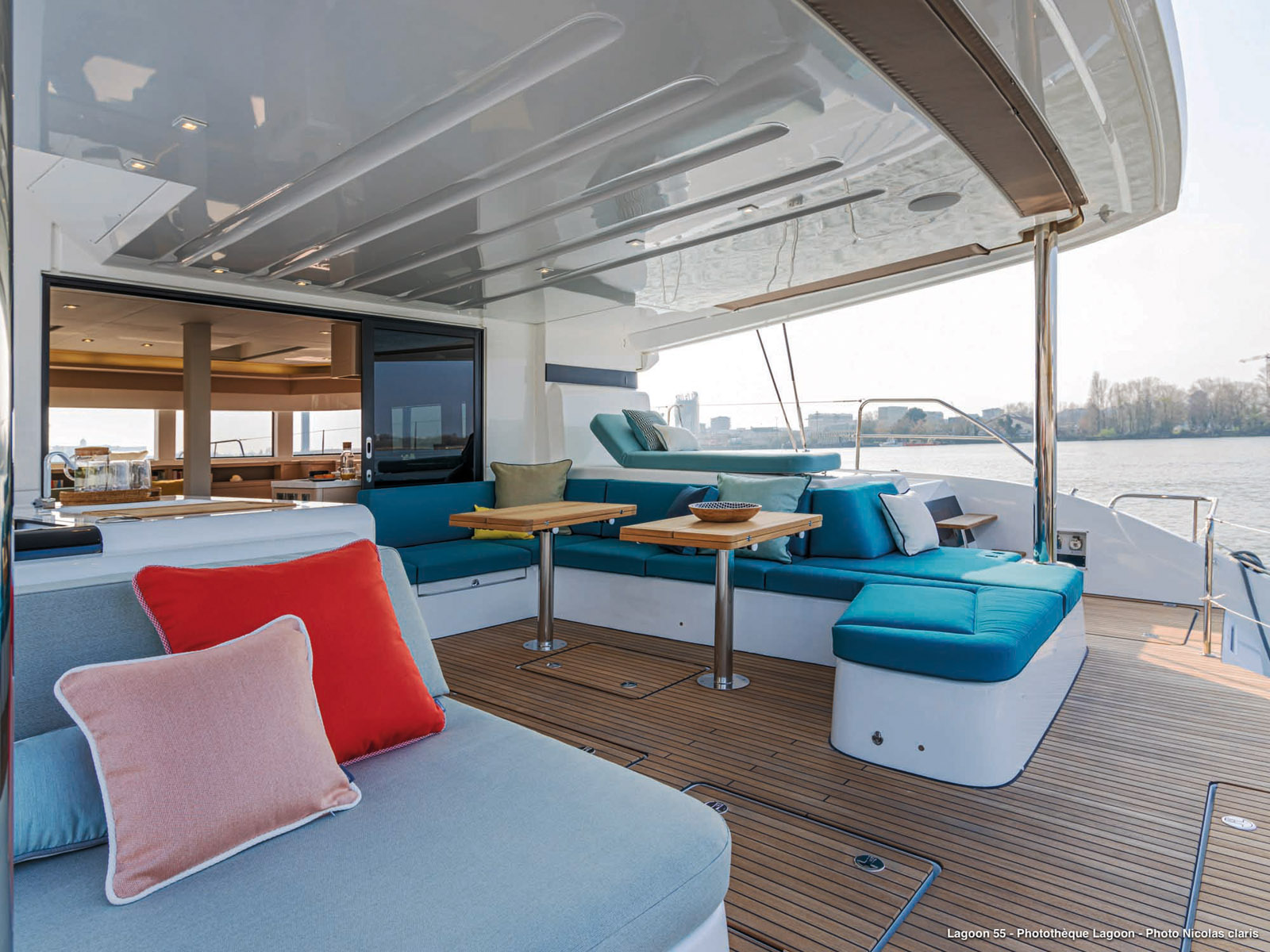 |
The aft cockpit features improved circulation all right to the back and steps to the diagonal sugarscoops. There is plenty of seating.
Conclusion
The Lagoon 55 is an ideal platform for blue water cruising for 8 to 12 people: a robust and comfortable catamaran that still requires two pairs of expert hands to be managed properly. The innovations featured - wider passage aft, reoriented transoms, integrated handrails on the coachroof, overhead hatches, sliding bay window - are all convincing. Combined with a luxurious finish, they make the Lagoon 55 an attractive new catamaran in this size range.
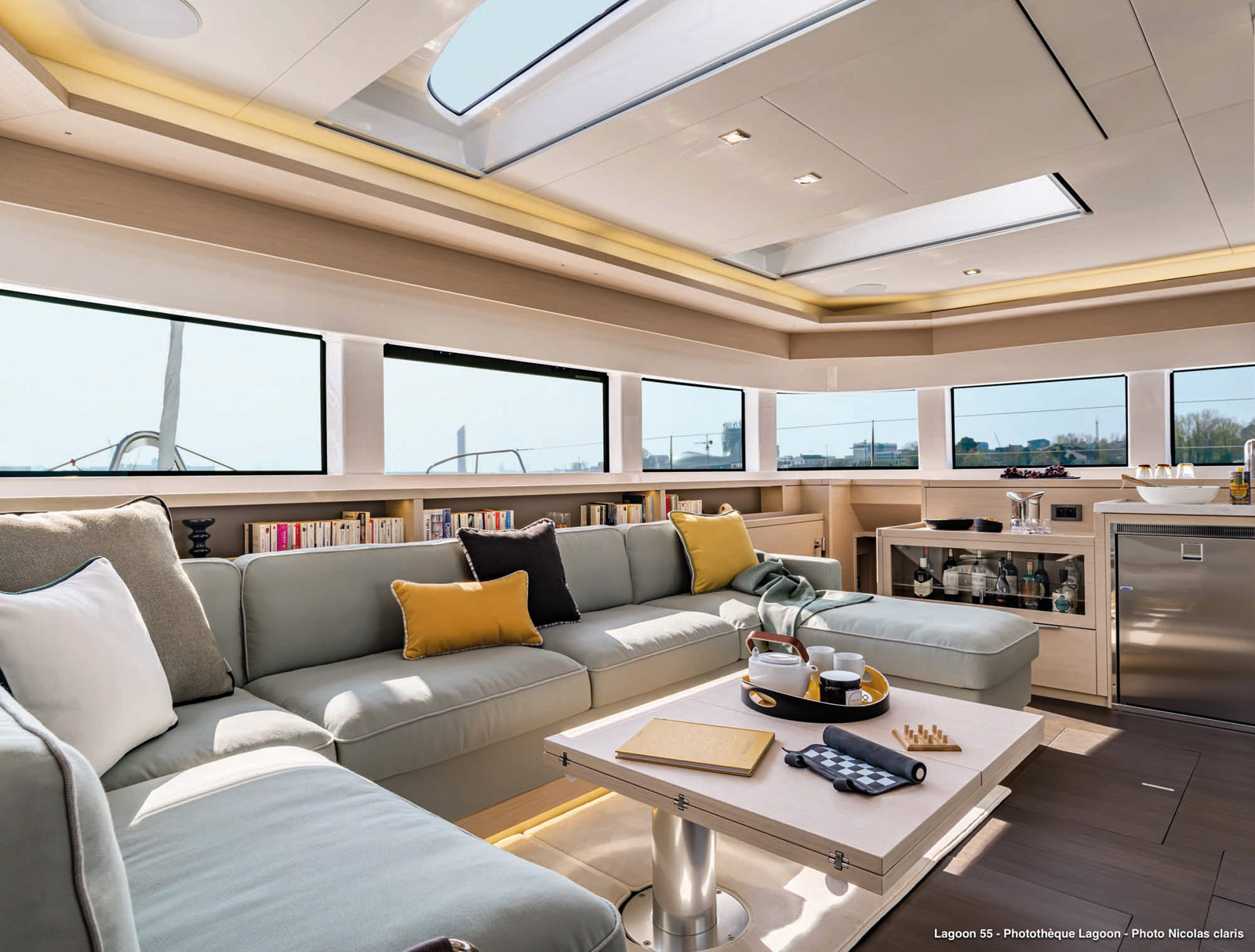
The almost 325-square foot (30 m²) nacelle opens generously on the cockpit. There is a large saloon, a nav station and a complete galley.
The pluses
+ Convincing redesigned cockpit circulation
+ Exceptional comfort
+ Flattering finish
The minuses
- Professional crew essential
- Flybridge enclosure not very esthetic
- No pleasure from the helm
 |
 |
 |
TECHNICAL SPECIFICATIONS
Builder: Lagoon
Architects: VPLP
Exterior design: Patrick le Quément
Interior design: Nauta Design
Material: polyester sandwich
Length: 54’4” (16.56 m)
Waterline length: 53’9” (16.39 m)
Beam: 29’6” (9 m)
Draft: 5’1” (1.55 m)
Air draft: 96’7” (29.43 m)
Light displacement: 58,433 lbs (26.5 t)
Fully-battened mainsail: 1,151 sq ft or 1,205 sq ft (107 or 112 m²)
Self-tacking jib: 796 sq ft (74 m²)
Code 0: 1,657 sq ft (154 m²)
Asymmetric spi: 2,927 sq ft (272 m²)
Water tank: 4 x 63 US Gal (4 x 240 l)
Fuel tank: 2 x 145 US Gal (2 x 550 l)
Engine: Yanmar 2 x 80 HP (4JH80) or Nanni 2 x 115 HP (N4.115)
CE certification - A: 14 ; B: 14 ; C: 20 ; D: 30
Prices ex-tax: From € 1,085,000 in the 4-cabin version
Comfort Pack: € 58,800
Electronics: € 17,800
Cockpit cushions, sunbathing area and flybridge: € 25,970
White painted mast and white carbon canoe boom: € 53,650
All electric winches and flatwinder: € 8,650
Gennaker fittings with bowsprit and furler: € 8,820
Code 0 in D4: € 18,500
Extra for square-topped main and jib in Hydranet: € 15,450
Hydraulic platform: € 48,850
Cockpits, sugarscoops and side decks in teak: € 42,700
Cockpit enclosure with glazing: € 6,800
Grey or cream gelcoat: € 9,200
Nanni 115 HP engines (N4.115): € 26,550
Folding propellers: € 6,250
Lithium batteries: € 29,800
Onan 17.5kVA 230V/50Hz generator: € 32,750
74 US gal (280 l)/H 230V watermaker: € 18,500
Air conditioning: € 42,350
Modular saloon table on electric leg: € 5,650
Carbon passerelle: € 3,000 4.20 m
Dinghy with 60 HP Honda outboard: € 26,750