
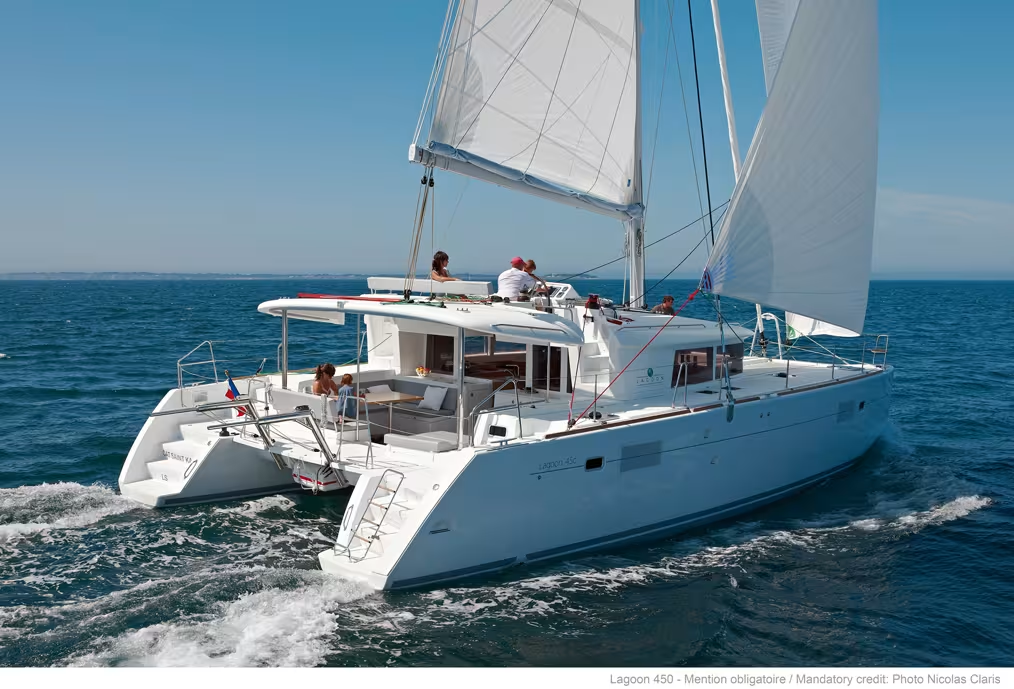
During our test of the 450 in September, we discovered a successful fun, family catamaran; the 2010 finishing and the more generous sail plan make it pleasanter and more versatile than its predecessors. The 560, from the same matrix, meets a much more ambitious specification in terms of reception aboard.
Infos pratiques
- Le chantier : Lagoon 560
- La fiche technique
- Découvrez notre vidéo exclusive
- Financez votre Lagoon 560
- Assuez votre Lagoon 560
- Articles autour du Lagoon 560
55' of development
When the Lagoon 55’ was launched in 1987, Jeanneau Techniques Avancées (JTA) was a young structure, created by the wishes of a bunch of enthusiasts, who were to distinguish themselves by the realisation of several exceptional trimarans (F40’ N. Irens, FLEURY MICHON, PIERRE 1er, the two prototypes for the Waterworld film, ...) and gave birth to a worldwide brand. An attractive silhouette, a judicious architectural signature, and the success of the 2 versions (55’ and 57’) was immediate! The creations of the acronym VP/LP (GERARD LAMBERT, BISCUIT CANTREAU I, II and III which foreshadowed the Orma 60-footers, PRIMAGAZ…) would never leave the foreground of ocean-racing! In 2000, the successor to the 55’ – 57’ took on the in-house design and became the 570. Built in the Bordeaux factory, it overturned the aesthetic codes, but retained classic ergonomics. With the 560, the builder took on board a whole new design step and went all out: creative ergonomics, innovative accommodation, suitable sail power, generously-sized engines, XXL flybridge and improved quality.
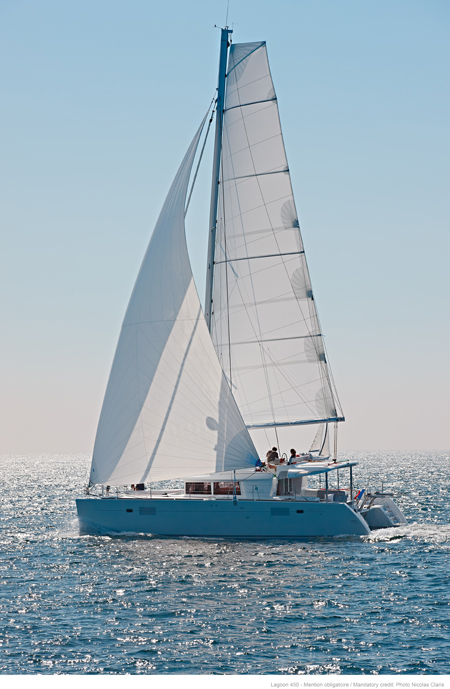
With this brand new 560, Lagoon is offering an incredible boat: volume and real seakeeping qualities are on the programme.
A relevant definition
Within the Beneteau group, Lagoon enjoys an enviable position for adjusting its strategy and optimising its models’ marketing development. The 560 demonstrates this aspect perfectly by arriving at the right time in a market which was abstemious in 2008, hesitant in 2009 but has revived at the end of 2010. With this boat, Lagoon is not seeking to beat future production records and is offering a luxurious catamaran with a high added value. The challenge seemed to be to anticipate the expectations of people disappointed in a motor boat industry which is drifting, to answer the objections of the Penelopes, who have heard that cruising under sail is nothing but suffering and deprivation, whilst catching hold of the wealthy sailing Ulysses who are ogling at the trawler ‘sirens’. The exercise was complicated; the designers therefore gave themselves the additional means to achieve this multiple aim.
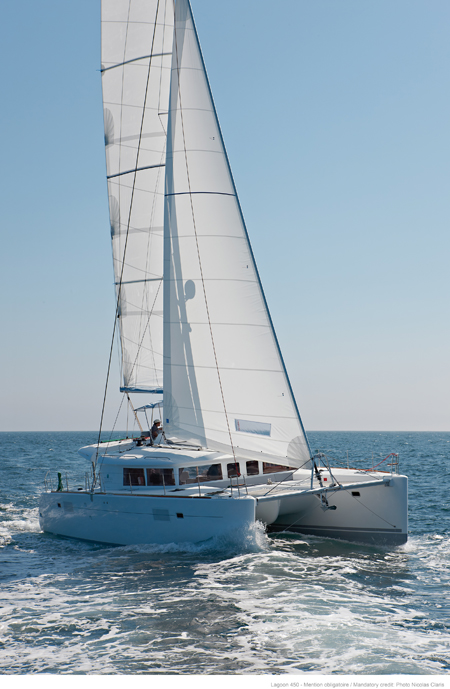
The 560 starts to sail from 3 knots of wind... Not bad for a 30 tonne catamaran!
Very imaginative organisation of the area
The builder now has the detachment essential for playing with bold ergonomic solutions, and maintains this ease, free of hang-ups, in the 560’s choices. By calling on Nauta, it got itself a demanding partner and displayed its ambitions in terms of quality and creativity. The flybridge, an area coveted by both owners and crews, here shows maturity and will satisfy enthusiasts, despite the many constraints it imposes aboard a sailing boat (access, safety, gooseneck height, centre of gravity, positioning of the fittings). The R&D department’s experience and the 560’s size allow convincing solutions to be found and use made coherent, or even pleasant. The spiral staircase is comfortable and safe. The electrically-assisted ‘airlock’ type watertight closure system (between the flybridge and the cockpit) originates in complex kinematics and was entrusted to a sub-contractor specialising in this set of problems; however in use, a direct path from the mast foot to the steering position is lacking. The cockpit-terrace here takes on superlative dimensions (in fine weather, or sheltered by canvas ‘walls’ late in the season); this marine atrium communicates with the galley, of course, but in a more surprising way with the starboard owner’s cabin and the guest cabin to port! At sea or at anchor, under the Barbudan sun or the frosts of the Faroe Islands, the ‘movement around the boat’ plan will remain pleasant; it invents a new kind of conviviality, which finally respects the crew’s privacy.
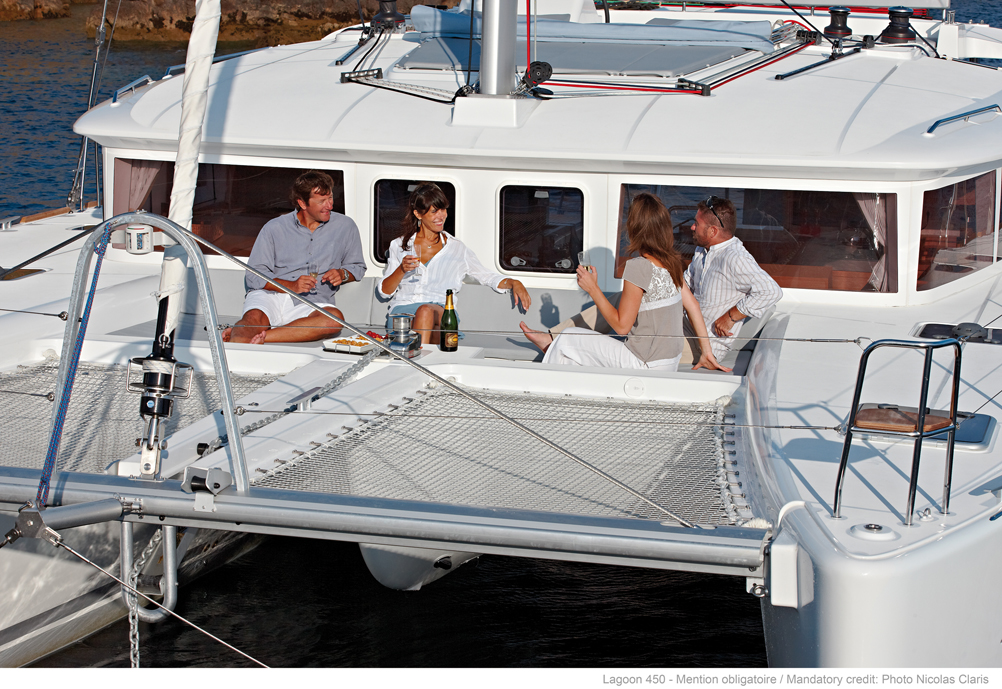
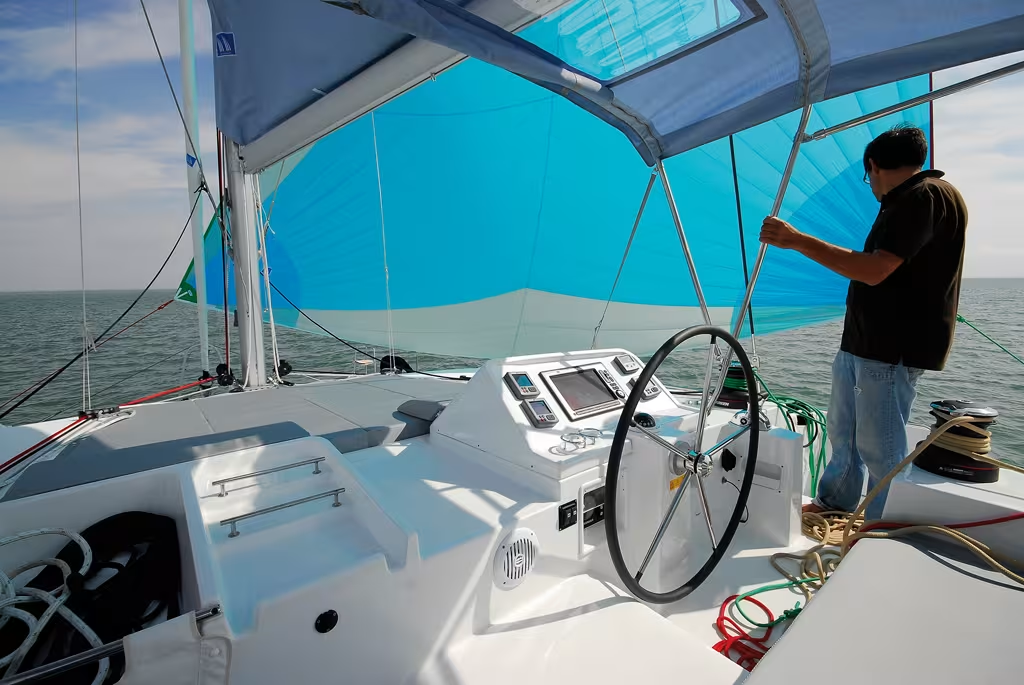
The control lines and the steering position are on the flybridge, where huge sunbathing areas await the crew... The best!
Complete separation of the technical and living areas
The 560 is a big multihull equipped with all the expected services, but also the associated complexity. The services are grouped in 3 separate assemblies: the aft lockers house the engines and their peripherals, as well as the air conditioning and automatic pilot. The compartment in the forward crossbeam holds all the electrical functions. The storage (24V, 800Ah), generation (7 to 15kVA generator), transformation and management (multiple dedicated invertors, regulators, ...) are grouped around a central floor which overhangs the battery bank. The architecture, whilst complex, remains readable and shows both an installation quality and selection of suppliers which are reassuring (a ‘panel open’ alarm seems essential). A skipper with foresight would however have the use and the service processes of this Airbus-style machinery explained to him. This relevant organisation rationalises maintenance and allows interventions without disturbing the running of the vessel.
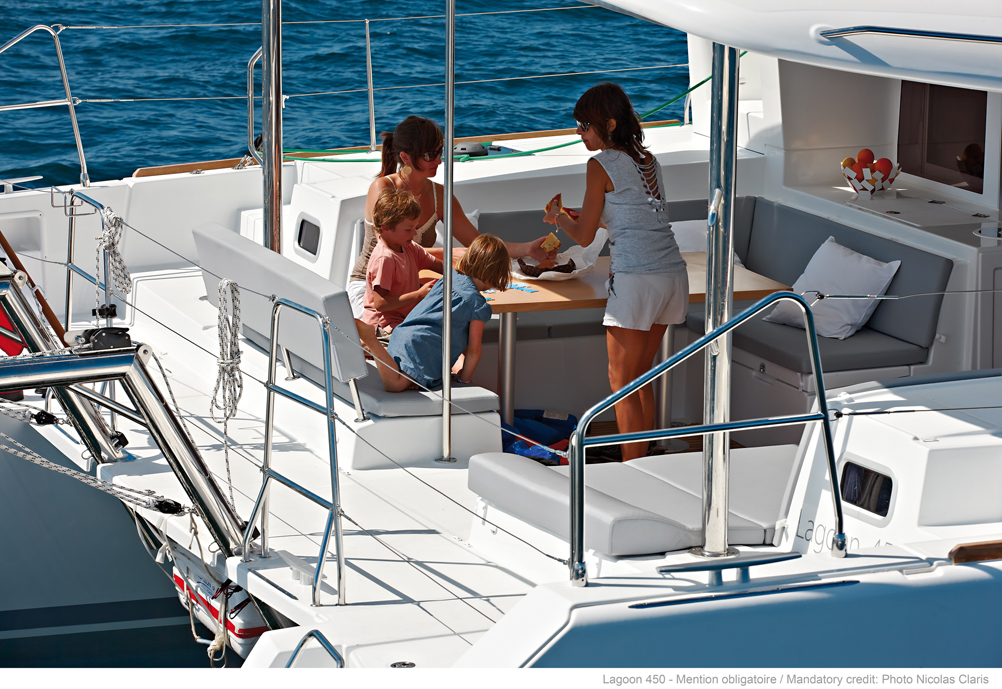
Flybridge, cockpit, saloon, forward cockpit: it’s up to you to choose your area...
Aim: life aboard
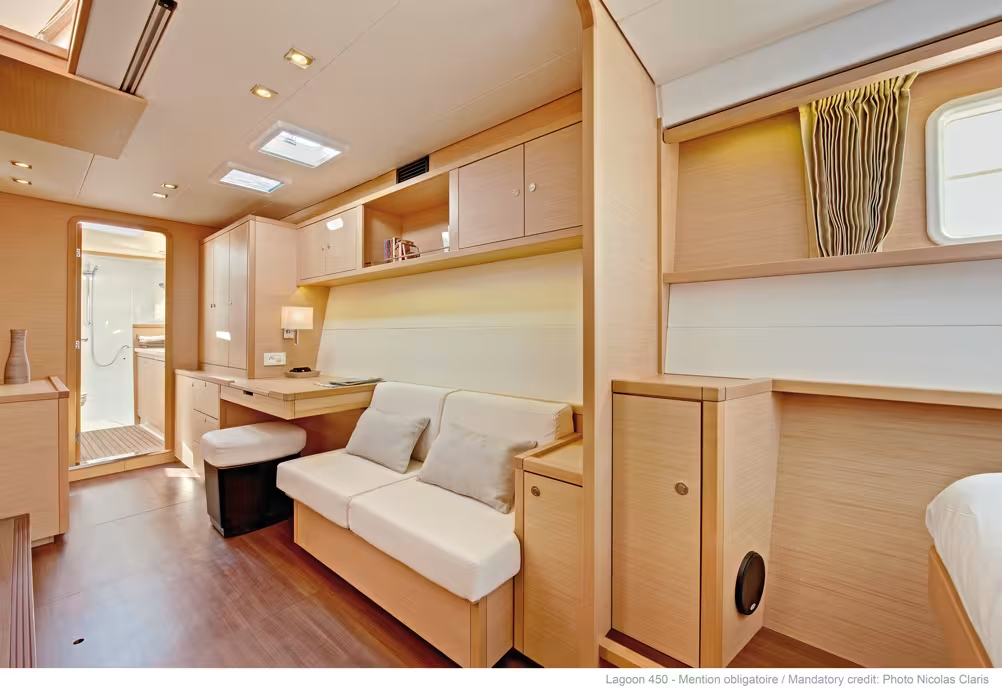
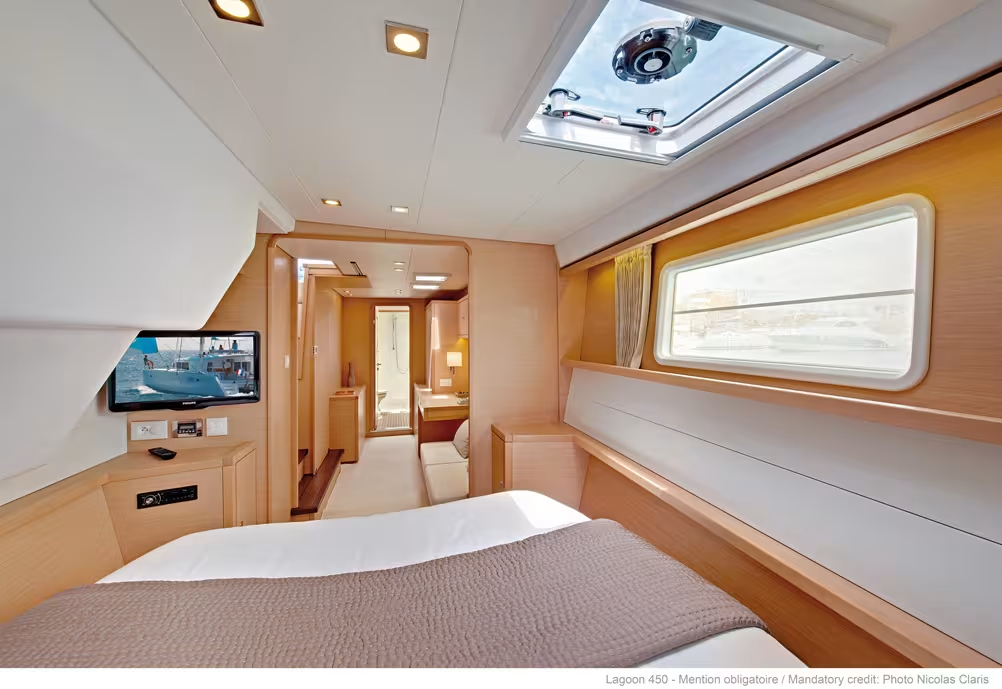
Most of the visitors to the Boat Shows at Cannes, Genoa or Barcelona were enthusiastic about the 560’s accommodation. Curiously, this positive point of view seems to be shared by the professionals and even certain traditionalist or even conservative amateurs. Nauta and Lagoon have therefore hit the mark! As on the 450, the style and rise in manufacturing standards are immediately noticeable. The creativity employed in the original division of the volumes, the individualised decorative treatment of the private areas, and the attractive atmosphere make up this catamarans main appeal. A recent trend: the saloon table is small fry compared to that in the exterior dining room; the 560 accommodates 6 guests inside around a day bed (for relaxed reading), whilst 10 people can easily get together outside! The clever central ‘island’ (also supporting a television, which deserves protection) turns the galley into a bar, multi-function serving hatch, crossroads for conversations. The owner’s volume is superb (the opaque bathroom façades don’t remove any of its charm!); the famous ‘chalet’ (port, aft) gets this nickname from the overall impression felt in the depths of this nautical lodge, with a view of the wake! The forward cabins benefit from a comparable treatment. The soundproofing, insulation and the feeling of being ‘at home’ are identical in each one; which do you choose?
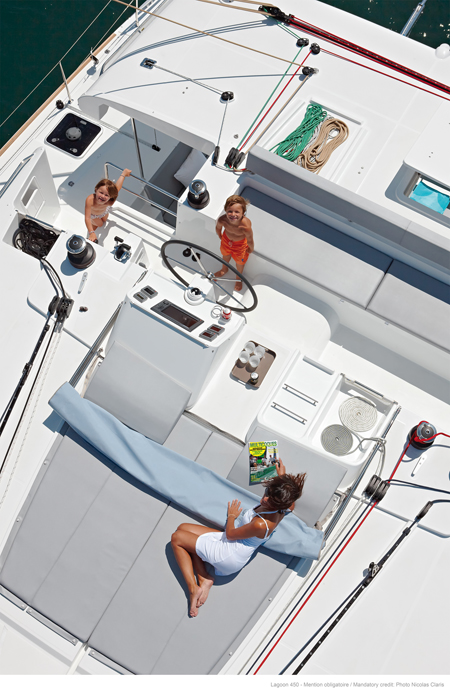
The cockpit is perfectly protected by the flybridge, and is quite simply...gigantic!
Strong winds and light weather, the true test
The fury of the Tramontane which had swept the Golfe du Lion the previous night had given way to a force 6 – 7, laced with sunshine, which gave us a field day. In the absence of a bow thruster or IPS transmission, a suitable, user-friendly harbour berth is recommended – the 560 measures almost 18 x 10m and has considerable windage. The test model’s big engines (2 x 110hp!) were obviously impressive, but you have to get used to the reaction time of the electronic controls, which are however perfectly suitable. We were under 2 reefs and the staysail, as close-hauled as the circumstances allowed (60° from the wind), facing regular gusts which would have made Gaztibelsa (in the sung poem by Brassens) go mad. 25-37 knots, swinging by 15 to 20°, the Tramontane didn’t turn us crazy, but made for an interesting test for this spacious, comfortably trendy, therefore heavy (32t!) catamaran. Under main alone, (square-headed, 2 reefs), the Lagoon 560 sailed to windward – a convincing sign of a balanced centre of effort. The unrolled staysail generated the power necessary to confront the nasty sea that you can imagine. On a close reach, the GPS displayed 8.5 – 9 knots and the coastline was speeding by in the direction of Cap Leucate. On the edge of the Port-la-Nouvelle ‘wind tunnel’ (a natural turbine which always generates one Beaufort force more than anywhere else), we tacked at the first attempt (which was not easy in those conditions) and opened up the sail plan. At 140° to the wind, we straddled the short seas and slipped along at between 9 and 11 knots, with a top speed of 12. The next morning, the light breeze allowed us to fly the maximum sail area (280m²!); the 560 started sailing from 3 knots of true wind and the speed progressed as the light south-easterly increased in strength. The comparative figures from the anemometer and the GPS are quite amazing up to 8 knots of true wind! After an anchoring session at Collioure, we sailed gently back to Canet-en-Roussillon under the big gennaker (7.5 knots at 160° to a true wind of 9 – 10 knots). The mainsail and genoa from Incidences deserve high praise; their shape and finishing is remarkable.
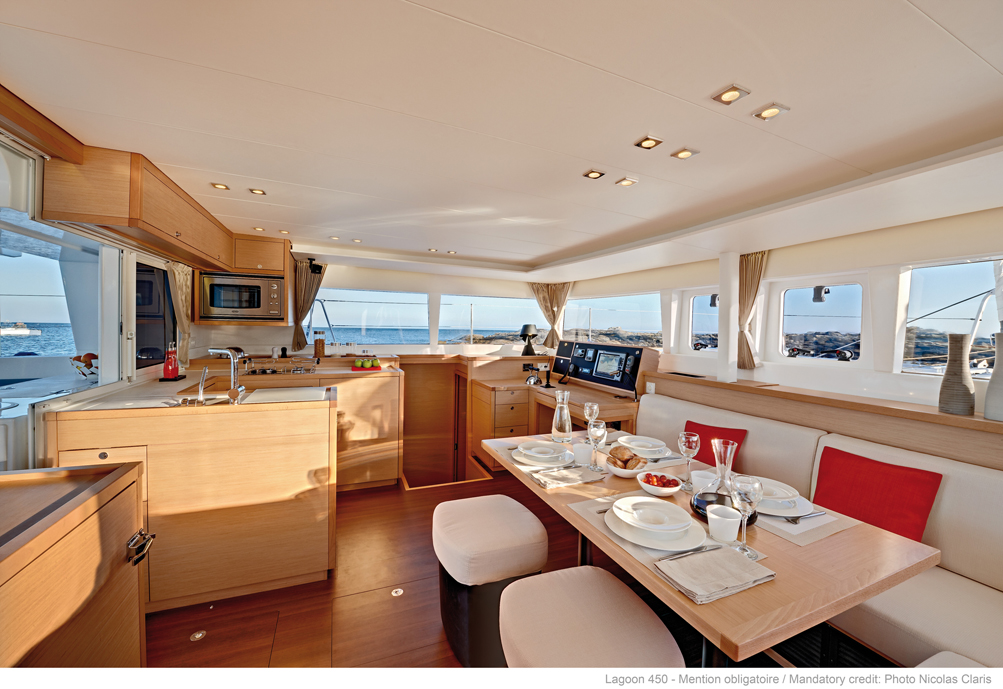
No, you are not in a warehouse conversion, but a cruising catamaran...
CONCLUSION
The 560 realises a synthesis of solutions used by Lagoon for a few years, it takes a decisive step in terms of the (successful) originality of its accommodation. The privacy enjoyed by the guests and the overall living comfort aboard allow it to compete with more prestigious boats. The new definition of the sail plan gives it good performance in light and moderate weather. However, the high budget, the presence of sophisticated technical equipment and the power available (both under sail and engines) mean it is intended for experienced owners. The presence of a sailor (or a maintenance service) with technical training will be necessary for several weeks in the year to keep this ‘pullman’ at the required maintenance level.
The plusses:
- Accommodation
- Services and finishing
- Dynamic qualities
The minuses:
- Absence of a barber for the mainsail and genoa and staysail sheet jammers
- Accessibility of the engine dashboards
- Numerous options
THE COMPETITORS
| Model | Builder/Architect | Weight in t | Windward sail area in m2 | Price in euros, exc. VAT |
| Privilège 515 | Alliaura/Lombard | 20 | 143 | 850,000 |
| Dean 5000 | Dean/Dean | 20 | 142 | 600,000 |
| Sunreef 58 | Sunreef/Sunreef | 30 | 181 | 850,000 |
| Nautitech 541/542 | Nautitech/Lombard | 18.5 | 143 | 703,800 |
| Diamante 555 | Diamante/Diamante | 14 | 150 | 1,170,000 |
| Neel 50 | Neel/Neel | 10 | 160 | 780,000 |
TECHNICAL SPECIFICATIONS
- Architect: Van Peteghem/Lauriot Prevost
- Builder: Lagoon
- Length: 17.07m
- Beam: 9.44m
- Displacement: 32t
- Draft: 1.50m
- Construction: balsa monolithic/glass/vinylester-polyester sandwich
- Mast height: 28.66m above the deck
- Mainsail area: 128m² (square-headed version)
- Genoa: 82m²
- Staysail: 45m²
- Gennaker: 155m²
- Water: 960L
- Diesel: 1300L
- Price: owner’s version 795,000 euros exc. VAT without options Comfort pack: 63,000 euros exc. VAT Gennaker + fittings: 15,000 euros exc. VAT Hydranet, square-headed mainsail + genoa: 20,000 euros exc. VAT Staysail complete: 9,100 euros exc. VAT Davits: 17,000 euros exc. VAT Tender lift: 36,000 euros exc. VAT Additional charge, 110hp shafts + electric controls + folding three-bladed propellers: 30,000 euros exc. VAT 17 kVA Generator: 22,200 euros exc. VAT 280L/h watermaker: 18,000 euros exc. VAT Air conditioning: 40,000 euros exc. VAT Commissioning: 13,668 euros exc. VAT (mast stepping, antifouling) at Bordeaux
