The 570 is one of the two novelties from Lagoon at the Paris Boat Show, along with the brand new motor catamaran. For more information on this new model, we cast for in a convoy on board…
Infos pratiques
- Le chantier : Lagoon 570
- La fiche technique
- Découvrez notre vidéo exclusive
- Financez votre Lagoon 570
- Assuez votre Lagoon 570
- Articles autour du Lagoon 570
Presentation
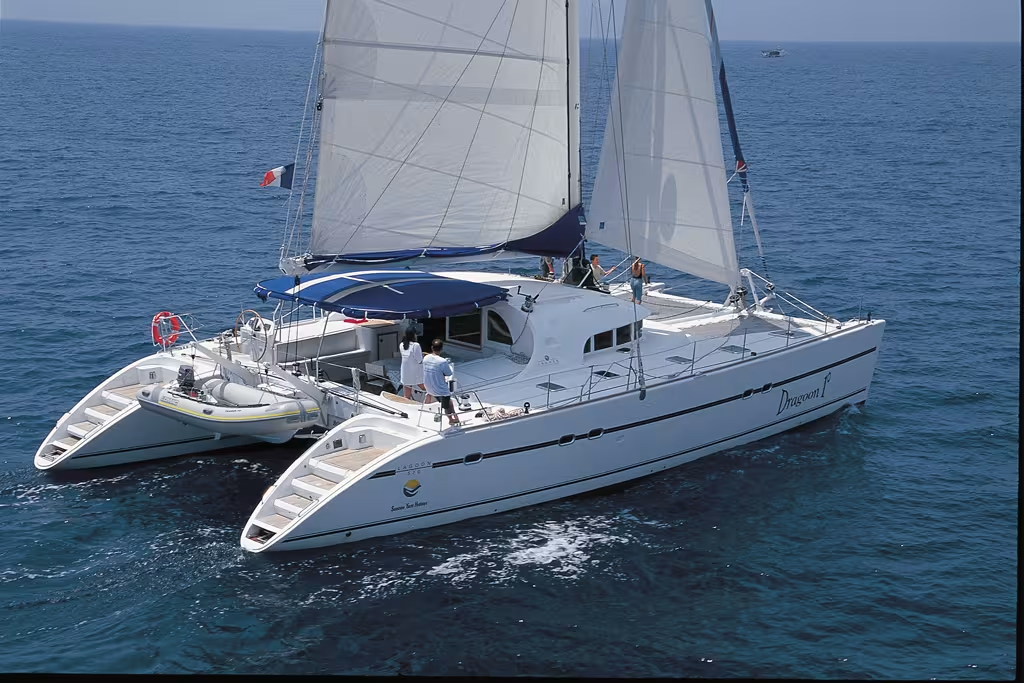
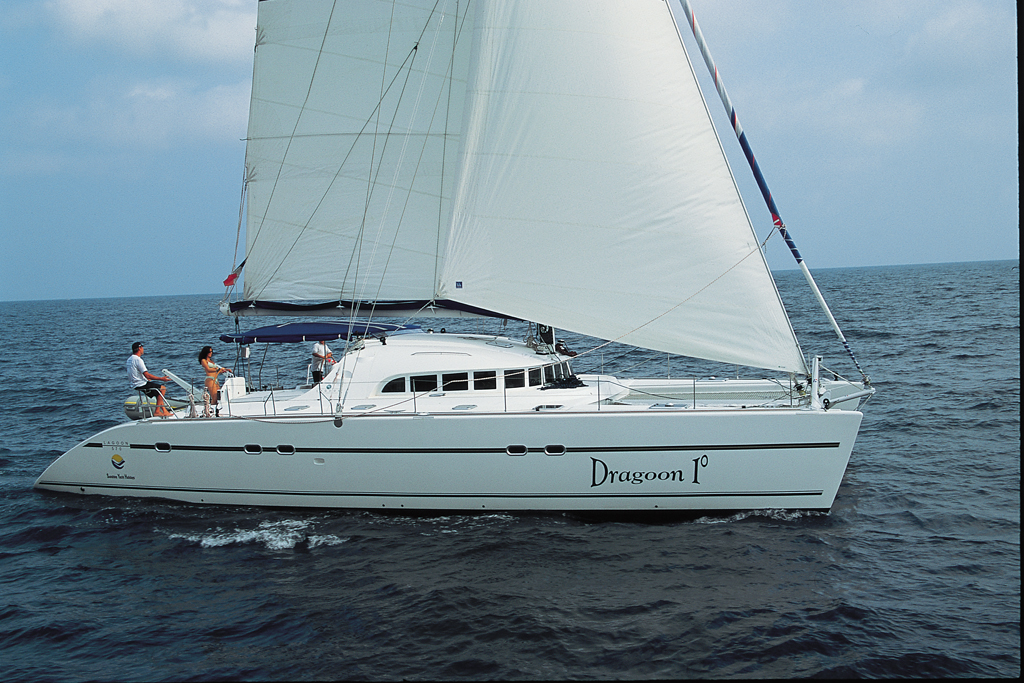
The LAGOON 570 is replacing the 55/57 in the new range, on the basis of the same tried and true waterlines. There has been extensive restyling of the deck layout, net and interior arrangement. The most visible part of this restructuring is certainly the new design of the roof that imposes a functional vision of this architectural element regardless of any pseudo-racing aesthetic compromise. The advantages are rational: maximum space, thermal comfort and, in the absence of fore slope, a running rigging at the mast foot with perfect ergonomic qualities. From the subjective standpoint: the avant-garde treatment of this volume may not be to everyone’s taste. The great majority of 570, delivered or on order, are owners’s boats destined to sail around the world.
The construction process
The heir to “Jeanneau Techniques Avancées”, the shipyard in Nantes where Bruno Belmont developed in particular GROUPE PIERRE Ier for Florence Arthaud and all the FLEURY MICHON craft for Philippe Poupon as well as formula 40s and other trimarans for “Water World”, the new production unit for large LAGOONs was obliged to set up a top-quality construction process. The general principle is glass-balsa-vinylester sandwich construction on casts with vacuum resin injection. The bottom of the net and the two interior half-hulls are cast in one piece and only the two outer half-hulls and deck complete the operation: the obvious seams between the net and hulls are thus more homogèneous. Balsa here replaces the traditional PVC foam and the fabrics are multiaxial of various weights, cut out and placed by hand in the casts with the greatest care. The construction process makes meticulous application possible since all the fabric, reinforcements, etc. put in place with resin-free spray glue. Thus, all the work you do is clean without concern for setting times. When everything is satisfactory, you insolate under a complete mesh of plastic film and drains before creating a vacuum and injecting the resin. Thus, we have the certainty of perfectly plastered skins and core and the resin goes well everywhere. The excess is drained through specific orifices to ensure light solid construction all in one time without successive polymerization. The quality of the stratification finishing linked to this process is admirable, resistance to torsion and general aging should also be top-level.
The 570 philosophy
The LAGOON 570 aims for “balance”, which means that her main characteristics should be moderate and concur to making this big boat a catamaran that is easy to handle and fast at all speeds, comfortable and seaworthy. That is the opposite of a “sophisticated” unit whose rebellious nature reserves both good and bad surprises. This will for powerful comfort and high average speed is manifest in the length-beam ratio - 17x9 - to be able to tackle the sea. The 14T displacement is moderate for the size for 5T live load. There is nothing excessive in a 170‑m2 sail area on a 22.50‑m mast, there again the power of the “sail-motor” seems well appreciated and consistent with respect to the concept. The functional adaptation of the whole deck layout, the fight to control friction thanks to Harken ball-bearing blocks and the installation of 3 power winches work toward this goal. The motors aim to be classic and efficient to control the craft in port. There are different approaches to the interior decoration of these large prestige multihulls according to the shipyard. Today, they all emphasize the roof and rival for ingeniousness to meet the expectations of often well-informed customers. The LAGOON recipe for this 570 is to emphasize space and the modern organization of the quality of life without forgetting the fine classic manufacture of the features. The time has come to take a closer look at the 570, freshly launched, during an autumn convoy of 100 miles from Bordeaux to La Rochelle. This navigation will also validate the boat’s reception by the owner and skipper. Thus, we were undertaking to “break in” this unit with her luxury optional equipment, ideal for a test.
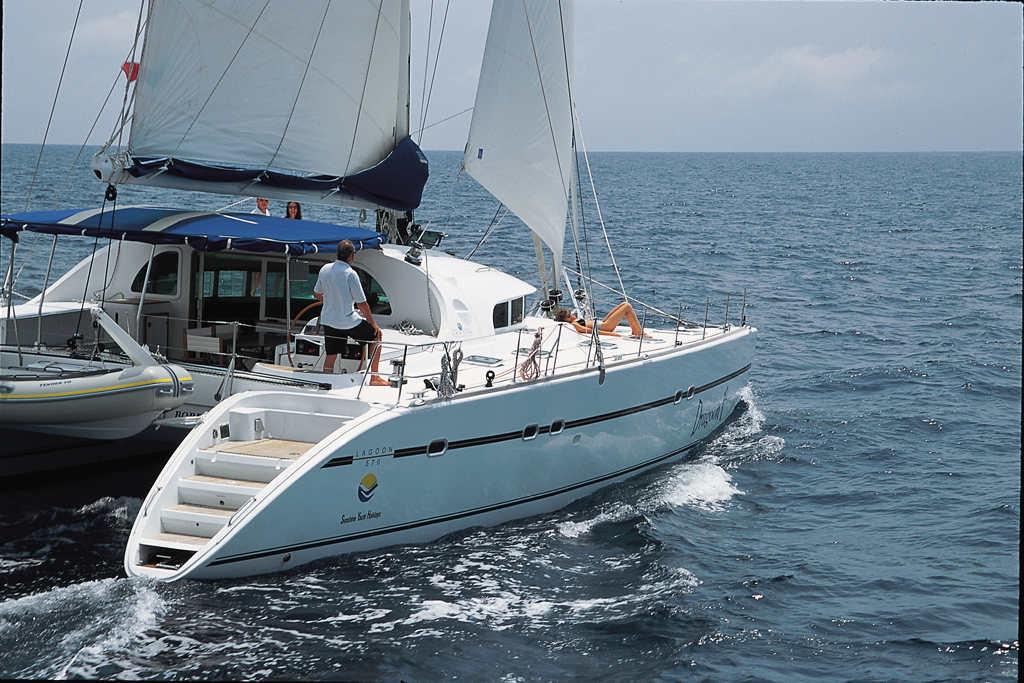
At sea
7:00 am on this late October morning, our LAGOON 570 weighed anchor: on the agenda, the descent of the Gironde Estuary over 50 nautical miles and then straight for La Rochelle. The weather announced a small low-pressure area that wasn’t too nasty, with quick passage of the winds from SW to NW. The challenge for this early morning was to accomplish the descent successfully with the current and pass the mouth of the Gironde before turning back, in short 45 to 50 nautical miles by motor before reaching the channel along the bar of the untamed coast. This is not something that usually raises optimism for most boats, but with our LAGOON, it did! The motors are really soundproof and emit to the outside no more than a slight murmur that has nothing unpleasant about it, and no perceptible vibration. Although these motors are the “small” 2x52CV, the shipyard recommends the 2x72CV option. At the beginning of our descent to the sea, we held our 9-knot average then, with the motors at the right temperature and with the help of the current, we held a 12-knot average, reaching 14 knots for 2 hours with a peak at 15.2 knots for a moment! This is my personal record with a motor on a sailboat. The current was probably at 4-5 knots that day. The “river” test was brilliantly successful; it is an integral part of the specifications for a cruising boat with an ambitious agenda. Silent operation, no vibrations, efficient propulsion, protection of the Maxprop three-blade propellers and skeg for the fin making it conceivable to sail up the Amazon, Orinoco or other American waterways in all serenity.
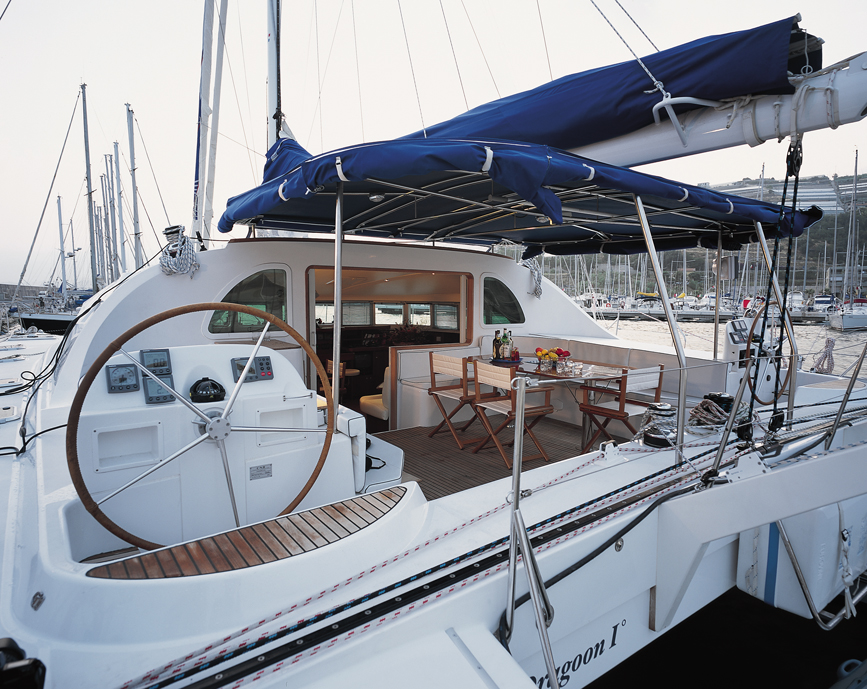
Mainsail and solent were hoisted as soon as possible, but there was another challenge awaiting the LAGOON: sailing upwind with the wind not very strong and the anarchical “choppiness” at the entrance to the estuary. She had no trouble starting, however, her speed oscillating between 7 and 8.5 knots for 12-13‑knots true wind. We headed 55° of the wind on the agitated water of the Gironde River. These conditions would spell trouble for lots of boats since the wind had been blowing at 20 knots for several days and the waves breaking on the Banc de la Mauvaise and the untamed coasts are no joke. The streamlined hulls designed by Van Péteghem and Lauriot Prévost here express all their qualities. The fins function perfectly with this design, speed and heading are there. The 570 doesn’t skin over the waves. The fine rudders I was able to observe yesterday in the shipyard are a model of accuracy and efficiency. They exceeded my expectations in this primordial aspect of multihulls; the fins - fairly narrow and deep - are perfect! The comfortable height of the net completes the 570’s agility upwind in a brown sea and maintaining speed whatever the sea conditions. From the lighthouse of Cordouan to Chassiron, you must keep the heading against a wind that begins its rotation toward the Noroît and forces us along the untamed coast and later the Island of Oléron. Against all expectation we tack just once. That’s remarkable and well illustrates the advances made by this big multihulls. Today, they are very versatile. Hoisting the gennaker on the boom marks the passage to the NW of Oléron in 12-knot wind beating on the water near La Rochelle, we reached a peak of 11 knots and a regular speed of 9-10 knots at 110° of the wind. Our gennaker was small, since it was intended for the tradewind and a maxi asymmetric spinnaker would have enabled us to surf in this slackening breeze.
The deck layout
Despite the presence of the very powerful discreet Harken electric winches. I wanted to undertake all the maneuvers manually. These tests are important since they demonstrate the aptitude of the fittings to function later with a heave load. Very special mention goes without hesitation to the design and realization of the deck layout on the 570. Electric or mechanical Harken winches, Harken ball-brearing blocks, rails and slides of the same brand make this boat easy and pleasant to adjust. You can play with this catamaran and adjust it with precision without any particular physical strain or limitation. The security and ergonomics of the work stations have been given very special attention. Bravo!
The rigging
The very fine 22.50m classic mast designed by J.P. Maréchal completes the faultless record for this compartment, the LAGOON 570 is a true sailboat. With white lacquer, perfect welding and finishing, this tube is rigged with solent and staysail on Proengin furlers. My only comments on this aspect are of optional order and concern the possibility of using the Dyform cable to the backstays so the diameter can be reduced to 16 to 14 for example and the addition of two Vectran backstays that do not contribute to the profile stability but do refine the solent luff in the breeze without compressing the mast too much with the shrouds.
The sail area
The set of Incidences sails on our test boat corresponds perfectly with the 570. The mainsail is beautiful, of the best Dacron and double crease, its shape and finishing are top-level; it is powerful and easy to adjust. The reinforcements are reassuring and the rings taken up by 4 oriented straps. The shape of the roach at each reefing point enables the block to working without friction. Considering the power available in the mast foot you have to use the electric assistance parcimoniously, in particular for reefing points downwind and the tensions of the halyards. The LAGOON 570 bears her sails high without strain for up to 20 knots true upwind and 25 knots crosswind, the speeds are thus “sufficient” and hum at around 15 knots at 100° of the wind.
Life on board
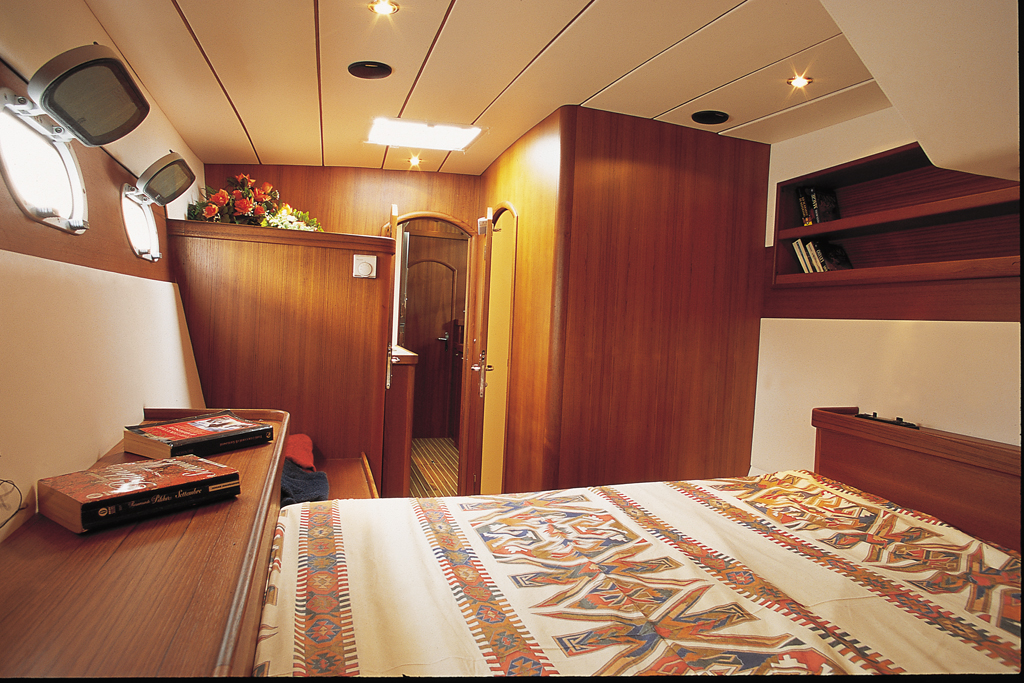
The 570 we tested is intended for the Virgin Islands. She is designed to provide the finest hospitality for very demanding American clientele, alternately with periods when the owner will invite friends. Thus, it is a charter version with 4 double cabins and accommodating for the skipper under the starboard helm station. Perfectly separate, with a double bed and washroom-and-toilet, the quality of this equipment participates in the perfectly successful life on board for the “captain” and crew.
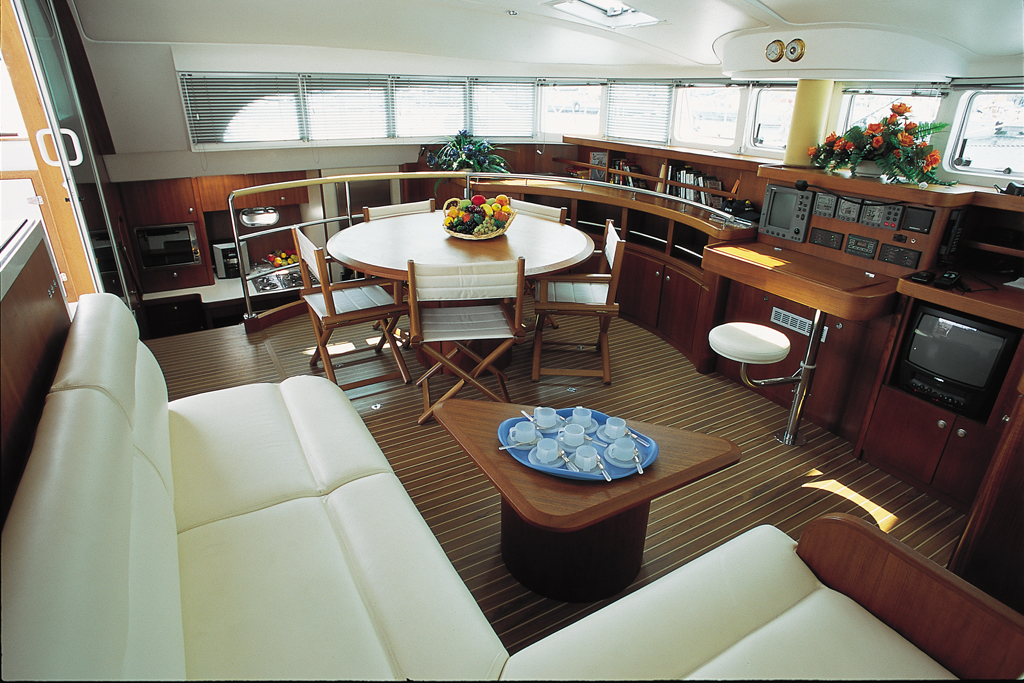
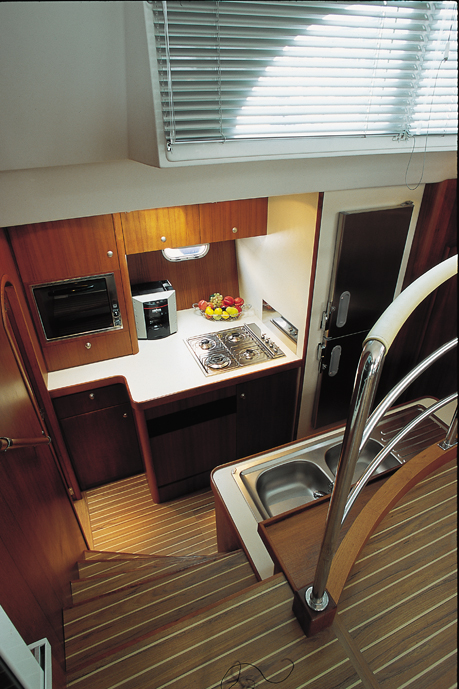
It is impossible for me to describe all the equipment on this catamaran, since there is so much, much of it quite unexpected, like the large plasma screen that rises electrically from a panel that conceals it during sailing and transforms the couch in the saloon into a “home cinema”. Its Dolby ambiophonic and DVD drive with a capacity of 200 films… much more than your video club could ever supply! Waterproof Bose loudspeakers in the spreaders support this sound system for evenings of dancing. The galley has professional equipment, positive and negative cold, 5-burner set, microwave oven, etc. A 250l/h desalinator should provide sufficient drinking water and the air-conditioning can be modulated in every cabin. This boat is also a pioneer in terms of being environment-friendly, since the black water is degraded by electrolysis and released into the sea at “swimming” quality. A weather station records all the parameters of the catamaran’s navigation zone and forwards them to a worldwide collection and observation network! The fore cabin to port has a compressor of course for oxygen tanks for scuba diving, and the central one has a Diesel-run generator. The woodwork here is in keeping with the highest standards of quality. This unit provides real comfort in all conditions, whether the weather is hot, cold or wet. The heat and sound insulation of the balsa sandwich material is one of the best I’ve ever seen. The panoramic roof cannot be described in one sentence: light, spacious, modular, this ‘living room’ is a success. The “outdoor saloon” under bimini meets many expectations: you can dine there in a wide range of conditions both at sea and at anchorage and the trunks covered with teak flooring. On board the 570 the transom is long, ample and comfortable; this direct access to the sea opens on top and there is one perfectly devised machine room per hull where all the functions and controls are identified with plastic labels that cannot be erased.
CONCLUSION
This big catamaran reaches all objectives, and they are ambitious. Very comfortable and quiet, the LAGOON 570 is a true sailboat: safe, seaworthy, fast. She is well balanced and “easy” to use for her size. The different versions make it possible to have the interior arrangement correspond exactly with the boat’s agenda. Life on this boat will be very pleasant for the owner, providing incredible autonomy while sailing around the world if you don’t let yourself be tempted by too many options, which require lots of care and a substantial budget. As a working tool, the 570 will export the quality of French know-how in terms of large multihulls, a sector to which French shipyards have strengthened their position as world leaders. Her navigating qualities are at the very highest level. This boat is reassuring in her behavior and should provide high averages in all weather on the high seas.
I liked
The general quality The fittings and rigging The feeling of the helm The balance between comfort and performance The ergonomics of the work stations (mainsail, mast foot, adjustment solent and berthing) The silence at sea inside the hulls The pleasant life on board
I would prefer
More daring in the outside decoration or brighter colors for the hulls Vectran backstays for sailing upwind in the breeze Pad-eyes on the roof Transparent panels that can be covered in the bimini to facilitate adjustment of the mainsail Tensioners for the backstays And - please - those beautiful straight stems of the 67!
Comparative table
OUTREMER 55 CATANA 581 LAGOON 570 Length 16.30m 17.70m 17.06m Beam 7.20m 9.10m 9.15m Draft 0.80-2.50m 0.90-2.50m 1.40m Motors 2x28CV 2x110CV 2x53CV Mast 19.20m 23m 22.50m Mainsail 77m2 115m2 104m2 Genoa jib 53m2 80m2 Solent 37m2 66m2 Staysail 27m2 Gennaker 120m2 112m2 Asym. Spinnaker 160m2 tri-radial 220 m2 tri-radial 225m2 Displacement 7.5-10T 16-20T 14-19T
LAGOON 570 TECHNICAL SPECIFICATIONS
Builder: LAGOON Designer: Van Peteghem / Lauriot Prévost Materials: stratified vacuum glass / vinylester Length: 17.06m W/l length: 15.85m Beam: 9.15m Draft: 1.40m Clearance: 24.27m Mast: 22.50m Light displacement: 14T Mainsail: 104m2 Solent: 66m2 Staysail: 27m2 Motors: 2x53CV