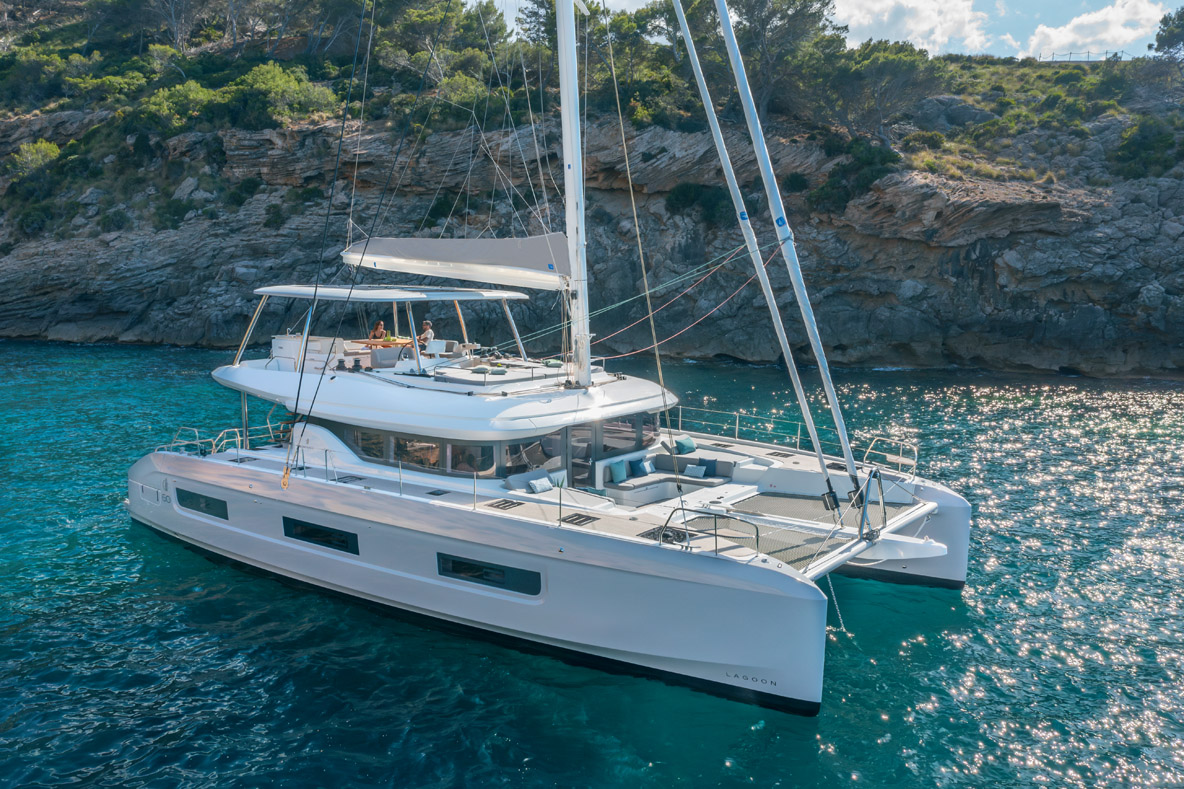
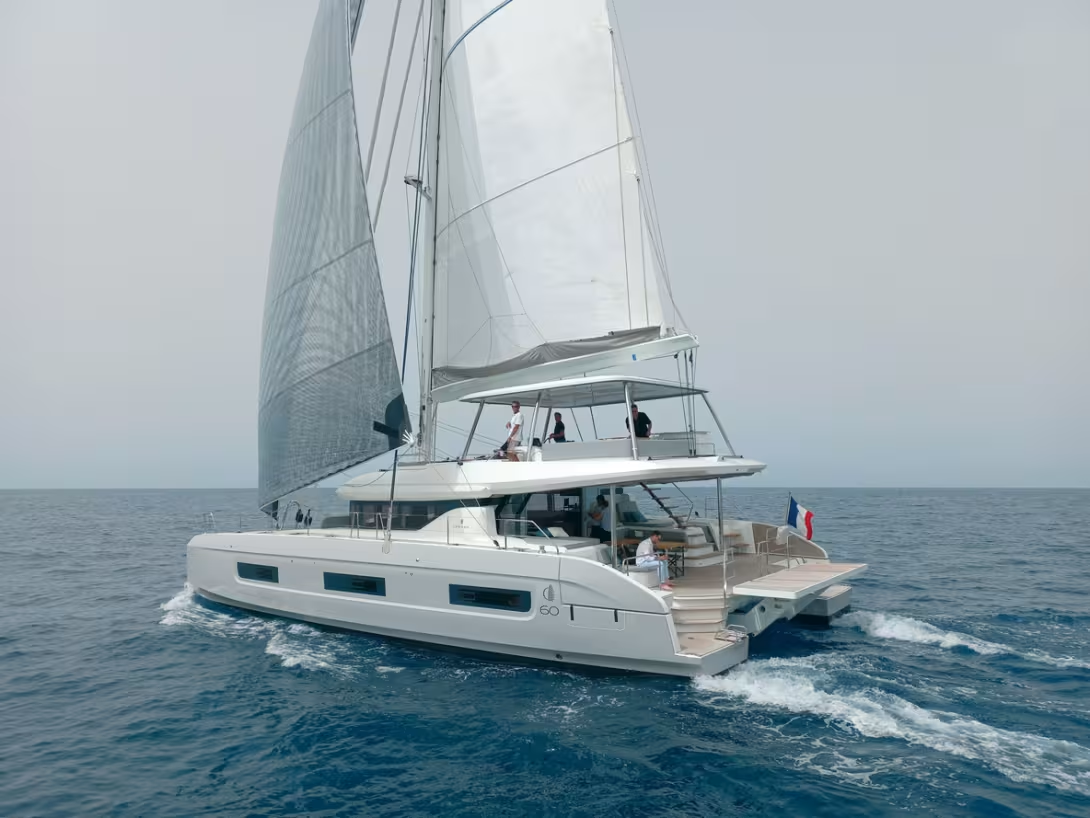
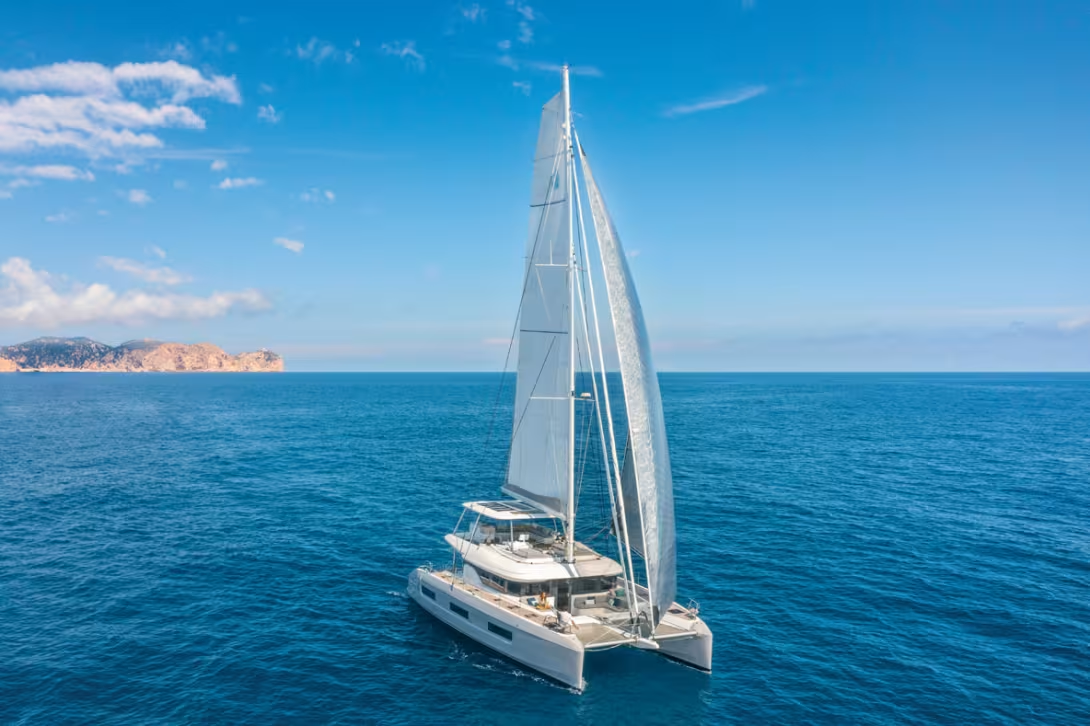
Lagoon, the world leader in cruising multihulls, hadn’t spent all its ammo during the euphoria that gripped the post-Covid market; rather, it’s now that the going is tougher that the manufacturer is pulling out all the stops with no less than two new sailing catamarans, the 43 and the 60, which will be presented at the Cannes Yachting Festival. It was the larger of the two catamarans, now the flagship of the “standard” range, that we got the chance to discover in the crystal-clear waters off the northern end of Menorca.
Infos pratiques
- Le chantier : Lagoon 60
- La fiche technique
-
 Découvrez notre vidéo exclusive
- Financez votre Lagoon 60
- Assuez votre Lagoon 60
- Articles autour du Lagoon 60
Conditions: sea state slight, 6 to 8 knots of wind
Replacing the former “first in class” model was never going to be an easy task. In this case, it would be the shadow of the 620 hanging over the 60. 169 units were sold of the larger Lagoon (before the Premium models), and it was a great success; the aim of the all-new 60 is to follow in the footsteps of this best-seller!
Back in March in Bordeaux, where all Lagoon yachts over 50 feet are built, we were able to see for ourselves at the very first presentation of the Lagoon 60 how all the key points of the 620 had been taken up and, of course, optimized to meet today’s requirements. We were also able to observe a number of innovations... which we were finally able to try out in real life.
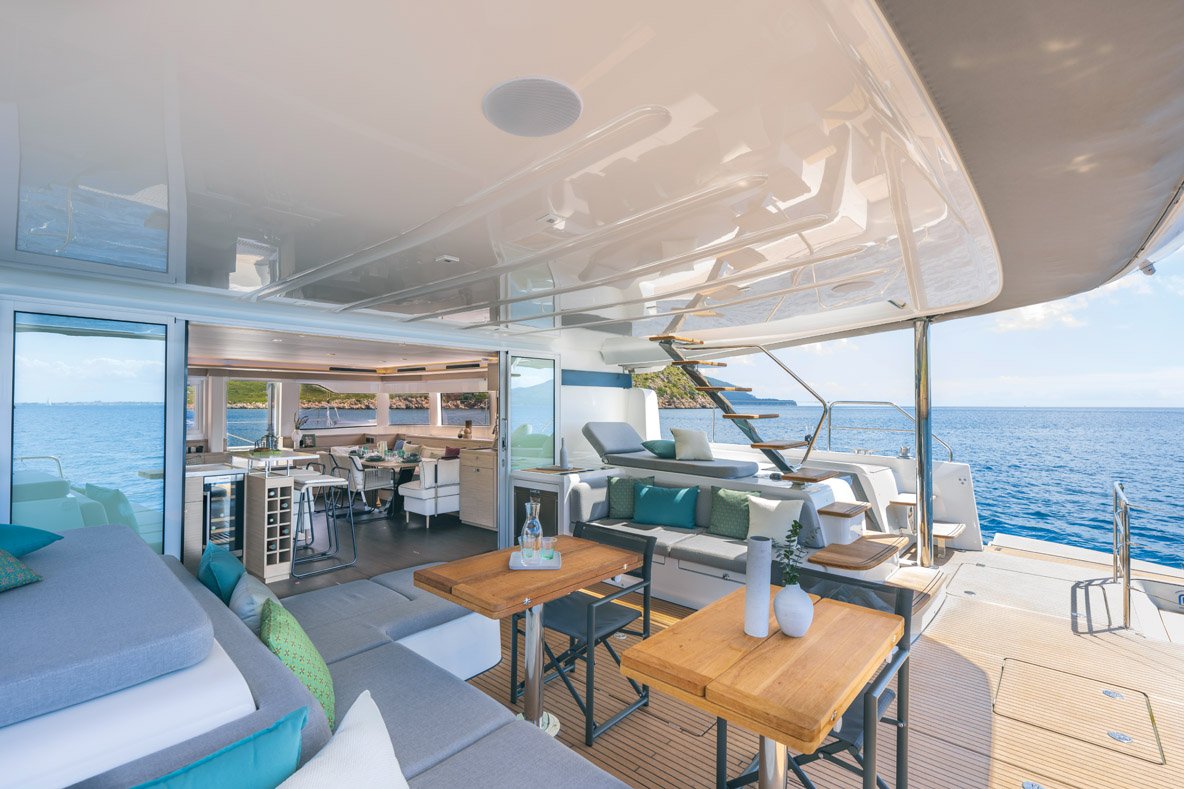
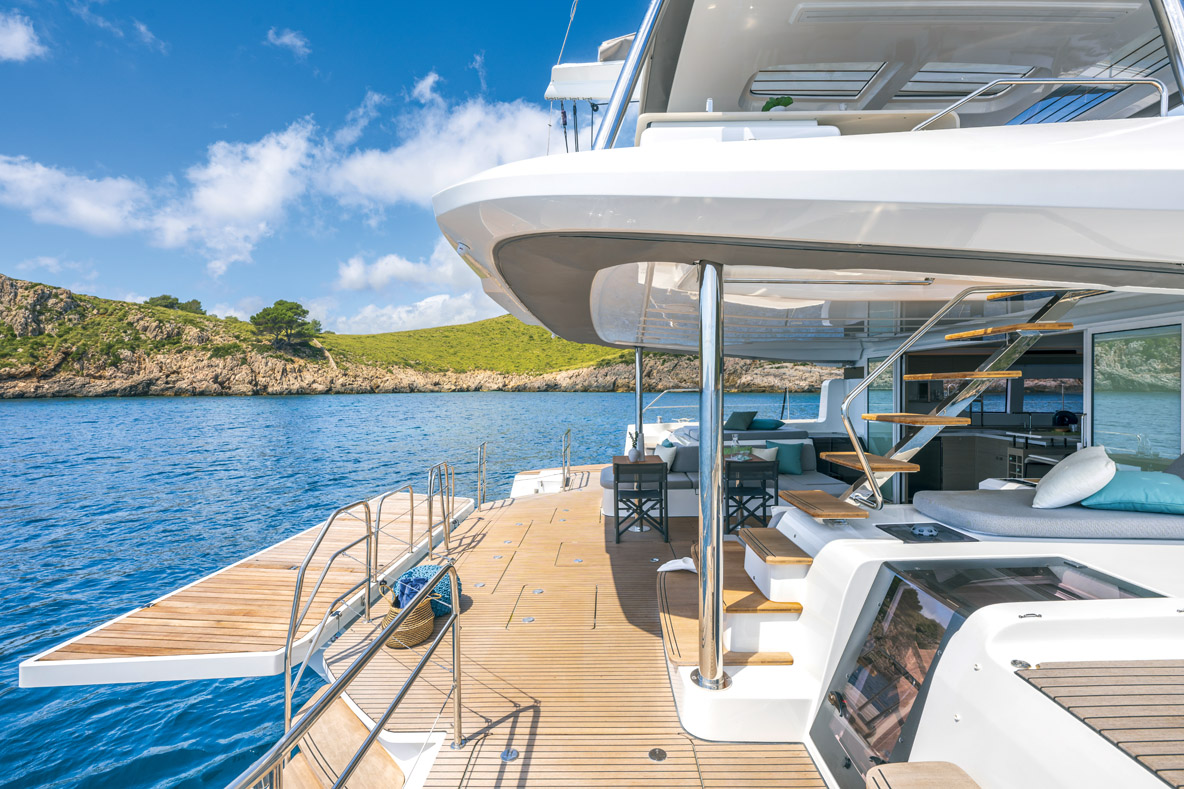
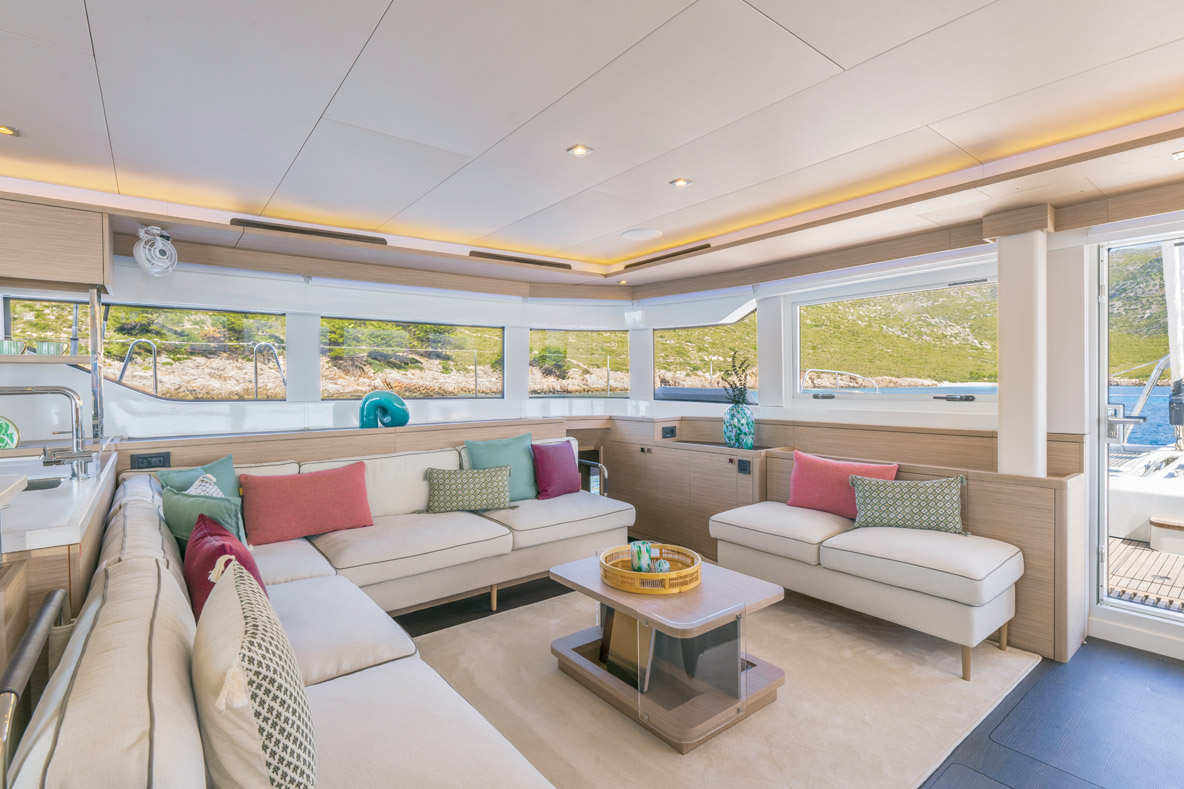
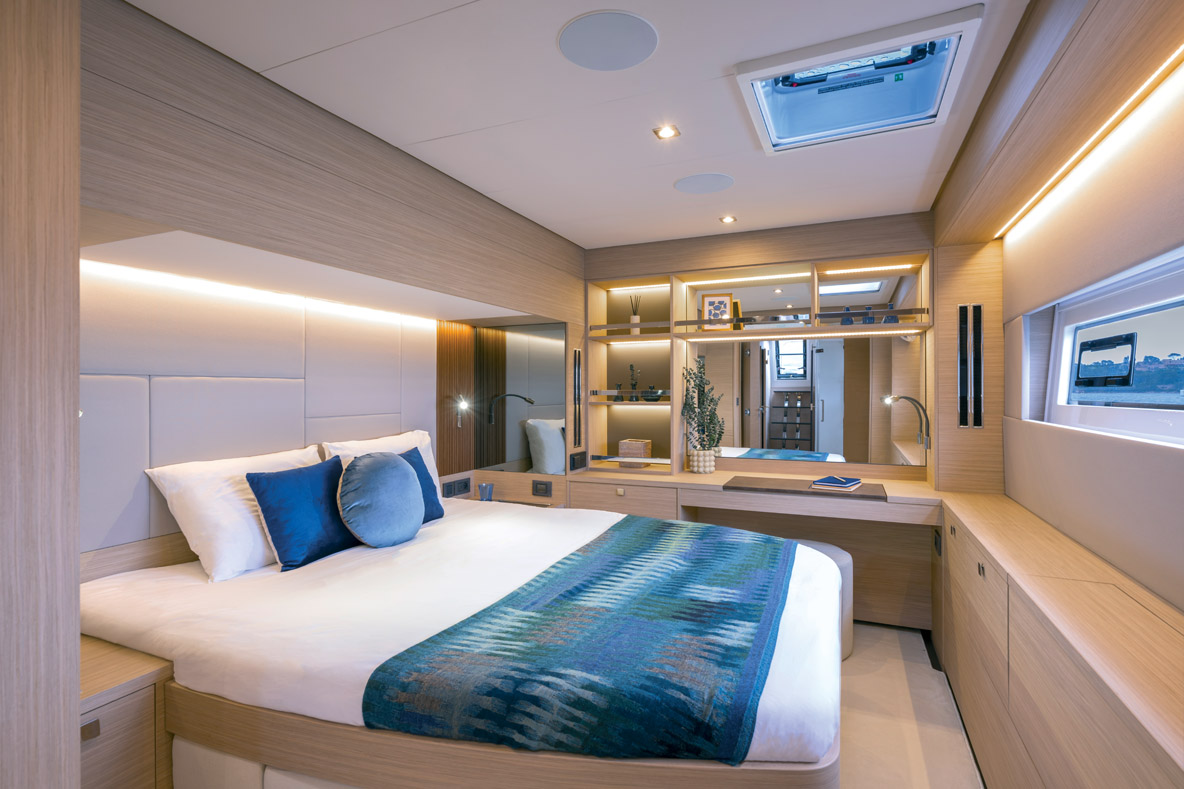
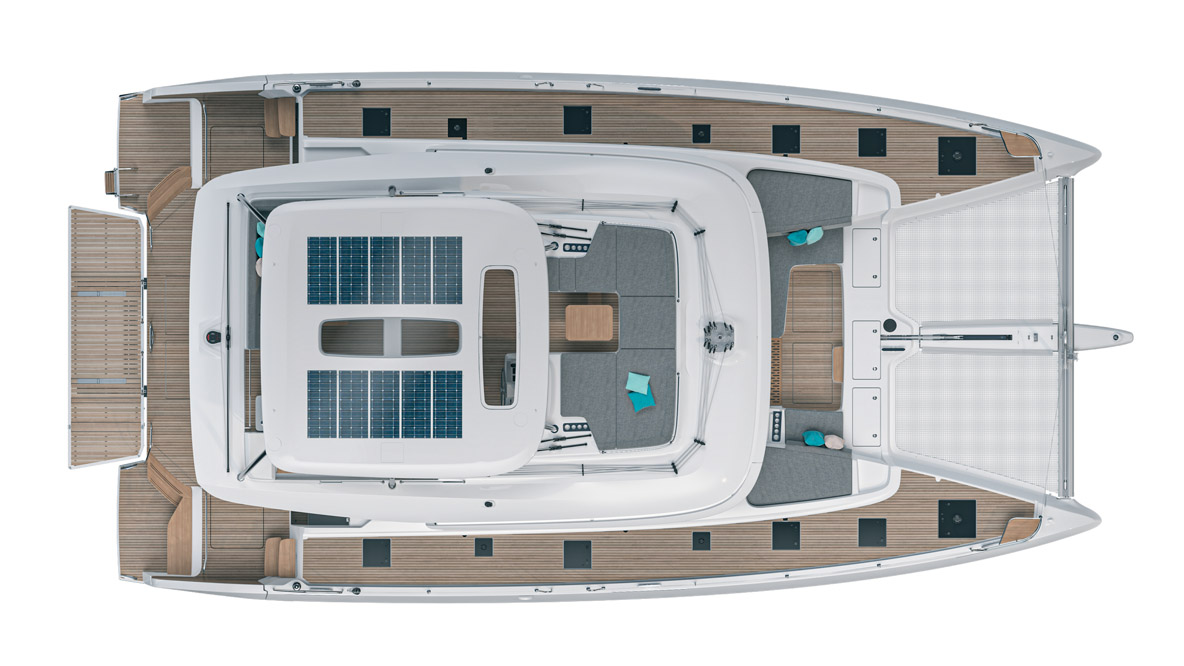
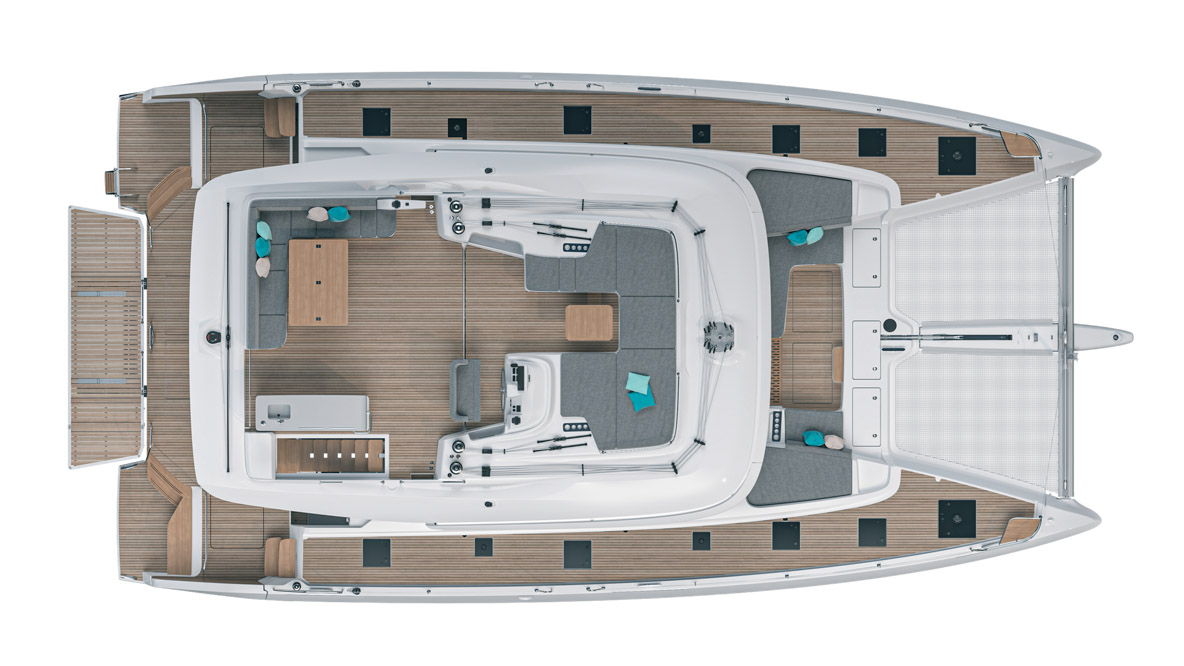
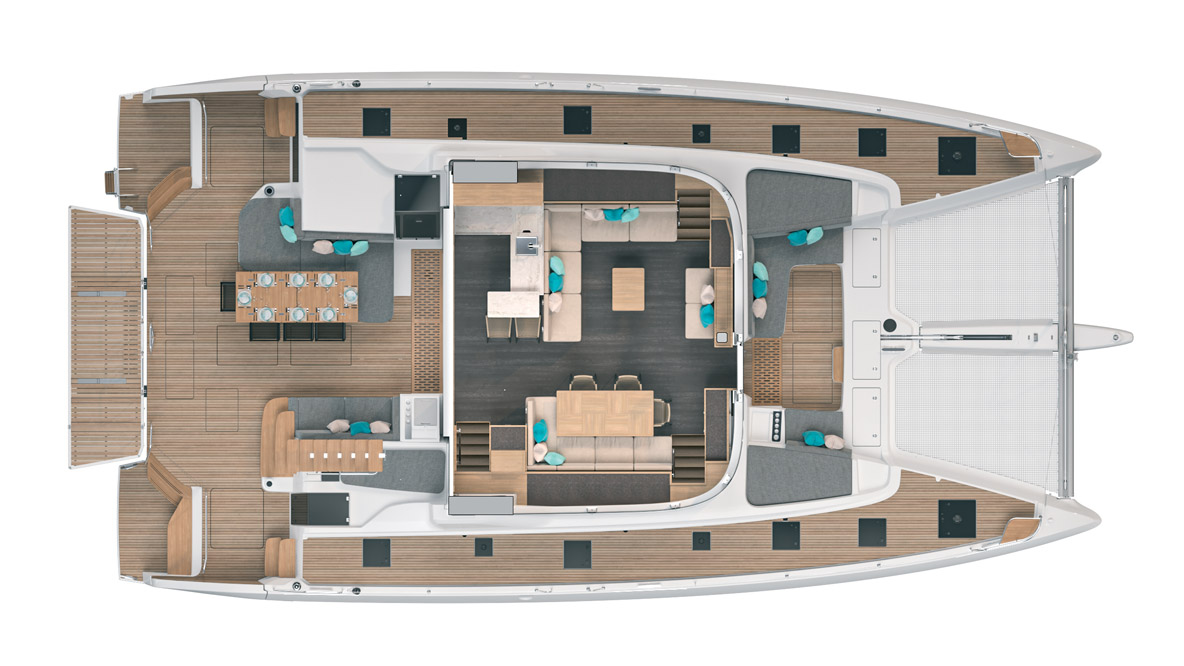
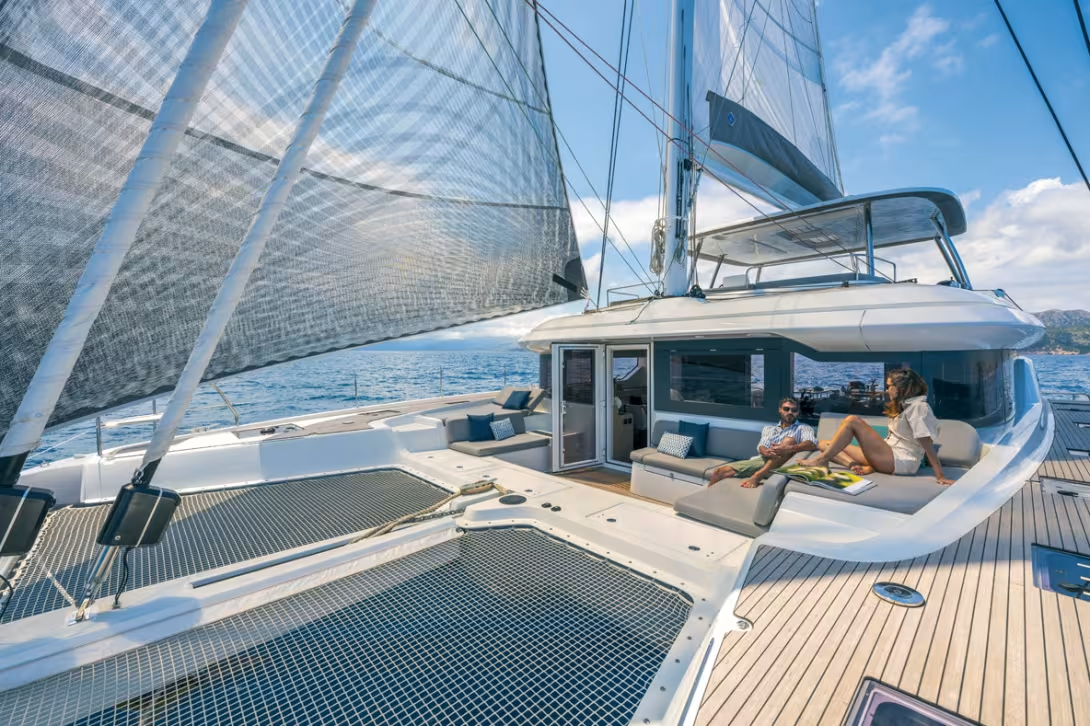
Brand manager Thomas Gailly and product developer Bruno Belmont welcomed us to Fornells Bay, Menorca. It’s not as easy to get to as the neighboring island of Mallorca, and the north-facing position doesn’t enjoy the sane favorable thermal wind regime found off Palma... But none of that mattered: there we were, in conditions very close to those of proper cruising: the Lagoon 60 was actually anchored here, with all the Lagoon staff sleeping aboard. The large catamaran had just completed a long seatrial, and the crew had been asked to report back to the shipyard on all sensations, good and bad. The aim, of course, being to fine-tune this new catamaran before the big commercial launch in September. As soon as we step aboard, the evolution from the 620 is immediately perceptible - it’s surprisingly easy to climb the steps up to the cockpit, or rather the Beach Club. Thomas and Bruno set out the positioning baseline “Openness, fluidity, comfort, generosity: the Lagoon 60 is a dream stage”. Beyond the marketing language, the figures confirm the XXL ambience on board: a 387-square foot (36 m²) cockpit with pivoting terrace, a flybridge equally as vast, a 215 sq ft (20 m²) owner’s suite, cockpit accessible via a forward door, saloon space of over 215 sq ft (20 m²)... Such features are virtually unheard of in this size range: the measured values are more in line with those of multiyachts - except that there are many square feet of sail area to hoist and unfurl above our heads...
A lengthy development
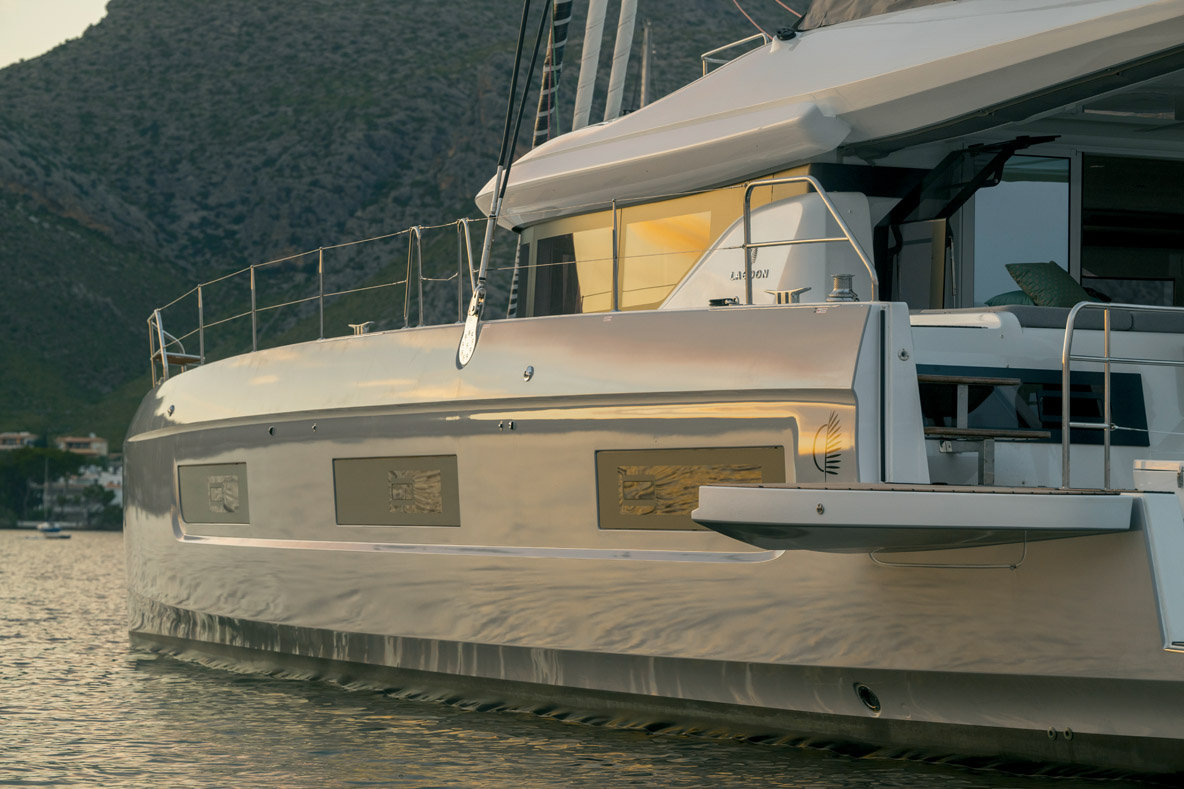
Numbers alone would be insufficient to describe and summarize the particularities of this new model. Bruno Belmont tells us that it took two years of development to reconcile satisfactory performance under sail with the ultimate in yacht comfort. On closer inspection, a number of technical difficulties were encountered in terms of design. It wasn’t easy to fit the immense space of the cockpit-terrace-lounge on the same level as the forward cockpit. As for the central bay window, it opens out to its full width, and the aft beam has been done away with to allow an unobstructed view over the water. The height of the nacelle has been raised to accommodate reinforced beams between the floor and the underside of the nacelle, which has been given a rostrum profile to better deflect the waves. The window frame is reinforced to reduce the maximum diagonal deformation to just 1%, which is essential for the window sections to slide smoothly in all conditions. The whole architecture is designed to stiffen the platform, making it more resistant to torsional forces. The forward door is also a subject with which the site has taken no half measures. Keen to offer safety to its circumnavigator clientele, the design team has opted for an oversized sample, as on the larger SIXTY and SEVENTY models. The return to a forward-stepped rig offers a number of advantages: a more forgiving and powerful sail plan in light choppy weather, a more open saloon thanks to the elimination of the mast compression post, and a flybridge that’s now perfectly unobstructed.
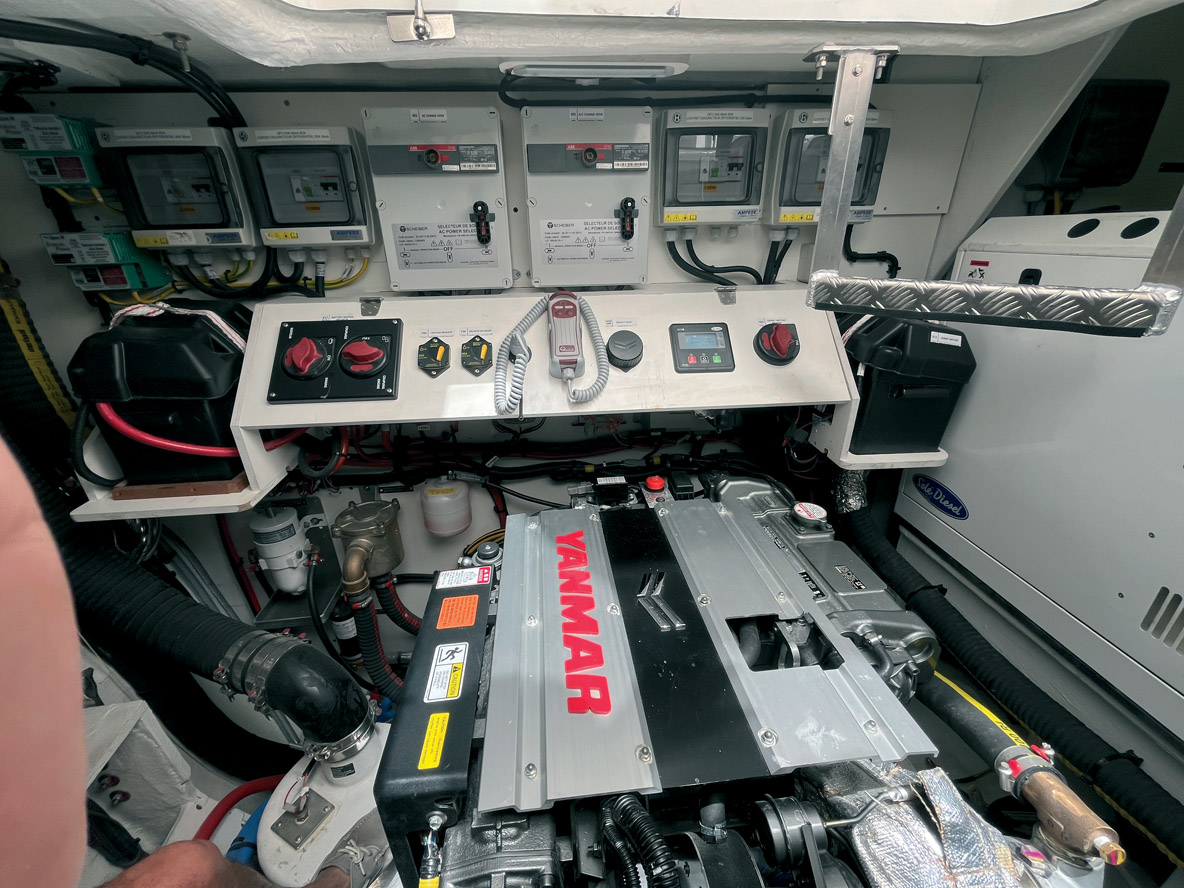
The decreed specifications were clear: the Lagoon 60 had to remain a simple catamaran, easy to manage and more energy-efficient. For the powertrain, Yanmar was asked to develop a special 150 hp motor with sail drive transmission, an arrangement that saves space and is more reliable than a V-drive. As for the chilled-water air-conditioning, it consumes 25% less energy - the system is designed to run all night on the lithium battery bank. With two 125 A alternators on each engine, we’re told that the generator only needs to run for 8 hours out of every 24 yet is still able to meet substantial “hotel” requirements.
Ease of use and versatility
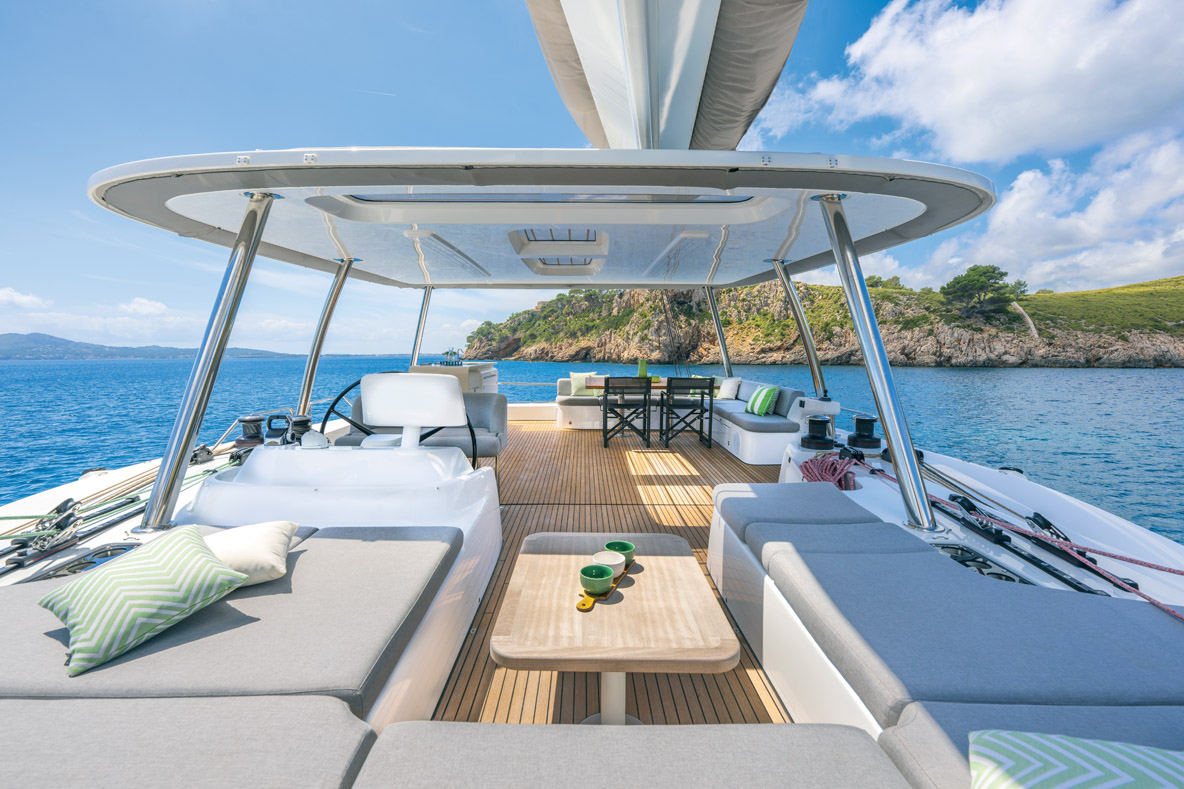
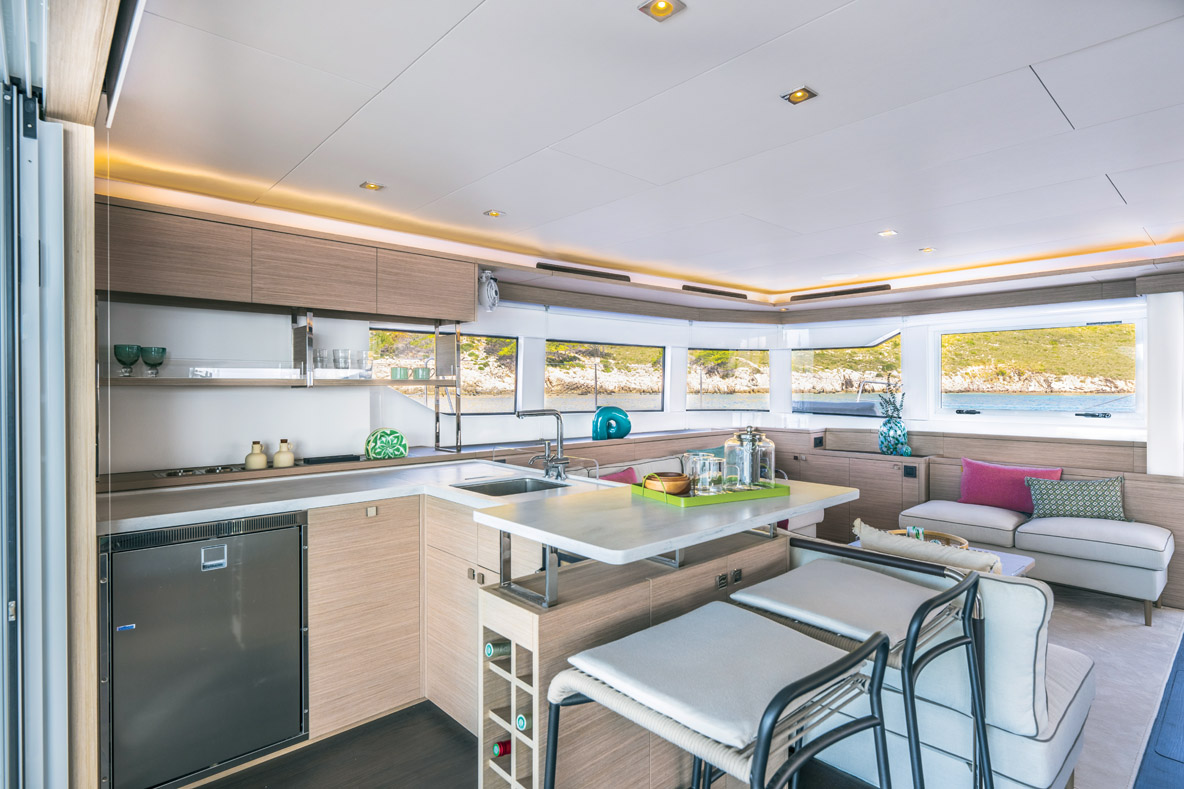
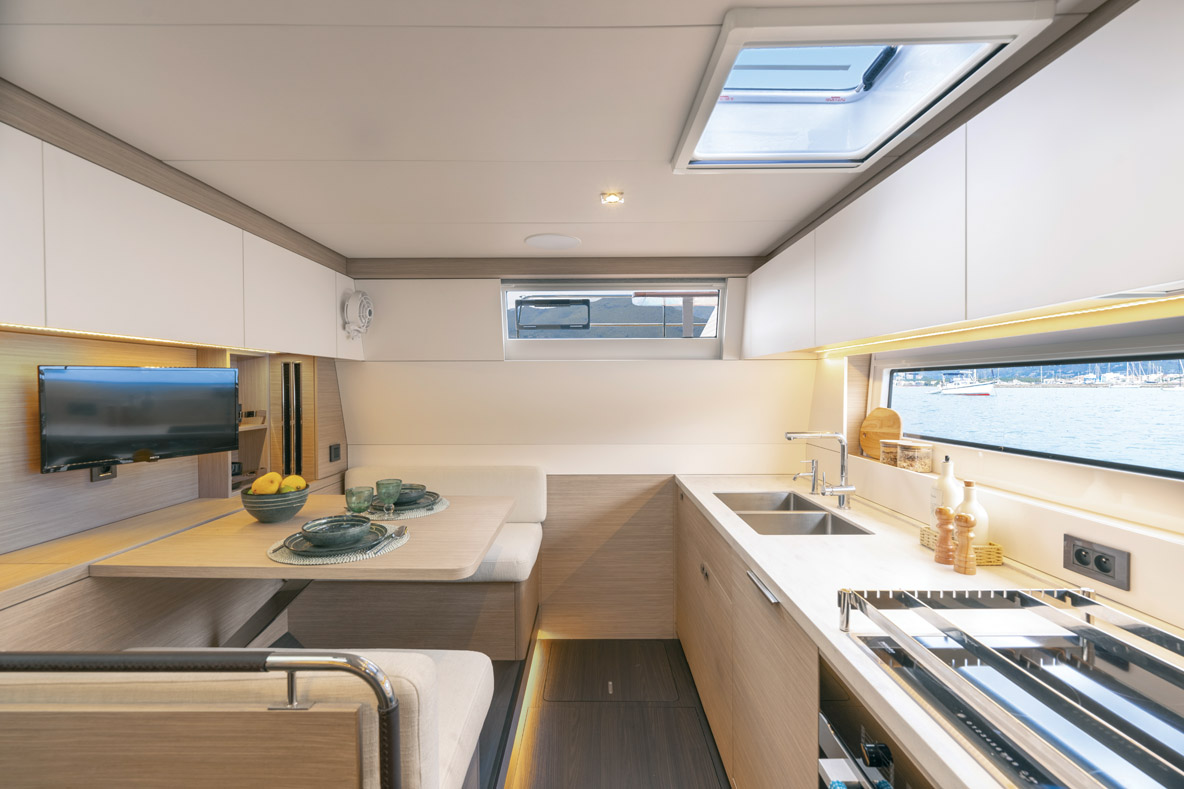
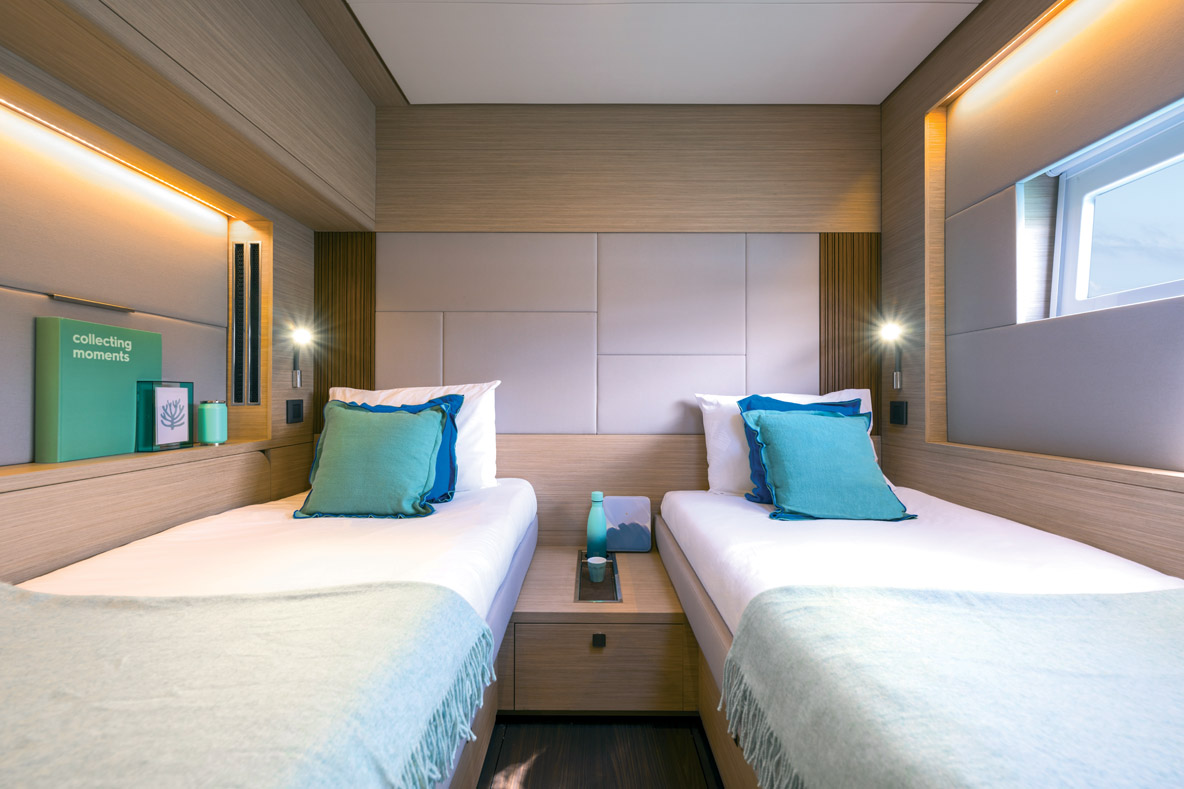
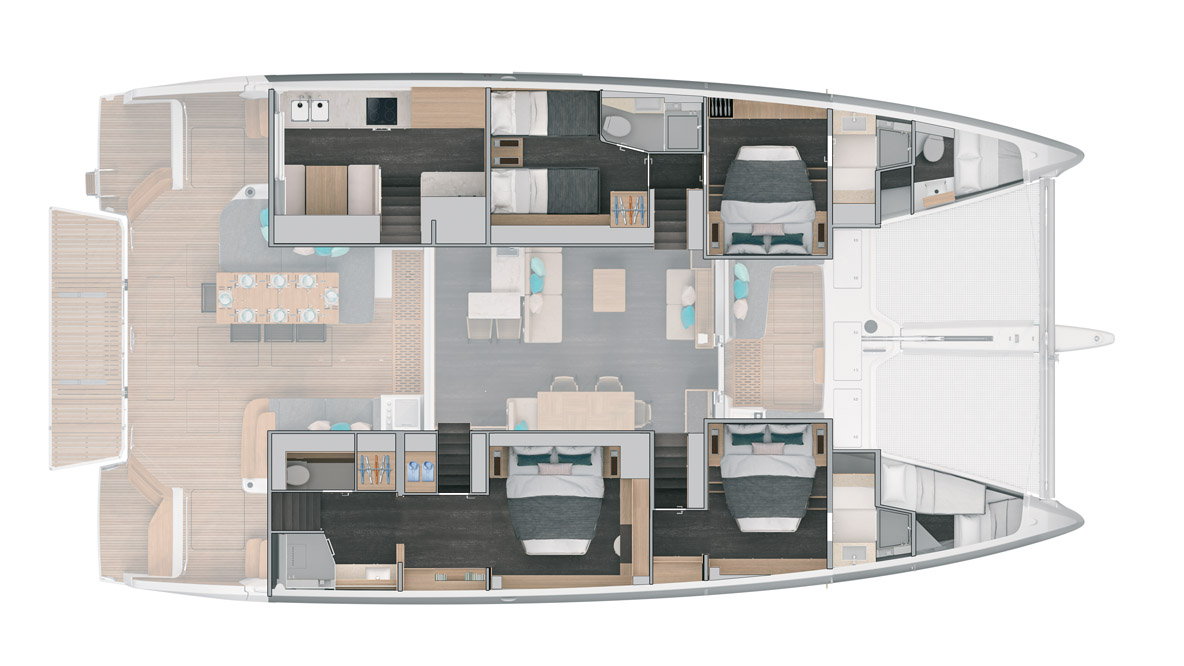
All the technical aspects have been designed to optimize on-board comfort, along with ergonomics and modularity. In these latter areas, the 60 boasts numerous features directly inspired by the premium SIXTY/SEVENTY range. It’s easy to get around on board, thanks to a carefully thought-out circulation system. The 45-degree flybridge companionway, the wide steps where you can pass one another, and the single-level floor will all be much appreciated. The aft terrace, with its large modular table and fold-down wings - facilitating boarding when alongside the dock - is a success. As for the full-width bathing platform, it’s a must-have feature! The saloon is equally convincing, especially in the galley down version. The space includes a counter/bar, half outside and half inside, where all the guests on board can meet for a snack, that is simply brilliant. The table and sofa are very comfortable and enjoy an unobstructed sea view. The sunbathing area forward on the flybridge is extremely pleasant. Under the hard top, the immense space is modular to the owner’s taste, with options available from the catalog. The choice of four or five cabins is determined by whether to have the galley down or up. The owner is pampered with his suite and its direct access onto the aft deck. The crew cabin adjoining the galley can be equipped with twin beds and direct access from the deck. The en-suite bathroom also serves for daytime convenience, but the layout of the heads compartment still requires you to step through the shower. Storage space is both plentiful and spacious, and finishes, such as the oak Alpi, are of the highest quality. The options guide for customizing finishes and choosing accessories runs to no less than 150 pages. Enough to find what you’re looking for. It’s clear that the expertise acquired in the multiyacht sector with the brand’s biggest models has been put to good use on this Lagoon 60.
Power and stability
All this comfort, of course, comes with a high displacement (34 tons as opposed to 30 for the Lagoon 620 and 28.2 for the Samana 59). With an upwind sail area of 2,500 square feet (233 m²), the sail are-to-weight ratio is 6.85 m²/t (7.67 m²/t for the Lagoon 620 and 7.23 m²/t for the Samana 59). Would the Lagoon 60 be equipped to cope the light airs on the day of our test? “It’s not just the power to weight parameter that dictates the performance of a cruising catamaran,” warned Bruno Belmont. “The hull form and the prismatic coefficient also play an important role” (see inset). And it all depends on what you’re looking for: long, exhilarating surfing at over 20 knots, or a comfortable average speed in most conditions? On the face of it, the Lagoon 60 ticks the second box.
On the flybridge, we discover a simple and efficient sail maneuvering station. The sheets and halyards return to electric winches on either side. The furlers, also electric, control a cutter-rig sailplan - main, genoa and staysail - plus a code 0 on the bowsprit. This is a pleasant configuration, well suited to being short-handed.
However, it lacks a transparent panel above the winches to see the sails when trimming - a blunder that will soon be forgotten, as the shipyard has already rebuilt a new T-Top mold. The 1,540-square foot (143 m²) square-topped mainsail and 1,722 sq ft (160 m²) code 0 are optional extras. Hosting and lowering the sails is simplicity itself, so much so that you’d never think you were aboard a 60-foot catamaran. With sails set, our multihull headed off on a slight swell. We kept a close eye on the GPS to keep track of the acceleration, and the Lagoon 60 eventually settled down at 8 knots, despite a true wind that wasn’t exceeding 10 knots. The power offered by the gennaker also helps stabilize this flattering speed, as the hulls smoothly ride the waves. Even in these light conditions, we could already see that this big catamaran, once it’s got going, is a good performer. Underfoot, you can also feel that the structure is perfectly rigid.
The helm console is equipped with Raymarine’s new camera system. With 360° vision and approach alerts, the system is very practical when it’s time to return to port, and reassures the helmsman, who can also use dual joystick control depending on which side he chooses to dock on. When it’s time to drop sail, you have to go up to furl the main in the beautiful Lorima canoe boom; it’s just a shame that a furling boom isn’t (yet) included in the catalog of options. Last but not least, the stern-mounted engines do not contribute to optimum weight centering, but they are particularly discreet, which is an undeniable asset when it comes to maintaining an average speed of eight knots in the absence of any breeze.
Conclusion
A modern cruising catamaran is a platform that is becoming increasingly complex as buyers demand ever more comfort. Lagoon’s designers are well aware of this evolution and have succeeded in combining ease of use with great comfort. The Lagoon 60 benefits from the experience gained with the Premium range: all it needs is a few more feet and it’ll be multiyacht…
“The prismatic coefficient has increased from 0.48 to 0.54”
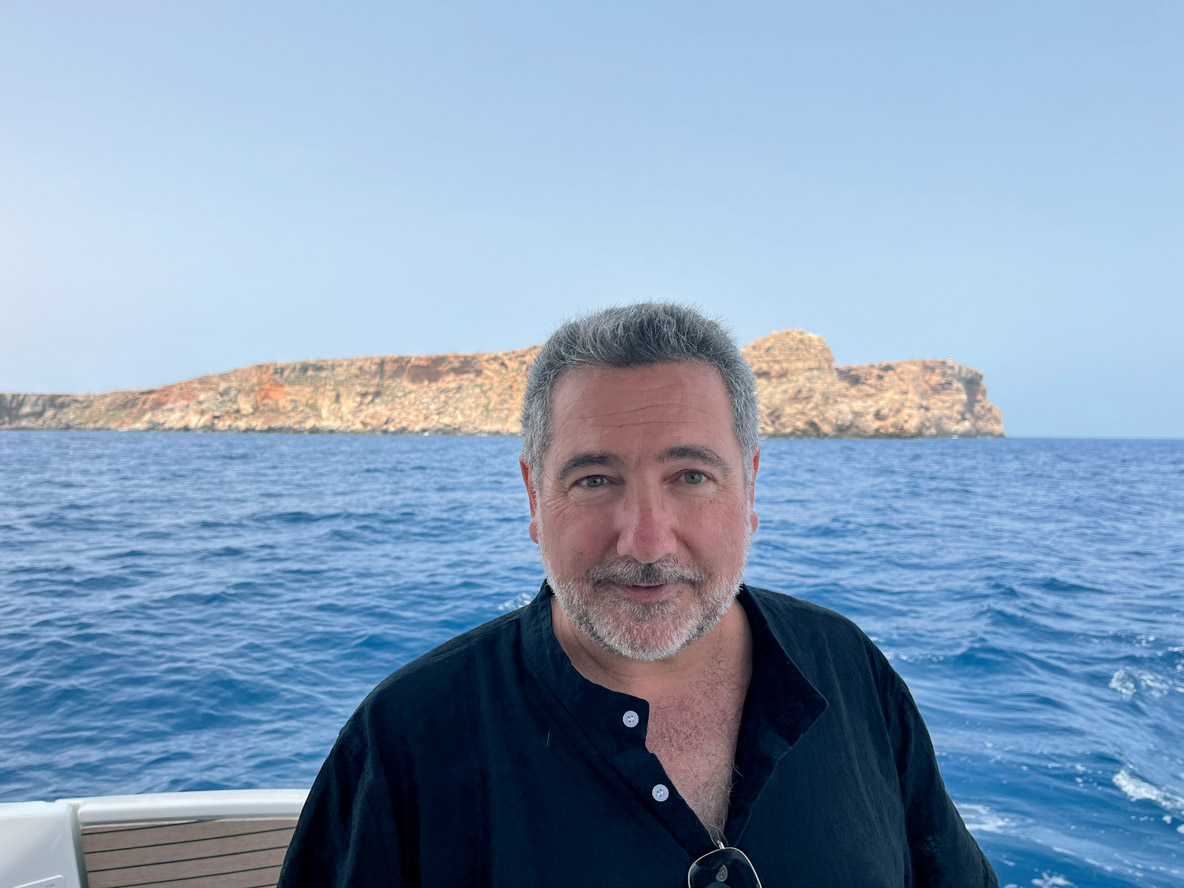
Bruno Belmont: Mister Lagoon
* The prismatic coefficient is equal to the ratio of the volume of the displacement to the volume of the prism corresponding to the cross-sectional area of the midships section multiplied by the length between perpendiculars (lbp). The prismatic coefficient is commonly denoted as CP or by the Greek letter phi - φ. The CP characterizes the fineness of the hull’s shape in a longitudinal direction.
Excellent distribution of space and volume
Powerful, easy-to-handle catamaran
Day-use heads compartment to be rethought
View of sails from flybridge needs to be improved
Technical specifications
Architect: VPLP Design
Exterior design: Patrick le Quément
Interior design: Nauta Design
Length overall: 60’ (18.27 m)
Beam: 29’5” (9.87 m)
Draft: 5’5” (1.65 m)
Air draft: 98’5” (30 m)
Bridgedeck clearance: 37” (95 cm)
Light displacement: approx. 76,300 lbs (34.6 t)
Square-topped mainsail: 1,542 sq ft (143 m²)
Genoa: 969 sq ft (90 m²)
Code 0: 1,722 sq ft (160 m²)
Engines: 2 x 150 HP Yanmar
Fuel: 340 US gal (1,300 l)
Water: 250 Us gal (960 l)
Berths: 8 -12
Price standard version: € 2,140,000 ex-tax
Fully equipped version: approx. € 3,000,000 ex-tax