
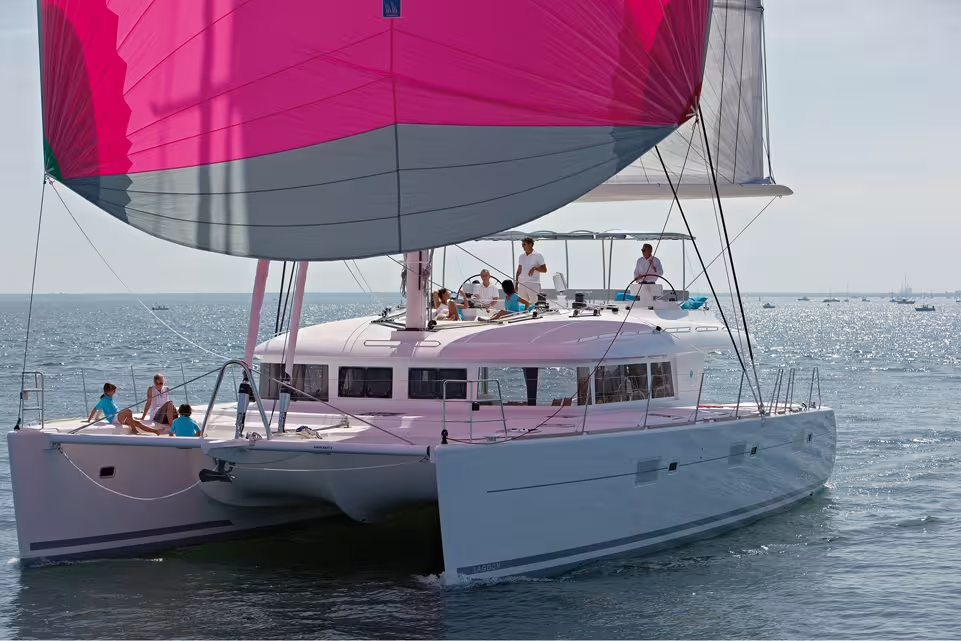
After the 67’ (a custom model), the 620 is the biggest catamaran built by Lagoon. When it was presented, it was one of the main curiosities at the last Cannes Boat Show; it must be said that this ‘cinemascope’ version is very impressive!
Infos pratiques
- Le chantier : Lagoon 620
- La fiche technique
- Découvrez notre vidéo exclusive
- Financez votre Lagoon 620
- Assuez votre Lagoon 620
- Articles autour du Lagoon 620
An ambitious project
With the Lagoon research and development department as project manager, and Van Peteghem-Lauriot Prévost at the drawing board, all that was lacking was a ‘name’ in the field of interior design to complete a conceptual team up to meeting this major challenge for the Bordeaux-based builder! This gap was filled by the arrival of Hervé Couëdel (who has a diploma from the prestigious Boulle school) and Pierre Hugon (joiner – cabinetmaker). This duo has already worked together on the Bordeaux 60’, the Wauquiez 55’ and was also in charge of some exceptional projects, such as ZURBAGAN (90’ monohull super-yacht, 2007 design Award) or ONLYNOW (104'). The presence at the Cannes Boat Show brought to an end the two-year technical marathon necessary for the completion of the most impressive genuine production model catamaran ever built up until now.
The Lagoon 620 is a generous boat which goes to meet new expectations and customers attracted by the stability and space offered by catamarans...
The wager of a big production multihull
The launch of the 620 put into concrete form the Vendée-Aquitaine based builder’s desire to keep up with the competition (which had for some time had an eye on the development of big, 60 – 70-foot multihulls) and to accompany a clientele with a lot of purchasing power in its escape projects. Lagoon didn’t enter the 80 to 150-foot multi yacht competition, but wanted to interpose an alternative offer to the advances of Sunreef or Catana in this segment. The business strategy was clear: use an international sales network and a recognised brand image to appeal to purchasers defecting from motor boats, charter skippers, or owners tempted by big multihulls who would feel reassured by a product stamped by the world leader in the segment. As always, the basic price was well-studied; the lover of customising would be happy with the various versions and options. The Lagoon’s force of attraction is not limited to rational arguments; it offers a reinterpreted approach to the volumes and ergonomics of a catamaran.
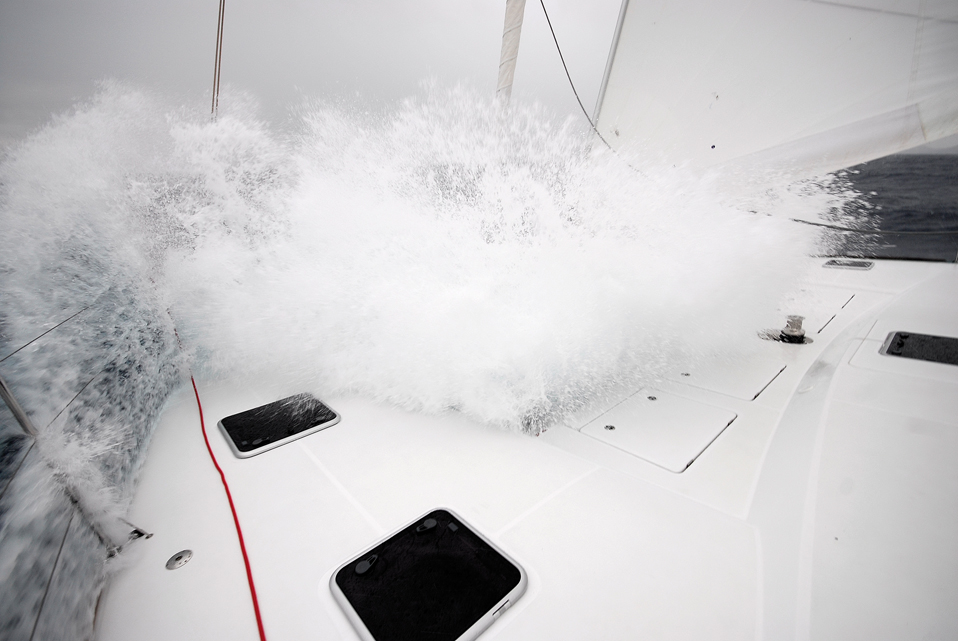
During our test, the conditions were...rough! 30 knots of easterly in the Mediterranean; despite appearances, the interior remains peaceful.
The conquest of space
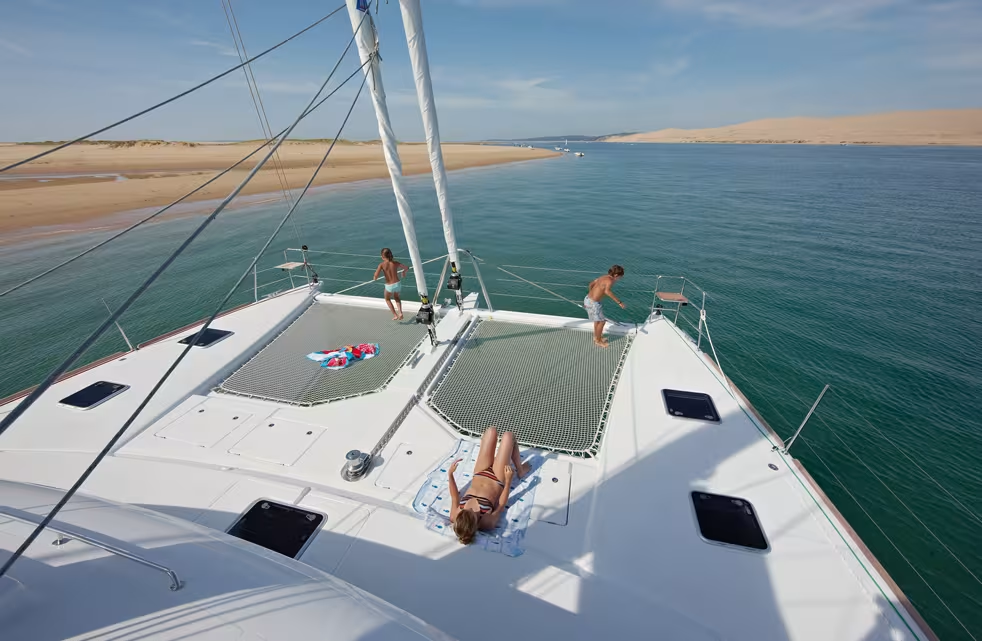
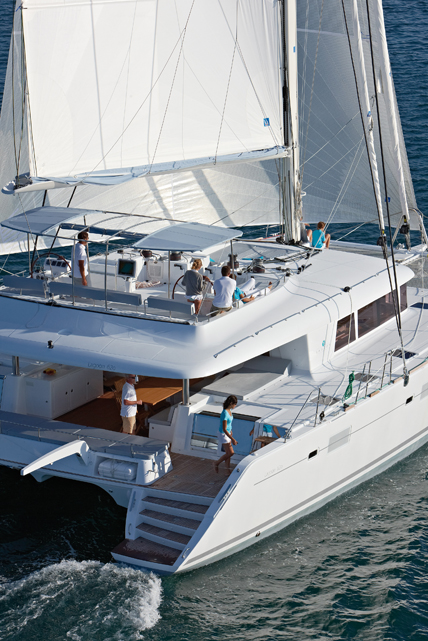
Without hesitation, the 400 won the trophy for the most liveable volume in its category; the 620 should imitate its young predecessor and succeed in retaining good seakeeping qualities. By observing the number of people on the decks of the 620 during the Cannes Boat Show, it was easy to suspect that something was going on! I had to wait until our test to understand the reason. Climb aboard with me for a brief visit; I’ll try not to use too many superlatives concerning the liveable area, but it won’t be easy! Access aboard is via unusually large stairways in the sugar scoops; depending on the weather outside, you enter a large veranda (if the ‘canvas’ kit is in place) on the same level as the saloon, or a multi-purpose terrace, on which there is a ‘wet bar’, a lounge and sunbathing areas which cover the superstructure of the owner’s area, and the galley, which open directly into the cockpit! A first aboard a catamaran. On charter, or when private cruising, the ship’s cook is spoiled and will enjoy pampering the crew. The work surfaces are fantastic, the light and the panorama, amazing! A new fluidity, created by the access to the cockpit (or the lounge) turns the ‘office’ into a tribal crossroads, which seems to be a direct invitation to capture sea bream or bonitos. Their preparation rises to the status of a pre-gastronomic attraction for the crew. Bravo, therefore, for this bold and successful galley. The only reservations apply to the obligation to close the huge access hatch in bad weather...and the optional household appliances.
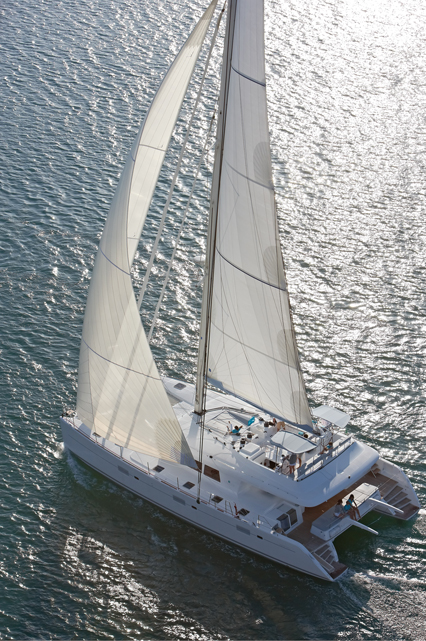
The 620 is a genuine ‘catamaran yacht’, capable of good averages in moderate winds.
A panoramic owner’s cabin
In its owner’s version, the starboard hull is organised around a bedroom, adjacent to a bathroom and a lounge-office, with direct access to the exterior! Movement around the boat and the perception of the volumes aboard are transfigured by this arrangement. In all climates, this new conviviality will be heartily approved of; it alleviates any feeling of claustrophobia. Concealment of this companionway will be essential so as not to generate a feeling of being on show in harbour.
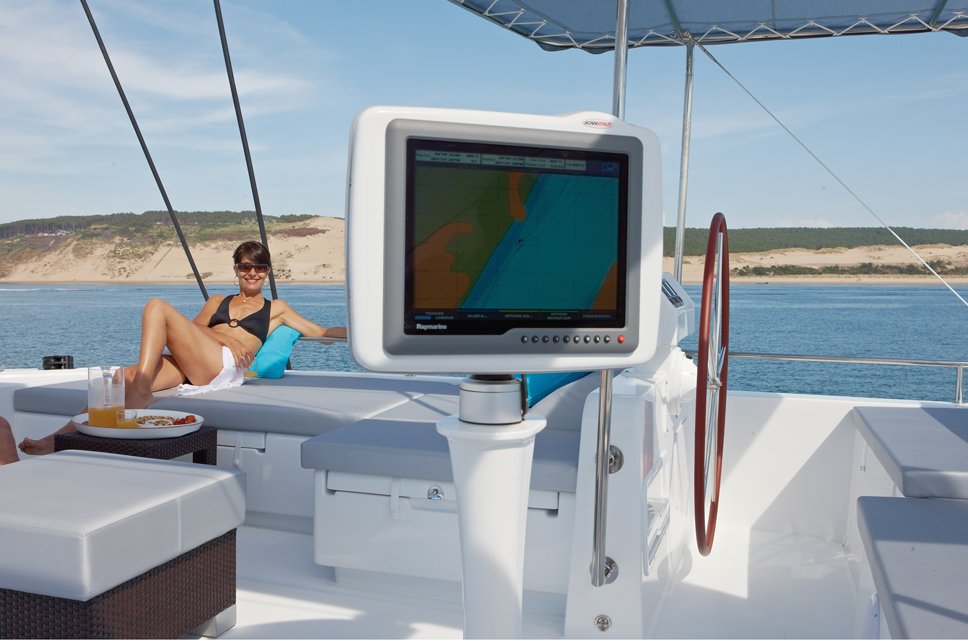
Steering position, relaxation area, the flybridge has everything!
A very ‘trendy’ saloon
The saloon’s area is considerable, but the organisation of the space, the choice of sober oak decoration, a dark ‘wenge’ floor and current lines, structure a pleasant atmosphere, and leave room for customised decoration! The overall treatment is well suited to nautical use.
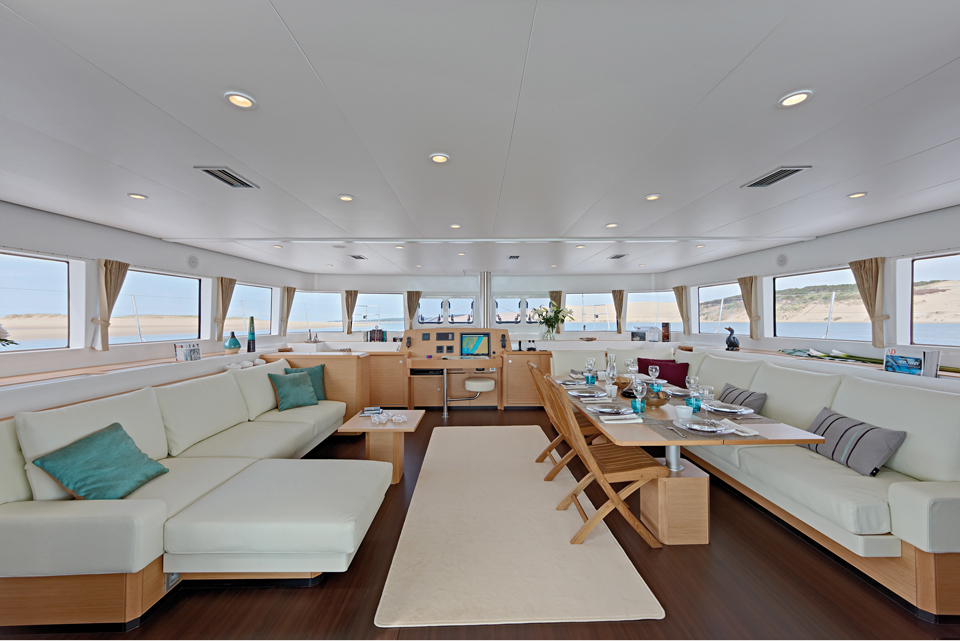
A saloon in cinemascope which will work at all latitudes... Magic!
Generous engine power and clear technical area
The greater part of these big multihulls (just like their monohull sisters) is dedicated to mixed cruising, in which the reliability, the power and the discretion of the engines play an important role. The sailing potential is not secondary, but the hang up-free culture of the purchaser of this kind of boat balances out this aspect, within an expectation of satisfaction which is less specialised and more global. The basic setup of 2 x 110 hp engines is generous; the 2 x 150 hp does not shock, with regard to more demanding programmes (the additional charge for the bigger engines is only 1,600 euros, but the folding four-bladed propellers will cost 13;000 euros , instead of 5,000 for the 110 hps). The engine lockers are clear, spacious, and accessible, allowing the fitting of voluminous peripherals requiring regular visits and maintenance (compressors, watermakers). The 620 is designed to offer its guests a comfort level up to shore-based standards; it will therefore be a big energy consumer. The reversible air conditioning, the abundance of fresh water, the food preservation, the lighting, the on-board electronics and the video equipment, will be serving a powerful boat and serious controls. The technical area, housed in the forward crossbeam, accommodates this equipment around a battery bank which is isolated in an adapted and well-ordered volume. The rationalisation of the design of this nerve centre deserves praise. However the absence of watertight panels for the connection bars and a finishing joint on the wooden support panels is regrettable.
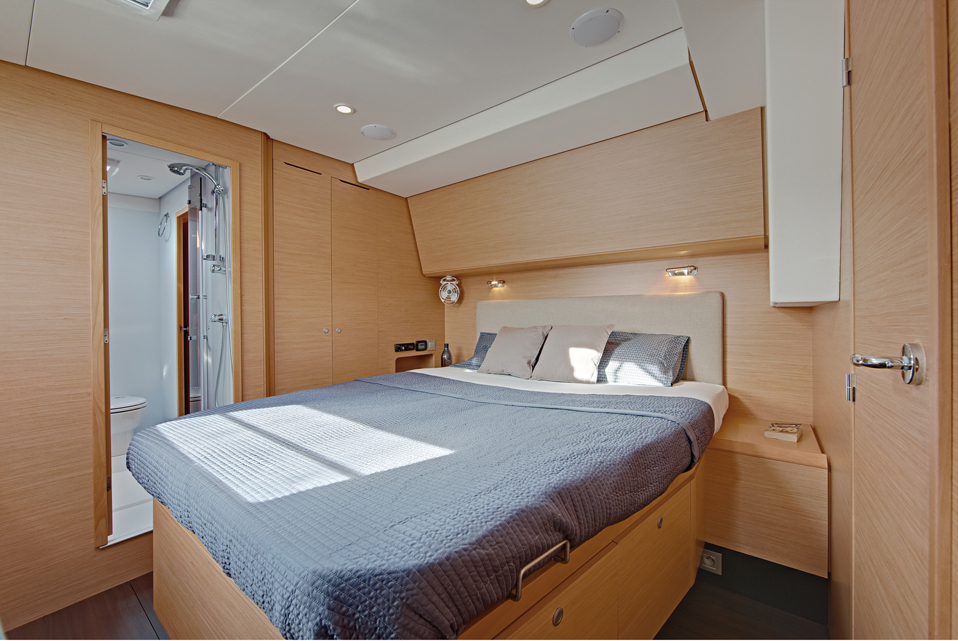
The guest cabins are of an exceptional size.
Nav. station viewpoint and deck saloon
The upper deck brings together the manoeuvring, steering functions, relaxation area and privileged observation functions. In this size, the flybridge really expresses itself and in good weather, encourages real conviviality between the crew and the guests.
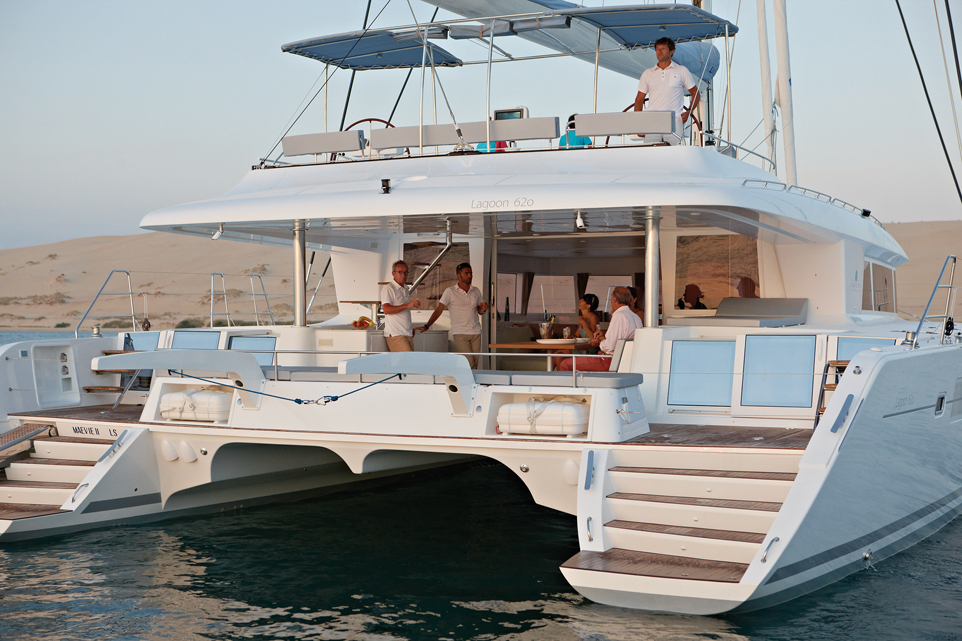
The living area is considerable, the size of the sugar scoops, phenomenal. The 620 really is a superlative catamaran!
A refreshing dynamic test
We got under way aboard a new 620 (which had nevertheless sailed round Spain), that the skipper was getting to know almost at the same time as us. The deck plan is legible, simple and well-organised. The power of the big Harken electric winches will not be found wanting. The strong winds were present; a 25 – 30 knot easterly was blowing over the Cannes Boat Show! The carbon, canoe-style boom and the switchable mainsail track rationalise the use of a 140m2 mainsail, by reducing the stacking height of the sliders, which makes access to the tack easier. The imposing square-headed mainsail was quickly hoisted to the first reef; bearing away on port tack we unrolled the staysail smoothly with the help of the electric furler. At a constant 10 knots, we sailed on a close reach under some impressive squalls. 1.5 to 2m of swell, reduced by the gusts, assaulted the catamaran, which doesn’t seem to bat an eyelid. The point of sailing was perhaps a bit lively for our crew of future customers, but everyone seemed delighted, despite the foul conditions. On a compromise course, the 620 sailed smoothly, without slamming or slowing down. The double steering position offers spectacular visibility; the directional effect of the rudders is satisfactory and the deck plan’s overall ergonomics are quite remarkable. Despite the swell and the strong breeze, the 620 tacked well (the mast rack and the jumbo repeaters, which trap the genoa sheets, should be done away with) and picked up its senatorial speed. Well trimmed, it cut clean wakes and could cover good averages in moderate breezes. In light weather, the Lagoon calls on a 190m Mylar gennaker, and maintains satisfactory performance deeper downwind, thanks to its 300m2 spinnaker. On the way back, we tested the improbable organisation of Mediterranean mooring buoys; the manoeuvre, carried out between two squalls, went off perfectly (boat in dynamic positioning from one mooring line). However the sudden arrival of a catabatic gust of more than 60 knots succeeded in convincing me that in addition to the 2,000W anchor windlass, a windlass is essential for each of the 4 mooring points, and that the bow thruster must be part of the on-board equipment.
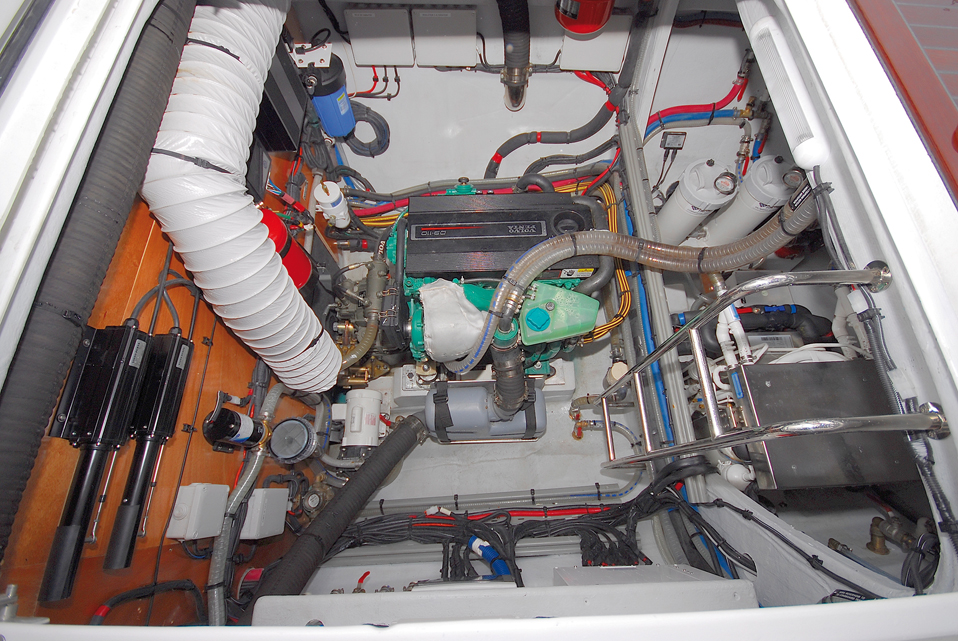
The clear, spacious and accessible engine lockers allow voluminous peripherals to be fitted.
CONCLUSION
Audacious, but coherent and well-built (in the Bordeaux factory, which has the expertise and equipment essential to the construction of boats of this size, 15 per year!), the Lagoon 620 has already reached its clientele. It should not be judged with the eyes of a speed enthusiast, but it should be understood that this generous boat goes to meet new expectations and customers attracted by the stability and space offered by multihulls. The 620 has good hulls; its reserves of power allow it to cover 200 miles a day in most conditions, and prove to be pleasant in light airs. The innovative architectural solutions adopted for the galley and the owner’s cabin are really relevant.
THE PLUSSES
• Space, comfort • Cruising programme • Designer accommodation
THE MINUSES
• Number of options • Watertightness of fittings on the model tested • Professional maintenance essential
COMFORT 4/5 SPORT 2/5
THE COMPETITORS
Model Architect Builder Windward sail area in m2 Weight in t Price (exc. VAT) in euros Ambercat 210 É.Lerouge Enmar 200 19 1,350,000 Galathea 65' Berret/Racoupeau Fountaine/Pajot 220 22 1,600,000 Privilège 615 M. Lombard Alliaura 214 22 1,435,000 Sunreef 62 Sunreef Sunreef 200 30 1,135,000
TECHNICAL SPECIFICATION
Builder: Lagoon Architects: Marc van Peteghem/Vincent Lauriot-Prevost Interior design: Couëdel Hugon designer Length: 18.90m Waterline length: 18.20m Beam: 10m Draft: 1.55m Unladen displacement, equipped: 27t Air draft: 31m Mainsail: 139m2 Staysail: 48m2 Genoa: 91m2 Gennaker: 190m2 Tri-radial spinnaker: 300m2 Engines: 2 x 110hp Volvo D3 or 2 x 150hp Yanmar Transmissions: Sail drive Propellers: fixed four bladed folding as an option Diesel: 2 x 650L Water: 4 x 240L Material: balsa/glass/vinylester and polyester sandwich (infusion process), monolithic below the waterline Keels/daggerboards: keels Price: 1,060,000 euros exc. VAT Main options (exc. VAT): • Hydranet staysail, electric roller: 21,172 euros • 4 windlasses: 16,000 euros • bow thruster: 7,500 euros • gennaker + fittings: 21,000 euros • spinnaker + fittings: 15,000 euros • watermaker: 15,000 euros • 7Kva generator: 15,100 euros • air conditioning: 32,000 euros • washing machine, dishwasher, microwave: 6,000 euros • electronics pack: 19,600 euros • delivery: 15,000 euros
