Catamarans in the over-75 feet bracket are not widespread on the world market and are all one-off builds. Lagoon has had an eye on this sector for quite a while now and has just joined in the game like the master player it is. As a matter of fact, the superyacht knowledge of CNB, partner of the Bordeaux shipyard and subsidiary of the Bénéteau Group, has allowed them to combine their skills and industrial know-how which is essential to building and marketing extraordinary catamarans. Here, as an exclusive preview, we test the latest sensational catamaran: the SEVENTY 7.
Infos pratiques
- Le chantier : Lagoon Seventy 7
- La fiche technique
-
 Découvrez notre vidéo exclusive
- Financez votre Lagoon SEVENTY 7
- Assuez votre Lagoon SEVENTY 7
- Articles autour du Lagoon SEVENTY 7
A bit of background to the early pioneers and big boats
CNB was founded in 1987 by Dieter Gust and Olivier Lafourcade at the Sud Ouest shipyards in Bordeaux, France (this was the yard which was responsible for the building of the 5-masted France II), to build big aluminum monohulls. Mari Cha II (a 92’ German Frers design) was launched in 1989, the first in a long line of unique boats which helped to establish the CNB brand in the world of elite sailing superyacht builders. They went from strength to strength. In 1992 CNB joined the Bénéteau group and opened up to big custom boats built in composite. Building Lagoons of over 50 feet was later to be brought into the Bordeaux factory before they diversified into a semi-custom range (the Bordeaux 60 and Bordeaux 76 monohulls). Jeanneau Techniques Avancées had been established in 1982 by a team of multihull fans, led by Jean-François de Prémorel, to build racing prototypes. They built 50-odd prestigious models (Pierre 1er, part of RMO, the huge catamaran Fleury Michon VII, the trimarans for the film “Waterworld” and the Irens-designed F40s, among others) prior to launching the Lagoon 55 in 1985, then the 57: these were giants in their day! JTA joined the Bénéteau group in 1996. 30 years later, the Lagoon SEVENTY 7 is the result of the fusion of these two stories.
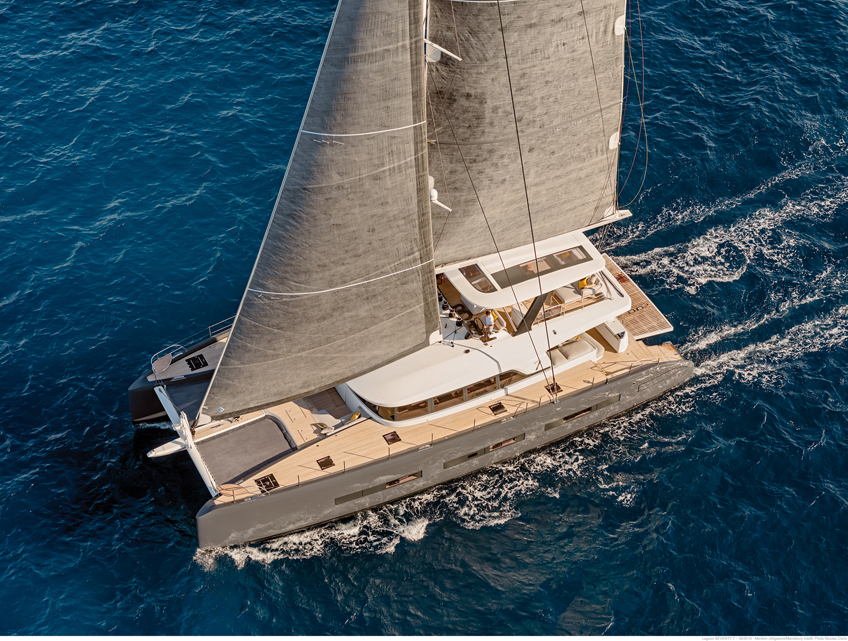
Superyacht catamaran and high-tech sails make a good mix (main and genoa in DFI by Incidence Sails)
A contemporary, classically elegant design.
Since its first outing at the Cannes Festival of Yachting, the SEVENTY 7 has been causing a stir! The number of appointments for viewings was becoming difficult to manage, and even for the company’s own dealers, it was difficult to get on board! The power of the Lagoon sales network and their communications partly fuelled this, but the personality of the boat itself played a role. Going from the curiosity stage, to discovery, the newcomer or the enlightened fans couldn’t fail to be moved by this amazing colossus. The boat’s perception has been meticulously developed by Marc Van Peteghem and Patrick Le Quément, and the lines of the SEVENTY 7 don’t owe anything to chance. Borne of drawing skills and experience and smoothing software for the most advanced shapes, the design for the most delicate sections (sugarscoops, bows, entry angles, framework) has let the lines flow like those of a prestigious sedan. It’s often said that it’s easier to design a big boat than a more modest-sized one, but I disagree. It would be easy to get either wrong! The important thing is getting the proportions in harmony: the creative inspiration which shines through must also give a clear indication of what the boat is for. The remainder is about talent, work and perseverance. The ultimate success has a special chemistry, and the boat comes alive! The SEVENTY 7 represents major stakes for CNB/Lagoon. There is no room for error at this level of investment in tooling and in design. The formal language of the SEVENTY 7 is powerfully expressed with this in mind, along with a desire to make an indelible, long-lasting mark on the sector. The design and finish of the anthracite-gray paint for the hulls seems to give a certain lightness to the lines of this 60-tonne multihull. Lengthening the coachroof and increasing its height have been done cleverly, with the hulls remaining predominant at first glance and holding the eye. The angle of the aft bimini supports and the work which has gone into the vanishing lines allows the amazing salon to fuse with the platform. Skillful design even makes the steps up to the flybridge seem to delicately integrate into the overall lines. The canoe boom (a tricky design to deal with) is sleek and doesn’t hamper moving around.
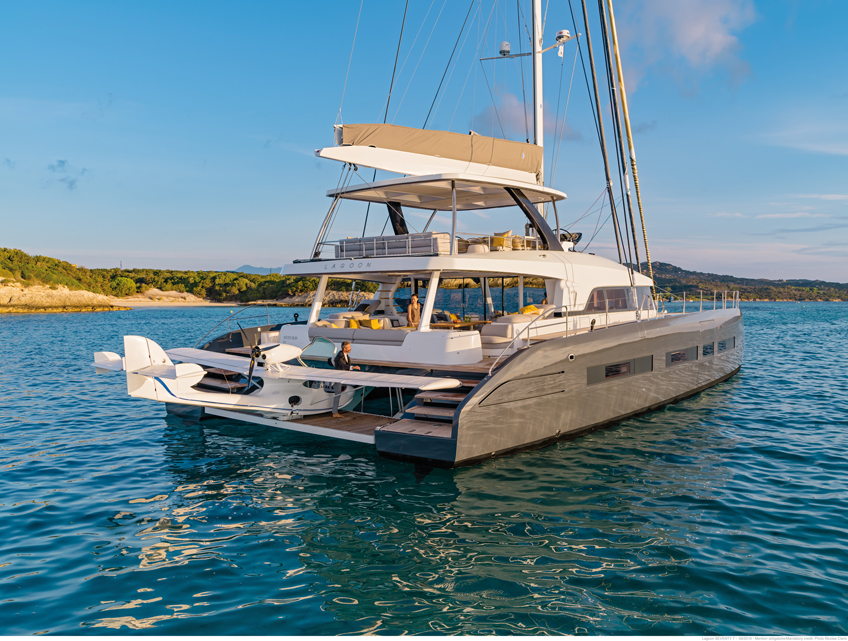
The Lagoon SEVENTY 7… an out of the ordinary catamaran
A guided tour of a 23 meter cruising catamaran
It would be a shame to just mundanely climb aboard this catamaran from the dock. Luckily, we found ourselves joining in the anchorage off Cannes. With the Tenderlift down at the water, bringing up the dinghy as the yard designed, was easy. The tender is an Ocean Master 500 with a 100hp 4-stroke Honda). The area provided by this platform, and the space on the sugarscoops is impressive, and permits safe access for numerous crew to board even if they are not seasoned sailors. The mobile structure also constitutes a great platform for swimmers or divers. The remote control also allows for the dinghy to be launched or recovered without any outside assistance. Quite remarkable! The first positive vibe you get on boarding the SEVENTY 7 is one of safety. There’s a feeling of being enveloped, with comfort underfoot. Nothing to stub your toes on, no sharp angles to cause a nuisance or split levels to trip over: it would appear that a stroke of genius has smoothed out all the typical hazards. The entry into the exterior salon has been the object of just as much attention: there is a passerelle to cross the boat and to get to the dinghy, whilst avoiding the aft beam and without disturbing anyone on board. The same precision has been applied to the design and ergonomics of the furniture. Gone are the straight and angular panels; in comes a world of friendly and seductive curves. But what use is style without function? Arriving in the lounge space of the cockpit, the two outdoor galley units (sink + refrigerator and electric grill) are ready to receive the efforts of the fisherman (or the local market). If the weather turns chilly, the fabric cockpit enclosure allows you to still enjoy this balcony without shivering.
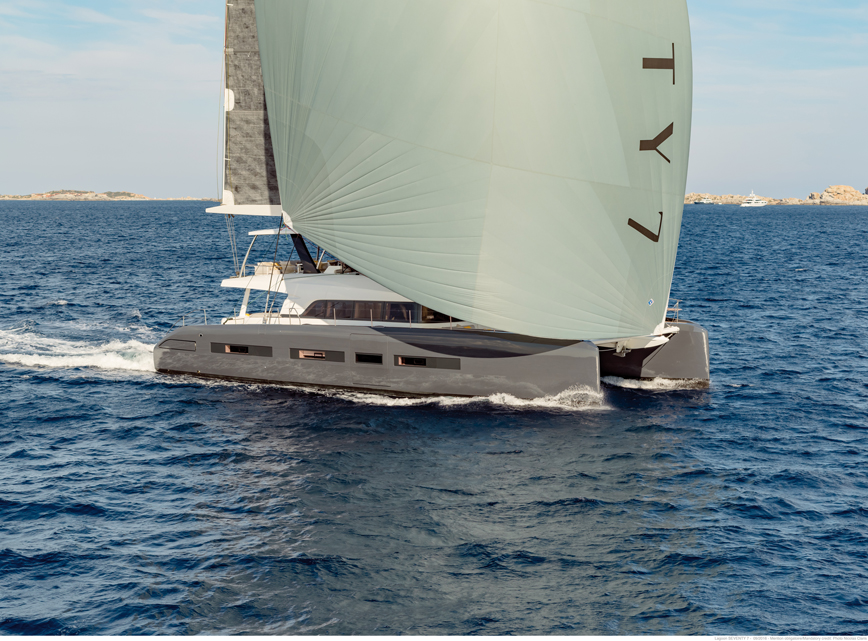
Elegant and powerful, the SEVENTY 7 is capable of good performance in medium conditions as well as in light airs
When it comes to sundowner time, the lounger to port, the two sun-loungers with adjustable backrests and the aft bench seat are great for lolling around, before making your way to the outdoor table, which comfortably seats 8 to 10, or to the indoor dining area. In supporting Nauta (the design partner for the interior layout), Lagoon has opted for Sunbrella fabric to offer upholstery to match the standards of this catamaran. The success of this is evident, and the materials used and the form and density of the seats are of a very high level, which freshens up this on board living area. Access to the boulevard decks is exceptional: there are low-height steps which mean that changing levels is effortless, with the sidedecks being perfectly secure. It is comfortable underfoot and everything is a delight to the eye. Everywhere is flush-decked, and from aft, the perspective is wonderful. Further forward, having bypassed the coachroof, you find the forward cockpit, with its two deep loungers well protected by the arms, under which are carbon supports, allowing for a sunshade to be erected. Taking into account the abundance of upholstery, covers are provided to protect them, without need to stow them below, other than for the winter. From this marine terrace, there is direct access inside via an electric door, which is both clever and substantially built. The fluidity of movement about this big boat is remarkable, and first impressions of the interior layout are flattering. Nauta has succeeded in the challenge of fitting out this vast space by turning it into a living thing. The complimentary functionality is such that you only need to fit in with it, rather than adapt it to suit you. An XXL-sized screen retracts into the deckhead and there is a fully-fitted bar, small saloon area below, large sofa and nav. Station equipped with a monitoring control panel for all the vessels’ systems. Light is abundant, but not aggressive, and its intensity can be adjusted to suit, by the use of electric blinds. The naval architects and designers must surely have lived on a prototype, to have come up with such high standards on hull number 1? Atmosphere, ergonomics, organization of space and style are harmonious. The result is inspiring.
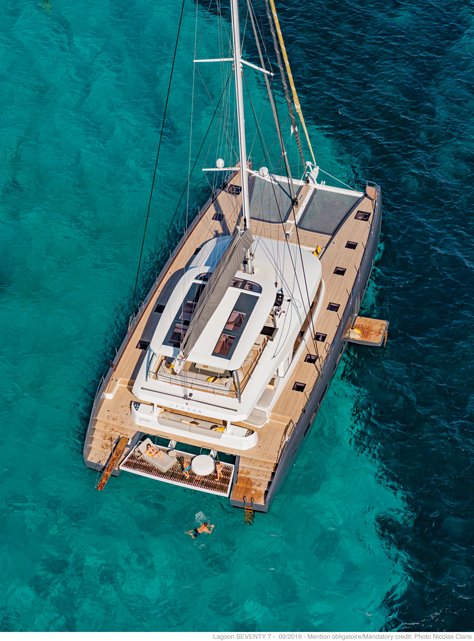
At anchor, the SEVENTY 7 makes a very effective marine leisure base
A personalizable catamaran
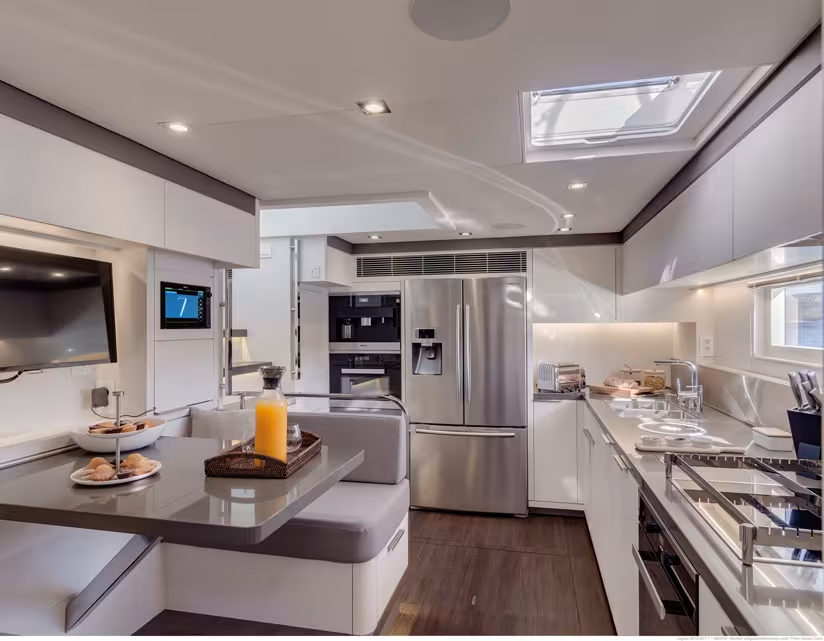
Our test boat was the 3-cabin owner’s version, with three bathrooms (3 separate heads), with galley and crew quarters aft to port (plus one crew cabin forward to starboard). With this configuration, the crew benefits from a private dining area and the chef from a real professional galley, which is well set-out and air conditioned. To anticipate any special requests, Lagoon has left this 25m² space available to be personalized to the wishes of future owners (multiplex meeting room, laboratory, studio or custom cabin. Anything is possible, as the whole area is free of any structural constraints. A pertinent idea which allows for creativity, all within a production series vessel.
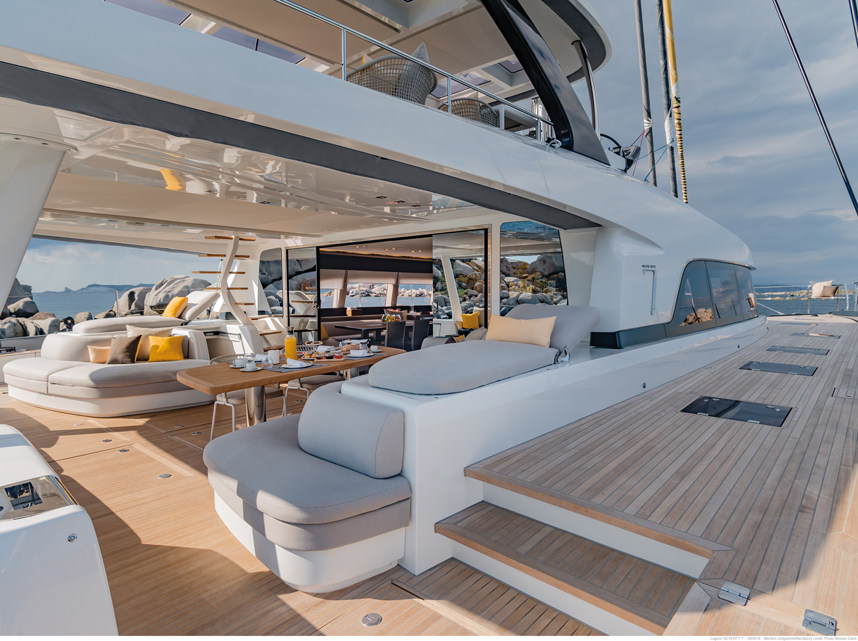
A catamaran’s architectural prowess? Welcoming, pampering the crew, putting everyone at ease, creating a real feeling of protection, all while allowing the sailor to enjoy sailing
An exceptional marine terrace
The size of the boat allows it to have a real flybridge, without impinging too much on the overall lines. The flybridge of the SEVENTY 7 houses two big helm stations with all the necessary instruments (great positioning of the engine controls and the bowthruster, though some protective covering might be welcome). The double watchkeepers’ seats offer a comfortable spot, and the panoramic view over the deck and the mast is excellent. A wet-kitchen area separates the forward area from the technical area, and on our test boat, tasteful fitted furniture gave an almost nomadic atmosphere with comfortable, light upholstery which was perfect to use. A meal for 10 people could easily be accommodated on the deck salon, with an additional table serving well for drinks or for the children to sit at. Safety is ensured by a tubular rail around the bulwarks, with padeyes on the deck to secure the furniture in rough weather. Access to the steps down (the very elegant design might need looking at again, as it’s the only area on the whole boat where there is a risk of a fall) is protected by two solid handrails and pivoting door.
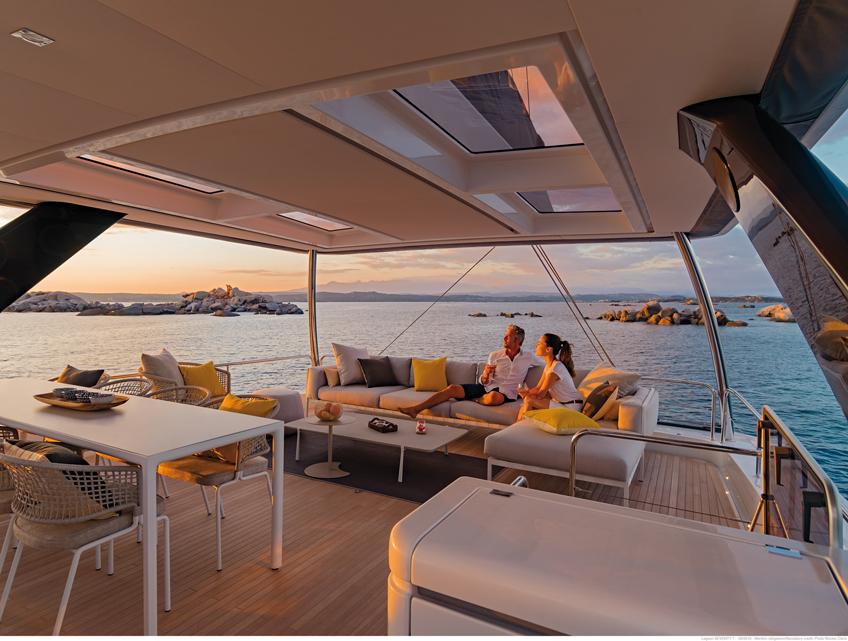
A real flybridge: very safe and remarkably comfortable
Bedrooms and suites
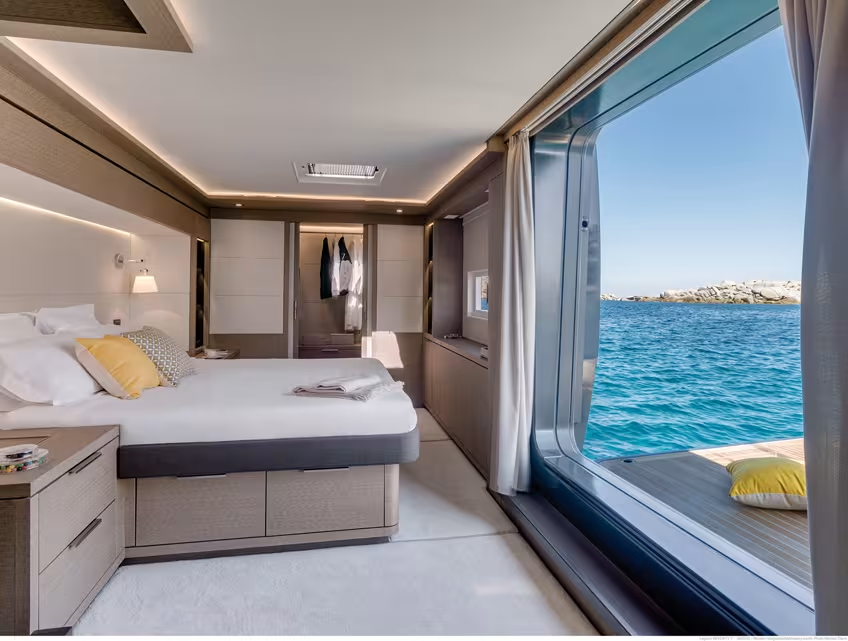
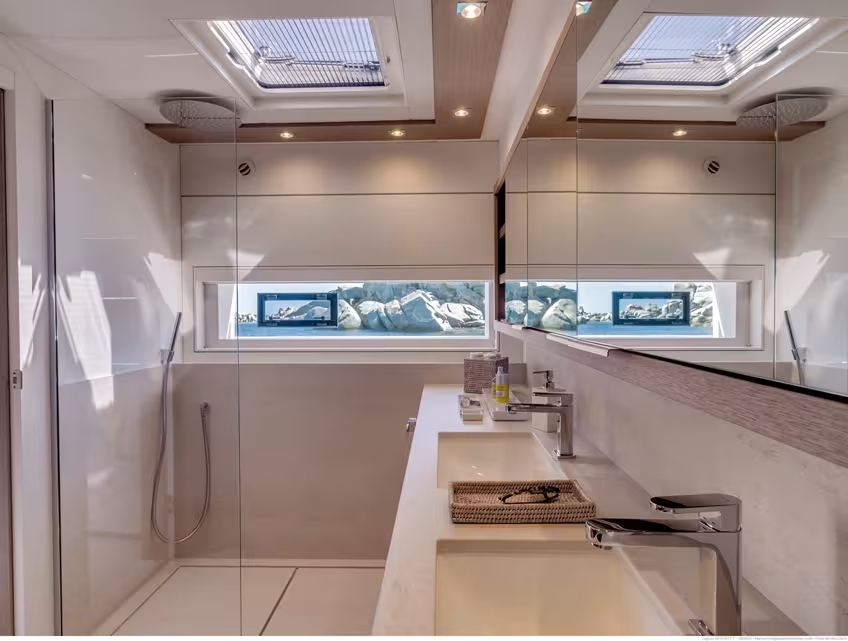
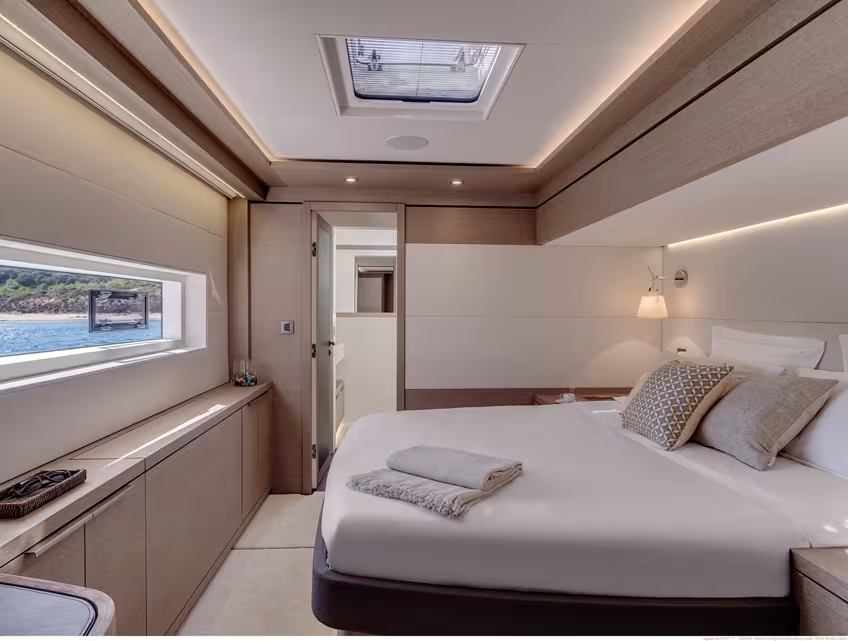
We’ll round up our tour of the SEVENTY 7 with the cabins: aft, to starboard, a guest suite is accessed via a private stairway at the entrance to the salon. Thick carpet, attractive and comfortable bathroom, small corner-desk, and natural and indirect electric lighting which creates a luxury, but not flashy, atmosphere. The port forward cabin offers exactly the same, except that the bed (170x200cm) is oriented athwartships. A large pivoting door in the topsides opens up to become a balcony, fenced by guardwires on carbon stanchions, creating an amazing relaxation area. This original idea really breaks away from the norm. The 4-point locking mechanism is secured by hydraulic rams.
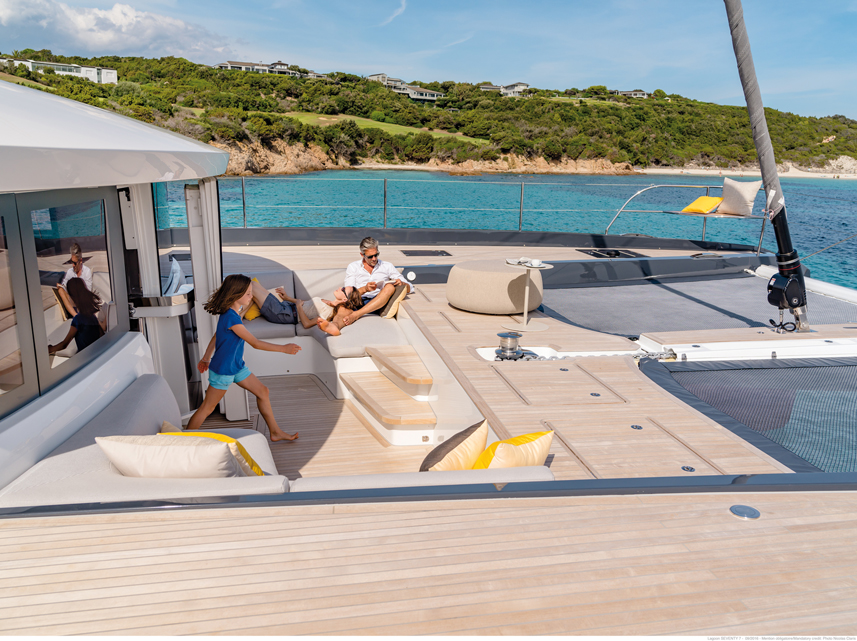
The forward cockpit is directly accessible from the salon via a wide pivoting door. A fabric sunshade on movable carbon mounts protects the whole area if desired
Technical Section: very accessible
The two hydraulic units (for the furlers and the Tenderlift) are easily accessible; the battery bank is located beneath the salon floor. Apart from the bow thruster (and some parts of the reversible 180,000btu air-conditioning), most of the technical aspects are housed in the engine rooms, around the two 230hp John Deere motors. These 6.8 liter blocks, which can deliver 400hp in some versions, are 6-cylinder, 12-valve, direct injection turbos. CNB’s design of these complex technical spaces is great, and despite the density of equipment, everything is rationally and clearly installed. On-board energy is supplied by two Onan generators of 19 and 27 kVA, and fresh water by two watermakers (90 and 280 liters/hour).
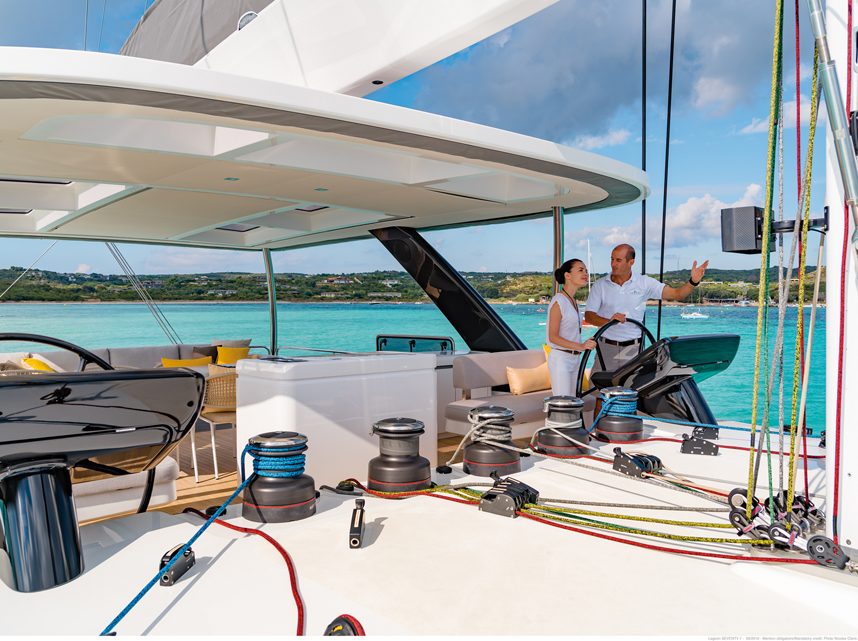
The two elegant helm stations offer a perfect view of the water AND the sails
Sea trial
A large part of the first day spent onboard the SEVENTY 7 was devoted to an enjoyable, and detailed, guided tour of discovery at anchor. Towards the end of the afternoon an easterly breeze started to pick up and we were able to lift the 7kg Spade anchor (a 3500W 24V windlass is there to handle 120 meters of 16mm chain!). The 192m² mainsail completes the assault on the 31 meter mast with the help of a big dedicated electrical winch. The hoist is fast, thanks to the Harken rails which drastically reduce the cars stacking up as they stretch out the surface of this impressive DFI black membrane sail (a filament composite by Incidences made of pre-impregnated bands, laminated under vacuum and hot-pressed). The Sparcraft aluminum mast which has three sets of self-stiffening, is held in place laterally by two capshrouds and two lowers in Kevlar of a colossal diameter. The longitudinal direction is ensured by the genoa and staysail stays. We unfurl the 230m² gennaker (Mylar Kevlar XGold by Incidences) on its hydraulic furler by hauling on the sheet with the help of a powerful Harken electric winch. As always onboard a big multihull, you need to ignore the size of the sails to use them and trim them normally. The big question was at what kind of wind strength does this huge catamaran start to react? The reply is immediately obvious: 6 knots of true wind inflates our 425m², and the SEVENTY 7 starts up effortlessly. The magical profiles start to fly smoothly, with a form worthy of a racing multihull. The view of the mainsail is good from the windows in the bimini, and the helmsman has a direct view of the huge Windex which indicates the variations in the breeze aloft (more favorable and stronger up there!) Between two of us, we handled a series of gybes - an exercise more fun than physical. It only requires a few seconds to ensure that everything is under control, before easing the main down by releasing the traveler (equipped with a fantastic Antal captive winch) to give a lee for furling the code 0. Next, center the mainsheet car, pass through the wind, unfurl again, and off you go.
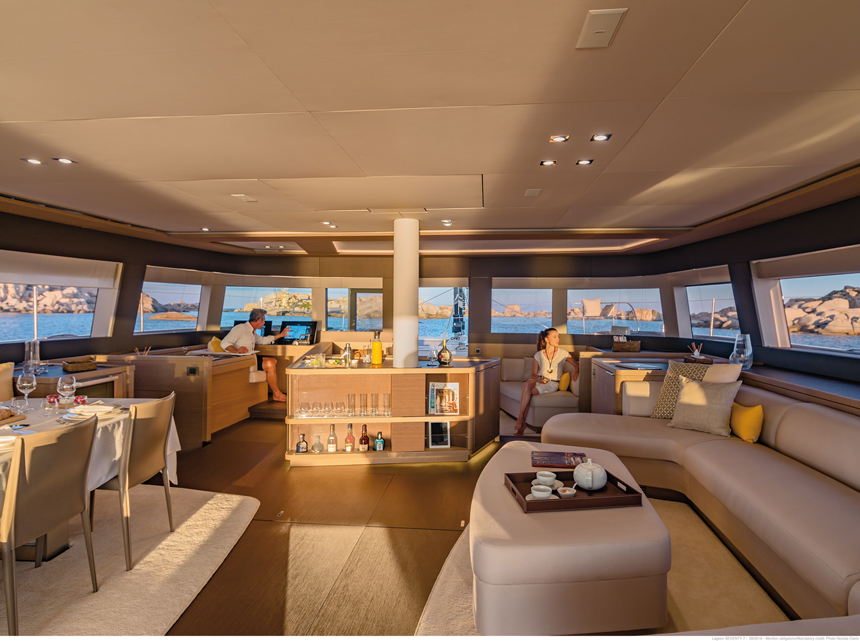
At the same time, it’s a dining room, saloon, lounge bar, navigation station and sound system-video room (XXL screen retracts into the deckhead). The layout inside the coachroof and its links with the other spaces bring a new approach to superyacht catamarans
Other than the ease of the maneuver itself, which highlights the quality of the deck layout, it’s the response of the boat which is striking. Such agility is amazing on a boat of this size in these conditions. The breeze freshened and the SEVENTY 7 bowled along at 7.2 knots with 9 to 10 knots of wind. Aside from the instrument readings, the speed of the boat is obvious, and it is enjoyable to trim, reactive when picking up again after gybing or in the variations in these light to medium airs. The sensations are real, even though they could be felt more through overall observation of the boat rather than through the helm, which is precise. However, the hydraulics filter out all the feel (when are the builders going to start producing an equivalent system to the automobile industry: fully assisted yet tight and sensitive?). The following afternoon, the easterly wind was more established (12-14 knots) and the SEVENTY 7 slipped along effortlessly at a senatorial pace between 8.5 and 11.9 knots. Easy for such a big machine!
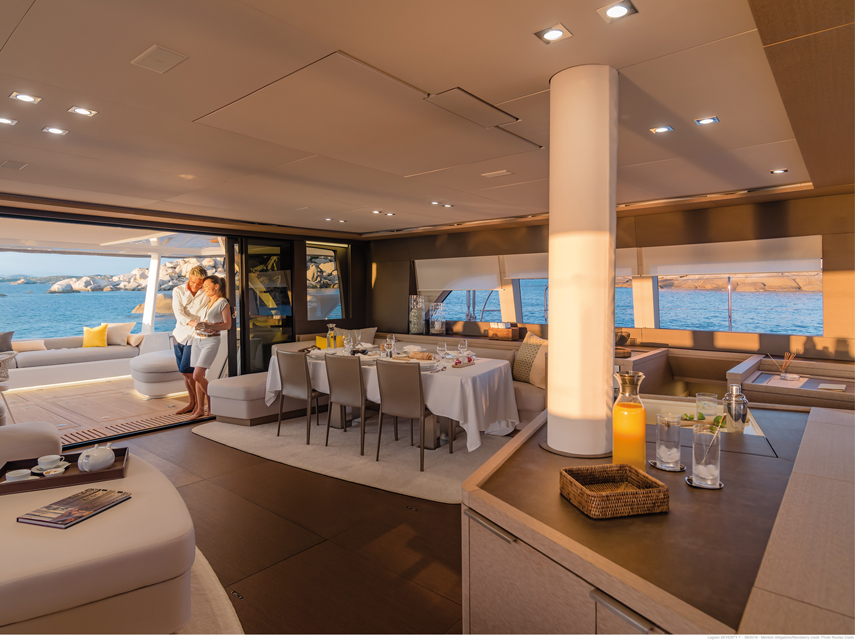
Luxurious yet not ostentatious. The creative and ergonomic design of the SEVENTY 7 invents a luxury lifestyle which is immediately attractive
Conclusion
This 23.28 meter catamaran will attract wealthy owners who like sailing, who have owned multihulls or monohulls and who want to continue to enjoy this unique way of life on the water and cruising… by changing size! The blasé sailor, bored with listing and prohibitory drafts, will rediscover the pleasure of cruising, but also there will be some converts from motor yachts, abandoning their cigars, overcome by all the attributes of this catamaran and its great multihull personality which knows how to be luxurious without appearing arrogant. The presence of a crew is indispensable, but will allow this super-catamaran to be offered for charter, where it will be very successful.
PLUSSES
- The boat has a captivating personality
- Elegant lines
- Stylish and ergonomic layout
- A fun boat to sail
- Great dynamic qualities
- Exceptional quality of life on board
MINUSES
- Not much feel to the helm
- Flybridge access stairway
- Access to the battery bank
- Deckhead fixings on the flybridge and in the cockpit
- Main halyard clutch needs upgrading
- A few waves slap under the topsides
A word from the naval architect, Marc Van Peteghem
The design of the SEVENTY 7 had to set the boat clearly in the yacht category, by being fully part of the Lagoon family, centered around living on board, while maintaining performances which allow 220 mile days. It was important to maintain the Lagoon values (family, enjoyable, welcoming). But above all, not to be ostentatious! The first comments we got from owners visiting the boat at the Cannes boat show showed that together, we (the yard, Nauta and ourselves) had succeeded in creating this balance. If I had to choose two words to describe the Lagoon SEVENTY 7, they would be “gentle giant”.

TECHNICAL SPECIFICATIONS
- Naval Architects: VPLP
- Builder: Lagoon/CNB
- Interior Designer: Nauta
- Exterior Designer: Patrick Le Quément
- Construction: Anti-osmosis balsa/glass/resin sandwich and polyester, with lower hulls in monolithic
- Length: 23.28m / 76’5”
- Beam: 11m / 36’1”
- Draft: 1.90m / 6’3”
- Air draft: 36.60m / 120’1”
- Light displacement: 57t / 125,685lbs
- Maximum displacement: 71t / 156 555lbs
- Mainsail area: 193m² / 2066sq ft
- Genoa: 130.4m² / 1403sq ft
- Staysail: 81m² / 872sq ft
- Asymmetric spinnaker: 500m² / 5380sq ft
- Motors: 2x180 or 2x230hp with shaft-driven props Fuel: 2800L/740 US gallons with transfer pumps and anti-overflow system
- Water: 1600L / 396 US gal
- Price of the model we tested, fitted with all options (air-con, 2 generators, 2 watermakers, dinghy, media center, Brookes navigation pack, 4G wifi/internet connectivity, reversing cameras, DFI sails, spinnaker, and so on): €4,340,147 excluding tax
Boat details
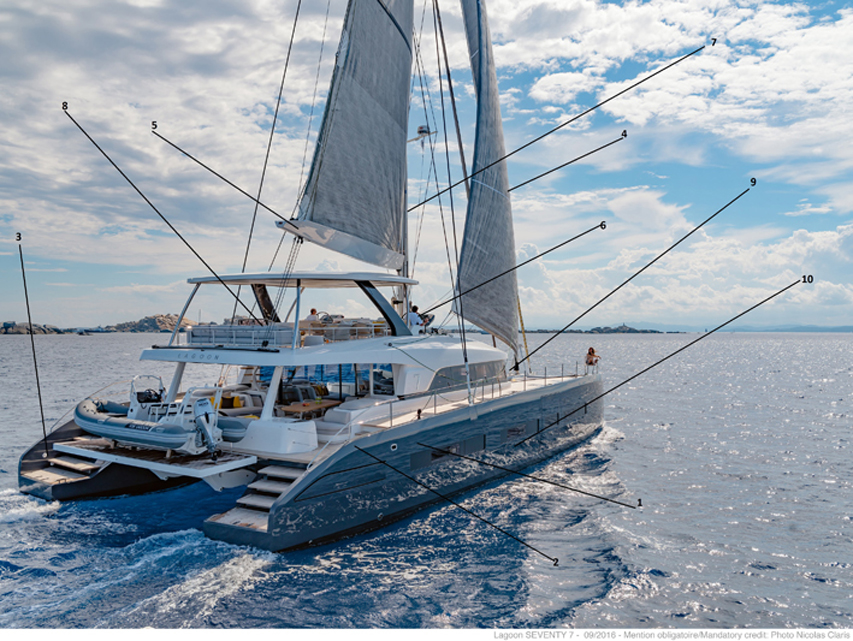
- : The level of detailed design on the hulls is commendable. The proportions, the angle of the sugarscoops, the skillful sheer, the fine line along the middle of the panels and the meticulously smoothed shape all contribute to the perception of an elegant profile which will stand the test of time.
- : Not so obvious here, but the hull decks are real outdoor walkways, and their general lines combine with the superb 20cm bulwarks giving a magnificent perspective and a visually distinctive note to the SEVENTY 7
- : The size of the boat obviously allows the sugarscoops to house a flight of steps of unusual comfort. The extra area provided by the Tenderlift transforms the aft end of the boat into a comfortable marine leisure area (a hydraulic diving platform / passerelle completes the picture)
- : The headsails are split in traditional fashion for this kind of big multihull. The power of the hydraulic furlers (staysail, genoa and code 0) is essential for the ease of handling such sail areas.
- : The canoe boom is indispensable for housing a 192m² mainsail. It is wide enough for a crewmember to crawl inside safely, lazy bags being a bit too delicate…
- : The two helm stations are really ergonomic, with big instrument consoles, elegant carbon wheels, and have a good visibility of the boat and the sails. The deck layout is very easily understood. The electronic gear shifts are close to hand, as is the bowthruster. Great watchkeeping seats.
- : The 31m lacquered aluminum Sparcraft mast carries 337m² of sail upwind. It is stiffened by three sets of spreaders and rod diamond stays. Lowers and capshrouds are in Kevlar
- : The flybridge on the SEVENTY 7 is designed down to the last detail and is very comfortable. Its size allows for the handling of the boat to be kept separate from the convivial aspect. Crew safety (crew or passengers) is remarkable
- : The forward cockpit is accessed via an electric door which allows for easy access from aft, through the salon to the foredeck, which reveals a multitude of ergonomic gadgets to welcome a large crew.
- : The side door pushes the limits of possibilities for an owner’s suite. The design and construction along with the four rams ensures its safety.