
Fountaine-Pajot’s best-seller, the predecessor to the Lipari 41 offers some great attributes for family cruising. And more, if suitably equipped.
Infos pratiques
- Le chantier : Lavezzi 40
- La fiche technique
- Découvrez notre vidéo exclusive
- Financez votre Lavezzi 40
- Assuez votre Lavezzi 40
- Articles autour du Lavezzi 40
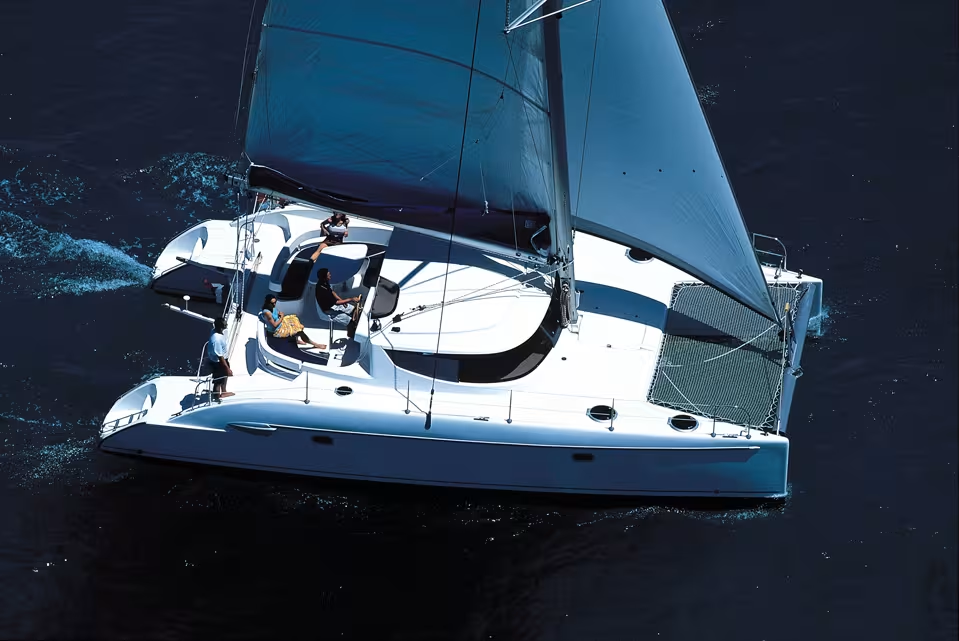
On the dock we find a catamaran which is compact, yet rather aesthetically pleasing. All the signs of having come from the Fountaine-Pajot yard are there - even if things have evolved a little since the early 2000s. The rounded bows have now become straight, the sheer of the deck is inverted, but the sidedecks as usual drop back to the aft steps, and the coachroof has the established sun visor - nothing better has been found to combat the greenhouse effect, that heavy and inescapable heat spreading from the non-shaded windows when the sun is at its zenith. The infusion build is standard, with bulkheads and equipment fitted directly into the hulls - it’s stiff, which gives long-term reassurance. Below the waterline, the glass cloth infused with polyester resin is at least 3kg/m², while the topsides, the sidedecks and also the underside of the bridgedeck are of 15mm PVC foam sandwich. As for the coachroof, that’s made up of a 1,600 to 2,000 g/m² laminate. A largely robust construction, but thanks to the use of infusion, a long way from the previously robust generations such as the Bahia 46 or the Belize which were a little heavier.
With 227 examples built over a seven year period, the Lavezzi 40 appealed to both charterers and individual owners, proof that this model lends itself well to a wide range of uses. Following in the wake of other Fountaine-Pajot models of this generation, the 40, designed by the Joubert/Nivelt/ Flahault trio, has relatively fine hulls - unlike its direct competitor, the Lagoon 380. Nevertheless, the hulls are rounded, principally to optimize the wetted area, but also to give better load carrying capability. This needs to be limited to less than two tonnes if you want to maintain performance at sea, whereas the Lagoon can take one tonne more. A design choice which indisputably translates into a yacht which is not only more lively under sail, but also more elegant. As evidenced on the water, even though the Lavezzi 40 will never be a star performer upwind, particularly in light airs (her keels at 1.10 meters are really short), in moderate winds our catamaran rapidly picked up to 7 or 8 knots. It must be said that the boat really benefits from the narrow and powerful rig. The Z-Spars mast, solidly stayed, has two sets of spreaders, contrary to most other cats which only have one. Because of this, the mast is better supported in a big sea. The mainsail is tall and has a generous roach.
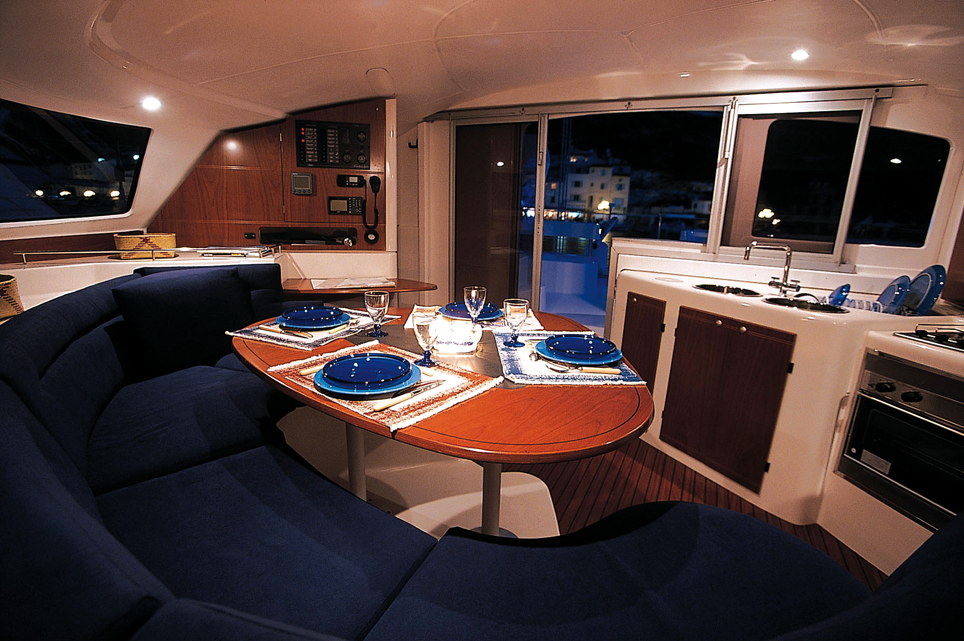
The salon table is big: perfect for enjoying meals with the whole crew. But also for use by navigator, who will quickly find the chart table too small.
Downwind rather than tacking
In 20 knots of wind - typical tradewind conditions - it flies along at 8, even 10 knots. With a large asymmetric spi or a gennaker for a slightly more upwind point of sail, averages of 12 to 13 knots become possible. And to top it off, the mechanical steering linkage, which combines chain and fiber, gives more feel, a fairly rare thing to find on a cruising catamaran. As for the motors? The yard fitted 2 x 20hp, aft of the cabins. Along with their tanks and other ancillary equipment, they are accessible behind a panel: good for sound insulation and the comfort of the occupants of those cabins. The standard motors give a cruising speed in the order of 8 knots, while the optional Volvo D1 30s (2 x 30hp) give an extra two knots. During maneuvers in port, even if the saildrives are mounted aft of the rudders, this rather beamy vessel is easy to handle when changing the direction of the motors.
The deck layout presents a large, one-piece trampoline followed by a hard deck forward of the mast. Into this is set a large locker of 2.5m³. Sails, fenders, windlass… everything apart from the dinghy and outboard, it’s crazy how much stuff you can fit in there! The sidedecks are nice and clear; no real handholds for bad weather, but easy to get along nonetheless. The cockpit is protected by a bimini, part of which is solid - the central section is made from polyester, making the lazy-bag accessible when it’s time to stow the mainsail. A typical strong point for cats: being on the same level, the cockpit and salon link together well via the large door. Remember that there’s no listing: the outside table is used as much underway as at anchor. Fitted against the rear of the coachroof, the helm position is well sheltered from spray and wind. The seat is big enough for two people. The visibility over the water is satisfactory. It’s from here that you control everything, with the help of Lewmar and Harken fittings - so good quality ones.
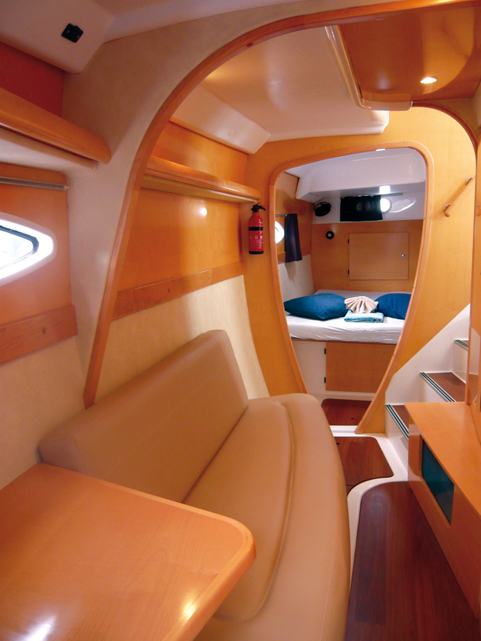
The owner’s version, with its dedicated hull, is obviously more sought-after…
The Lavezzi 40 is available in a three cabin version - with one hull as an owner’s suite - or a four cabin option - built as the charter version. In both cases, you’re better off aft, rather than forward. This is the problem with hulls which are fine on the waterline despite voluminous superstructures. So the adults end up nearer the cockpit, leaving the cabins nearer the bows for the kids. The finish is with a light ceiling, the surfaces in polyester and the upholstery in beige, which wears well. Just going back to the owner’s version for a minute, it’s the whole of the starboard hull which becomes a suite, with a desk and then the bathroom forward. In the salon is the dining area set to starboard, with a triangular table, and a diagonal passage to the offset companionways. Ideally situated, close to the cockpit, the galley has good storage. Being made from polyester, the work surface cleans easily with one wipe of a sponge.
The cook is provided with a three-bowl sink unit, an oven and a four-burner hob, a freezer and slightly smaller fridge. Even though the basic versions are rather plain, the Lavezzi 40 lends itself well to offshore cruising, with 11m³of storage space. Provided you are properly equipped - safety, electronics, downwind sails - you could set off for a year or more, around the Atlantic or the world. It’s an attractive option, being at the same time a recent boat and fairly affordable…and easy to re-sell, which is no bad thing.
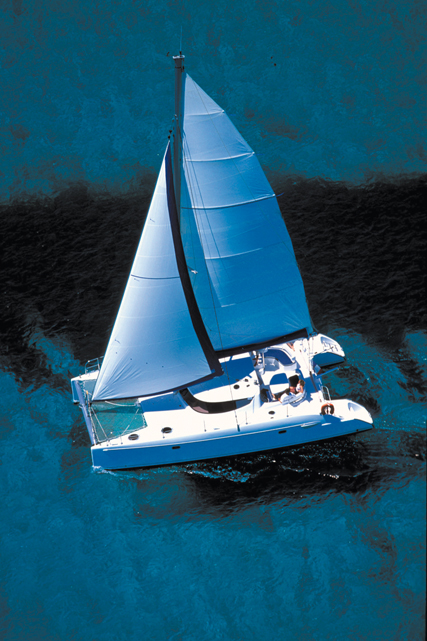
With its narrow mainsail and overlapping jib, the Lavezzi 40 is better-performing than its competitors of the same size. On ocean passages, 9 knot averages are possible.
Pluses:
Satisfying performance in moderate conditions
Good value for money
Good on-board comfort, outside as much as inside
Minuses:
A few osmosis problems on early models
Small chart table
Narrow forward berth
Points to check:
One delivery crew reported the deck lifting, a few charterers have complained about cheap quality seacocks and plumbing fittings, and owners are keen to point out early-stage osmosis issues with early models - principally due to the use of an already damp drainage product in the sandwich core… As for the rest, users are unanimous: the Lavezzi 40 is safe, sturdy and will still be going strong in twenty years or so. Things to check if the boat has been in charter: condition of the motors and the sails.
Lavezzi 40 technical specifications:
Construction: Polyester glass sandwich
Designers: Joubert/Nivelt and Olivier Flahault
Yard: Fountaine-Pajot
227 examples built between 2002 and 2009
Length overall: 11.90 meters
Waterline length: 11.61 meters
Beam: 6.50 meters
Draft: 1.10 meters
Light displacement: 6.00 tonnes
Mainsail: 55m²
Genoa: 35 m²
Motors: 2 x 20hp diesel
Fuel: 250 liters
Fresh water: 2 x 270 liters
Second hand prices: starting from €160,000
