The presentation of the Leopard 40’ (MW #80) at the 2004 Grand Pavois was a first test, aiming to gather the reactions of the European clientele. That of the 39’ at Cannes, Le Nautic in Paris, and the La Grande Motte multihull boat show is a matter of a more assertive winning strategy. We dedicated two days to the test of this catamaran, which has aroused the interest of the observers.
Infos pratiques
- Le chantier : Leopard 39
- La fiche technique
- Découvrez notre vidéo exclusive
- Financez votre Leopard 39'
- Assuez votre Leopard 39'
- Articles autour du Leopard 39'
South Africa so close to the West Indies?
In 1991, John Robertson and Jerry Caine created a boatyard at Woodstock (!) in the suburbs of Cape Town. Their reputation, associated with the attractive cost of local labour, encouraged Moorings to establish, in 1995, a close relationship with the builder, and surf on the demand for charter catamarans, which was growing fast at the time. A full range (38', 42', 45', 62') was created progressively and exported to the charter company’s bases in the Caribbean, then all over the world. Setting up in the American zone encouraged local development; the Leopards only make rare excursions to Europe.
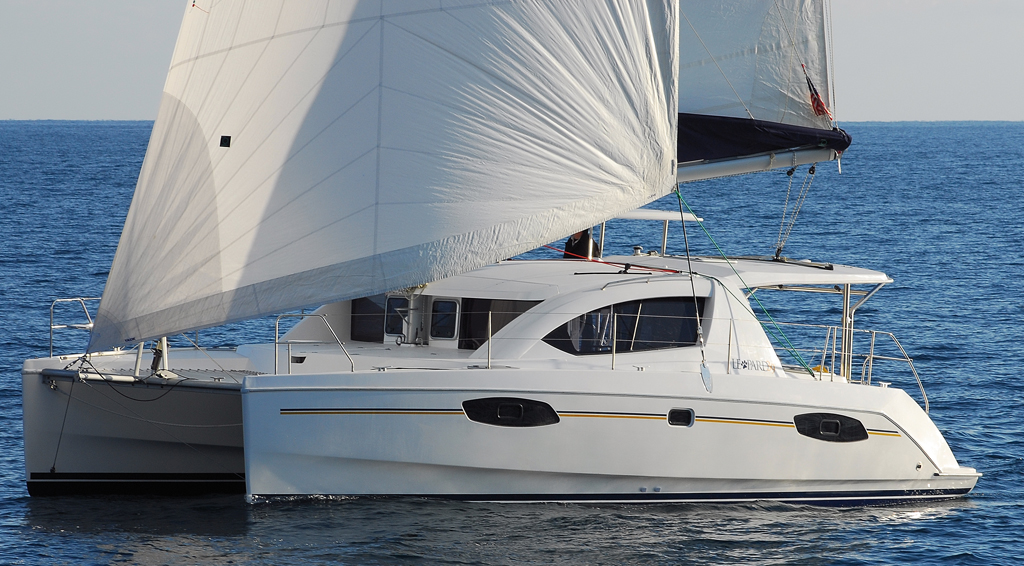
On the first day of our test, in a very light breeze, the Leopard showed good natural ability.
From the multihull to the business plan
The arrival of Lex Raas (a defector from the Beneteau group) as operational director accelerated this development; the world’s n°1 charter company pulled the 3rd multihull builder along in its wake! The experience of intensive use, the knowledge of customers’ expectations, and the availability of a competitive production tool logically pushed Moorings into renewing its range and diversifying its commercial ambitions in the direction of the owners. It was no longer enough just to persuade buyer investors; it had to appeal to the users.
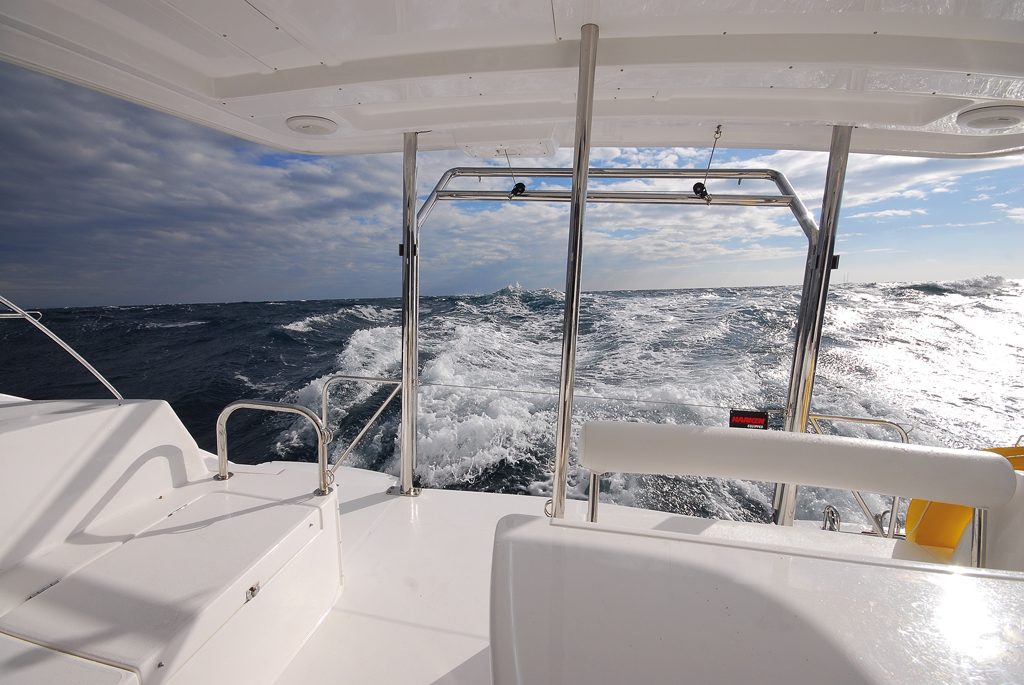
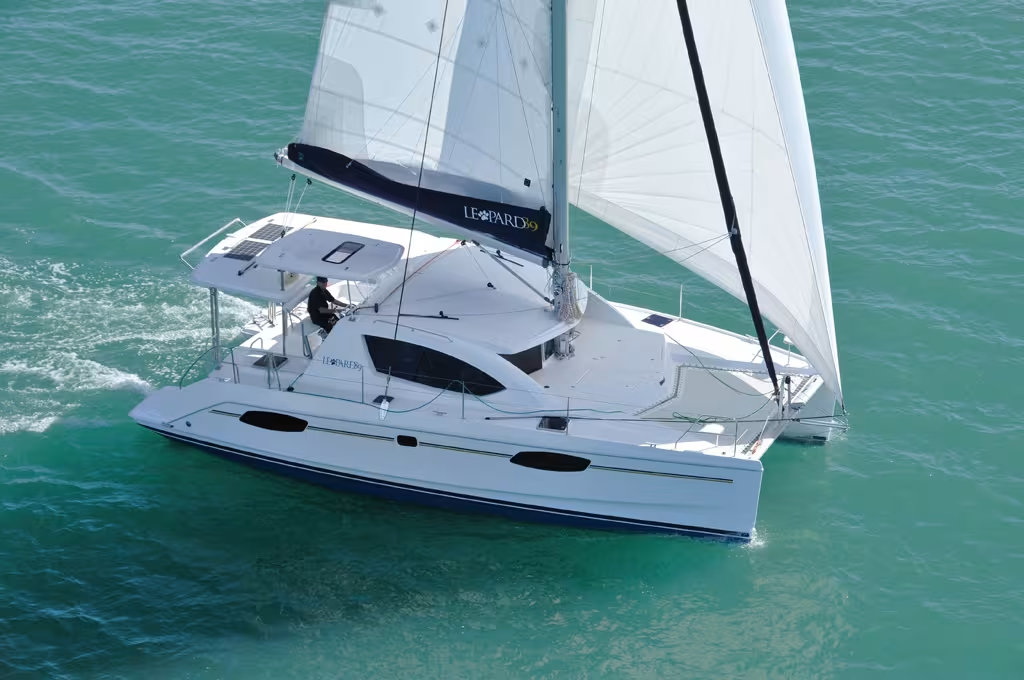
Slightly over-canvassed (logical, for a test), the Leopard slips along at between 9 and 15 knots (top speed 17.6) on the rough sea at the start of a gale.
Looking for a new brand image
With the Leopard 40’, Robertson & Caine interrupted a decade of collaboration with the Simonis-Voogt design office and entrusted the design to Gino Morelli. This decisive turning point was explained no doubt by the need to break with the reputation of boats which ‘slam’ (the previous design’s bridgedeck tunnels were too low!), but was justified above all by the wish to use an international designer...who was not French!
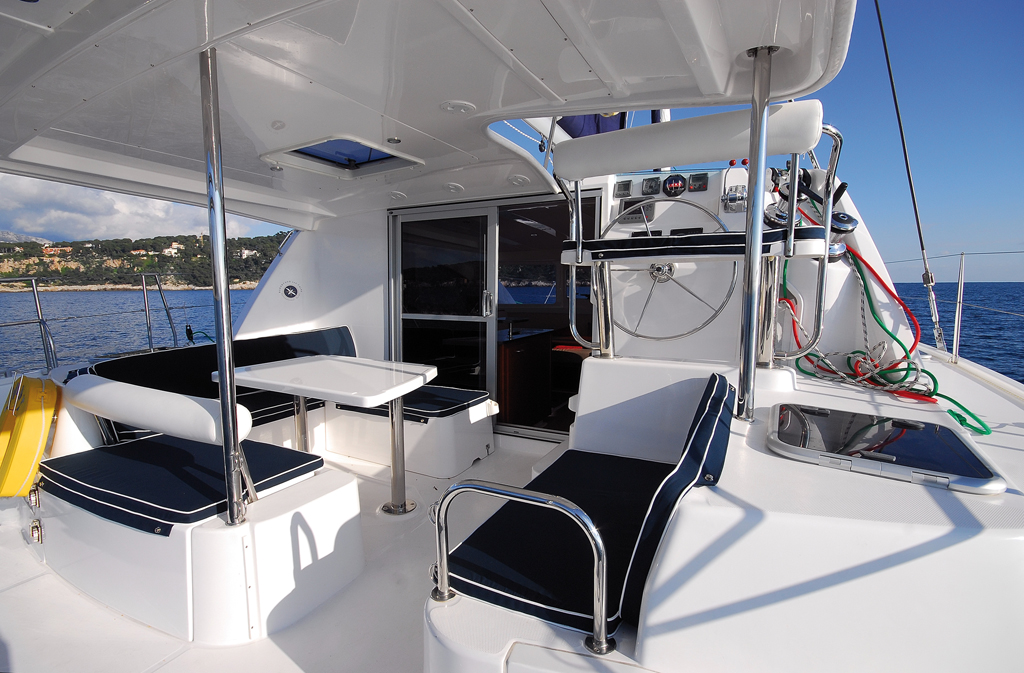
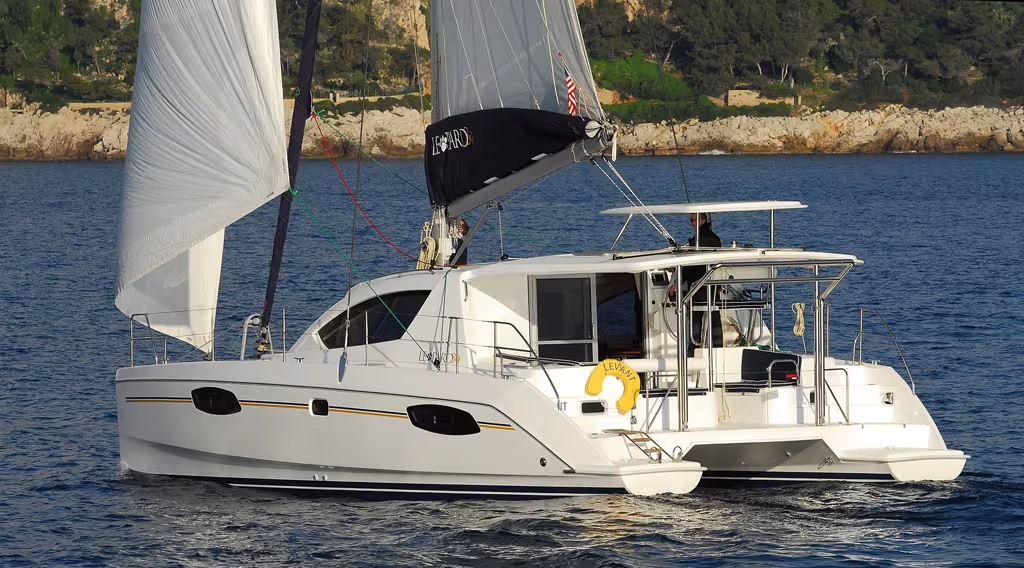
The cockpit is always the most-used place aboard a cat in the sunshine. Here the areas are pleasant and the rigid bimini will protect you effectively.
A modern, high-performance industrial tool
The factory was completely redesigned in 2003, and now occupies 3 hectares; it is an installation which is comparable to the European models, which allows the 450 tradesmen to work on 14 boats simultaneously on the assembly line. The average build time is 45 days. The Leopards are all built in glass/iso polyester/balsa sandwich, by manual contact lamination. The balsa core is an attractive solution, if it is accompanied (as is the case) by rigorous realisation and good maintenance (it must never be exposed to moisture!). This use can become virtuous if the wood comes from ethically managed forests, and is an alternative to the highly polluting pvc foam manufacturing process.
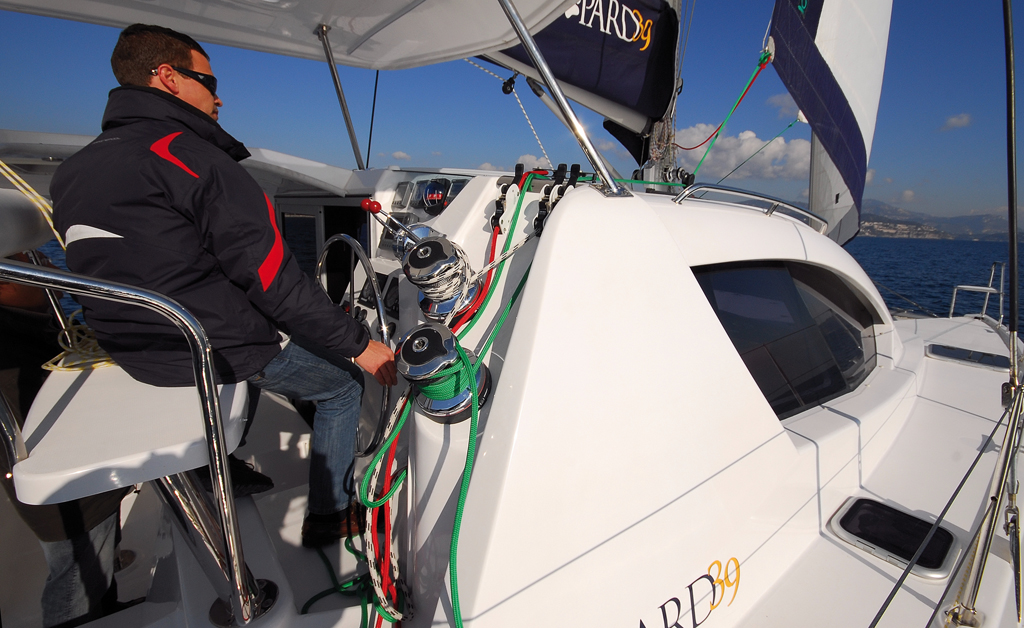
A practical and very easy to use nav station.
Judicious positioning
The world leisure sailing market has been seriously disrupted by the crisis, but the multihull segment continues its development. The small, poorly supported builders continue to suffer and survive in the niches (one-off racing prototypes, or one-offs with high added value); elsewhere we are witnessing industrial concentrations. The coveted yacht segment remains in the hands of a few; that of the 40 – 50 footers is trying to take the step towards bigger products with a large profit margin. The race for internal volume seems to be marking a pause, to the benefit of a welcome concern for quality, without really maintaining a distance with respect to the law of programmed obsolescence (artificial renewal of the range). Leopard’s strategic choice is lucid: sailing catamarans of from 39’ to 46’ (37’ and 47’ in power cats) which are strong, easy to use and designed around demanding specifications, anticipating intensive charter use, and, no less tricky, that of ‘maintenance’ by owners!
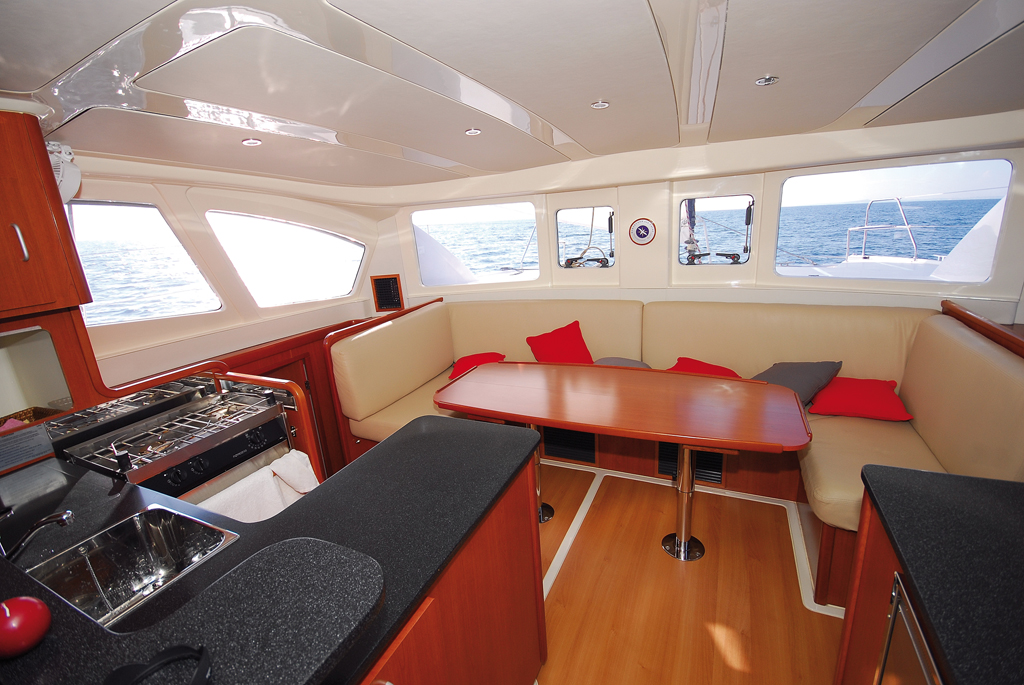
Inside, we find a good build quality and a pleasant atmosphere!
Silhouette, ergonomics and accommodation
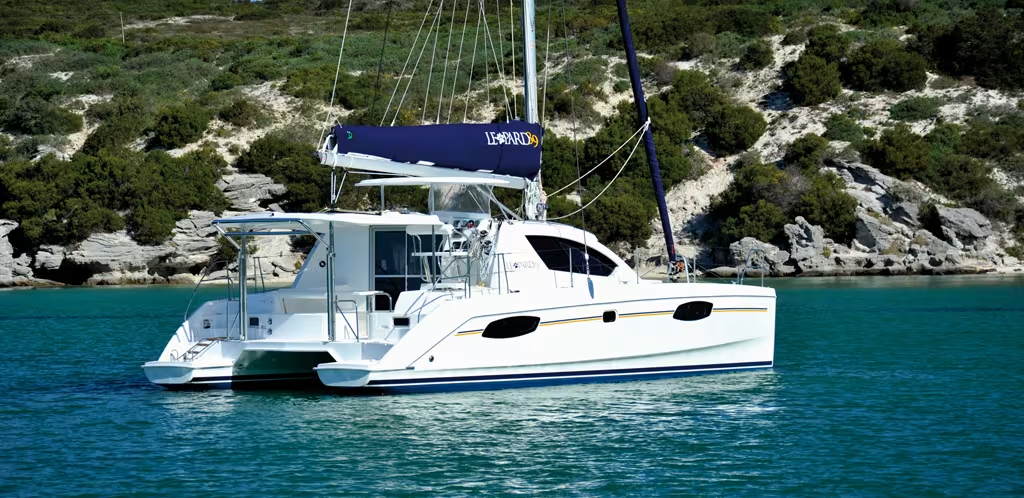
The 39’ realises a synthesis of the previous exercises, which have already been crowned with success (the 38 was named ‘Boat of the Show’ and ‘Best Catamaran 200’ by two American magazines) and outclasses the 40’! Very consensual, it takes into account the solutions unanimously validated by the competitors, offering a successful interpretation. The composite phase uses reassuring scantlings and good finishing; the woodwork is neat, and the interior atmosphere is pleasant. The ‘soft furnishings’, the light and the wood or Corian facings contribute to the creation of an attractive atmosphere. I appreciated the rigorousness of the domestic and drainage installations; the pumps and seacocks (industrial quality through-hull fittings) are clearly accessible and protected from moisture, with double jubilee clips present throughout. The technical locker is gelcoated. The engine, the rudder post and the rigid rod returns bear witness to a legible installation and a desire for rational service.
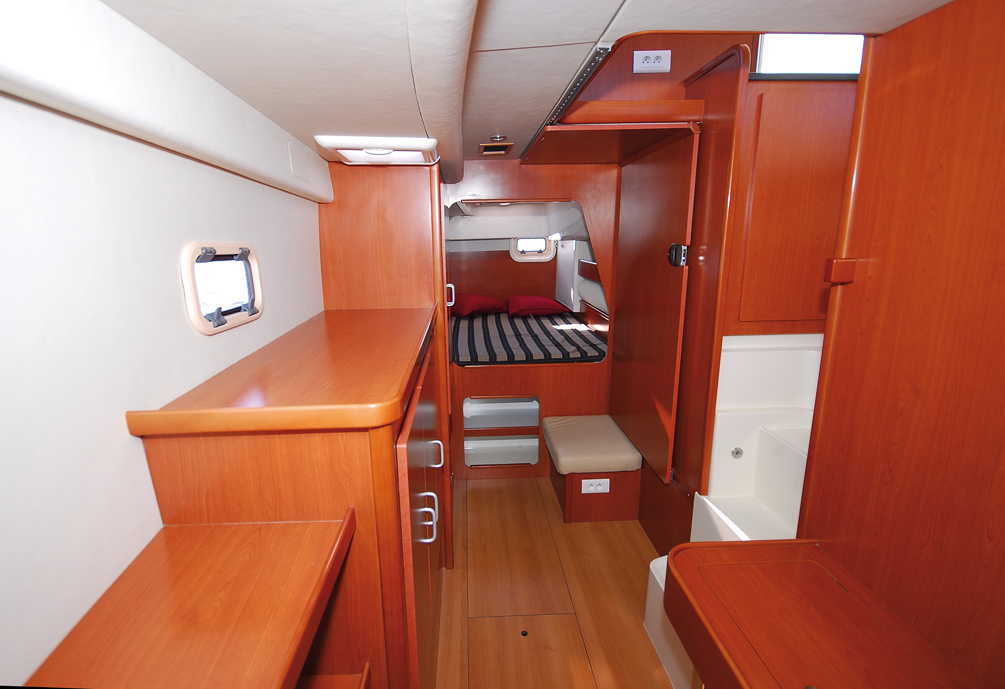
Only offered in a 3-cabin version, the owner’s hull is really nice...
Surprise on the water!
On our first morning, we stopped the engines with 4 knots of wind. The Leopard started moving, under (square-headed) mainsail and gennaker, and showed unexpected vitality! The breeze filled in progressively, to reach 8-10 knots, and the boat accompanied the light gusts directly, with the GPS displaying speeds equal to or superior to the polars (around 8 knots with 10 knots of true wind at 90°). The deck plan is practical and of an obvious simplicity in use. All the control lines return to the navstation (apart from the reefs); the Harken fittings and Spinlock jammers are almost faultless, but the winching area is a little cramped. The next day, the wind window we were aiming for (it was January!) was punctual, and we had two hours to sail to windward before the arrival of strong east-north-easterly gale. With full main and genoa unrolled, we set off on a close reach, prepared for a battle. The wind gradually freshened, 12-15 then18-20 knots, and the ocean swell warped a horizon which was becoming white – a clear warning. The keels were working well, and confirmed the previous day’s facility. It was time to take a reef, but the boat’s behaviour showed that it had plenty in hand, and that we should wait; we were testing to approach the limits! The slim hulls advanced hungrily and the progressive ‘step’ in the hull played its role; the boat passed through the waves smoothly and dynamically, the bridgedeck did not slam at all (!) and the Leopard showed itself to be tolerant to temporary over-canvassing. With the traveller open, without trying to luff, it is sound and quite dry. I noted the stiffness of the rig arcs, which do not deform under load. We continued on our course (whilst remaining attentive) and I took great pleasure in piloting this multihull, which remains rigorous under strain. The self-supporting Z Spars mast with one set of spreaders is generously dimensioned; the Quantum sails in Hydranet offer an ideal shape/grammage /performance compromise for cruising use. The helm (mechanical linkage) is precise and pleasant, and the diameter of the wheel allows real control of the trajectory. As the anemometer was displaying 31 knots of apparent wind, we had to either take a reef...or bear away! The breakers were rolling their crests, as a warning signal, but they didn’t stop the Leopard (with the main wide open in 30 knots of true wind) straddling a lively wave for around 5 seconds until it reached 17.6 knots! The accuracy of the transmission and the rudders’ directional effectiveness allowed us to continue this exercise without risk at between 9 and 14 knots (the wind was lighter near the coast). We finished the test close hauled, tacking under 1 reef/full genoa in 20 knots of true wind; the pointing ability was quite satisfactory, 100° from one tack to the other, with a constant speed of 7.5 – 8.5 knots.
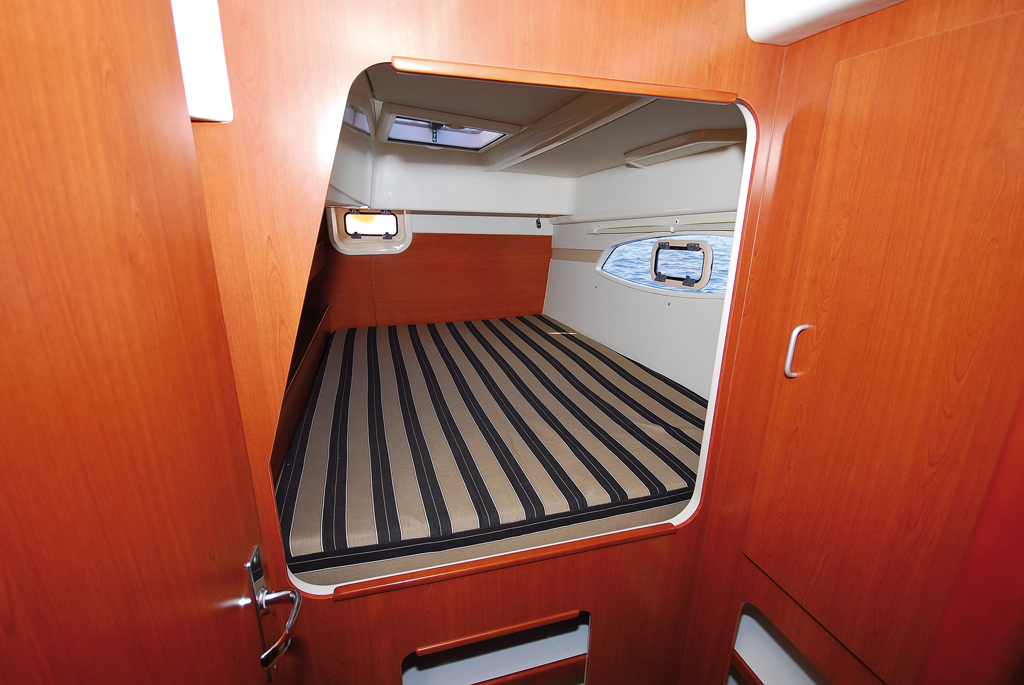
The other cabins are up to the builder’s standards, with real manufacturing quality.
CONCLUSION
The Leopard 39’ is a good catamaran - homogenous, practical and well-built. It is quite narrow, but our test showed that it is safe in rough weather, agile, and pleasant to sail. As for performance, the balance sheet is more than positive.
LES CONCURRENTS
Model Sail area in m² Weight in kg Price exc. VAT in euros Builder Helios 38 cruiser 76 5200 251,250 Edel Composite Lipari 41 89 7600 228,000 Fountaine Pajot Nautitech 40 87 7400 289,000 Nautitech Lagoon 380S2 79 7260 183,600
TECHNICAL SPECIFICATIONS
Architect: Gino Morelli Builder: Robertson and Caine, Cape Town, South Africa Length: 11.43m Beam: 6.04m Draft: 1.05m Displacement: 9t Air draft: 19.10m Windward sail area: 92m² Engines: standard 2 x 20hp / 29hp as an option Fuel: 350L Water: 780L Construction: balsa/glass/isophtalic polyester, manual contact lamination Daggerboards/keels: bolted-on keels Basic price: 215,000 euros exc. VAT Electronics pack: 9,445 euros exc. VAT Delivery Europe: 20,000 euros exc. VAT Bowsprit + code 0: 5,500 euros exc. VAT Square-headed mainsail: 473 euros exc. VAT Launch at Cape Town + safety equipment: 10,000 euros exc. VAT
The plusses
Easy use Seaworthy, lively boat Top quality equipment
The minuses
Questionable silhouette head on Kicker and fixed propellers Delivery (price and constraints)