Despite their real commercial success in the West Indies and the USA, Leopard catamarans, from the South African boatyard, Robertson and Caine, are not very well known in Europe. With its new 40 footer, ‘the other multihull country’ has associated itself with a heavyweight partner (Moorings) to get a foothold in a sector which many builders were beginning to neglect. To ensure success, the two associates went to talk to a design team with a reputation, Gino Morrelli and Pete Melvin.
Infos pratiques
- Le chantier : Leopard 40
- La fiche technique
- Découvrez notre vidéo exclusive
- Financez votre Leopard 40
- Assuez votre Leopard 40
- Articles autour du Leopard 40
THE CONCEPT
Lex Raas, the new director of Moorings, believes in the development of multihulls and since 1995, close relations with Robertson and Caine have been created. The world leader in the bare boat charter market has applied the same formula that made it so successful with Beneteau to the catamarans: improved specification, careful siting of bases, service quality, fleet reliability. Moorings enjoys an exclusive contract with the Durban-based boatyard and now has a complete range. The 43’ and 47’ account for the major part of the production, the 62’ less, because of its size. The 40 footer’s mission thus seems to be to penetrate the European owners’ market with a similar argument and to attract other categories of buyer-manager whilst offering charterers an easy, cheaper boat!
The Leopard 40, a catamaran which makes you want to go cruising…
ARCHITECTURE
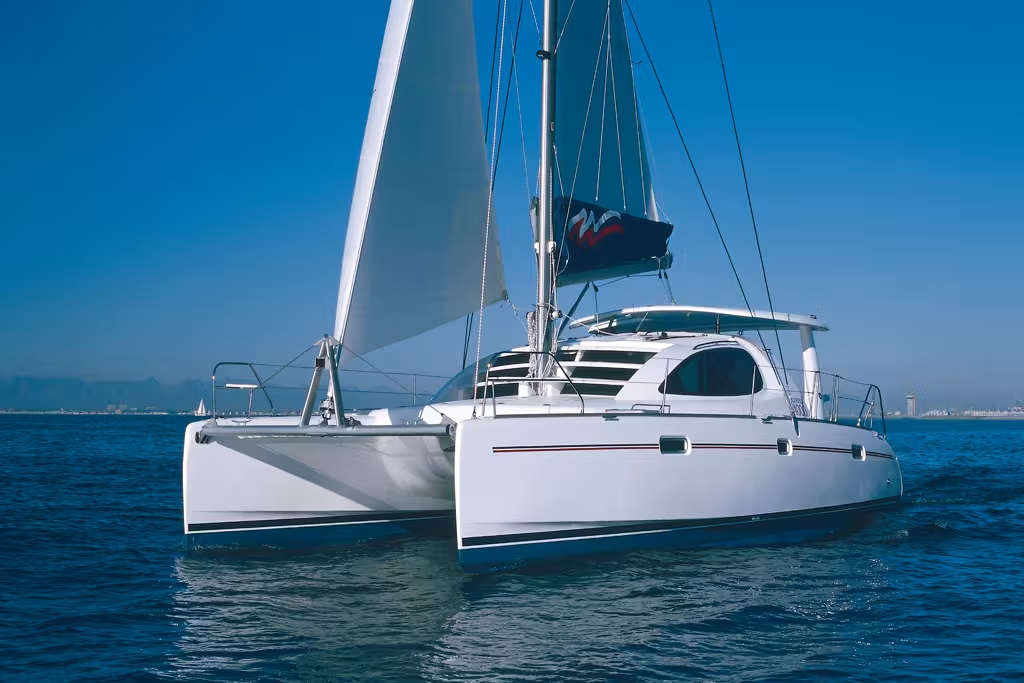
The other models in the Leopard range were designed by Alex Simonis and certain of their characteristics (low nacelles, high wetted surface) do not go well with the philosophy of the younger aficionados who want to sail a livelier multihull. Gino Morrelli and Pete Melvin were thus chosen to design the 4000. Gino Morrelli is quite a character; with Alain Petit Etienne, he designed and built the 63’ catamaran REGION DE PICARDIE. In 1980 he had mastered the epoxy Nomex Carbon Kevlar vacuum process whilst the French were still spreading polyester resin on foam. It was he again who caused a sensation in the formula 40 class in 1990 with NORD PAS DE CALAIS, which became ALINGHI (holder of several records, including the Bol d’Or, on Lake Geneva) and HAPPYCALOPSE. He was also part of the design team for STARS AND STRIPES and Steve Fosset asked him to design PLAYSTATION-CHEYENNE (which he also sailed aboard). Gino, the eclectic, is also the designer of the Nacra Inter 20 (recent winner of the Round Texel) and the Gunboat 62'. It is obvious that the Leopard 40 belongs to the Leopard range, the characteristic styling is immediately recognisable (frontal steps to protect against the sun, hard top, lateral tear drop shaped portholes…) but Morelli’s influence can be seen more in the fine hull lines and the height of the nacelle above the water. The Leopard 40 is a comfortable boat and is therefore nothing like the racing prototypes mentioned earlier, however the emphasis on respectable performance seems obvious: fluid cabin roof design, nacelle height which conforms to European standards, but above all fine forward sections, progressive U shaped hull lines, with a reasonable counter and wetted surface area. The platform is less powerful (6.13m beam) than the French models (between 6.80 and 7.10m beam) giving a catamaran which takes up less space, is lighter and more lively in light weather. Resistance to leeway is provided by fixed ailerons; this choice was made to prevent damage when beaching and to give more accommodation space. The final architectural trick is the ‘bulge’ around the hull which gives good internal volume despite the slim hulls...but beware of overloading.
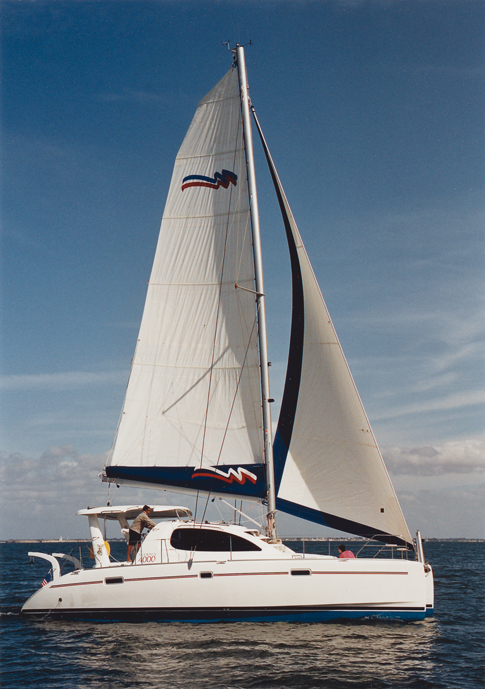
The pretty, up-to-date lines of this 40 foot catamaran by Morrelli / Melvin
CONSTRUCTION
Robertson & Caine today have modern industrial machinery and excellent productivity (150 boats per year with 200 technicians). The Leopard 40 is built on a mould and the main operations (including gel coat application) are carried out manually. Lamination is by contact using quality multidirectional tissues and isopthalic resin. Certain stages of the sandwich process are carried out under vacuum with a balsa core (hull above and below waterline!) Several elements are laminated in secondary moulds and are then integrated into the chassis (furnishings, shower trays, consoles, etc…).
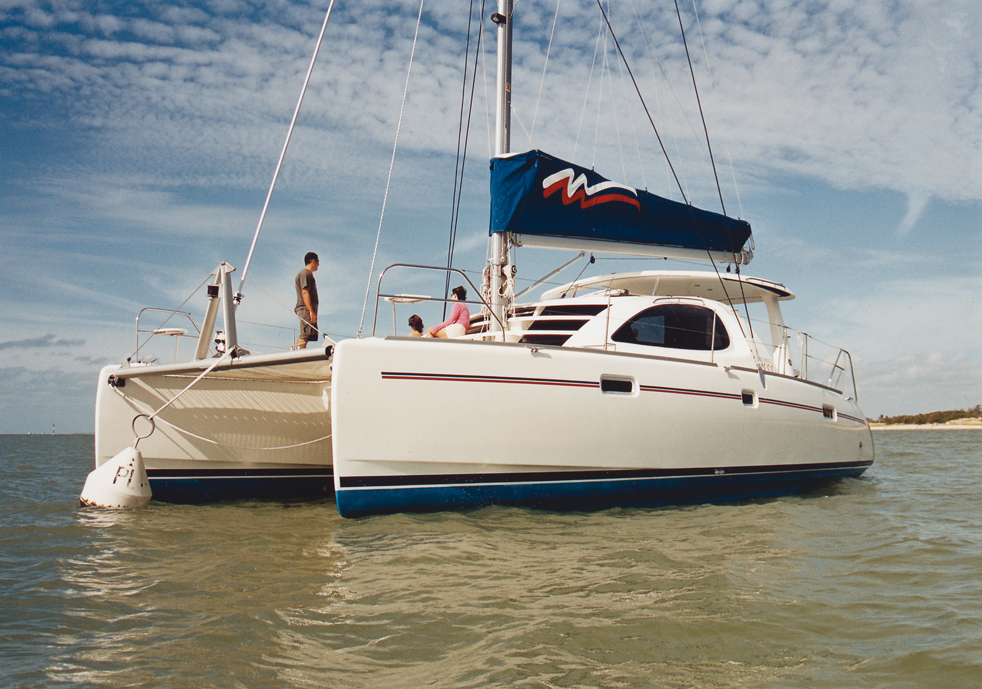
The Leopard offers an excellent compromise both at anchor and under sail…
GENERAL PRESENTATION
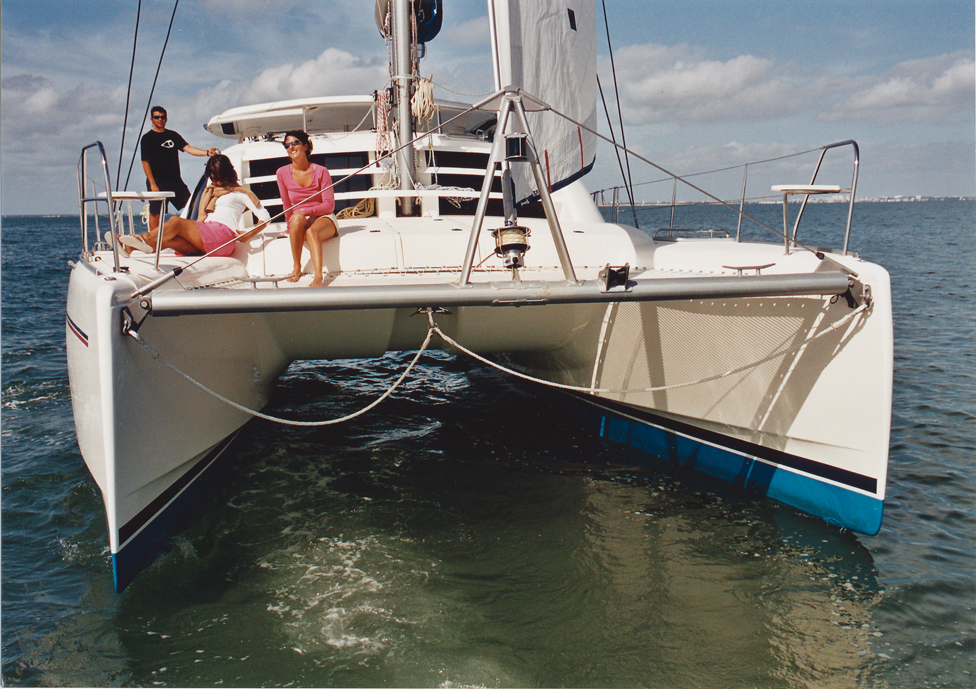
The Leopard 40 is a nice-looking boat; its original silhouette is harmonious, despite the height of the cabin roof. The only thing that slightly mars its fluid lines is the hard top, but it appears that this is a must for its programme! Personally, I would have preferred a canvas bimini with a rigid step and two mainsheet tackles, but I trust the builder, who knows his job. Boarding via the stern is made easier by the discontinuity in the crossbeam which gives direct access to the cockpit. The exterior saloon consists of a wide bench seat and table to port; the steering position occupies the starboard side. It is easy to move around; this is helped by an aft transverse gangway serving the davits and the dinghy - a practical arrangement for adults, but this open arrangement could pose a safety problem for children. Movement around the deck has been well thought out (well-placed handrails) and access to the roof is practical and safe. The nacelle does not extend too far forward and opens onto a vast trampoline; access to the anchor and chain is straightforward, the anchor is dropped directly below the crossbeam. Two very big lockers house the fresh water tanks, the fenders, the spare sails…or the bicycle, and give access to the structural network of the central bulkhead, whose dimensions and construction quality are reassuring.
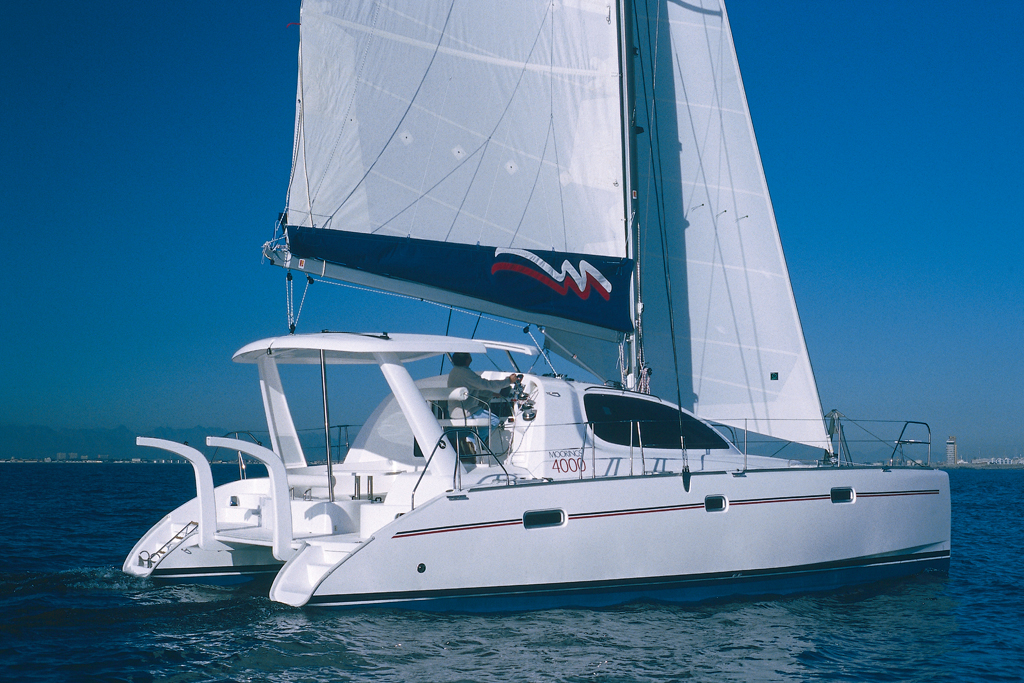
The rigid bimini offers good shelter, even if it does spoil the boat’s general lines…
MAST AND RIGGING, STEERING TRANSMISSION
The mast is a classic Sparcraft tube, simple and solid, with just one set of spreaders and an intermediate diamond for stiffness. A pair of lowers and two cap shrouds in Dyform make up the lateral rigging. The Proengin furling gear supports an overlapping genoa (120%), but the original plans do not provide for a bowsprit or a gennaker. The excellent quality forward crossbeam is stiffened by a martingale in discontinuous rod. The mainsail is stowed in a good quality, practical lazy bag (yes, it does exist!), but the boom is supported by a rigid kicker, a debatable choice on a multihull. Trimming is taken care of by a mainsheet track mounted on the rigid bimini and the sheet returns to one of the pair of winches on the console. Ball bearing blocks, turning blocks, in fact all of the Harken deck fittings deserve a mention as much for their individual quality as for their careful positioning. Despite an obvious wish to "hide" the operational side of the boat and put the emphasis on easy living, everything works well. The wheel (through its cable transmission) controls a rigid connecting rod which links the two rudders - a logical choice.
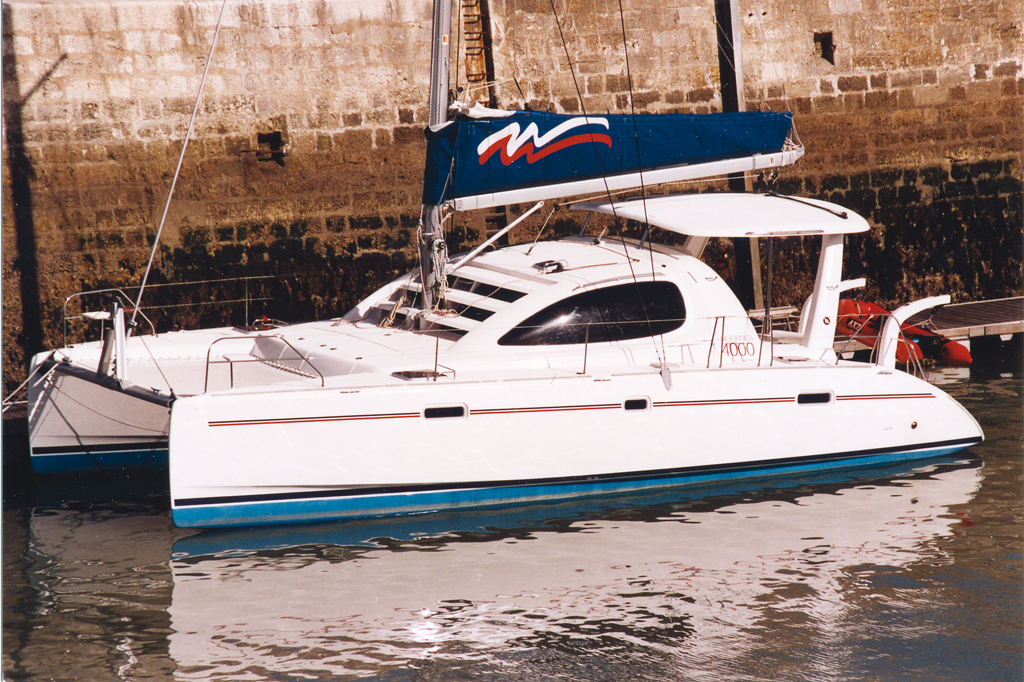
Easy to manœuvre and comfortable…the Leopard 40 should be a huge success with charterers…
ENGINES
In its basic version, the Léopard/Moorings 4000 is equipped with 19 hp Volvo Penta diesels (2 X 40hp as an option) with saildrive transmissions. On the version tested (2 X 40 hp) the engine locker architecture proved to be practical and rational ; access to the filters, the waterlock, the battery and the cooling liquid reservoir is easy and a visual check of the mechanics as well as the steering transmission only takes a few seconds.
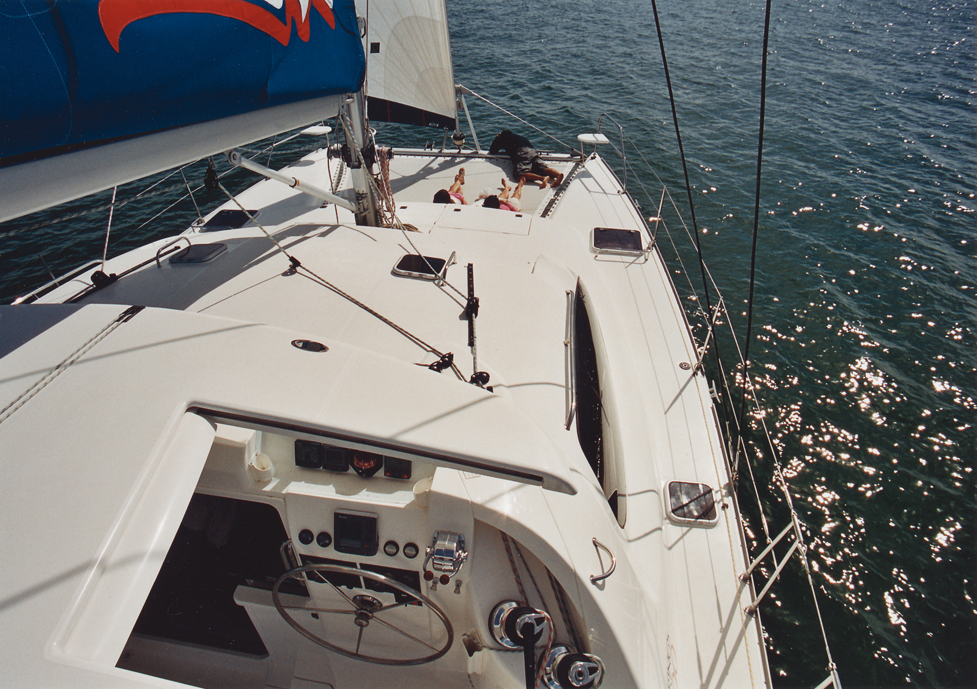
Above the steering position, the rigid bimini opens for a better view of the forward part of the boat and the sails…
INTERIOR ACCOMMODATION
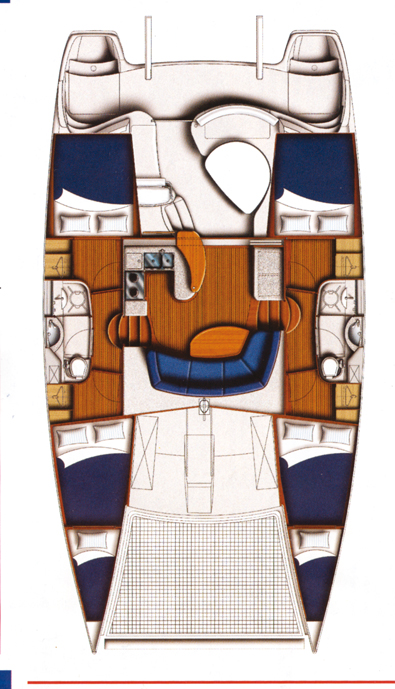
At sea, things must be simple, robust and reliable (especially if you want to enjoy the anchorages); the 40’ Leopard seems to have tried to achieve that objective. The surfaces are pleasant to look at, the finish is good, the volumes and the maintenance have been well thought out. Wood veneers and the laminated ‘teak’ floors are treated (with Oberflex or Stratifil). The whole boat will be very easy to maintain in good condition. Access to the hulls is by a set of moulded steps ; in the 4 cabin version the organisation logically gives priority to sleeping volumes; the 2 heads are large and practical, but must be shared ! The different galley functions and the quality of the installation reveal the designers’ experience: the Corian work top which can also be used as a serving hatch, the large double sink, the stainless steel cooker and oven and the fridges mean that cooking is ‘just like at home’.
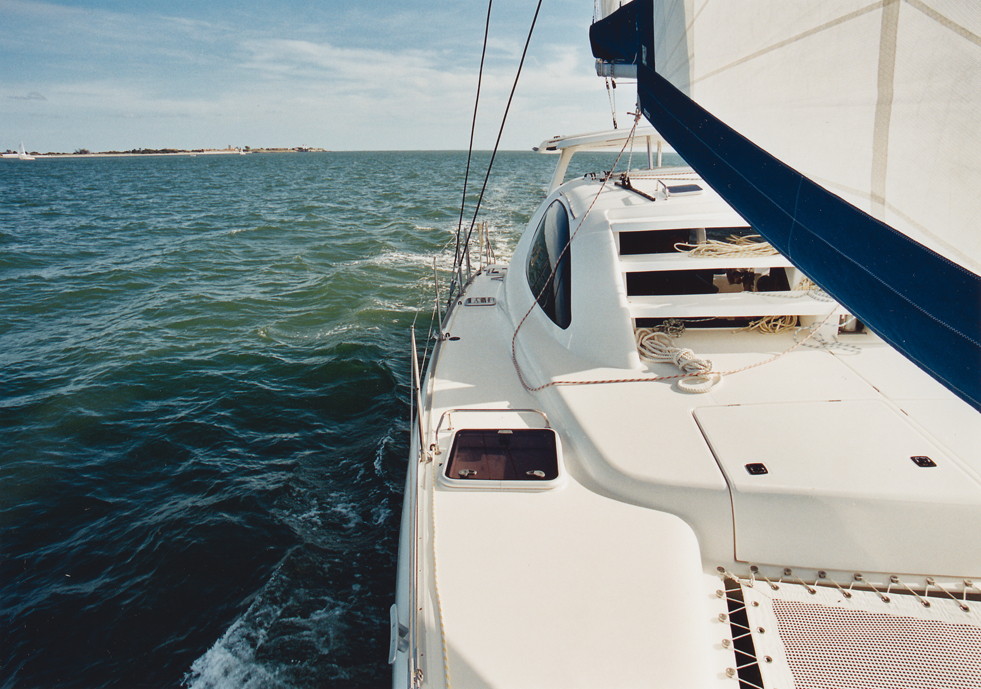
It is really a Leopard : we find everything that contributed to the range’s success, such as the large steps on the forward part of the cabin roof…
TEST AT SEA
We sailed for two days off La Rochelle at the start of the Grand Pavois. First impressions in the pertuis Breton were good, honest and direct: the Leopard 40 picked up well in light airs and its overlapping jib combined with the high sail plan makes it a lively boat. The hull design gives it an advantage in the performance department. The reduced drag of the counter and its fine entry confirm that the ‘hull with a bulge’ option is a success. On a broad reach at first, then with the wind abeam in a breeze of around 12 - 13 knots, the Morella-designed boat managed a respectable 8.5 – 9 knots. This 40 footer showed a real willingness to follow the variations in the breeze and proved to be more manoeuvrable than its predecessors; it reacted well to different adjustments, sailed well downwind and should prove to be lively under spinnaker. At the end of the afternoon we moored on the jetty at St. Martin in the charming little outer harbour with its perfect architecture. After an excellent night aboard we sailed back up the pertuis Breton towards the ile d’Aix; beating in a light breeze, the 40’ sailed close to the wind with no fuss; at 50° to the true wind, the appendices work well. The wind freshened a little; at 6 – 7 knots in a true wind still blowing at less than 10, we made quick progress through the current induced turbulence, with no apparent leeway. Curiously, when the boat is supported by its leeward hull, it has a slight heel - odd but not unpleasant and connected with the unusual geometry of this boat. The helm has a reasonably good feel and the rudders are precise, but, as is often the case on comfortable cruising catamarans, the steering position could be better; a larger wheel would improve the situation. The sliding hatch in the hard top gives a reasonably good view; the intention is laudable but it is not perfect. Despite everything, the general ergonomics of the steering position deserve a good mark: the controls are easily accessible and the unusual winch console proved to be practical and functional. At the end of the afternoon, a long broad reach left a fine wake and at the helm I managed 10 knots in around 15 knots of breeze.
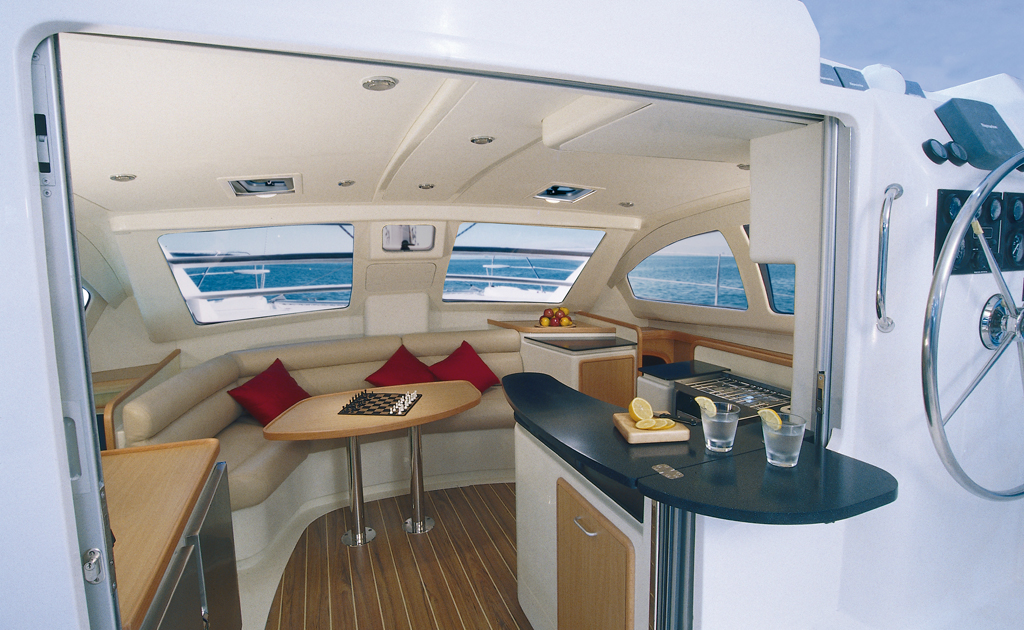
A refined and very functional interior.
CONCLUSION
With its generous sail area and well-designed hulls the Leopard 40 seemed to sail well: in a good breeze it should be quite a dynamic performer. To take advantage of these qualities it is advisable to avoid overloading it, as this would force the relatively slim hulls to float lower in the water. Its 7.6 t displacement does not put the Leopard 40 in the lightweight multihull class, but it has a real vitality in light airs. It is pleasant to live aboard, easy to use, seriously built and developed and has beautiful sails from Quantum South Africa (robust construction, generous specifications, numerous reinforcements and good shape) ; the Leopard is a cruiser worth getting to know. Its price is attractive in South Africa, but the delivery partly reduces that advantage ; the Durban boatyard is objectively a competitor for the French (or American) mass-produced boats and will have to keep its prices down to make up for its lack of image. The Moorings sales force trump card will be the deciding factor in the success of this catamaran.
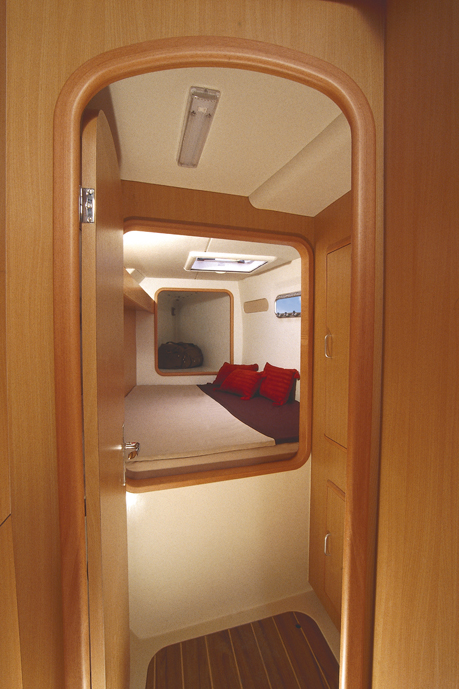
The cabins are comfortable and the finish is very good.
TECHNICAL SPECIFICATIONS
Architects Gino Morrelli-Pete Melvin Builder Robertson & Caine Length 11.97m Beam 6.13m Draft 1.18m Displacement 7.63t Engines 2X19cv Volvo Sail-Drive (ou 2X40cv) Fuel 350l Water 780l Windward sail area 96m2 Optional equipment on boat tested • electronics + automatic pilot • 2 X 40hp engines • suit of sails in woven Dacron Price of basic version 239,000 euros (tax not included)
THE COMPETITORS
LAGOON 410 PRIVILEGE 395 LAVEZZI 40 COUGAR 41 ISLAND SPIRIT 40 Builder Lagoon Alliaura Marine Fountaine-Pajot Cougar Durban Fortuna Cats South Africa Architect Van Peteghem-Lauriot Prevost Marc Lombard Joubert-Nivelt Ian Farrier Phil Southwell Length 12.37m 11.95m 11.90m 12.71m 11.89m Beam 7.02m 6.56m 6.50m 6.43m 6.80m Unladen weight 7.2t 7.5t 6.2t 6t 6.9t Windward sail area 99m2 82m2 90m2 112m2 92m2 Price of basic version (tax not included) 282,900 euros 320,000 euros 317,700 euros 290,000$ US 230,000$ US
The plusses
Pleasant to use Ease of maintenance Hull design
The minuses
Hard top ergonomics Shroud diameters a bit small (good for Dyform quality cable, but the sizes are a bit on the small side for a cruiser). Delivery price reduces the ‘bargain’ aspect