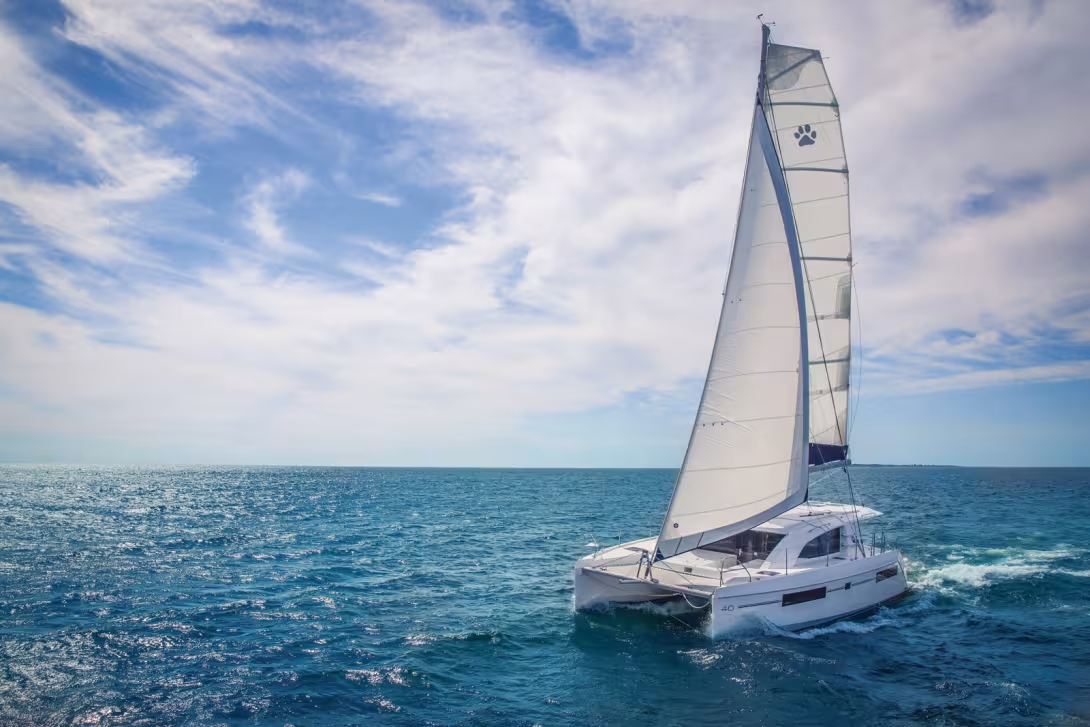
The boat that replaced the Leopard 39 welcomes, with even greater ease for an under 12-meter (40’) hull, a crew of 6 to 8 people. Her real plus? An XXL-sized nacelle that opens into the cockpit, and also onto the foredeck.
Infos pratiques
- Le chantier : Leopard 40 (2015)
- La fiche technique
-
 Découvrez notre vidéo exclusive
- Financez votre Leopard 40
- Assuez votre Leopard 40
- Articles autour du Leopard 40
To avoid any confusion, let's make it clear from the outset that we are talking here about the model released since 2015 and not the model prior to the Leopard 39; that Leopard 40 was launched in 2006. So, our 40 is very recent, but a second-hand focus is appropriate for at least two reasons - firstly because production is due to cease this year, apparently to be replaced by a 42. Second, because some of the boats will soon be coming out of the Sunsail/The Moorings fleets. Of the 216 units built to date, around 140 have been operated in charter. Yes, but Irma has gone through the charter companies' home bases in both the British Virgin Islands and Sint Maarten, significantly depleting the fleet of Leopard 40s (vintages 2015 to 2017). This model could therefore prove to be rarer than one might have thought on the second-hand market. These examples offered for sale will be viewable on Sunsail’s Brokerage. As for second-hand boats offered by private owners, half a dozen are already on the market – check out the Leopard Brokerage website.
So what is the major interest of this model? Her size! 40 feet is considered to be a minimum size for a real cruising catamaran. It’s a size just capable of accommodating two families for one or two weeks' charter, but also of becoming a home for two adults and their children. And all this for a minimum price, since the majority of boats on the market, except for a few models, start more or less at 12 meters (40’).
More glazed surfaces
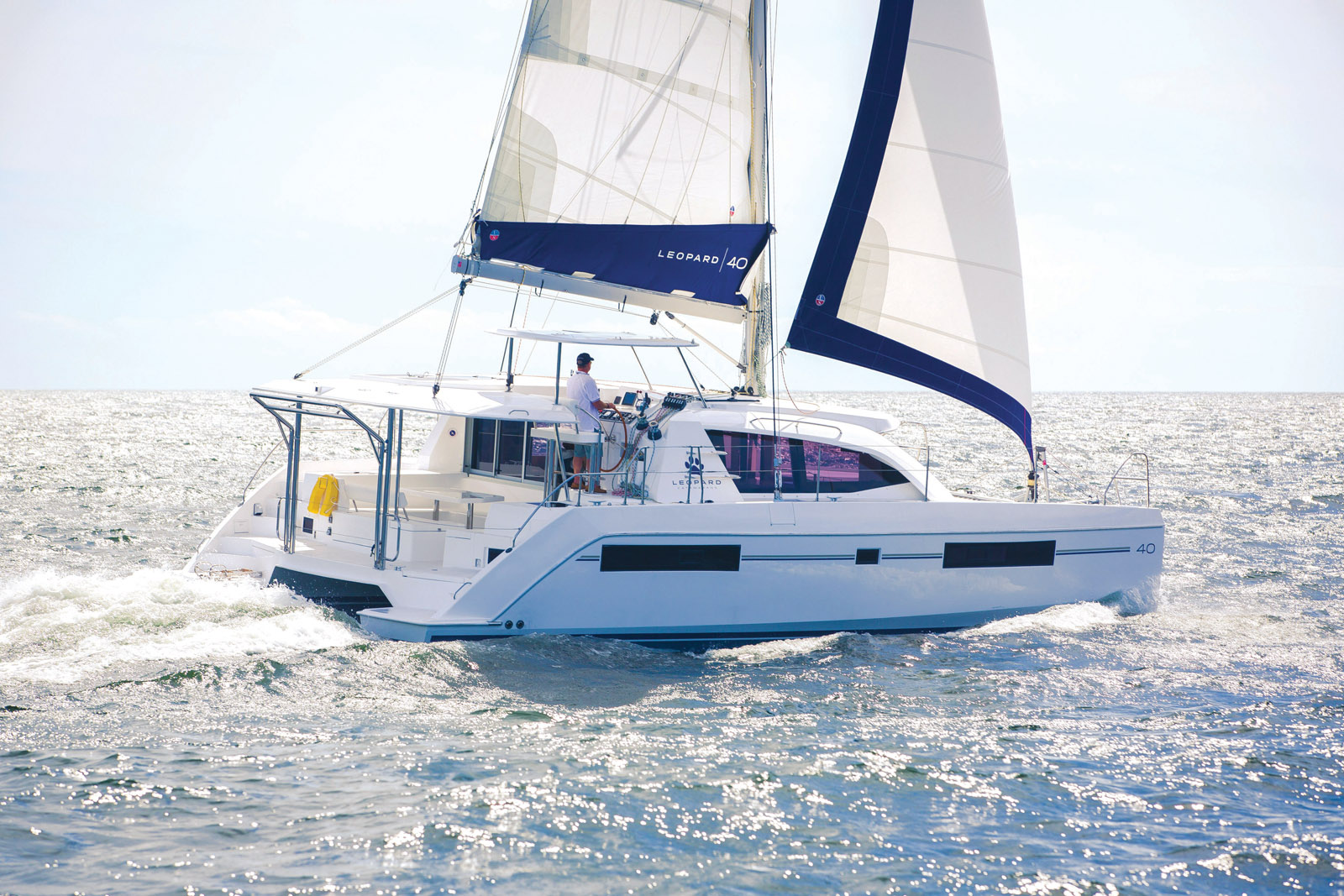
What's new on the Leopard 40 compared to the 39? More modern lines, more glazed area and, notably, a front door for the saloon. With the 44 and the 48, the yard made headlines in 2011 by offering forward cockpits and, above all, a door connecting them directly to the saloon. The 40 continued the success of her big sisters, but without the cockpit. It was limited to a few steps for easy access to the forward lockers, the anchor locker - and the trampoline. Moving around the coachroof, which is largely overhung by a cap to limit the greenhouse effect, is fluid and safe thanks to the wide side-decks, the numerous handrails and the rubber seal around the superstructure. To access the mainsail's lazy bag, steps are cut out at the starboard aft end. You can walk on the bimini, which covers a good area - it is very strong...
The cockpit is therefore perfectly protected from spray and from the sun. It has a U-shaped table and bench seats – and with the two stools on board, eight people can eat comfortably. Protected by a mini bimini, also rigid, the helmsman has a bench seat large enough - 107 cm (42”) - to have someone keep him company. Within reach are the helm and engine controls, of course, but also two winches and a battery of clutches. All the sail handling maneuvers come back here. To trim the mainsail, the yard abandoned the idea of a traveler for two independent mainsheets.
Built for the breeze
The two engines make it possible to get out of a very crowded space: with the helm amidships, playing on the throttle levers, you can swivel on the spot. With the mainsail up - optional for a square top - and the code 0 unfurled, the Leopard 40 is astonishingly agile: during our tests, we recorded 4.6 knots in 7 knots of true wind and even 5.8 knots in 9 knots of wind. Under genoa, at 55° to the 11-knot wind, we managed to peak at 5.5 knots. A glance at the wake and the track on the plotter confirms that the leeway is almost insignificant. Honest performance and perfect smoothness at the helm: good features this out-and-out cruising catamaran. With folding propellers instead of the pair of fixed three-bladed ones delivered as standard, it's not far from a knot better than you would otherwise get. The polars supplied by the architects promise an average speed of 12 knots under gennaker in 16 knots of wind. So the 40 likes a breeze!
Diagonal movement around the saloon
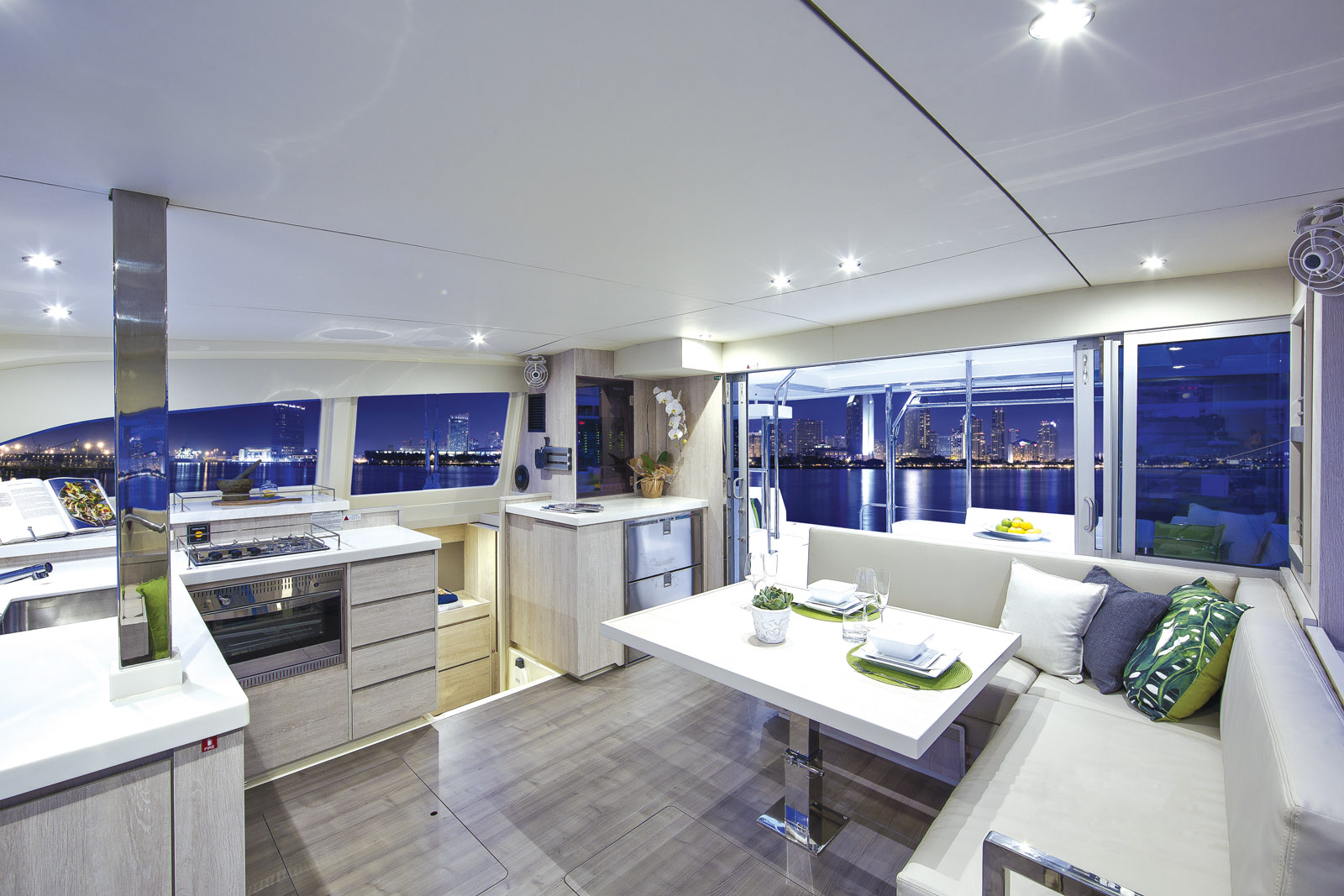
Inside, there is no door tread but a wide opening, 1.84 m (6 feet) high, and then a headroom some 20 cm (8”) higher. One is immediately impressed by the natural light provided by the generous glazing and the ease of moving around. This is because the layout chosen in the nacelle is atypical: the galley, traditionally against the cockpit on the port side (the door to the cockpit is offset to starboard), is pushed forward to starboard. And then the dining area takes its place, but this means losing two sides in the process, obliging you to use stools if you’ve got a large crew. So the natural passage across the saloon is diagonal, from one door to the other. And it works! The chart table remains firmly in place in the port forward corner of the saloon, allowing an unobstructed view forward. The access to the cabins is neat with a large cut-out overhead and sturdy stainless-steel handrails. The starboard hull is reserved for the owner. With a wide berth aft, stowage, wardrobe, desk and XXL-size bathroom, you’ll be better off than at home. Opposite, on the port side, two neat cabins share the same bathroom - a rational formula in our opinion, rather than dividing in two a volume already necessarily reduced in a 12-meter (40’) hull, however wide it may be with its chines.
Conclusion
The Leopard 40 has been produced in about a hundred examples in the Owner's version. This has the advantage of offering a hull with a single cabin and sometimes attractive options such as the teak deck. It is of course these models that will be the most sought-after. However, the four-cabin version is perfectly suitable for a family going blue water cruising.
Points to check
At Robertson & Caine, they know about charter... as partner for 25 years with The Moorings (then Sunsail), the South African shipyard designs its catamarans according to very specific requirements. General robustness, ease of handling, comfort, accessibility, and ease of maintenance all take on their full meaning here. Ultimately, the Leopard’s qualities haven’t escaped the notice of private users, many of whom have expressed a desire to buy them. The Leopard 40, barely 5 years old, is therefore a healthy catamaran that is always in great shape. On the other hand, 30 weeks of charter operation per year will have certainly burnt out the sail wardrobe - if it is the original - and put a lot of hours on the motors.
Plusses
Forward-facing chart table
Good behavior in a breeze
Overall robustness
Minuses
Lack of punch in light airs, especially with the standard mainsail
Few fixed seats in the saloon
Poor visibility to the port bow from the helm station
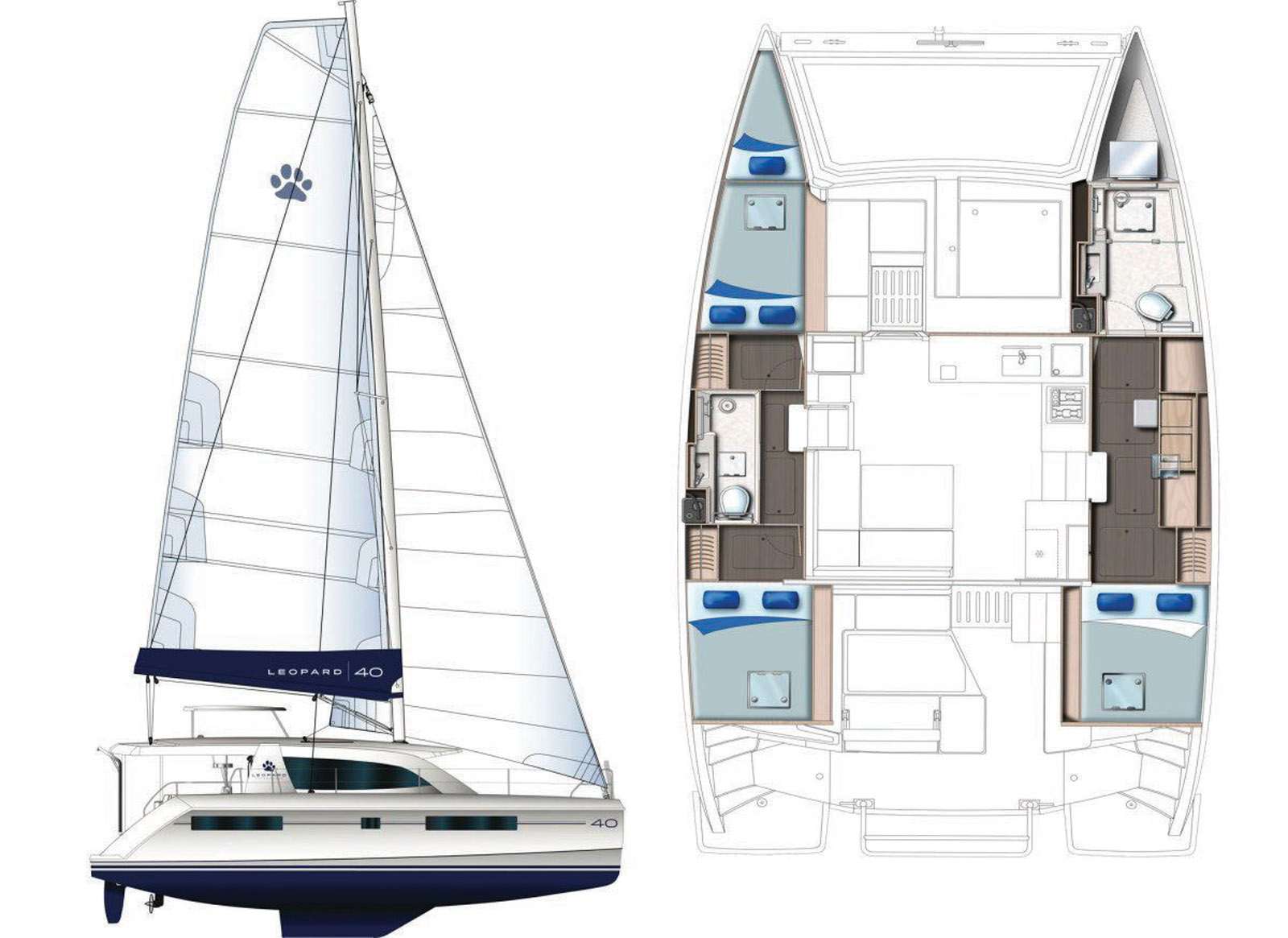
Technical specifications
Builder: Robertson & Caine
Architects: Simonis/Voogd
Hull length: 11.99 m (39’4”)
Waterline length: 11.62 m (38’2”)
Beam: 6.72 m (22’1”)
Draft: 1.35 m (4’5”)
Displacement: 10,530 kg (23,215 lbs)
Upwind sail area: 80.9/95.9 m² (870/1,032 sq ft)
Genoa: 39.5 m² (425 sq ft)
Mainsail: 41.4/56.4 m² (445/607 sq ft)
Gennaker: 94 m²(1,012 sq ft)
Engines: Yanmar 2 x 29 hp
Fuel tanks: 780 l (206 US gal)
Water tanks: 360 l (95 US gal)
Construction: Balsa sandwich infusion
CE Certification: A for 10 persons
Prices from: € 200,000