The Leopard shipyard replaces one of its bestsellers by introducing the 42, a catamaran with modern design and optimized spaces. A concept which seems well inspired, since even before its official launch, the builder has already had signed 34 orders.
Infos pratiques
- Le chantier : Leopard 42 (2021)
- La fiche technique
-
 Découvrez notre vidéo exclusive
- Financez votre Leopard 42
- Assuez votre Leopard 42
- Articles autour du Leopard 42
MULTIHULLS WORLD EXCLUSIVE
Test location: Fort Lauderdale, Florida, USA
Conditions: Northeasterly wind 25 knots, slight chop, 7 people on board
The 42 is the latest addition from the Leopard shipyard. It replaces the 40, a catamaran that remains one of the brand’s great successes. Manufactured in South Africa by Robertson & Caine in collaboration with Simonis & Voogd Yacht Design, the Leopard 42 has been designed taking into account customer feedback and carefully studying the desires of today’s buyers. Compared to the 40, the 42 gains in interior volume with, for example, a 35% increase in living space in the guest cabins and a 30% increase in the owner’s cabin.
The design also benefits from a facelift with a style inspired by the 50. This is particularly evident in the glass surface area, which is twice as large as on the 40. The hull also has a long porthole that takes up three quarters of the length and the main deck is almost exclusively surrounded by glazed surfaces. To offer so much natural light while preserving the integrity of the catamaran, the shipyard has largely reinforced the interior structure. Apart from the structural reinforcements, the boat also benefits from serious fabrication updates with more and more parts made in infusion, in order to gain in solidity and lightness. The coachroof, for example, is made in a single piece, a pretty good industrial achievement. Another manifest change is that the hull/deck assembly has been revised to be even more solid.
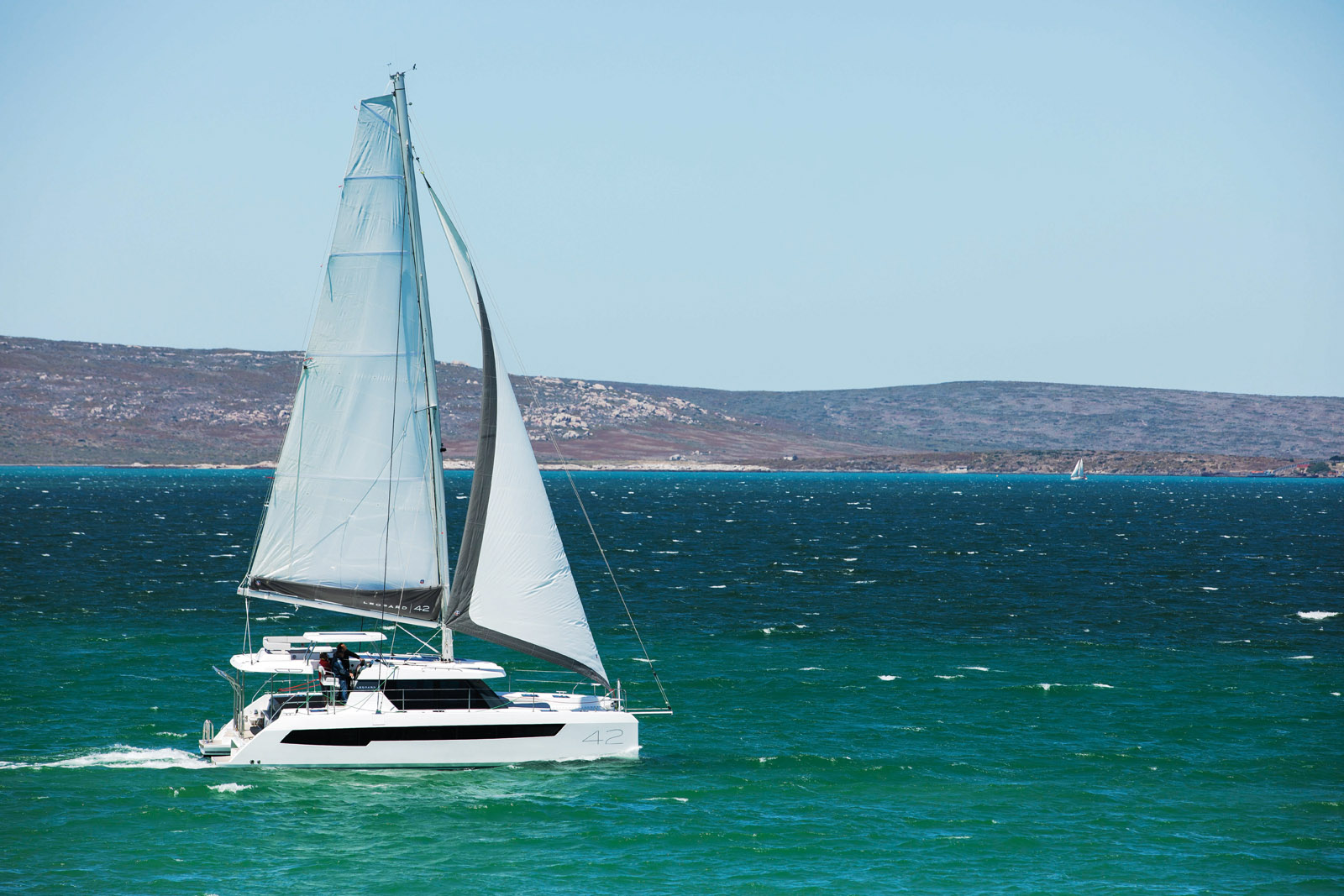
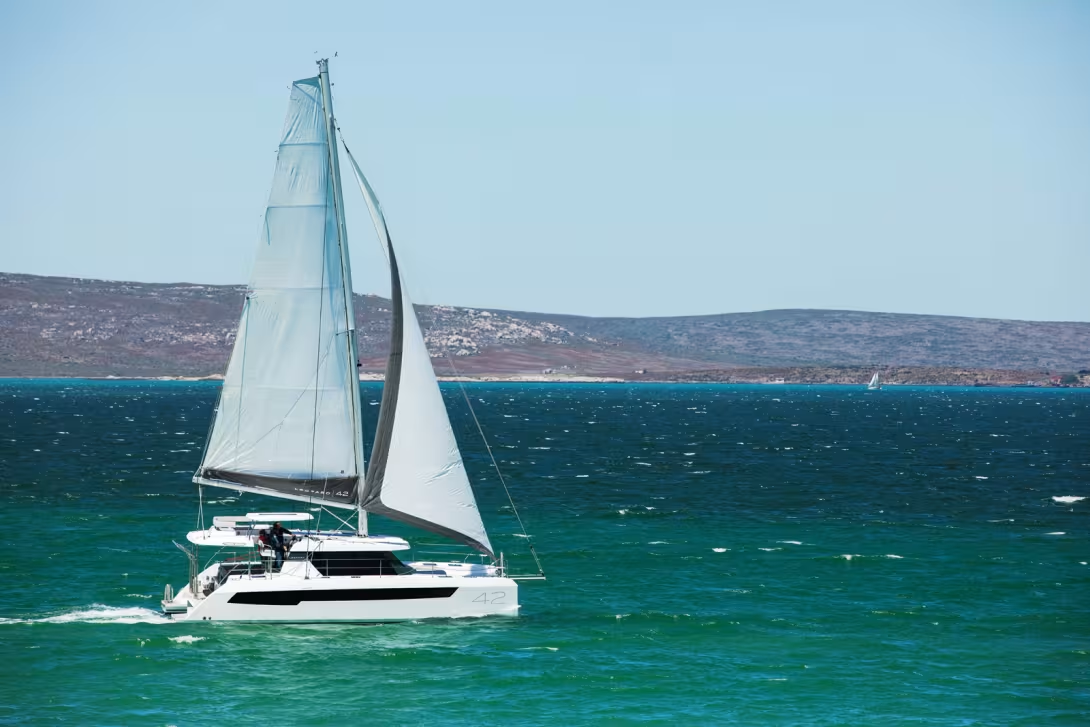
Solid and pretty good on the water, here in Cape Town, the Leopard 42 has no problem in a well-established wind, it even allows it to show off its performance.
A really spacious living area
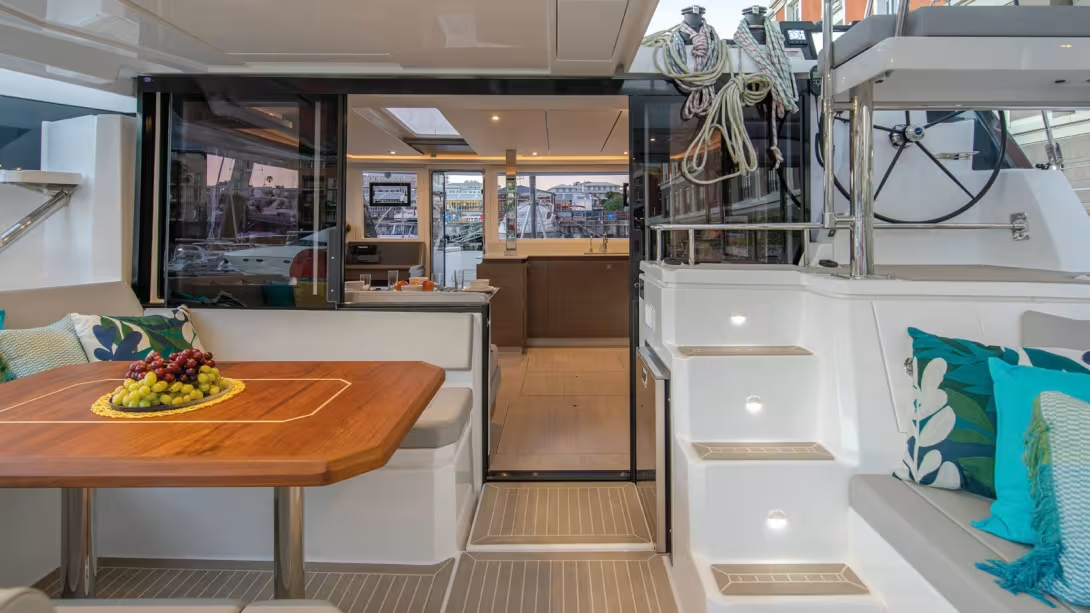
Despite this increase in volume, the look remains slender, and the fairly high vertical bows finish off this very dynamic profile. The slightly angular design contributes to the modern look of the catamaran, while the upper deck windows, extended by a black painted section, almost give the impression that the coachroof is floating above the hulls. It’s stunning. The mast is installed slightly forward of the central point and, in the end, the look of this new model is very well balanced. To get on board, you have to use the sugarscoops. Well-widened at the rear, these offer a nice space to access the bathing area with, on the port side, an oversized swim ladder. Two steps allow you to climb up to the cockpit, which is widely open at the rear with only a pushpit and two guardwires to prevent the crew from falling. This makes it easy to move around the back of the cockpit, which is a good idea. However, you will have to be careful if young children are on board. The aft central space between the two hulls accepts a 12-foot tender with two winches to hoist it out of the water, and it is also on the pushpit that the propane barbecue is installed. The rest of the cockpit is composed of a large U-shaped lounge that can accommodate nine people around a good-sized table. On the starboard side, a bench seat offers additional seating. Under these benches you can find lots of storage compartments, while the back of the aft bench is reversible, allowing you to sit facing the sea and watch the nautical activities taking place behind the catamaran. The only regret is that there is no cup holder...
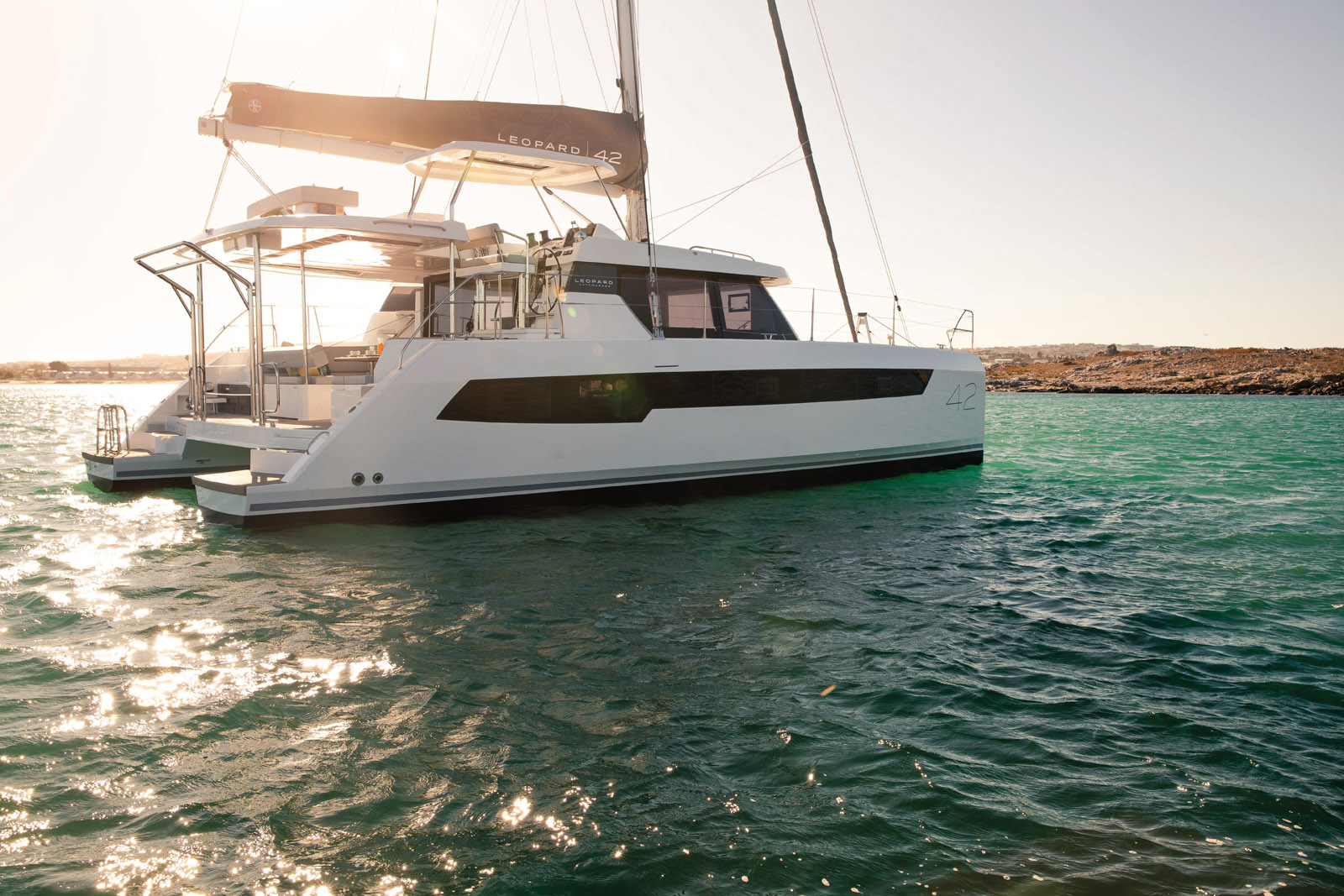
The design of the Leopard 42 is resolutely modern with a well-managed balance between the white of the superstructures and the large, tinted glass surfaces. The slightly angular lines also give it a dynamic look.
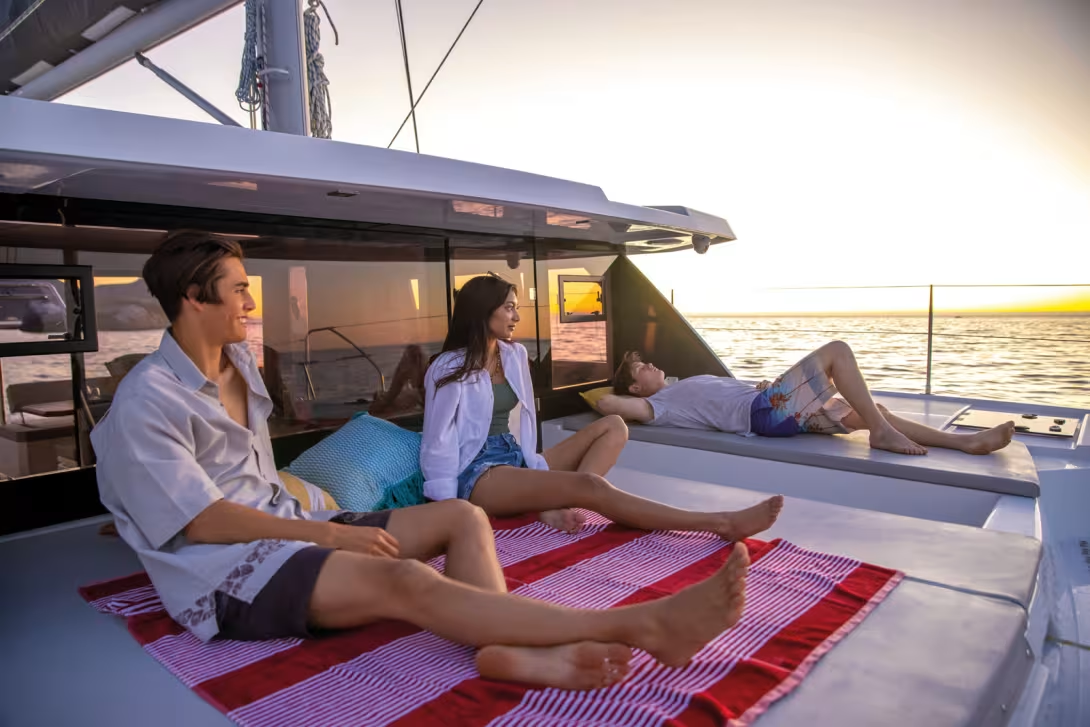
From the cockpit, the circulation towards the other external zones is rather easy. On the starboard side of the cockpit, a small staircase leads directly to the helm station, but it can also be accessed via the side-deck. On the port side, in addition to the generous side-deck (75 cm - 29 in), a small staircase leads to a lounge area, one of the great new features of this 42. Consisting of a saloon and a small table, the space allows the crew to have a drink while enjoying the sunset and staying under the boom. Unfortunately, nothing is planned to transform this space into a sunbathing area, which is a pity. Also, if the conversation is easy with the helmsman, there is no direct physical possibility to join him. Two reasons for this: the lack of space to offer a staircase on starboard, as on the 45, and the desire not to disturb the helmsman. Once again, it makes sense.
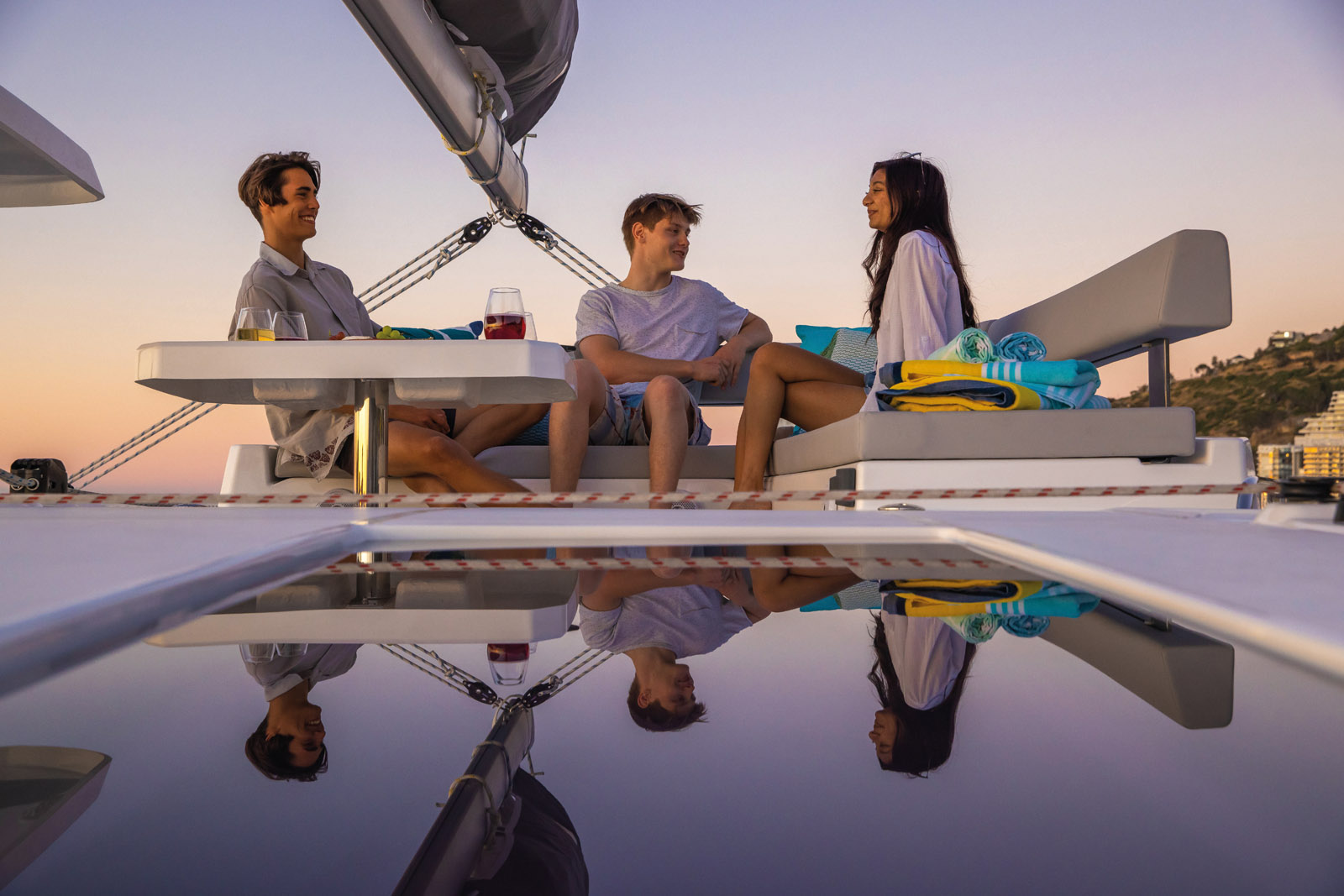
One of the great new features of the Leopard 42 is the lounge area, a perfect spot to enjoy the sunset or to chat under way without disturbing the helmsman.
Continuing towards the bows, we reach a beautiful space dedicated mainly to sunbathing with two double sunloungers. Under the mattresses there are large storage compartments, perfect for the fenders or to stow the other headsails, the genoa being installed on furler. A central cover gives access to the anchor wind-lass and, if necessary, a roller allows you to use a second anchor. Forward of the sunloungers, two trampolines complete the foredeck, while on the front of each hull, a large storage area with a translucent cover also serves as a crash box.
To reach the main deck, you can either go back to the cockpit or, more simply, use the front door. A layout that greatly facilitates circulation on board.
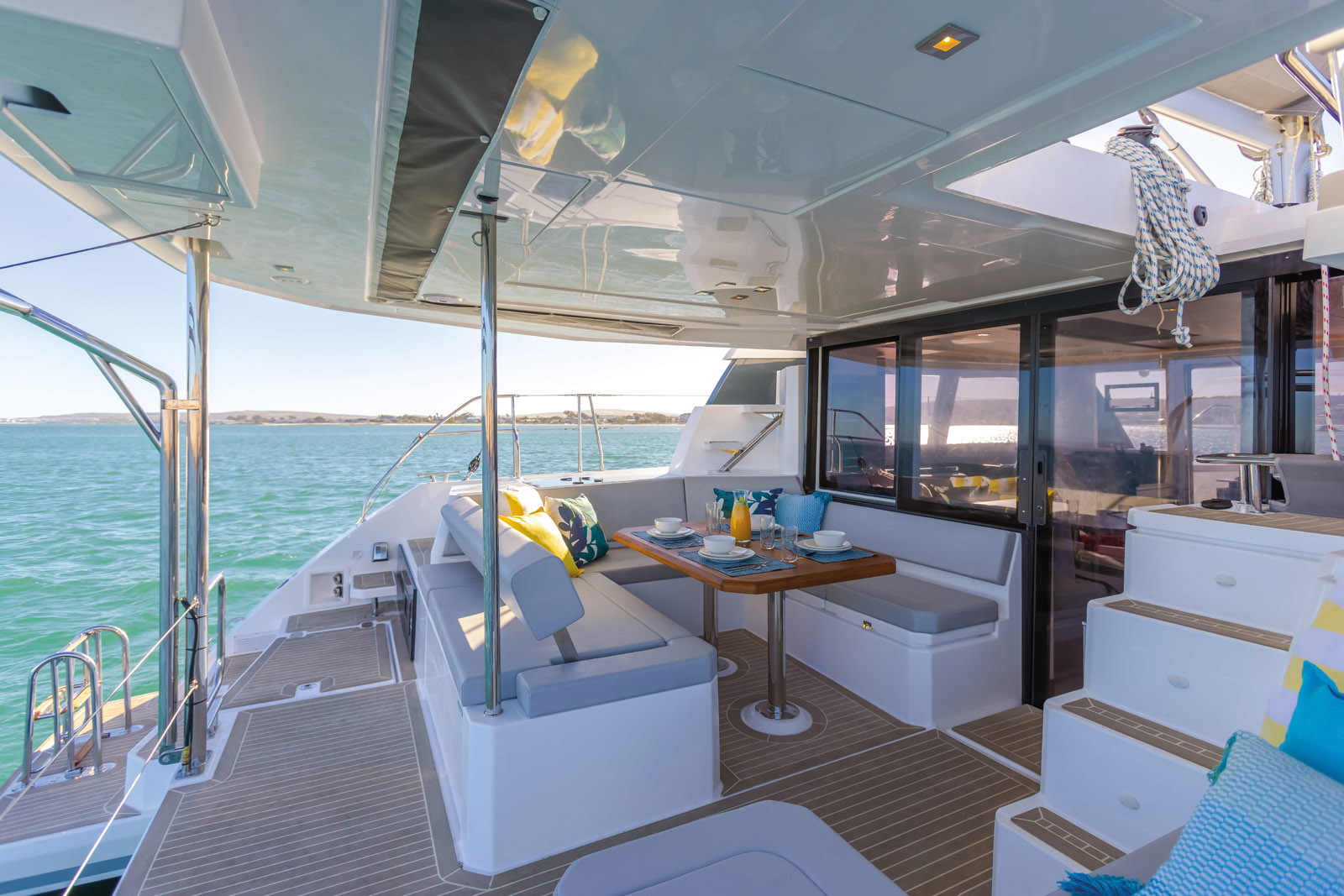
The aft cockpit is perfect for getting together with a huge table and 9 to 10 seats.
An interior bathed in light
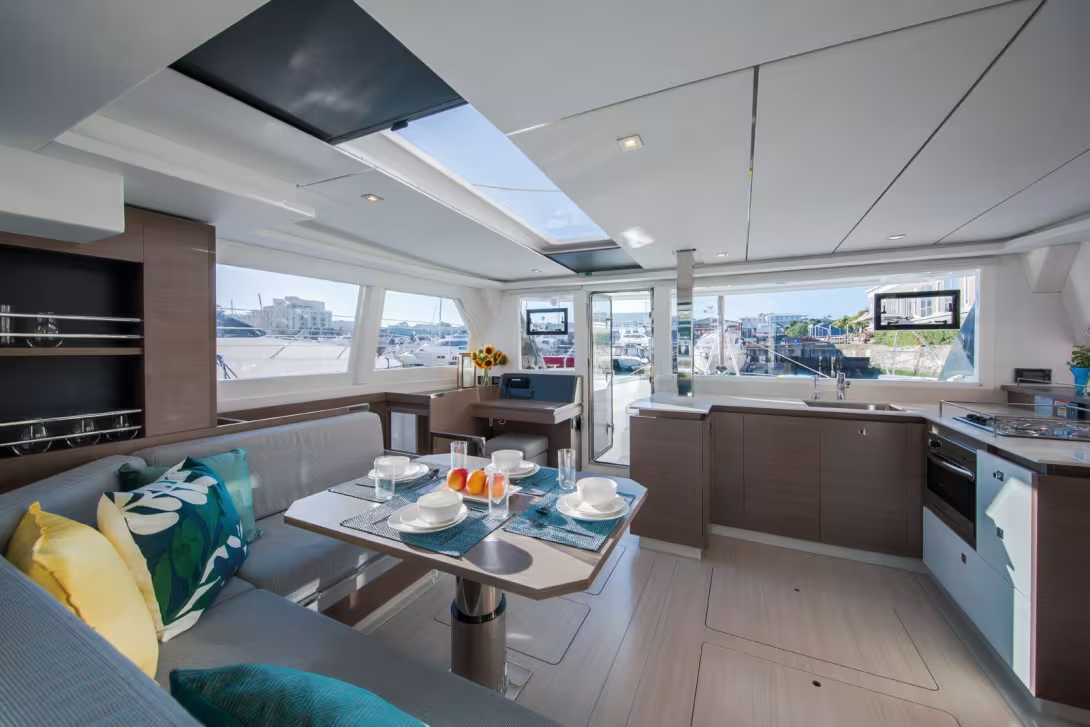
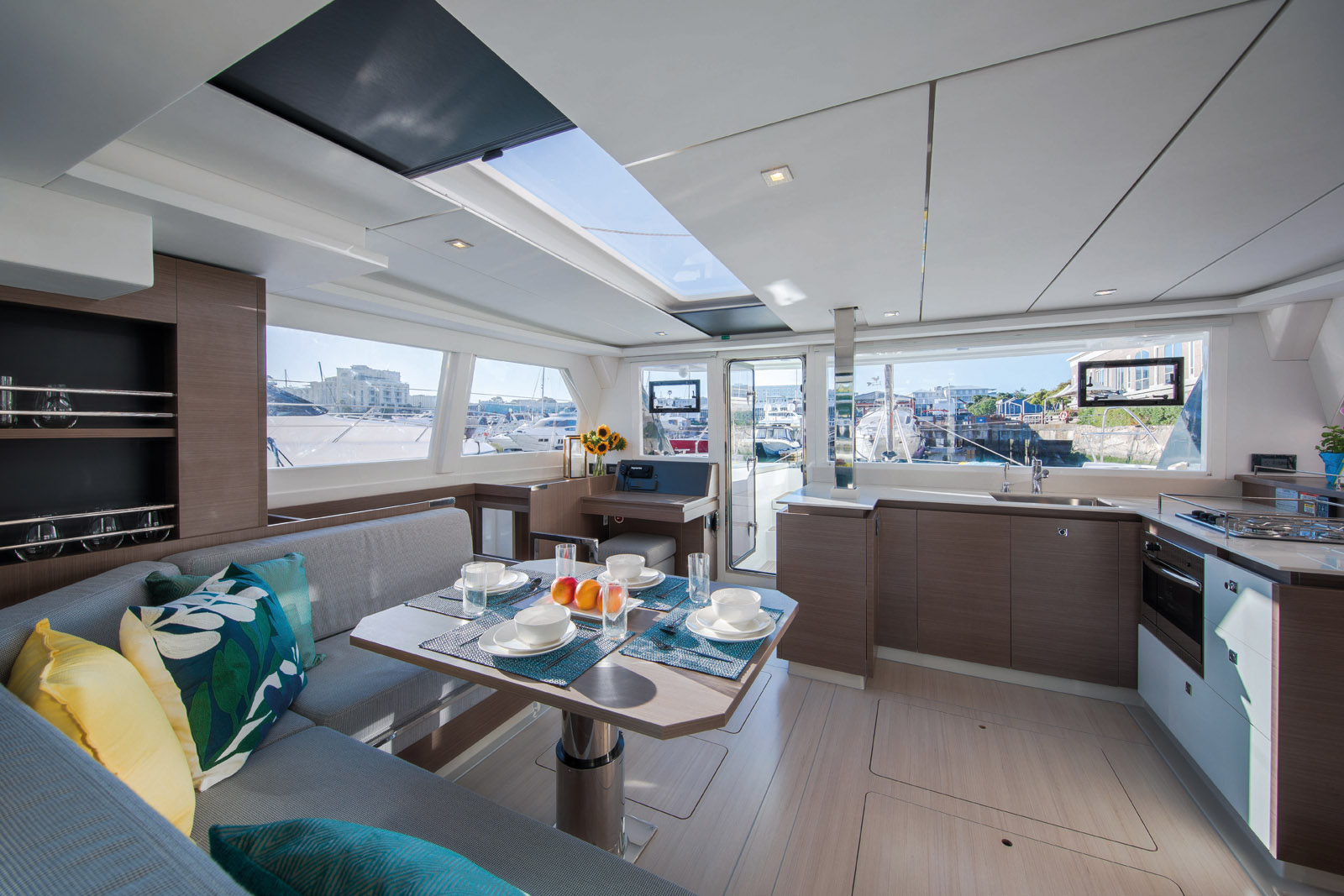
Very spacious and bathed in light, the main deck includes an L-shaped saloon for six people, a galley and a chart table - a rare feature. The table in the saloon can also be lowered to turn the whole area into an additional double berth. From almost every point in the interior, there is a 360° view, so you can make the most of the anchorages. The galley is simple but complete, with a sink, a cooktop, an oven and a large refrigerator with a freezer. To improve the interaction with the cockpit, a sliding window come in addition the rear door, a good idea.
 |
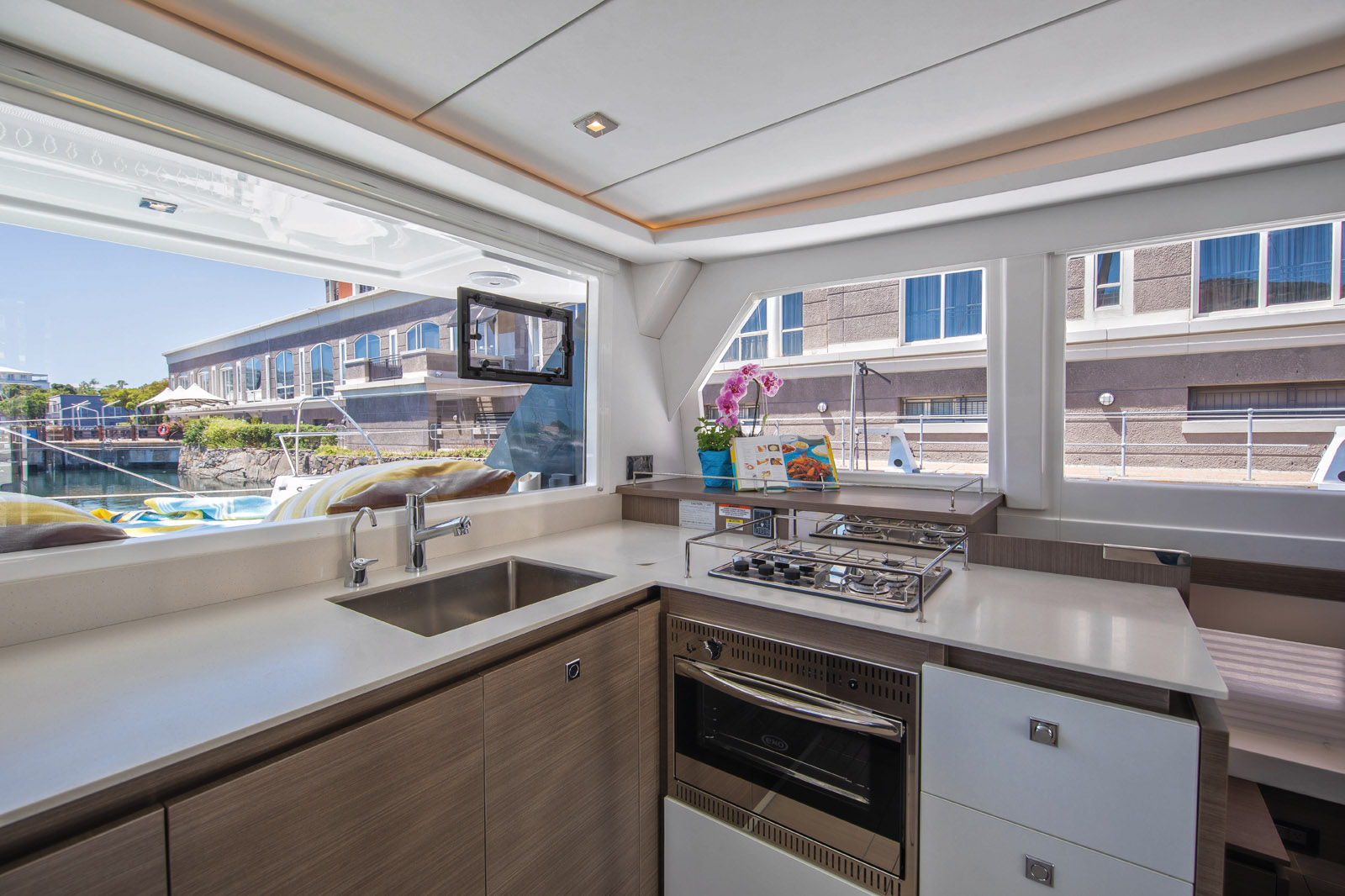 |
The main deck is relatively large and, above all, bathed in light thanks to the numerous glass surfaces. In addition to the galley, it has a comfortable L-shaped sofa that can also be used as an extra bed for two people.
The galley is simple but functional. However, to be fully equipped, you’ll need to add some options.
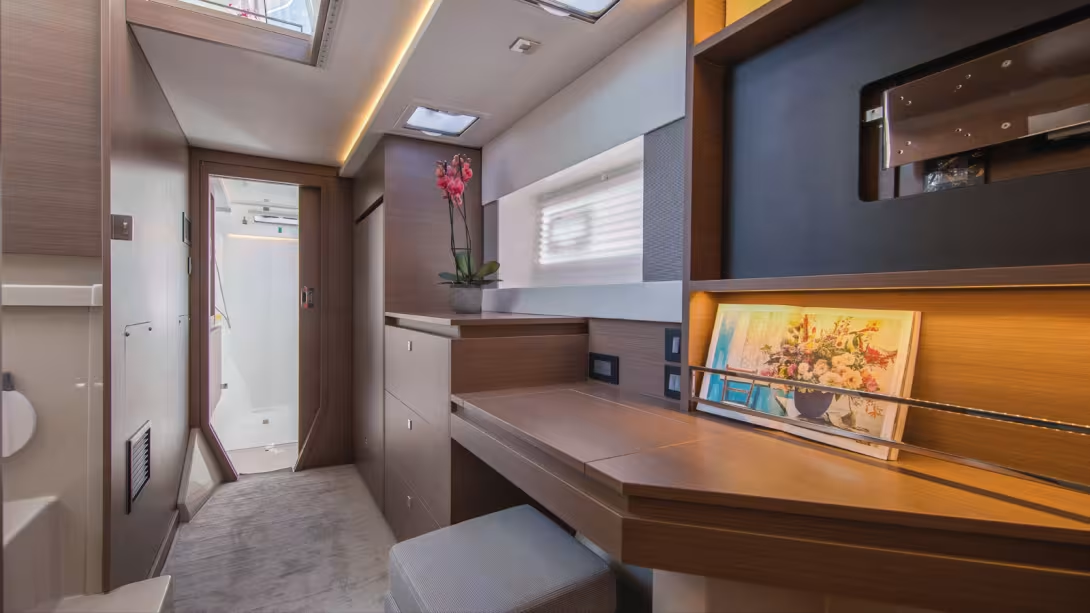
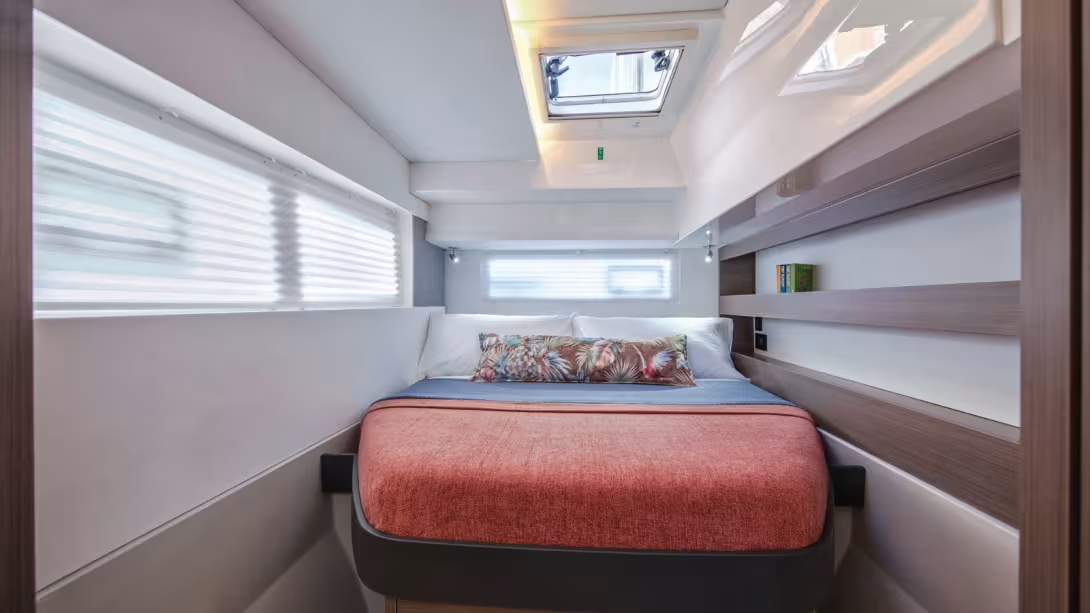
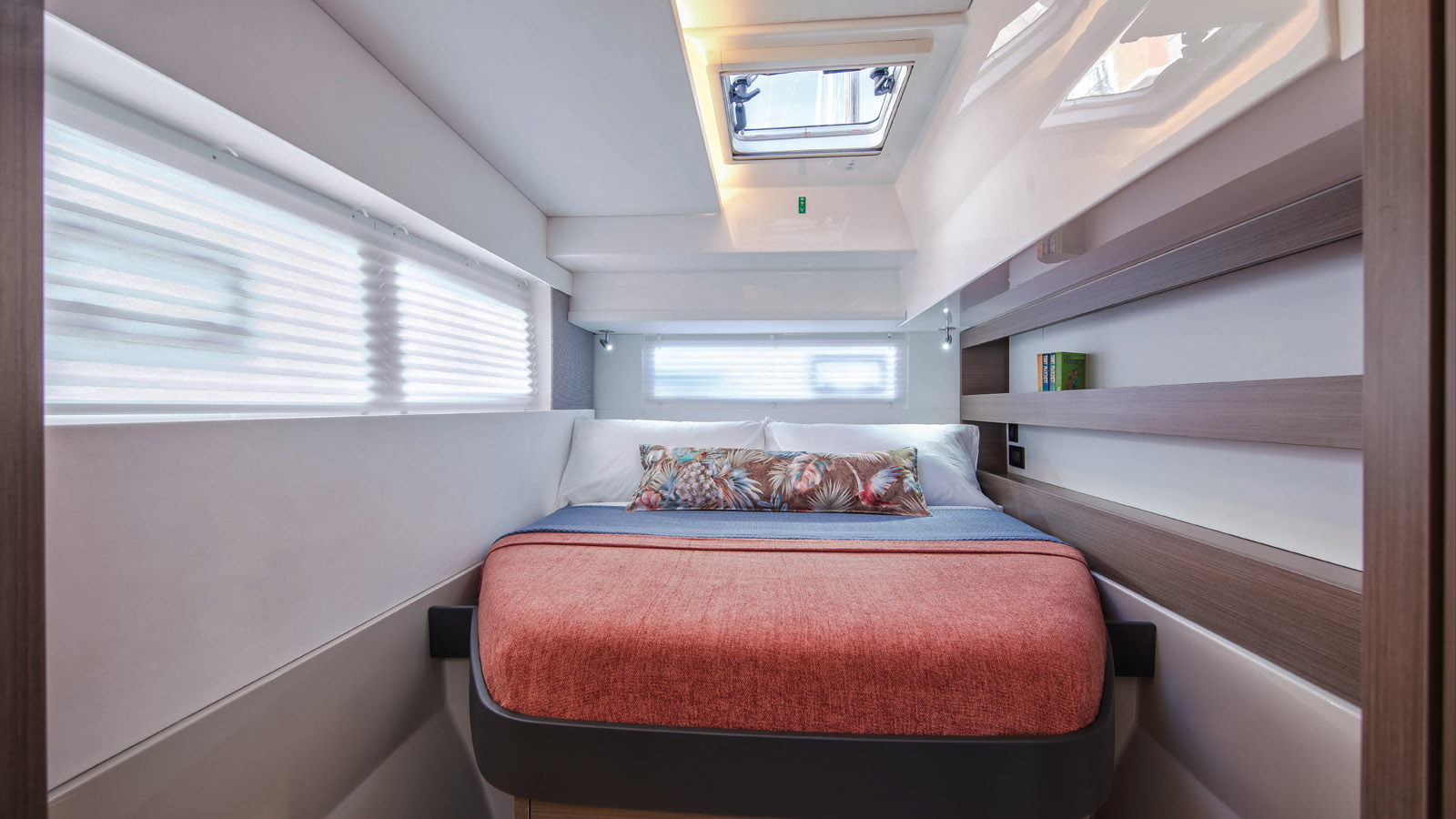
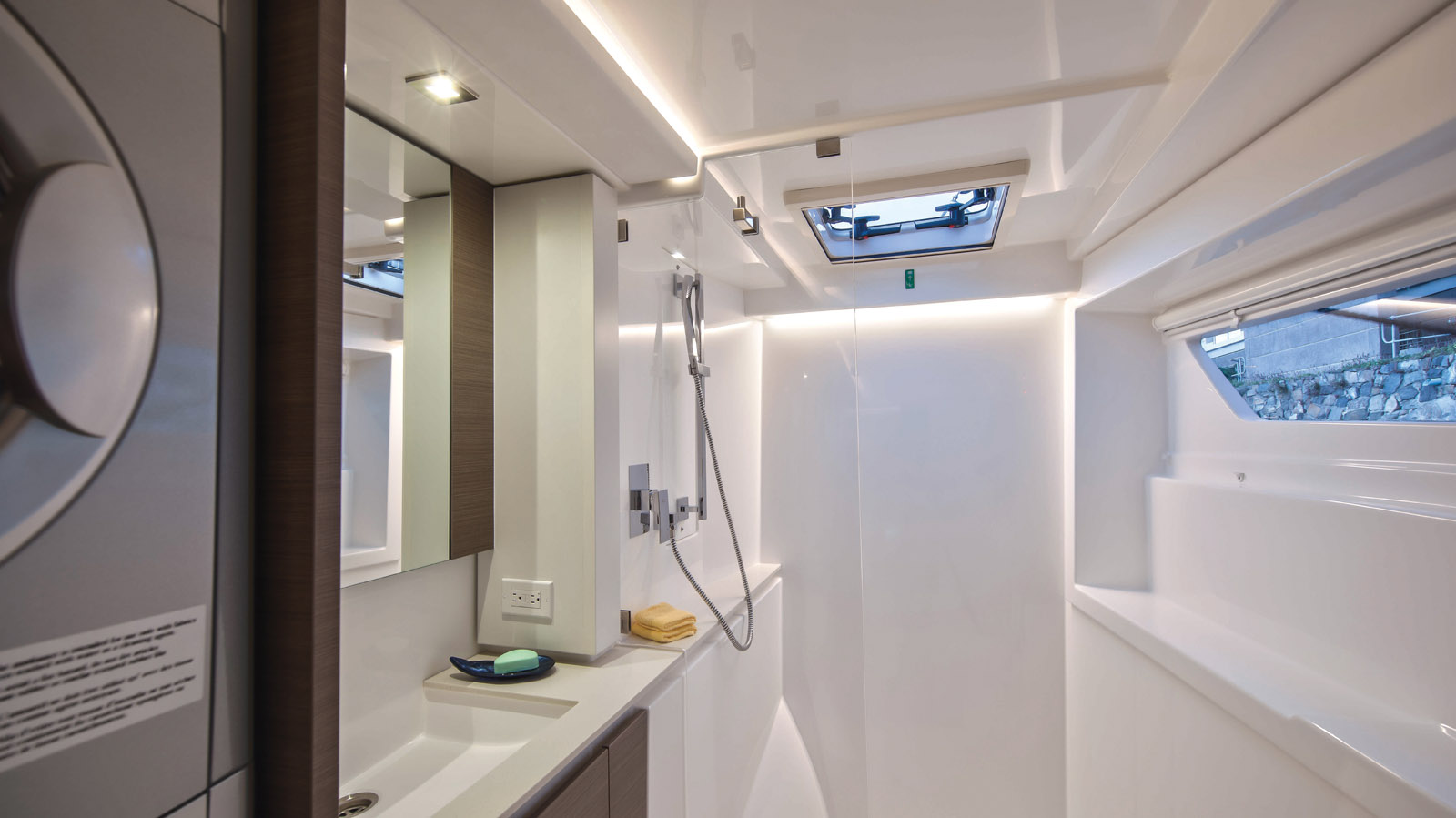
A staircase on each side gives access to the cabins, knowing that the catamaran is, of course, available in three or four cabin versions. In the three-bedroom version, the one we tried, the owner’s area occupies the entire starboard hull. This allows for a queen-size bed, a vanity/desk, a fairly spacious bathroom with sink and toilet, and even a washing machine (option). Thanks to the long portholes, this cabin is very bright and offers a breathtaking view. There are also some interesting points such as the sliding door with an integrated upper part to close the companionway completely and guarantee real privacy. Good point again for the porthole installed in the transom to bring even more light into the cabin. On the other hand, the shower is not completely closed, which is a shame. What’s more, with a 29 cm (11.4 in) step height, the staircase is a bit steep. Finally, the port hull has two cabins, each with its own bathroom, a nice touch compared to the 40, especially for chartering.
 |
 |
All the cabins have a double bed and plenty of light, thanks, for example, to the porthole located in the transom.
In three-cabin version, the owner’s cabin benefits a nice space with a double bed, a vanity/desk, a large bathroom and even a washing machine (optional)
The Leopard 42 is really designed with a seafaring spirit and offers a considerable amount of storage compartments. The shipyard takes advantage of every space in the catamaran, starting with the floor where there are lockers everywhere. When you inspect the smallest nooks and crannies of this boat, you also realize how serious the construction is. This is another detail that will please charter companies. On the other hand, in order to maintain attractive rates, the shipyard has opted for a single color of wood. Fortunately, there is a wider choice of upholstery, which offers a small degree of customization. The equipment is correct, but not excessive, including some appliances, LED lighting, USB chargers and wireless chargers for smartphones. The list of options is quite long, however, with, for example, 110/ 220 V outlets in the bathrooms, audio system, navigation electronics, solar panels, the upholstery in the lounge area and the teak finish.
Great performance under sail
To move the 14 tons of the catamaran (12,467 kg - 27,485 lbs unladen), the builder has provided an appropriated sail plan with a mainsail of 717 sq ft (66.6 m²) and a genoa of 500 sq ft (46.5 m²), giving a total sail area of 1,217 sq ft (113.10 m²) close-hauled. These characteristics, without making it a racing sailboat, offer the catamaran good performance, especially for the boat’s program, which is both family cruising and chartering oriented. In addition, the Leopard also includes a code 0 of 676 sq ft (62.8 m²) and a code D of 1,021 sq ft (94.9 m²). In the end this represents a very good starting point. If necessary, a square-topped mainsail or an asymmetrical spinnaker can be added to complete the Leopard’s starting set.
Before hoisting the sail, a glance at the helm station confirms the know-how of the brand. In addition to the fact that the area is somewhat isolated from the cockpit and the lounge area to avoid unwanted traffic bothering the helmsman, the Leopard 42 has a complete return of all halyards next to the helm (and not behind). In addition, a rope well has been installed on the left side of the helm to avoid having the lines round your legs. A bag can also be placed in this same area, allowing, for example, to easily recover an object that could fall into the well. It’s pretty clever. In front of the helmsman, the navigation instruments are easily readable, there are also two 12-volt sockets, and the engine controls, all with very good visibility. Another good point about this helm station is that it is protected by a hard-top, a good idea in tropical areas where you can be burned by the sun or showered by heavy rain. Moreover, this hardtop has a translucent section so you can look at the rig.
The day of our test from Dania Beach, just south of Fort Lauderdale, there were no tropical showers or blazing sun, but instead a strong northeast wind of around 25 knots with gusts well over 30. Conditions that did not worry the builder since this number 1 hull had already been tested in rough conditions in South Africa, just after leaving the factory. The fact remains that while the wind was easily manageable with a reef in the mainsail, the open water off Fort Lauderdale, with waves reaching 6 to 9 feet (2 to 3 meters), was really less welcoming. As for the Stranahan River, the obligatory passage facing due east to reach the Atlantic, it can even be dangerous like most of the inlets on the Florida east coast in these conditions. So, we started our test with one reef and under mainsail only, taking advantage of a milder sea in the «intercostal», fortunately not very busy at the beginning of March. From the very first leg, we were able to see that our catamaran was quite comfortable in these conditions. We started with an upwind leg on starboard tack. At 60° to the apparent wind, with 18 knots of wind, the Leopard 42 accelerated quickly until it reached almost 4 knots, and when we got out of the shelter, the anemometer went up to 22 knots, which allowed us to close the angle a little to 50°. The GPS then read 4.7 knots, which is not bad regarding the weather conditions and the small sail area. The catamaran behaved very well under the gusts, so we decided to unfurl all the genoa, this time upwind on starboard tack. We changed course to expose ourselves a little more and the wind reached 26 knots. Sailing on starboard tack, a little more exposed to the elements, at 50° from the wind, the GPS indicated 6.6 knots and by modifying a little our course to 60° from the wind, we sailed at 8.3 knots under genoa, which is really not bad. Our navigation was unfortunately a bit limited by the small body of water and by the reef in the mainsail. By using full sail, we should easily pass 9 knots on a beam reach, which allows a good cruising range. In addition to the performance, the boat is very pleasant. No squeaks or noises and a very smooth helm, even in gusts. We would have really liked to take some measurements under code 0, a sail provided in the standard version, but it was not possible. Nevertheless, in a few hours, the catamaran had already given us a good idea of its potential. To maneuver in the marina or without wind, the Leopard 42 is equipped with two 45 HP Yanmar sail drive engines coupled with two tanks receiving a total of 158 US gal (600 liters) of fuel. A drivetrain that will make it possible to face all situations and that, moreover, is rather discrete.
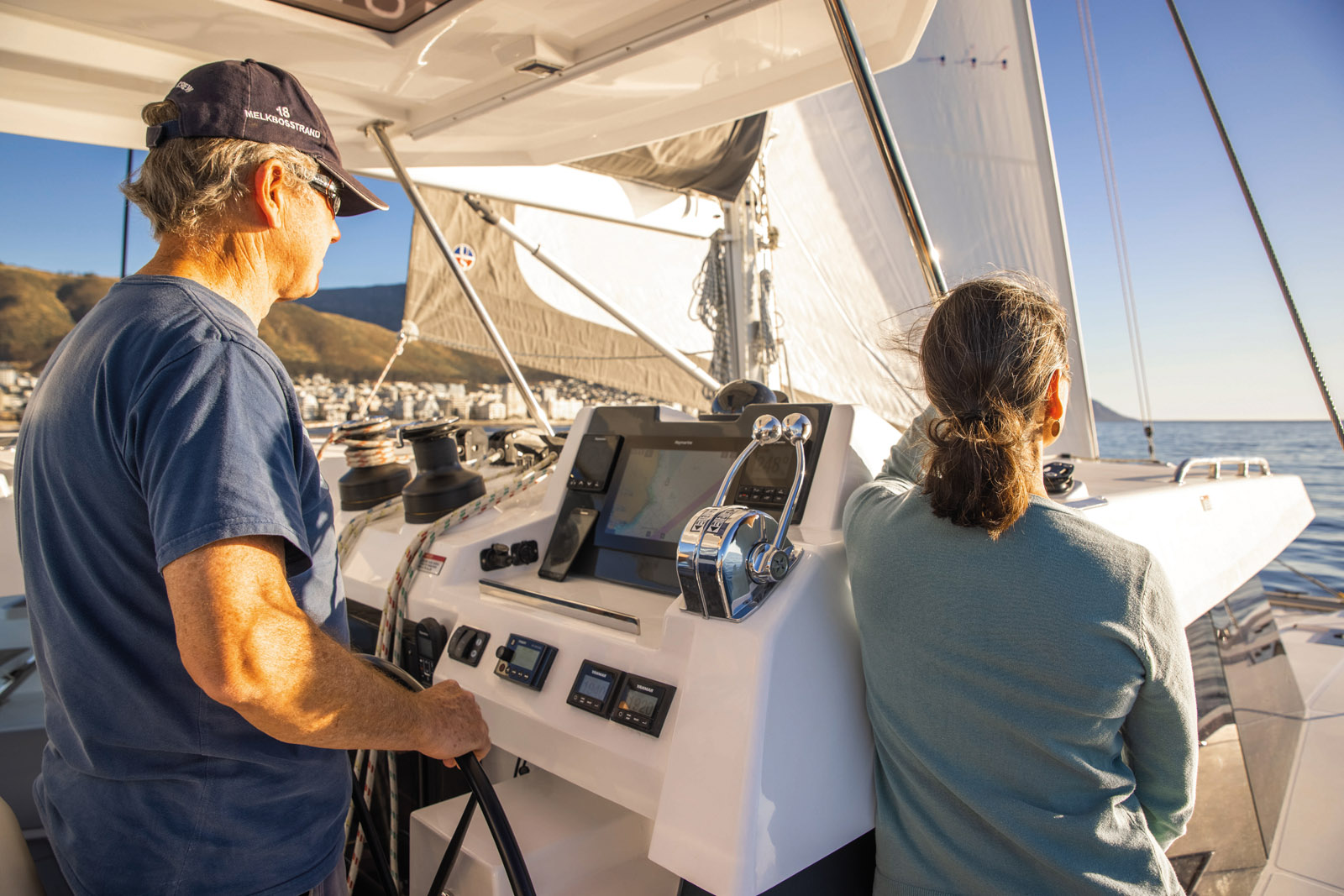
The helm station, slightly isolated, offers perfect visibility as well as protection against the rain and the sun.
Conclusion
Primarily intended for the charter market, this new catamaran also has what it takes to seduce private owners. Well built, it offers a modern decor, an interior bathed in light and convivial spaces everywhere. On top of that, the Leopard 42 is seaworthy while remaining gentle at the helm. Finally, although its price is higher than most of its direct competitors, it remains attractive in terms of the features offered. This new Leopard is a reasonable choice for those who wish to invest in a beautiful cruising unit. The catamaran will also be available for management/charter under the name Moorings 4200 and available at many of The Moorings’ charter bases.
The Pluses
Spacious Interior
Number of windows
Performance under sail
The Minuses
Stairs to access the cabins
Non-convertible lounge area
Only one color of wood available
TECHNICAL SPECIFICATIONS
Builder: Robertson & Caine
Designer: Simonis & Voogd Yacht Design
Overall length: 41’7’’ (12.67 m)
Waterline length: 40’10’’ (12.44 m)
Overall beam: 23’1’’ (7.04 m)
Draft: 4’7’’ (1.40 m)
Air draft: 67’10’’ (20.68 m)
Light displacement: 27,485 Lbs (12,467 kg)
Laden displacement: 37,849 Lbs (17,168 kg)
Berths: 8 (10 in 4 cabins version)
Fuel tank: 158 US gal (600 L)
Water tank: 174 US gal (660 L)
Black water tank: 44 US gal (166 L)
Mainsail: 717 sq ft (66.6 m²)
Genoa: 500 sq ft (46.5 m²)
Upwind sail area: 1,217 sq ft (113.1 m²)
Code O: 676 sq ft (62.8 m²)
Code D: 1,021 sq ft (94.9 m²)
Engines: 2 x 45 HP Yanmar
Price ex-tax: € 399,000 3-cabin standard version
Principal options ex-tax:
Carpet (3-cabin version): € 2,774
Fusion audio system: € 1,854
Axiom multifunctional screen: € 5,240 4 kW
Digital Radar: € 3,398
Axiom compatible fish finder: € 2,472
Raymarine AIS Transmitter: € 2,472
Shaver sockets 110/220 V (4): € 1,280
Electric winch: € 2,272
Microwave Oven: € 294 220 V
Washing machine: € 3,086 220 V
Ice-maker: € 2,626
Forward sunloungers (2): € 3,099
Asymmetrical Spinnaker: € 4,452