
With the Leopard 44', Robertson & Caine is pursuing the renewal of its range, and maintaining innovative trends to accompany its development and the distribution of its models in the northern hemisphere, by the charter giant, Sunsail-Moorings.
Infos pratiques
- Le chantier : Leopard 44
- La fiche technique
- Découvrez notre vidéo exclusive
- Financez votre Leopard 44'
- Assuez votre Leopard 44'
- Articles autour du Leopard 44'
An industrial tool and sound marketing
In the article dedicated to the test of the 39’ (Multihulls World n° 117), we told you about the impressive career of the small-scale company founded in 1991 by John Robertson and Jerry Caine. After having successfully come through the potentially insurrectionary period at the end of Apartheid, the ‘rainbow nation’s’ economic and social fabric avoided confrontation and bounced back to figure today amongst the most promising up-and-coming countries. The South African centre of the nautical industry includes many multihull builders (Scape, Dean, Admiral, African Cats, Knysna, St Francis…); this very dynamic segment is of course, for the most part building for export. Moorings’ choice of having its boats built in Cape Town, then taking shares Robertson & Caine was made under the impetus of Lex Raas (operations manager, defector from Bénéteau), who was familiar with the workings of a high-performance company set up. Lex was also familiar with the specifications of the leader in bareboat charter, as Beneteau was supplying them with monohulls, and he thus adapted his products for this very special customer. Together, these interactions allowed the South African builder to compensate for its handicap of remoteness, and rise to 3rd position in the world. Moorings and Sunsail are now part of the German Tui group, (16.5 billion euro turnover), the world no.1 in tourism (voyage-hotels-shipping)!
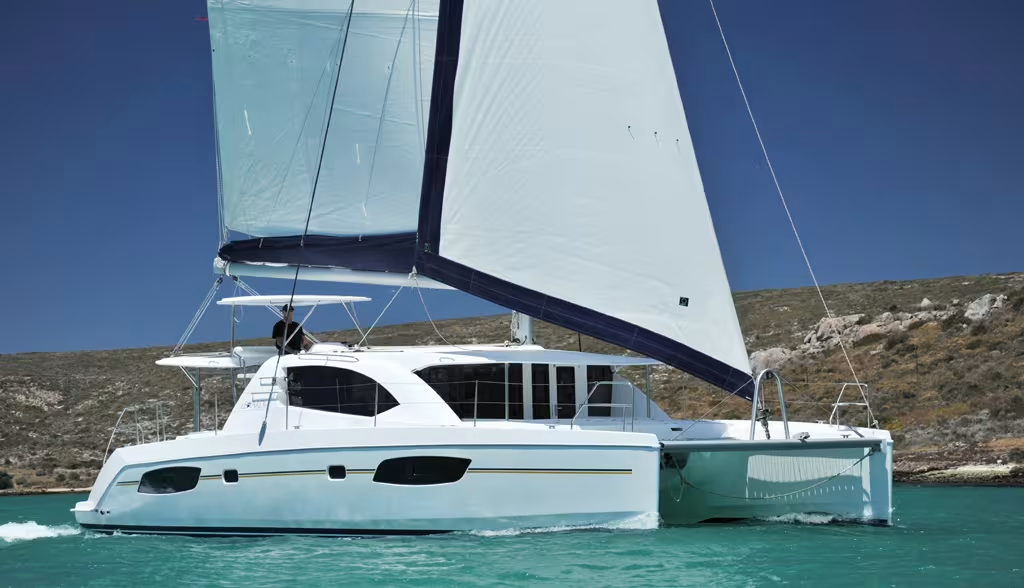
Overhung by a generous sail plan, the 44’ asserts an original silhouette…
The development of a view of catamarans; the change of architects
Alexander Simonis had been designing the Robertson & Caine fleet for almost a decade. In association with Maarten Voogd, he specialised in the design of custom mega-monohulls, of 80 to 90’, which monopolized the podiums of the classic southern hemisphere events (Nicorette I and II, Les Folies…). Influenced by the French school of cruising multihulls, and wanting to renew its image, the Cape Town builder and its American partner selected, in 2000, a designer who was in the spotlight in the prestigious international arena of ‘no limits’: Gino Morelli (associated with Pete Melvin on the Playstation project, for Steve Fossett’s round-the-world trip).
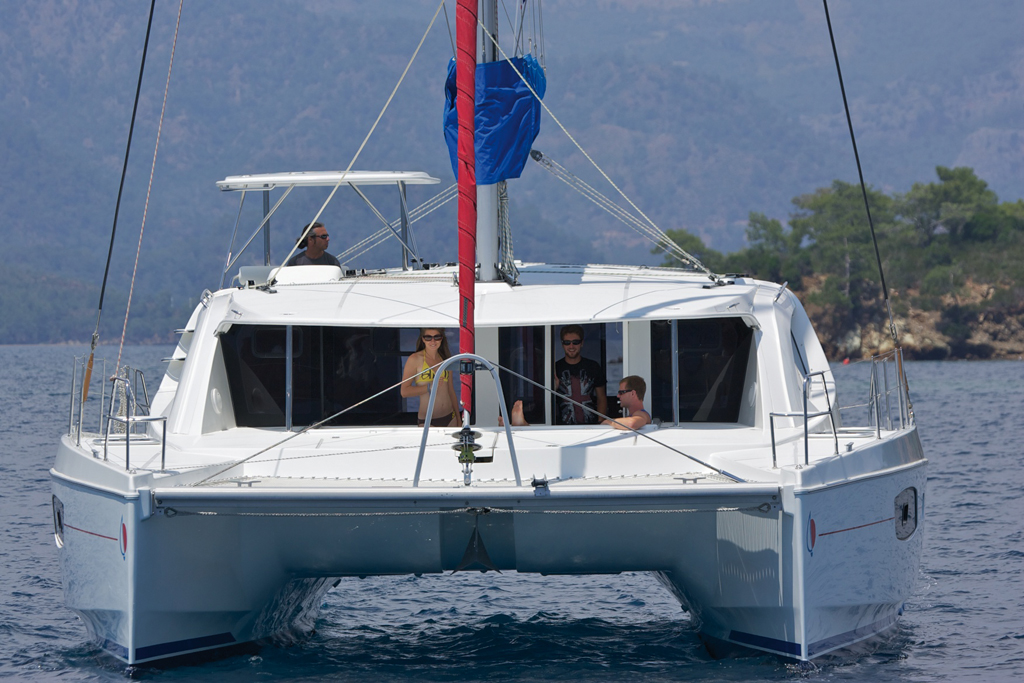
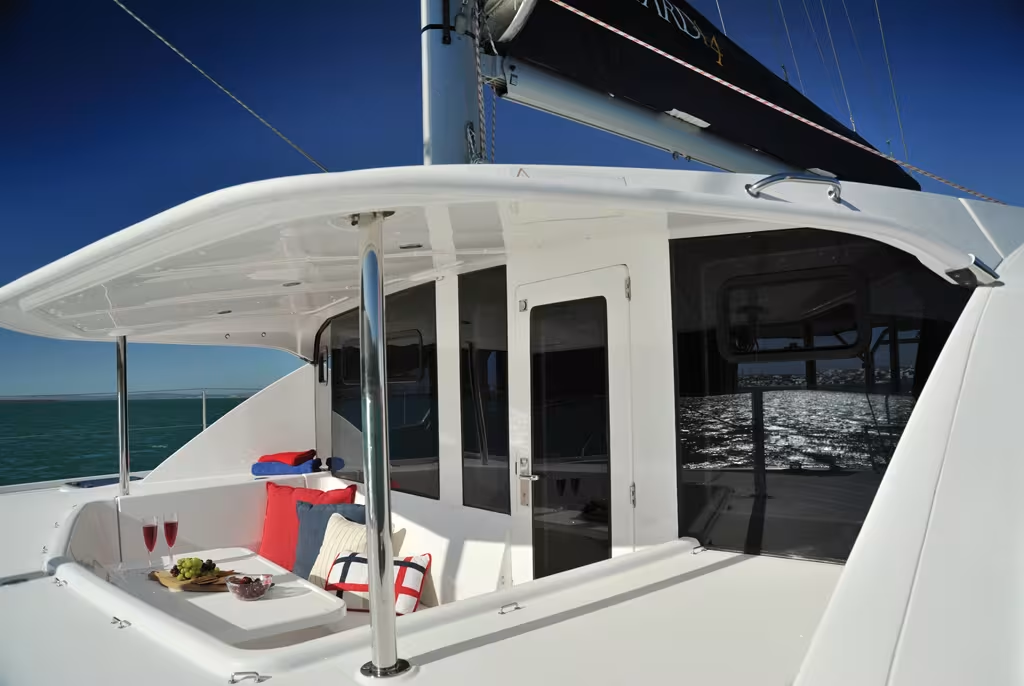
Both at sea and at anchor, the forward cockpit is the place to be!
Second wind
The 40' (also called the Moorings 4000), designed by the digital pencil of the Californian international office, and presented in 2004 at the Grand Pavois in La Rochelle, showed the new direction. The Newport Beach duo was familiar with de-centering strategies, and was used to working from a distance with operators in far-away set-ups (China, New Zealand, Mexico). After the 46’ and the 39’, the 44’ was tested in the charter bases during the 2011 season.
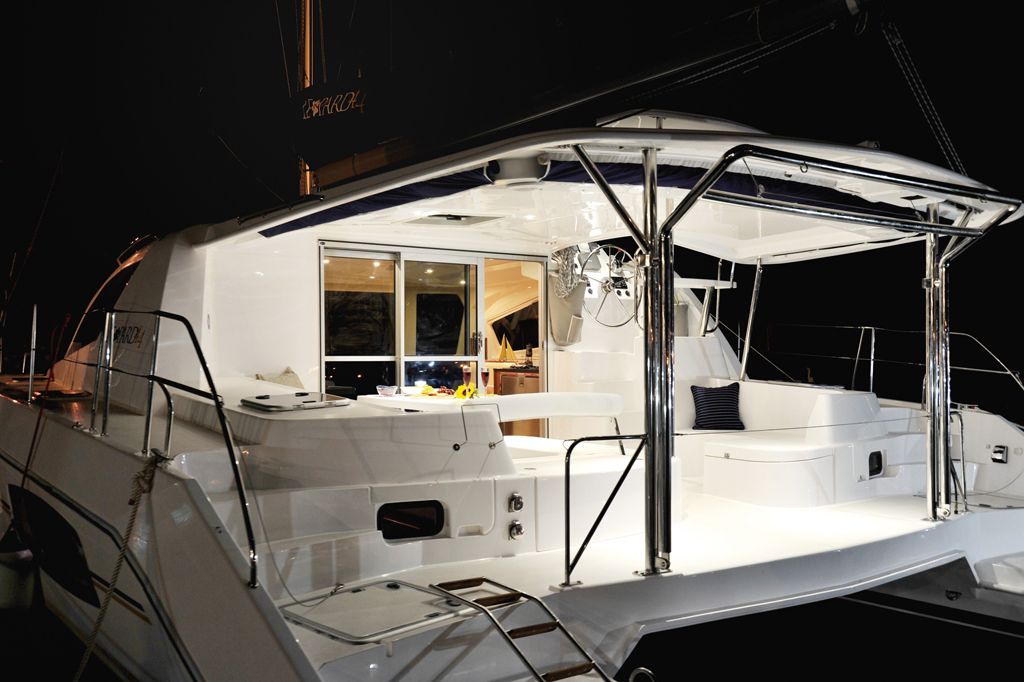
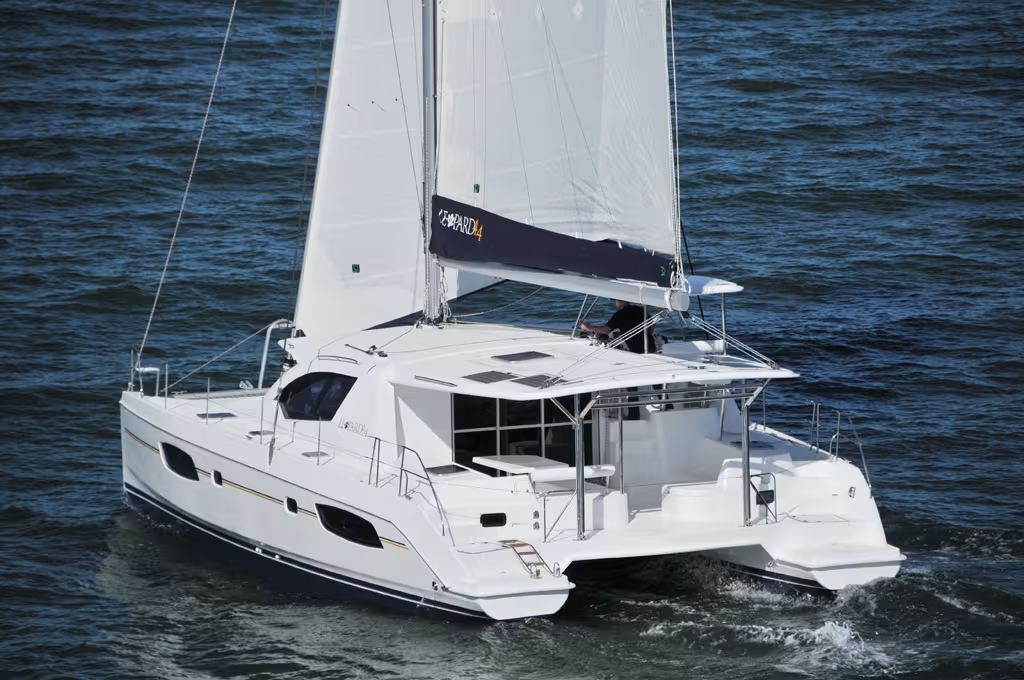
Well protected by the rigid bimini, the aft cockpit is a model of its kind.
Looking for lost space
The Californian associates had already thrown a first pebble into the water, by fitting a mastfoot cockpit to the Gunboat platforms (initially built in South Africa!); here they re-cycled a part of this idea, giving it different aims. At the price of architectural constraints, which they overcame (indentation in the structural front face); Gino and Pete transformed the cruising catamaran’s ergonomics, by opening up the forward area. The expected benefits were huge! They created a second cockpit, and air-conditioned the boat in tropical anchorages. A hard top over this new oceanic balcony opened up an unusual view point, perfectly suited to conviviality in the cruising areas aimed at. During our sail (February 2012, in the Mediterranean), we didn’t really take advantage of this nautical patio, but it is easy to imagine its use during holiday wanderings. The serious way the R & D department has tackled the question of the strength of the perspex panels, and the closing system for the communicating door, leaves no lingering doubts about the concept’s reliability. A cover is available for inopportune conditions, or over-wintering; oversized drain scuppers have been provided. Our test 44’ had suffered the assaults of the sea during its 8,000-mile delivery trip from Cape Town to Nice, with no damage.
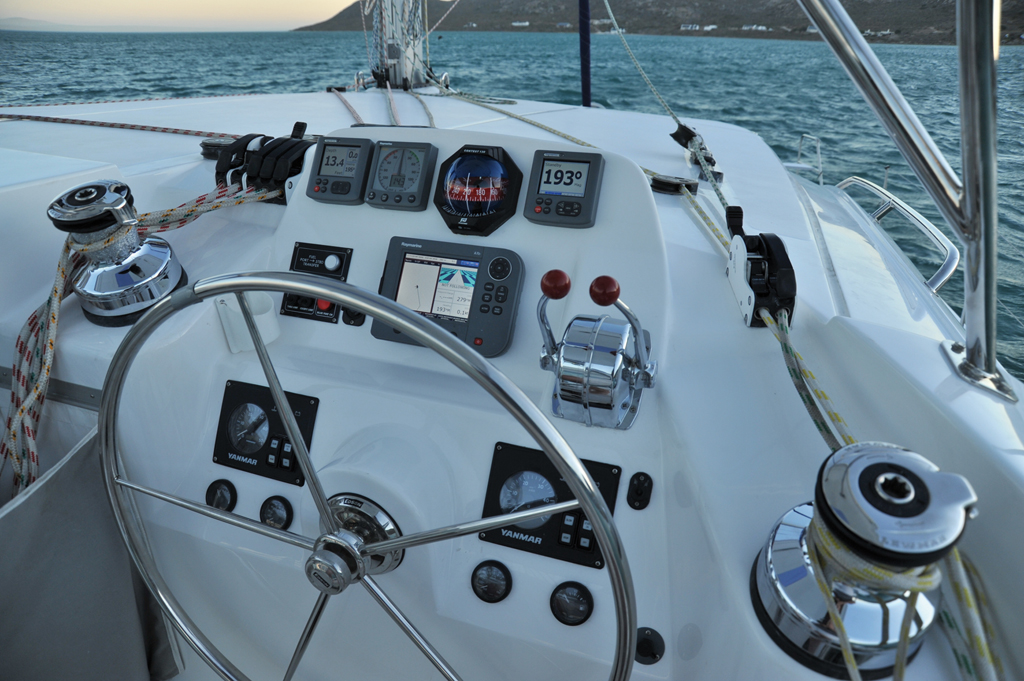
A functional, pleasant steering position, equipped with remarkable rope tidies
Accommodation following contemporary trends
The private owner’s version made available to us revealed a really appealing style of furnishing, which left no hint of its initial charter-management vocation. Care has been taken with the woodwork; the soft colours of the species chosen contribute to the overall warm, functional atmosphere. The numerous black Corian surfaces rationalise maintenance and encourage good ageing in the heavily used areas; they are also pleasing to the eye. The chart table has disappeared, paper charts can be used in the saloon, although they have nowadays been superseded by the laptop. The galley, with double sinks, is equipped with a Force 10 cooker/oven (superb standard equipment), and a two-drawer stainless steel refrigerator with a large capacity, which will allow the cook to plan ahead! The starboard hull is up to usual standards, with a big, easily-accessible bed, a sofa and a desk. The bathroom is voluminous, and ergonomically pertinent. The carefully constructed interior mouldings look very good and again rationalise maintenance. The laminated floors are hard-wearing and of good quality. Large openings in the floors give access to a network of labelled and easily understandable seacocks. The port hull houses two nice cabins with independent shower-toilets. The skylight cut-outs are effective and elegant (Catana initiated this solution, which was at first questioned, then heartily approved of, with the 471). The ventilation calls on a battery of hatches and fans (optional), which will guarantee remarkable overall comfort without the assistance of air-conditioning.
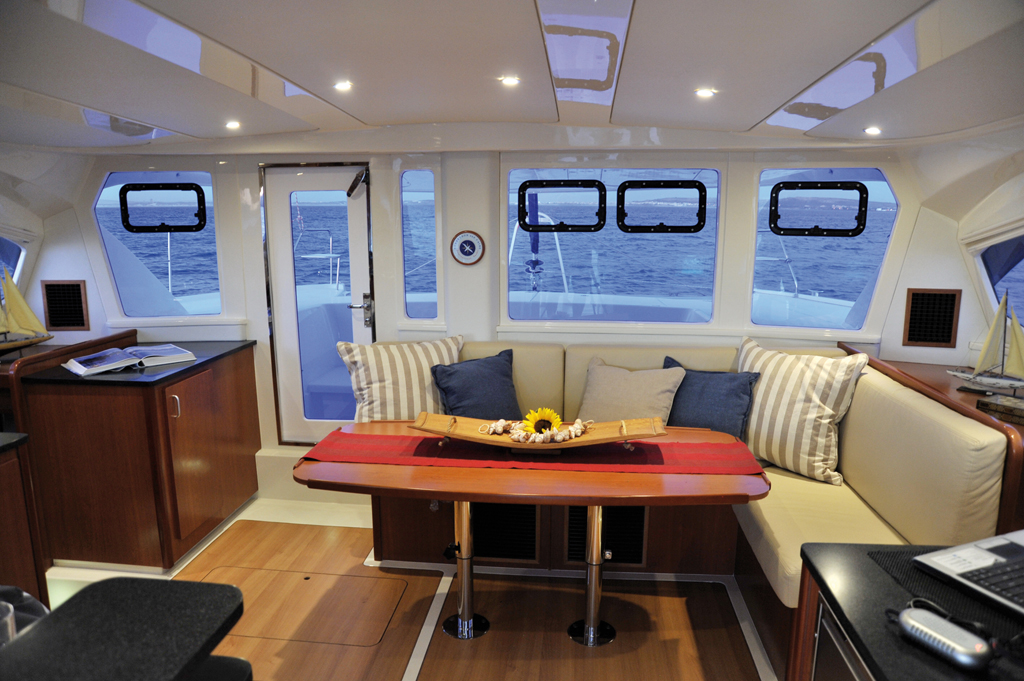
The interior atmosphere is appealing, with an uninterrupted view over the lagoon...
Construction and architecture
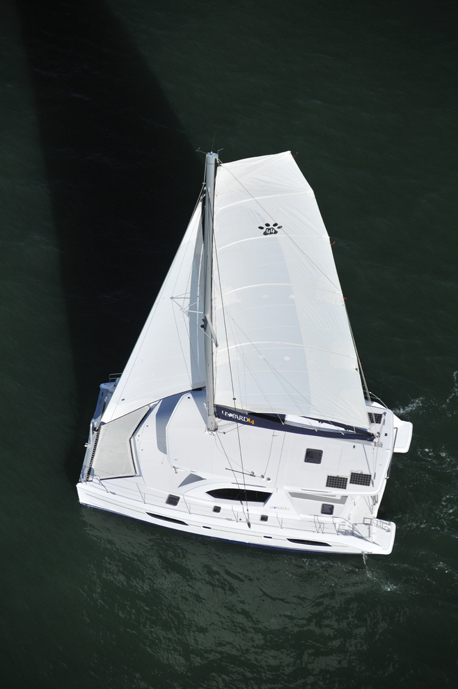
Robertson & Caine boats have the reputation of being strong; the construction process in a balsa/glass/vinylester sandwich, under vacuum, with contact lamination, is generously dimensioned. The use of an end grain balsa core is perfectly justifiable (Lagoon also use it). The builder insists on retaining the sandwich below the waterline, except in the reserved areas around the rudders, the keels and the seacocks… This will not give any particular problems when chocked ashore, just like a lifting keel boat, but we would nevertheless like to see an epoxy treatment offered. Overhung by a square-headed mainsail, and standing firmly on its two pretty, longitudinally-stepped hulls, the Léopard 44’s silhouette under sail is completely coherent. The view from dead ahead however is less favourable; the ‘glazed’ area becomes prominent.
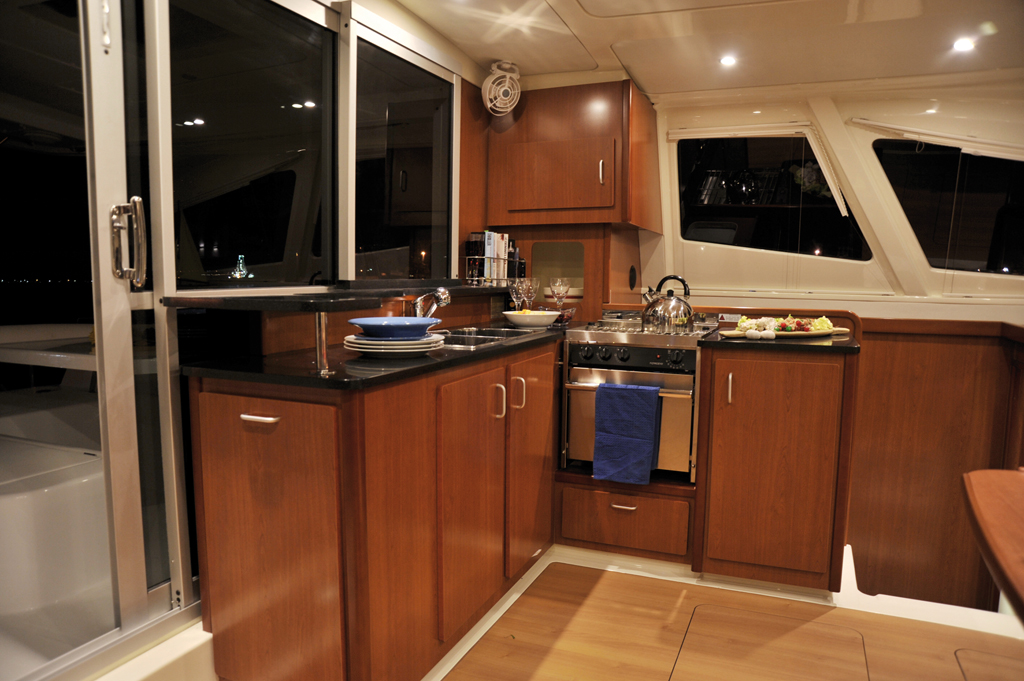
The finishing is high quality, and the particularly comprehensive galley will delight the cook.
A Léopard in a strong wind
Boat tests in winter allow us to escape congestion on the water and often offer a dynamic playground well suited to a more immediate discovery of the candidate’s seakeeping qualities. After close observation of the weather conditions, we reached the area we were aiming for after a good hour under power, fighting against a short, forbidding swell originating from a strong north-north-easterly gale blowing out at sea (the ‘vein’ of wind was in the wind corridor between Italy and Corsica, perfectly identified). Entering the ‘stadium’, 7.8 miles off Nice, we were all impatient to discover the behaviour of the generous 44-footer and observe its reactions in the steady 20, 22, then 25 knots of breeze. The sea was quite heavy, streaked with white crests. The copiously-canvassed catamaran made light of it, at 8.5 knots over the ground and 55° to the apparent wind. Granted, this angle is more like a close reach, but progress was fast and the point of sailing rather comfortable considering the sea conditions; this kind of VMG suits crews...and boats on the open sea. The nacelle passes well; the boat can be luffed on demand. This kind of ease surprised me, shedding doubts on my a priori linked to the corpulence of the forward side of the coachroof and a potentially handicapping CX. Once again, we know nothing about a boat until we have tested it at sea! Next, in a beam wind, the 44’ sped along on a relief which was now rougher, without showing any tendency to wallow to leeward or roll, despite admittedly being over-canvassed. The absence of traveller is not a problem in itself; it obliges the crew to adjust each tackle, which is an incentive to choose a 3rd electric winch. Using the 2nd one (the one for the reef pendants, also optional) is possible; I tried it and it worked well, but limits the speed of reaction. If I had to choose, I would give priority to the mainsail equipment, even if it meant leaving the pendants on a manual winch. Under full mainsail in this kind of weather, the Léopard 44 behaves reassuringly; the mainsail must imperatively be opened wide before bearing away, otherwise the catamaran will refuse to accompany the movement. The owner’s manual recommends taking in the first reef below 20 knots; it’s right! The deck plan is pleasant to use; its ergonomics grouped at the navstation imply the use of assisted winches. Downwind, the 44’ lengthens its step, at 9, 10 and sometimes 12 knots; the waves were not quite high enough to get the boat surfing. Hand steering is precise, and even enjoyable, thanks to the line and rod steering system. The automatic reefing (we reefed once, just for the exercise) is child’s play, but the builder should modify the gooseneck’s cross bolt, to avoid chafing the outer sheath of the pendant.
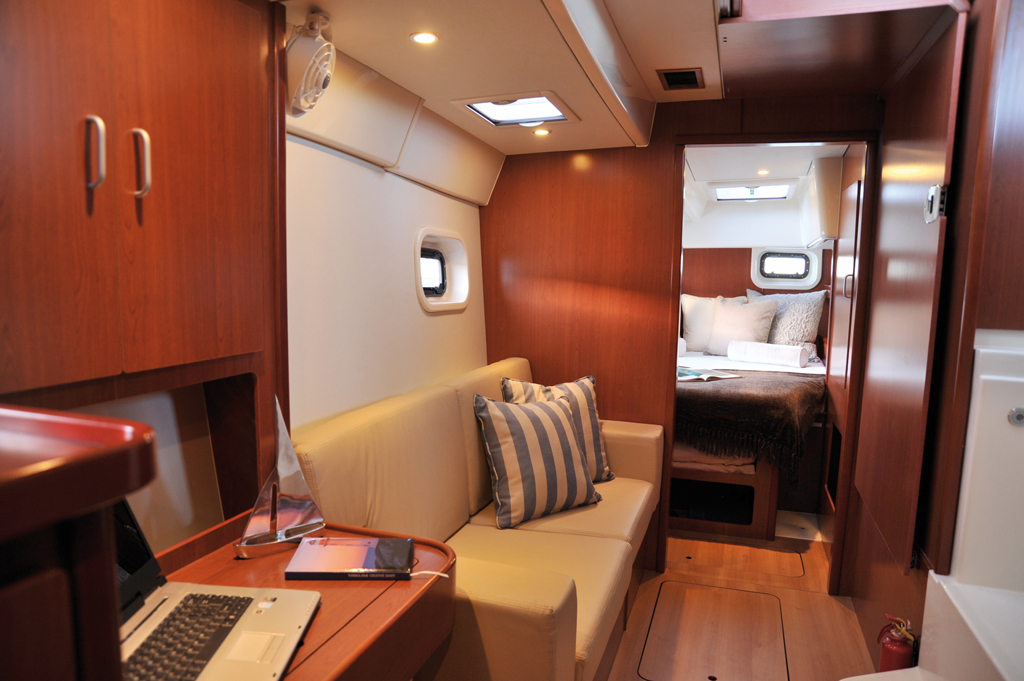
In the hulls, we find nice cabins and a tastefully fitted-out owner’s hull…
CONCLUSION
The 44' is not as lively as the 39’, to which it is close in spirit (although proportionally wider), but this hang-up free platform’s seakeeping qualities are good. It is an easy to use, strong, well-equipped catamaran; it is not over-engined, and the 39hp option is essential. Its size, its balance and its coherence mean it is not limited to charter use.
TECHNICAL SPECIFICATIONS
Architect: Morelli-Melvin Builder: Robertson and Caine (South Africa) Length: 12.98m Beam: 7.25m Draft, half-laden: 1.30m Bridgedeck height, half-laden: 0.71m Unladen displacement: 12.6t Mainsail area: 74m² Roller jib: 44m² Asymmetric spinnaker: 130m² Engines: 2 x 30hp/2x39 as an option Transmission: Saildrives Propellers: fixed, three-bladed or folding twin-bladed Gori propellers with the 39hp option Water capacity: 780l Diesel: 700l Basic price, exc. VAT: 335,000 euros Main options: 39hp engines with folding propellers: 7,500 euros Raymarine electronics pack, with autopilot: 9,600 euros Essential electrical pack: 4,000 euros (110 or 220 v) Victron 100A charger-inverter: 3,000 euros Two 70-watt solar panels on the bimini: 2,700 euros Spectra 12V/7Ol/h watermaker: 15,000 euros Bowsprit/Code 0/furler: 7,200 euros Extra for square-headed mainsail: 500 euros Delivery to Cape Town and export: 10,700 euros Delivery to Annapolis (USA) or La Rochelle (France): 20,000 euros
The competitors
Model Builder Windward sail area in m² Unladen weight in t Price, exc. VAT in euros ORANA 44’ Fountaine-Pajot 110 8 339,000 LAGOON 450 Lagoon 132 15 360,000 NAUTITECH 441 Nautitech 100 9,2 400,000
THE PLUSSES:
- Build quality - Charter management environment - The concept’s conviviality
THE MINUSES:
- Access to the coachroof - Non-consensual silhouette - Absence of electric mainsheet winch as standard
