
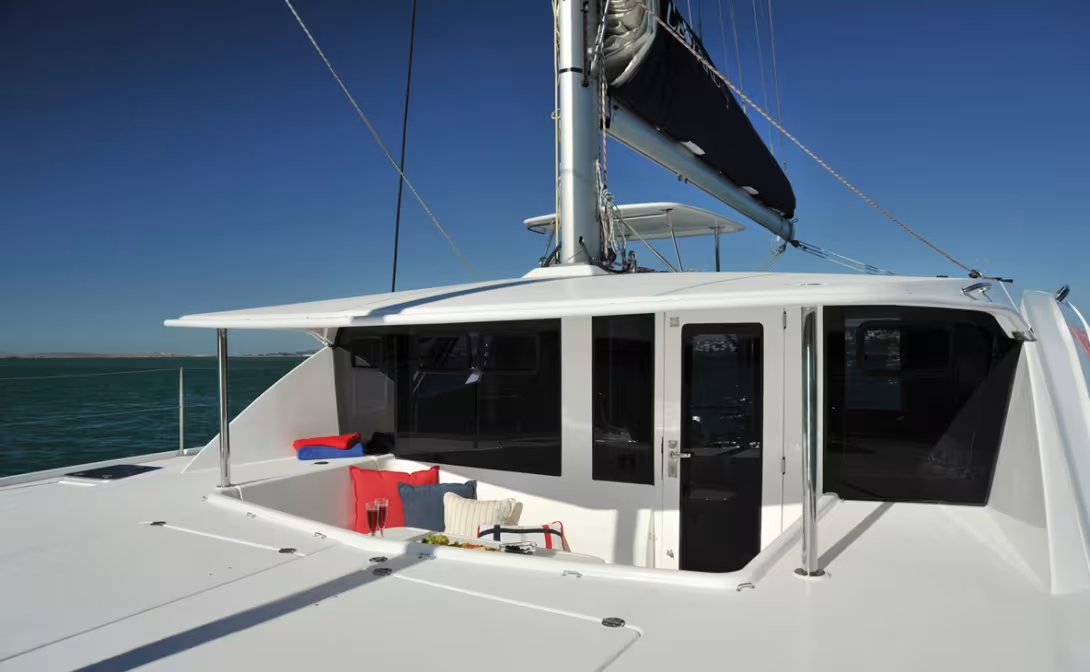
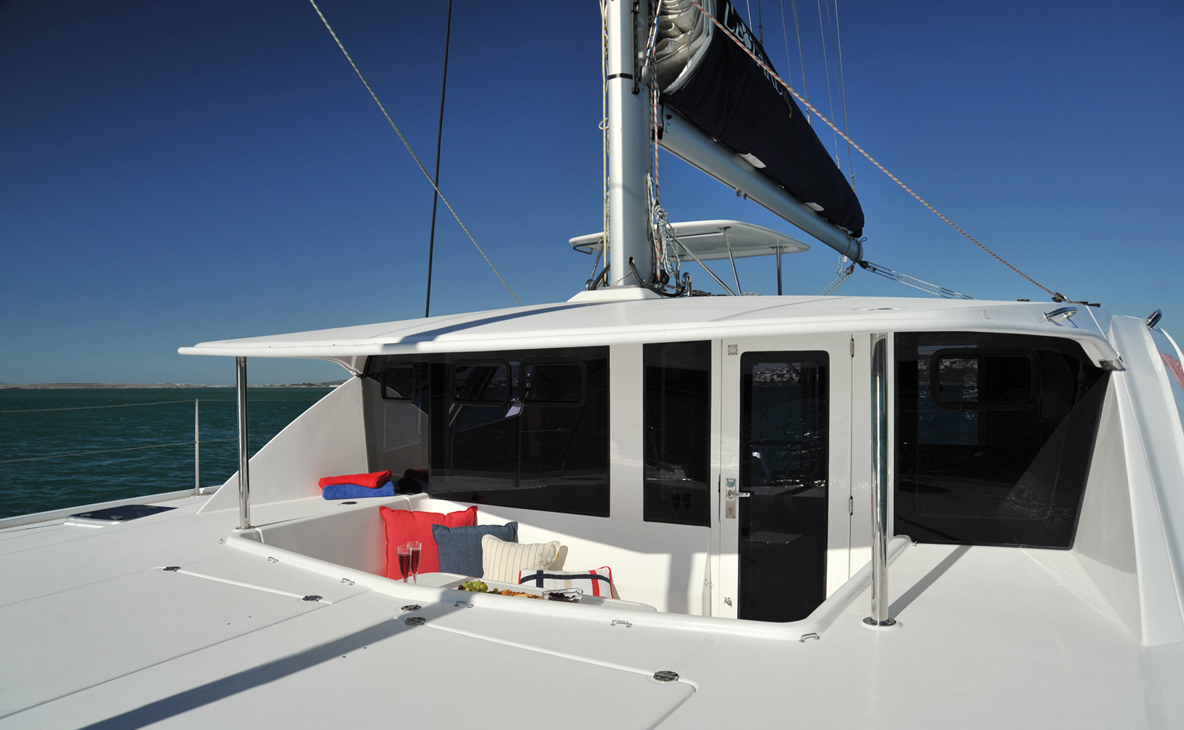
Catamaran builders had got us used to the idea of a forward cockpit... accessible from on deck. With the Leopard 44, a Robertson & Caine design, there is access through from inside the saloon. This new configuration left no-one indifferent, and it has since become a feature on all the yard’s models.
Infos pratiques
- Le chantier : Leopard 44
- La fiche technique
- Découvrez notre vidéo exclusive
- Financez votre Leopard 44
- Assuez votre Leopard 44
- Articles autour du Leopard 44
Robertson & Caine is a yard like no other. The largest manufacturer in South Africa, established in 1991, first produced custom-made sailboats from 36 to 70 feet before signing an exclusive partnership agreement with The Moorings - today part of same group as Sunsail. Since then, they have offered catamarans under the Leopard brand that correspond very precisely to the requirements of the charterer. Early on, the focus was on sturdiness - when you are bringing cats from Cape Town, this is a good idea! Other priorities were ease of use and optimization of maintenance operations, not to mention performance. But Leopard did not content themselves with being just "charter cats". They are also true owner’s catamarans and have brought real innovations, like the famous forward cockpit, accessible from the nacelle. Quite a story! When this famous “front door” was first presented in 2010 on the Leopard 44 (the model replaced by the 45 a year ago), competitors and skeptics of all kinds hastened to knock the idea. The risk? Taking a big wave over the bows that would explode everything... This is a fear that makes the yard managers smile. With their previous 700 catamarans equipped with a front door, they note that no problems have ever been reported at sea, and that the required standard for evacuating water from the forward cockpit - 90% of volume in 5 minutes - was pushed to 100% in less than a minute. As for the door itself, it is semi-reinforced and waterproof. Serious stuff! Note that this front door is not just exclusive to Leopard: the SC48 built by Garcia and designed by Pierre Delion also adopts a forward opening. In addition to the forward cockpit, the new trend at Leopard is to attract private buyers. In recent years, versions drawn with a dedicated owner’s hull have been designed and offered. And not without success: today they represent a third of all sales!
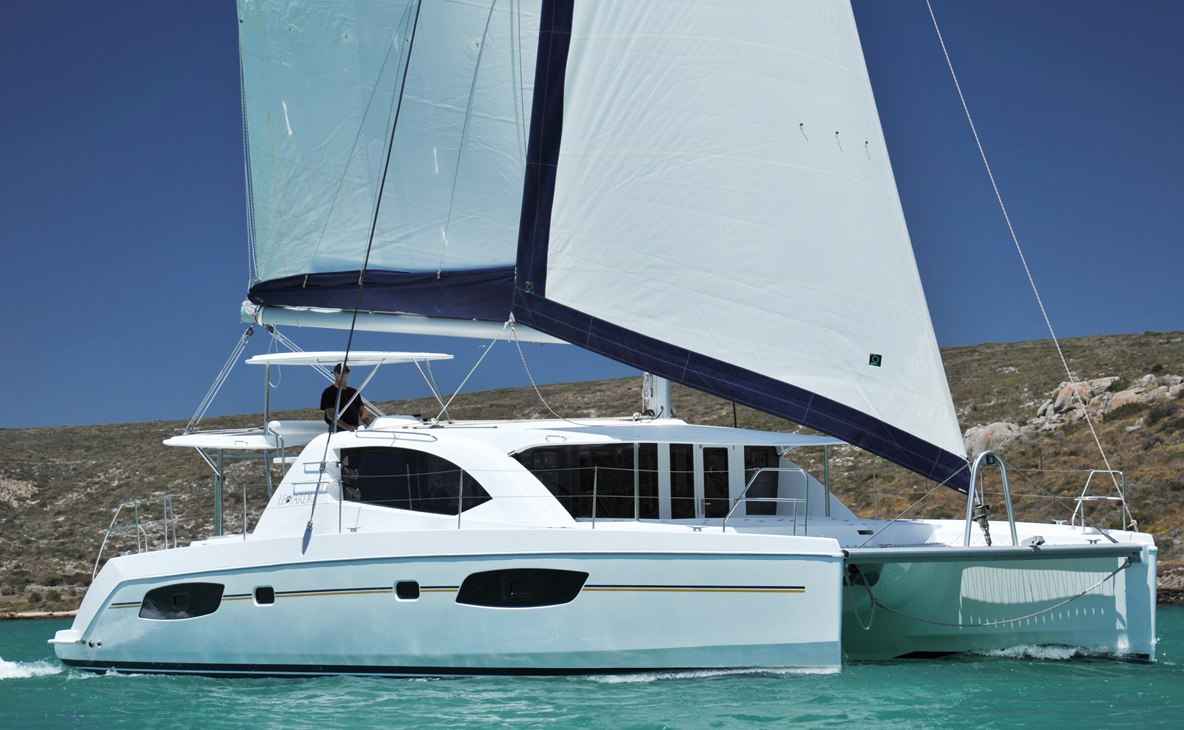
Pronounced steps in the hulls offer a good performance / comfort compromise
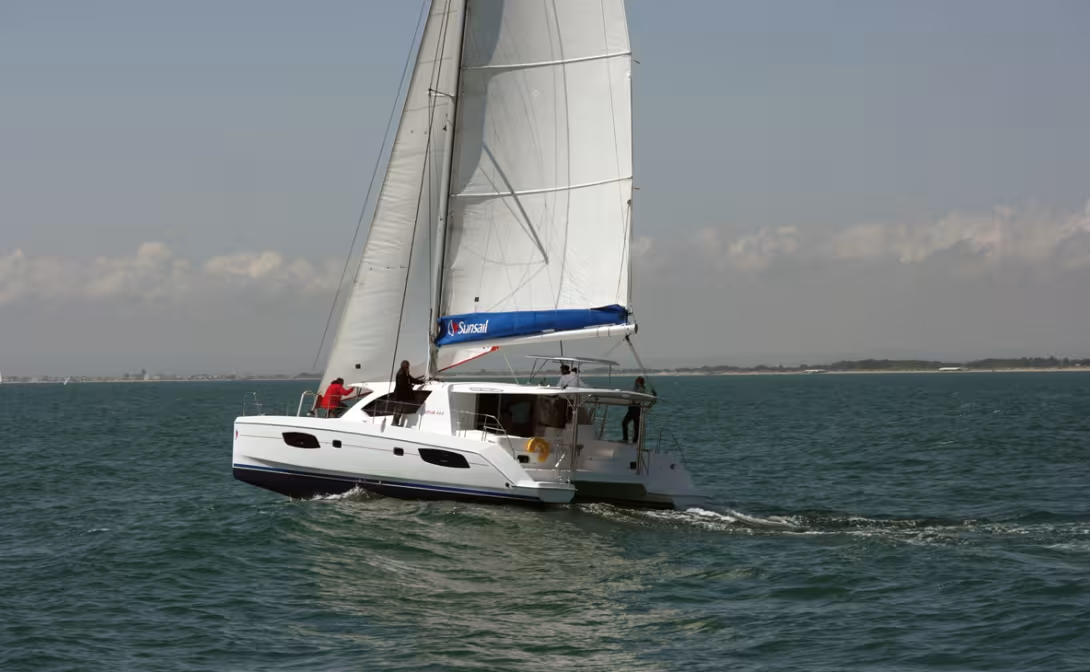
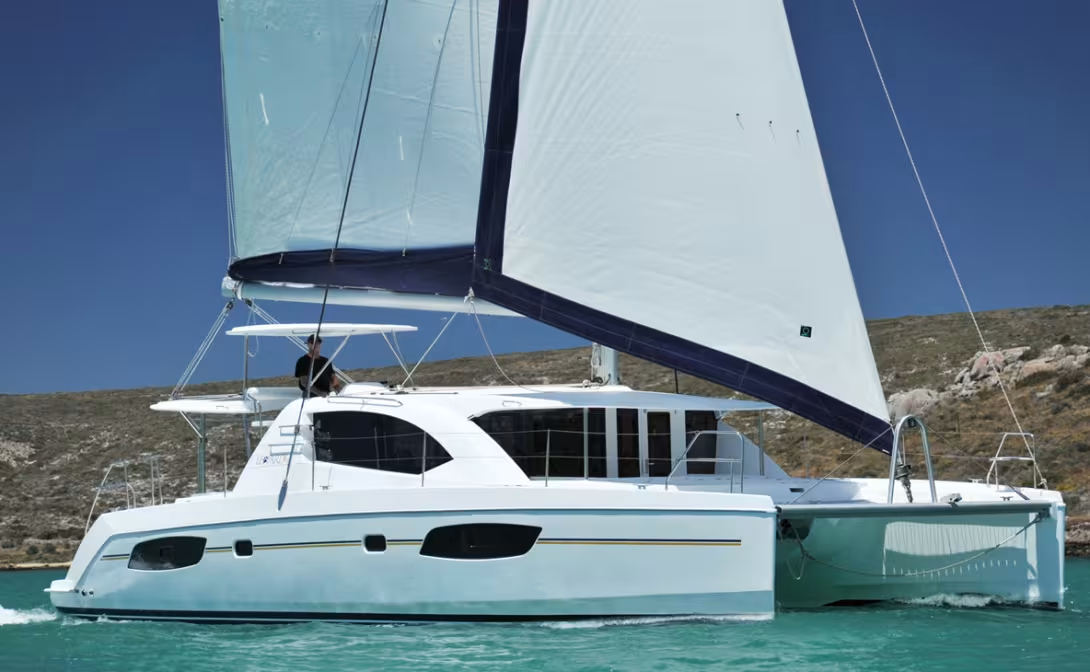
The principle of the step - a narrow waterline below a stepped-out section to offer greater volume inside the hull above the waterline - was applied on each side of the hull. And it's a real plus, not only for interior comfort, but also for rigidity. As a bonus, it makes for a drier boat. The underside of the nacelle is now perched much higher (at 75 cm) than on the yard’s early models. And the nacelle design has been carefully worked out to limit any unpleasant slamming from the waves. The naval architects have retained fixed skeg keels that limit the draft to only 1.05 m. As for rigging, the long Z-Spars mast is self-tensioned by a triple spreader. It is held by the forestay and two capshrouds that are set well aft. As standard, the 44 is equipped with two 30hp motors, though 39hp was available as an option. Despite a careful glass/balsa sandwich construction, the displacement remains significant - 14.9 t ready to sail. That gives a sail area-to-weight ratio of 7.91 m² / t compared to the 8.66 m² / t of the Lagoon 450 for example. So, in light weather, don’t expect miracles. The 44 waits until there’s 7-8 knots of wind to properly get going at 5 knots and more, but offshore in a good breeze, averages of 145 to 150 miles per day have been routinely reported by delivery crews. With its raised nacelle and fairly fine hulls, the Leopard 44 makes good passage through the sea but does pitch readily. This, no doubt, because of the rather high center of gravity.
A traditional deck layout…
Aft, the crew is perfectly protected by the imposing rigid bimini. The table - which can accommodate seven - and its seats are off center on the port side. Also to port, a stainless steel bathing ladder is to be found. The raised helm station can seat two people. All sail maneuvers converge on three winches accessible by the helmsman. The side-decks are a little narrower than average, but ensure a clear way forward to the (small) trampoline. The handrails are numerous and well placed.
The forward cockpit is protected by an imposing visor. To optimize weight centering, the anchor and ground tackle are moved aft toward the coachroof. A bridle remains in place to take the load on the bows and no less than four pairs of cleats to take warps and springs. Outside stowage is generous: two large lockers forward, one beneath the forward cockpit before and another for the raft.
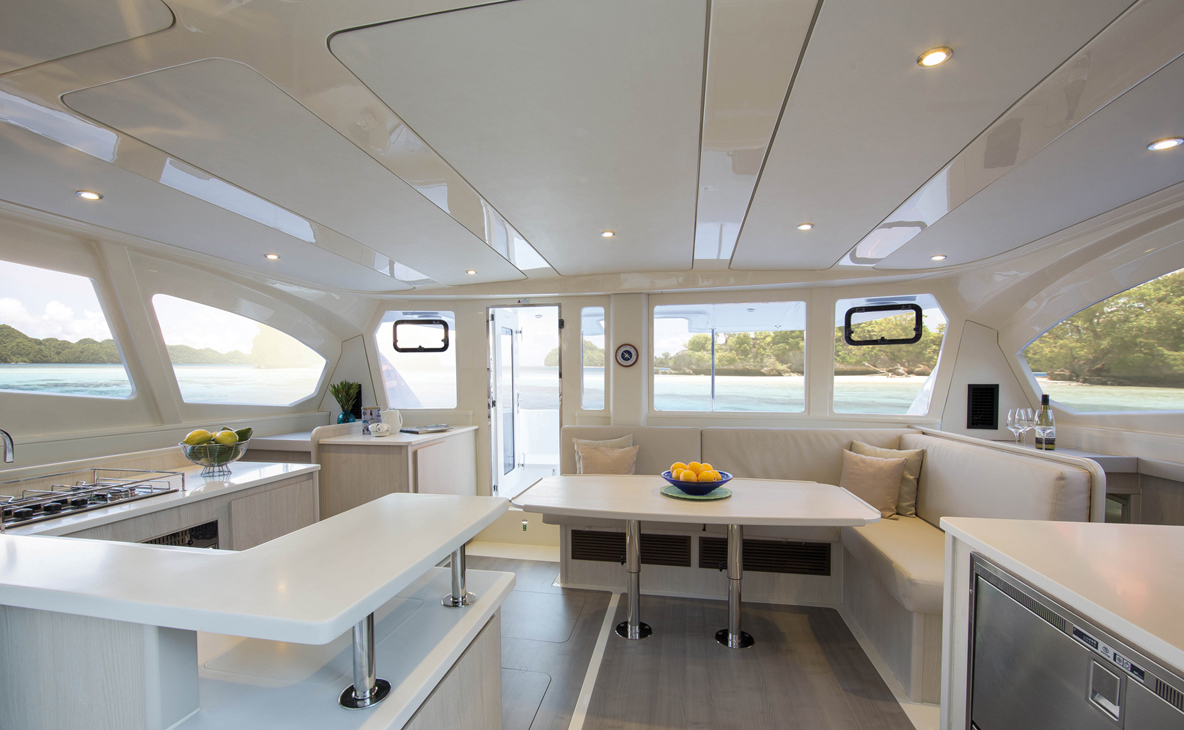
Faultless accommodation
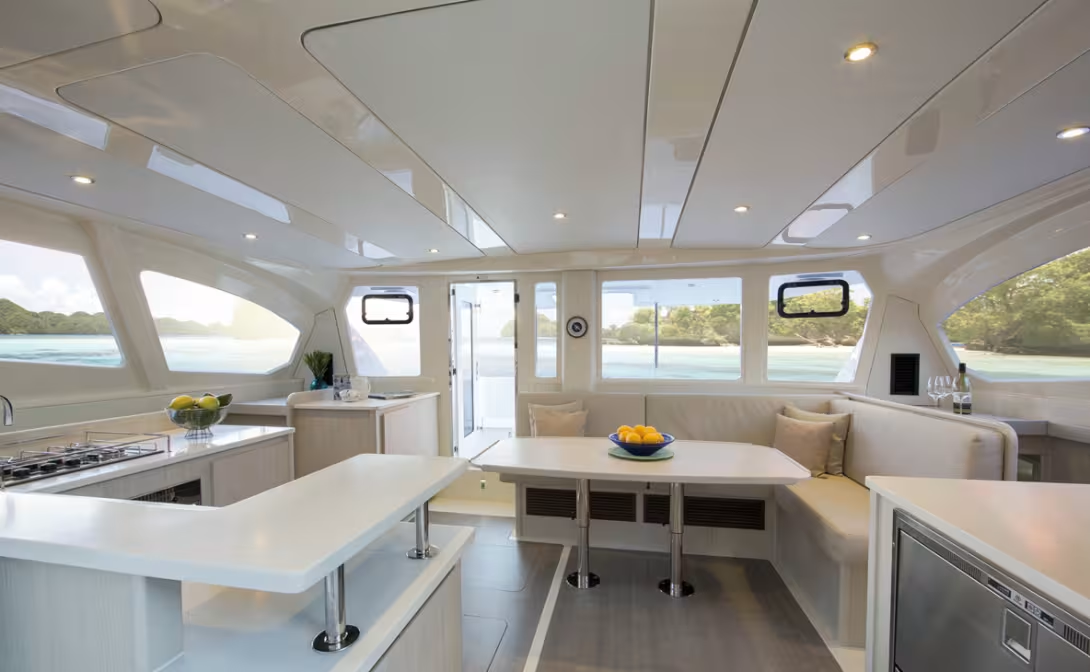
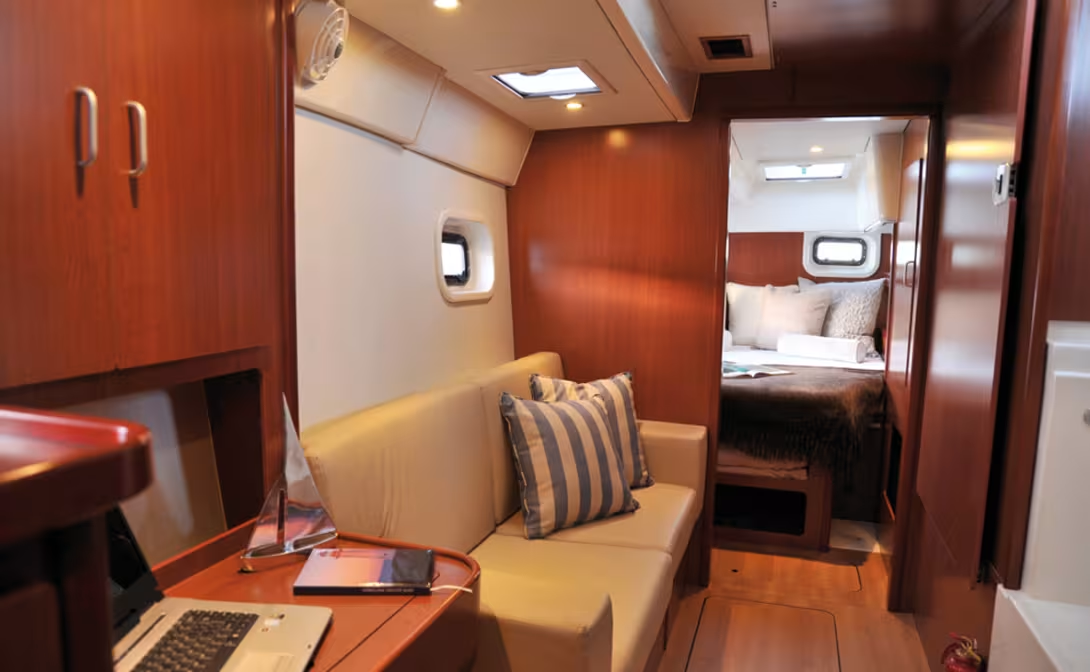
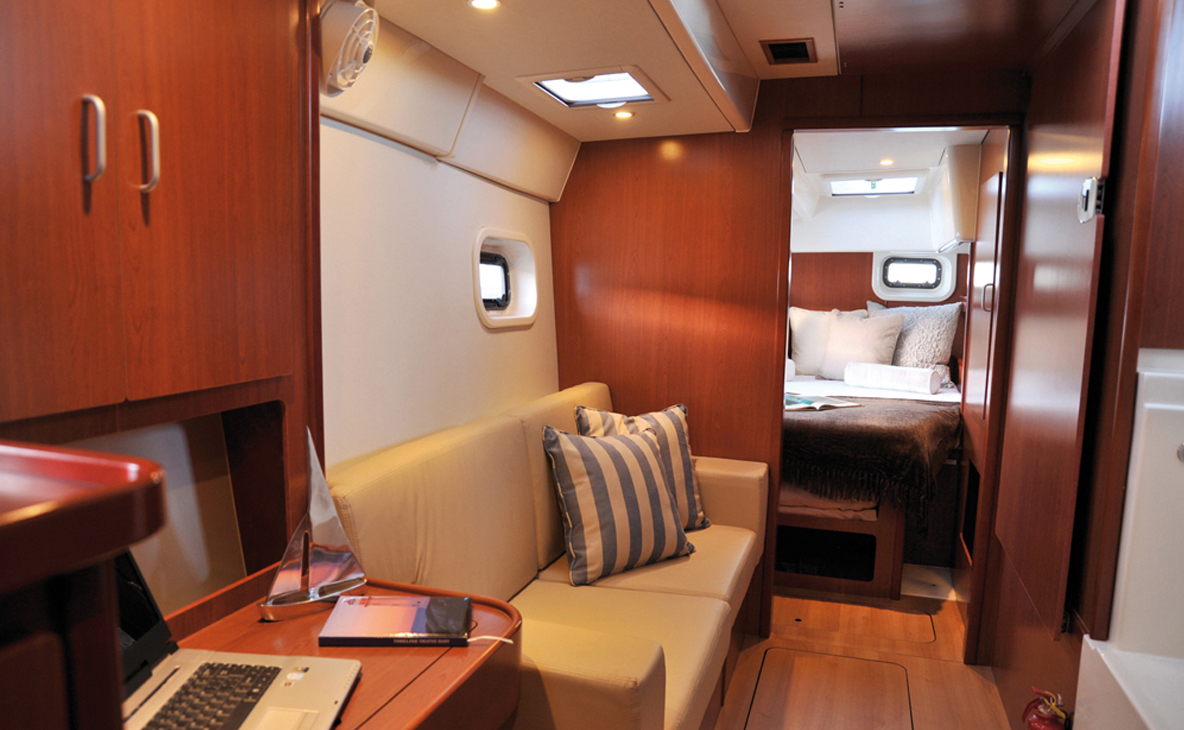
The nacelle layout ensures a good circulation, diagonally, from one door to another. And in practice, it’s easier to access the forward cockpit and the trampoline through the interior, without having to go up on the side-decks. Unusually easy, in fact, and forming part of the appeal of this model! With 2.12 m of headroom, you won’t feel cramped, especially as the light is generous and the ventilation good too. The saloon table, measuring 82 x 163 cm, can seat 7 to 8 people. It also doubles up as the chart table. Thanks to its direct access from the cockpit, the galley with its two sinks is very convivial. Preparing good food is certainly not a chore. On the other side of the entrance, the yard has installed the fridge and the very comprehensive electric panel. The cabins are obviously located in the hulls - three or four cabins depending on the version chosen and as many bathrooms. The bunks, which are 1.60 m wide at the head, will accommodate couples even more comfortably than at home. There’s a great amount of stowage space available. And the finish is clean, tasteful and able to withstand intensive use.
Conclusion
Offering maximum comfort, the Leopard 44’s aim is to maintain honest performance with fine hulls and a sleek sail plan. This catamaran does pretty well, even in light airs. And the comfort inside and on deck is worthy of a much larger catamaran. A good argument for anyone intending to liveaboard long-term, especially as the load capacity - 2.2 t more than the semi-laden displacement - is significant. And the forward cockpit connected to the saloon? A real plus both underway and at anchor!
Points to check:
With the exception of a few cracks in the gel coat at the join between the inboard hulls and the aft beam, nothing remarkable, especially as the 44s are still very recent. Designed for intensive use, these models age well and have easy access to all technical aspects - motors, seacocks, electrical equipment - very important for long-term cruising.
We like
General comfort and volume of the nacelle
Comfortable forward cockpit
Robustness and easy maintenance
We don’t like
Chunky outline - especially seen from forward
Disappointing performance in very light airs
Technical specifications:
Builder: Robertson & Caine Catamarans
Naval Architects: Morrelli & Melvin
Hull length: 12.98 m
Waterline length: 12.70 m
Beam: 7.25 m
Draft: 1.05 m
Weight: 14,900 kg
Upwind sail area: 118 m²
Mainsail: 74 m²
Genoa: 44 m²
Gennaker: 130 m²
Fresh water: 780 l
Fuel: 700 l
Motors: 2 x 30 hp
Construction: balsa/glass/polyester sandwich
Production: 200 examples built from 2011 to 2016
Price: € 240,000 to 360,000 ex-tax
