A year after the Leopard 46 was launched, the time had come for the Leopard 45 to step out of the spotlight. This model had featured in the catalog for seven years, boasting impressive sales figures - almost double those of her predecessor, the Leopard 44. Today, the Sunsail and Moorings fleets, in addition to the fleet of privately owned catamarans (the latter representing just short of half the examples), currently have nearly 40 models available on the market, the majority being in the Caribbean, the United States, and Europe.


Infos pratiques
- Le chantier : Leopard 45 (2017)
- La fiche technique
-
 Découvrez notre vidéo exclusive
- Financez votre Leopard 45
- Assuez votre Leopard 45
- Articles autour du Leopard 45
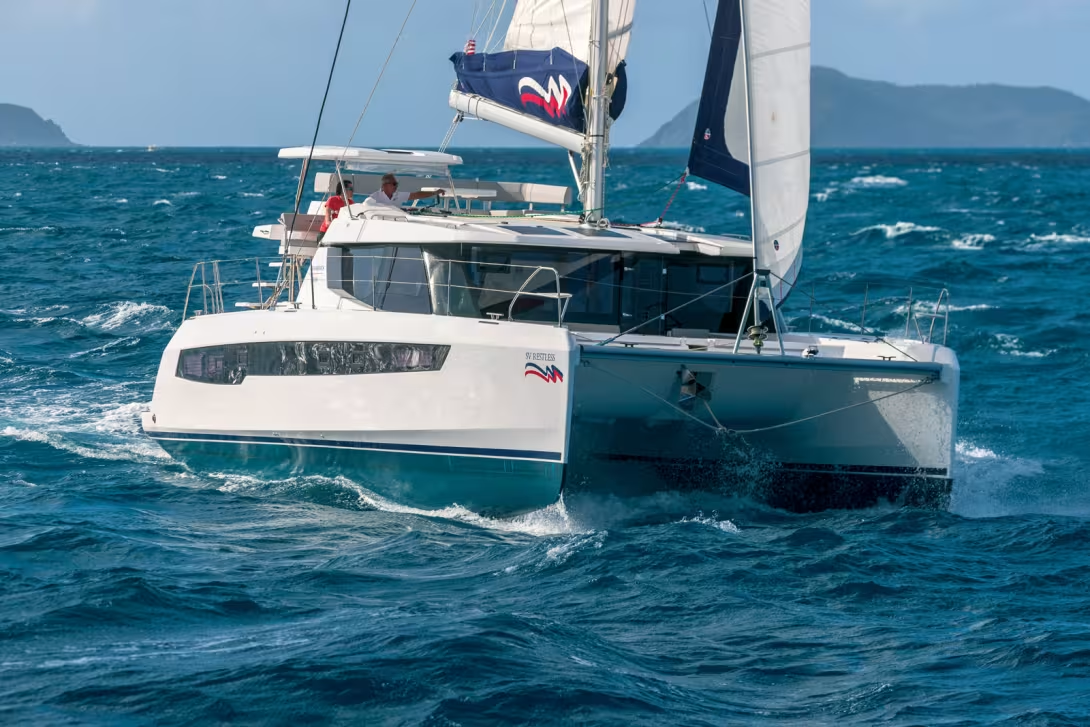
While the program for the 45 remained identical to that of the 44 — a simple, reliable, and easy-to-handle catamaran — the emphasis was placed on design. Gone are the particularly heavy lines of the 44 when viewed from ahead: the coachroof supporting uprights in anthracite gray and the very long bimini tops, which protect both the aft and forward cockpits, succeed in refining the silhouette. Another new feature was the removal of the two stainless steel supports on the 44’s coachroof visor. If this was about designing a more elegant catamaran, then it represented quite a challenge for the Simonis/Voogd team. This is a real feat of engineering given the forward surface area of the coachroof. The steps on both sides of the hulls have been retained, offering multiple advantages, in addition to visually reducing the freeboard: reduced width at the waterline to give higher average speeds and the assurance of maintaining decent-sized berths in the cabins.
A Forward Door that will be Talked About for Years...
Ah, the controversy over the famous forward door is long gone! In 2010, when the Leopard 44 debuted the famous forward cockpit accessible from inside the nacelle, few specialists would have bet on the widespread adoption of the design. The Robertson & Caine shipyard has since imposed its concept on all its models, and this now means nearly 2,000 catamarans equipped with a forward door on all the world’s seas. For those who are still skeptical, we can quote the manufacturer: “The requirement standard for draining water from the forward cockpit is 90% of the volume in 5 minutes. Here, on the Leopard 45, any water that may have entered is drained back into the sea in 45 seconds.” As for the door itself, it is virtually bullet- proof and is watertight.
Rigidity and Robustness
In addition, the South African shipyard has long delivered its catamarans by sea and has always focused on robustness. To achieve this, the builders didn’t hesitate to incorporate a double steel beam (galvanized) that absorbs the compression loads from the rig - a real guarantee of rigidity. Other priorities in the design of this model were ensuring ease of use, optimizing maintenance operations, and not compromising on performance. On board the 45, there are many well-thought-out and clever details, such as the water-draining storage compartments for masks, snorkels, and fins, immediate battery access, the reversible aft cockpit bench seat backrest, engraved plates (no stickers) with instructions at the bottom of the lockers, and an accessible and well-labeled electrical panel.
A Lounge Deck that Takes Center Stage...
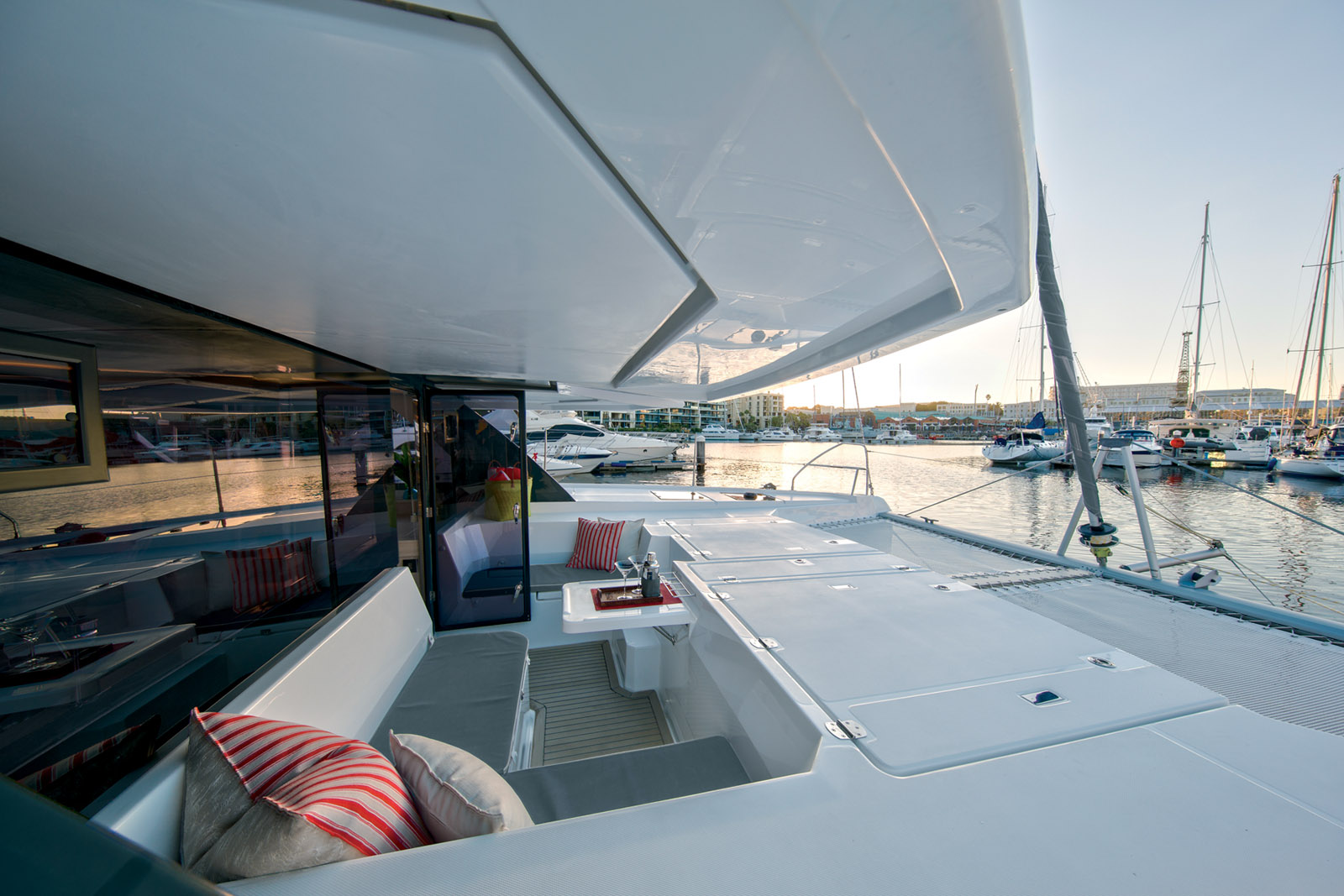
Most of the relaxation areas aboard the 45 are particularly well protected from the sun and the weather: aft cockpit, forward cockpit, and helm station. The shipyard had initially decided to do without the flybridge sun lounging area, but then a Lounge version was proposed... and this was soon rolled out across all models.
Traffic flow on deck is smooth everywhere, with stainless steel handrails in easy reach and steps to climb onto the coachroof from either side. For launching and stowing the tender, Leopard has developed efficient electric davits (visually efficient that is, as the mechanism itself is pretty noisy). At the rear, there are large sugarscoops that are great for swimming from, and on the port side, a ladder worthy of a municipal swimming pool.
Easy Circulation Inside
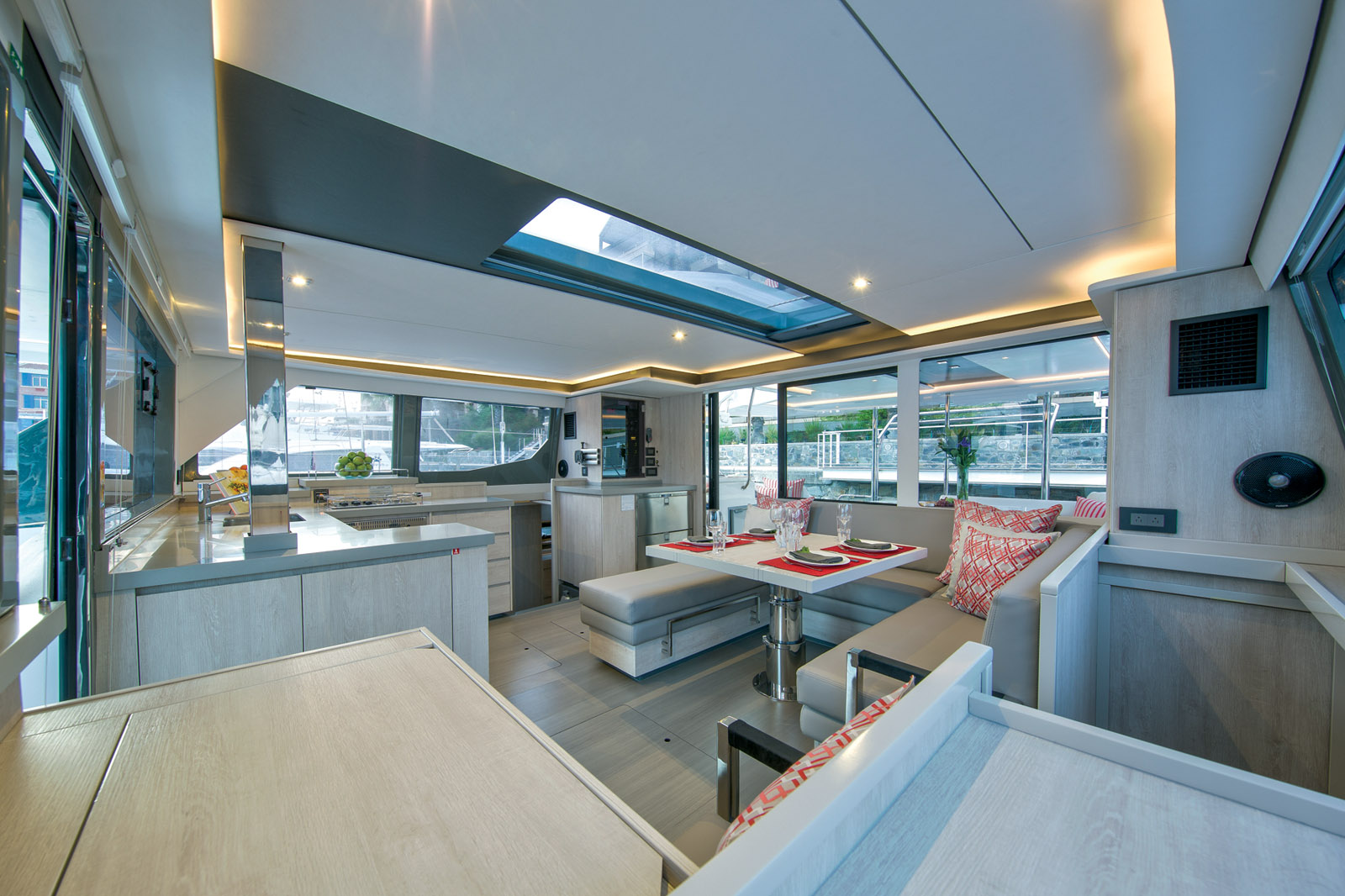
The nacelle has been designed to accommodate the two cockpits, preserving a large diagonal floor area for moving from one to the other. It works perfectly: you find yourself passing through the nacelle when it’s time to get ready for anchoring... The saloon, which can be converted into a triple berth, adjoins the saloon on the port side. At the front of the nacelle is the famous forward door, of course, but also a chart table on the port side – there wasn’t one on the 44. This forward-facing mini-office would be more appealing if the stool was higher and more accessible. Similarly, the angle of the chart table top is uncomfortable on your forearms.
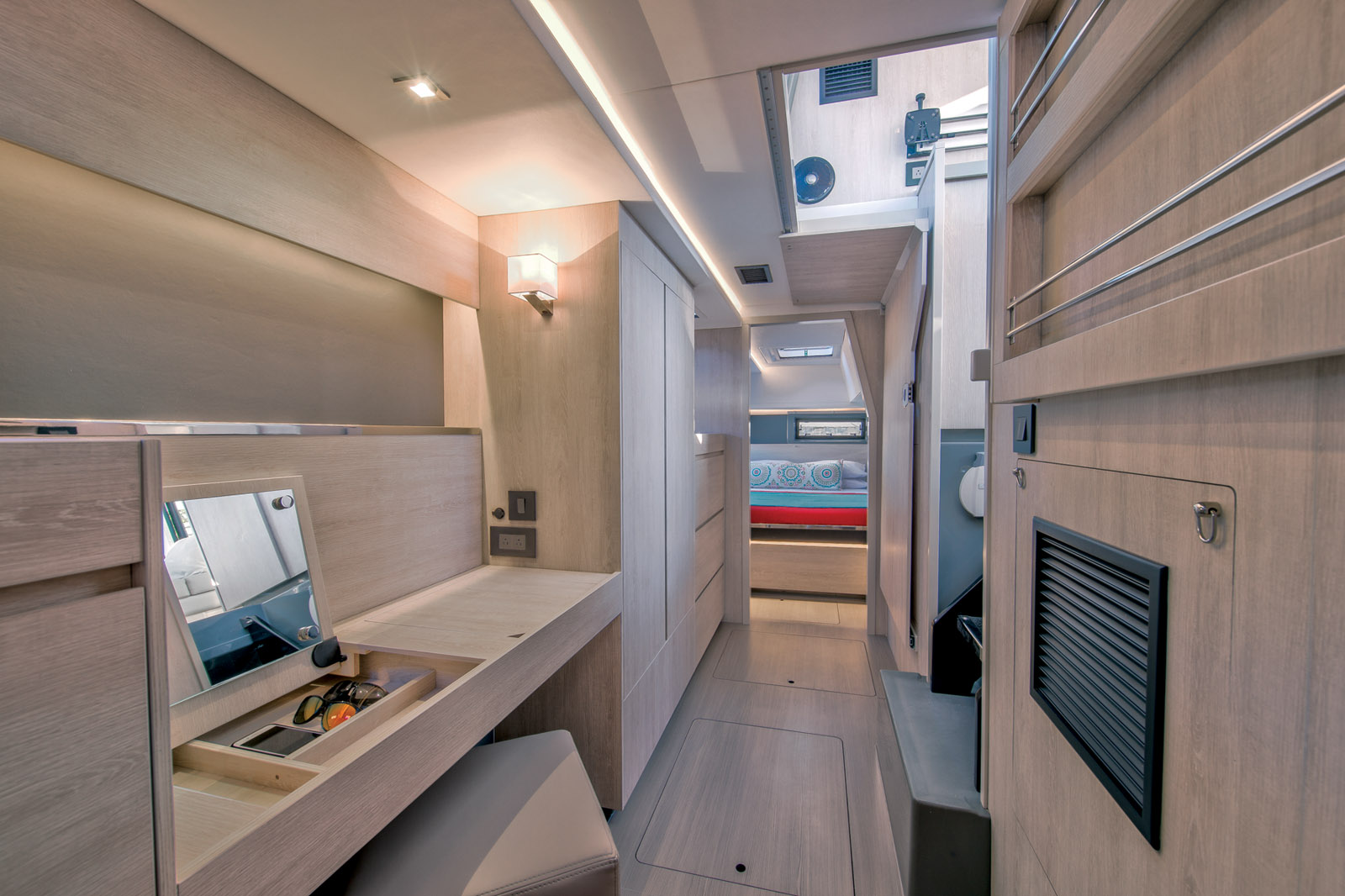
Like all modern catamarans, the Leopard 45 offers flush-decked access. There’s no “all open” formula here, but there are still some nice windows and doors. Almost too much in fact: the aft door is so transparent that you can easily walk into it without warning... when it’s closed. No complaints about the L-shaped galley: perfectly calibrated for life on board with a full crew, it features a huge sink and multiple storage spaces. One of the Leopard 45’s strong points is its impressive storage capacity throughout the boat. The only flaw is the fresh water pump, which is not soundproofed and is particularly noisy - this installation could do to be adapted. The materials and colors used in the cockpit are much more contemporary and stylish than those of previous models. However, some of the headlining panels need a stronger fastening system. On board the Owner’s version, the entire starboard hull is dedicated to the owner. The companionway can be closed off for greater privacy, with the added bonus of plenty of cupboards, closets, and other storage spaces. Not to mention a large aft berth and a very well-designed bathroom. The starboard hull offers two cabins and the same number of bathrooms. As for the forepeaks, these can be converted into crew cabins.
Loves the Breeze
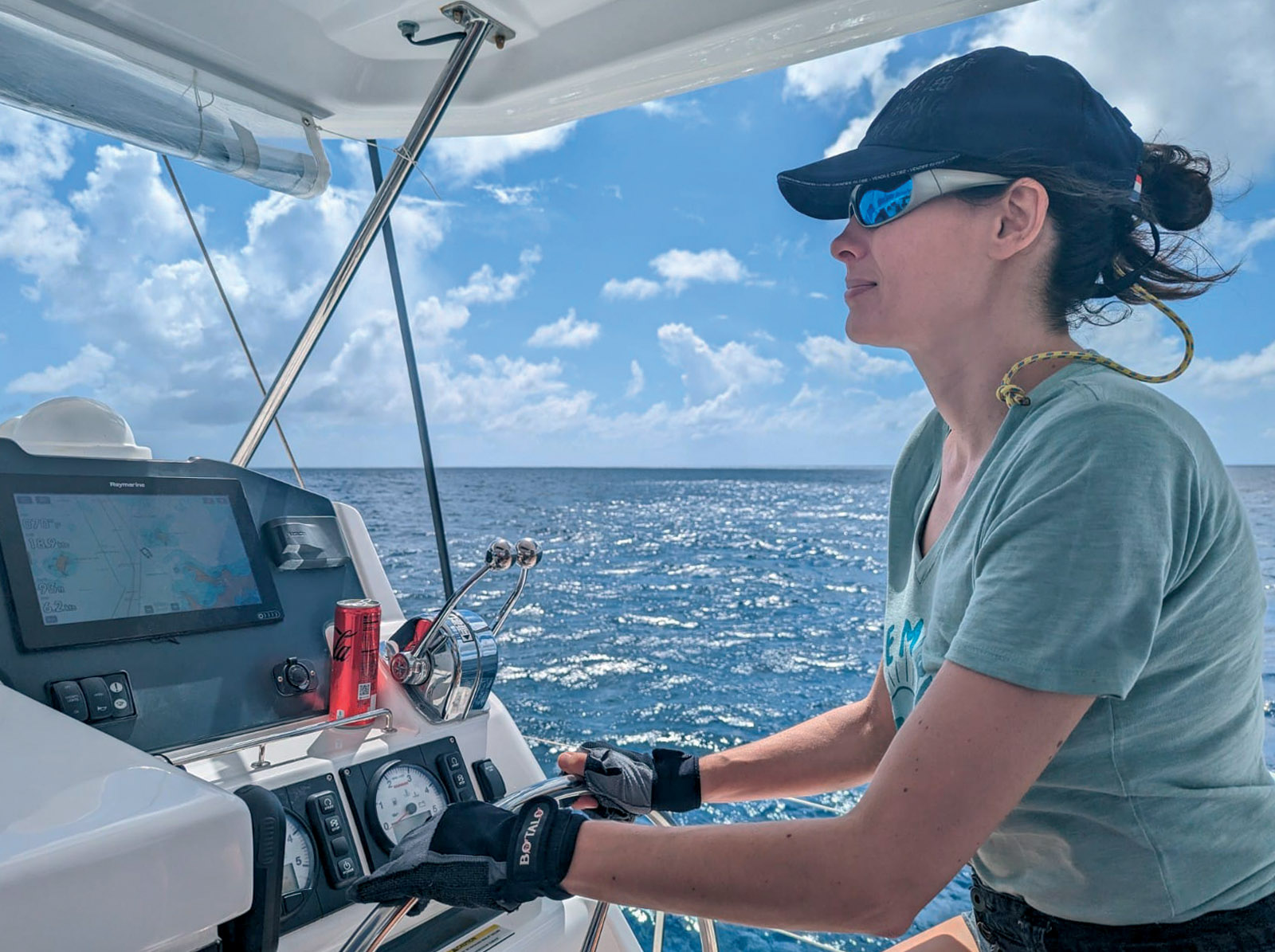
The standard powertrain was already quite powerful when this model was launched with twin 45 HP motors, and these were upgraded to 2 x 55 HP. The Leopard 45 can thus handle all sea and wind conditions and maneuvers pretty well in port, especially when inverting the throttles. On the other hand, beware of windage particularly when coming alongside to port, as visibility is reduced for the helmsman who is offset on the starboard side. From the helm station, which is equipped with a large bench seat, setting the sails is extremely simple thanks to the three winches — two electric and one manual — which handle all sail maneuvers, including the gennaker sheets and the furling line. With half an hour’s use, you’ll have mastered the catamaran’s controls and will be able to start fine-tuning the trim (mainsail twist, genoa traveler position, etc.). The helm, while not offering any real thrills, is smooth and direct. The view of the water is good when looking forward. The bows cut through the waves well, and the good bridgedeck clearance means no slamming. When sailing close-hauled, you can count on a heading of 50/55° to the true wind, with virtually no leeway (thanks to the relatively deep fins) and an average speed of 5 knots in 9 knots of true wind. The rig, while not particularly powerful, proves to be effective and forgiving. As for displacement, it remains reasonable even though the sail area/weight ratio peaks at 8.51 m²/t. With folding propellers, you can gain half a knot in all conditions. In a good breeze, the Leopard 45 becomes much more fun: average speeds of 8 to 10 knots are guaranteed
Conclusion
This Simonis & Voogd design offers a good balance between comfort and performance and remains easy to maneuver, even when sailing short-handed. Most of the examples currently on the second-hand market (and this will continue to be the case for a few years) are from the Moorings and Sunsail fleets and are known as the Moorings 4500 and Sunsail 454, respectively. In this charter configuration with Dacron® sails, fixed propellers, and no spinnaker, the Leopard 45 may seem a little sluggish in light airs... but there’s nothing to stop you from giving it wings with a smooth hull, folding propellers, and one or even a couple of downwind sails!
Points to Check
Overall, this model remains an excellent base even after five years of intensive charter work. The structure is solid, as is the rig. As for the on-board equipment, it is still fairly basic, allowing for DIY maintenance without necessarily calling in a professional. The only problems we’ve heard about are electrical in nature – faulty wiring, loose terminals. In theory, these teething problems have had plenty of time to be resolved.
That leaves the usual major “consumables”: engines, sails, plumbing, and running rigging obviously require detailed inspection.
Seakeeping quality
Comfort and ease of handling
Domestic soundproofing needs improvement
Relatively neutral design
Technical specifications
Architects: Simonis & Voogd
Construction: balsa/glass sandwich
Length: 45’ (13.72 m)
Waterline length: 42’11” (13.07 m)
Beam: 24’2” (7.36 m)
Draft: 1.50 m (4’11”)
Air draft: 70’ (21.34 m)
Light displacement: 14,500 kg (32,000 lbs)
Mainsail: 785 sq ft (73 m²)
Furling genoa: 545 sq ft (50.4 m²)
Spinnaker: 1505 sq ft (140 m²)
Drivetrain: 2 x 55 HP
Fuel: 185 US gal (700 l)
Water: 206 US gal (780 l)
Cabins/berths: 3/4 – 6/8
CE Certification: A
Production: 368 units from 2017 to 2024
Second-hand price: from € 320,000 ex-tax