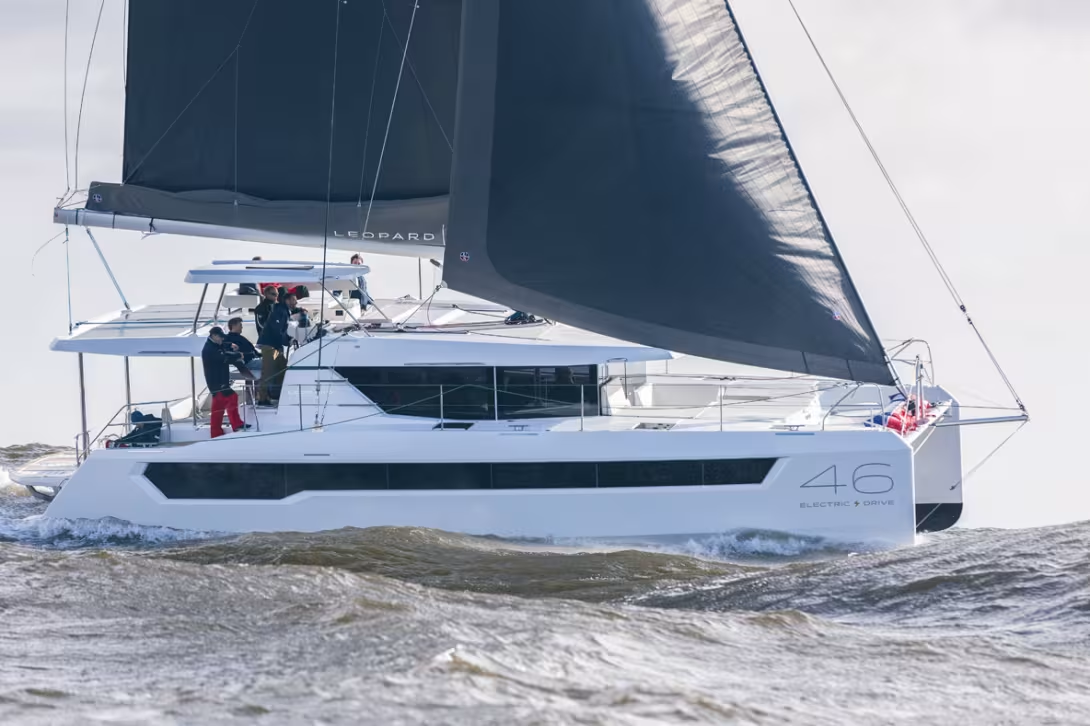
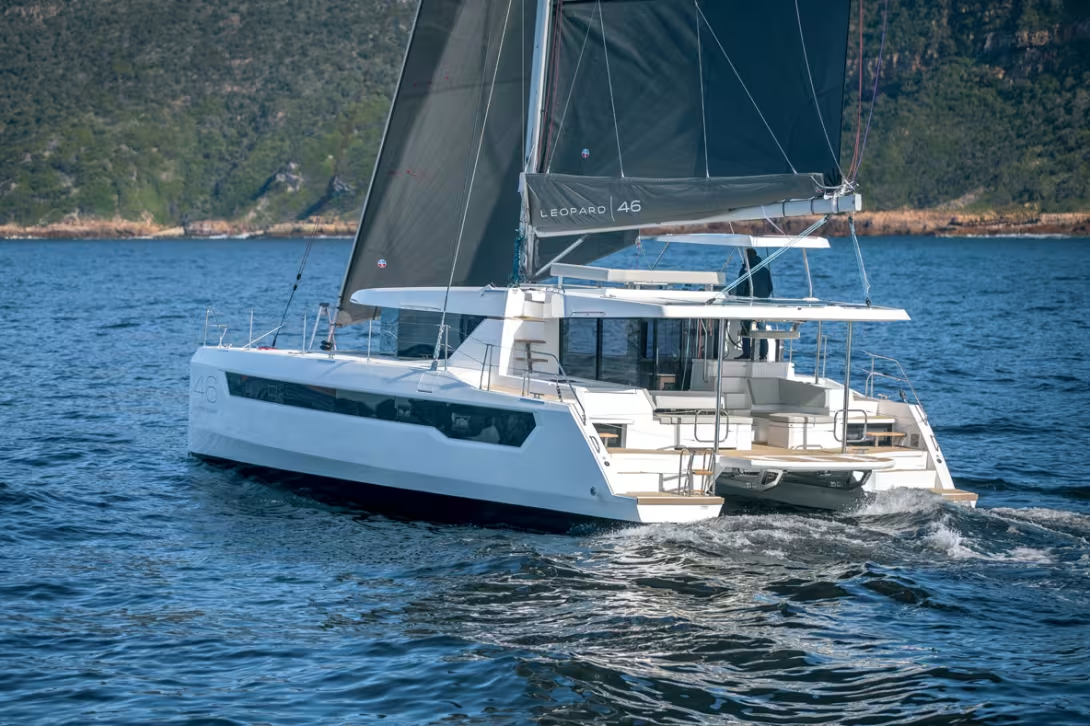
After eight years of loyal service, the Leopard 45 gives way to the Leopard 46. For this new catamaran, the designers in charge of the project didn’t seek to revolutionize the genre, but rather to improve and optimize one of the brand’s best-sellers. This intelligent approach has resulted in a highly versatile multihull that is truly suited to its dual Owner/Charter program.
Infos pratiques
- Le chantier : Leopard 46 (2024)
- La fiche technique
-
 Découvrez notre vidéo exclusive
- Financez votre Leopard 46
- Assuez votre Leopard 46
- Articles autour du Leopard 46
The Leopard 46’s task is to replace the 45, which was a huge success for the brand - 368 units were sold. It’s no easy task to succeed an icon, and Robertson & Caine (builder of Leopard catamarans) drew on its experience and customer feedback to optimize the multihull’s layout and performance.
From the beginning, the designers wanted to create a catamaran that would be very habitable, i.e. with totally optimized on-board space. The idea was also to create an open concept, with a very bright main deck that was truly open to the rest of the boat. The shipyard also wanted to offer good performance under sail, whether in charter mode or in the hands of a private owner. Finally, Leopard is taking advantage of this new model to go electric, offering this mode of propulsion as an option. An interesting set of specifications, and an even more interesting result.
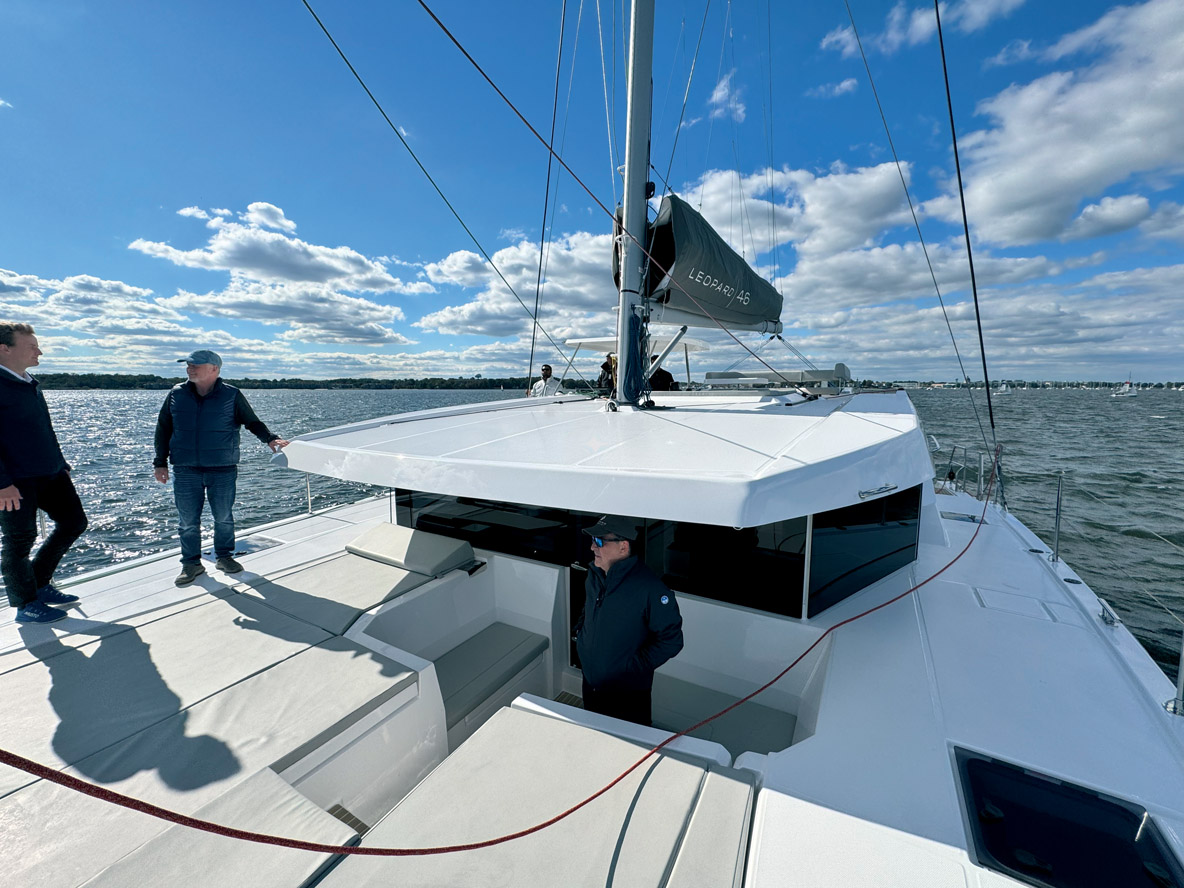
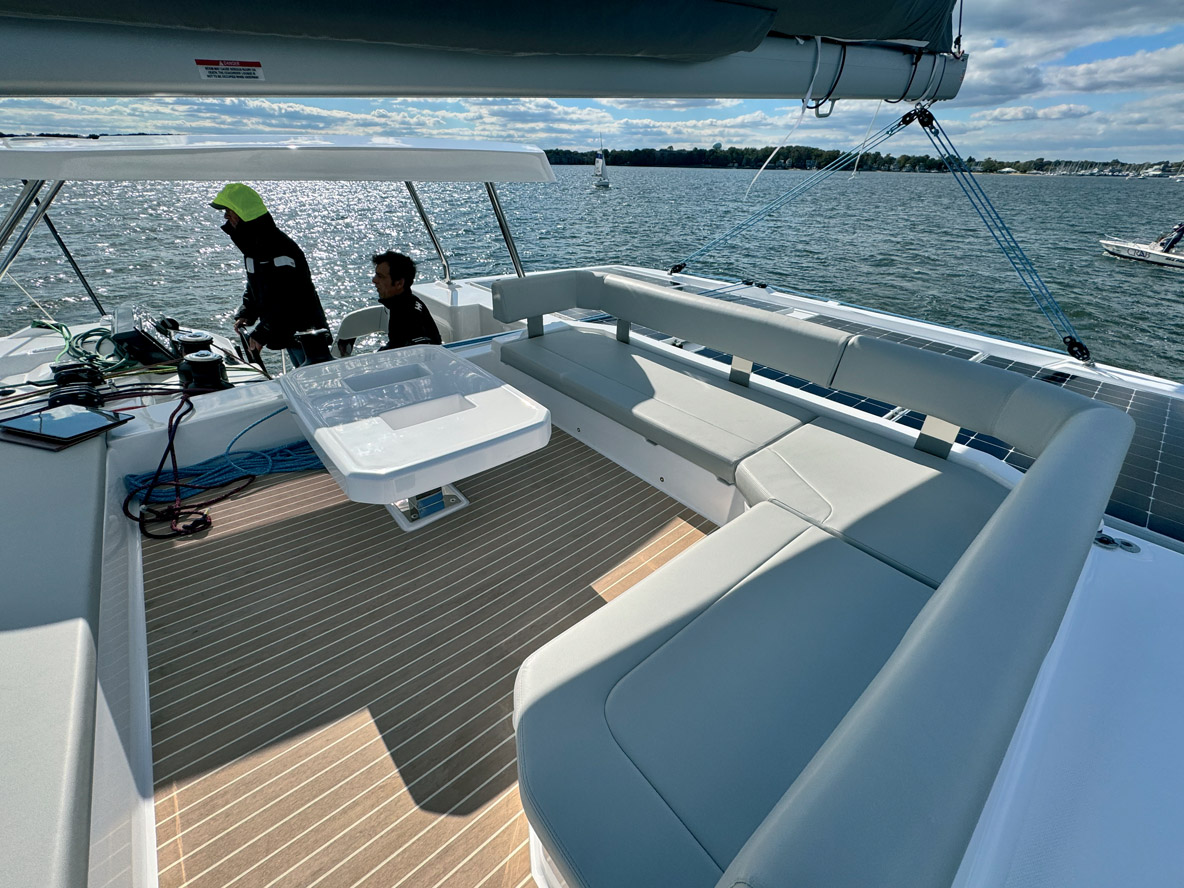
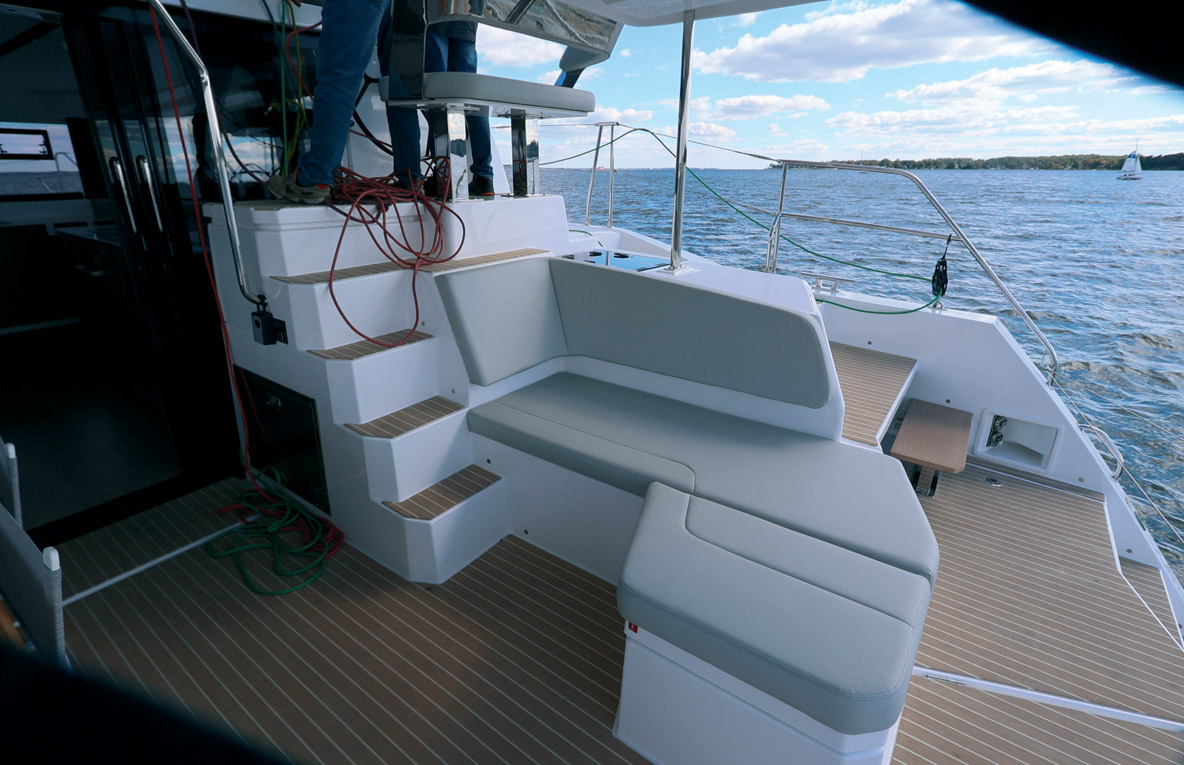
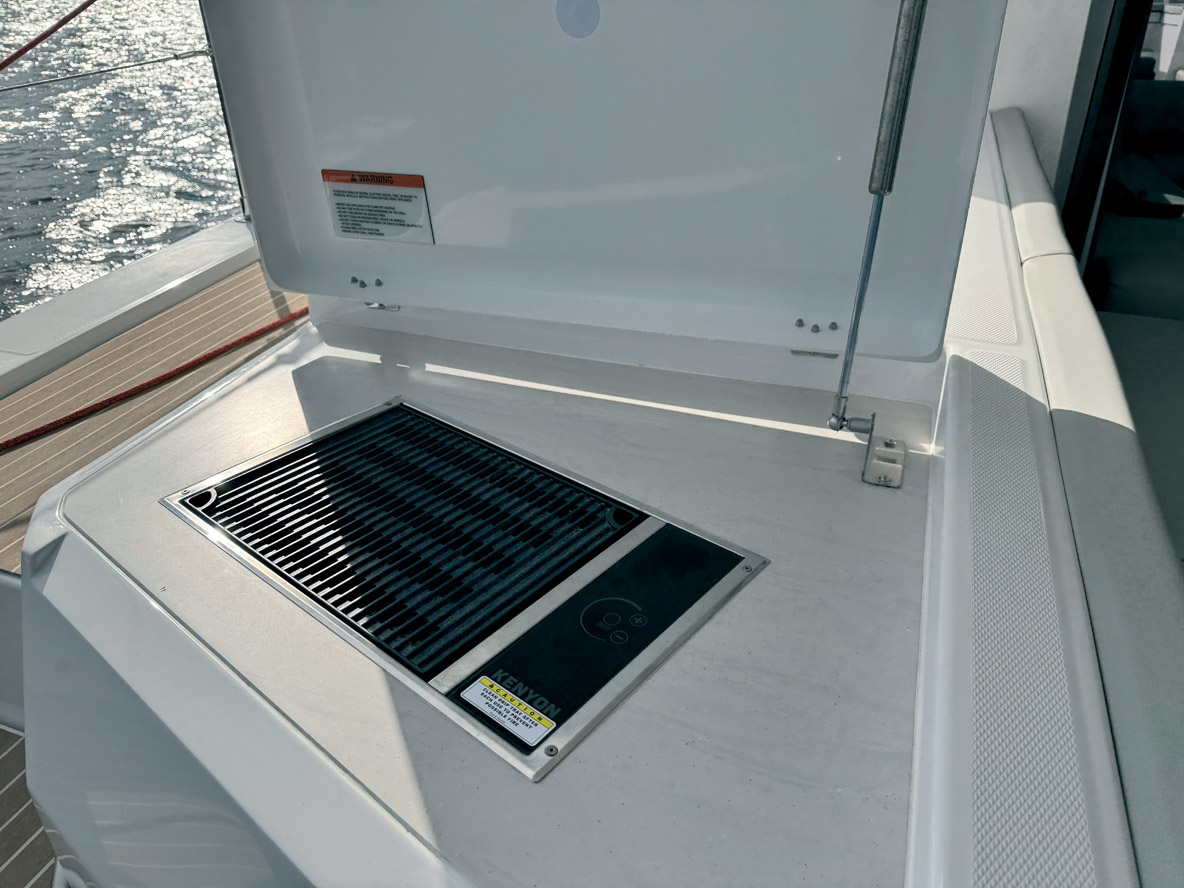
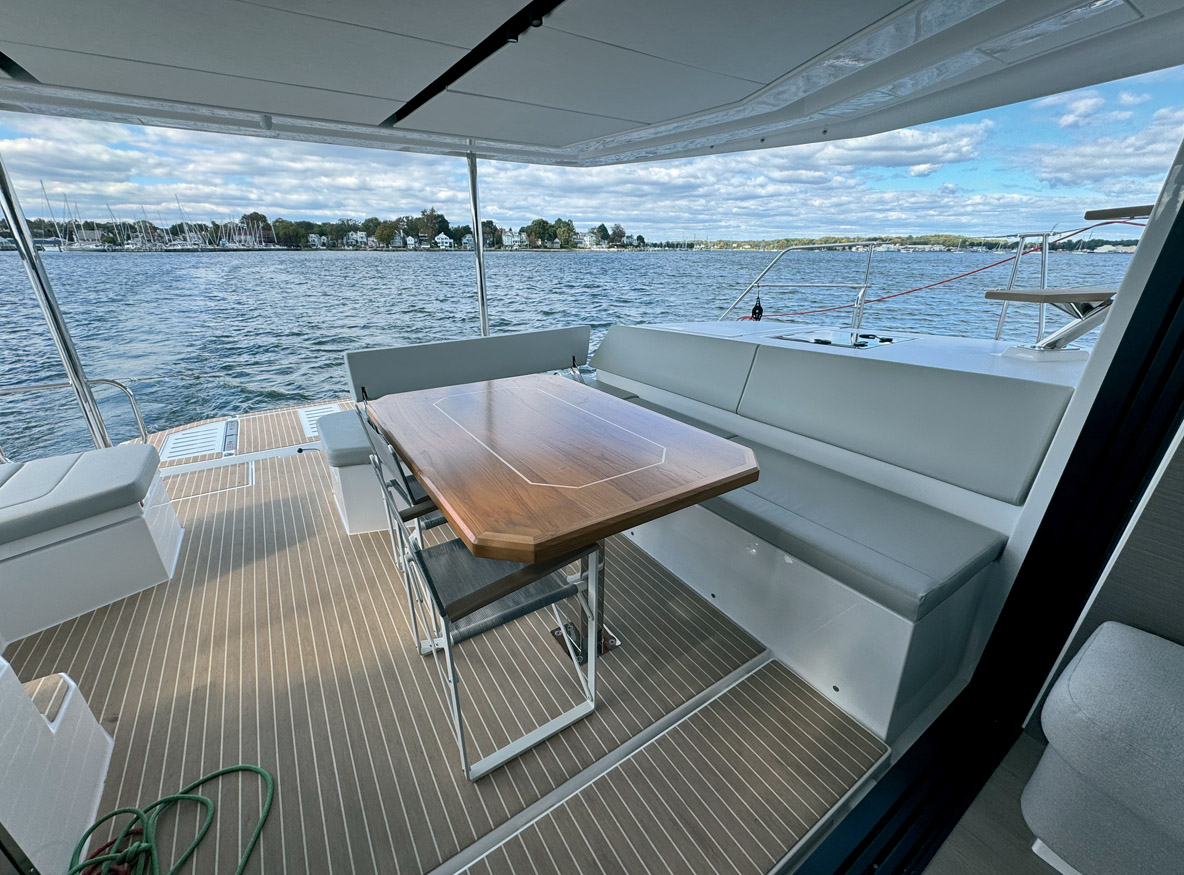
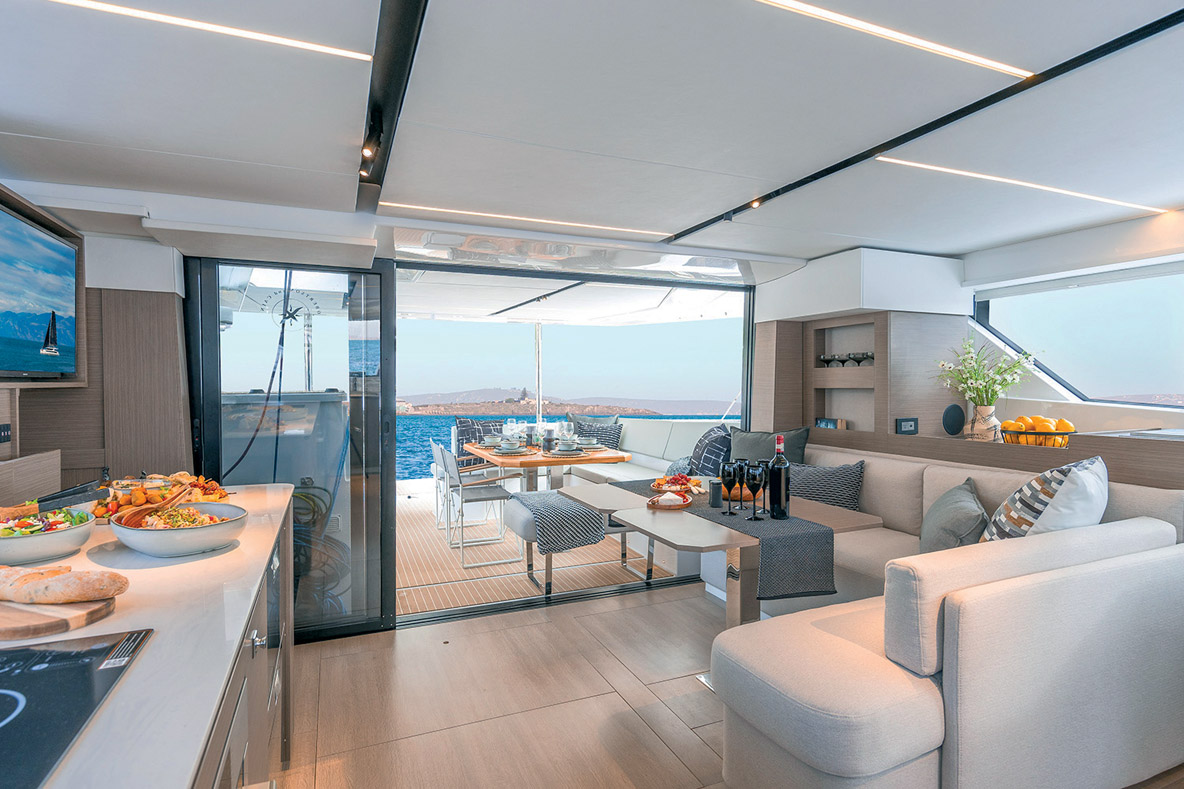
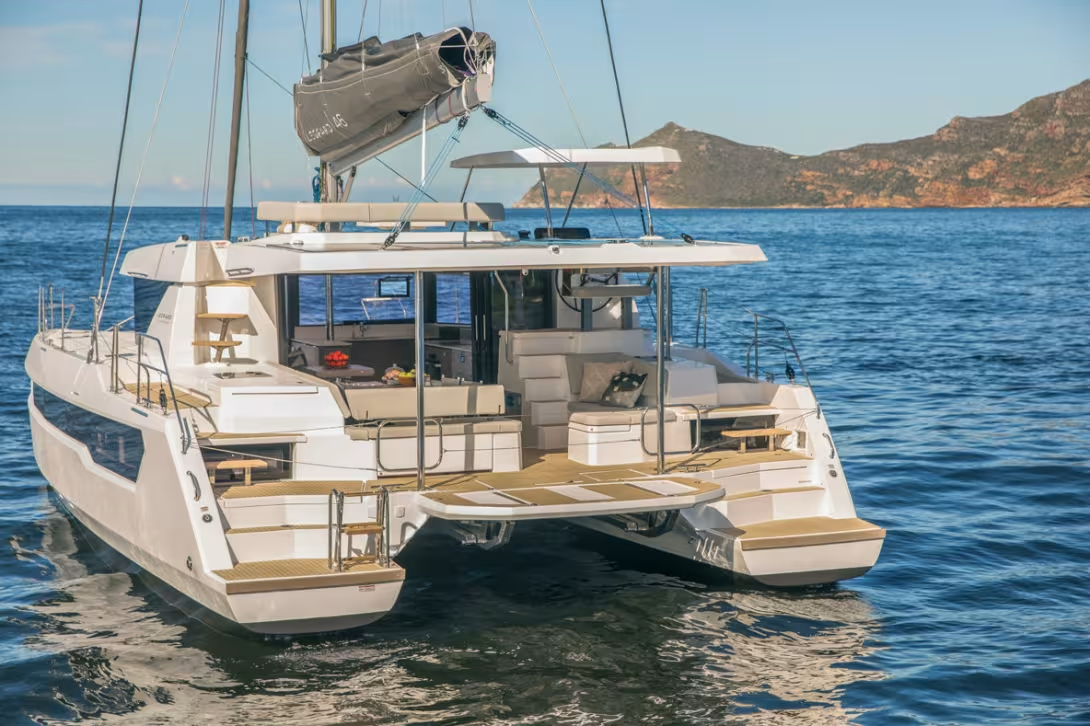
Aesthetically, the Leopard 46 swaps its two modest hull portholes for a long strip that occupies three-quarters of the length, as if to better embrace the world of yachting. The coachroof remains quite similar but features a straight windshield for greater interior space. Once in the cockpit, the user of the 45 will not be disoriented. The layout is fairly classic for the brand, with an L-shaped dining area to port and a lounge seat to starboard, topped by access to the helm station. The electrically- operated aft platform can be lowered for bathing or dinghy storage, and when raised, complements the very open cockpit. Access to the sun lounge is still from the port side-deck, but the small saloon itself has been moved forward a little to make room behind it for the solar panels. This modification saves the owners from having to add a hoop to support the panels.
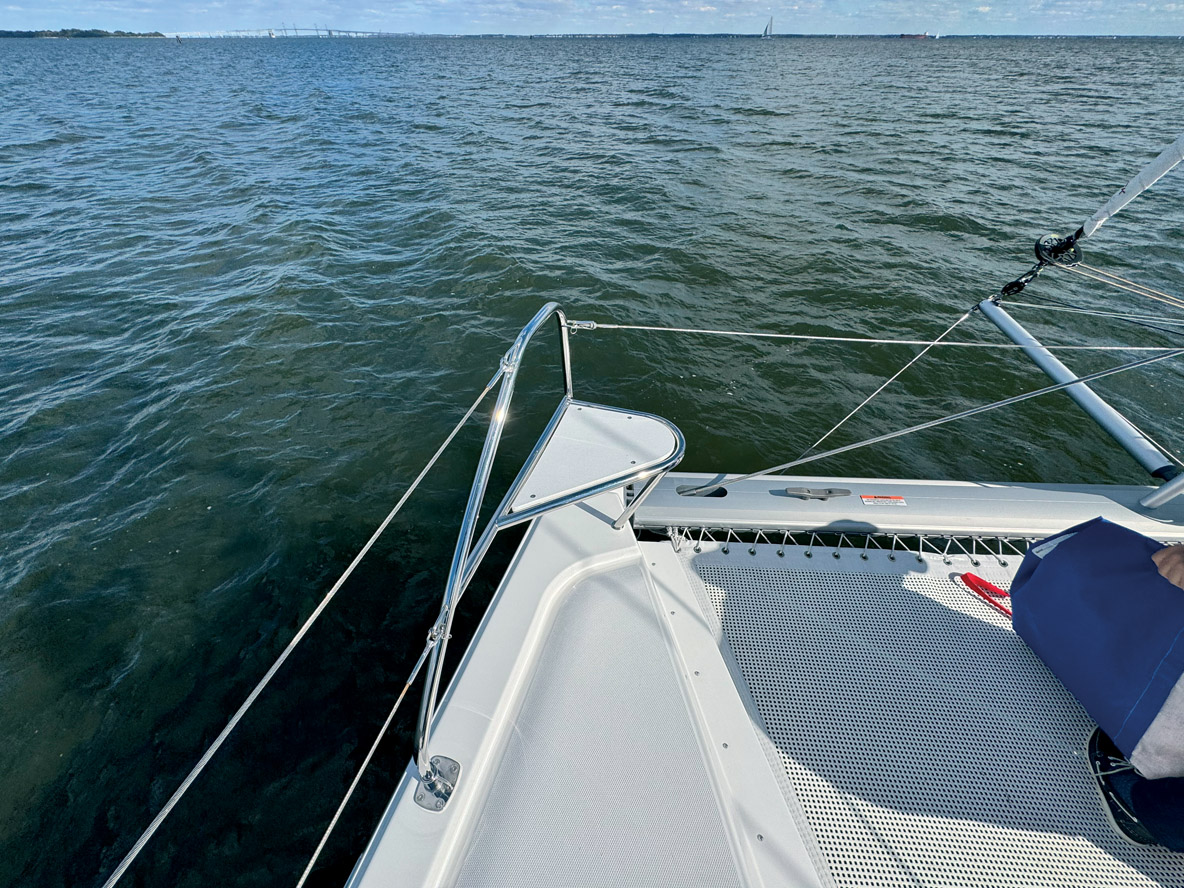
The foredeck, too, follows a familiar formula: a space combining seating and sunbathing. Too bad there’s no table. On the other hand, the cushions conceal a series of lockers, a very practical arrangement for storing sails or bulky equipment. Access to the bow for maneuvering is via a classic trampoline, and there are small seats for admiring the dolphins or checking out the seabed.
A fundamental change from the previous generation is that the crew cabins are no longer located in the forepeaks, this area is now fitted with storage compartments. It’s worth noting that this is a general trend: on most recent multihulls, skippers, cooks and hostesses are now housed in “decent” quarters - and that’s a good thing!
Abolishing the Frontier Between Inside and Outside
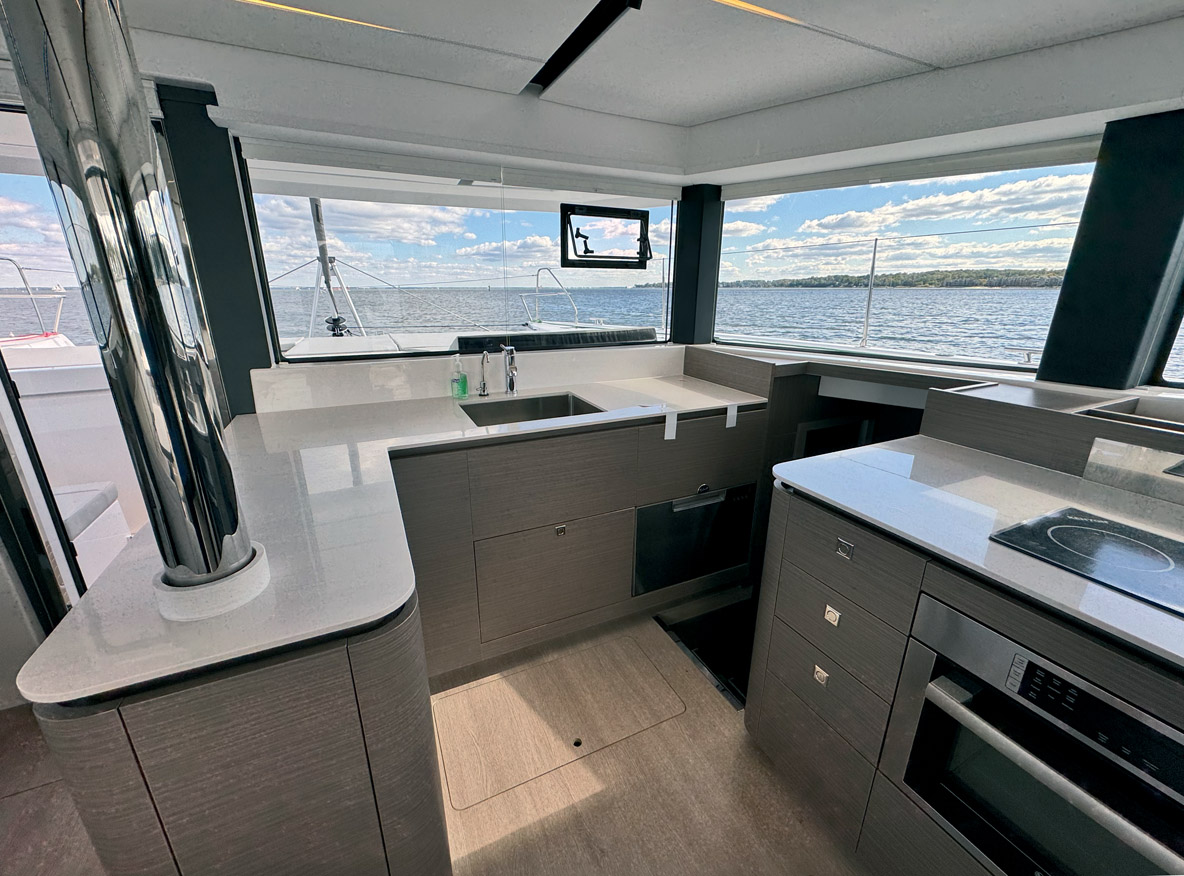
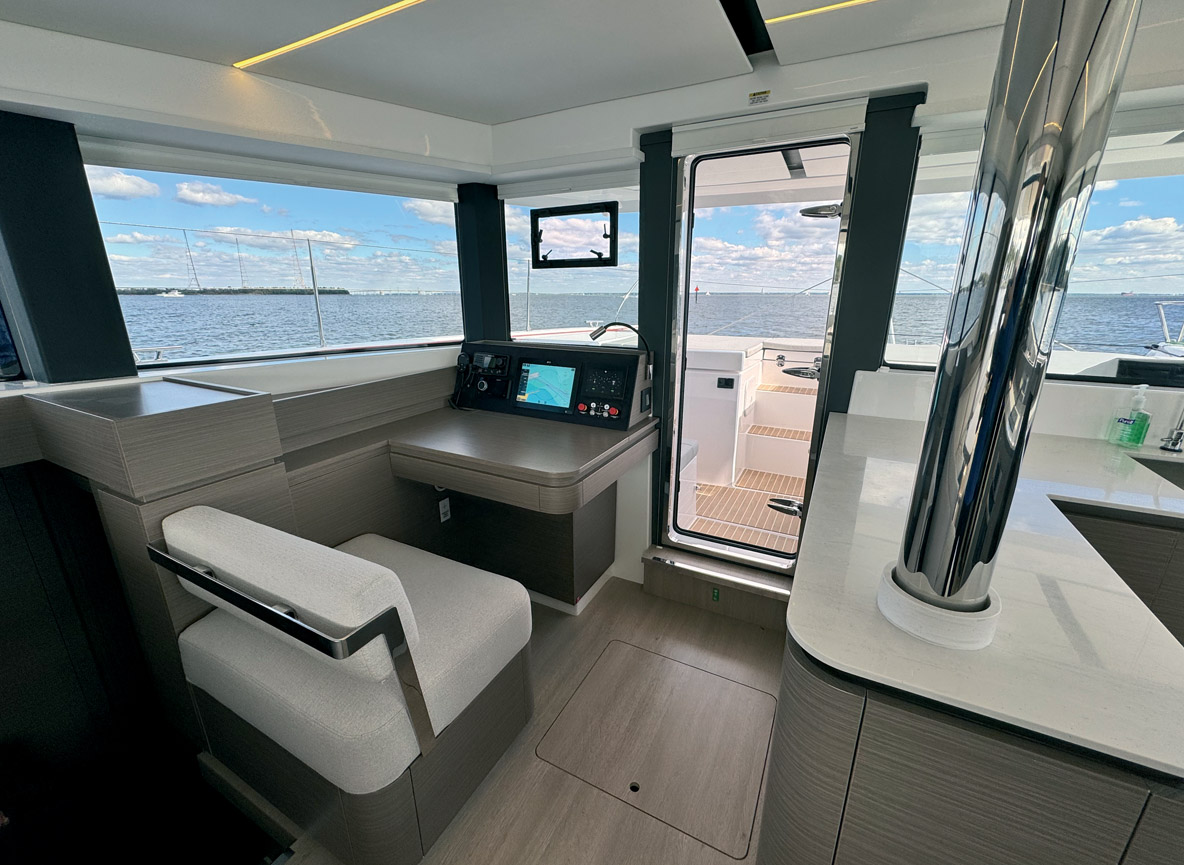
The catamaran’s circulation has been well thought out, whether in terms of the side-decks, which are wide enough to pass each other, the cockpit or even the interior, with a door leading directly from the main deck to the forward cockpit. In fact, you can almost go from the stern to the bow without encountering any obstacles. A key consideration for Alexander Simonis, the architect, the idea being to abolish as far as possible the frontier between exterior and interior. Once the sliding doors separating the cockpit from the main deck are fully opened, the challenge is a complete success. In addition, the galley is no longer aft of the main saloon but has been replaced by an L-shaped sofa whose central table extends from inside to outside. To complete the picture, the interior lounge is available in five different configurations to suit every need. The galley is now located on the starboard side and includes two sections: a longitudinally positioned unit housing the cooktop, oven and refrigerators, while the second, L-shaped section is nestled forward to starboard. Finally, a very functional navigation station with all the necessary electronics is located on the port side, facing forward. This highly rational layout facilitates circulation while preserving conviviality. What’s more, the large windows all around offer a 360° view while adding plenty of light to the interior.
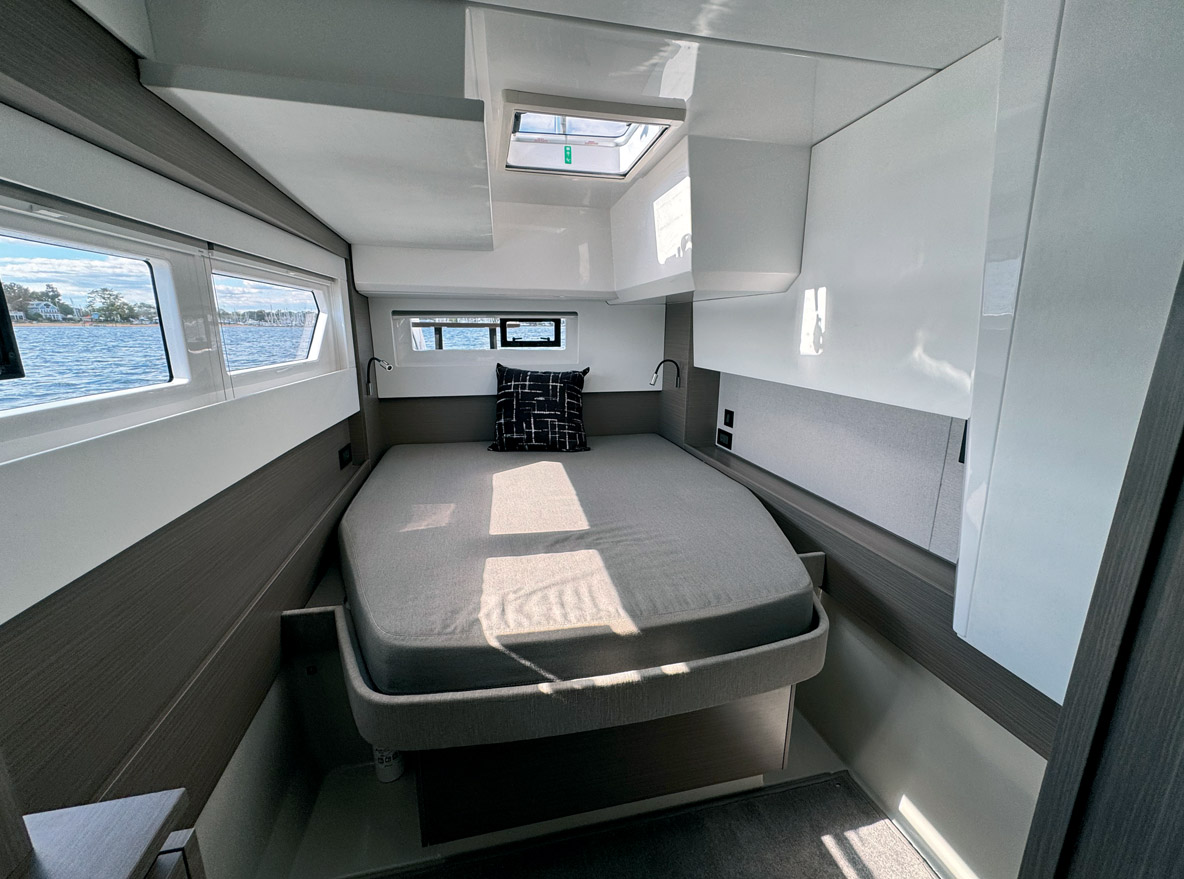
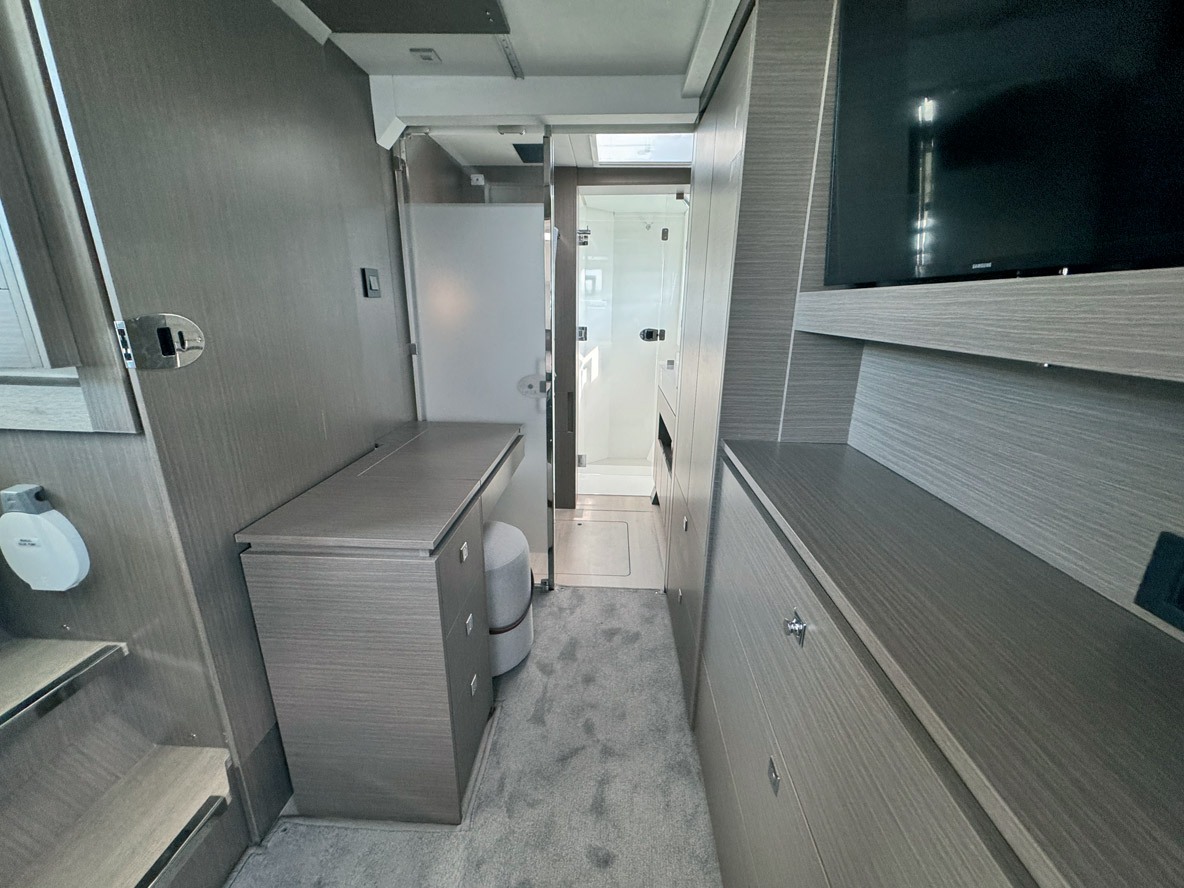
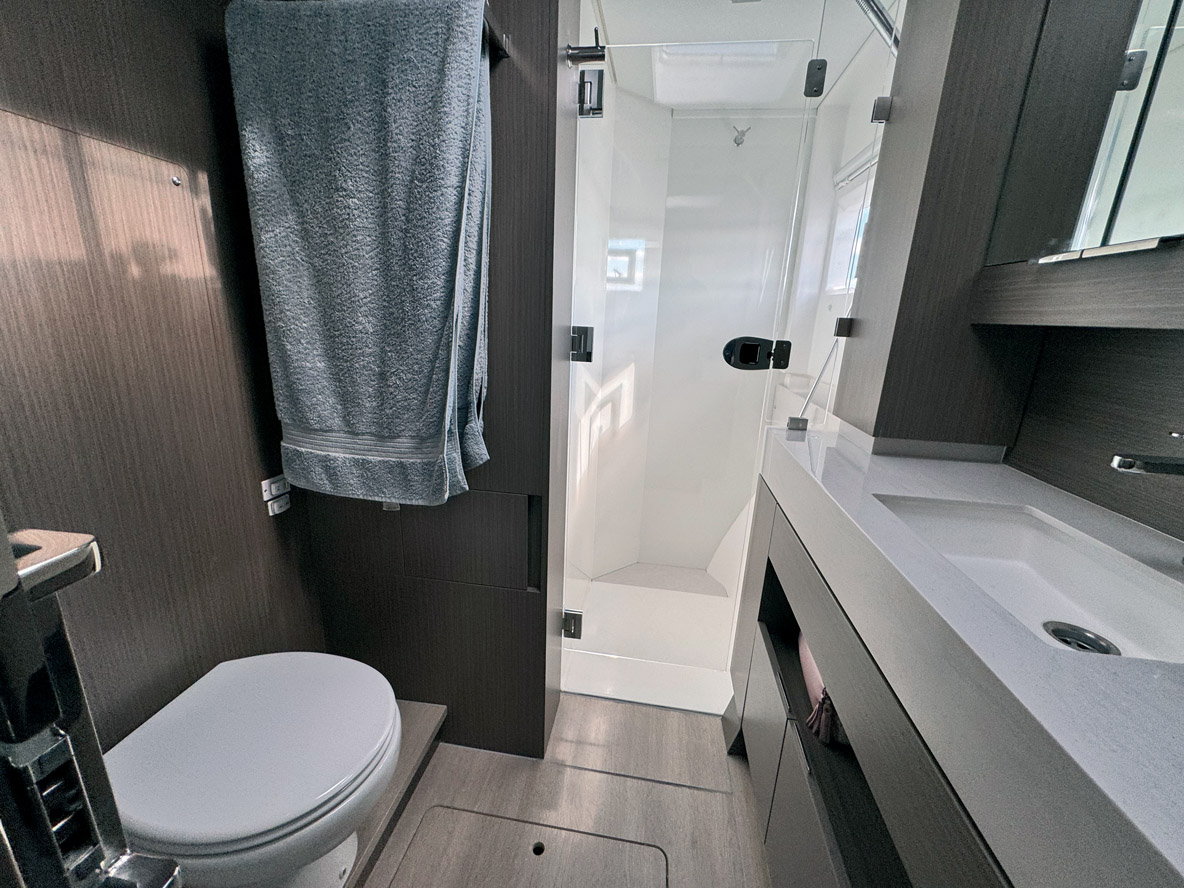
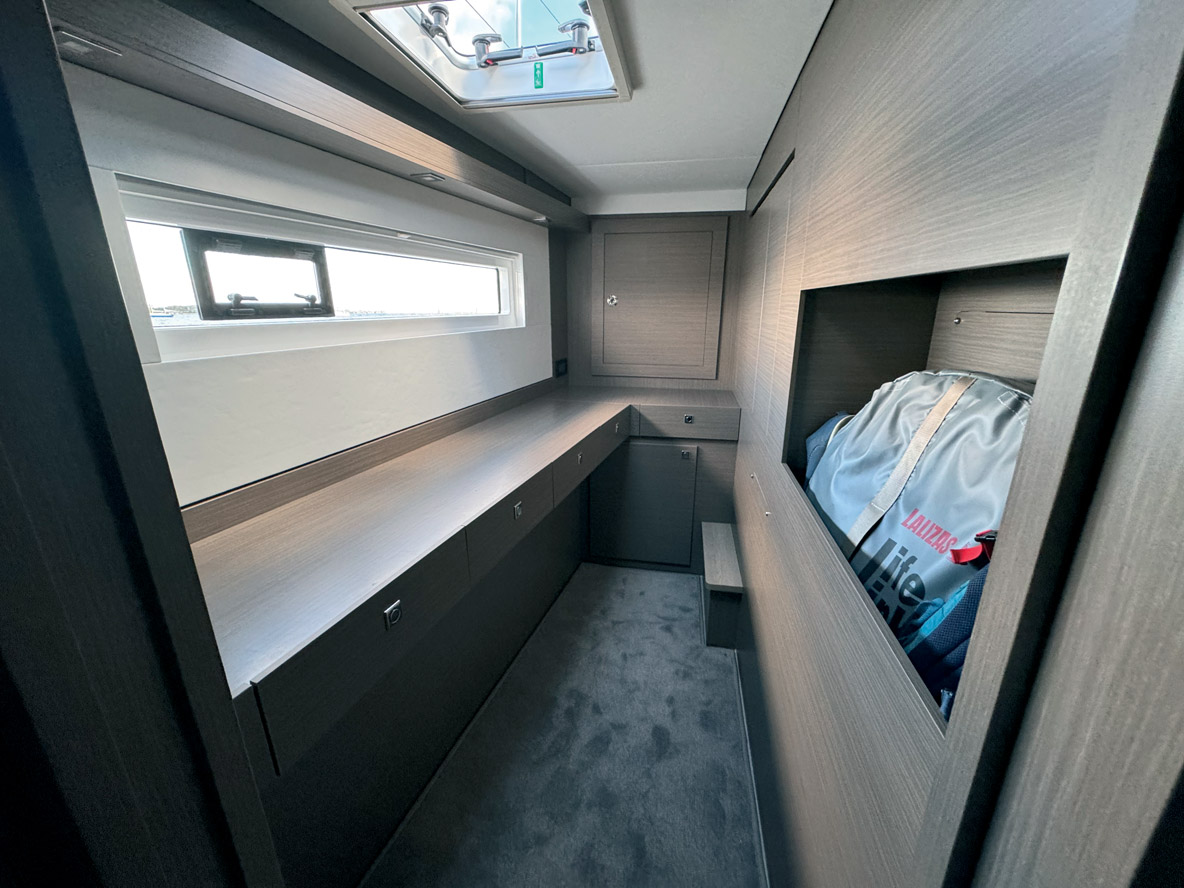
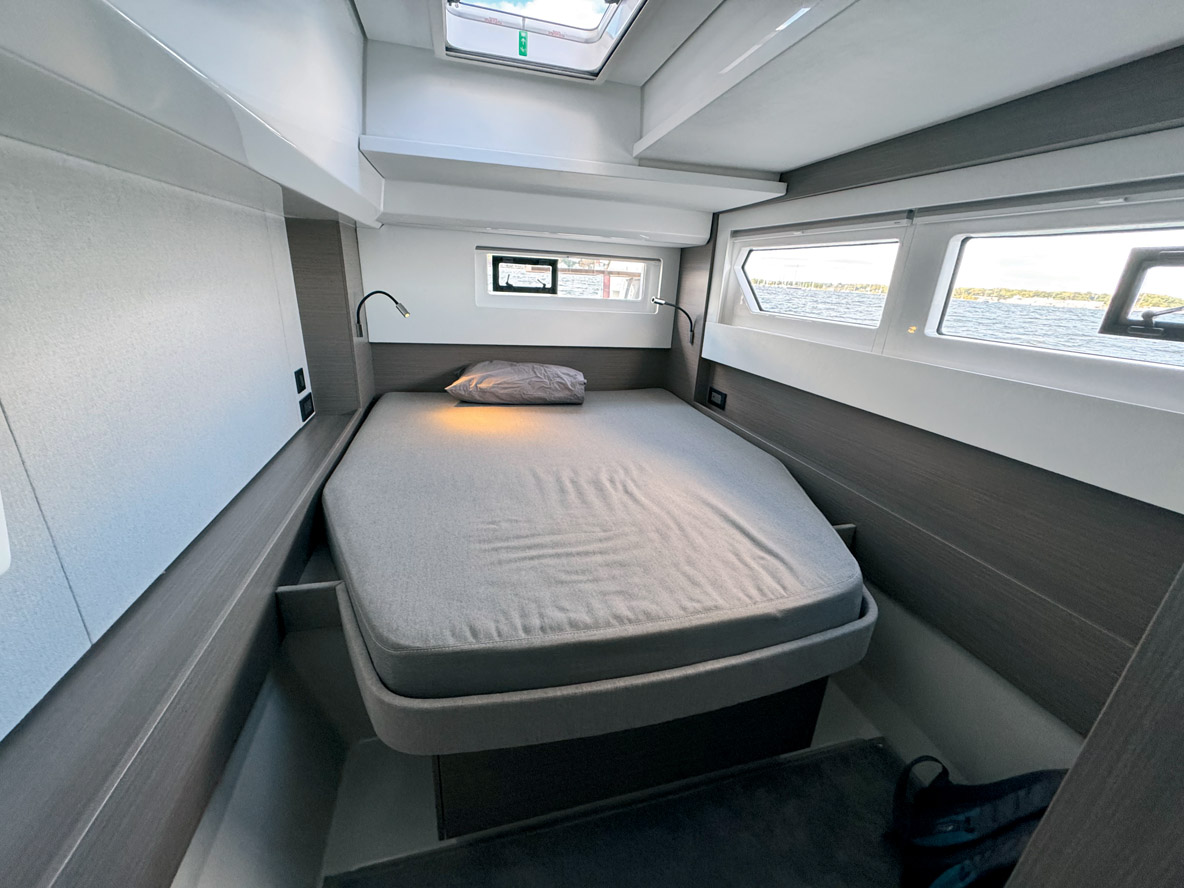
By completely redesigning the interior layout, Leopard was able to optimize space. As a result, the Leopard 46 is available in three, four and even five cabin versions, including the crew cabin - not bad for a 46-foot catamaran. The three-cabin version offers considerable volume, as the owner’s cabin occupies a good part of the starboard hull, and is complemented by the “utility room”, a multi-purpose cabin that can be converted into storage, a workshop or any other use you can think of - a blessing for long-haul sailors. The port hull houses the other two cabins, one of which has the bed in a transverse position, and above all, separate access for the two cabins. The four-cabin version follows more or less the same layout, but with the forward part of the starboard hull transformed into a cabin. Finally, in the five-cabin version, two bunk beds and a small toilet are housed in the middle of the port hull, with shared access between this cabin and the one on the bow. This last version is particularly well suited to chartering. What’s more, each owner is free to configure the catamaran as he or she sees fit.
Thanks to the long hull portholes, every nook and cranny of this sleeping area benefits from natural light and, above all, a direct view of the sea, which is very pleasant.
As for the furniture, the builder has opted for simple lines and materials in modern colors, which lighten the visual aspect of this interior. Of course, woodwork and fabric colors can be chosen from a wide range of possibilities, and the long list of options means that each catamaran can be customized as desired. Robertson & Caine’s construction and assembly techniques are of the highest quality, but this comes as no surprise, as this South African shipyard has a long tradition of reliability.
The Leopard 46 comes as standard - with a 5,000 W inverter, convection microwave oven, sound insulation panels and much more.
Longer Mast and Increased Sail Area
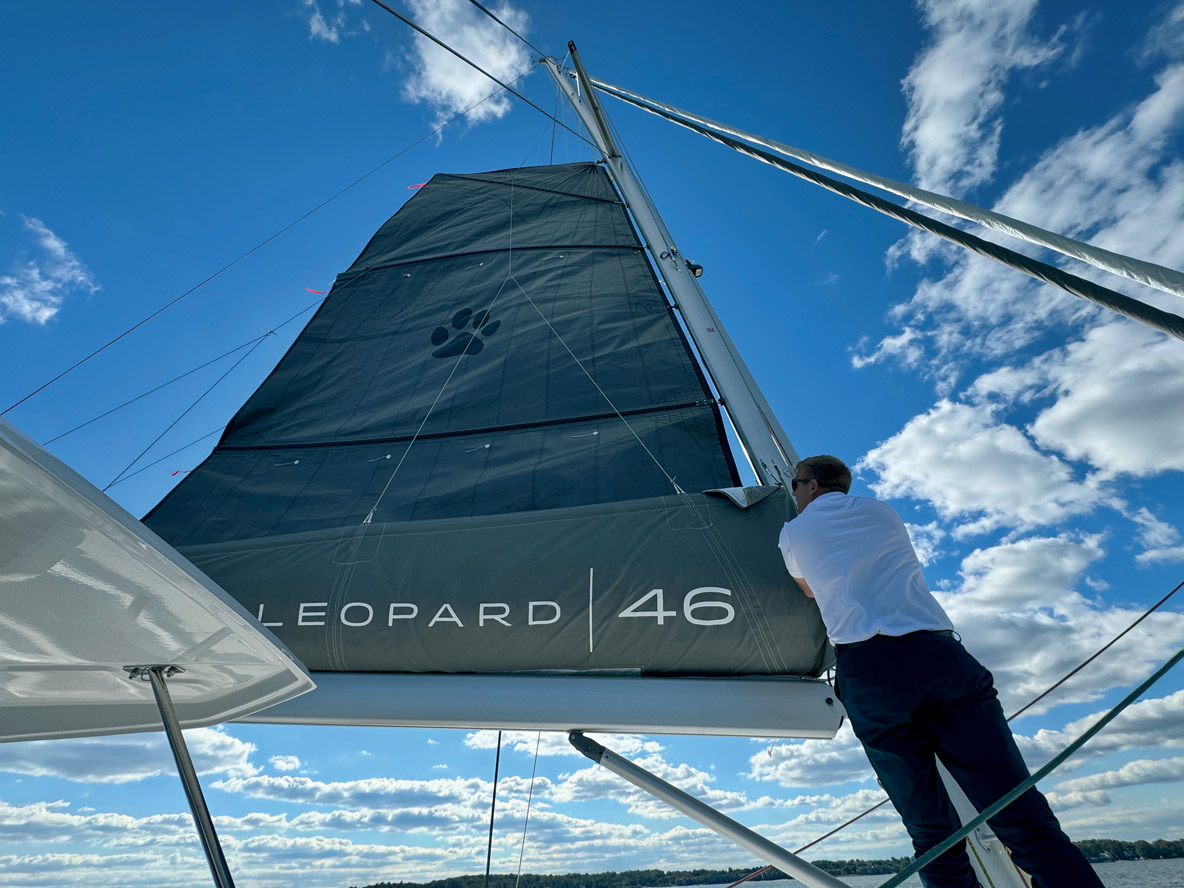
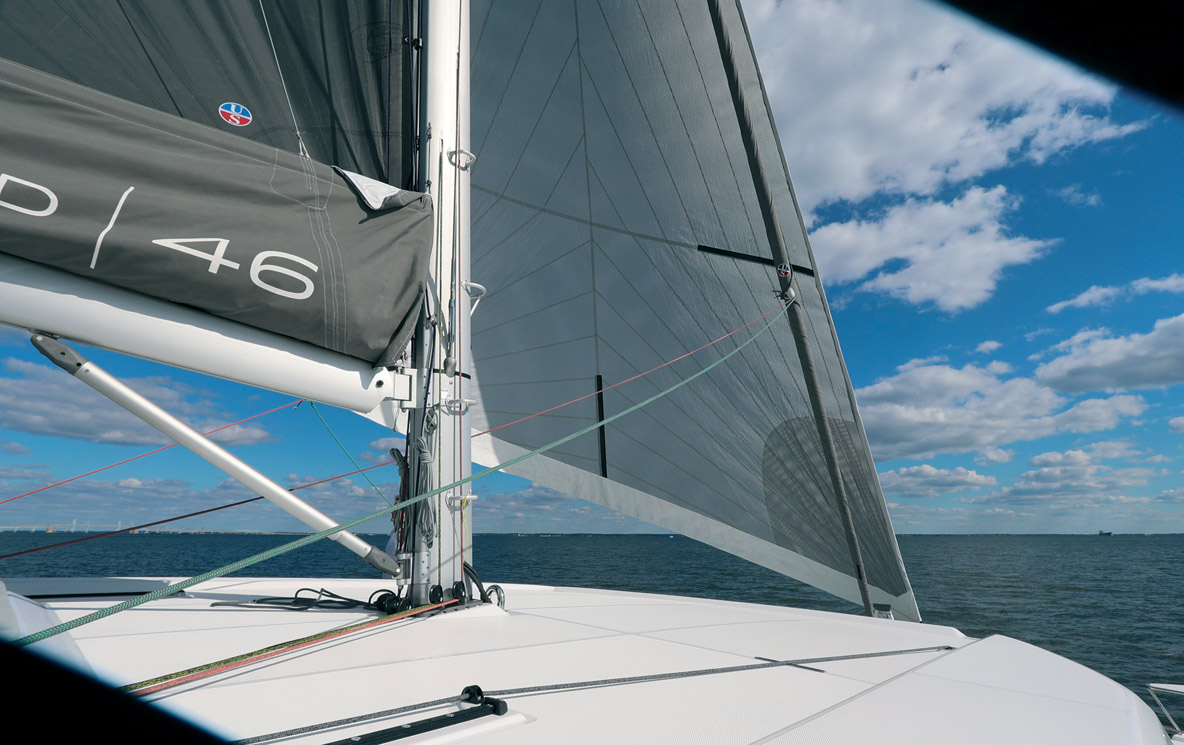
Faced with increasingly fierce competition in this key segment of the 45/50-foot market, it’s important to keep a competitive catamaran, a fact that the shipyard has clearly understood, especially as the Leopard 46 is heavier than its predecessor, weighing in at just over 17 tons. The Leopard 46 therefore gets a slightly longer mast and slightly more powerful winches. This brings the standard sail area to 144.4 m² (1,554 sq ft), with the option of adding a spinnaker and/or gennaker. There’s even the option of a set of Ullman sails optimized for performance.
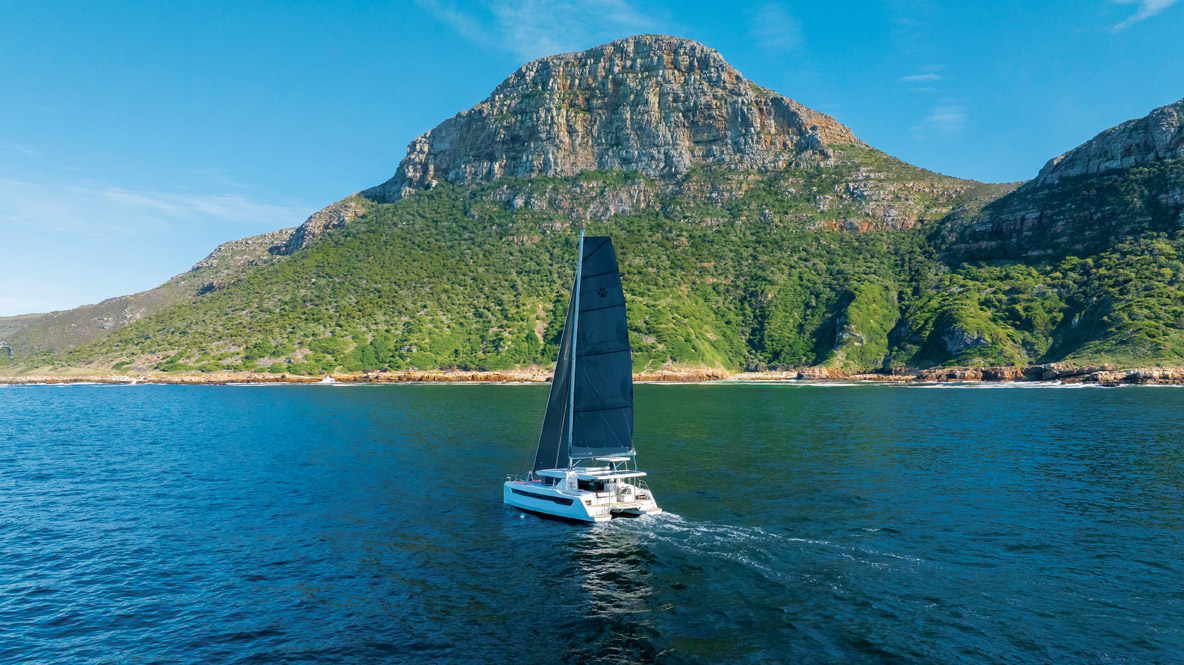
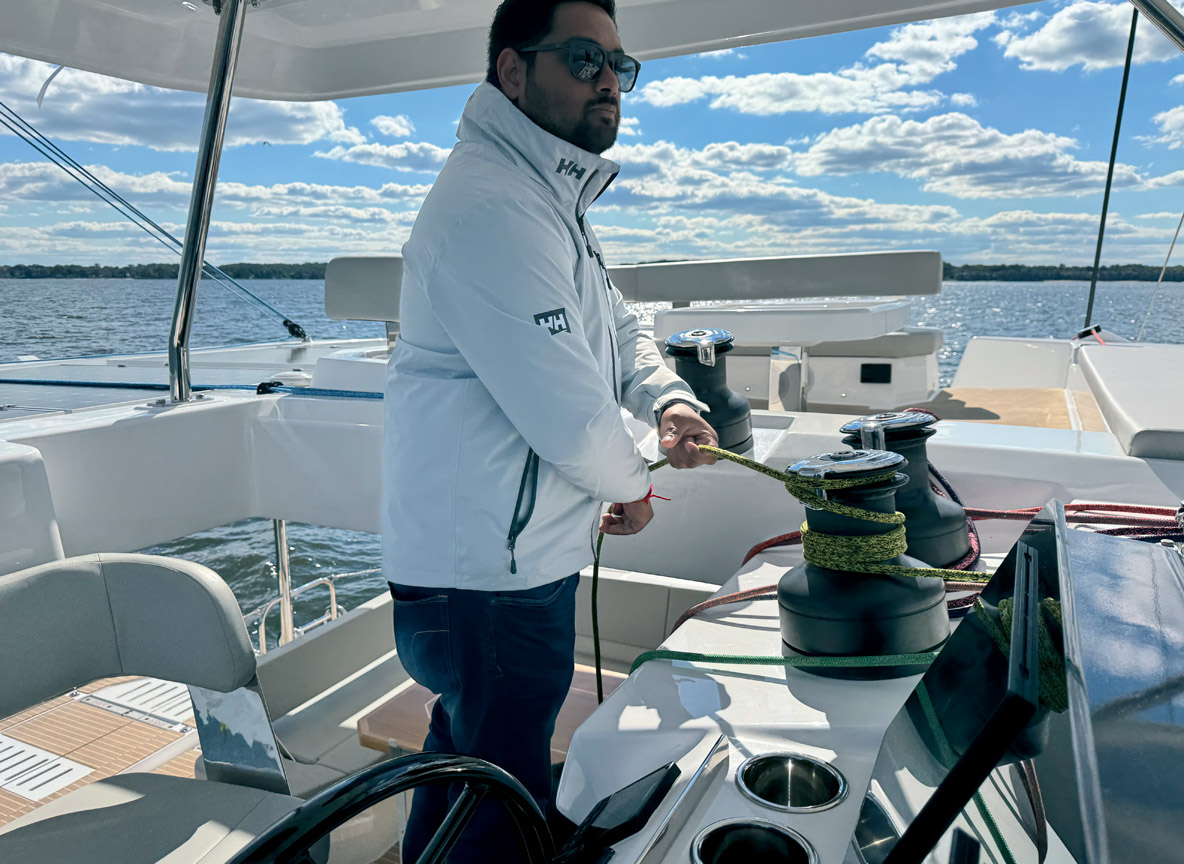
For our test, we had the standard sail with a Code 0, which is nowadays an essential sail for boosting a pure cruiser. To put the 46 through its paces, we had an easterly wind of 7 to 9 knots, with smooth sea. Rather mild conditions, in line with what we often find in Chesapeake Bay, but already giving us an idea of the new Leopard’s capabilities. The first thing to notice is just how easy it is to use. Everything has been designed to be controlled from the helm, making this catamaran easy to operate single-handed. The second pleasant surprise, once the sails are hoisted, is the catamaran’s responsiveness, taking advantage of the slightest breeze to accelerate. The 46 needs a little time to establish a stable speed, but once underway, its performance is quite satisfactory. As a catamaran with skeg keels, its optimum performance lies around 90° to the true wind, and this is precisely where we achieved the best results. Under code 0, with 11.5 knots of wind, the Leopard 46 made 7.8 knots.
Then, as we tacked, we hit a little more wind, enabling the multihull to reach 8.5 knots with 14 knots of wind, which is pretty decent. In slightly more sustained conditions, the catamaran should easily maintain a speed of 9 knots, which is quite satisfactory for the boat’s program. Unfortunately, we didn’t have a spinnaker on board this model. A pity, as the catamaran should perform quite well with this sail. In addition to performance, we really appreciated the smoothness at the helm, as well as the multihull’s responsiveness. Tacks and gybes are carried out smoothly, making sailing all the more enjoyable.
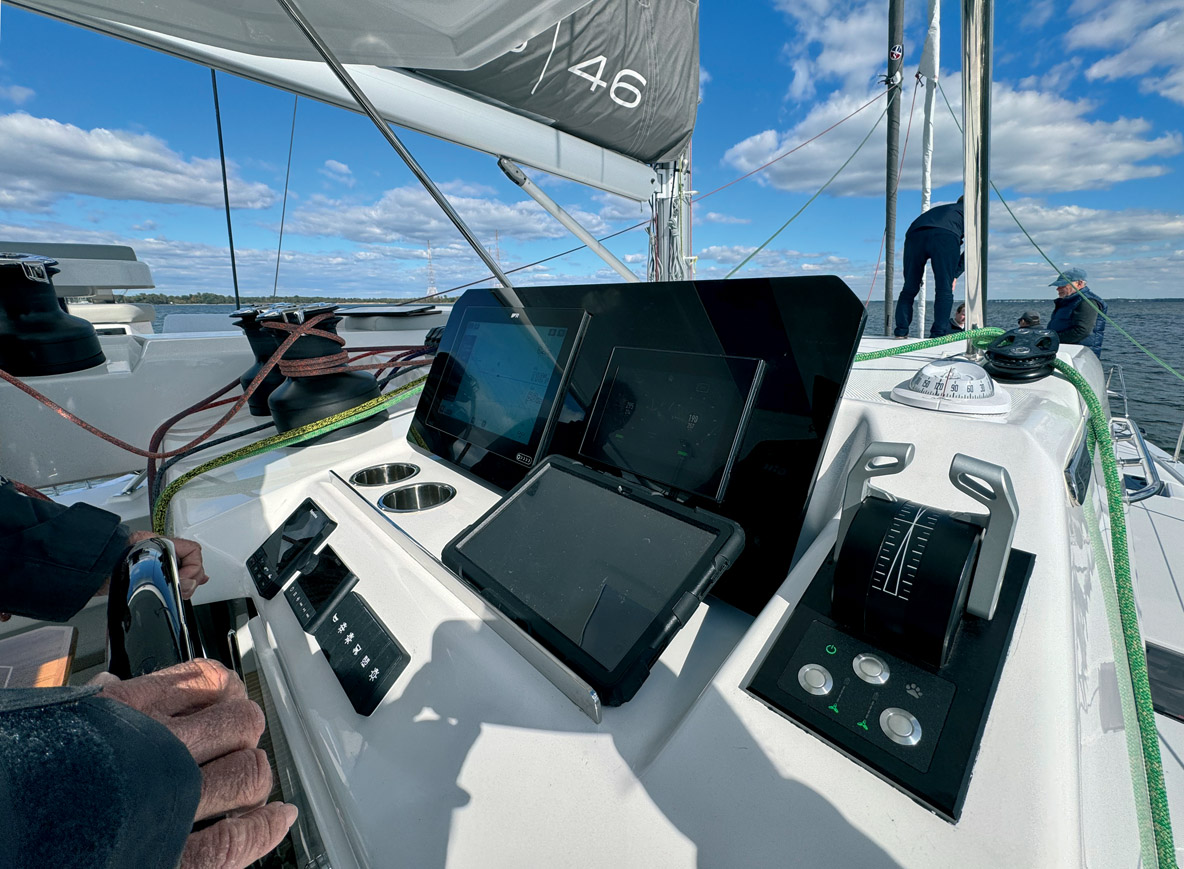
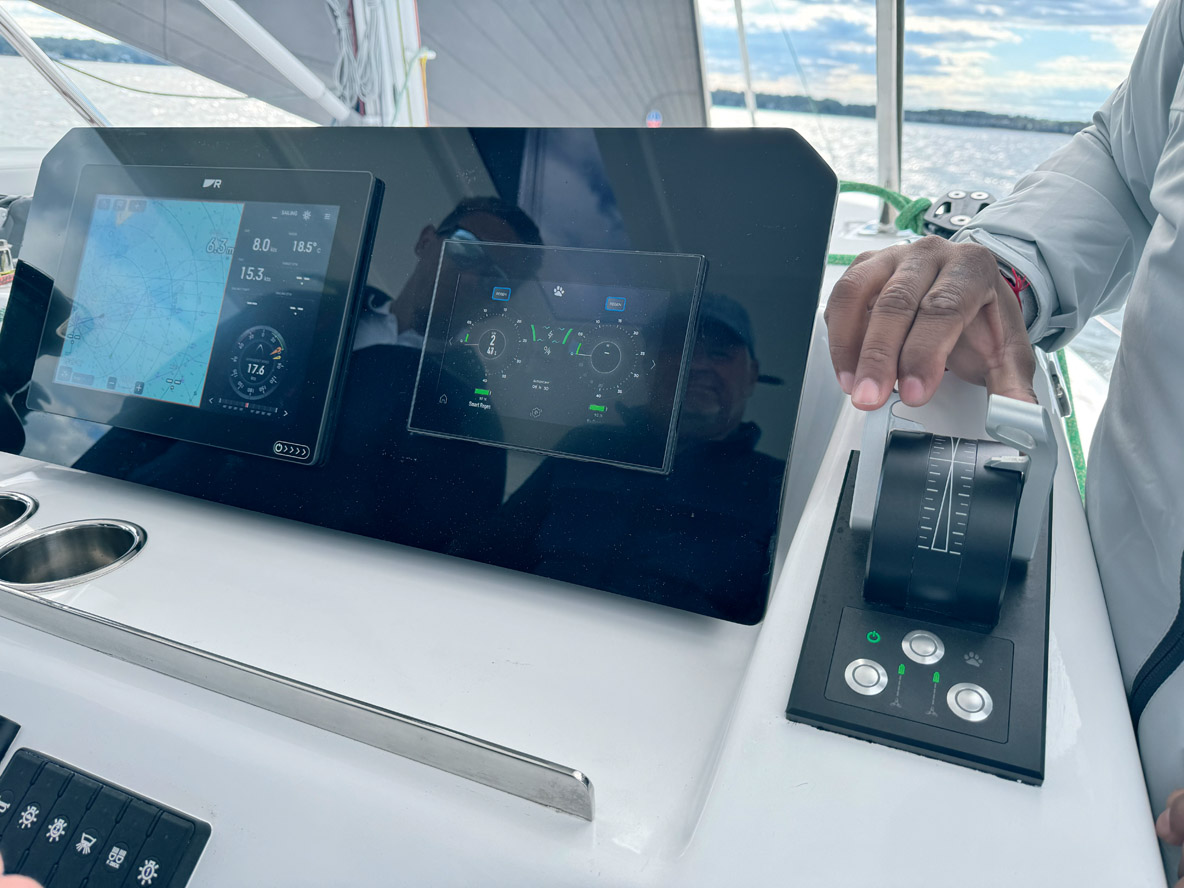
When it comes to on-board comfort, the helm station is also to be commended. It has a clear view of the sea and the rig, as the hard-top is fitted with a roof window, and is fully electronically equipped to keep all the necessary information at hand. It also allows you to keep in touch with the rest of the crew, whether below in the cockpit or in the sun lounge just beside. Last but not least, the whole helm station can be completely enclosed by a transparent canvas, a real plus for rainy days.
Optional Electric Propulsion
To get out of the marina or for windless days, the Leopard 46 is equipped as standard with two 45 HP Yanmar engines, which can be increased to 2 x 57 HP as an option, a proven power in this category.
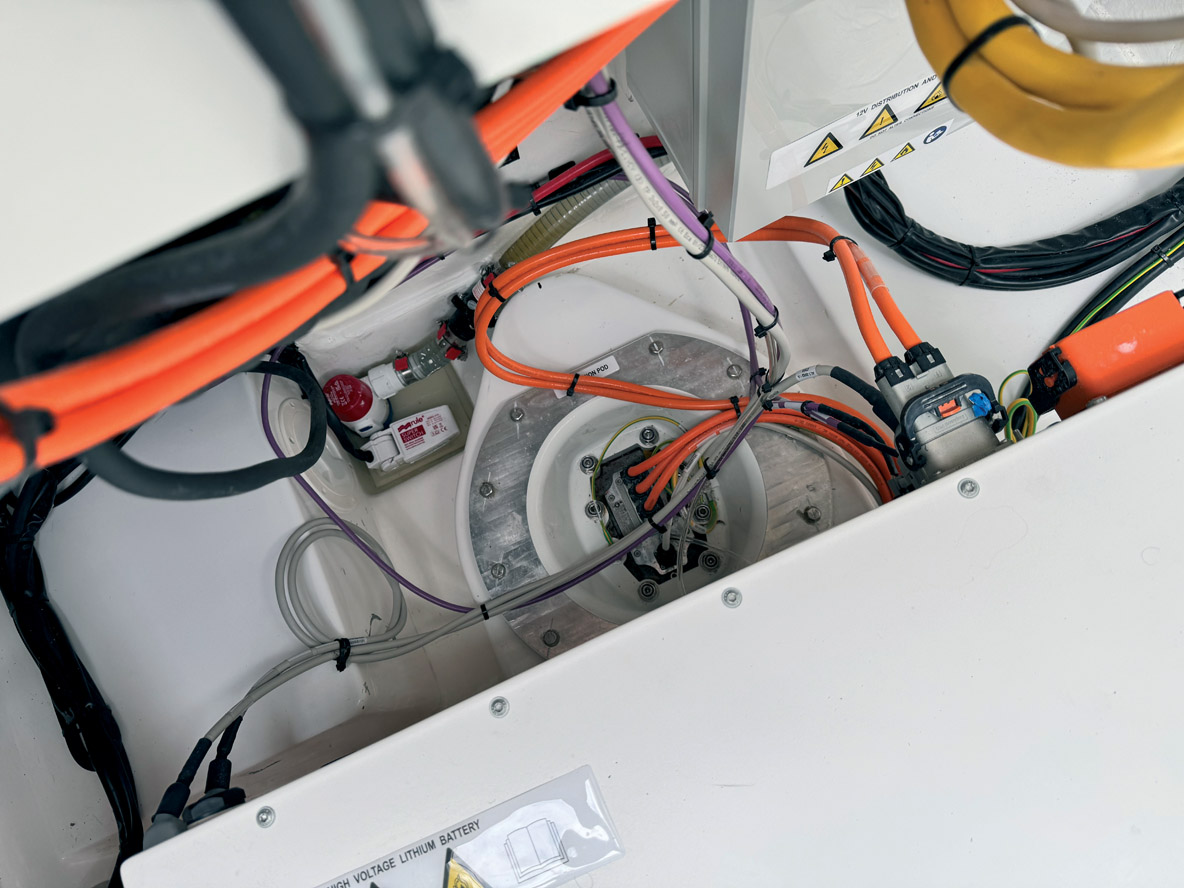
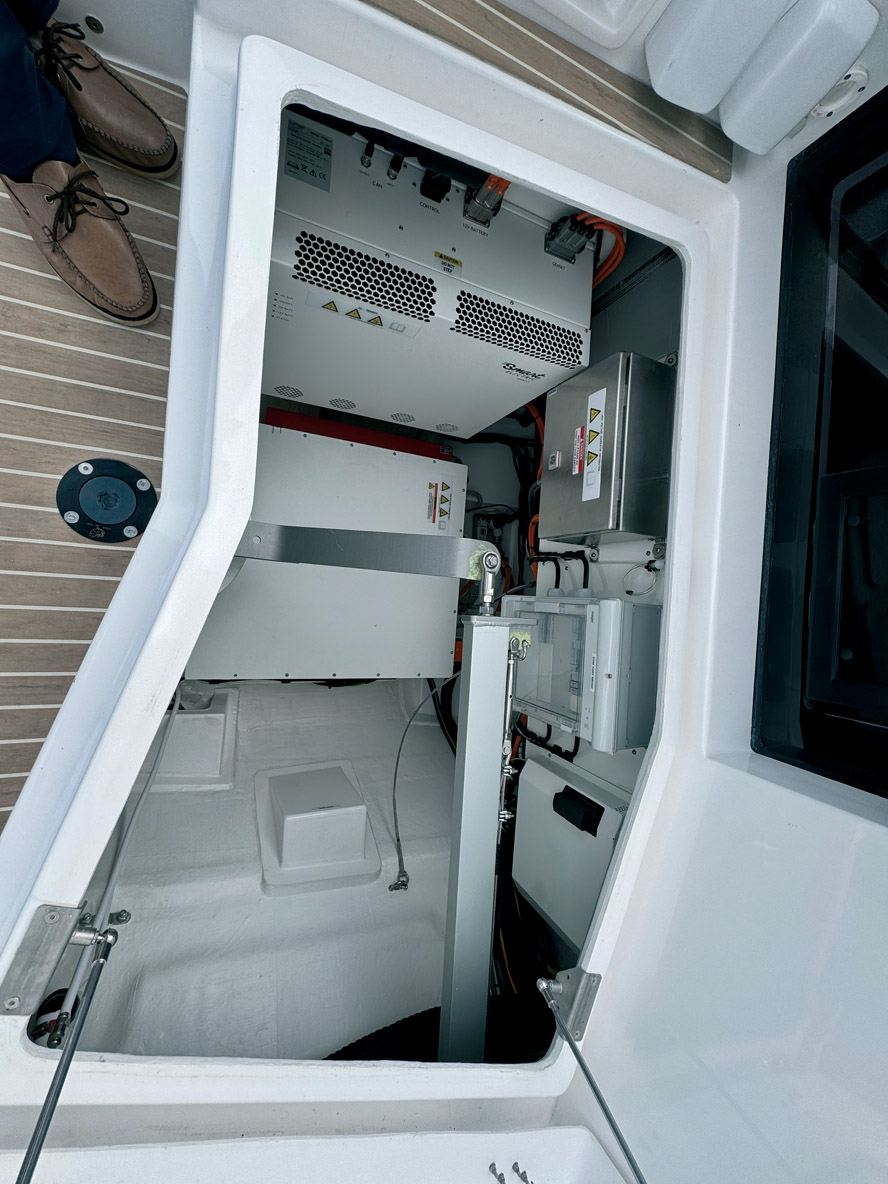
However, there’s another, far more innovative option: the catamaran is available with electric propulsion, a first for the ship- yard which, after extensive testing, validated the system developed by Fountaine Pajot. A carefully considered choice - and a wise one, since it’s the high volume of orders that will bring the price down - which relies on two 25 kW (34 HP-equivalent) pod-type electric motors associated with two 27 kWh lithium batteries. This electrical energy comes from a number of sources, starting with solar panels, a generator and a clever propeller-driven hydrogeneration system that recharges the batteries when under sail at speeds of 4 knots or more. The whole system is controlled by the HMI, a simple and intuitive interface that indicates the status of the electrical system in real time, i.e. the production of solar energy or that coming from hydrogeneration. It also allows you to intervene on the system to fine-tune settings, and in particular to choose the desired percentage of hydrogeneration. If the battery is too weak, the system automatically switches on the generator to replenish the charge, and in the event of overload, the system automatically goes into safety mode. This is an effective solution that ensures almost total energy self-sufficiency when cruising. In terms of safety, the battery bank is equipped with an extinguishing system to prevent on-board fires, and is also designed to withstand humidity, high temperatures and vibrations. Finally, the battery pack is EMC-compliant, meaning that it is designed to operate with- out creating electromagnetic interference for other on-board electronic devices. The batteries are rated for 4,000 cycles, so there’s plenty to look forward to. The only downside is that the cost of the system ($187,000) is currently rather high.
Conclusion
Replacing a successful model is always a risk for any manufacturer. To carry out this mission, Leopard took care to capitalize on its success by improving what could be improved. The result is convincing: the Leopard 46 features a reworked, highly livable interior, without sacrificing performance or comfort. The real surprise of this 46 is the possibility of choosing an electric motor; a new feature that allows the manufacturer to stay in the race. In short, the Leopard 46 is a smooth evolution... which, in our opinion, is sure to be as successful as its predecessor.
Performance
Possibility of electric propulsion
Electric propulsion system cost
Many options
Technical specifications
Architect: Simonis & Voogd
Overall length, 47’6” (14.48 m)
Beam: 24’1” (7.35 m)
Draft: 5’6” (1.65 m)
Unladen displacement: 37,939 lbs (17.2 t)
Standard drivetrain: 2 x 45 HP Yanmar
Fresh water: 185 US gal (700 l)
Fuel: 182 US gal (690 l)
Black water: 48 US gal (181 l)
Upwind sail area: 1,554 sq ft (144.4 m²)
CE Category: A
Price: $789,000 ex-tax, ex yard (South Africa)
Main options in $ ex-tax
Electric propulsion: 187,303
Yanmar 57 HP (x 2): 13,879
Audio system: 8,900
Autopilot: 1,651
Air conditioning 18,000 BTU: 46,591
Solar panels 2 x 400 W: 7,776
Watermaker: 21,464
Ice maker: 3,644
Asymmetric spinnaker: 10,727
Code 0: 6,586