
With the new 50, Leopard are aligning themselves slap bang in the target sector of cruising catamarans - the most competitive one! At the crossroads of charter use: luxury charter or to be sailed by connoisseur owners, the 15m catamaran is just about the critical size. Has the Cape Town-based shipyard hit the mark?
Infos pratiques
- Le chantier : Leopard 50
- La fiche technique
-
 Découvrez notre vidéo exclusive
- Financez votre Leopard 50
- Assuez votre Leopard 50
- Articles autour du Leopard 50
A South African, in the top 3 multihulls builders worldwide!
The Woodstock yard was founded by John Robertson more than 30 years ago, with Jerry Caine joining him as partner in 1991. As early as 1995, close ties were forged with Moorings to supply the fledgling catamaran charter market (Moorings then merged with Sunsail into an international travel group and became the giant in the sector). Logistics control and customer knowledge (mainly Americans in the Caribbean to begin with, but now globalized) are driving the Leopard's design through a thorough rationalization of the features and increased equipment (cooling, air conditioning, electrical self-sufficiency). The arrival of Lex Raas (a defector from the Bénéteau group) to the position of operational director is accelerating this evolution, and the world leader in chartering is pushing Robertson & Caine in their development. This has enabled them to become one of the top three multihull manufacturers. Their experience of intensive use of the boats, the knowledge of the sailors' expectations and the availability of very competitive production and distribution tools now push Moorings / Sunsail to regularly renew their range and to diversify their commercial ambitions in direction of the owners. It’s not enough to convince investors or lessors. We also need to seduce private buyers! Over the last several years, Franck Bauguil, in charge of product development, has breathed new life into it, along with Simonis-Voogd's return to the design team.
The African “Multihull Valley”
The Robertson and Caine factory has grown to cover an area of 4.5 hectares in the heart of this southern region where many multihull shipyards flourish (there was already Gunboat and Tag, and now there is Knysna, Xquisite, Libra, Royal Cape Catamarans and St Francis...!). The yard employs 600 staff who produce no less than 4 units per week. The range, exclusively dedicated to catamarans includes 4 sailboat models (40', 45', 50' and 58') and two Power Cats: the 43' and 51'. The principal and associated operating requirements of the customer, combined with the experience of the manufacturer, guide the choices towards a resistant manufacturing process, and reinforced technical implementations to guarantee reliability for charter boats which can sometimes sail 40 weeks per year! This can also help to limit maintenance or repair work. The transition to partial infusion for the 50 is a clear progression, and should progressively become standard as the assembly line moves toward total infusion with its associated reductions in weight. The use of multidirectional E-laminated cloth, laminated over a high-density balsa core remains the norm. Isophthalic resins and gelcoat prevent the onset of hydrolysis (but an epoxy coating is an option for the underwater hull). The skegs are foam-filled with closed cell polyurethane. The 50, like all Robertson and Caine boats is doubly CE and IMCI certified and the construction meets all the ISO standards in force.
A redesigned silhouette
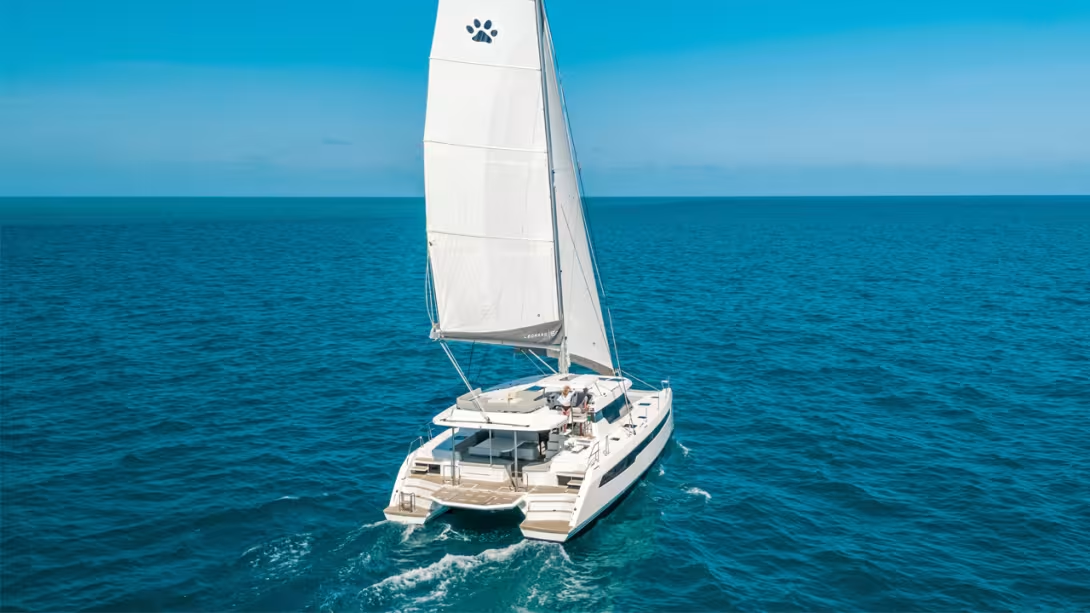
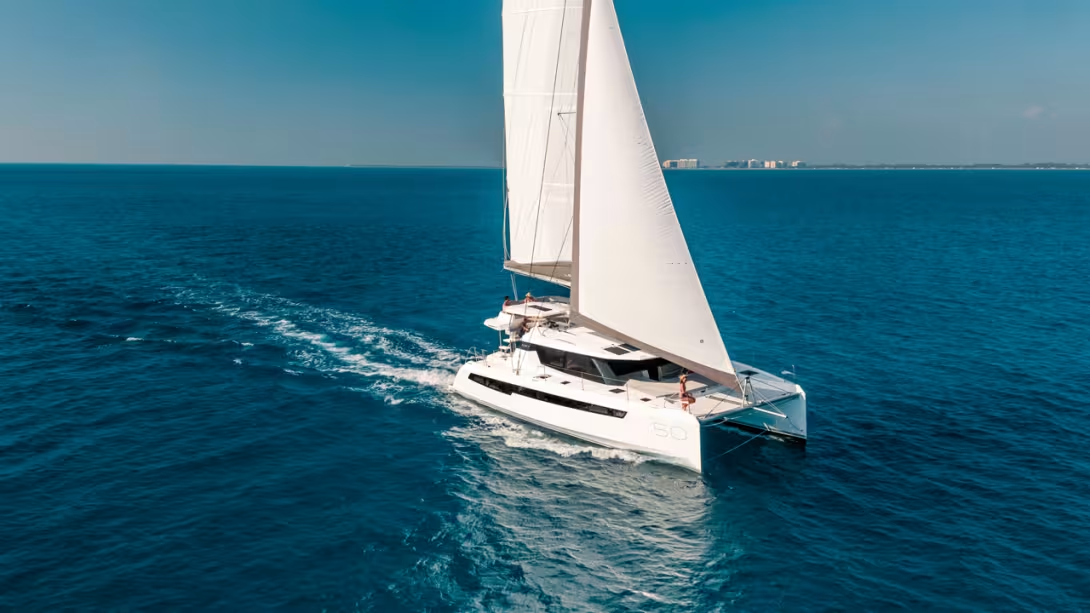
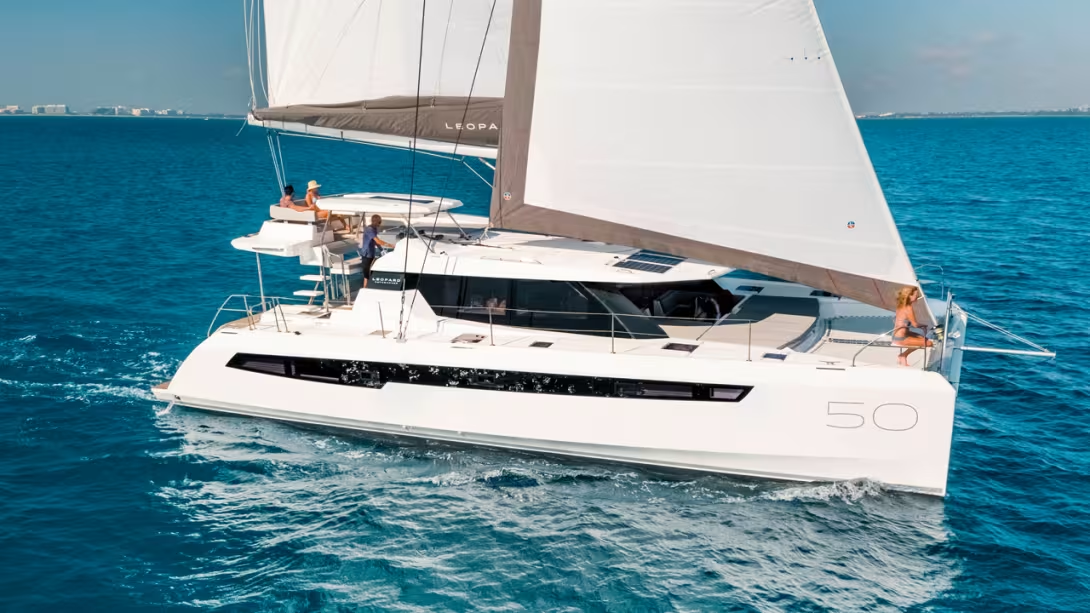
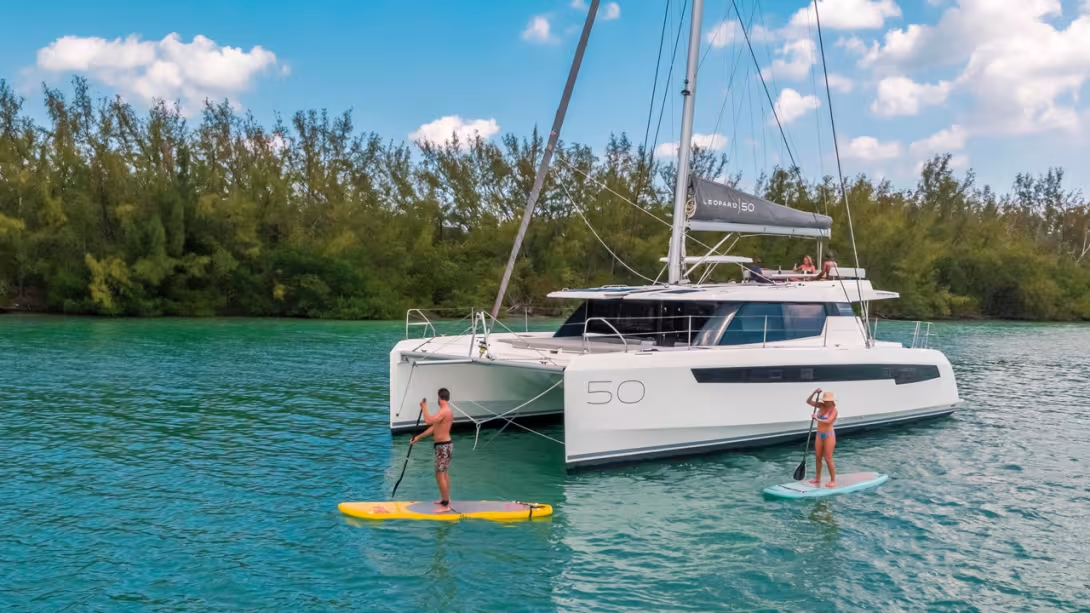
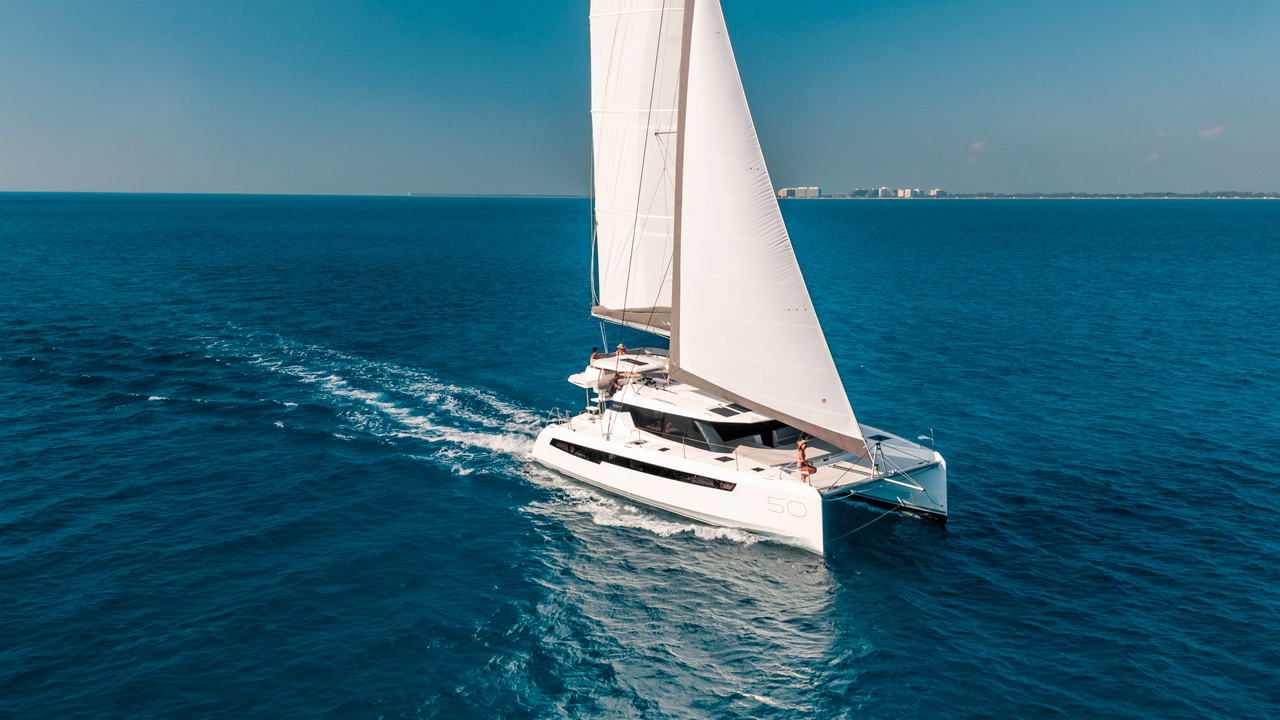
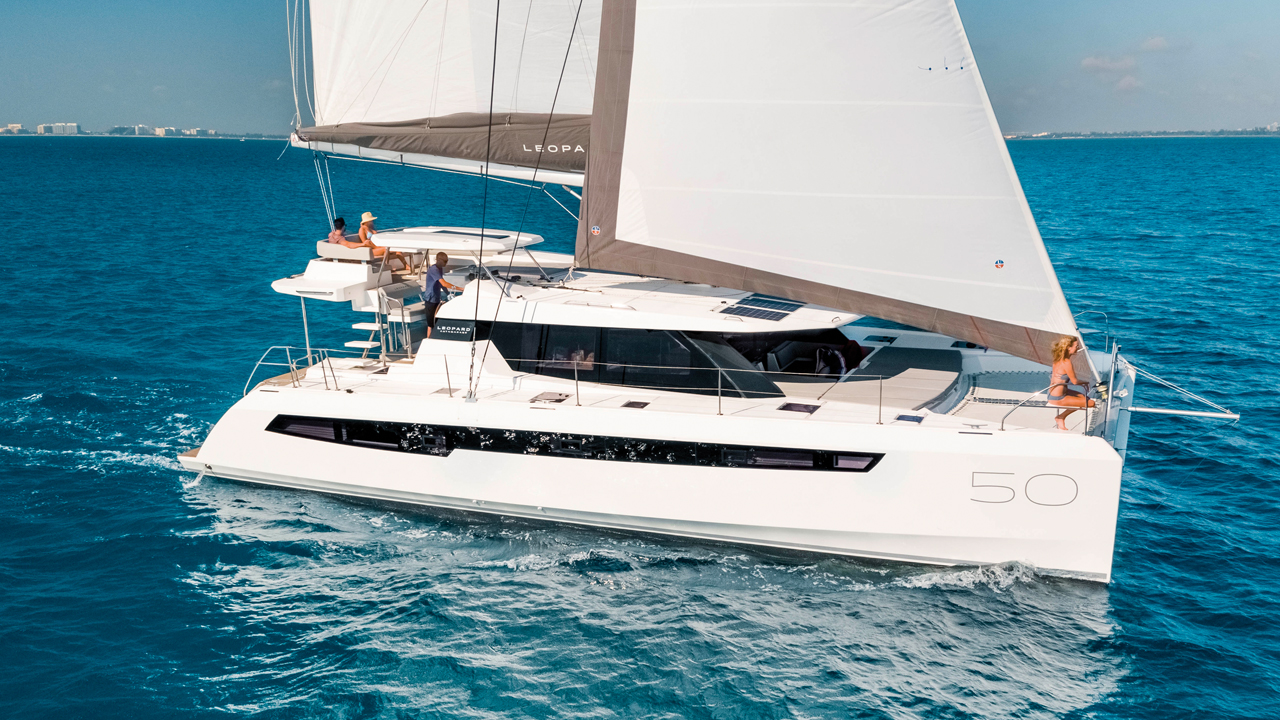
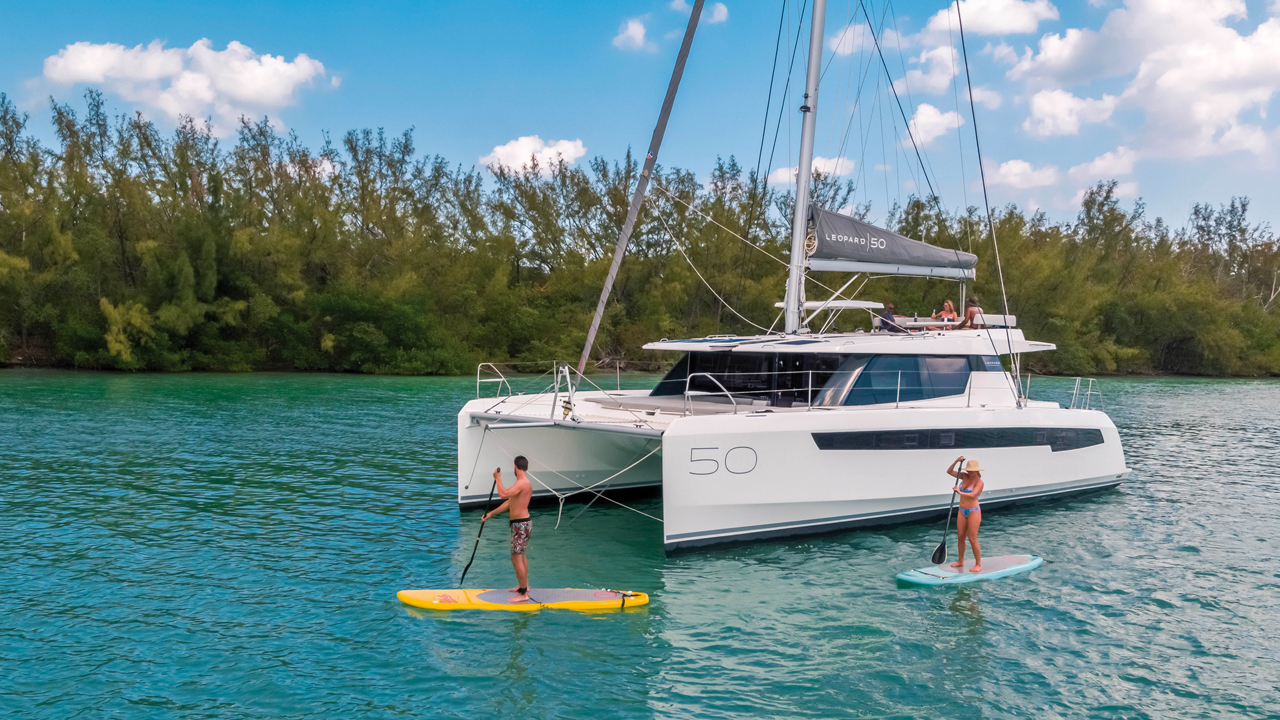
The overall lines of the 50 have nothing to do with the design of the 48’ generation from 2012: the bows have been redrawn, and are now straight, visibly offering a more forthright attack on the water. The step in the hull has been extended as far as the forefoot and the deck edge has been subjected to some skillful aesthetic smoothing, creating a much more fluid and flattering appearance. Despite more generous interior space, and hull sections widened compared to the 48', the distribution of volumes and the smoothing of forms significantly improve first impressions of the 50! The silhouette is more dynamic, deliberate and contemporary. The work on the coachroof uprights (more vertical, with deceiving black gelcoat) and the complete redesign of the windshields bring the 50 closer to the current trends in general styling without giving the impression that they have copied anything. The identity characteristics of the brand remain very real, and this design feels well-inspired.
The concept influences the construction
As the main bulkhead and aft beam have disappeared to create open space, the feat consisted in replacing these vital structural elements with mechanically equivalent structures hidden inside the chassis! Other yards have adopted this principle: the 1st generation Gunboats for example; Lagoon uses it to be able to move the rig further aft. On the Leopard 50, there’s a grid in welded stainless steel that replaces the main bulkhead, taking the torsional forces and the compression of the mast. This chassis, bolted to the bulkheads of the hulls which merge largely with the nacelle, is embedded in the saloon floor to create a homogeneous and totally invisible structural assembly (reinforced with carbon). Aft, the approach is the same, but the metal is replaced by filleting and composite bulkheads to create a structural box housed between the bottom of the nacelle and the floor of the cockpit.
Interior Styling Revolution
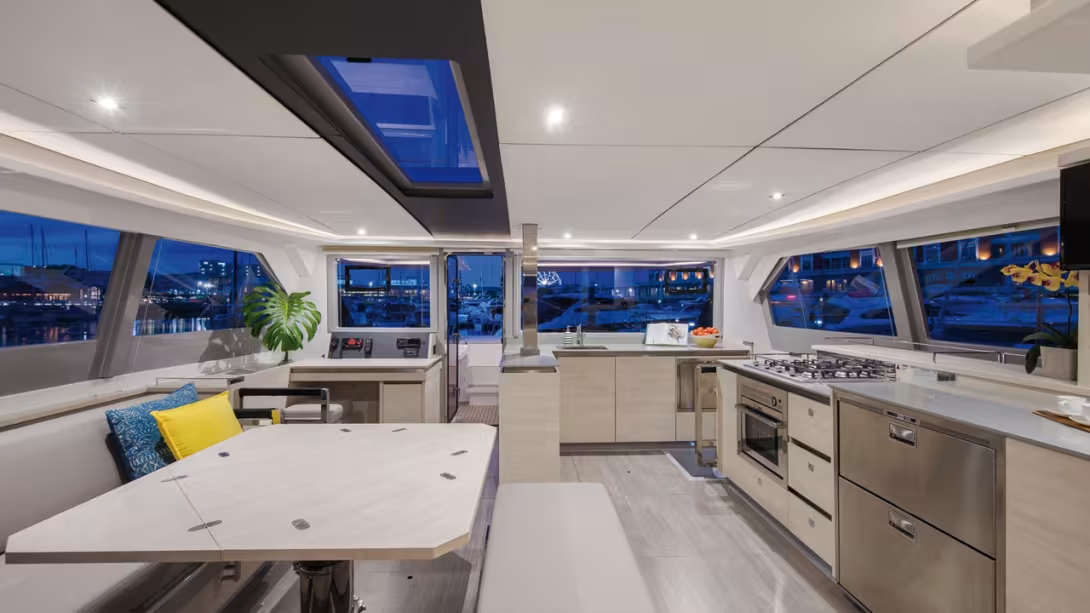
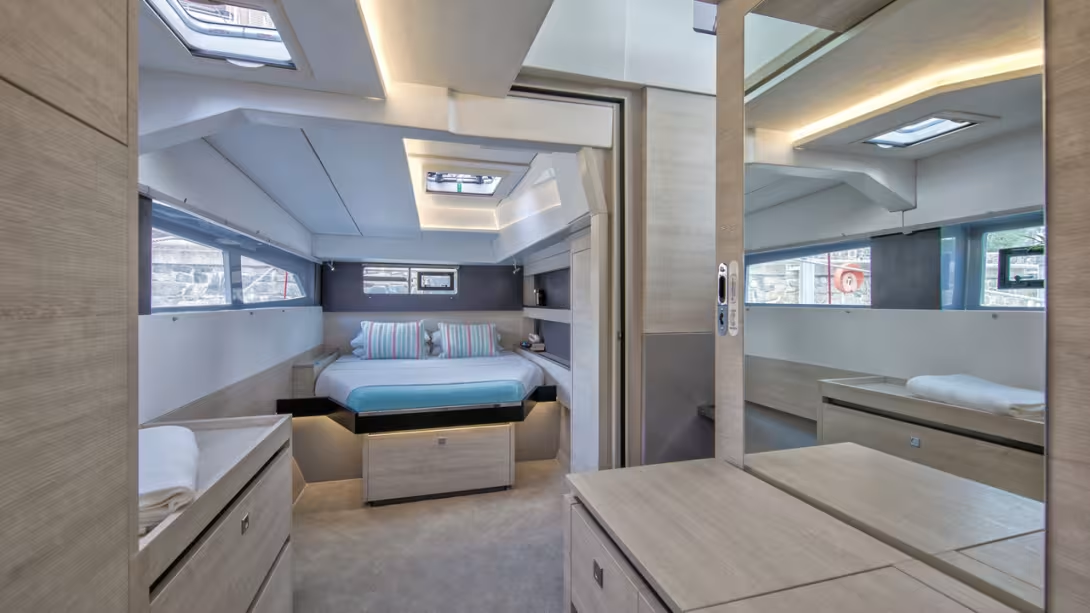
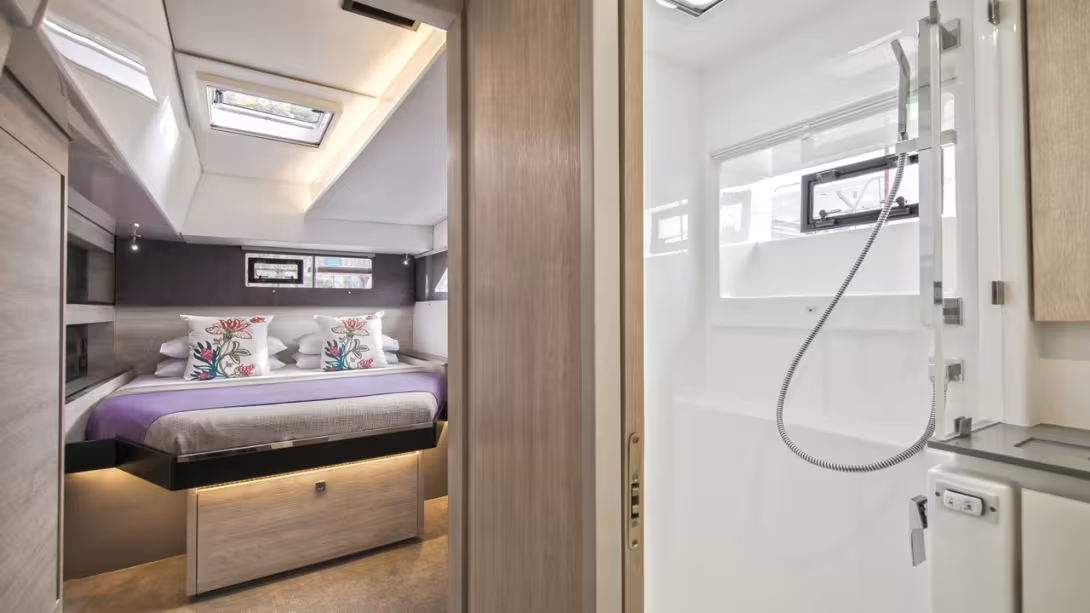
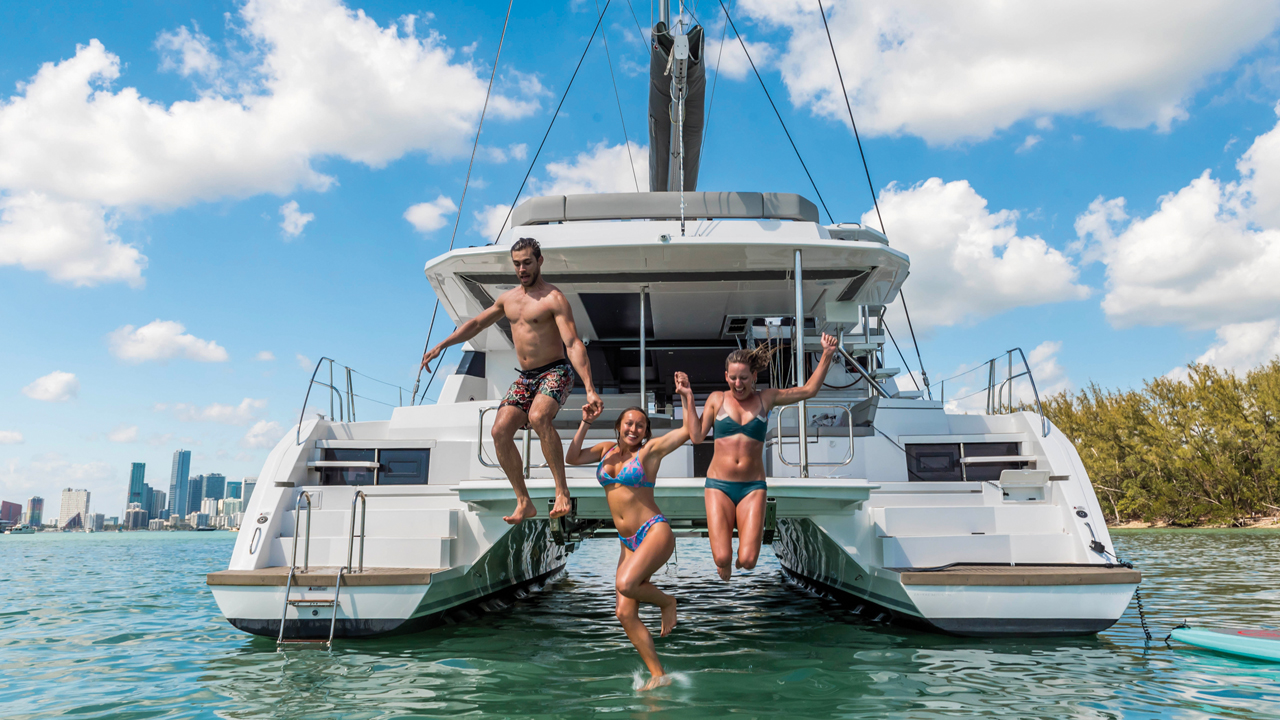
The 48 represented the pinnacle of cabinet-making in cherry wood, in which the yard was master. Naturally this has been picked up by the boat’s successor. Like the exterior design, the interior style is deliberately closer to European trends without letting go of the idea of home-comfort type volumes. Light is abundant, the UV protection effective, and everything clearly assembled with care. The plumbing, deck hardware, electrical fittings and the choice of galley elements contribute to a good overall perception of quality. On our test boat (among one of the first examples), I did pick up on one or two small details (TV screen too exposed, the bag for the lines overflows into the track of the sliding door...) and minor changes require updating, but we were shown the corrective sheet established for this purpose for future units. The layout of the 4-cabin version is particularly smart, with the boat offering each occupant the intimacy of an owner’s version combined with the friendliness of a much larger charter unit. The two cabins in the starboard hull (including the main cabin, aft) benefit from individual companionways and a level of privacy that will be much appreciated! This distribution of volumes allows for the boat to comfortably accomodate 4 couples, with the comfort of each cabin, the intelligence of the individual accesses, the abundance of outdoor spaces and the fluidity of the general circulation effectively helping to prevent the inevitable frictions related to the life in such a community. A real success! The boat is also available in a 5-cabin version, more specifically aimed at the charter sector.
Everyone on deck!
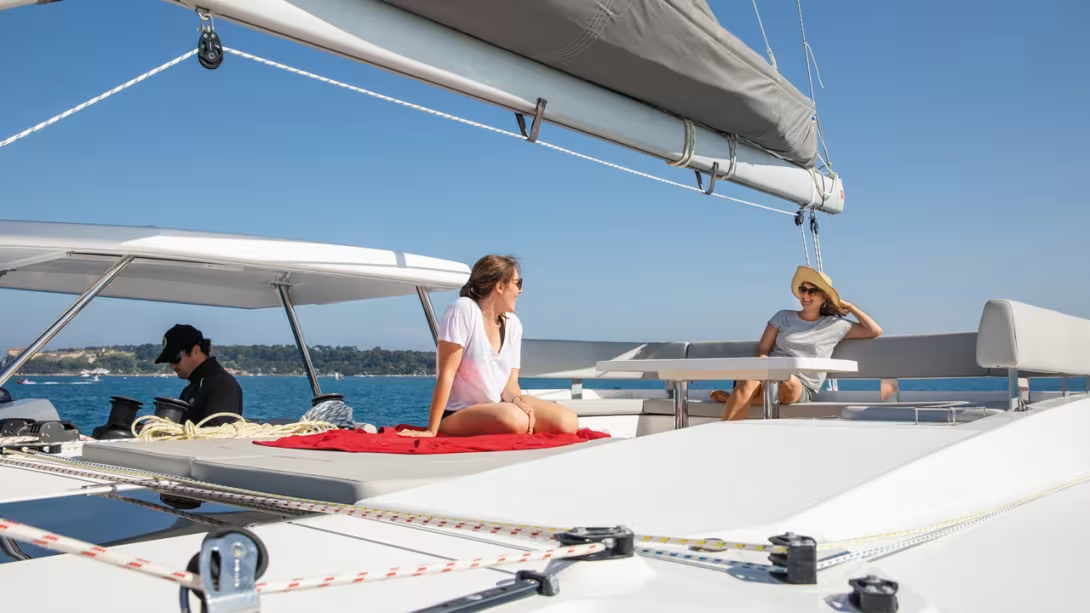
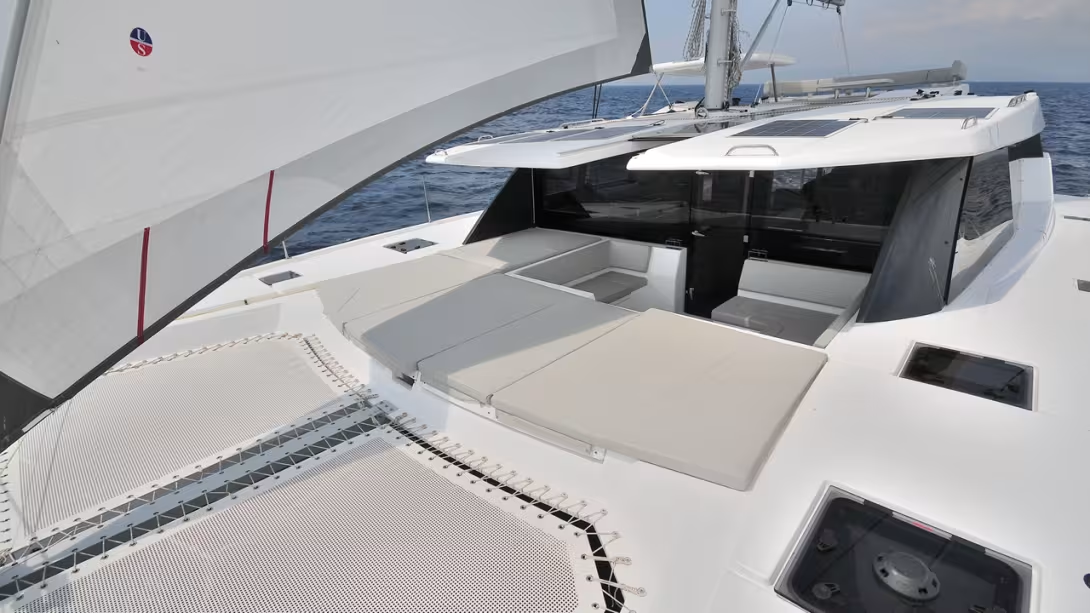
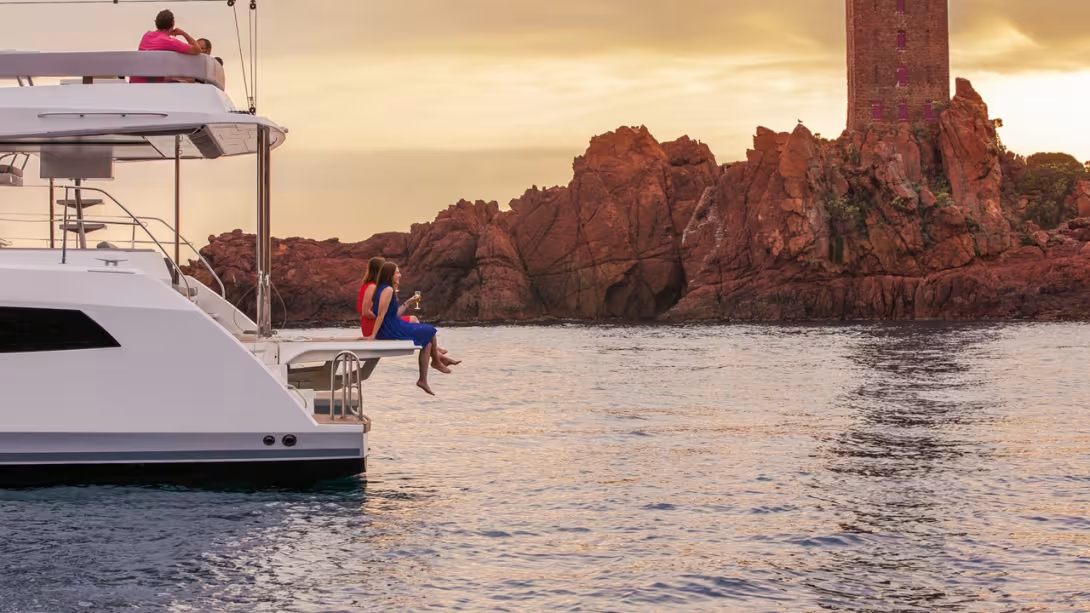
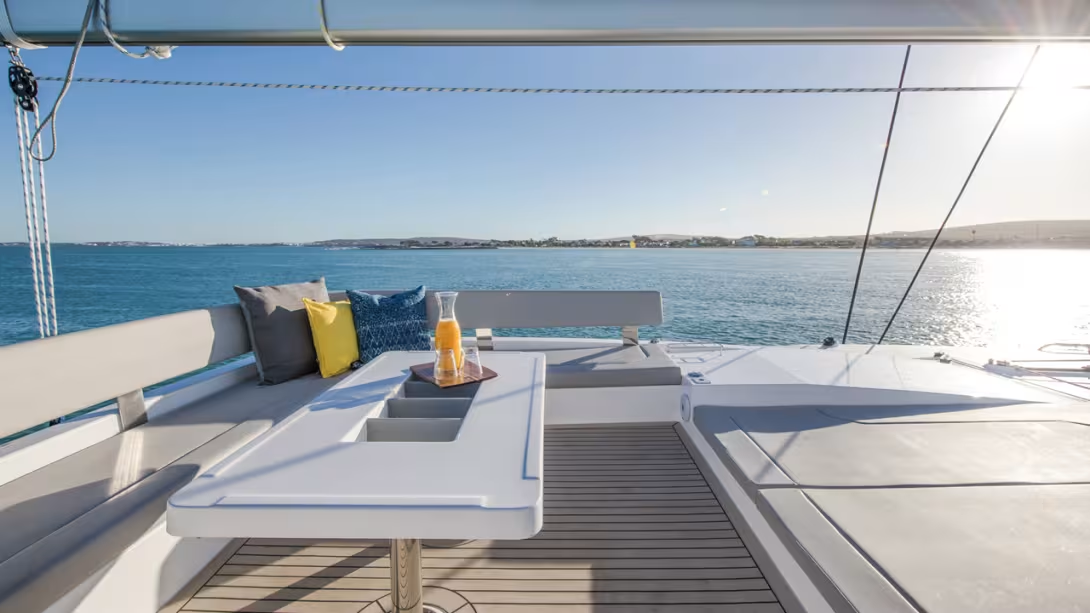
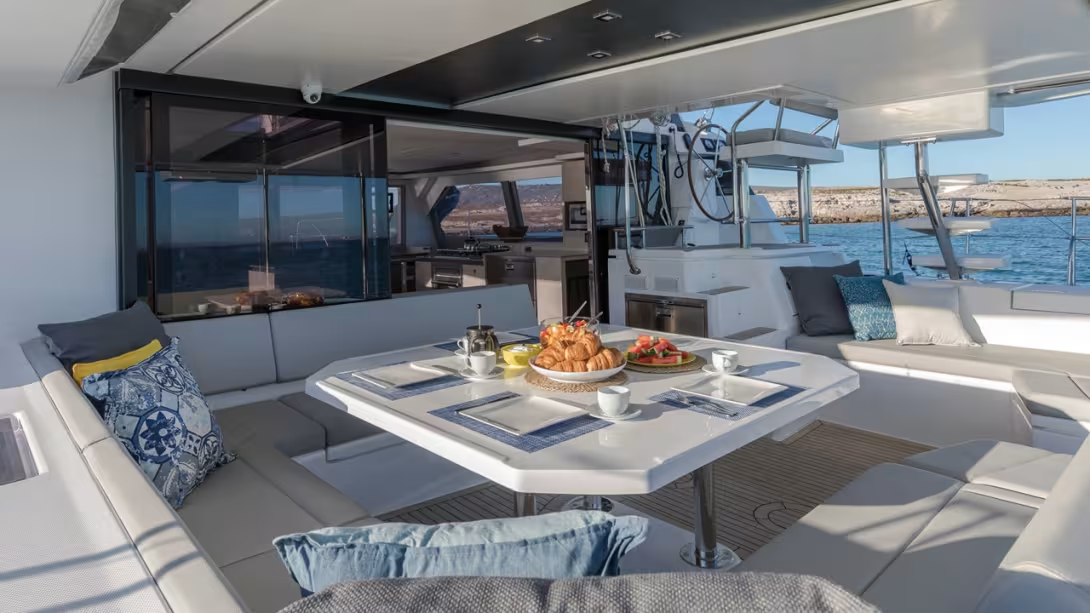
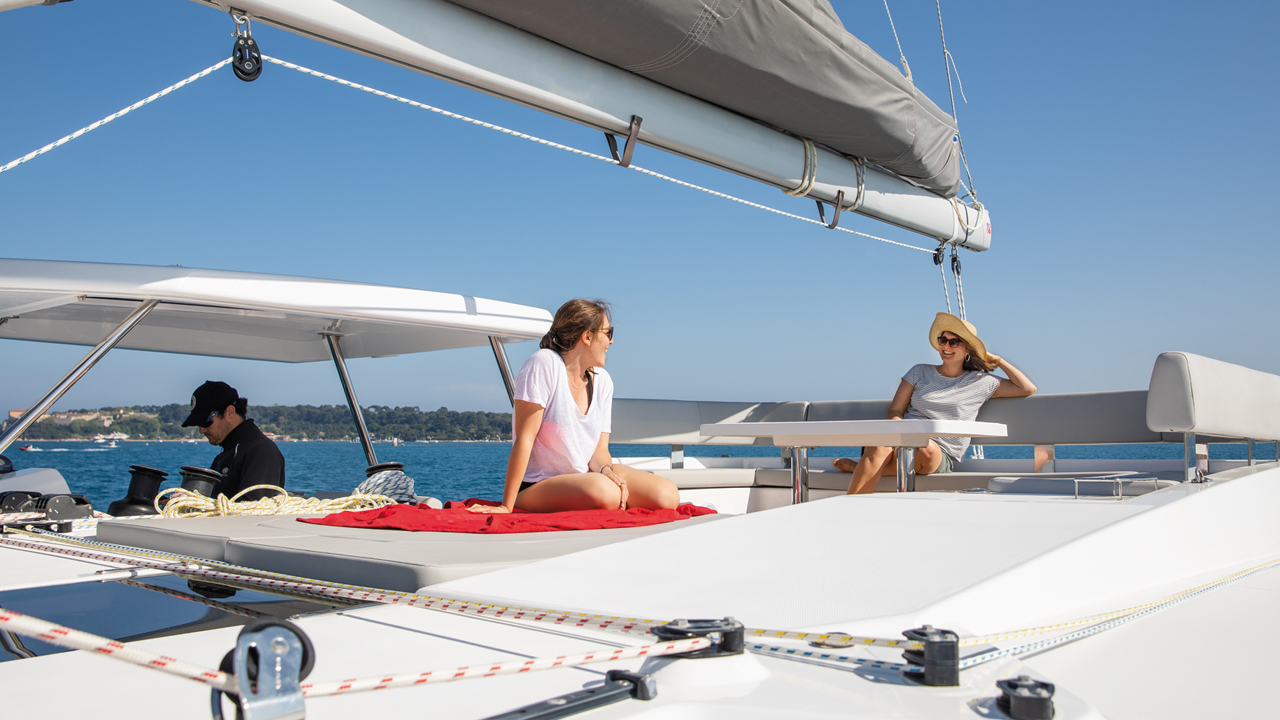
With its forward cockpit accessible from the deck saloon (something exclusive to Leopard), the 50 is becoming one of the champions in the category of boats with "outdoor spaces". The Lounge version that we tested with the upper terrace offering an attractive flybridge area, comfortable even at sea (in moderate conditions) stil retains the traditional cockpit common to both versions (Lounge and Performance). The cockpit remains the privileged refuge for night watches, evenings at sea or dinners at anchor.
A fun catamaran with a superlative deck plan
The 50 offers remarkable living space, but its displacement and its aerodynamic profile could penalize it. The 48 counted 18 tonnes, half-laden for 14.75m length and 143m² of upwind sail area. The 50 tips the scales at 22t with 163m² and 15.40m in length, but efforts on hull design and centering weights seems to disprove the numbers: the 50’s sea-keeping is more fluid, better balanced and less subject to pitch than its predecessor. The manual engine controls are perfect, firm and as clear as is necessary. No need for the complexity and extra power of electric levers! The power of the 80 hp Yanmars is convincing, exceeding 9.5 knots or a comfortable 8 knots at an economic cruising speed (for a consumption of 10 l / h. Warning, this increases to 20 l at 9 knots!). The difference in price of € 18,700 compared to the standard version (2x57 hp) encourages reflection on a sailboat catamaran with auxiliary engines, but the folding propeller option is not up for discussion, regardless of the chosen power. Fixed propellers are not very compatible with a multihull. For our test sail, we enjoyed perfect conditions (12-18 knots SE, with a slight sea off Saint Raphael in the South of France): a chance to discover our 50’ test boat in real conditions. The Cape Town yard is continually studying the ergonomics, with a full-size mockup deck plan and this remains relevant as it is apparent in different areas. The access to the helm station, the lounge deck or the forward cockpit feels natural and reassuring. The built-in deck hatches are pleasant underfoot and the generous sunbathing area provides an unexpected oasis of relaxation. The 99 m² square-topped (optional) mainsail is equipped with a welcome Karver hook and hoisting it is not a problem for the big Lewmar electric winch. Surprisingly, the boat starts with agility in these medium airs (even under just the mainsail). The generous canvas, the elevation of the sail plan and the overlapping genoa undoubtedly contribute to this result, but the feeling of centering weights and the absence of parasitic (pitch/roll) amplitude of movement also reinforce the pleasure. Inside, with the sliding bulkhead closed, sound is muffled, creating an ambience which allows an excellent level of comfort. You have to remind yourself that you are traveling at 8.5-9 knots close-hauled in 15 knots true. The polars from the naval architect indicate 10 knots of speed at 40° to the apparent in 25 knots true, and our observations are close to this, and we estimate having a tonne on fluids on board, giving realistic usage conditions. Under code D (a beautiful sail by Ullman Sails) beyond 90° to the apparent, I even noted the Navionics system showing a peak at 11.2 knots with less than 20 knots true (sliding down a wave probably). Beyond the numbers, it is certain that in this configuration (clean hulls, folding propellers, mid load), the Leopard 50 is pleasant to sail and has a good stride. It's not about aiming to be hard on the wind, but if you listen to the boat by adjusting it well and finding good compromises with the sea, it is agile enough and able to hold a good course in surprising comfort. By playing on my own with the sail-handling maneuvers (tacking/gybing/trimming), I discovered with satisfaction a deck plan which is understandable, readable, fluid and fun to use. What’s surprising on a big boat like this, is that it’s perfectly feasible for everything to be managed by one competent crewmember. Reefing is made easy by the continuous line, and all you need to do is pay attention by keeping the sail well-placed relative to the apparent wind by making correct use of the electric winch. The blocks, the choice of fiber (as standard), and perfect alignments of the deck hardware contribute to a real pleasure in use. I particularly appreciated the lead of the furling line across the deck instead of the usual setup across the coamings. The mechanics of this make sailing maneuvers more flexible and efficient. You still need to tie the reefs up if they are to be set for a long period and a mainsail preventer should be considered essential for downwind work. The big mainsheet track is super-efficient (electric winch essential) and could even in these sizes be coupled to an electric Line-Driver such as the Antal, which would perfectly complement this well-designed and well-constructed deck layout. The cable steering is a little too geared up, but remains effective coupled with nicely directional rudder blades.
Conclusion
I found the Leopard 50 to be a pleasant surprise on the water, and I especially remember the pleasure of easily mastering the deck plan which flows so well. The accent has been intelligently placed on the relationship between intimacy and conviviality with the layout. This integrates the "urban chic" lifestyle of the clientele (charterers or owners) who expect a cruising catamaran of this size to fulfill all their desires.
Technical specs of the Lounge version as tested
Architects: Alexander Simonis/Maarten Voogd
Builder: Robertson and Caine
Construction: Balsa/glass/vinyl-polyester sandwich (carbon reinforcing in places) in infusion process
Length: 15.40m
Beam: 8.04m
Draft: 1.53m (lightship)/1.67m at maximum displacement
Half-laden bridgedeck clearance: 1m
Light displacement: 20t/20.6 in L version
Maximum displacement: 26t
Air draft: 23.52m
Mainsail area: 94m2 standard/ square-topped option: 99m2
Genoa: 64m2
Upwind sail area: 158m2/163m2 (square-topped main)
Code 0: 90m2
Code D: 157m2
Water: 700l
Fuel: 920l
Holding tank: 170l
Motors: 2x57hp or 2x80hp optional
Transmission: Sail drive
Price ex-tax: € 575,000
Principal options in € ex-tax
Flybridge: 14,288
Carpet in passageways and cabins: 2,620
Blinds in saloon: 5,361
80hp Motors: 18,743
Bruntons folding propellers 5,450 for the 57hp and 5,869 for the 80hp
Raymarine electronics pack with autopilot: 11,179
Electrical pack with 100A charging and 3,000W inverter: 16,172
AGM batteries: 1,677
600W solar panels/inverter: 10,133
117 l/h Sea Recovery watermaker: 17,467
Electric winch for the mainsail with additional recommended batteries: 5,113
Full exterior upholstery: 15,344
Square-topped mainsail with Karver hook: 1,680
High performance Code 0: 9,674
Code D plus furler: 7,927
Delta anchor and 70m of chain: 1,735
Delivery to Cape Town: 17,048
Handover in Cape Town and fuel: 4,214
CE/US safety pack: 4,214
Transport to Europe by ship: 50,475
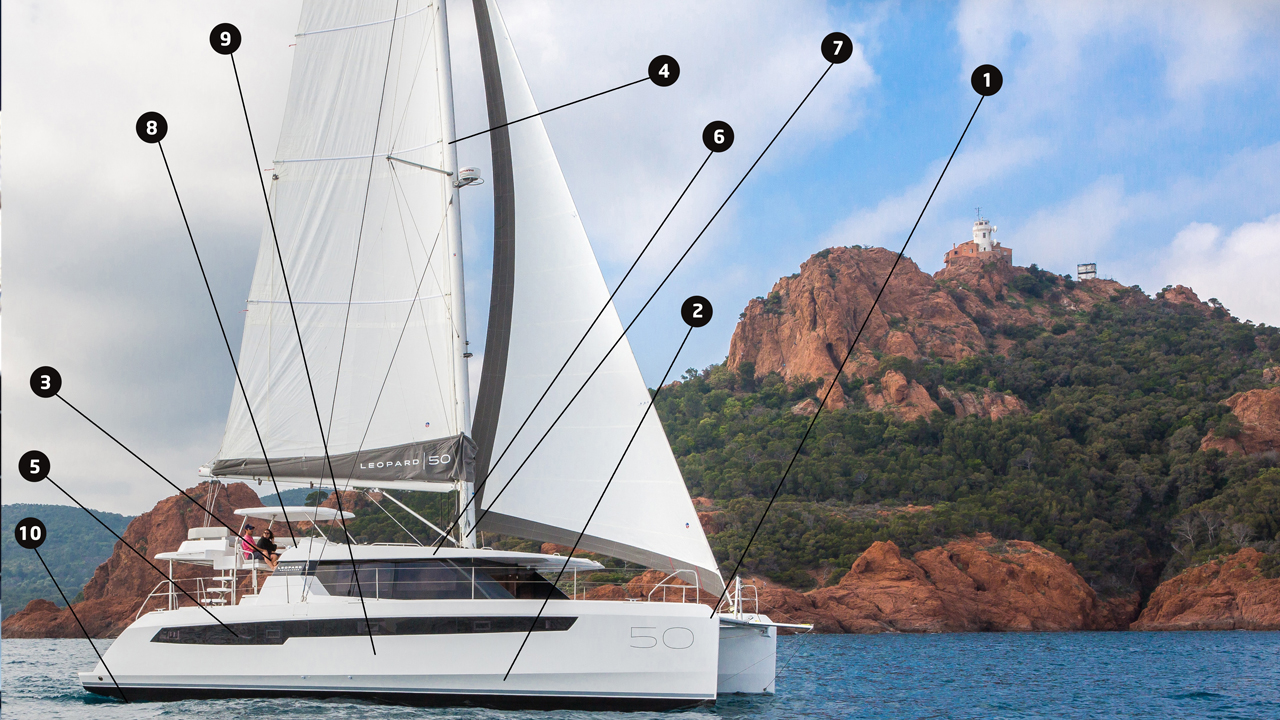
1: Fine water entries for efficiency and cleverly angled stem-head for aesthetics
2: The lower step breaks the vertical appearance of the topsides and acts as a spray deflector
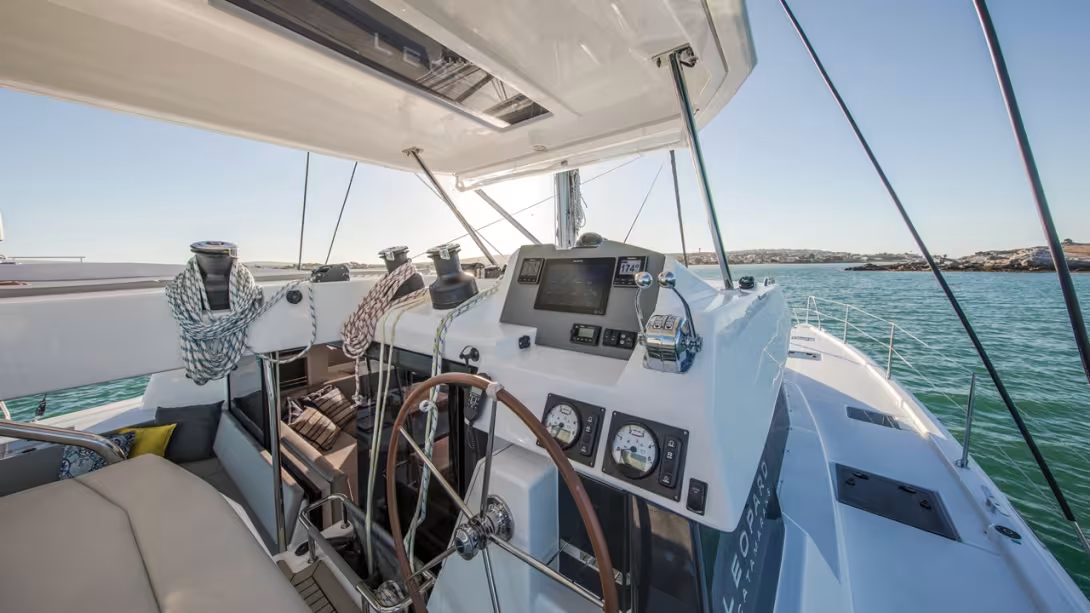
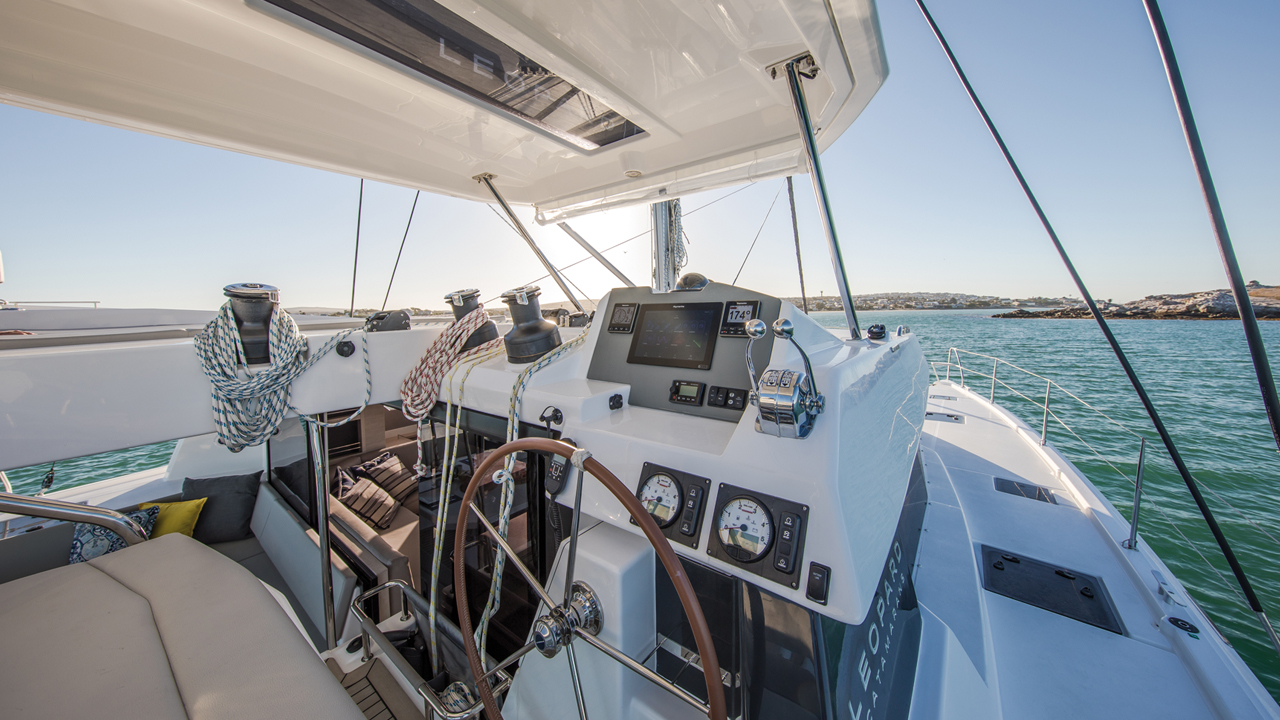
3: The watchkeeper’s bench seat is very comfortable and has clearly been designed with care. The position of the helm is good and the cable transmission steering is effective.
4: The excellent Sparcraft mast is sleeved mid-length for transport. One set of spreaders, double diamonds; generously sectioned and well-stayed for a rig without worries.
5: The portlights housed in an elegant reveal in the topsides are opening, and give personality and dynamic effect to the outline of the boat
6: On the 50, the bimini is higher than on the previous model and the coachroof has a more elegant fit. There will still be large areas of Plexiglas surfaces to change when the time comes!
7: The 50’s mast step is seated (as on all Leopards now) on a mast support on an H-shaped frame that stiffens the whole platform and replaces the forward beam-bulkhead, allowing access forward
8: The 50’s deck-plan has risen to the level of the best in this category, with 2 electric winches and top-quality blocks and hardware. Sail handling maneuvers are clear, simple, effective and easy to perform
9: The silhouette of the 50 demonstrates a clear progression: a lot of work has gone into the design
10: Our test boat was equipped with Bruntons three-bladed folding propellers, an essential option that provides a real difference in speed
PLUSES
- Successful deck layout, excellent sail handling for short-handed crews
- Attractive design
- Real privacy in the cabins; great conviviality on deck
- Furling line lead and mechanism
MINUSES:
- Epoxy protection for the underwater hull is optional
- Accumulated price of delivery to Cape Town and shipping
- Saildrive transmissions on the 80hp version instead of V-Drive transmission
- Be careful of overloading. The last tonne of weight is always the worst
- Location of the secondary electrical panel in the hull
|
Model |
Builder |
Upwind sail area in m² |
Weight in T |
Basic price ex-tax |
|
LAGOON 50 |
LAGOON |
158 |
20.8 |
€ 540,000 |
|
SABA 50 |
FOUNTAINE PAJOT |
141 |
14 |
€ 640,000 |
|
XQUISITE X5 |
EXQUISITE |
142 |
18 |
$ 1,200,000 |
|
PRIVILèGE S5 |
PRIVILEGE |
141 |
16.8 |
€ 995,000 |
|
BLUE WATER 50 |
DISCOVERY |
138 |
14.5 |
£ 995,000 |
Leopard 50 by Alex Simonis
So, what is new on the 50? In one sentence: More Space, a lot more: more luxury, indirect lighting and more advanced systems like the universal shore power “plug and play” arrangement to name but a few of the most striking changes. But not at the cost of performance. How so?? (The usual sales and designers talk). Not really! We have spent countless hours on the hull design and wind resistance refinements which, combined with the weight saving achieved over the previous versions have resulted in a remarkable performance potential. Take this together with the single station, all electric deck layout and you have a yacht which is as easy to sail as ever. The physical size of the boat has grown but the physical amount of effort it takes to operate has shrunk. Cruising in comfort is a combination of speed and ease of handling. You want the speed so that you can cover ground and reach more destinations in a shorter timespan. This is not only more exciting it is also safer as faster boats have the potential to avoid bad weather much better than slow boats. However, that extra speed cannot come at the price of a lot of physical effort or extra crew. It should be just as easy as before: set the sails, get on your course, switch on the autopilot and enjoy. In other words, it’s the new Leopard 50. For the first time in the Leopard range, the 50 will be available in two versions. Currently already available is the Flybridge version. Next will be the all new Performance version which will hit the water at end of 2018. This version will as a result be lighter and have less wind resistance then the flybridge version. It also allows us to fit a bigger mainsail for boosting the yachts’ light weather performance. This version is more dedicated to the serious blue water cruiser who wants to do extended sailing and do it shorthanded. These sailors might very well give preference to performance over additional seating areas, and with the ever-increasing customer base it makes sense for Leopard to broaden the options and also start catering more for those who value performance.
Alex Simonis, June 2018
