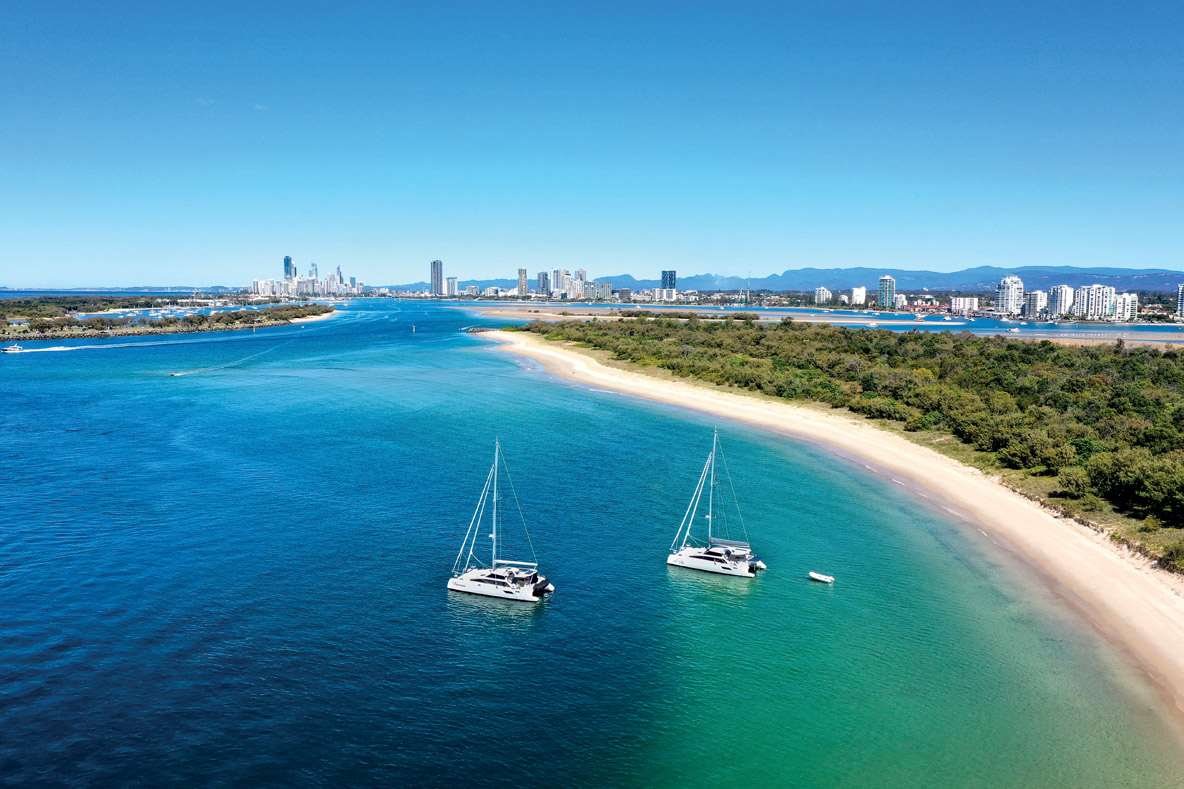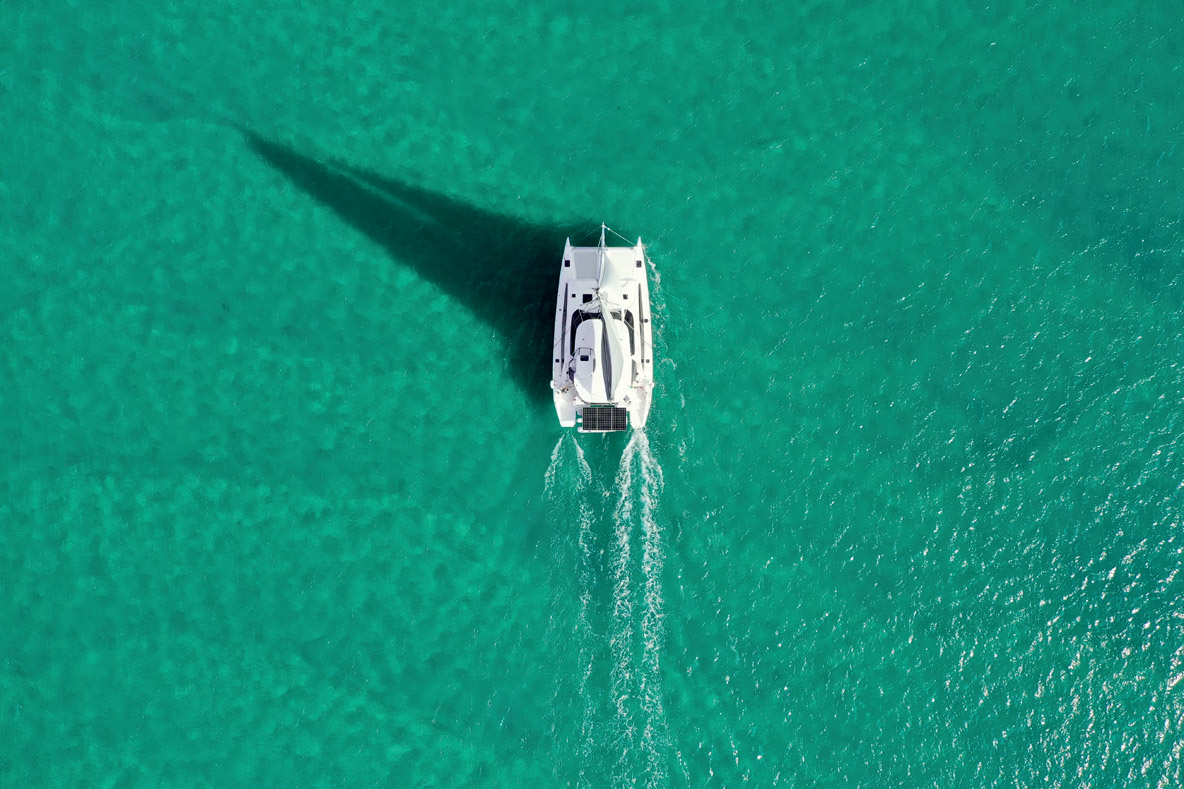
A carefully thought-out evolution of the previous model, the 45, the Lightwave 46 is probably one of the only sailing catamarans to be mass-produced in Australia. This new model that we got the chance to test just south of Brisbane is perfectly suited for blue water sailing - we’ll take you on board!
Infos pratiques
- Le chantier : Lightwave 46
- La fiche technique
-
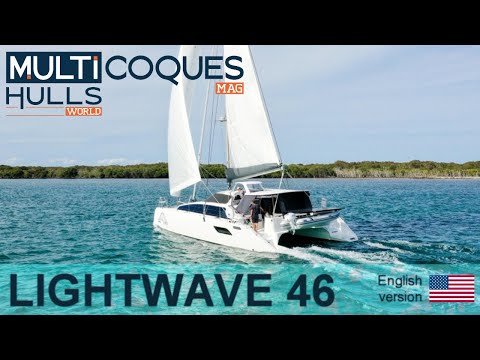 Découvrez notre vidéo exclusive
- Financez votre Lightwave 46
- Assuez votre Lightwave 46
- Articles autour du Lightwave 46
Conditions: 12 to 14 knots of southerly wind, sea state slight
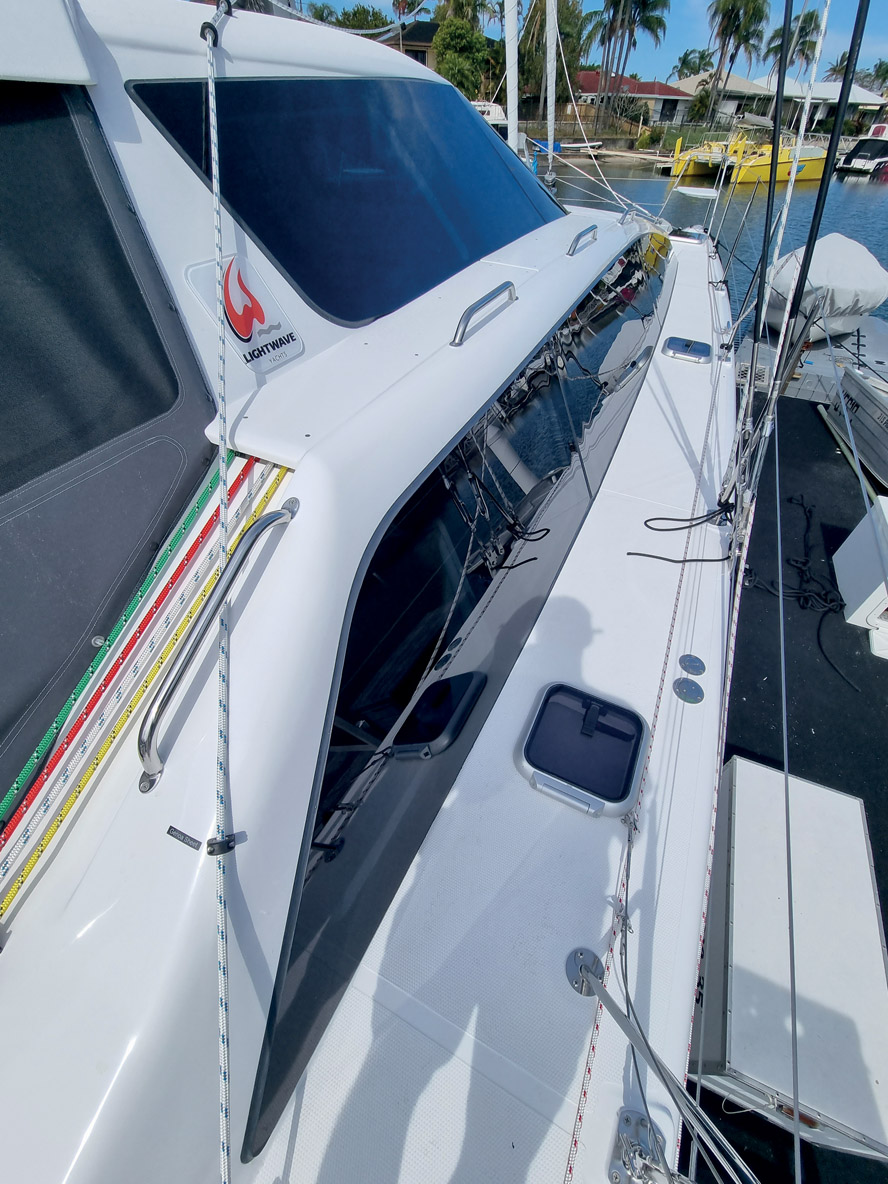
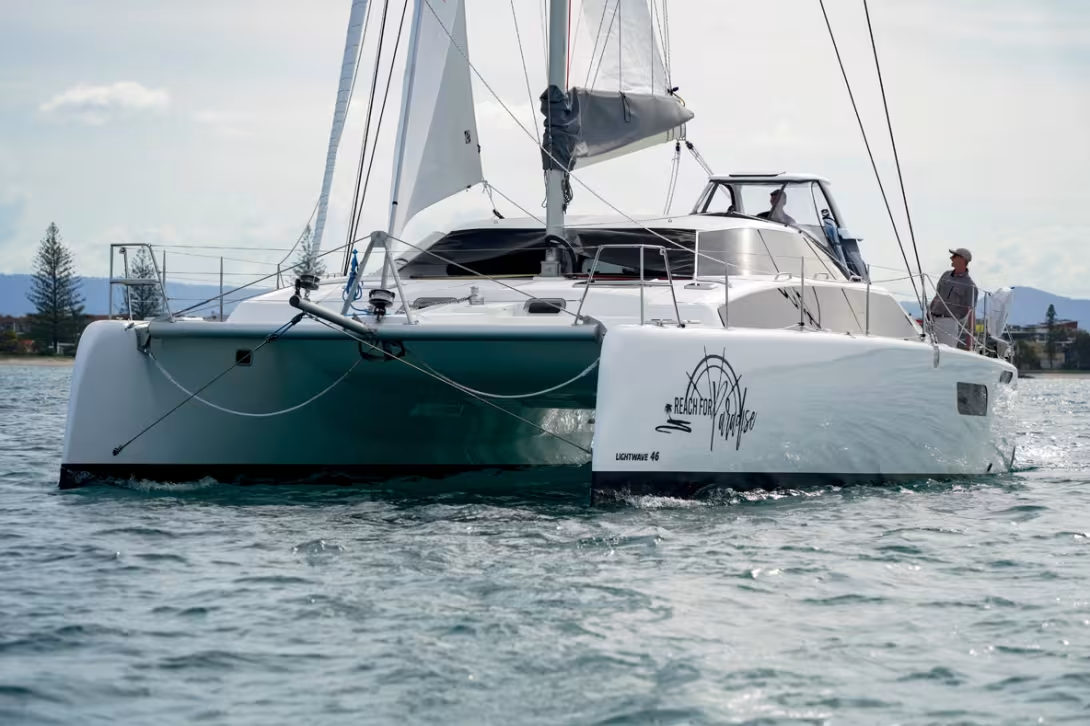
The latest Lightwave launched recently in sub-tropical north Australia and continues the reputation of this long-established Gold Coast yard. This new 46 model is a major evolution of the original Tony Grainger designed hulls, penned for the popular Lightwave 45 that launched in 2005. This revamp reflects new market demands and includes a sleeker topside profile with restyled windows. What hasn’t changed is the elegant, raked lines of the boat’s profile and the stepped cabin sides, a prettier arrangement than some other slab-sided designs. Also, the new hulls have reversed wave piercing bows, restyled windows and sharpened cockpit lines. Hull #1 of this model was released in 2021 to celebrate the company’s 25 years of trading, so hull #2 has been a while coming; reflecting the effort that goes into each of these boats. Looking further ahead, a powercat model is also planned with dedicated hulls for cruising under twin engines – see our Multipower News feature. “It’s really exciting times for us and we are fully committed to delivering more quality catamarans to a new generation of owners,” said managing director Roger Overell.
Responding to the demand for high-performance offshore catamarans
The director has been building quality performance cruising catamarans on the Gold Coast for a quarter of a century, so his company has learned to adapt to the changing times and now has a thriving composite manufacturing branch to the business as well. Roger Overell is taking advantage of the increased global demand for multihulls: “The larger catamaran market is increasing, and while the ‘floating social platform’ catamarans consume a big market share, there is still demand for performance catamarans by avid sailors wishing to do bluewater cruising.” Lightwaves are designed to be comfortable bluewater cruisers and with a very active and far-flung owners’ association giving feedback, the yard can offer semi-custom builds to ensure your dream ship really does become reality.
A new, bigger yard
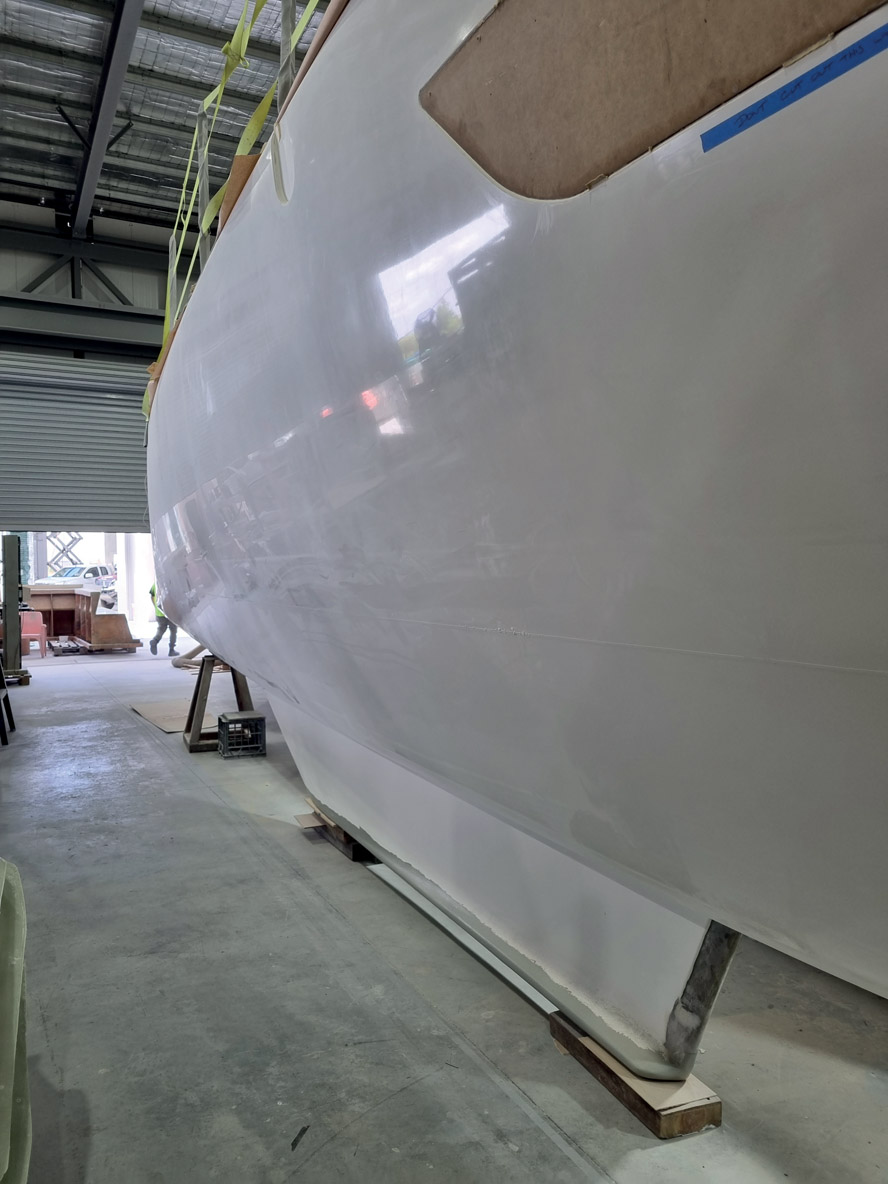
Lightwave Yachts has recently moved, and is now set up at Yatala, in one of the main industrial parks just south of Brisbane. As part of our boat test, I visited the latest expansion to their spacious yard, where business manager Louise Overell showed me around: “Our latest building creates a whole new space for completion of the hulls, once they are molded in the factory behind, so frees-up space for us to build at least three boats annually in a high-quality way.” The vast new building has a gantry crane and has good road access for the highway, where the boats are moved 12 miles to the water during the night. In the molding shed I viewed a hull under construction, noting the long and deep mini-keels, hand-sprayed interior and the Divinycell closed foam core build that ensures their famed lightness but with strength. A five-year warranty is standard.
Living under the sun…
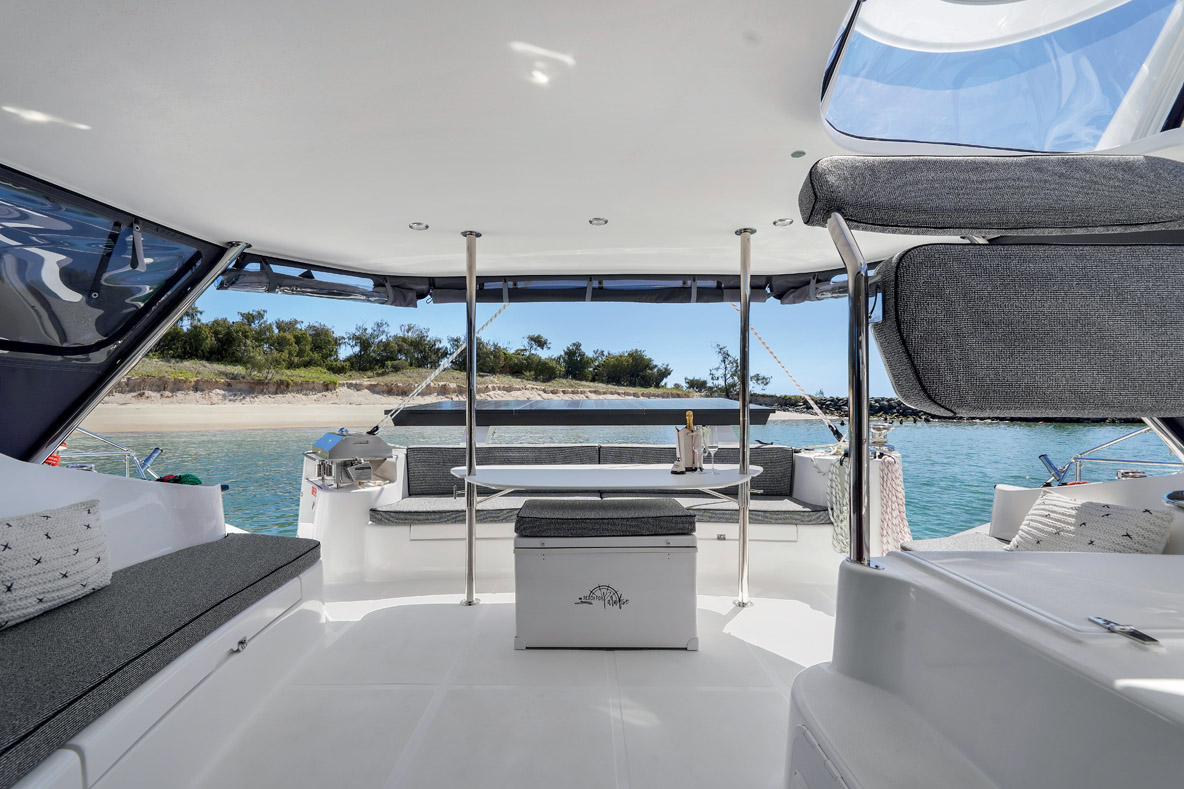
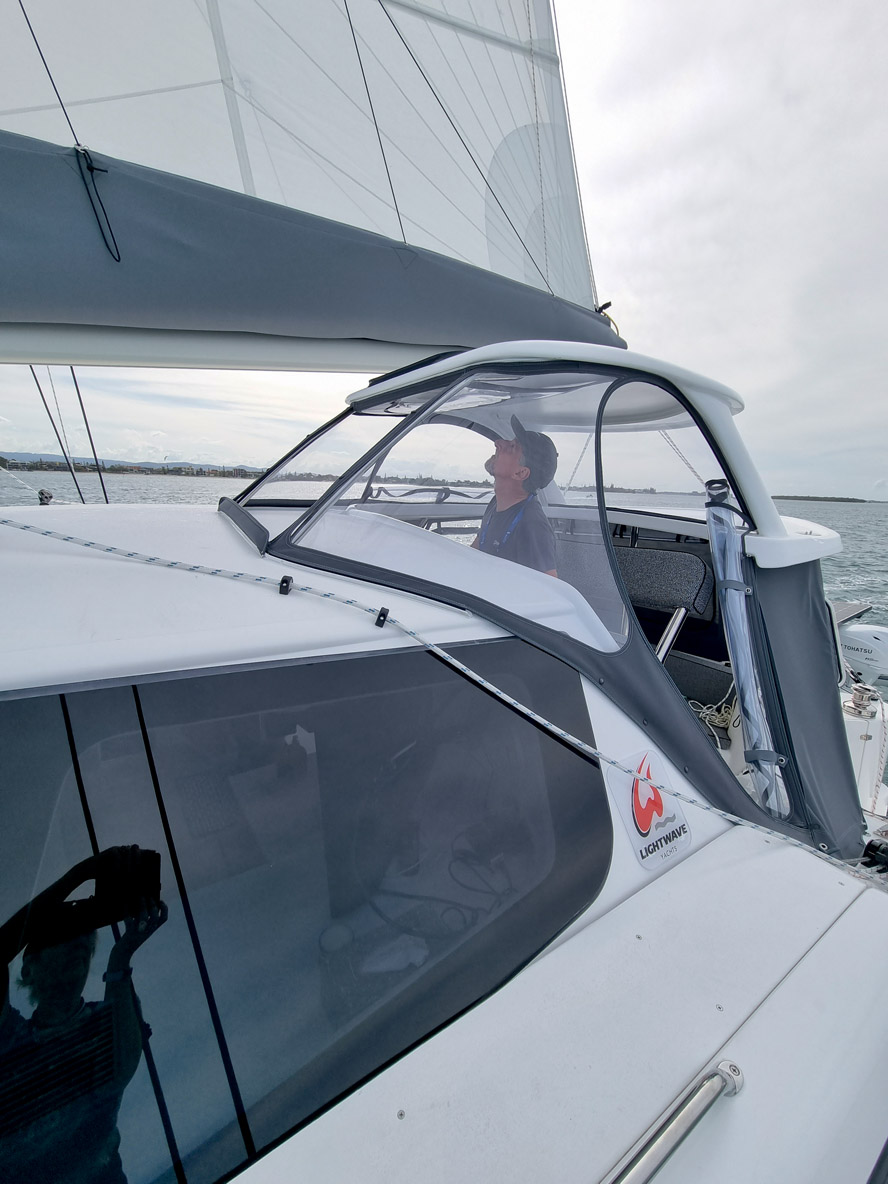
A short drive down the highway to skyscrapers of the glamorous Gold Coast brought me to the Lightwave 46 hull #2, recently launched. Nestled against a pontoon, a familiar scene met my eyes. Unsurprising, given this is an evolution of the proven 45 design; and of course, remembering the adage ‘if it ain’t broke, don’t fix it’. The same high standard of finish was apparent in the paintwork and indeed the Light Maple woodwork; clearly built to last. Our warm (you could say hot) and sunny Australian climate means that outdoor living is the focus of local boats; and the Lightwave 46’s aft cockpit demonstrates this well. The fully extended hardtop ensured this aft cockpit was protected – and a tented surround fitted. This gives a protected area for seating 12, while nearby on the portside is Lightwave’s signature raised helm station, enclosed with a shapely hard-topped cubby. Quality fit-outs here include the flip-out steerer’s seat with 4.9 cubic-foot (140L) refrigerator underfoot, which means the skipper never needs to leave the helm for a refreshment. Behind is a handy locker for dive tanks and other accoutrements.
Skeg keels or daggerboards
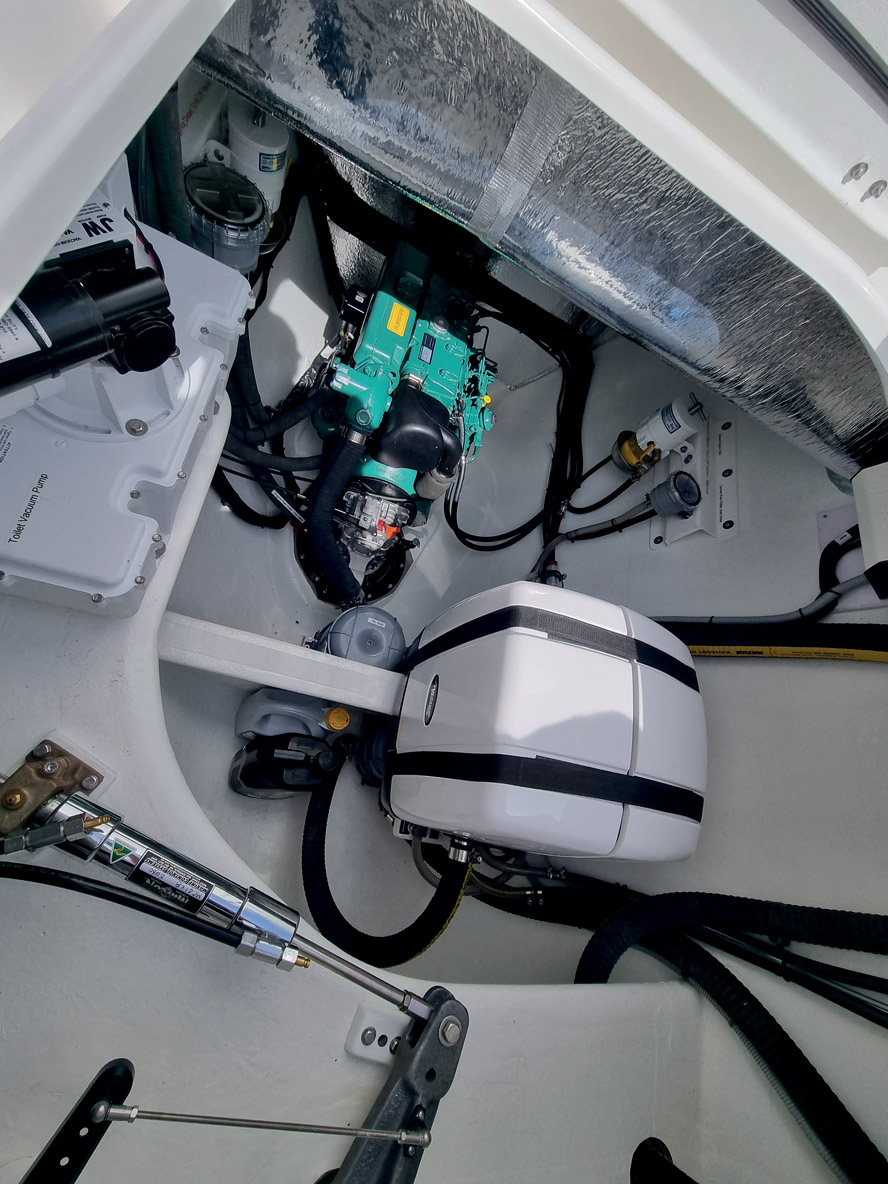
The aesthetics of the Lightwave 46 are greatly helped by plenty of waterline length. Also, the flair of the fairly narrow hulls add to this effect while giving good topside height to ensure a high bridgedeck clearance of 37” (95 cm) to avoid the customary cat slap as you bash to windward. Low-aspect keels are designed to allow beaching of the Lightwave 46 while protecting the saildrives and composite shafted twin rudders. For extra grunt to windward an optional dagger board can be specified. Engine access is via a hatch on each stern and showed generous space around the Volvo 50HP saildrive motors, with filters and AGM starting battery, all elevated in case of water ingress. Folding propellers are used to maximize sailing performance. In the starboard one, a small Whisperpower generator was fitted to run the Dometic aircon and a washing machine. Also here, the steering hydraulics are easily accessed, and all tankage is inboard to centralize weight.
No sail maneuvers forward of the helm
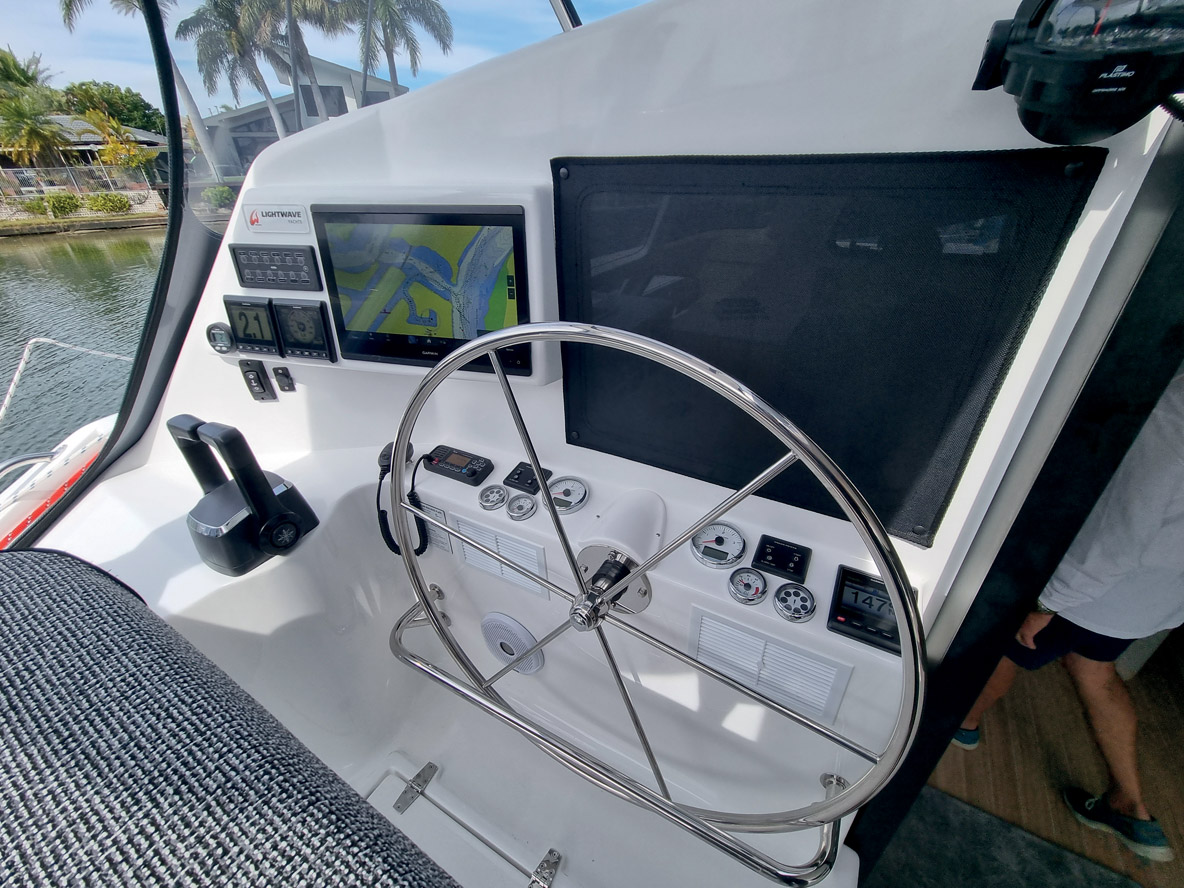
The review boat, that’s destined for east coast cruising, came with a well-equipped helm station.
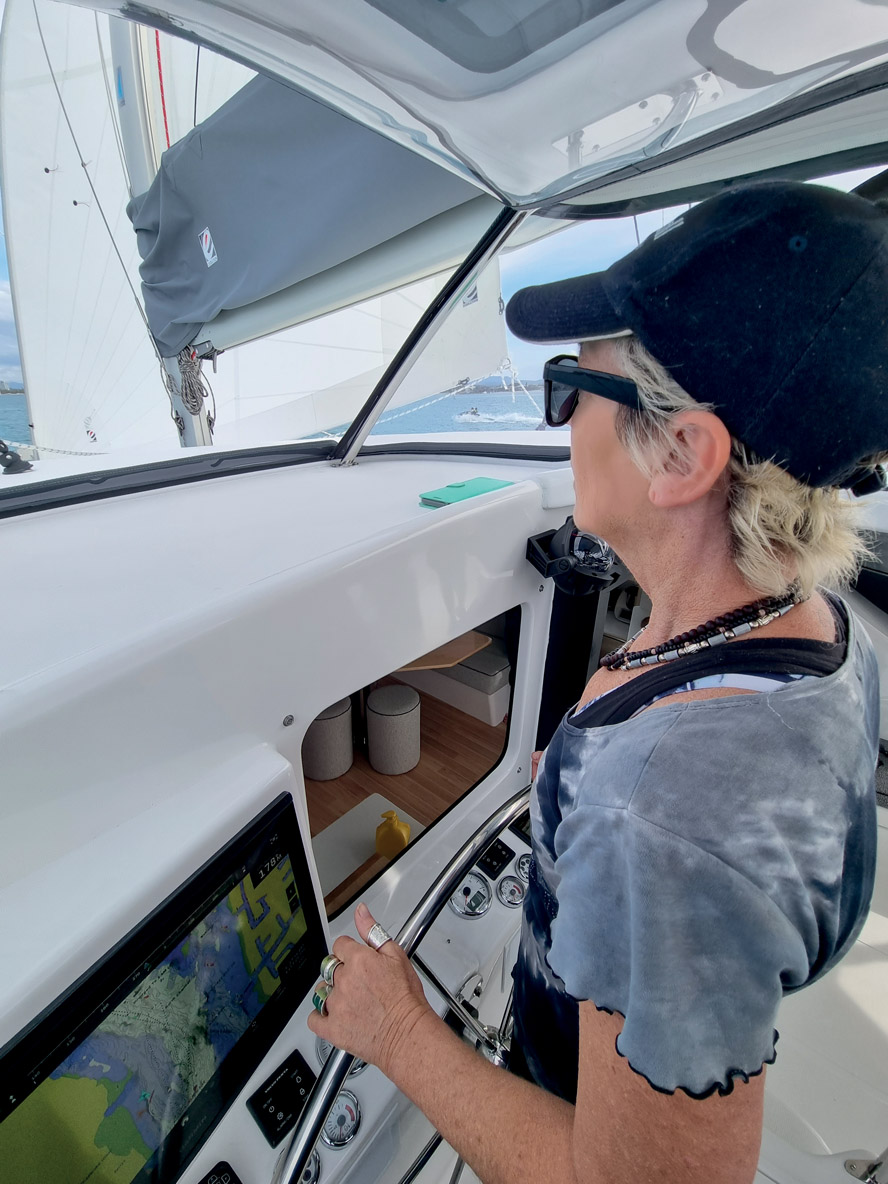
A Garmin plotter, surrounded by wind instruments and autopilot. Engine gauges were all viewable at waist level in a customized bulkhead layout. The medium diameter stainless steering wheel, hydraulically operated and electronic throttles outboard, complemented a very functional helm layout. Sail controls are behind the helm, not a typical layout for short-handed sailors,
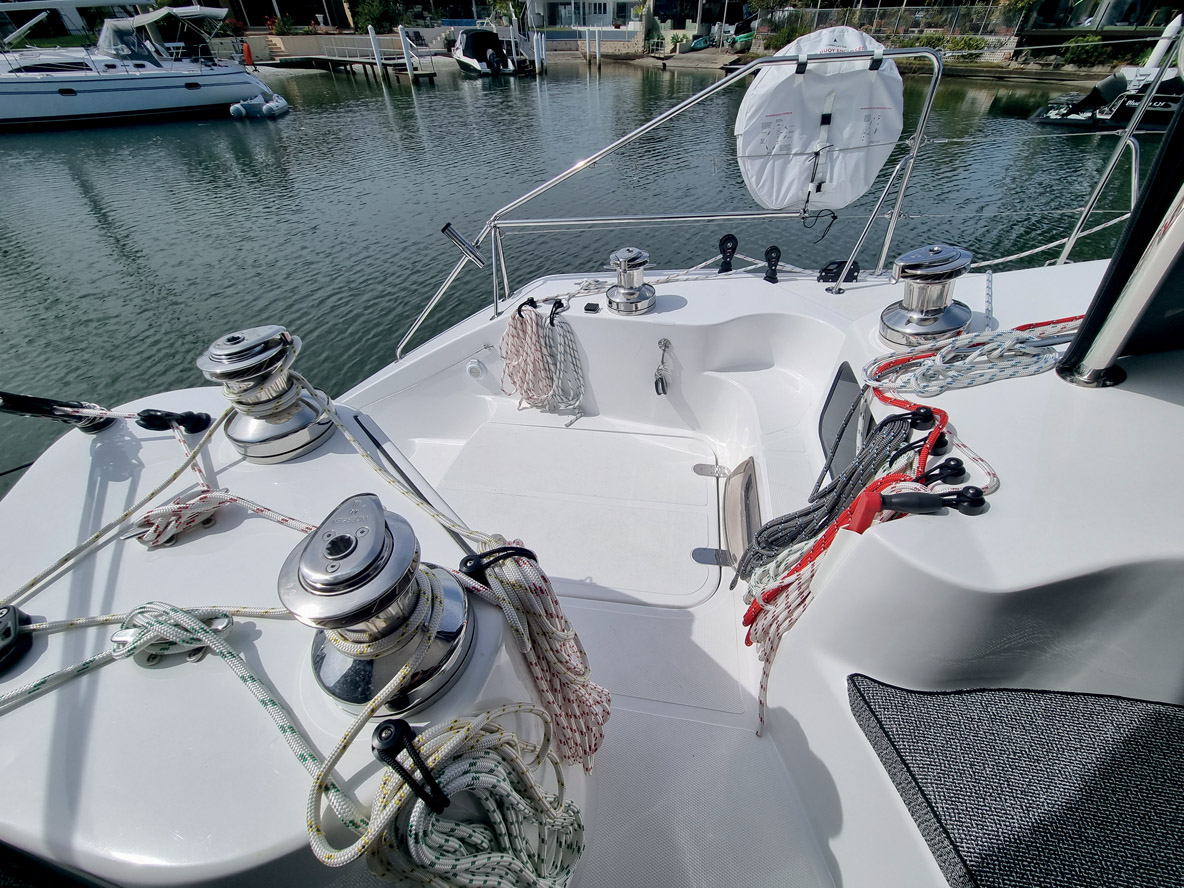
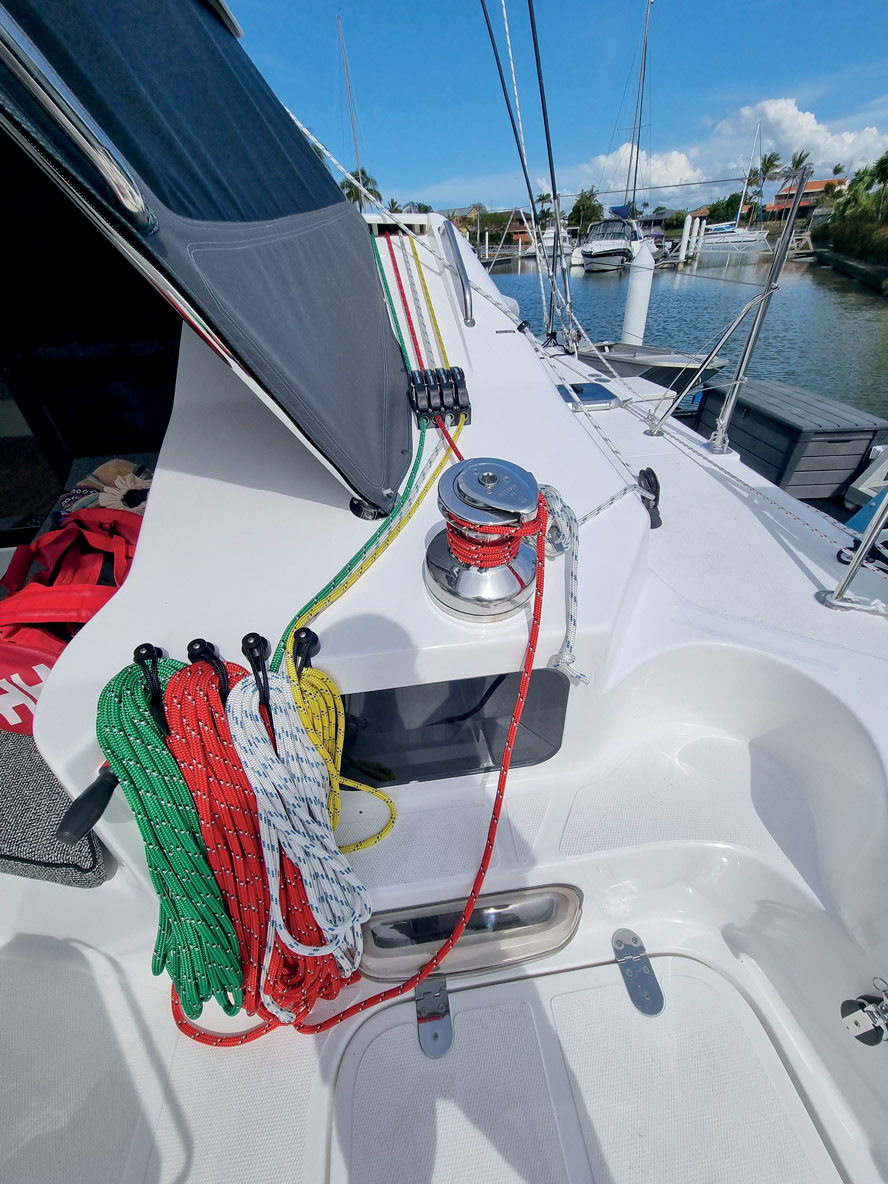
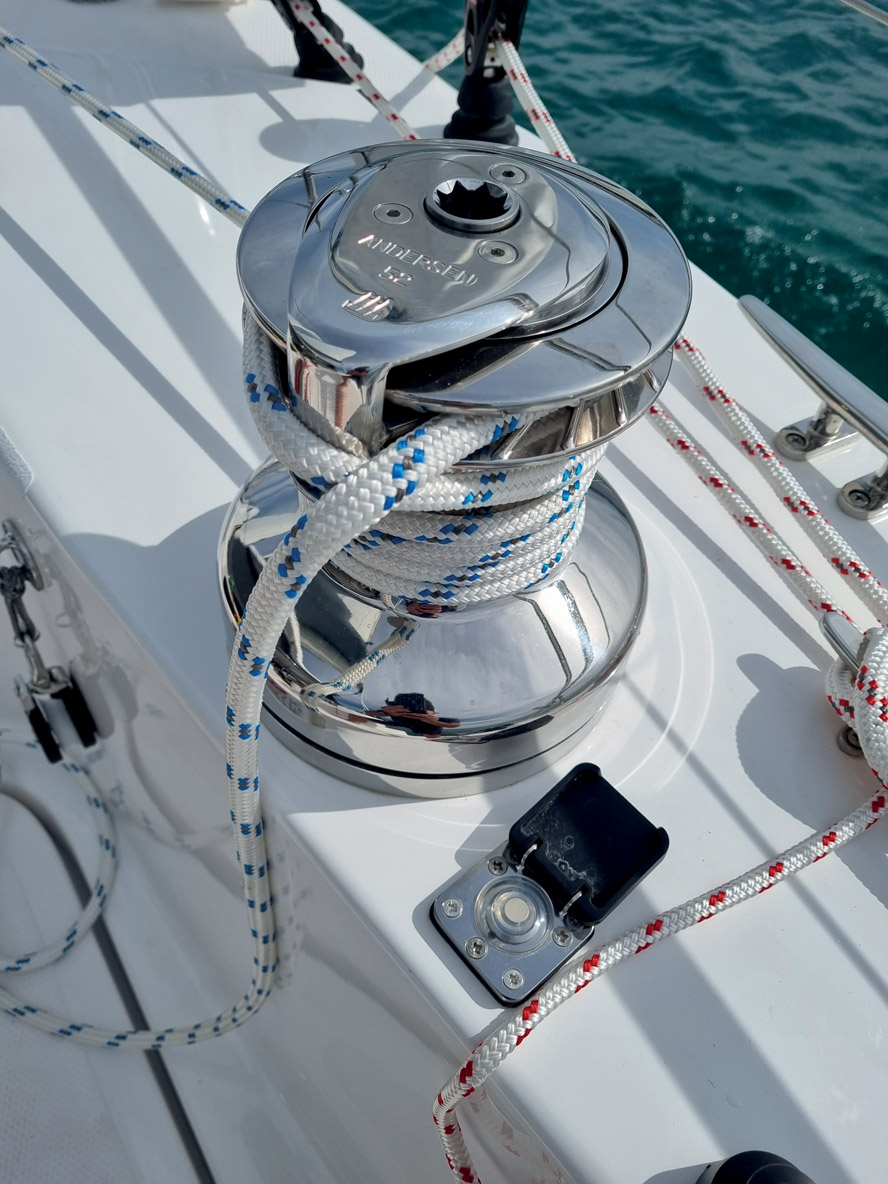
but they are very well organized; and Roger would argue a safer arrangement. All lines lead back to each stern quarter via gutters and Spinlock jammers, then wound on quality Andersen 46 winches, with an electric Andersen 52 on each side as well for quick main halyard hoists and trimming. Other good features on the stern deck include the ability to elevate the table to create more space. In place, its 6½-foot length makes an ideal dining spot for four along the transom bench (or 6 when you add a couple of stools). For shore leave the molded davits on the transom can quickly deploy the dinghy. Handily, beside the transom mounted barbecue to starboard is a small sink and dual-purpose cockpit shower. Other useful details include the curved grab rails leading to the waterline and pop-up cleats on the swim platforms.
Twin-sheet mainsail
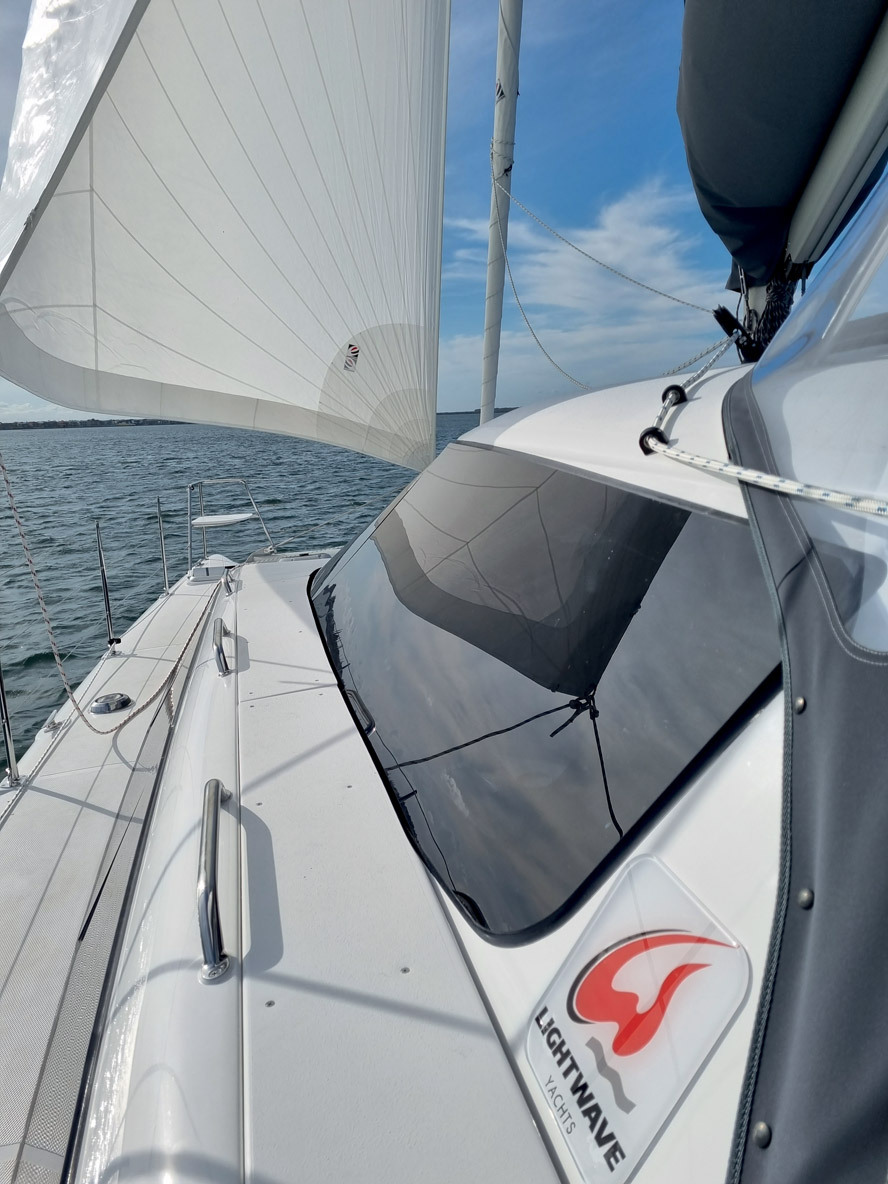
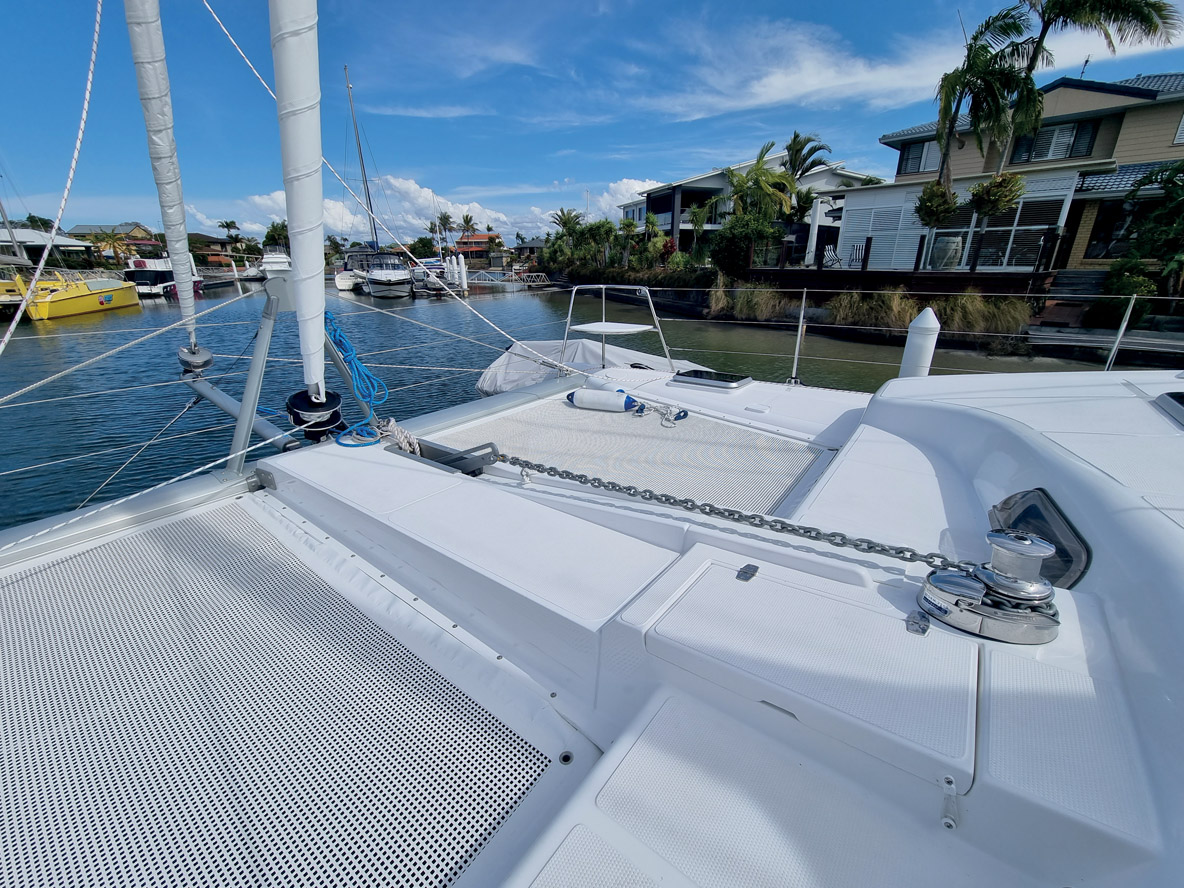
Designed as a serious bluewater cruiser the Lightwave 46’s sailplan is intended to cope with a wide variety of conditions. The cutter rig with furling screecher outside and genoa inside is easily controlled from the cockpit. The double spreader Australian Allyacht Spars mast with swept back outboard shrouds is sturdy - and being a catamaran, there’s no backstay - but a topping lift held the boom up since no vang is needed. Up front the small prodder is used for deploying the screecher and gives good separation ahead of the forestay-genoa. The mainsail has two sheets, sheaved through a block on each side of the transom, designed to ensure good purchase and put some twist on the fully battened mainsail. Sailcloth on this particular boat was upgraded to the Pro- Radial fabric made by Evolution Sails; which gives longevity with performance; and two sets of cringles for slab reefing are fitted.
Gold Coast Sail
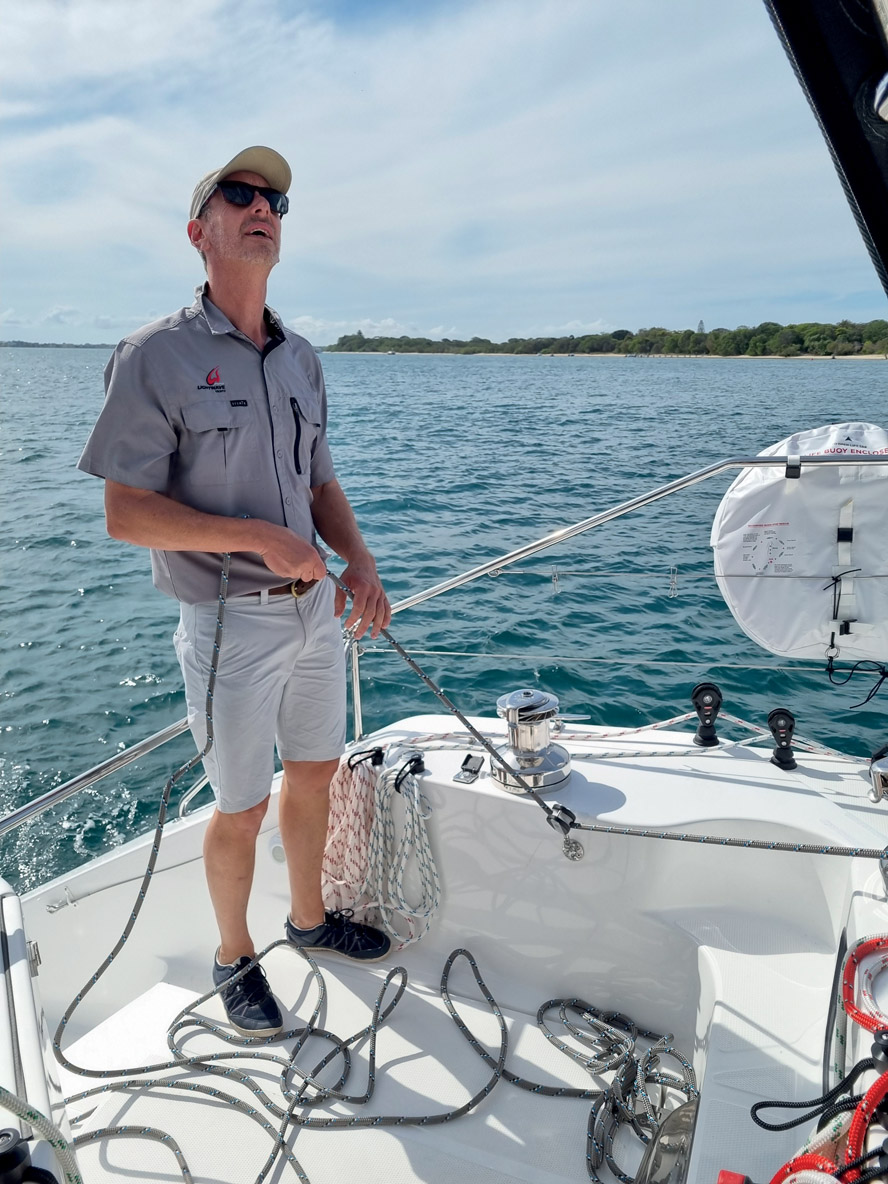
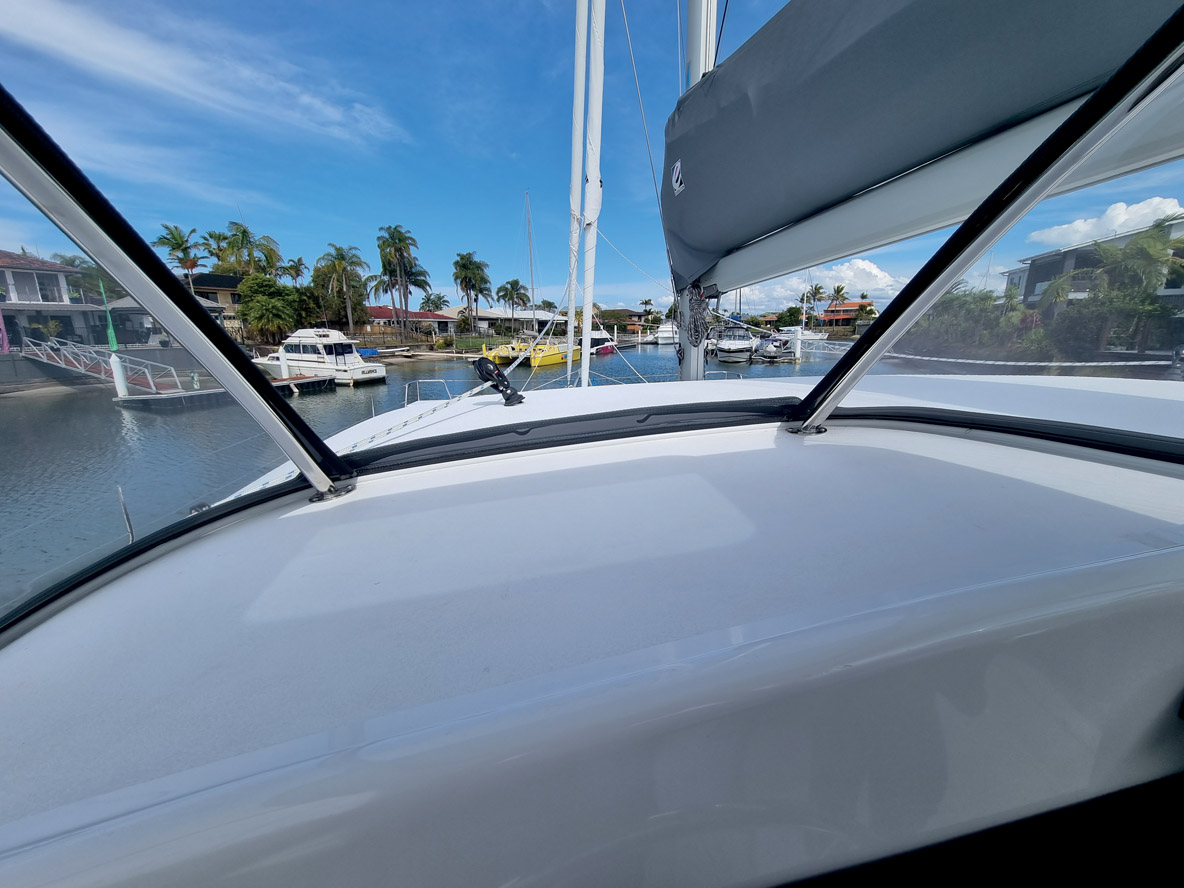
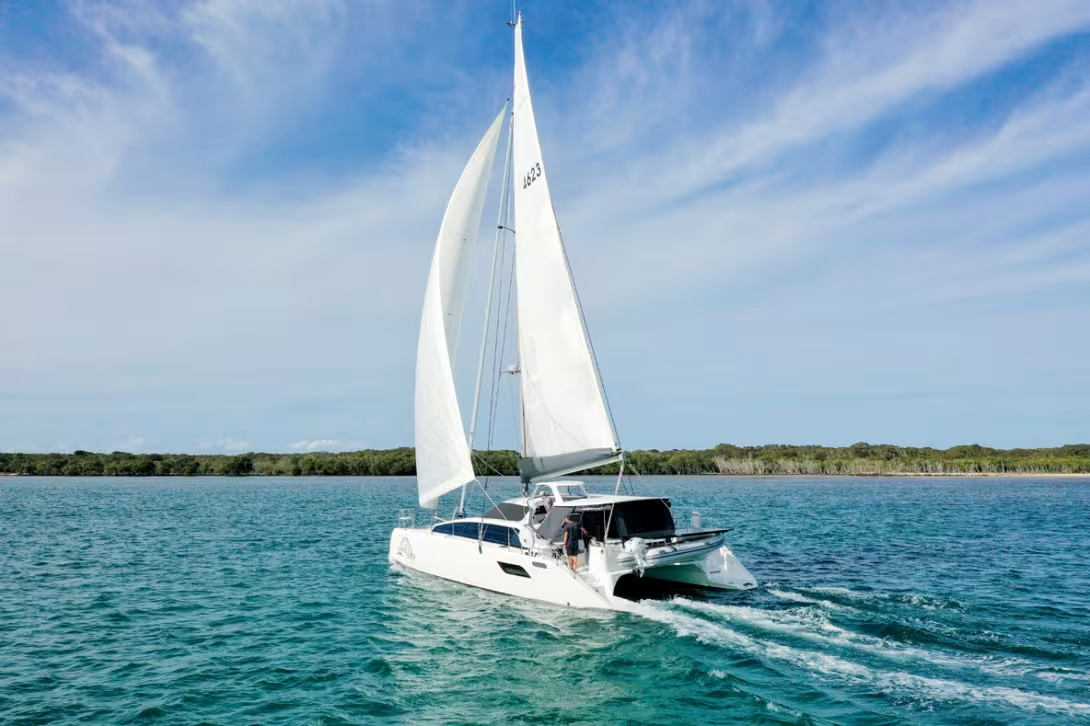
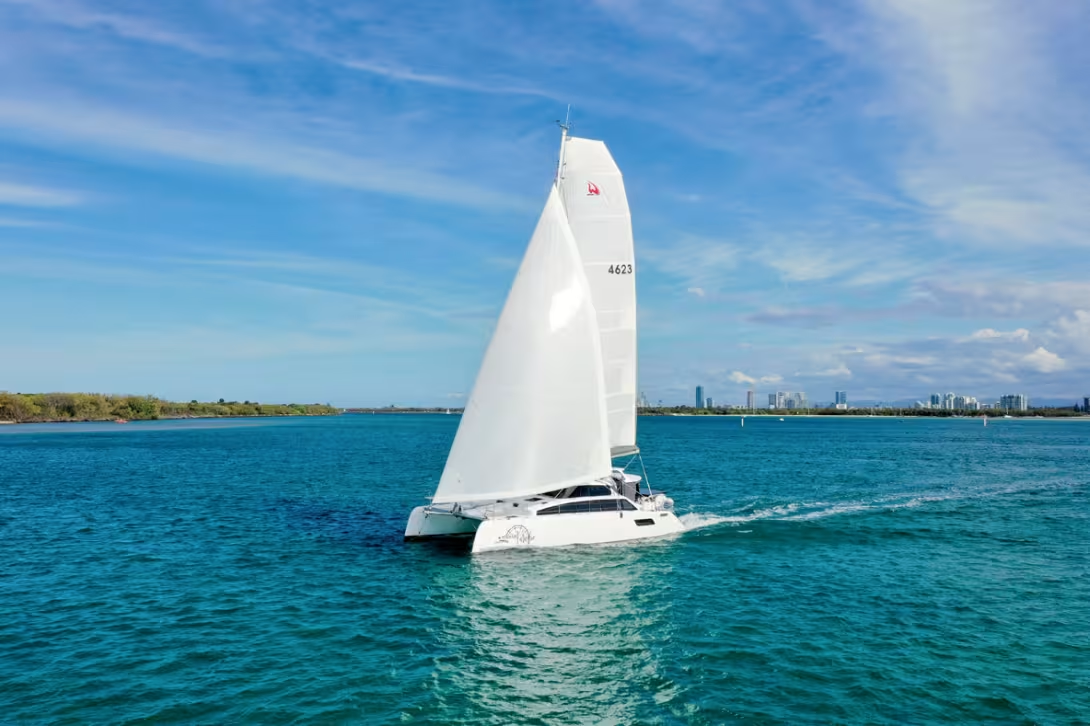
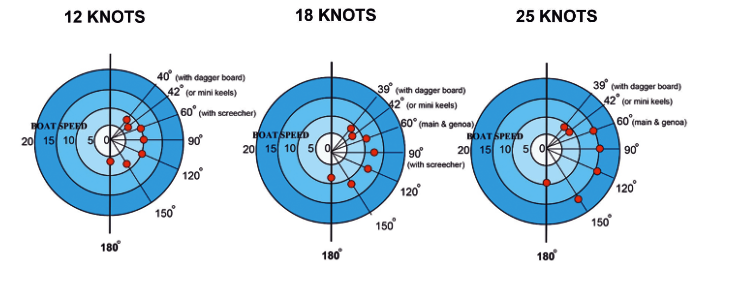
After snaking our way out of the narrow backwaters of the Gold Coast and emerging onto the equally confined waters of the Broadwater we accelerated into the light southerly breeze (the 50HP Volvo pushing us along at 8 knots) before hoisting the mainsail. A job easily done between Roger and I, using the electric Andersen winch and guided by the lazyjacks. With a steady 12-14 knot working breeze, the genoa was then rolled out of its Profurl furler and we accelerated cleanly towards the skyscrapers of the Main Beach. From my unimpeded helm view I set a course on the wind while Roger cranked the gear in. Both standing or sitting positions on the padded double seat proved comfortable with the large diameter stainless wheel responsive to the hydraulic controls connecting the rudders. And by leaning out beyond the GRP hard top, there were views of the mainsail tell-tales. The GPS numbers showed 7 knots to windward (at 42° sail angle) in the 12-knot breeze, which matched the polars supplied. No sooner had I found my groove than the plummeting Garmin depth gauge prompted us to tack, a maneuver that kept Roger pretty busy, with the twin mainsheets to control as well as headsail sheets.
This sheeting layout was similar to other cats I’ve sailed and for energetic tacking (or racing) a person on either side of the boat is preferable. But remembering that this is a bluewater boat where you may lay a tack for an hour or two, it shouldn’t be an issue. Note that there’s the option of a 323 square foot (30 m²) self-tacking solent as opposed to the 441 sq ft (41 m²) overlapping genoa. With the catamaran well-trimmed, I could feel the acceleration – the sheltered waters had only a small chop. The reward for the long tacks to windward was a run home under screecher. The downwind sail unfurled easily, and we rolled up the genoa as I settled in at 120° off the wind, with our highest speed reaching 8.4 knots in the dying 12-knot breeze. Equally drama-free was gybing with the screecher, which was quickly furled then unfurled by hand. Some more waves would have tested the boat more but the high bridgedeck clearance should ensure performance is still up there.
Galley up or galley down
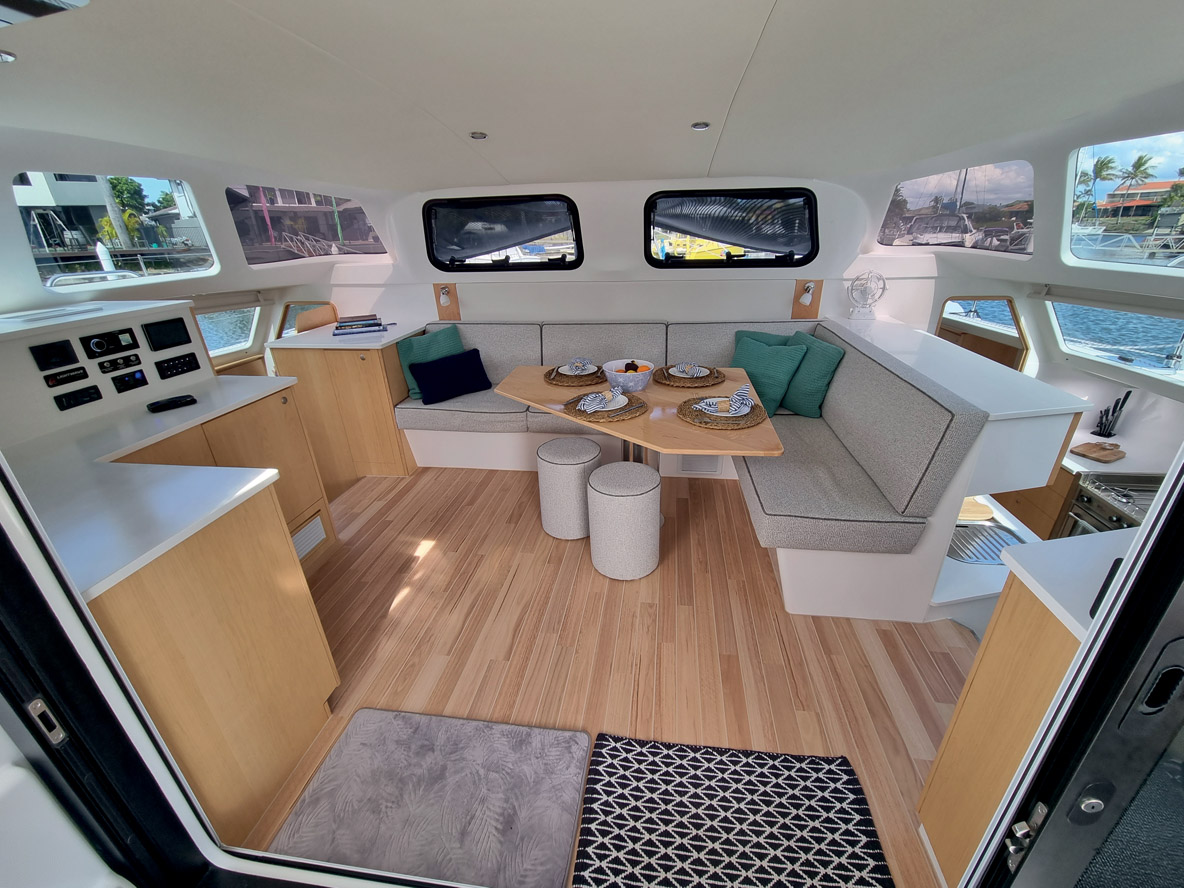
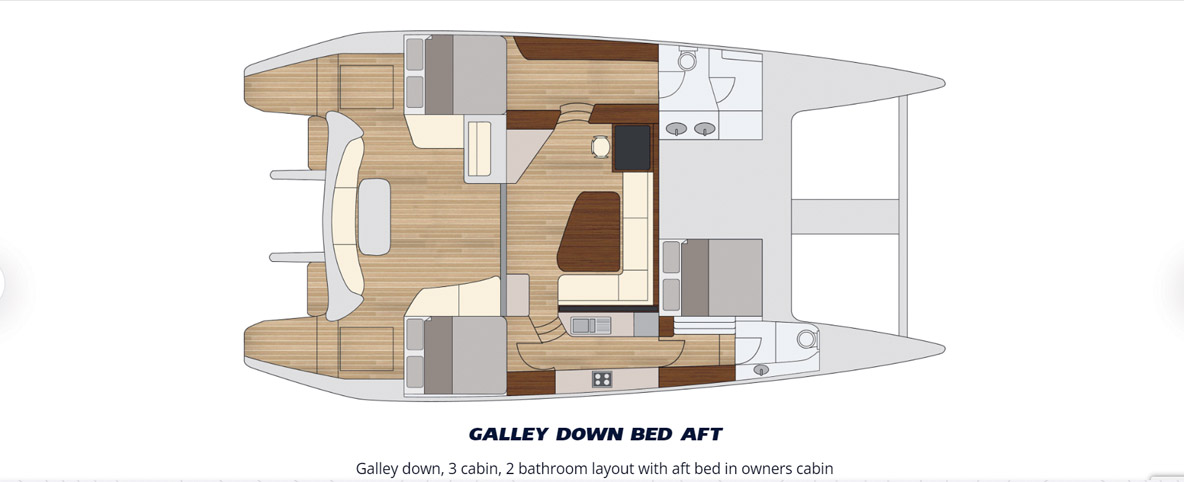
The review boat came with a three cabin and two head layout, with galley down. However, the galley-up version is available. This layout leaves the main saloon clear for lounging with the port quarter housing the navigation bench and room for six guests on the L-shaped settee beside the dinette area. The saloon is open and airy with plenty of large opening toughened glass windows for natural light and good airflows from large twin windows at the front. Underfoot, practical laminated composite “timber look” flooring is used throughout. The internal saloon bulkheads positively gleamed thanks to the high standard of two pack paint finish on them – something that Lightwave spend a lot of effort doing in their dedicated paint shop.
Owner’s layout
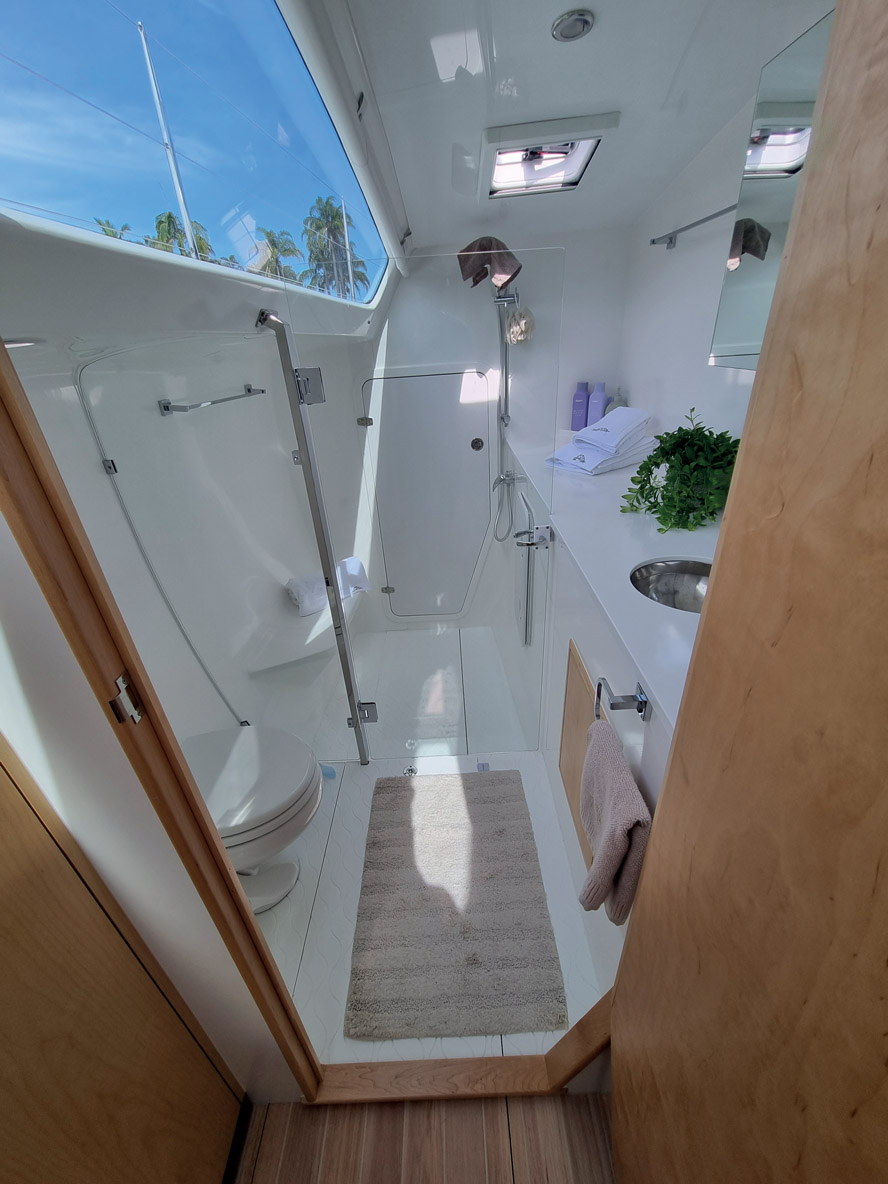
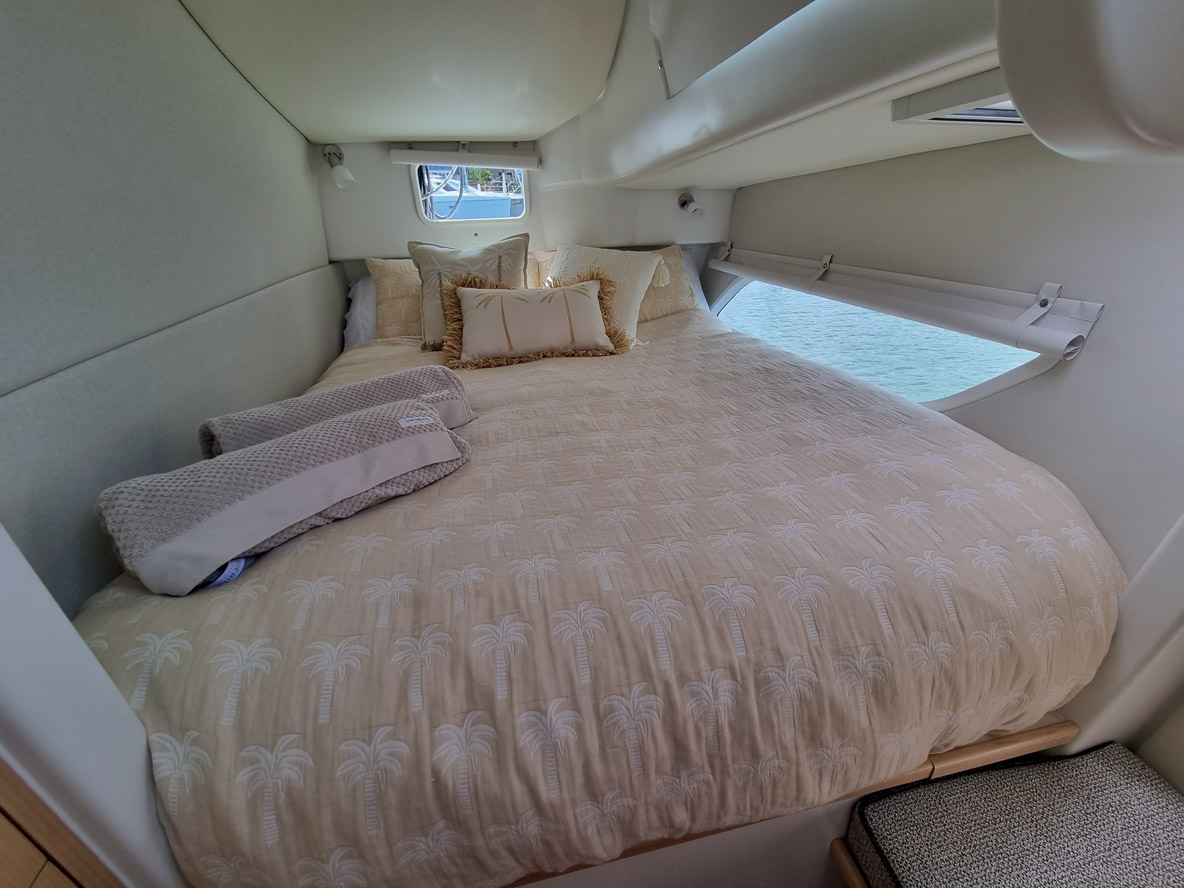
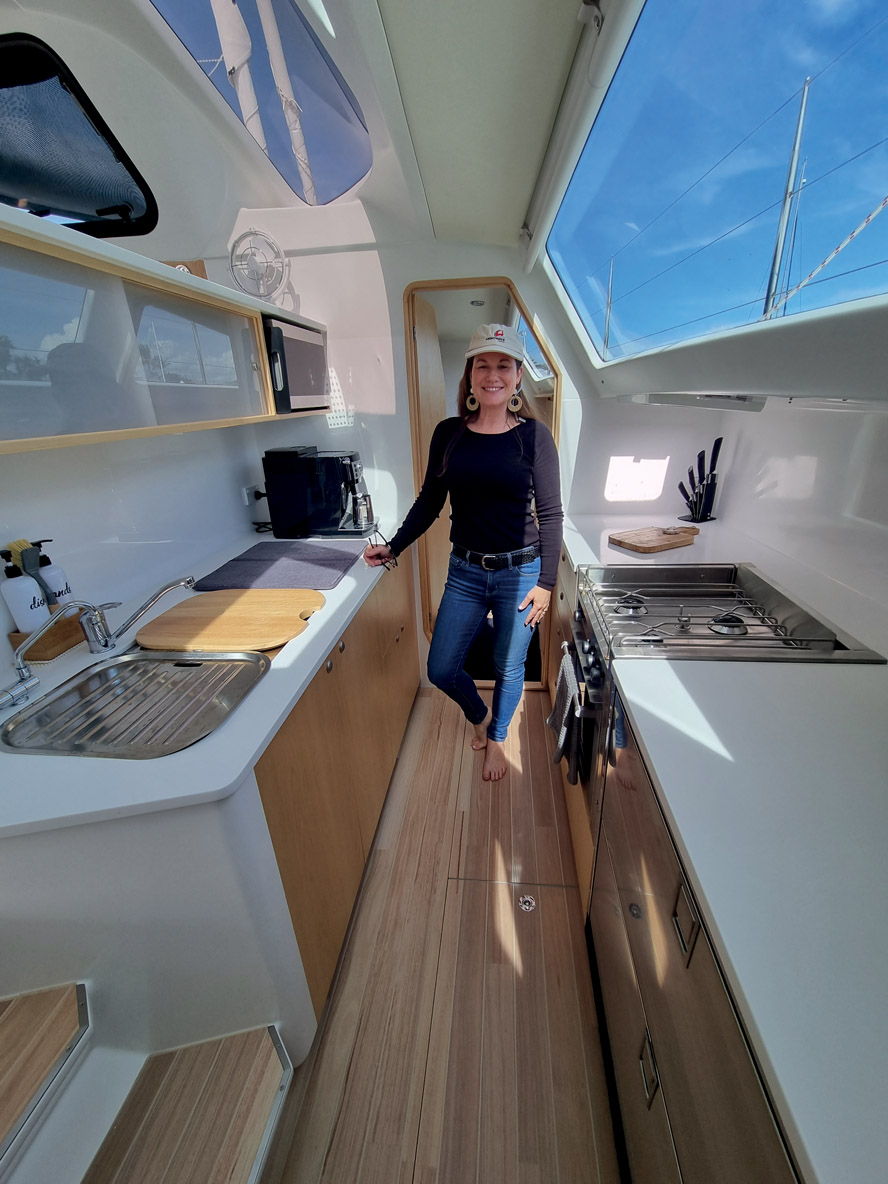
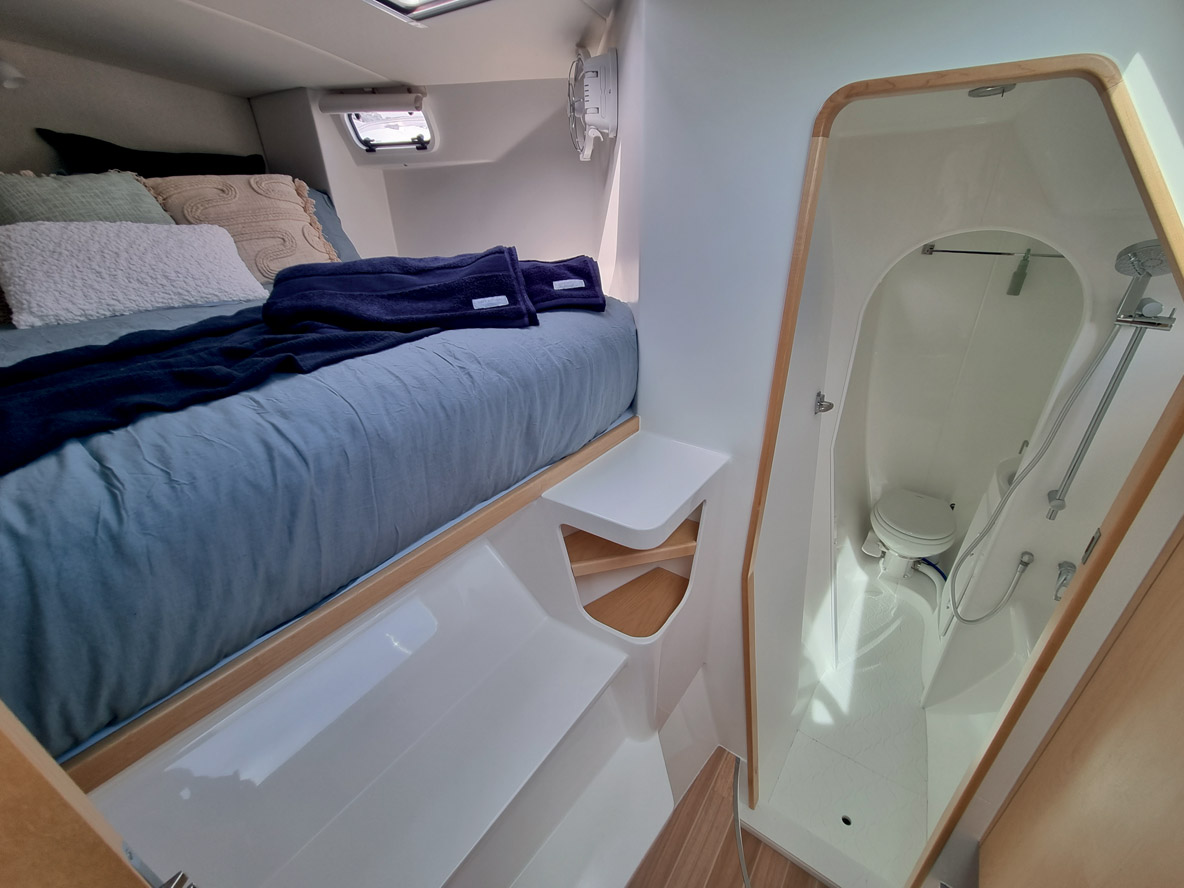
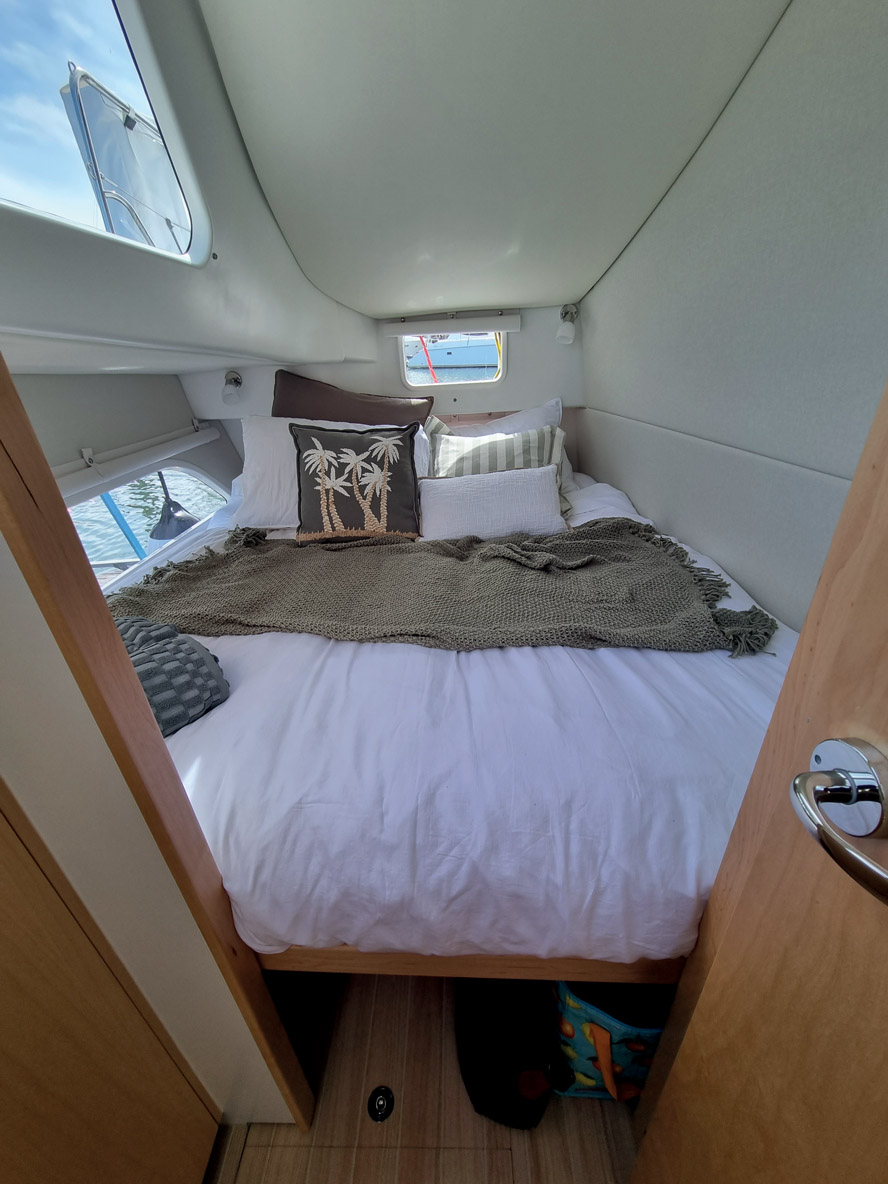
Our three-cabin, owner’s version is particularly good for both seagoing and being at anchor because the queen-sized bed is aft and sits longitudinally along the port hull. The crawl-in bed is surrounded by hatches for ventilation and light, along with a bench seat at its foot. A spacious ensuite heads compartment uses all of the forepeak and benefits from abundant natural light from the large rectangular hull window. Between, is generous storage and cupboard space, so ideal for longer cruises. Over on starboard, the galley dominates the middle part but avoids stuffiness by the low-cut bulkhead to the saloon. This openness allows the crew to watch the kettle boil as they sail along and ensure the cooking area is well aired and pleasant. Notable features here included twin 6.7-cunic foot (190L) front opening two drawer refrigerators by Isotherm with a high quality three burner Force 10 stove-oven plus microwave. Deep double sinks with pleasant deck-eye views when cooking and stylish composite molded surfaces completed a functional area. The accommodation too starboard has a cabin fore and aft with queen sized beds. The crawl-in aft one benefits from three windows to offset the stuffiness when the door is shut. The forward cabin is an ensuite but with 39” (one meter) headroom on the queen bed, as it’s on the nacelle level. Ablutions are well taken care off with an electric vacuum-flush toilet and shower up front. The lightly shaded Maple was neatly finished throughout as were all fixtures and fittings, always a sign of quality aboard a multihull.
Conclusion
This new model is based on the proven qualities of the Lightwave 45 - many have sailed around Australia and beyond, some have even circumnavigated. So, this is clearly an ocean-going catamaran presented here. This multihull, with its multiple possibilities for customization, can respond exactly to numerous specifications while still retaining its personality – two-level coachroof, racing boat style maneuvers. Another strong point of the Lightwave 46 is its quality of construction and the standard of finish – showing the care taken by the builder in the smallest of details. Lightwave Yachts is planning to visit Europe in the winter to explore market opportunities for the yard: this sounds to us like an excellent initiative because this Lightwave 46 certainly deserves to be distributed throughout the world!
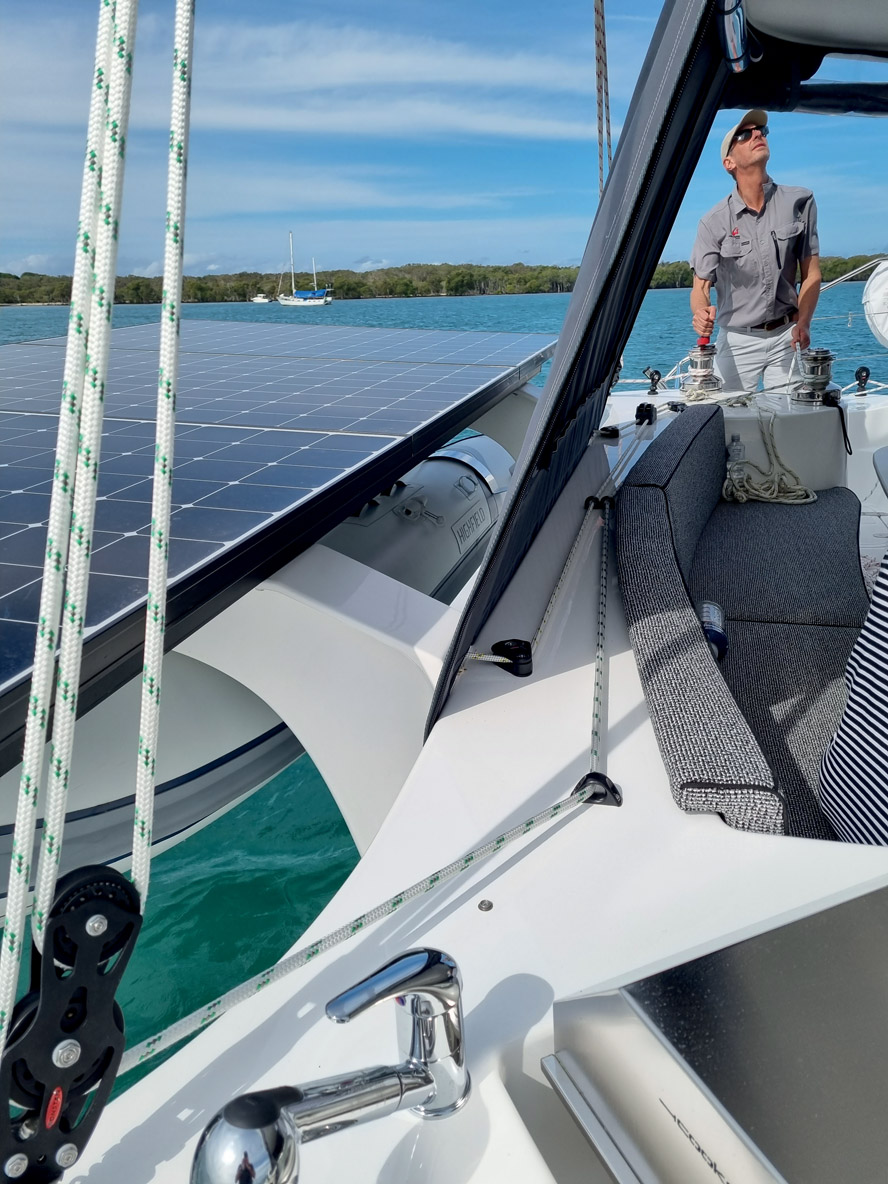
Under the L-shaped lounge settee the securely laid out bank of Lithium batteries can output 600 Ah with the review boat was optioned with a Victron 3000W inverter, 120-amp charger along with the Whisperpower generator in the engine room. In addition, 1,200 Watts of solar panels are on top of the dinghy davits. In the saloon the main circuit board fittings looked sturdy with neatly organized cable runs, fuse boxes and main power shut-offs. There is 600Ah house batteries and separate AGM Engine starting batteries (which have 115amp alternators).
Various layout options available
Choice between skeg keels and daggerboards
Side-decks a little narrow
No island beds
TECHNICAL SPECIFICATIONS
Architect: Lightwave Yachts
Length: 46’ (14 m)
Beam: 24’ (7.3 m)
Draft (mini keels): 4’ (1.2 m)
Air draft: 68’2” (20.8 m)
Light displacement: (7.5 t)
Laden displacement: (10.5 t)
Mainsail: 808 sq ft (75 m²)
Self-tacking jib: 323 sq ft (30 m²)
Genoa: 447 sq ft (41.5 m²)
Gennaker: 810 sq ft (75m²)
Spi: 1,655 sq ft (154 m²)
Bridgedeck clearance: 37” (95 cm)
Headroom (Saloon): 6’6” (2 m)
Headroom (Cabins): 6’9” (2.05 m)
Engines: 2 x Volvo Penta 50HP (3-blade folding propellers on sail drive legs) (55 Yanmar optional)
Fuel: 211 US gal (800 l)
Water: 211 US gal (800 l)
Price: AUD$ 1,120,820 (inc. Australian GST)