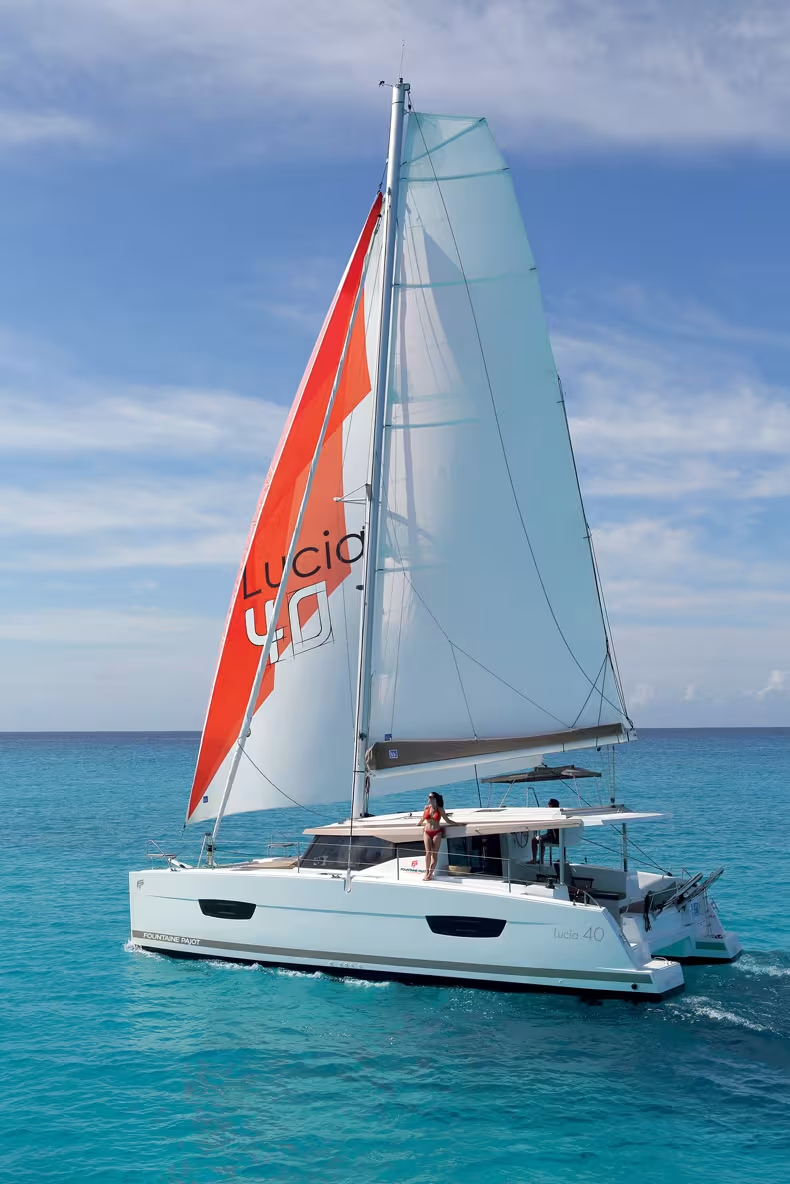
Launched in December 2015 at the Paris boat show, the Lucia 40 established itself as the replacement for the Lipari 41. Like larger models such as the Hélia 44, Saba 50, Ipanema 58 and Victoria 67 before it, the smallest catamaran in the then range was by Berret-Racoupeau Yacht Design. The credo of this seductive 40-footer? Modern lines, comfort, but nothing too much, to keep the multihull simple, the displacement moderate and, above all... the price attractive!
Infos pratiques
- Le chantier : Lucia 40
- La fiche technique
-
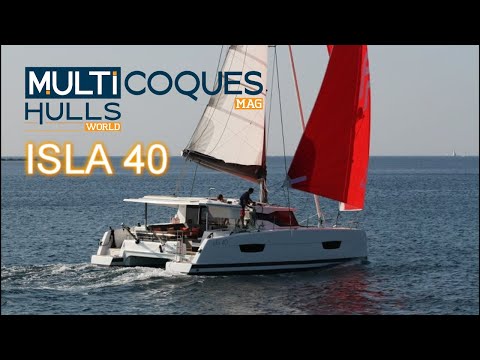 Découvrez notre vidéo exclusive
- Financez votre Lucia 40 / Isla 40
- Assuez votre Lucia 40 / Isla 40
- Articles autour du Lucia 40 / Isla 40
This model has had two lives in one, having been re-launched in 2020 under the name Isla 40 (see inset). This entry-level catamaran from Fountaine Pajot has just been withdrawn from the shipyard’s catalog, to be replaced by an upcoming 41-footer, the name of which is due to be announced shortly. The Lucia 40 and Isla 40 are therefore now pre-owned catamarans - but still very recent. For buyers, these models offer a double advantage: firstly, they present themselves as “minimum” live-aboard platforms, i.e. admittedly compact, but nonetheless comfortable enough and well thought-out for a 12-month Atlantic circuit as a couple, or even with one or two children. The second advantage? These 40-foot catamarans are easy to handle and to maintain.
A True Ocean Cruiser
For anyone wondering about the ocean-going capabilities of this 40-foot catamaran, the facts are clear: a large number of Lucias were delivered to the West Indies on their own bottoms from La Rochelle, and there have been numerous Mediterranean and Atlantic circuits and even circumnavigations - including around the Cape of Good Hope. The infusion construction is made up of three parts: nacelle bottom, inboard topsides and outer half-hulls. The sandwich consists of a balsa core and multiaxial glass cloth skins. The deck and coachroof are injected parts - vacuum laminated in a two-sided mold. All this inspires confidence, especially as this model features four buoyancy zones.
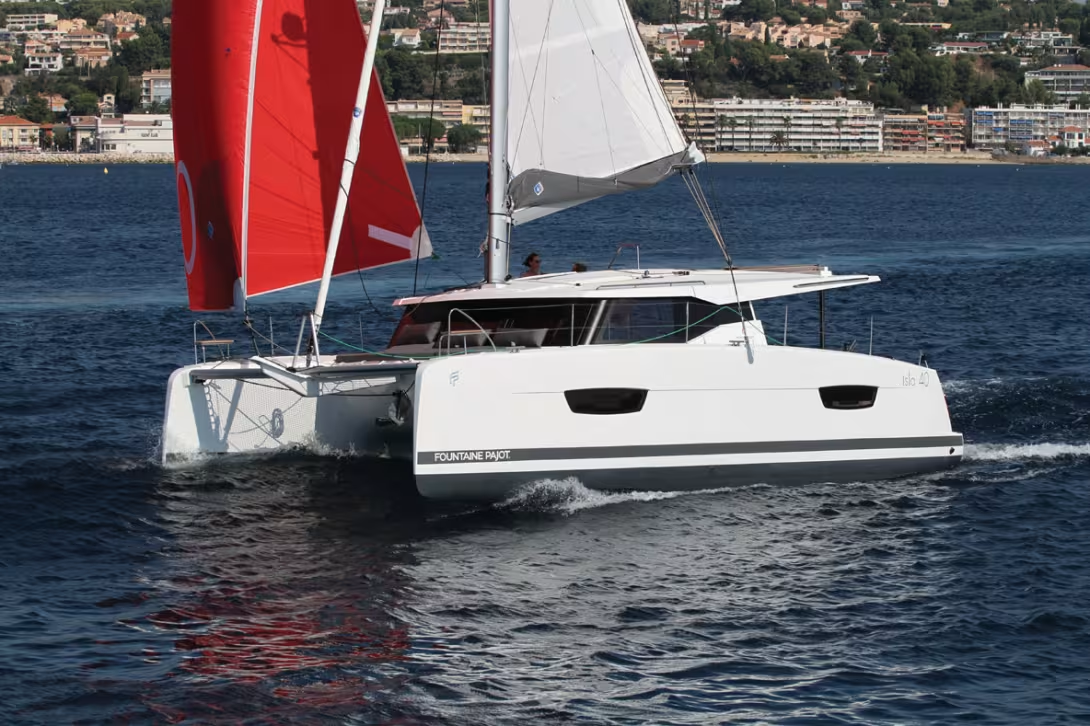
Under way, this catamaran benefits from a rather favorable sail-to-weight ratio of 11.67 m2/t, and hulls optimized to reduce wetted surface while supporting the load rather well. If you look closely at the tunnel between the hulls, you’ll notice the bridgedeck clearance and, a little above the waterline, a discreet chine. We were lucky enough to test the Lucia 40 in a good breeze (22 to 25 knots) with everything on beam, and the speed was between 8 and 10 knots. The Isla 40 test took place in calmer conditions, and we recorded 5 knots upwind at 50° from a true wind speed of 8/9 knots. With the gennaker up, in a slightly better breeze of 12/15 knots, the GPS indicated 8-9 knots. In short, the Lucia-Isla isn’t a thunderbolt, but it goes very well under sail, provided the wind is right. As for the drivetrain, the yard offered twin Volvo 20 HP motors as standard, though look for models equipped with the 30 HP option. The vast engine compartments are easy to access.
A Traditional Helm Station
The uncluttered deck layout immediately proves effective, as do the 24-inch (62 cm)-wide side decks, the non-slip surface that grips even when wet, and the well-placed handrails on the coachroof. On the foredeck, the builder fitted sunbathing areas, which are much appreciated by the crew. As for the cockpit, well protected by its rigid bimini, it features a table to port, a lounger to starboard and a vast, unobstructed area between the two. The sugarscoops provide direct access to the water - or to the tender. Unlike other larger models, the Lucia 40 and Isla 40 have not adopted the concept of the sail maneuvering station ahead of the helm station. Instead, all maneuvers are performed from a single, mid-height control station. From the three winches and two banks of clutches, the helmsman can easily manage halyards, sheets and other lines, which are easily stored in a dedicated rope locker. As an option, Fountaine Pajot offered a small fixed bimini for protection.
3 or 4 Cabins?
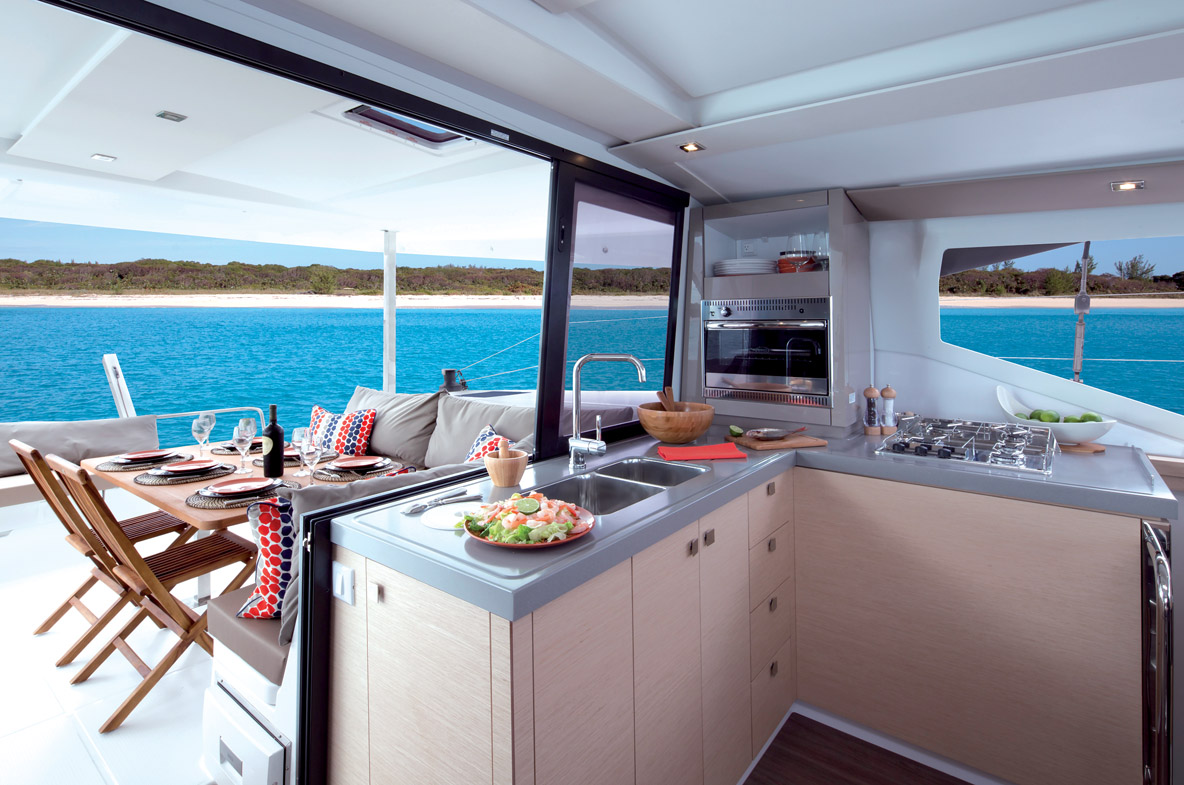
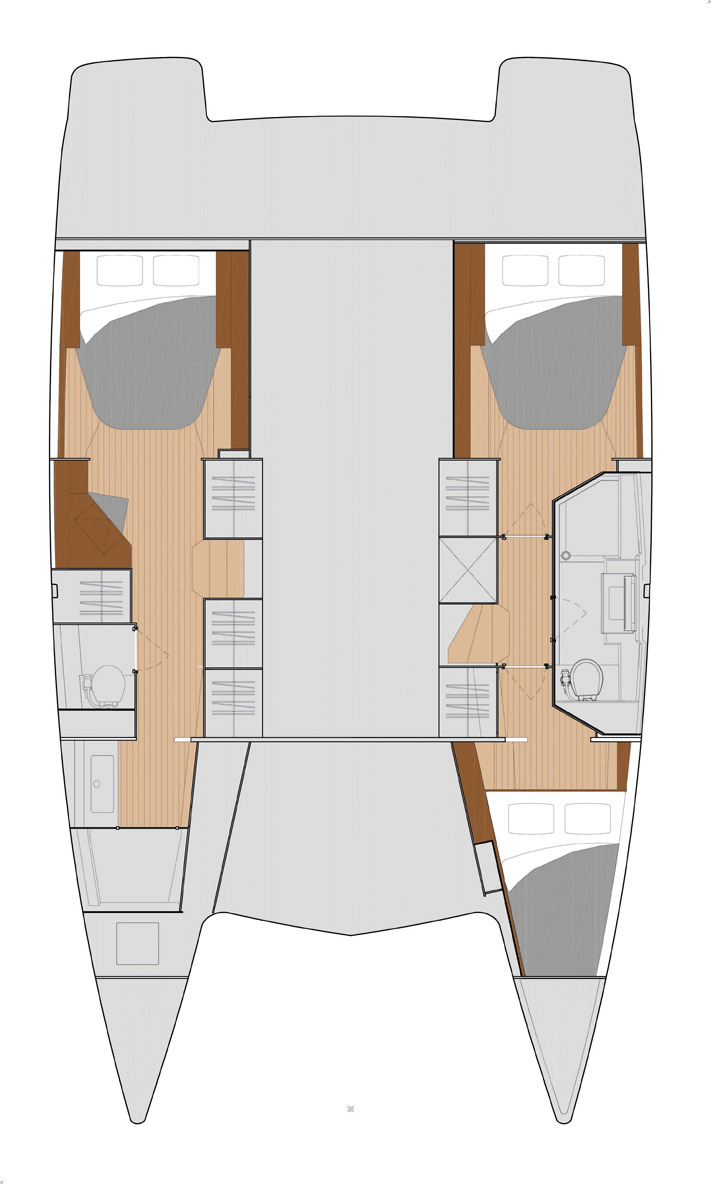
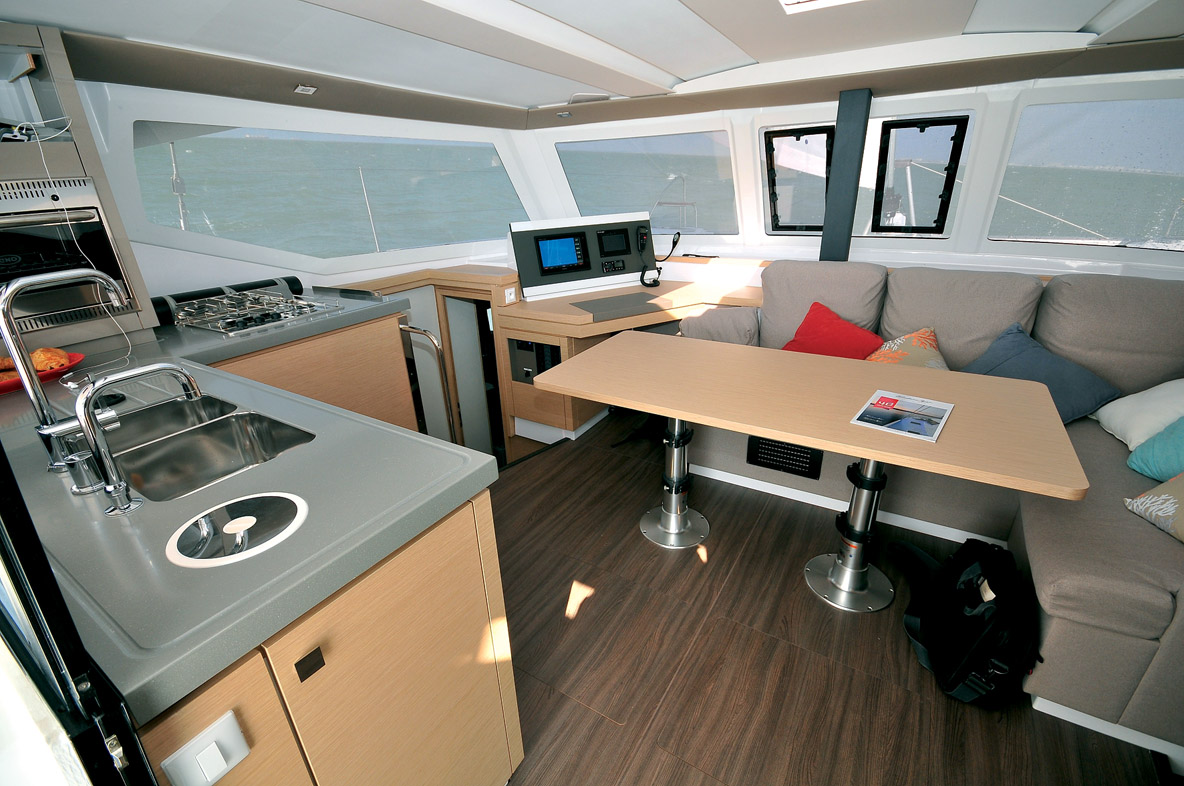
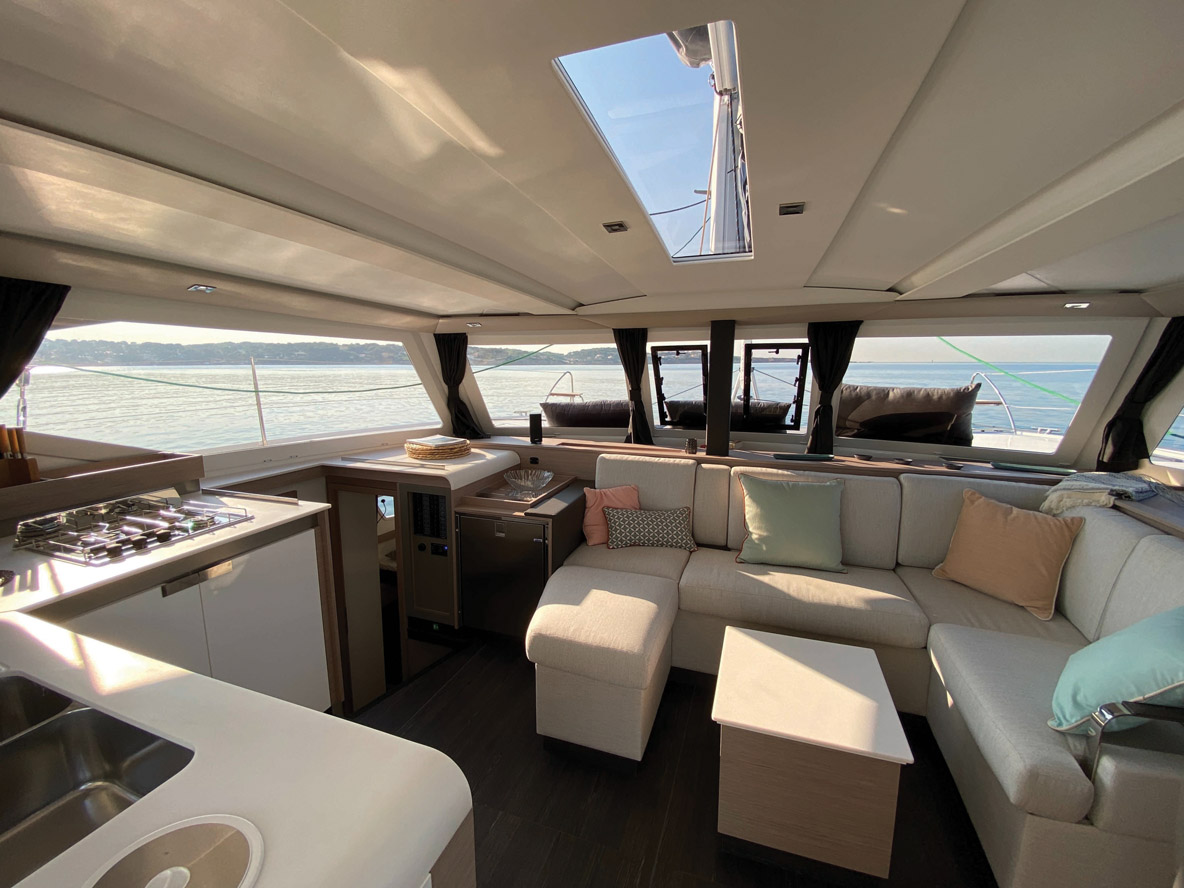
It’s the classic story: charter companies opted for the 4-cabin version, while owners went for the 3-cabin version - the entire starboard hull is dedicated to them. There’s a good balance between the two versions: 51% of production was 4-cabin - the remaining 49%, the 3-cabin. In terms of sleeping arrangements, there’s not much difference between the Lucia 40 and its successor: the aft cabins are still equipped with island beds, unlike the forward cabins. On the other hand, the Isla offers the possibility of fitting a mini skipper’s berth in the starboard forepeak. It’s in the nacelle that the layout evolved. The Lucia had its saloon area at the back of the nacelle, with a small chart table on the port side. On the Isla, this disappeared in favor of a watchkeeping berth and additional storage - navigation instruments are now grouped together at the rear of the nacelle to starboard. Note also the rounded shape of the furniture, a design borrowed from the Elba 45. The L-shaped galley, which communicates directly with the cockpit, remained unchanged. All versions offer generous volumes - given the compact size of this model - thanks to cleverly optimized layouts.
Conclusion
The Lucia 40 - like the Isla 40 - is an excellent choice for a couple, possibly accompanied by one or two children: admittedly, it’s a bit of a minimum multihull to set sail, but this model ticks all the boxes in terms of seaworthiness, comfort and ease of maintenance and handling. This catamaran also has the advantage of being both easy to find and sought-after, guaranteeing a good price on the second-hand market. In fact, 550 units of this model were built, which translates into a good twenty units available on the second-hand market.
Lucia vs Isla Spot the Difference!
From the outside, the Isla 40 is distinguished from the Lucia by its inverted bows - extended by 8 inches (20 cm). The deck layout is virtually identical - it’s inside that the two models differ. Thanks to its longer hulls, the Isla was able to accommodate a small skipper’s cabin in the starboard forepeak. The “4 cabins + skipper’s cabin” version has been a great success with charter companies. As for the Isla’s galley, it is better equipped with storage space. However, with the redesign of the saloon, the Lucia’s traditional “seated” chart table was replaced by a simple “standing” unit near the cockpit on the starboard side.
Points to check
Structurally, this catamaran is rigid and sound - which is already an excellent starting point. Overall, this model is robust: charter companies who have used - and are still using - the Lucia 40 and Isla 40 testify to sometimes intensive use without major problems. In more detailed terms, however, there are a number of issues worth mentioning, such as insufficient counterplates for cleats, deck hardware that might be considered slightly inadequate, the uneven quality of exterior accessories (cockpit cushions are very hard-wearing, but other fabrics have been quickly baked by the sun) and the lack of durability of interior hardware, which tends to oxidize. Other points are raised by Owners: some don’t appreciate the original windlass, others complain about the sharp corners of the furniture on the Lucia. In terms of “customization”, the numerous usable volumes and empty trunking allow for additional installations; the only hitch is the glued ceiling, which could hinder certain modifications.
Attractive layout plans
Reasonable budget given the possible program
No desk area (except for a possible Owner’s cabin) aboard the Isla
Technical Specifications
Architects: Berret-Racoupeau Yacht Design
Material: Polyester/foam sandwich
Length: Lucia 38’6” (11.73 m) / Isla 39’2”(11.93 m)
Beam: 21’9” (6.63 m)
Draft: 3’11” (1.2 m)
Light displacement: 19,620 lbs (8.9 t)
Mainsail: 624 sq ft (58 m²)
Genoa: 398 sq ft (37 m²)
Engines: 2 x 20/30 HP
Fuel: 79 US gal (300 l)
Water: 140 US gal (530 l)
Lucia 40 production years: 2015-2020
Isla 40 production years: 2020-2024
Total production: 550 units
Second-hand price: € 340,000 ex-tax for a Lucia 40 € € 450,000 ex-tax for an Isla 40
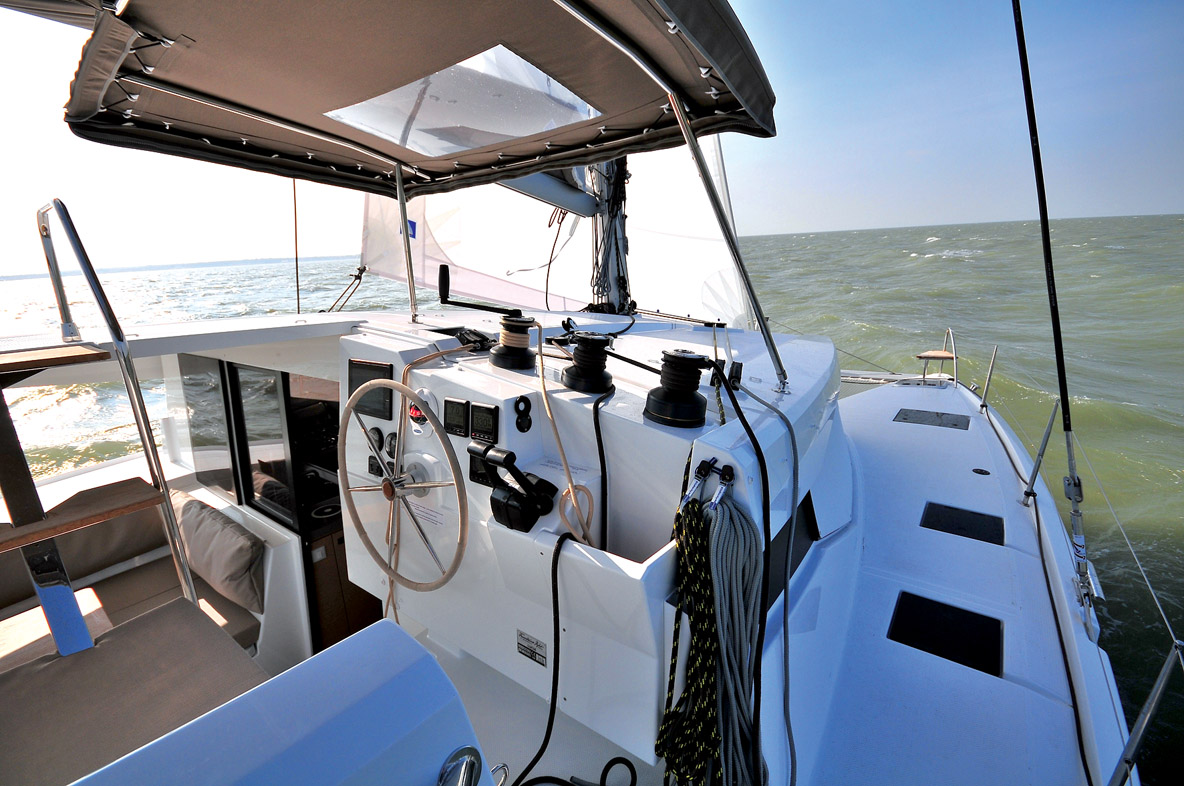
A large stowage locker stores reefing lines, and straps are provided for coiled-up halyards.