
40 years and 40 different catamaran models! These two numbers neatly sum up the great adventure of the La Rochelle boatyard set up by sailing enthusiasts who went into business! Here we test the Lucia, the milestone 40 footer representing this vintage.
Infos pratiques
- Le chantier : Lucia 40
- La fiche technique
-
 Découvrez notre vidéo exclusive
- Financez votre Lucia 40 Fountaine Pajot
- Assuez votre Lucia 40 Fountaine Pajot
- Articles autour du Lucia 40 Fountaine Pajot
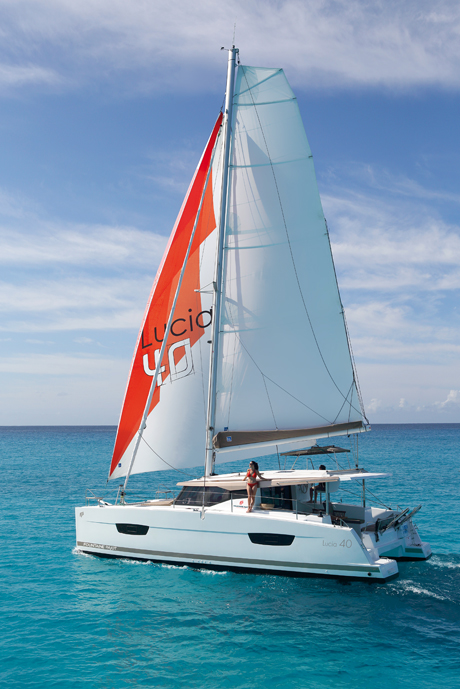
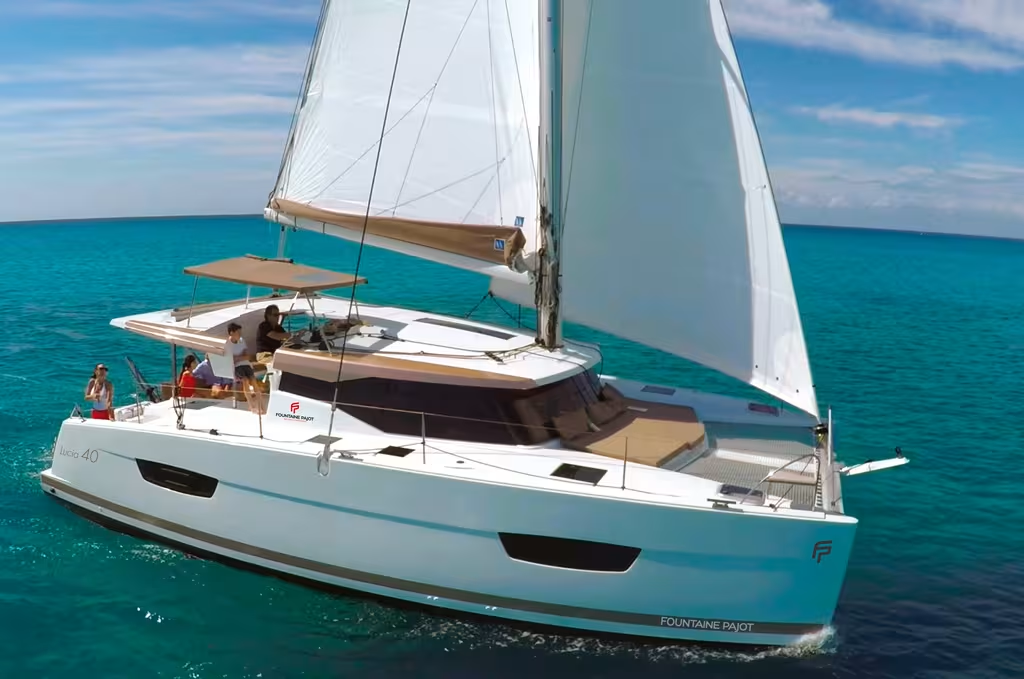
The Lucia's generous sail area allows her to shift along easily in light airs
The La Rochelle story
During the 1970s, the development of cruising boats was in full swing, but it was a handful of champions from dinghy racing, and preparations for the Olympics, who made their mark on the future of the French multihull. Fountaine Pajot was founded in 1976 by Jean-François Fountaine (selected for the Olympics in the 470 class and Half-tonner world champion) and Yves Pajot (silver medalist at the 1972 Olympics). They were joined by Daniel Givon, R_mi Tristan and Pierre Fountaine. They started building 20s, 470s and 505s at Aigrefeuilles in 1978. There followed by the building of the trimaran Royale (One of the first foilers!) to Le Graal plans for Philippe Facque and Lo´c Caradec, then the revolution of Charente Maritime I and II and the subsequent wins (Lorient - Bermuda - Lorient in '83 and the La Rochelle - New Orleans race) of this extraordinary innovative catamaran designed by two others from La Rochelle: Michel Joubert and Bernard Nivelt. A whole cast of future players on the multihull stage gravitated towards this up-and-coming yard: Fred Charpail, Philippe Pallu de la Barrière, Pierre Follenfant, Jean Batiste le Vaillant and many more. The arrival of the Louisiane heralded the arrival of the first French production catamaran. This was to be an unprecedented success which propelled the builder to the forefront of the industry. The yard which also has a factory at La Rochelle (for large models) was floated on the stock exchange in 2007 and sailed trouble-free through the slump of 2008-2012 publishing double-figure growth rates in 2014 and 2015. This evolution has continued after the departure of J-F Fountaine (who became the Mayor of La Rochelle), showing far-sighted success. The executive management was entrusted to Nicolas Gardiès and Romain Motteau (Hobie 16 world champion) and the presidency of the group to Claire Fountaine (wife of Jean-Franois and former 47 world champion with Christine Briand in 1983). The financier Nextstage took a 35 per cent share in the business which today has 400 staff. The Fountaine family retains ownership of 54% of the shares in the yard.
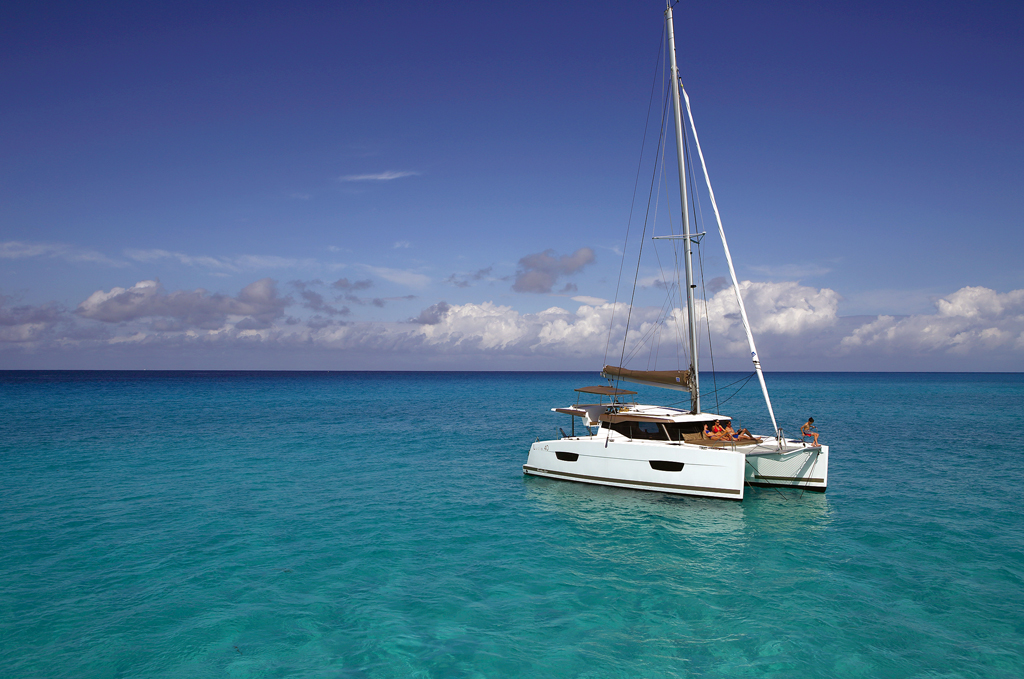
Compact, but sympathetic, lines reveal an amazing interior volume
A sailboat range in rapid development
In the 12m category, the Louisiane 37 became the French pioneer. The subject of many modifications and conversions, it is today seen as a kind of ancestor and unfortunately very few examples have received the maintenance which would have allowed this pretty catamaran to maintain its original qualities. The Fidji 39 succeeded it with a more voluminous shape and far superior internal ergonomics, and the Athena really hammered the message home, becoming a very popular model, now much sought-after. Next came the Lavezzi which, for the same length, offered the living space of a bigger boat, then the Lipari 41, which corresponds to today's standards. The Joubert-Nivelt design team played a determining role in the history of Fountaine-Pajot, and it is now Berret-Racoupeau which designs the new models. The flagship is the Victoria 67, followed by the Ipanema 58, the Saba 50, the H_lia 44 and the Lucia, which is now the replacement for the Lipari in the range.
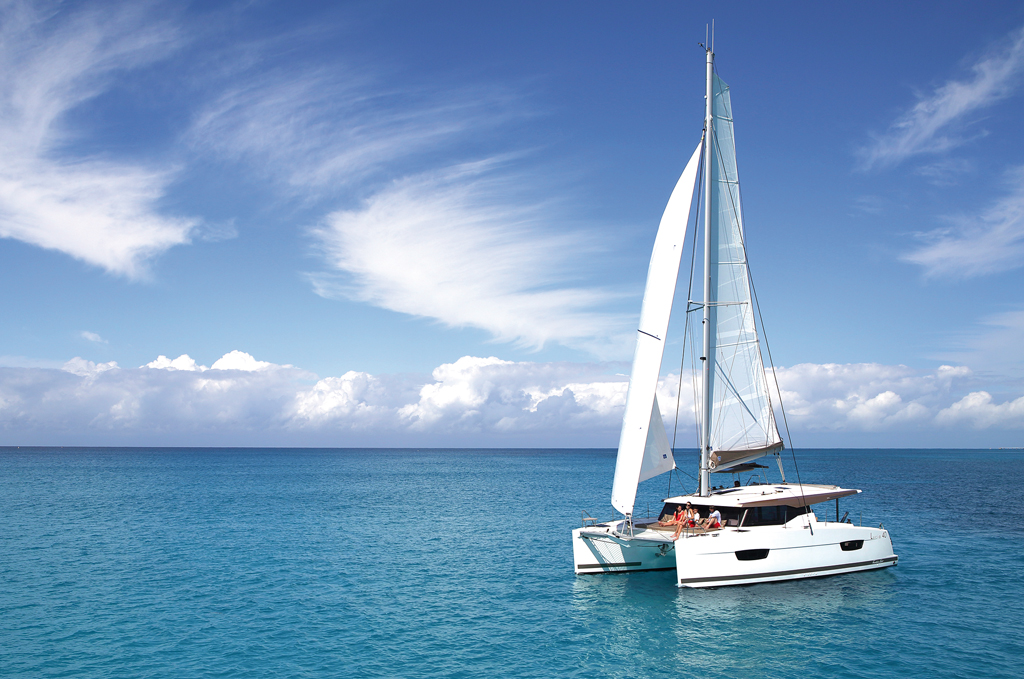
Easy to handle and very welcoming, the big 40 footer will be great for new catamaran converts, as well as allowing more senior globe-trotters to continue sailing without excessive effort
The first encounter with the Lucia 40
Like many visitors to the winter boat shows, we discovered the new 40 footer at Paris then at Dusseldorf 2016. Adorned with a nice orange covering, it really shows the standard of work of a compact contemporary platform, but one which hides a surprising interior volume.
Architecture, lines and construction
Despite only being 11.73 meters in length, the Lucia is a big boat with convivial outdoor areas, a comfortable, well-equipped deck salon and voluminous cabins. The nacelle extends fairly far forward; the semi-circular hull sections are generous, to accommodate a useful load, while the bows remain fine-entry and the bridge deck clearance appropriately high. A small increasing step widens the inside hulls without creating those disgraceful lumps liable to create slamming in a chop. The traditional vertical bows are elegant, and the outboard topsides pleasant. Two portlights above a little longitudinal line, and a decorative band, stretch the perception of the hull sides. The design of the coachroof is stylish, very light, almost transparent, with the angle of the windshield topped by the middle overhang which is clever and integrates well into the overall lines. The same goes for the bimini top. The fairly sleek sail plan confirms the impression of a generously-canvassed sailboat. The construction of the hulls by infusion is carried out in three stages (the lower part of the nacelle with the inboard hulls, joined to two outboard half-hulls). The sandwich is composed of a balsa core and multi-axial glass cloth. The deck and the coachroof are injected parts (vacuum-laminated in a double-sided mold), a specialty of Fountaine-Pajot.
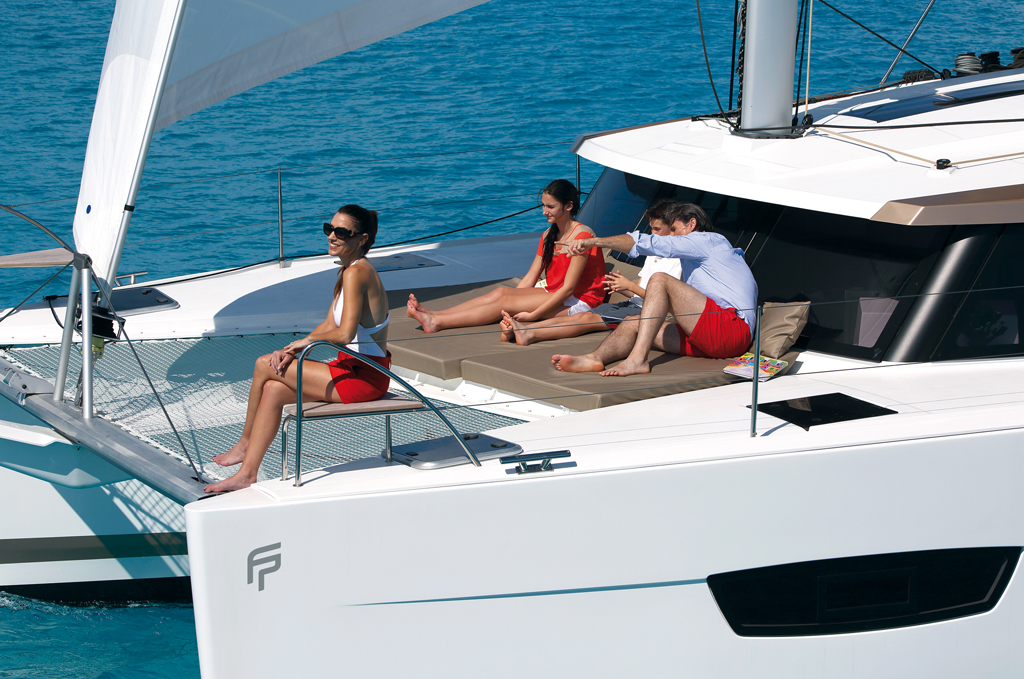
Without borrowing on too many of the modern trends in catamaran design, the Lucia has some innovative areas
Inside-outside, the areas blend into one
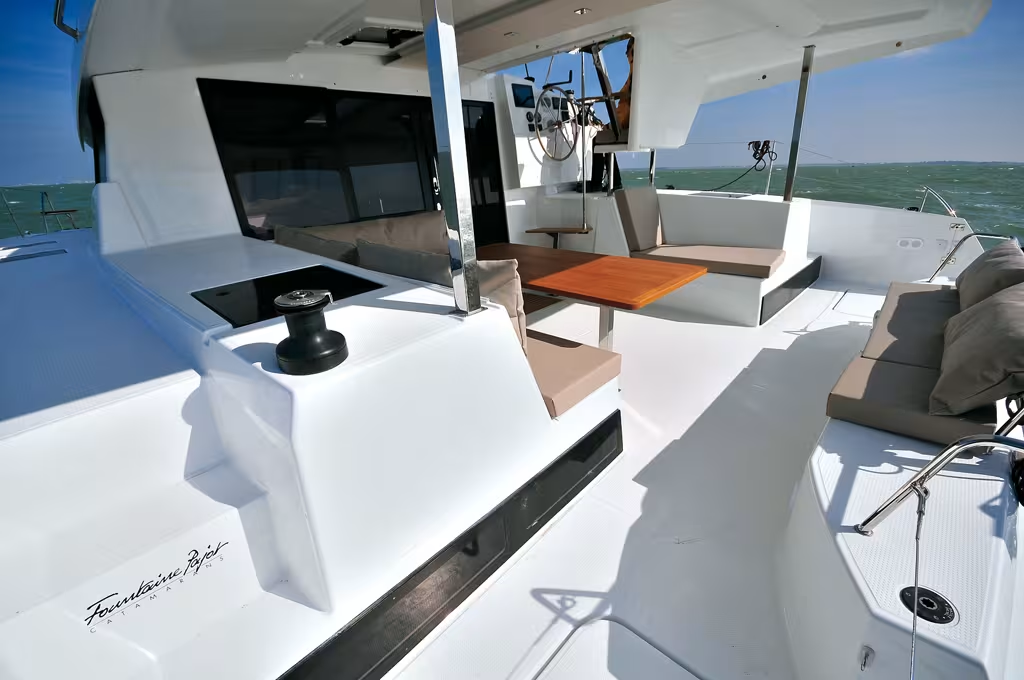
In the small world of the catamaran, the current trend is towards getting rid of bulkheads. The Lucia keeps up with this trend without resorting to all the recent innovations (movable after bulkheads, forward cockpit accessible from the interior, tilt and turn façades). Isabelle Racoupeau, the designer and Olivier Racoupeau, the architect, have dealt with this question not by radical means, but by carefully looking at the interactions between the areas. The sliding glazed door (strategic communications point on a catamaran) has been dealt with in a traditional way by optimizing all its good points. The opening is wide, with the main section sliding into the helm station bulkhead, while the section opposite slides into the galley island in the cockpit's dining area. This space seems to have been the subject of very careful attention. Perfectly linked to the galley, the eight-person table and the corner seat are carefully shielded from the wind and the sun, this marine terrace is completed by a sun lounger to starboard and a neat bench seat aft. The upholstery cleverly stands out, and the separated cushions/backrests are a really neat sailboat idea. The way they are fixed down using a sewn beading (better than press-studs or Velcro) allows them to be stowed away quickly inside if needed. The four-person sun lounger located at the aft of the trampoline is an original and fun place to be, Ideal for those quiet moments at sundown or when sailing in settled conditions.
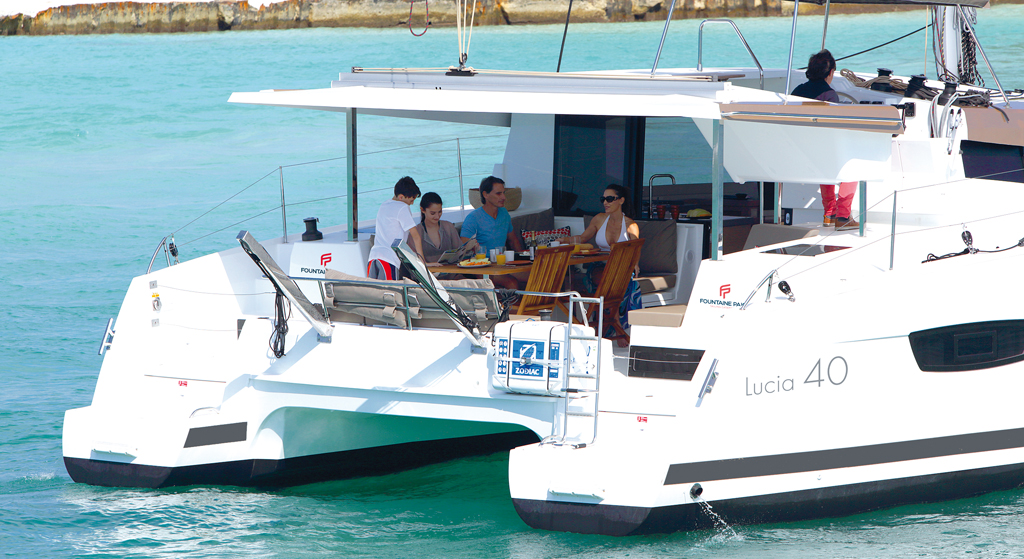
The terrace cockpit has been well- designed. Access to the galley is fluid; the aft bench seat and lounger complete this exterior dining area
A light and airy nacelle
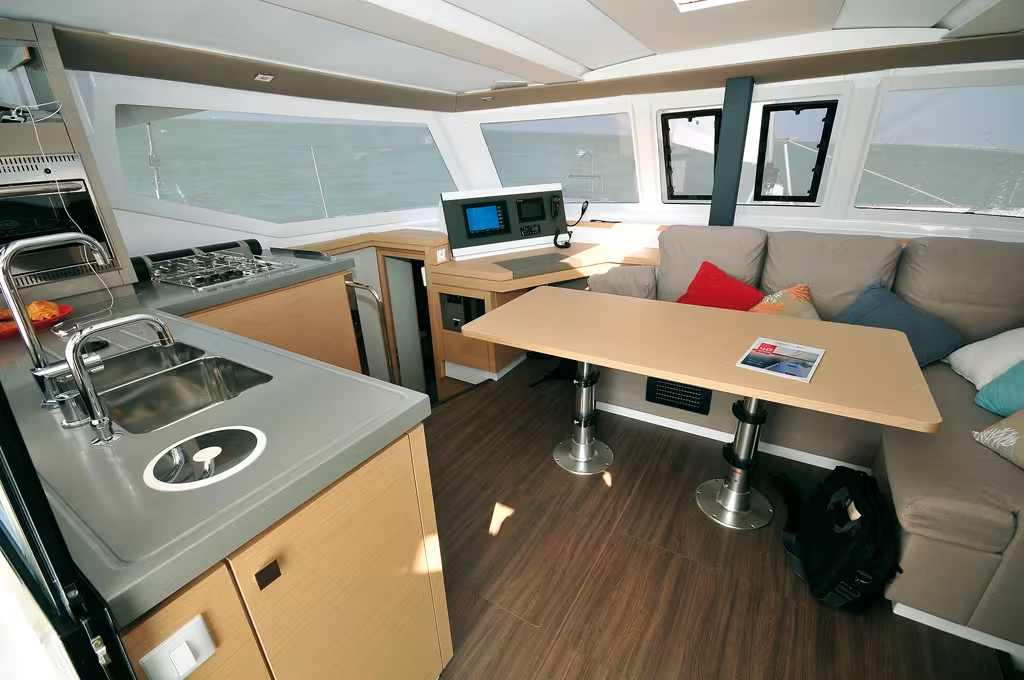
The progress achieved by building the coachroof in injection allows for the structure to be made more airy and give more light using less material. The structural supports are more discreet and the panoramic view of the exterior is significantly improved. The Batyline protection combined with the smoked tint of the Plexiglas helps maintain privacy. The two very large opening Lewmar hatches nicely fill the salon with fresh air, and can take on the role of serving hatches at sundowner time. The same level of attention has also been paid to the interior upholstery, notably for the cushions which are better than the usual rectangular foam ones. The large L-shaped galley is smart and complete with three-burner cooktop, oven, double sink, and top-quality refrigerator drawers. The chart table is small but sufficient, well-placed at an angle to port.
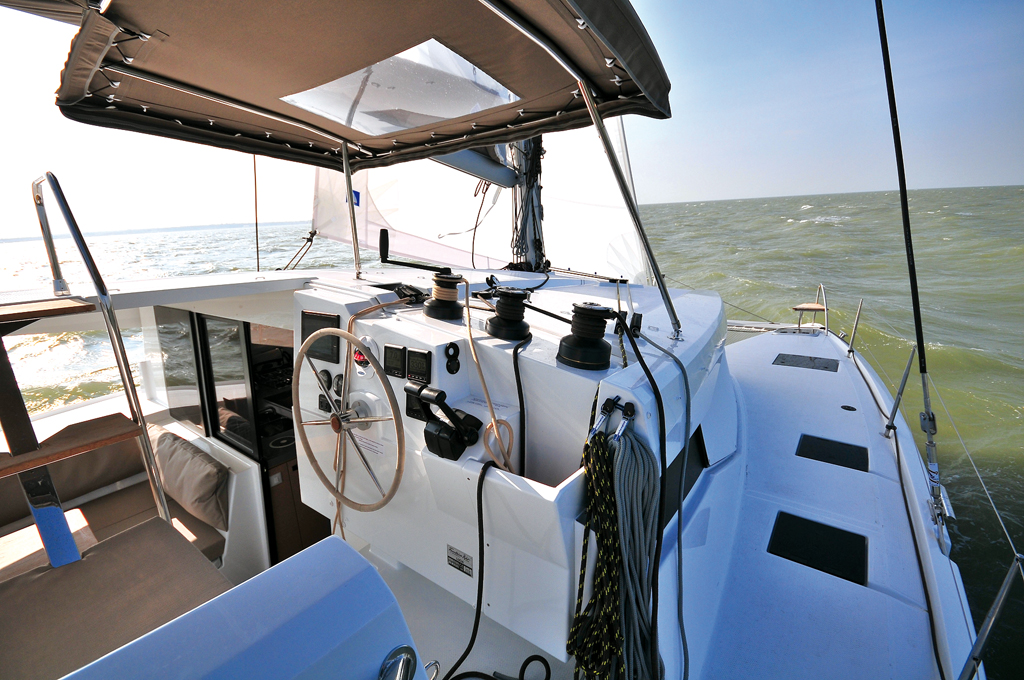
All sail-handling is led back to the helm station, not too exposed, preserving the overall lines. Note the stowage box for lines and the straps for the coiled halyards
And spacious cabins
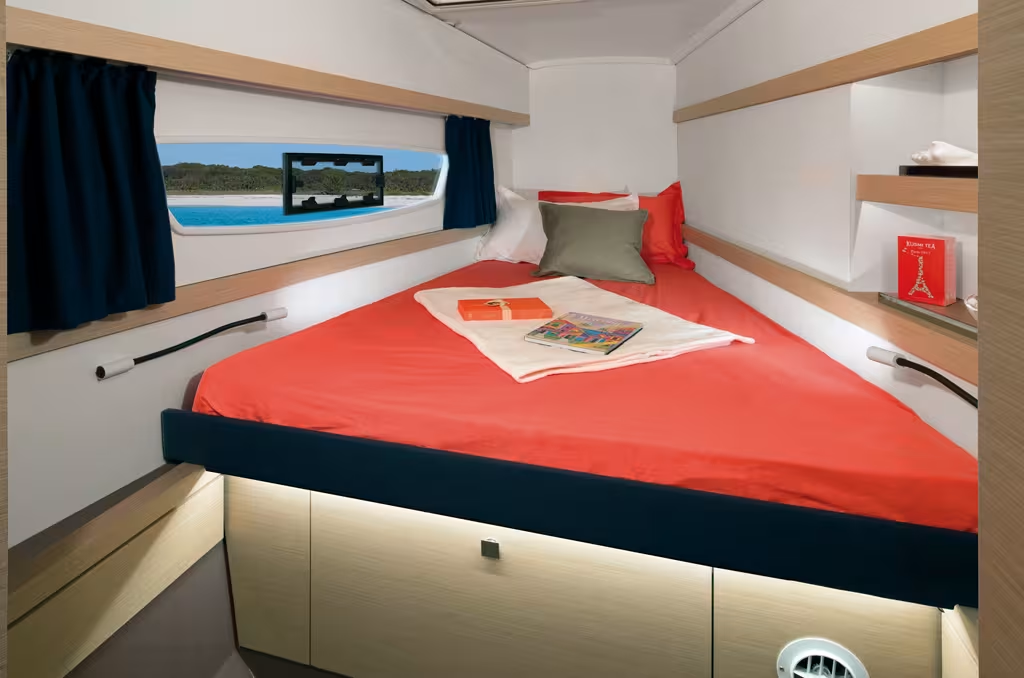
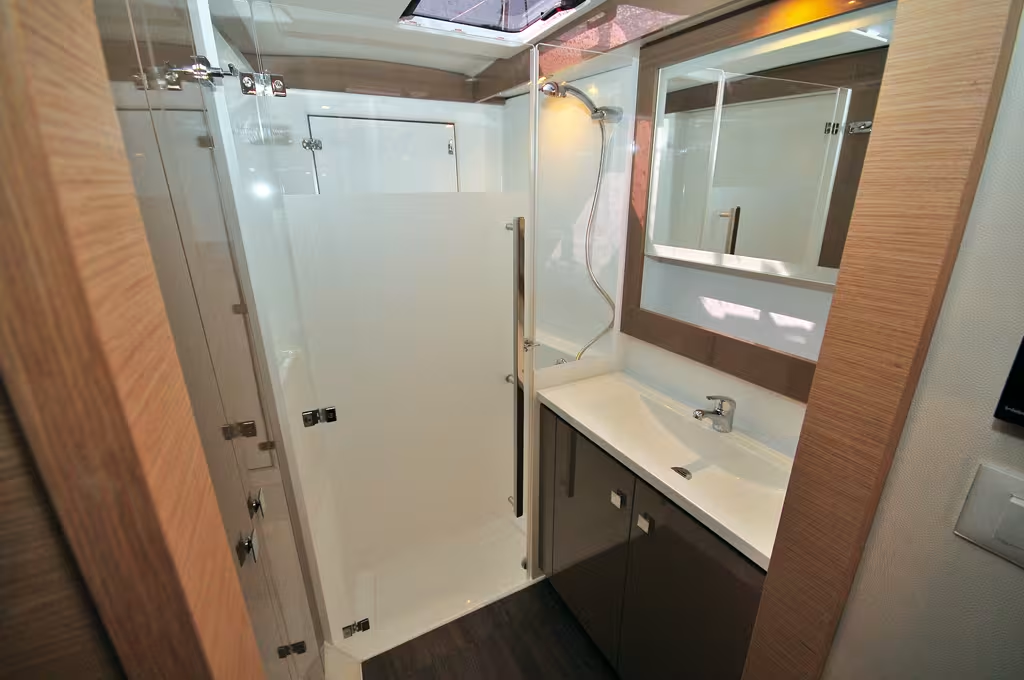
It's on the owner's version that you really see the volumes, but first you notice the quality of the fittings, the woodwork (in light oak Alpi) and the creative design: remarkable for a model of this size. Separating the toilets and the bathrooms increases the level of comfort perceived. Guests are no longer less well-treated: the forward and aft cabins to port offering the same a level of comfort with separate, private showers and toilets. Ventilation and light are worthy of a charter of model (top of the range bedding is standard).
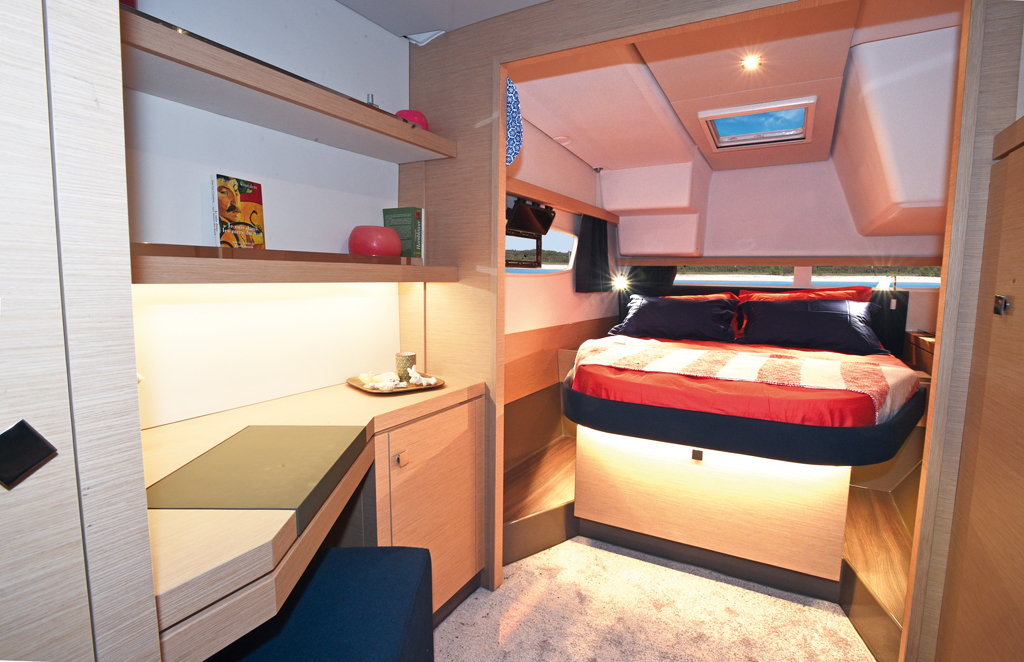
A creative design which transforms the interior of the 40 footer
The engine compartments
Their Layout is clearly been well thought out and implemented. The 30hp Volvo motors on the version we tested were three cylinder , 1100cc models weighing 158 kg each including their saildrive transmission, and were fitted aft of the rudders. There is space to work around the engines. The alternators put out 35 A at tickover and 100A at cruising speed. The raised location of the service bank is clever, and the battery shut-offs are well labeled and protected. The aluminum plate which supports the rudder tube is bolted to the aft bulkhead and is crossed vertically by the rudder post and also includes the rudder stops. The link bar between the rudders and the autopilot ram are connected on a rod, all of which is clear and accessible. Only the polystyrene foam for unsinkability of the hull is not to the same standard as the rest of the installation. I would have preferred to see Airex (there are four insubmersible zones as well as the sandwich itself).
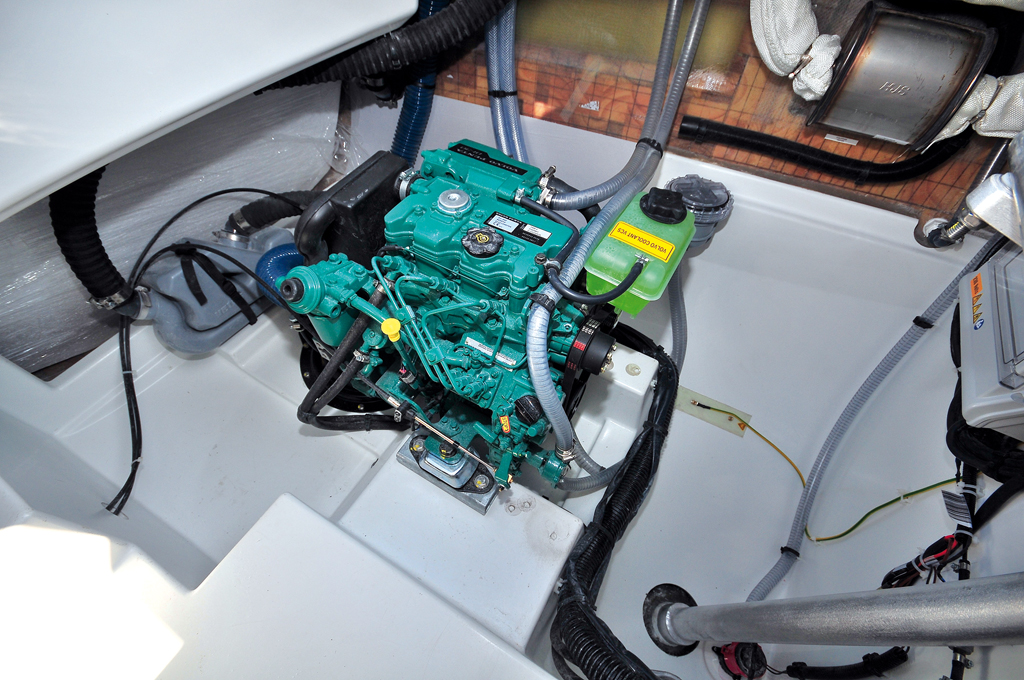
An engine compartment with room to work. Note the compact balsa/glass sandwich. A hatch shuts off the aft of the compartment where there is polystyrene for buoyancy, though I would have preferred to see a dense foam.
Two days on board in March
We made the most of two nice days early spring to test the Lucia off La Rochelle on France's Atlantic coast, setting off the first day with 22-25 knots of wind for a 30-mile gallop. Unfortunately we didn't have a gennaker on board, but the strength of the northeast wind made up for this lack of equipment. It would have been interesting though to have tried a smaller downwind sail with this range of wind to push the boat a bit harder. Under full main and with the genoa completely unfurled, we were well-canvassed, but the Lucia showed herself to be tolerant of this and be more than capable. We made a long run with the wind just aft of the beam, with the traveler well-eased: the catamaran behaved perfectly and remained stable. The average speeds were between 8 and 10.2 knots. The substantial Z diffusion mast, which has one set of triangular spreaders, remained unaffected and quietly inspired confidence in this breeze. The short and choppy sea on this stretch of coastline makes for a good testing ground of which the 40 made easy work. Downwind the average speeds remained high; the stability of the platform was noticeable and reinforces the feeling of safety. There are obviously limits which you should not exceed as always (which are clearly indicated in the user manual), but they are prudent advice which an experienced crew can interpret for themselves. We set in one reef to come back upwind, and were appreciative of the continuous reefing line, with the traveler eased right out to spill wind, we continued under genoa without bearing away during the whole maneuver. The bows are efficient upwind and easily get through the chop. Nevertheless it's best not to try and come too hard on the wind. As for the sail handling, everything works well even with a single electric winch on which it is possible to momentarily transfer the sheets of the mainsail and the genoa (by taking two turns on their respective winches) to then revert to the safe situation of one line on one winch. This makes gybing easier (traveler and sheet to center) and even tacking on board on your own (there is quite some tension in the genoa sheet!). We used this technique over the course of the two days without once getting a riding turn. On our test boat, hull number four, the clutch for the main halyard was a bit small, and was misaligned with the direction of effort. A bigger mast clutch and an outer sheath would better preserve the halyard on long runs. The large container for the line ends is practical and the two quick blue performance straps allow for neat stowage of the halyards. The traveler ends logically terminate next to the mainsheet. Perfect, except the clutches are not labeled. The watchkeeper's seat is very comfortable, even in the lively conditions, and the deck layout is clear. No problem of panoramic visibility either from inside or from the helm. The wheel is connected via metal cables and is fairly precise and the directional stability of the boat is excellent. However, I might have preferred a slightly larger diameter wheel.
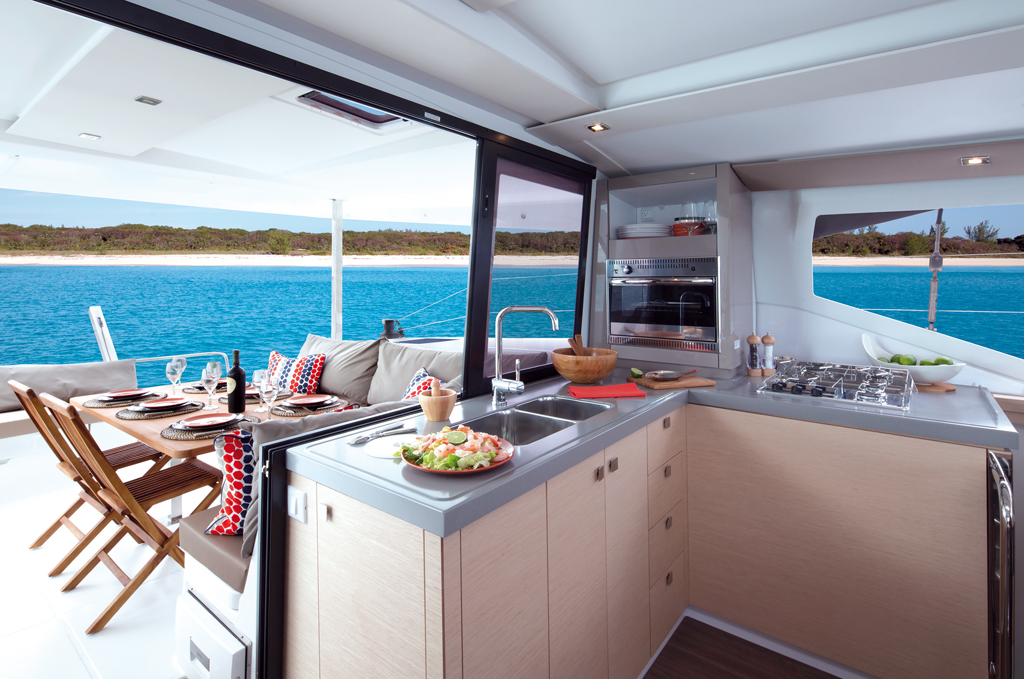
The moveable folding bulkhead which slides into the galley island in the exterior dining area
Conclusion
The Lucia seems to be a good vintage. Very liveable and with tasteful d_cor, the build quality ensures a boat which will age well, and her size and characteristics lend themselves to a wide variety of programs. The ease of handling certainly won't deter new multihull converts, and her 40 feet will allow more senior sailors to continue cruising without excessive effort.
Technical Specifications
- Architects: Berret-Racoupeau Interior
- Designer: Isabelle Racoupeau
- Builder: Fountaine Pajot
- Construction: Foam glass sandwich polyester composite (infusion process for the hull, injection for the coachroof and deck)
- Length: 11.73m
- Beam: 6.63m
- Draft: 1.20m
- Mainsail: 58m2
- Genoa: 37m2
- Motors: 2x20hp Volvo (2x30hp on option, as fitted to our test boat) Versions available and prices in — ex-tax: 3 cabins-3 bathrooms or 3cabins-2 bathrooms: 254,000 4 cabins-4 bathrooms: 257,000 4 cabins-2 bathrooms: 256,000
- Principal options in — ex-tax Offshore equipment pack: 32,000 (epoxy primer, windlass, square-topped mainsail + ball-bearing batten cars, davits, genoa furler, exterior upholstery, 1 electric winch, 1 black water tank... ) Garmin 1 electronics pack: 11,000 3X100W solar panels: 2,750 60liter/hr Watermaker: 10,548 30hp Motors: 2,758 Three-bladed folding propellers: For 2x20hp:2,030 / for 2x30hp: 2,828 Heating (hulls and salon): 10,300 Delivery: 8,900
Pluses
- Nice overall aspect / outline
- Contemporary interior layout
- Build quality
- Cockpit dining area
Minuses
- Aesthetics of the bowsprit
- Head of square-topped mainsail need to be attached manually
- Helm station bimini fixed on tubular frame
- Tacking with 2 genoa sheets
The competition
| Model | Builder | Weight in t | Sail arean in m2 | Architect | Basic price ex-tax |
| Bali 4.0 | BALI | 8.6 | 81 | X.Fay/Bali | 253,000 |
| Lagoon 400 | LAGOON | 10.35 | 84 | VPLP | 261,600 |
| Nautitech Open 40 | BAVARIA/NAUTITECH | 7.8 | 92 | M.Lombard | 276,000 |
| Leopard 40 | ROBERTSON/CAINE | 9.34 | 96 | Simonnis/Vogdt | 279,000 |
Caption
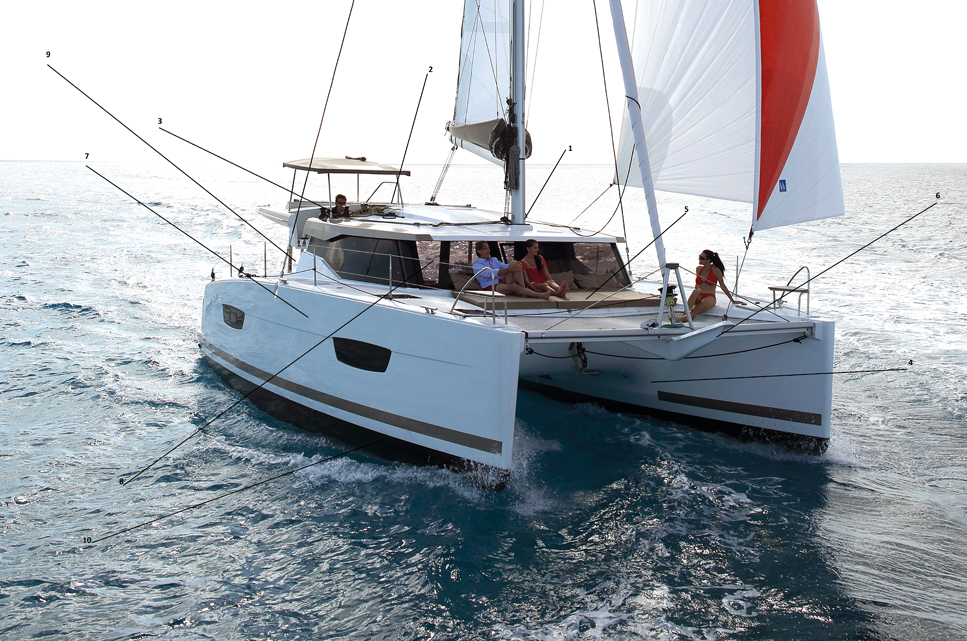
- : The Zdiffusion mast section is reassuring, the triangulation of the spreaders adding to the peace of mind
- : The traveler crosses the entire bimini, allowing the leech to be adjusted as necessary, but sheeting position need to be placed on deck for close points of sail. The visibility of the mainsheet car is perfect
- : The helm station is well-designed and made, the deck layout remains simple and well-sheltered
- : The bridgedeck clearance is just right, and the –tunnel” is clear
- : The large sunbathing area is great, but you need a plan for stowing everything away in bad weather
- : The bowsprit in composite is a good idea, even if it's not that pleasing to the eye
- : The design of the exterior topsides, always a tricky subject with catamarans, is neat and adds to the overall pleasing lines
- : The coachroof style is a success, the new design being possible with injection molding
- : The watchkeeper's seat is comfortable and safe. Not too high up, it remains protected from the wind and perfectly linked to the cockpit
- : Despite all the extras, the Lucia looks well within her lines, the fine-entry bows combine with generous midships and aft sections to accommodate the variations in load
