Behind its relatively traditional appearance, the Max 44SC keeps its secrets well hidden! This catamaran stands out from the crowd thanks to its asymmetrical hybrid powertrain, combining safety and energy efficiency. This propulsion system has been validated by an impressive 10,000-mile voyage from Vietnam all the way to France. We got the chance to discover this model at the International Multihull Show.
Infos pratiques
- Le chantier : Max 44SC
- La fiche technique
-
 Découvrez notre vidéo exclusive
- Financez votre Max 44SC
- Assuez votre Max 44SC
- Articles autour du Max 44SC
Conditions: Calm sea, 6 to 8 knots of wind
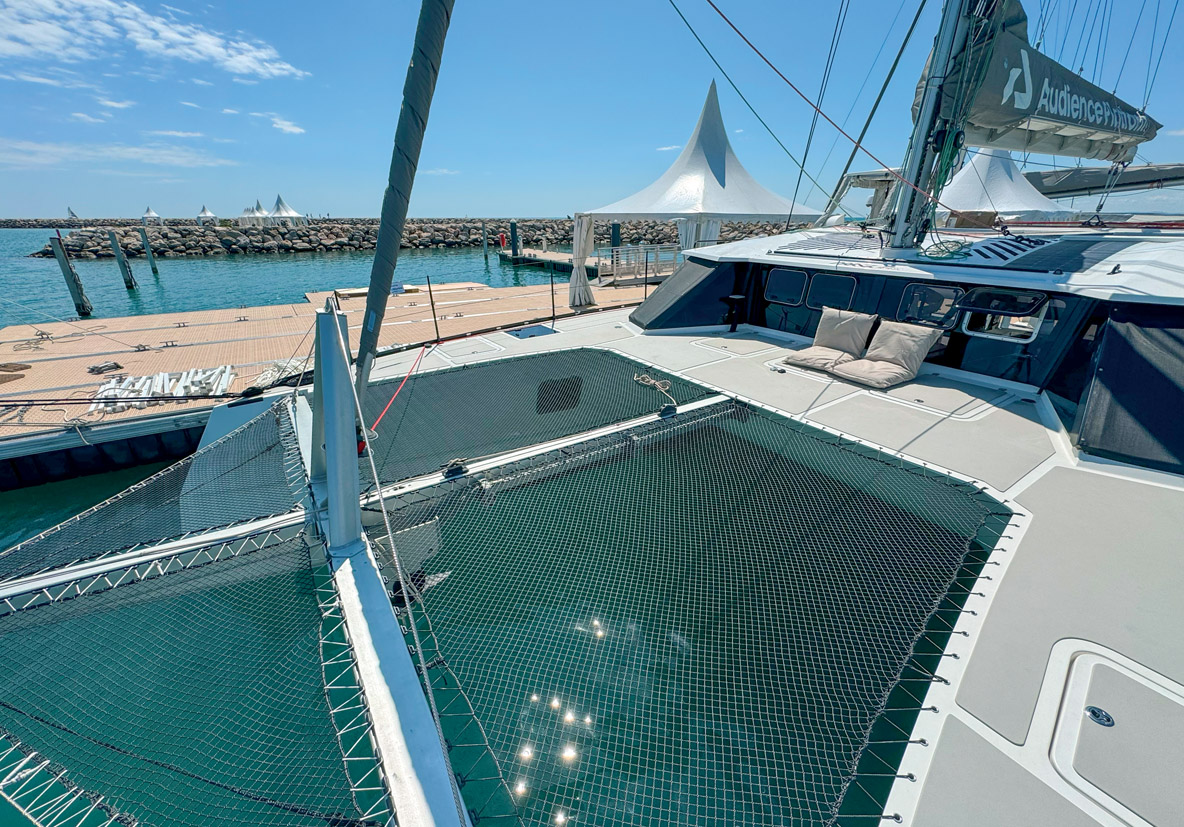
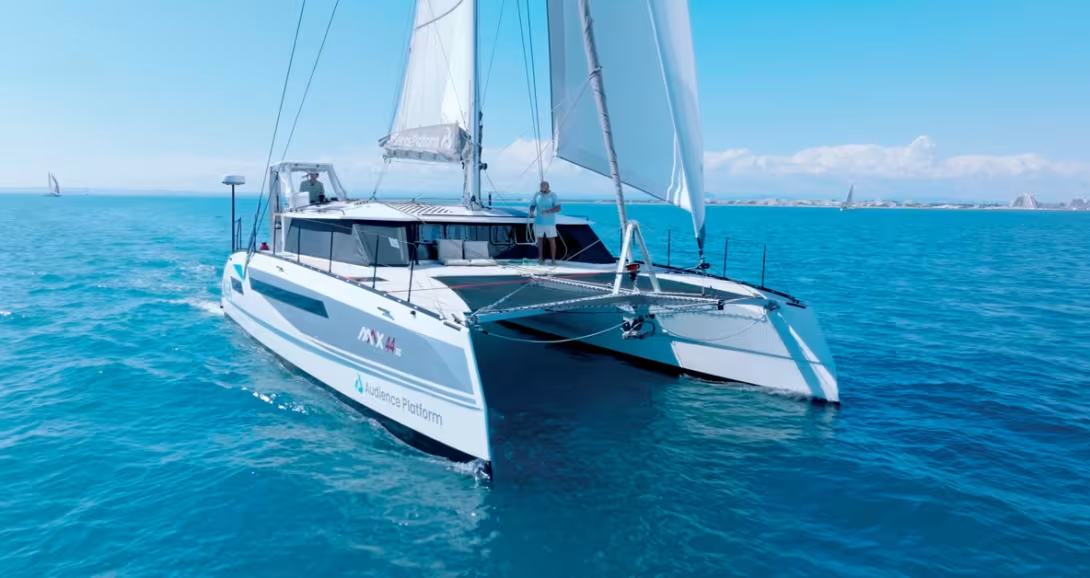
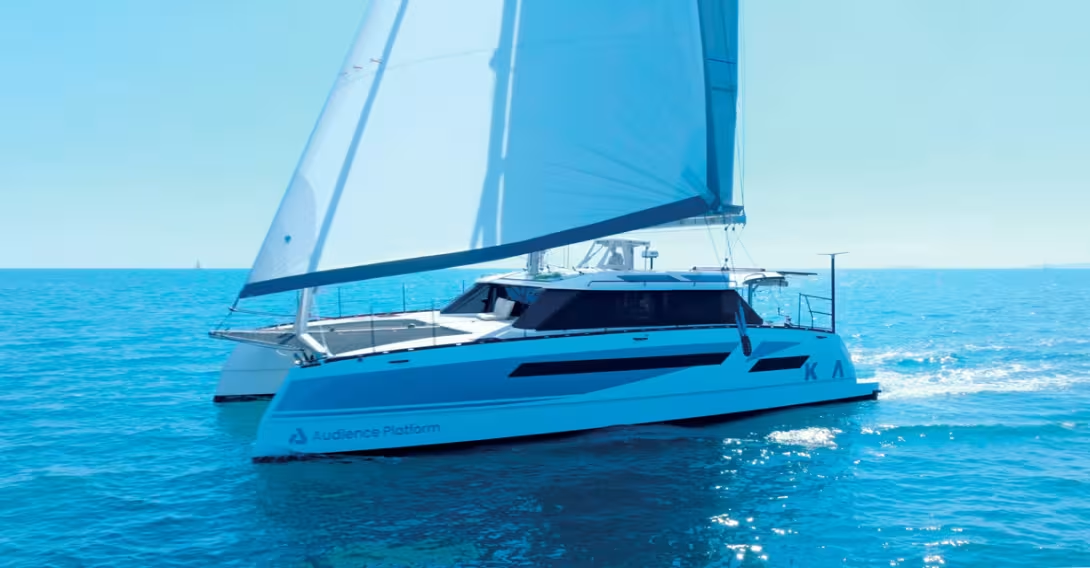
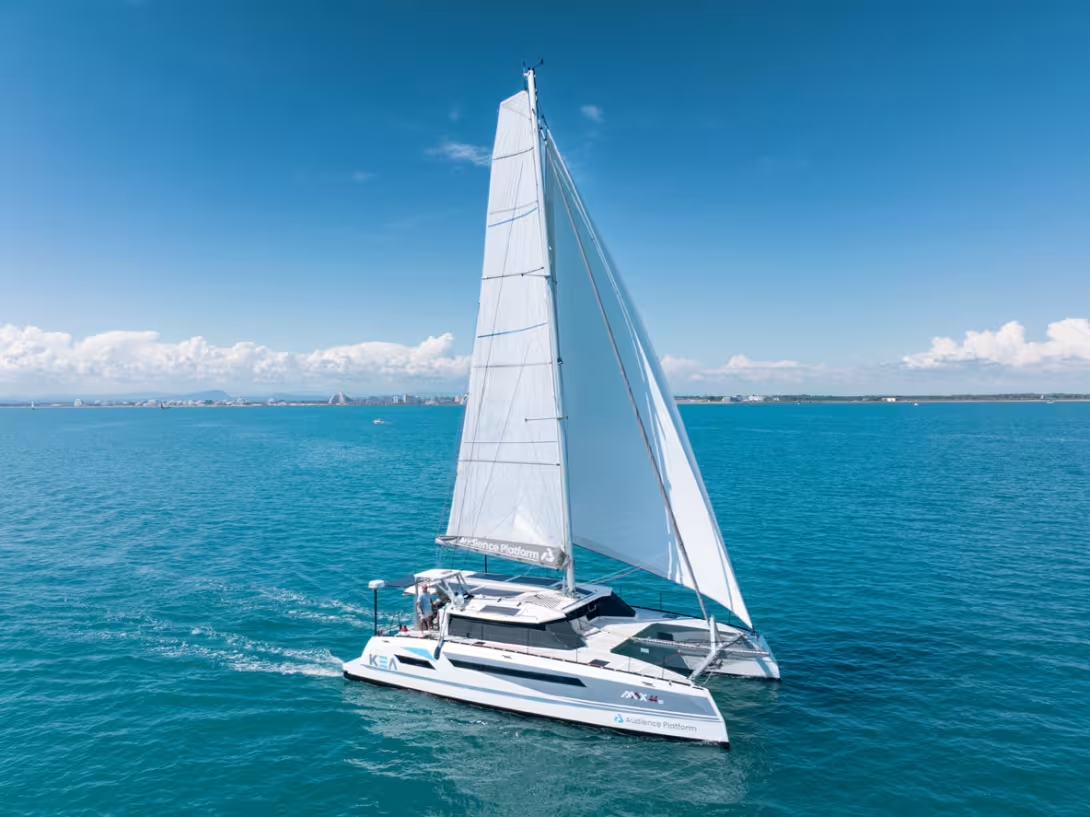
At the far end of the boat show pontoons, a 44-foot catamaran stood out somewhat from the well-behaved and well-marketed landscape of the major multihull builders. The Max 44SC combines a relatively conventional design at first glance with particularly slim waterlines and a sleek sail plan. Built in Vietnam under the supervision of Terry Dewhurst, an Australian who has already proven himself in multihull construction, this boat went on to surprise us with its relatively new hybrid propulsion system, which could be described as asymmetrical—a concept already developed by O’Yachts.
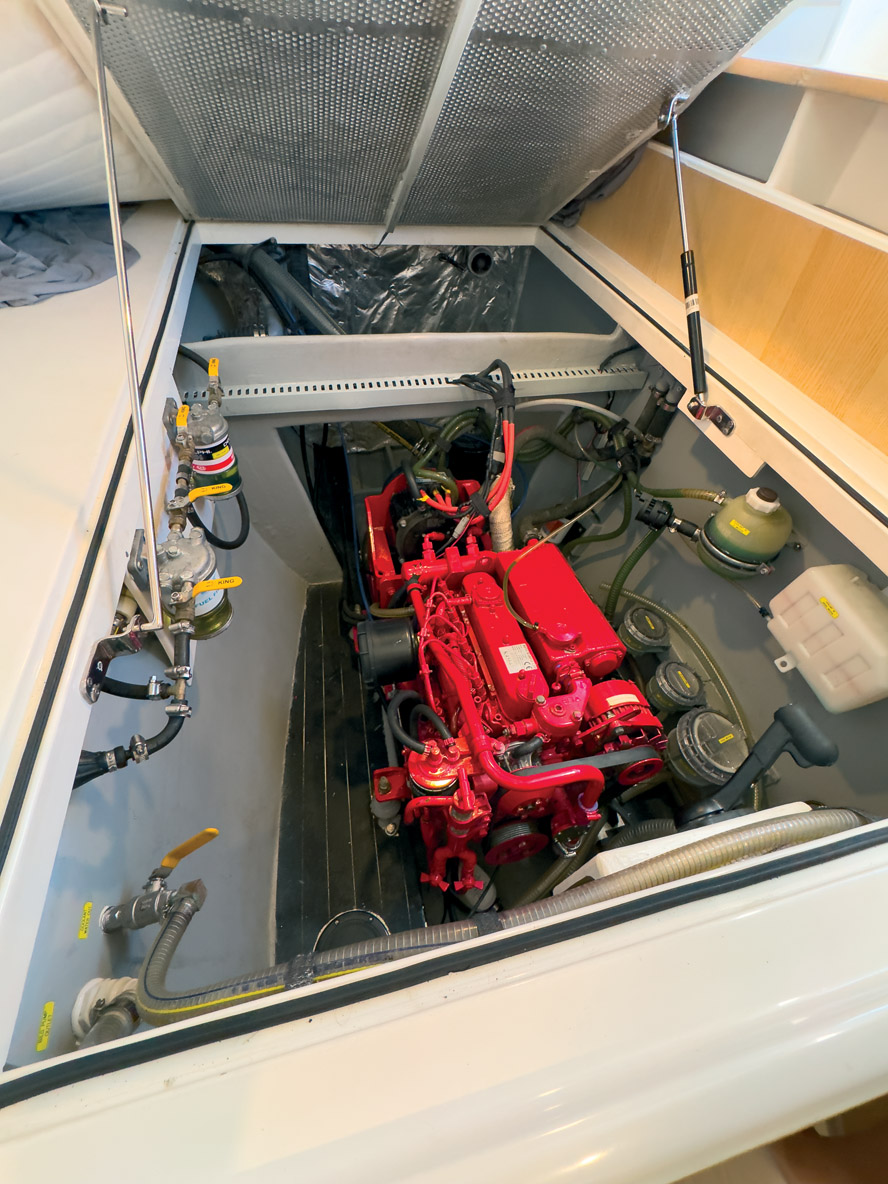
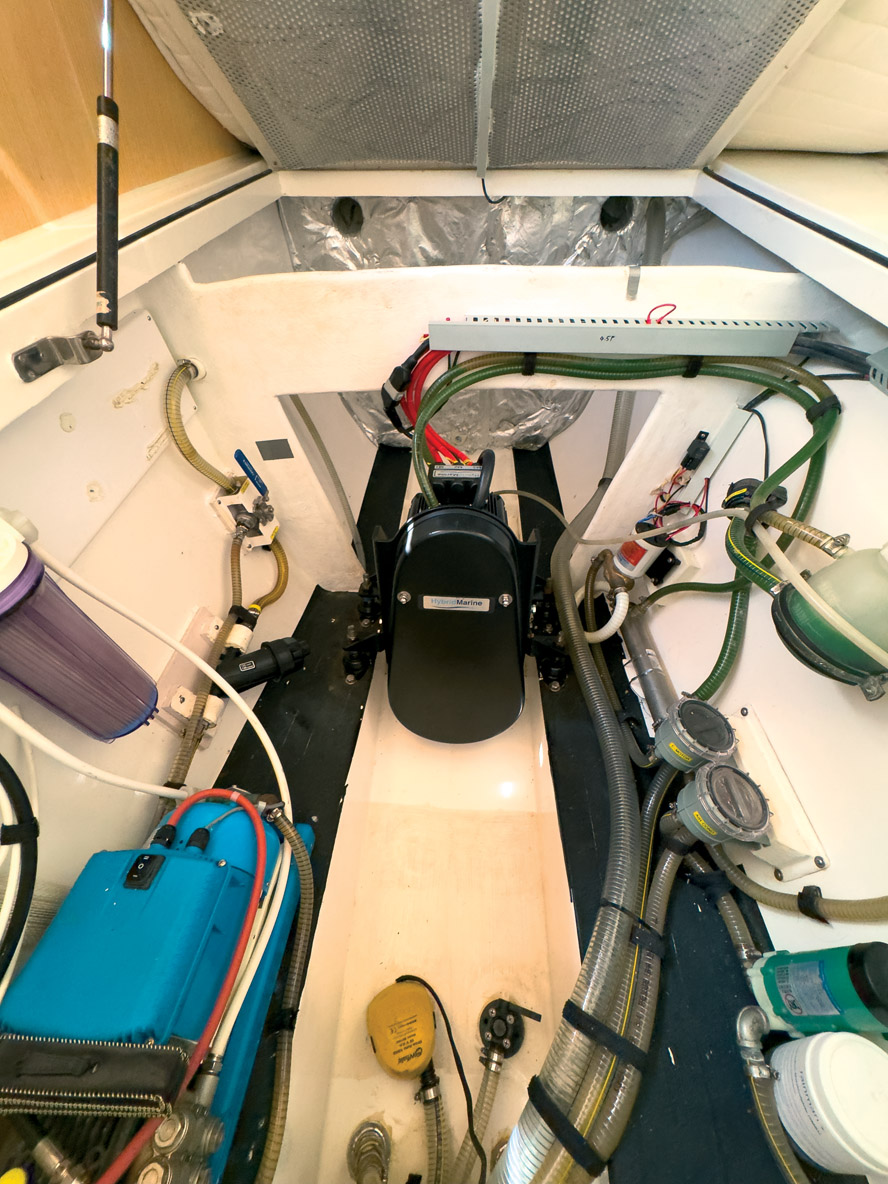
Developed with the help of Hybrid Marine, a British company specializing in hybrid propulsion for workboats and sailboats, the Max 44SC presented at La Grande-Motte was equipped with a diesel-electric hybrid engine in the port hull and a pure electric motor in the starboard hull.
Watertight Glass Window in the Nacelle
On the day of our test sail, the sun was beating down and there was barely a breath of wind in the Bay of Aigues-Mortes: over the land, there was not a single cumulus cloud on the horizon above the Pic Saint-Loup mountain that might have given us any hope of a thermal wind... meaning that we would be setting off with a maximum wind speed of 8 knots. Stephen, the owner, was somewhat disappointed because he describes his catamaran as particularly fast in a breeze. I consoled him by explaining that this article is primarily part of our Forever Green special edition and that we are mainly interested in the hybrid propulsion system, so light airs were not a problem!
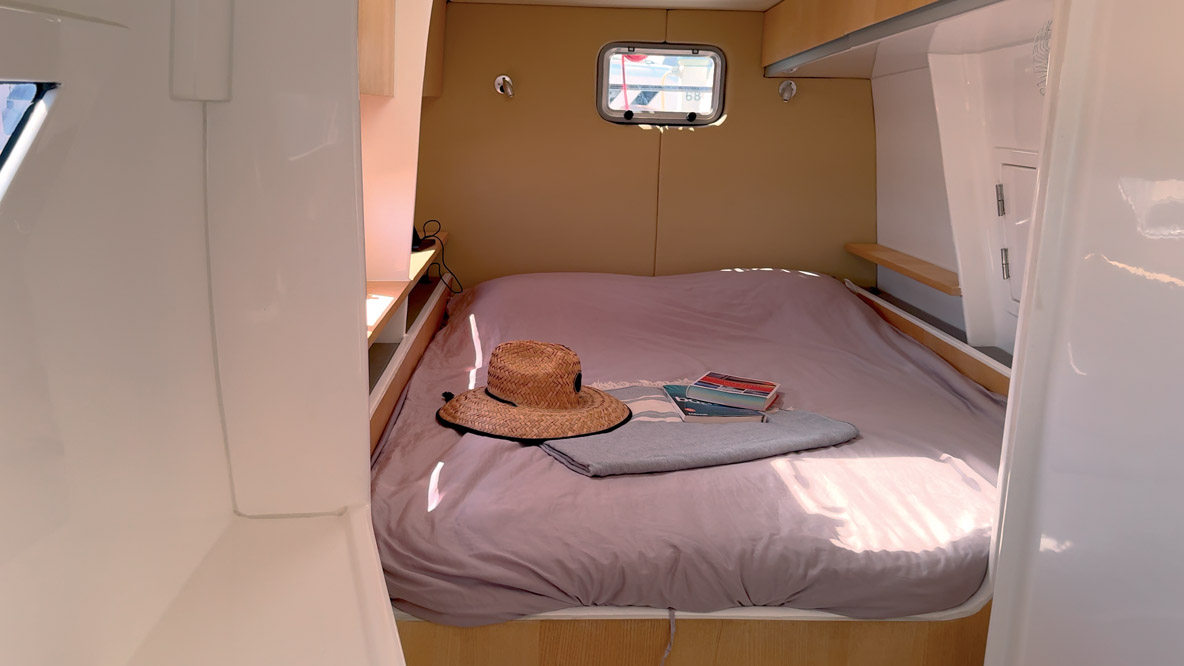
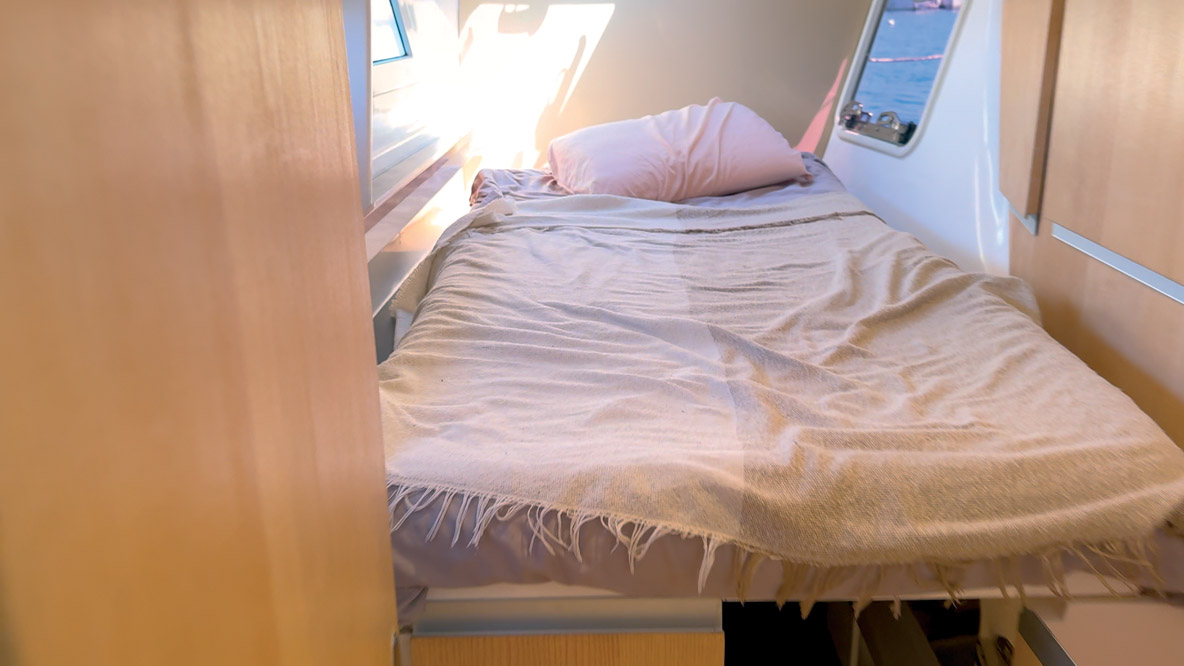
The layout is fairly standard for a catamaran of this size. The starboard hull is for the owner, with a cabin featuring a bed that is a reasonable size for a multihull with such a narrow beam 55” (140 cm) and a bathroom with a very large shower. In the port hull, two companionways lead to a guest cabin aft that is the same size as the owner’s cabin, and forward, to a smaller 39” (100 cm) additional cabin. Between the two, there is a heads compartment with toilet and shower that is accessed via doors on each side.
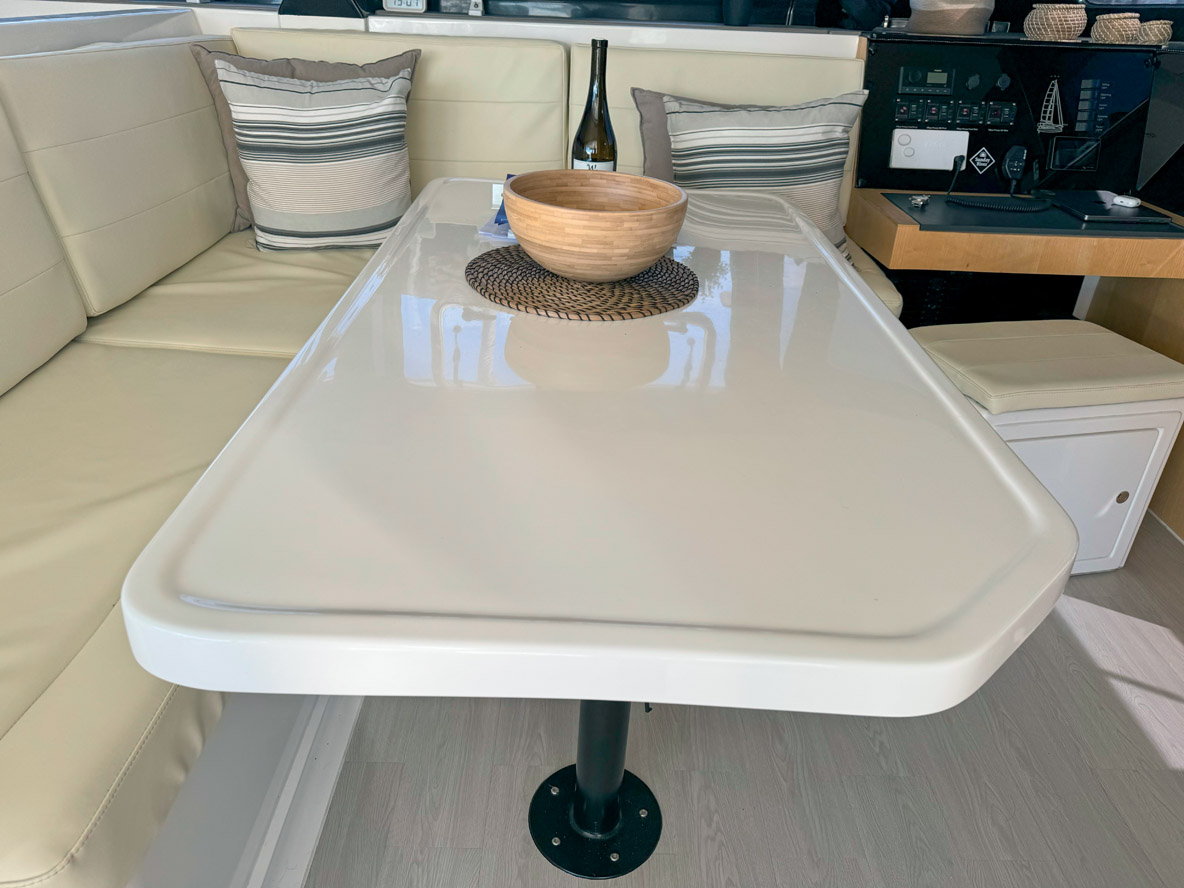
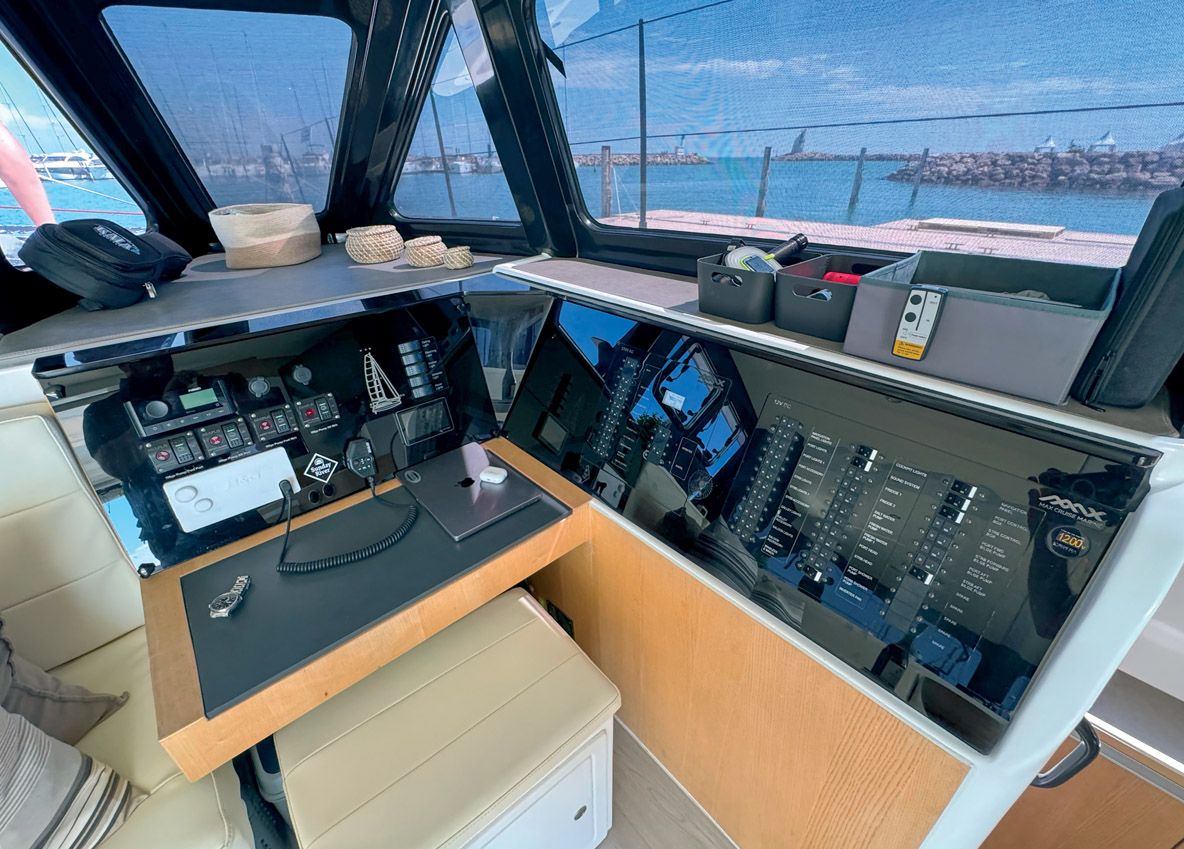
In the nacelle, I really liked the layout of the saloon with a U-shaped galley on the port side for cooking in all conditions and an L-shaped bench seat on the starboard side that can seat four people at its composite table. In the forward starboard corner, there’s a forward-facing chart table, and this is where all the electrical panels are to be found.
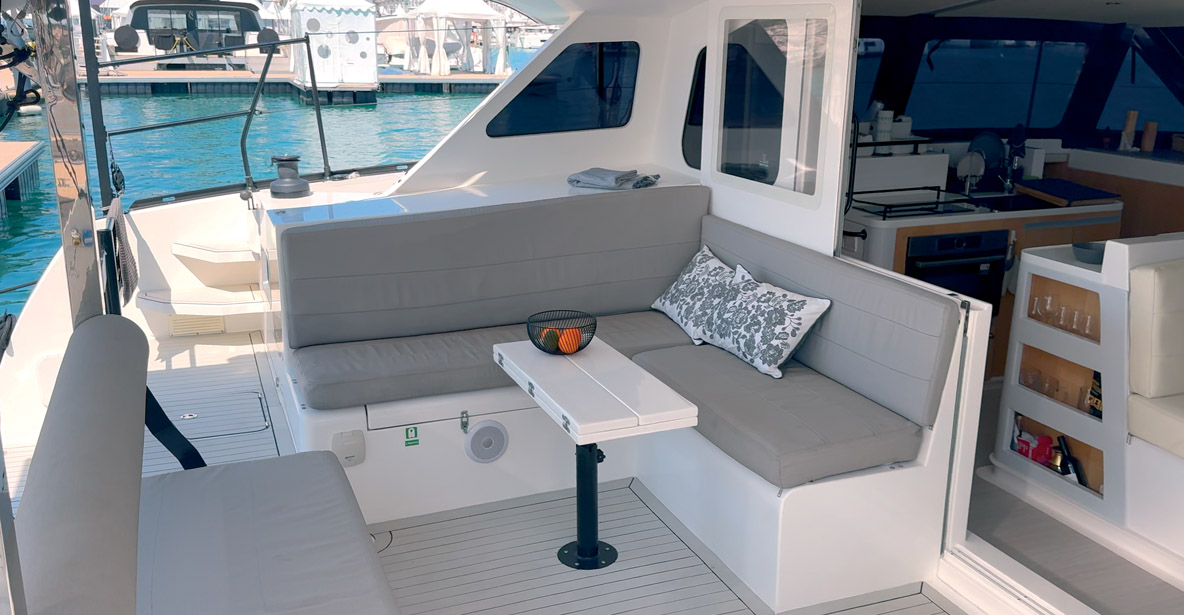
Compared to the interior, the cockpit is smaller but very cleverly laid out with a table, an L-shaped bench seat, and two sunbathing areas. A special mention must be given to the glass window, which is a proper watertight door. This feature is of a higher quality than would generally be found on your average multihull.
Good Seamanship at the Helm
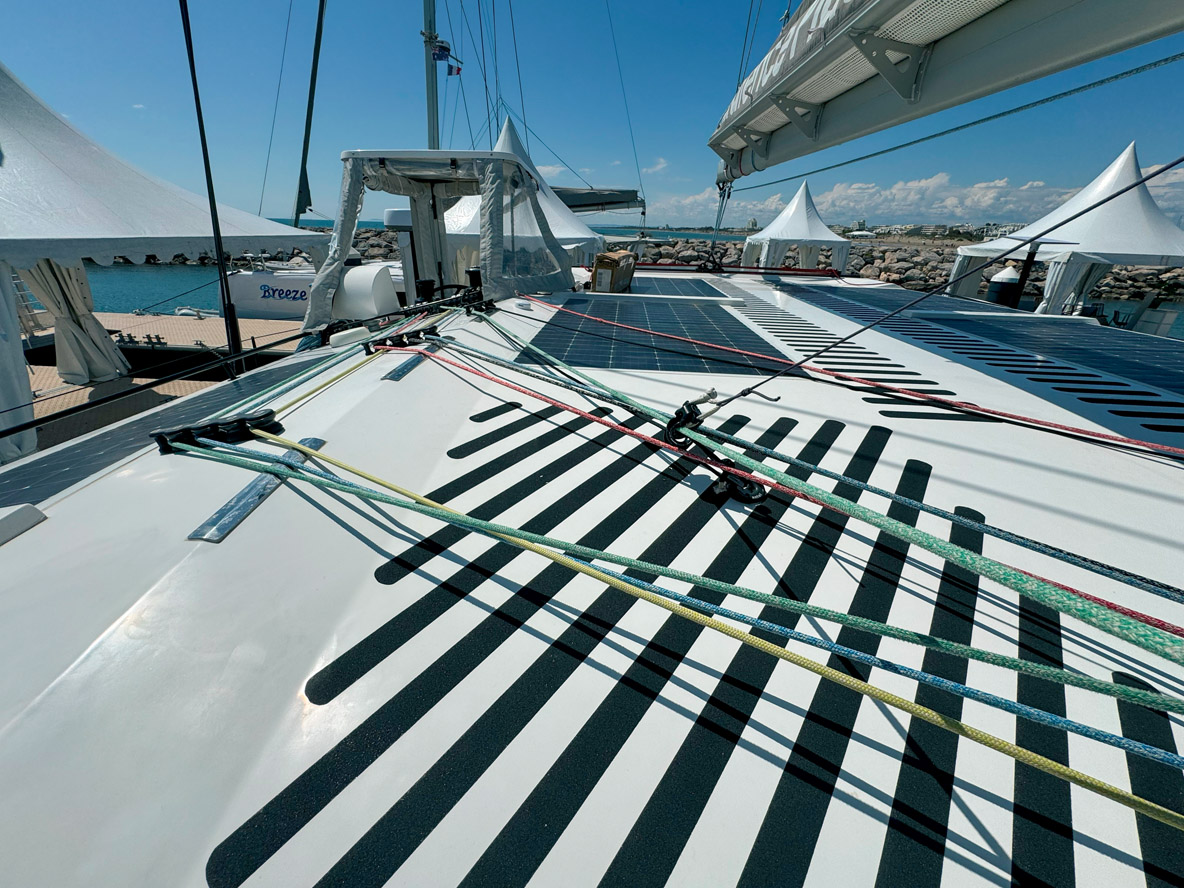
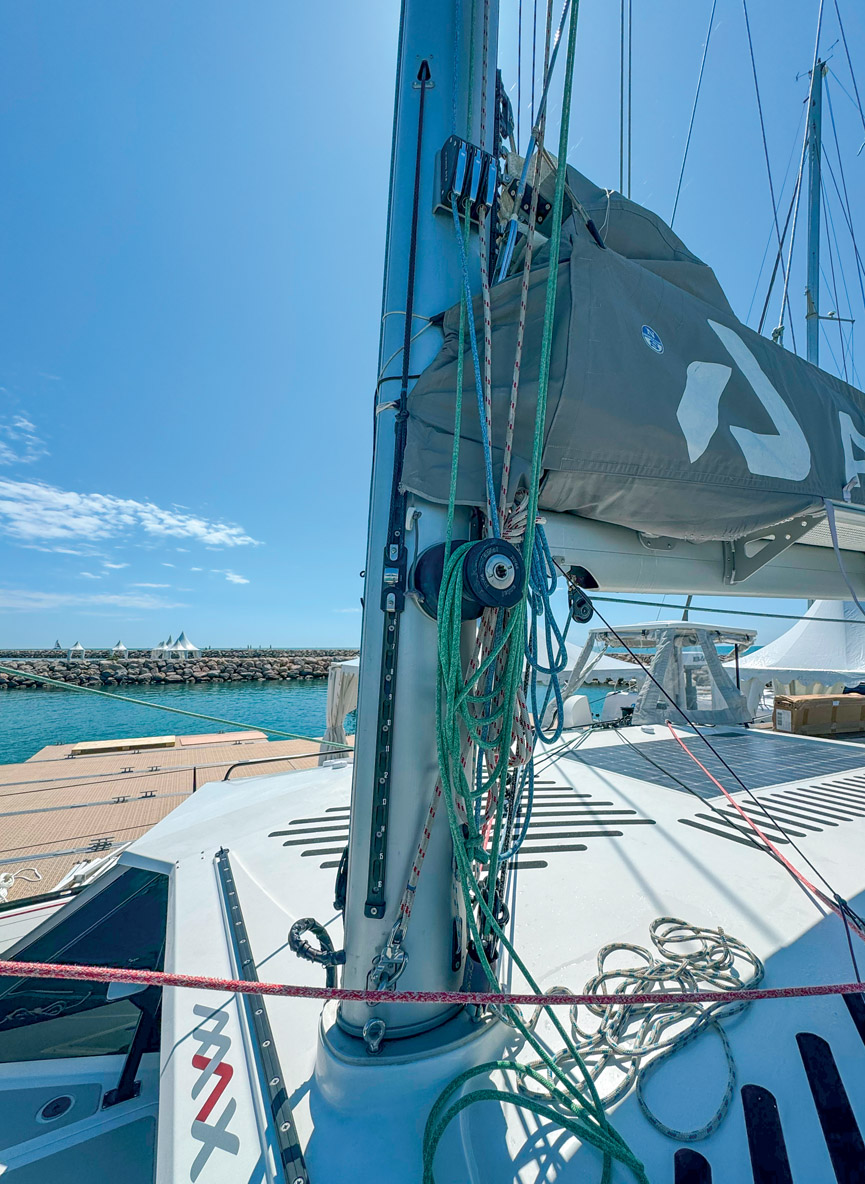
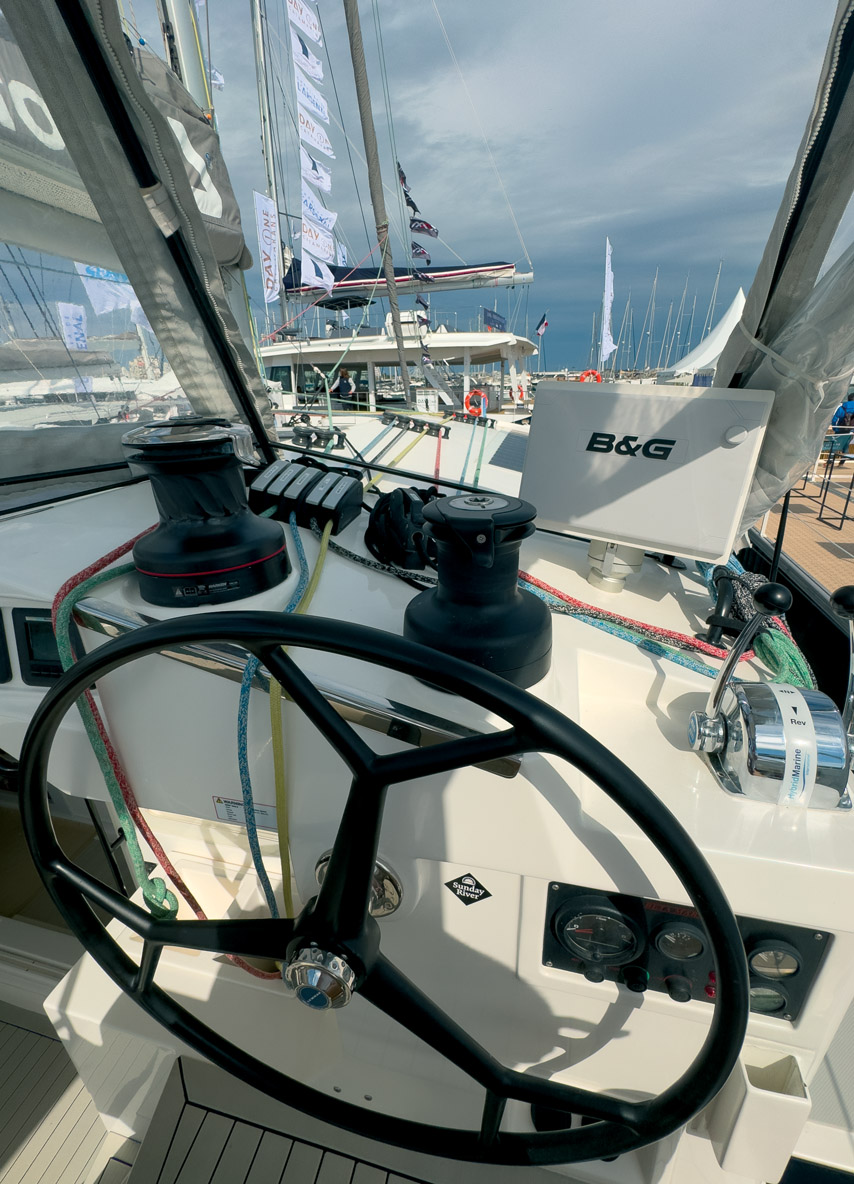
The helm station is a semi-flybridge setup and houses all the controls, except for the sheets for the Code 0 or spinnaker (these are on the side decks) and the halyard (this is at the mast foot) for the downwind sails. The deck hardware is very well dimensioned, and a crew member can handle the sails without getting in the way of the helmsman. There is a 3D genoa adjustment system, though the sheeting angles seemed very “tucked in” to me and would probably benefit from being a little more open.
On the other hand, I’m not a fan of the very low position of the radar on a small mast at the after end of the starboard hull. Even though the B&G radome’s emissions are fairly low and guaranteed to be harmless by the manufacturer, I’m not so sure it’s ideal for the helmsman to have a “scanner” at eye-level all the time. What’s more, this position considerably reduces the range of the equipment (between an antenna positioned at 6 feet up and one at 20 feet up on the mast, the radar range is doubled according to the simplified formula of multiplying the square root of the height of the antenna by 2.23).
The multihull’s finish is fairly “rustic” compared to current standards coming out of the larger shipyards, but the assembly, the quality of the fittings, and the ergonomics of the maneuvers exude good seamanship. As an example, aluminum spreader bars have been welded to the boom to facilitate the use of the lazy bag, offering all the advantages of a canoe boom for a fraction of the price!
Numerous handrails are judiciously placed and reinforce the impression of a sturdy, well-designed catamaran.
It should be noted that this 44SC has just completed the passage from Vietnam to La Grande-Motte via the Suez Canal, a voyage of just over 10,000 nautical miles, which may explain the slight patina on some of the equipment.
Under Sail... and Why Not with Electric Assistance?
We began with the Code 0 to try to optimize the catamaran’s speed under sail in the very calm conditions. At 90° to the TWA in 6 knots of wind, the 44SC still managed to reach 4 knots. The Max 44SC’s hull has very fine-entry bows, which guarantee remarkable ability to glide through the water in light airs. Despite our still modest speed, the helm was pleasant and responsive. We started one of the electric motors to give us a little boost and create some apparent wind. With 30% power, the multihull gained a knot and immediately became more lively.
However, I was a little surprised by the noise of the electric motor. I don’t know if it originates from the propeller, the transmission or the motor itself, but I measured 67 dB in both cabins, which was almost the same noise as when the port diesel engine was running. In my opinion, the shipyard would do well to work on insulation and transmission optimization to take full advantage of the electric propulsion. The noise of electric propulsion is a real issue that is still poorly understood by manufacturers, who are often surprised by the high-pitched “whistling” generated by conventional transmissions.
We then tried to sail a little closer to the wind, but with the Code 0 using the spinnaker sheets, it was impossible to sheet it in sufficiently to sail closer to the wind. Given the quality of the deck hardware, it shouldn’t be too complicated to run a set of sheets inside the shrouds.
Several Modes of Propulsion Available
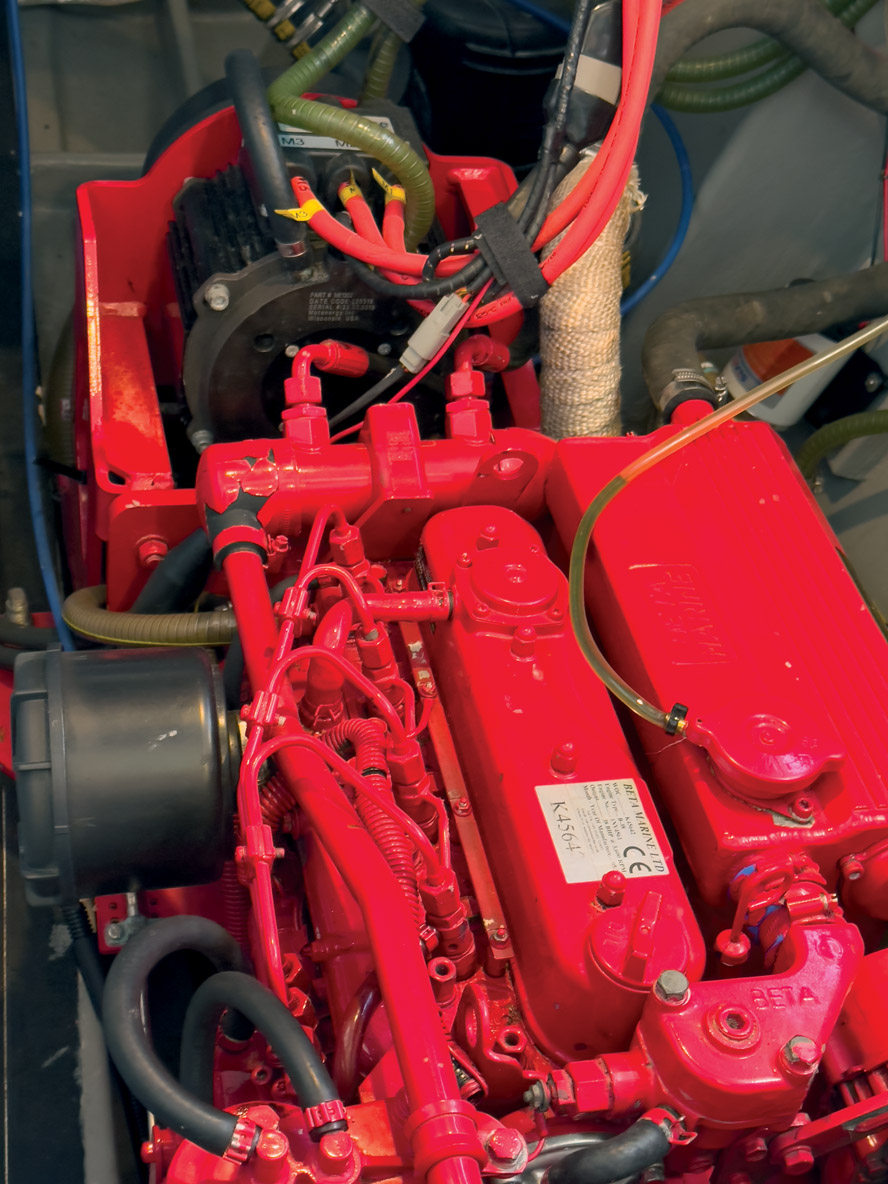
In terms of propulsion, the Max 44SC can operate in several modes: Diesel only with the 30 HP Beta Marine engine, a mix of diesel on the port side and electric on starboard, and finally full electric on both sides. It should be noted that the diesel engine can be disconnected from the propshaft and used as a 5-kW generator. The 10 kW electric motors, supplied by Hybrid Marine, are also capable of hydrogeneration when the catamaran is under sail. Obviously, the light airs conditions during our test did not allow us to measure the efficiency of that side of the system.
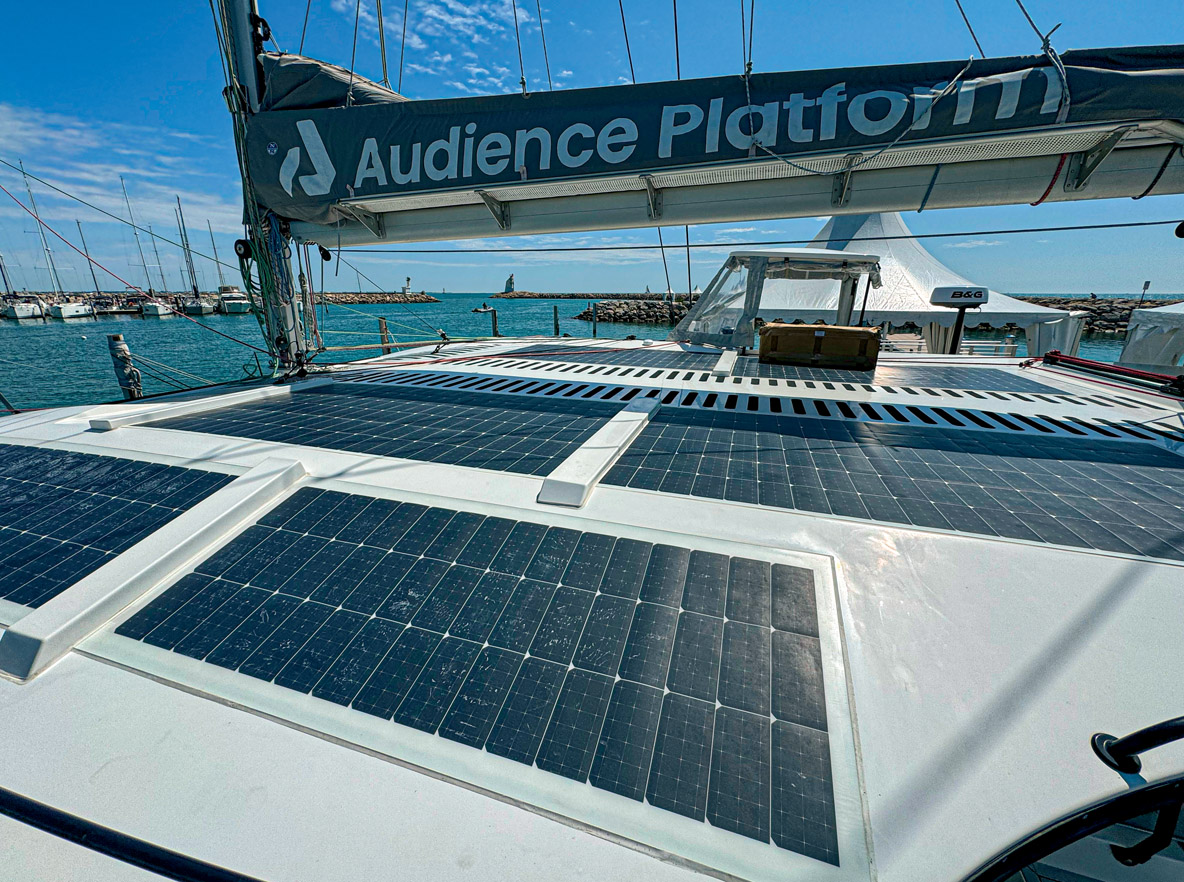
The electrical installation is reinforced by 3 kWp of flexible solar panels, cleverly distributed over the coachroof. The battery bank comprises four 4.8 kWh batteries in 48V. The 30 HP Beta Marine motor, based on a Kubota engine, is very reliable and free of electronics. However, it is quite noisy compared to other engines of the same size. At 40% power, with both engines running on electric power, the catamaran can cruise at just shy of 5 knots, with a range of about 4 hours.
Conclusion
I enjoyed sailing this discreet 44-foot catamaran, which is particularly well built and laid out. Its cleverly designed deck hardware makes it easy to maneuver and contributes to making this model a very seaworthy multihull that is ideal for sailing short-handed or for a family of five for safe long-distance work. The “mixed” powertrain is an excellent formula that combines efficiency and minimal fuel consumption. This pleasant surprise, which is shaking up market standards, is soon due to be improved even further, as the shipyard has just announced the Max 45SC, a revised version of the 44 with a more load-bearing stern that can support the extra weight typically seen aboard for blue water voyages.
Stephen Sapper A Satisfied Owner
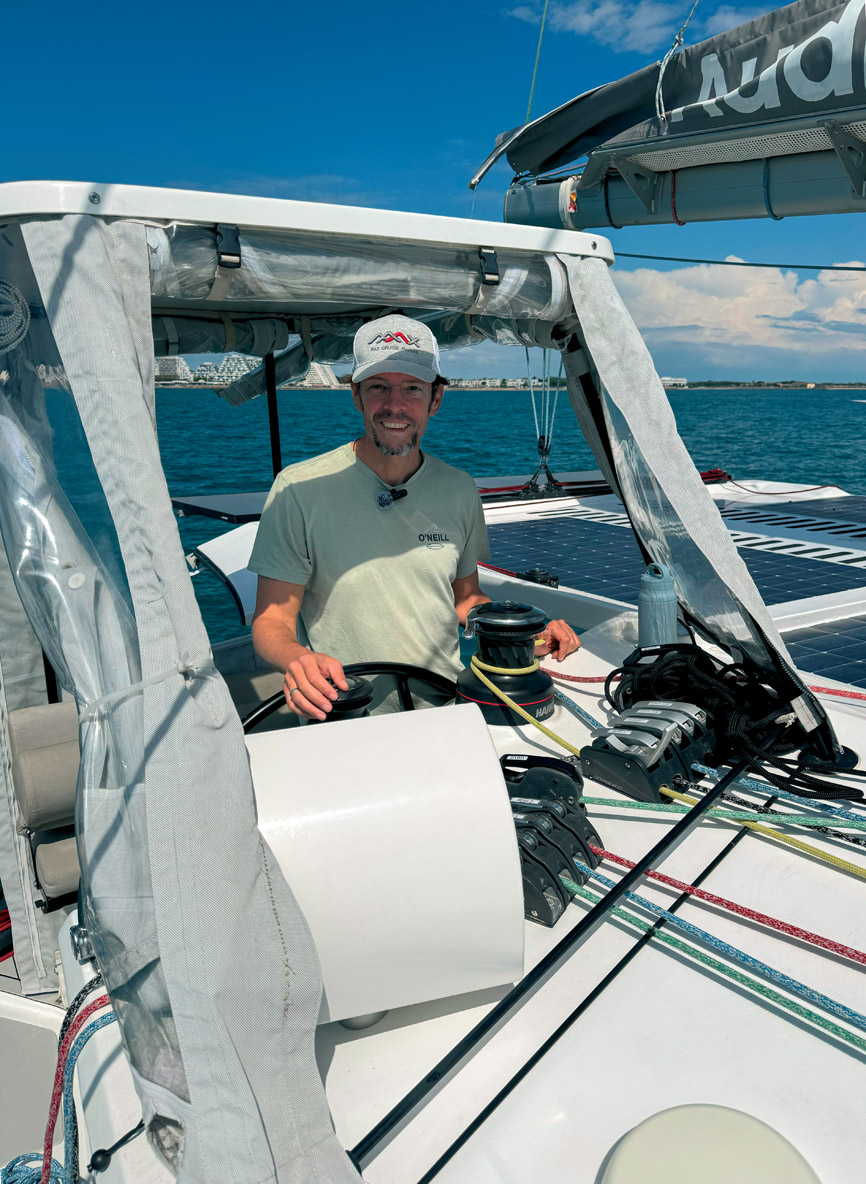
I think Hybrid Marine and Max Cruise are real pioneers in this field. Hybrid Marine has been building robust hybrid systems for decades, and Max Cruise was one of the first yards to put a hybrid catamaran in the water. Before doing so, they invested to ensure a reliable and efficient system. Since we switched to the new cooling pumps in Malaysia, we have operated the entire system from Southeast Asia to the Mediterranean without a single problem. This reliability, combined with the efficiency and energy independence of the system, gives me genuine confidence in recommending hybrid propulsion to any serious offshore sailors.”
Max Cruise Marine: Production Deliberately Limited to 10 Examples a Year
10,000 Nautical Miles in Hybrid Mode... And in 3 Numbers!
Hours on electric motors: 1,600
The watertight glass window
The option to equip the catamaran with daggerboards
Position of the radar antenna
The finish could be improved
Technical Specifications
Length: 43’ (13.1 m)
Waterline length: 42’ (12.8 m)
Beam: 23’11” (7.3 m)
Draft: 21”/5’10” or 3’10” (0.54/1.77 m or 1.16 m)
Displacement: 17,000 lbs (7.7 t)
Upwind sail area: 1,059 sq ft (98.4 m2)
Mainsail: 732 sq ft (68 m2)
Self-tacking solent: 327 sq ft 30.4 m2)
Gennaker: 840 sq ft (78 m2)
Standard Drivetrain: 2 x 25 HP outboard motors or 2 x 30 HP inboards
Basic price of the Max 45SC: $ 642,000 ex-tax
Price of the 45SC with equipment equivalent to the 44SC we tested: $ 852,531 ex-tax
Price of main options in $ (ex-tax):
Hybridization: 105,930
10,000 BTU air conditioning in each hull: 13,800
B&G electronics package with radar and autopilot: 15,000
Carbon mast with fiber rigging: 43,870
Aluminum mast extended to 18 meters (59 feet): 12,305
Daggerboards: 10,486