When a leading Australian manufacturer of racing prototypes (albeit one which is still little known among the yachting public) decides to position themselves with one of the leading naval architects in the cruising catamaran market, it demands attention. The entry level craft in their range starts at 50' and further models of 55', 60' and 90' are expected. So there is an openly stated intention to get a foot in the door of the Multiyacht sector... by multiplying innovations! We were eager to discover these iconoclastic catamarans and report back on our initial thrills aboard the McConaghy 50.
Infos pratiques
- Le chantier : Mc Conaghy 50
- La fiche technique
-
 Découvrez notre vidéo exclusive
- Financez votre McConaghy 50
- Assuez votre McConaghy 50
- Articles autour du McConaghy 50
A 50 footer and a 60 footer in the Mediterranean
Visitors to the International Multihull Show at La Grande Motte in the South of France had the chance to discover a preview of the MC50’s revolutionary silhouette, and those who went to the Cannes show saw the 60, which is almost a sistership (but 3m longer). The establishment of a commercial base for the brand in Palma de Mallorca makes it easy for them to be exhibited at these Mediterranean shows, thus improving accessibility for potential customers of this type of exceptional multihull. We took advantage of a beautiful summer’s day in the bay of Saint Tropez to discover this luxurious and original carbon machine.
From craftsmanship to industry, a stupendous development!
John McConaghy founded the yard in 1967 near Sydney. He began manufacturing skiffs, Tornadoes, then Class A catamarans, and was one of the pioneers of advanced marine construction techniques (vacuum Kevlar, pre-saturated carbon, post-curing). In 2000, two of the yard’s long-term employees (Mark Evans and Jono Morris) took over the company and developed it. They seized the opportunity to build a factory in Zuhai in southern China (near Hong Kong) with the ambition of creating a standard-setting center for the manufacture of boats and high-tech carbon parts. In 2014, the Tiger Group of maritime investors, led by Graham Porter, joined them which provided even more potential for the development of the challenge whilst still allowing the two companies to remain owners of their investments. The yard now employs 200 people, which is still modest by industry standards in general, but quite significant within the boating industry, where the products have a high added value. The numbers and quality of the production are as impressive as the signatures of the partner architects: German Frers, Bruce Farr, Reichel-Pugh, Gérard Dykstra, Nigel Irens, VPLP and John Shuttleworth have all put their names to boats made at McConaghy, and these include some of their best and most impressive designs. The yard has delivered more than 600 foiling Moths, 2 America’s Cup AC45s, countless cruiser-racer monohulls including most of the winning giants of the Sydney-Hobart race (Alfa Romeo, Wild Oats...). Renaud Banuls has had a splendid 53' trimaran built there! The yard also delivered, in 2012, the astounding 42.5m (140’) motor trimaran Adastra (John Shuttleworth design)! And this is only a small part of the production. Formula One chassis, a bathyscaphe for James Cameron, latest generation appendages, composite aeronautical parts: nothing is left to chance. From the ingenuity, the thrill of the challenge, and the mastery of this talented team hungry for European and American recognition in a field where we weren’t expecting it: multihulls.
A British architect for an Australian catamaran built in China: The globalization of multihulls
Jason Ker entered the international arena with Bribon, the amazing winner of the 7 inshore heats of the 2003 Admiral's Cup! He then became one of the main designers of the most successful IRC prototypes in both hemispheres. With the extraordinary Class 40 Concise (a king of surfing!), the Ker 51 Tonnere, the Hong Kong 42 Black Baza, the Ker 41 Anything, and some of the fastest recent monohulls in the Southern Hemisphere, Ker has participated in the fantastic renewal of the global design of monos, with multihull performance! He also designed the South African challenger for the America’s Cup (Team Shosholoza 2007) whose speed was universally admired despite a limited budget. The very beautiful Salona 67 and 60 series models are also from the Southampton-based office. The firm was involved in the design of prototypes for the America’s Cup until 2014. With multihulls having had a profound impact on the Valencia, San Francisco and Bermuda editions of this very traditional challenge, there was additional motivation to take an interest in cruising catamarans (despite the temporary return of the extravagant AC75 in a racing format!).
A stunning silhouette!
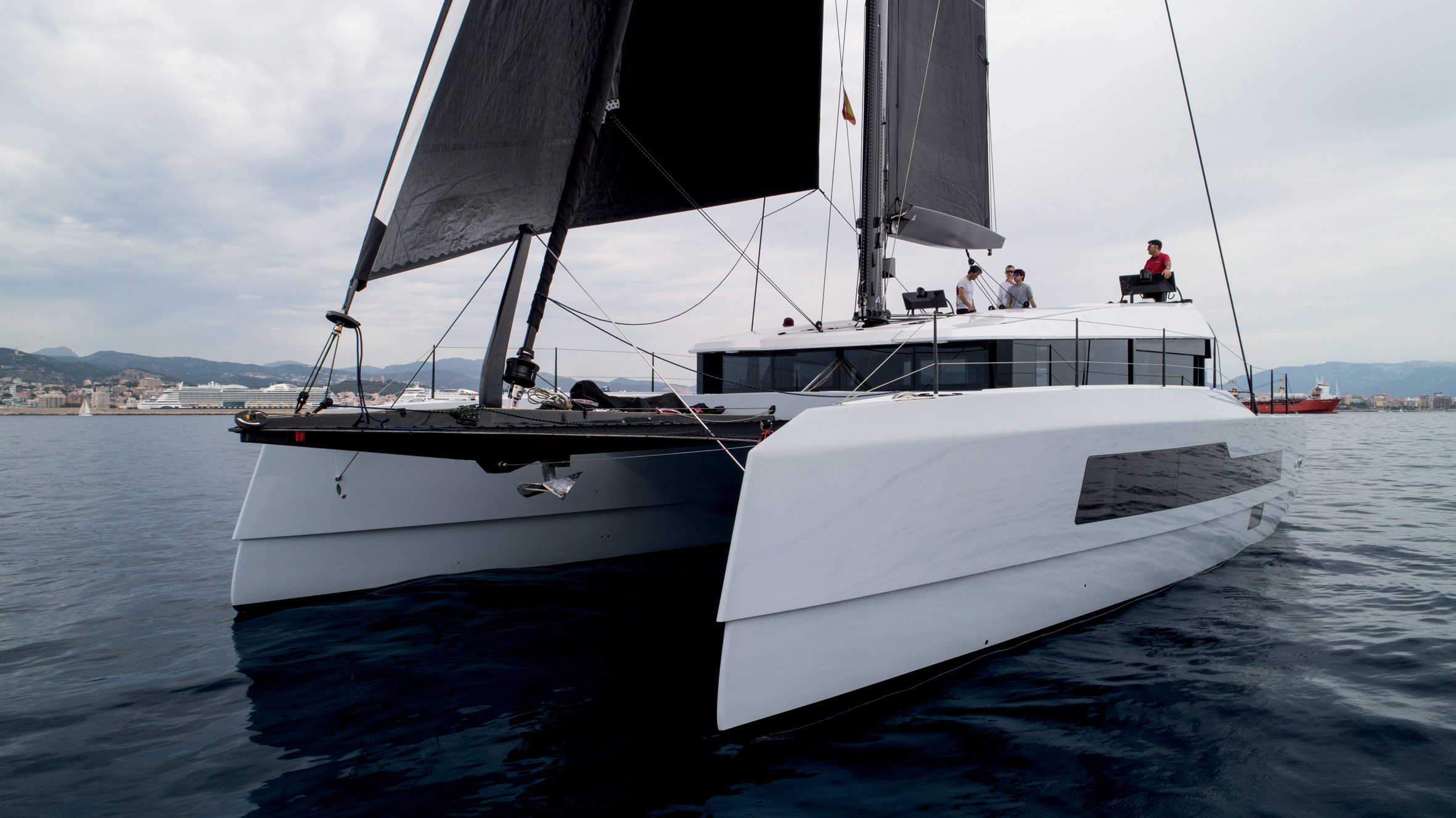
It would appear that Jason Ker has been instructed to break the rules! He succeeded in doing so by enthusiastically taking on the design brief of McConaghy catamarans! The design of the hulls is ultra-contemporary: the slim forward sections are overhung by an anti-spray rib and the inverted bows are a nod to the AC 50 of 2016-17; the absence of a forward beam, and the monopod cathedral suspended above the compression beam/bowsprit skillfully interpret a trend already seen on some Darren Newton catamarans or the TS 42 customized by Petitjean Composite or even the HH 66. The perfectly tensioned trampolines are beautiful. The perception looking beam-on is less flattering because the glazed surface and the aft cockpit both add weight at first glance. However, this style, perfectly handled by the designers must be analyzed in the overall context of the boat and judged after testing. The beautiful carbon canoe boom and the pretty (fixed) Axxon mast also in black fiber reinforce the feeling of an extraordinary catamaran: a hybrid teeming with high-tech solutions and a new approach to the use of a multihull in cruising.
An innovative catamaran
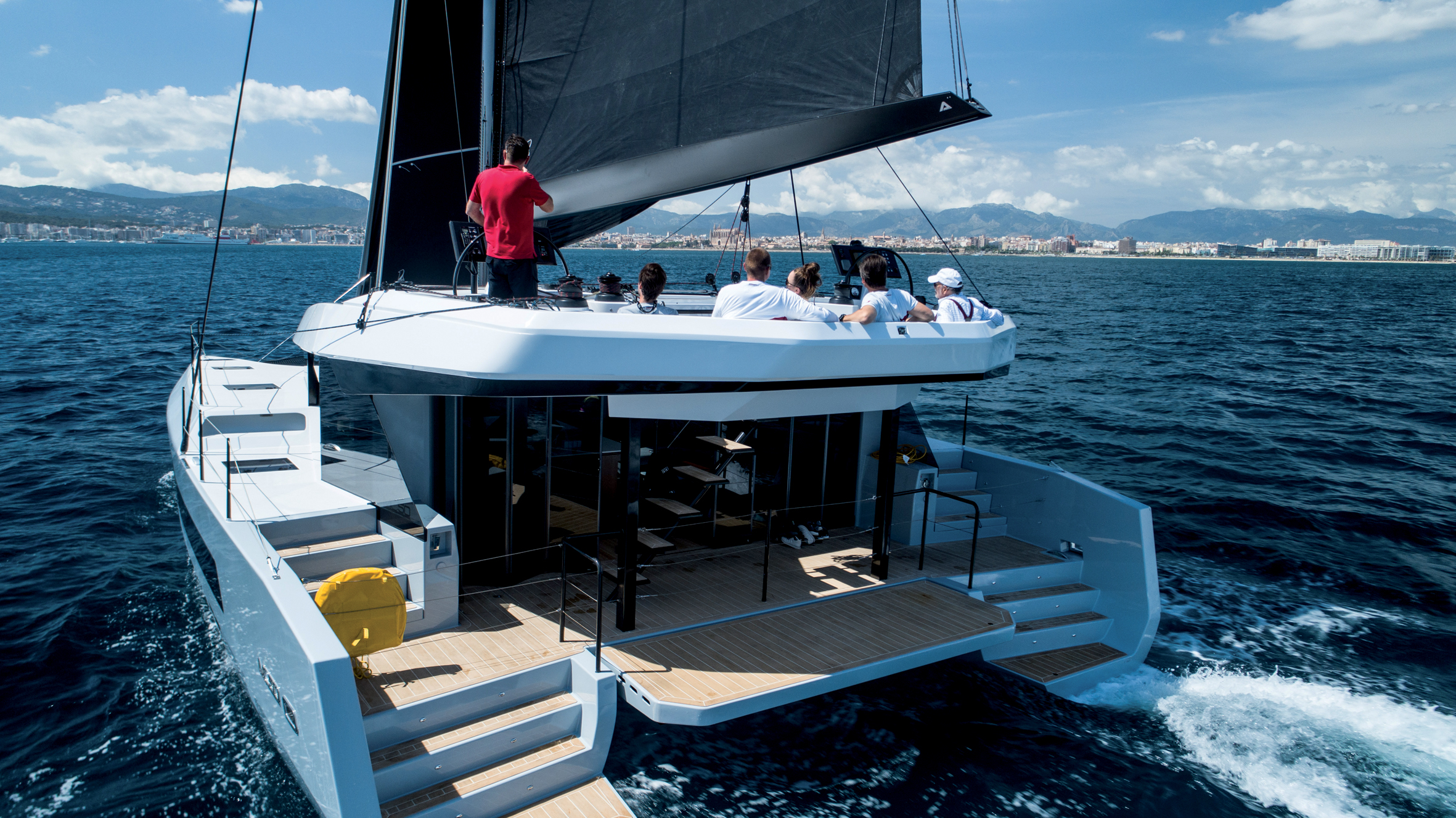
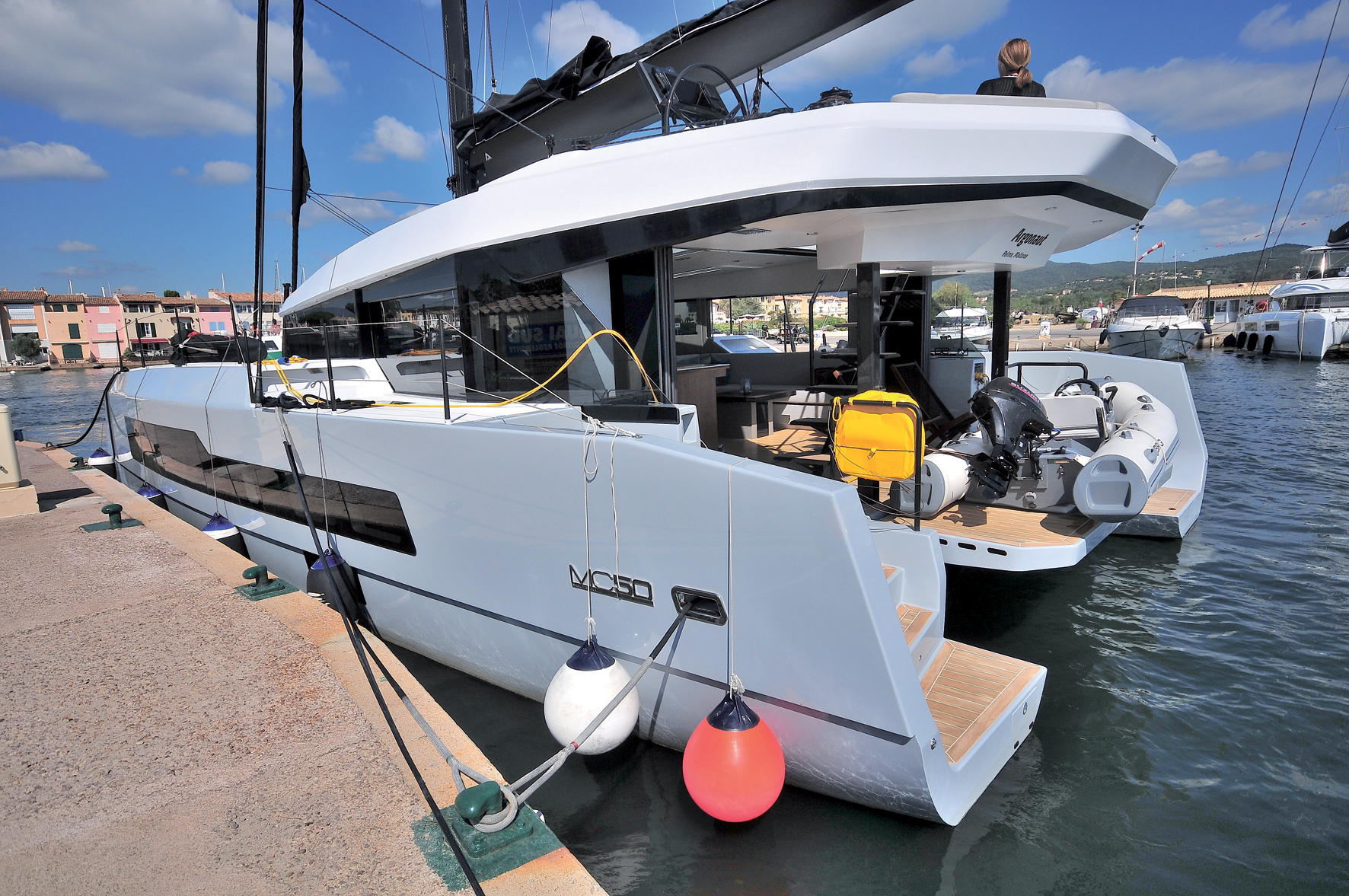
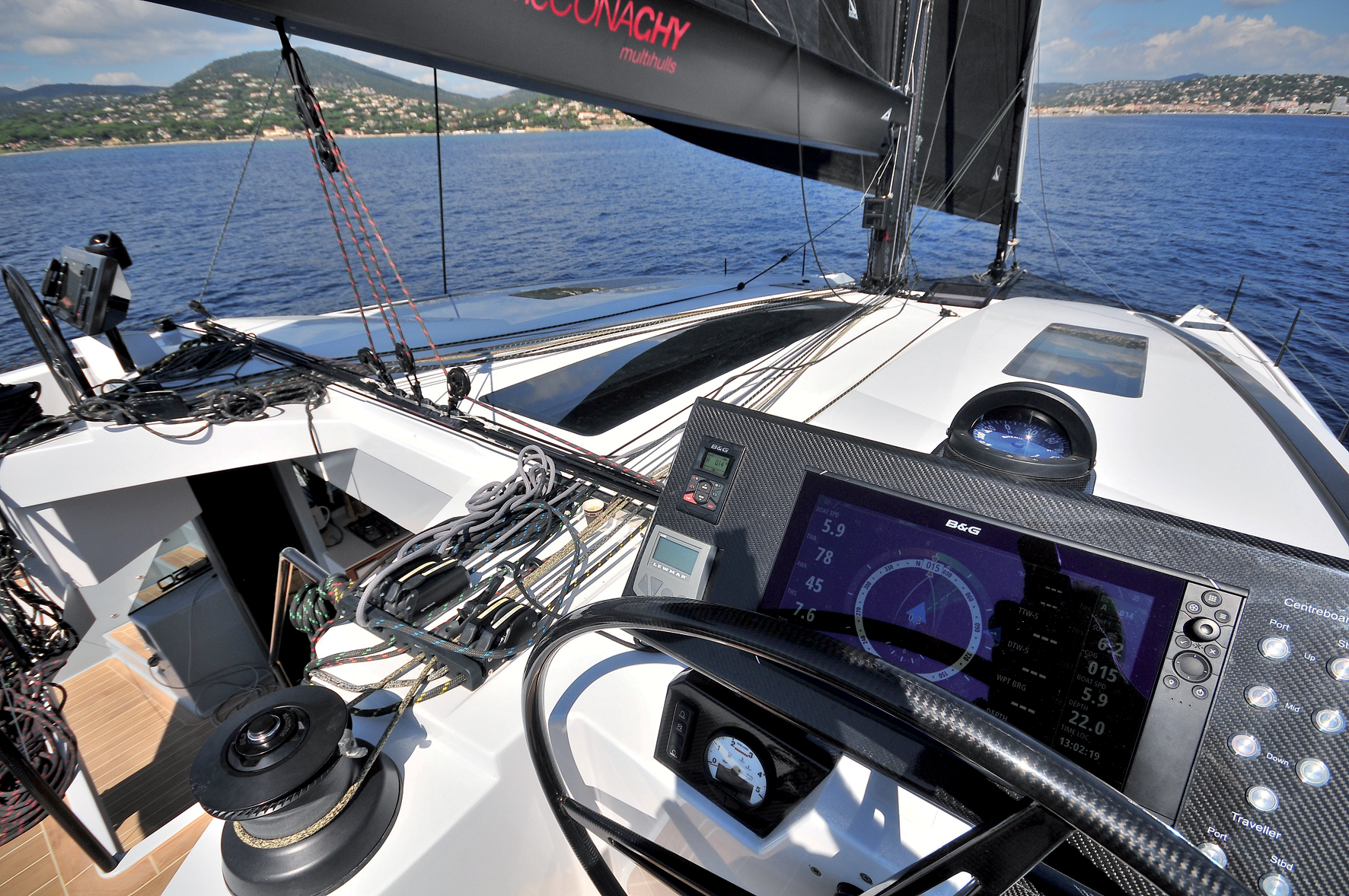
Out of the water, the MC 50 displays very fine-entry bows, a moderate hull rocker (for easy pivoting when tacking) and a fairly small wetted surface area. The spatula form of the nacelle is delicate and the tunnel elegantly merges with the entire structure, synonymous with a good ability for crossing and reducing slamming in rough seas. Weight centering, intensive use of carbon and the absence of a forward beam also contribute to this advantage, provided that you keep an eye on the true displacement under sailing conditions (about 15.5 t!). The considerable glazed area is made of toughened glass to reduce deformation and accelerated ageing associated with polycarbonate, while improving light quality. But this comes at a price and there’s extra weight that must be compensated for both in the structure and aloft (note the relevance of a carbon mast and fiber rigging!). The interpretation of the anti-leeway plan is judicious even if it imposes important manufacturing constraints: These are pivoting centerboards! These very elongated appendages (3.75m of draft with the boards down!) are housed together with their hydraulic lifting system in pods inside the hulls: a safety fuse installed on the cylinder allows the board to rise naturally in the event of an impact. A great idea, but why hasn’t this been applied to the rudders as well? Another innovation is that the helm station is found at the aft end of the coachroof, on the bimini, in a balcony-flybridge position. This original arrangement is a world first and seems to be justified for two main reasons: it allows the exchange area between the saloon and the cockpit to be completely open, and also offers the double helm station an unprecedented panoramic view.
Guided tour of a Multi-loft
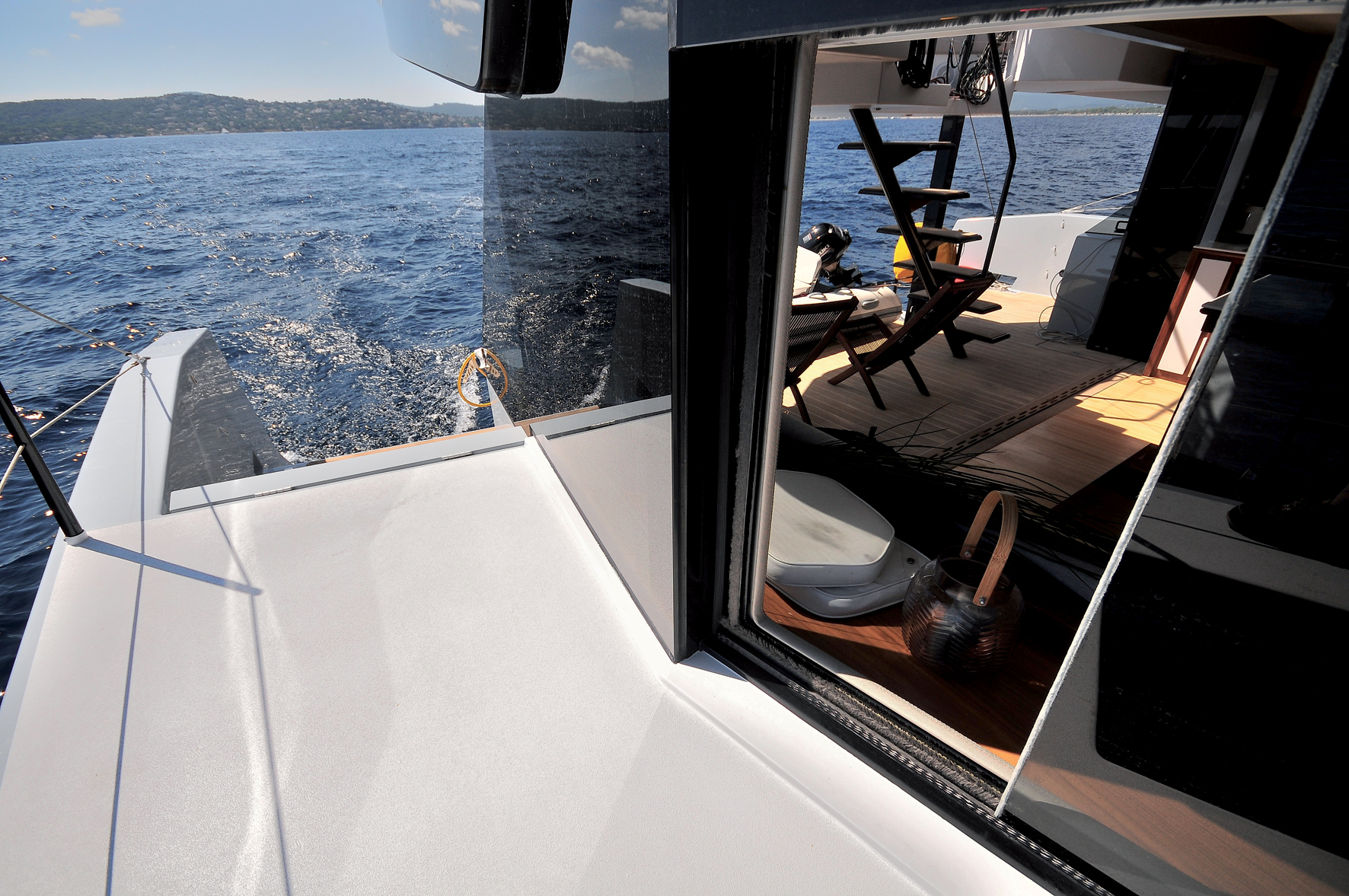
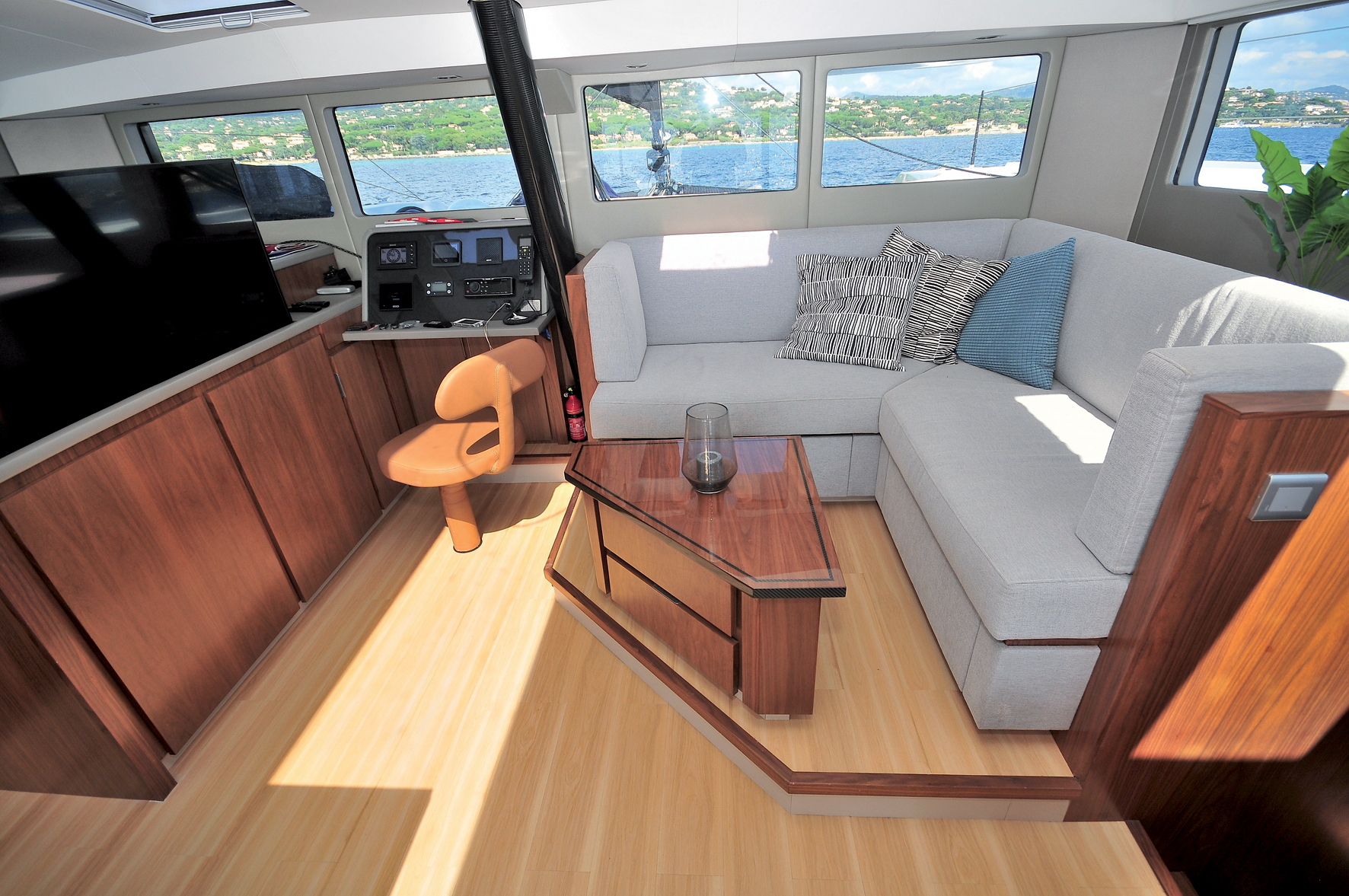
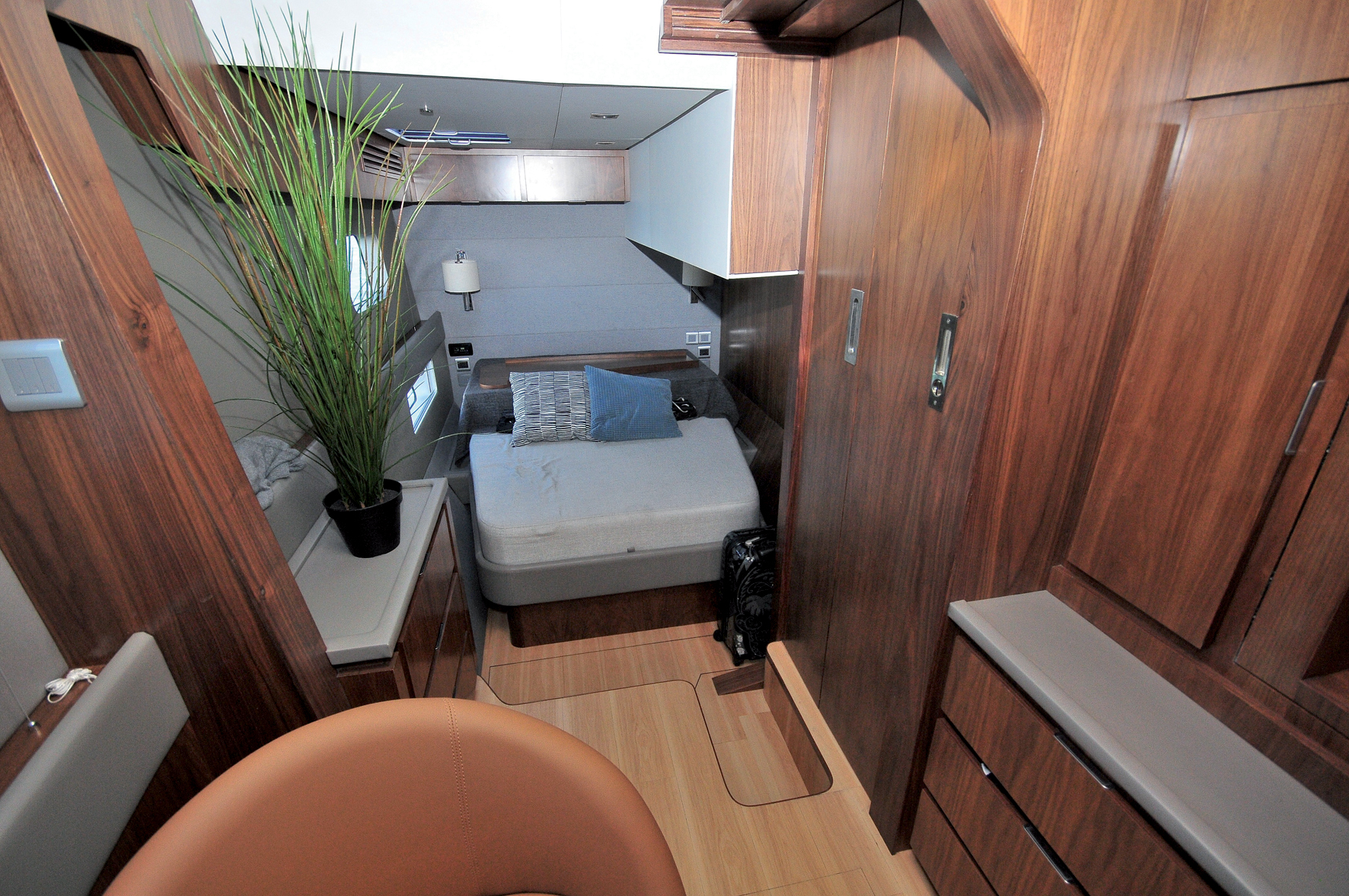
This amazing catamaran is available in a 3-cabin owner’s version, a 4-cabin or even day charter versions and the buyer can choose between 3 different stylish atmospheres: Sweden, Bermuda and Hong Kong (Sweden for our test boat). These 3 options are a good alternative to semi-custom which generates additional costs and additional time for the design team: here, the future owner can choose between 3 different finishes, giving (almost) customization without the hazards! The “Sweden” version uses warm cherry wood trim, light oak floors and beautiful ecru-colored upholstery. In the master cabin, very pretty, 60s-style egg-seats in skillfully upholstered leather are to be found, and the differences in level contribute to an enhanced perception of the original space (but beware of the step!). The woodwork is remarkable, and the large windows allow a view beyond the walls. The bathroom is beautiful (but the basin is too small!); the atmosphere is wonderful, almost unique! The fully-equipped galley allows you to work in a protected semi-outdoor environment as soon as the sliding side windows are open; it faces a central Corian-topped island/bar around which 10 people can sit comfortably. The sofa bench is spacious and the superb ceiling is pierced with blackout skylights and LED spots to the most beautiful effect. Natural light coming in is splendid and this beautiful lounge space seems to magically exist inside or outside depending on the settings of the sliding side and aft panels. The cockpit is a terrace, on one level with the hydraulic platform, for diving and swimming. Access to the "bridge" is via a sheltered staircase, made safe by welcome carbon handrails. Below, conviviality; above, sailing! Guests who wish to do so can also sit comfortably on the helm station bench without disturbing or being disturbed by the crew in action.
A serious machine room
Access to the engine compartment is via a very large tilting panel assisted by rams. The entry itself is topped with a coaming, providing excellent protection against potentially devastating water ingress at this point. The engine layout is a little more advanced than on most equivalent models, which is a good thing: the space around the powertrain is considerable, allowing for easy and safe working. The automatic extinguisher is a large 7kg unit which is perfectly integrated, as is the Glendinning electric control unit. The electrical installation (shore power charger, circuit breakers, cable runs) is clear and legible, with functions identified by some serious labeling. Congratulations are due also for the small tubular staircase that protects the motor and offers an excellent hand-hold. Aft, a strong structural shelf carries the load of the rudder tube’s upper bearing, and on which the rudder arm and the hydraulic helm drive cylinder are fixed.
Sea-trial
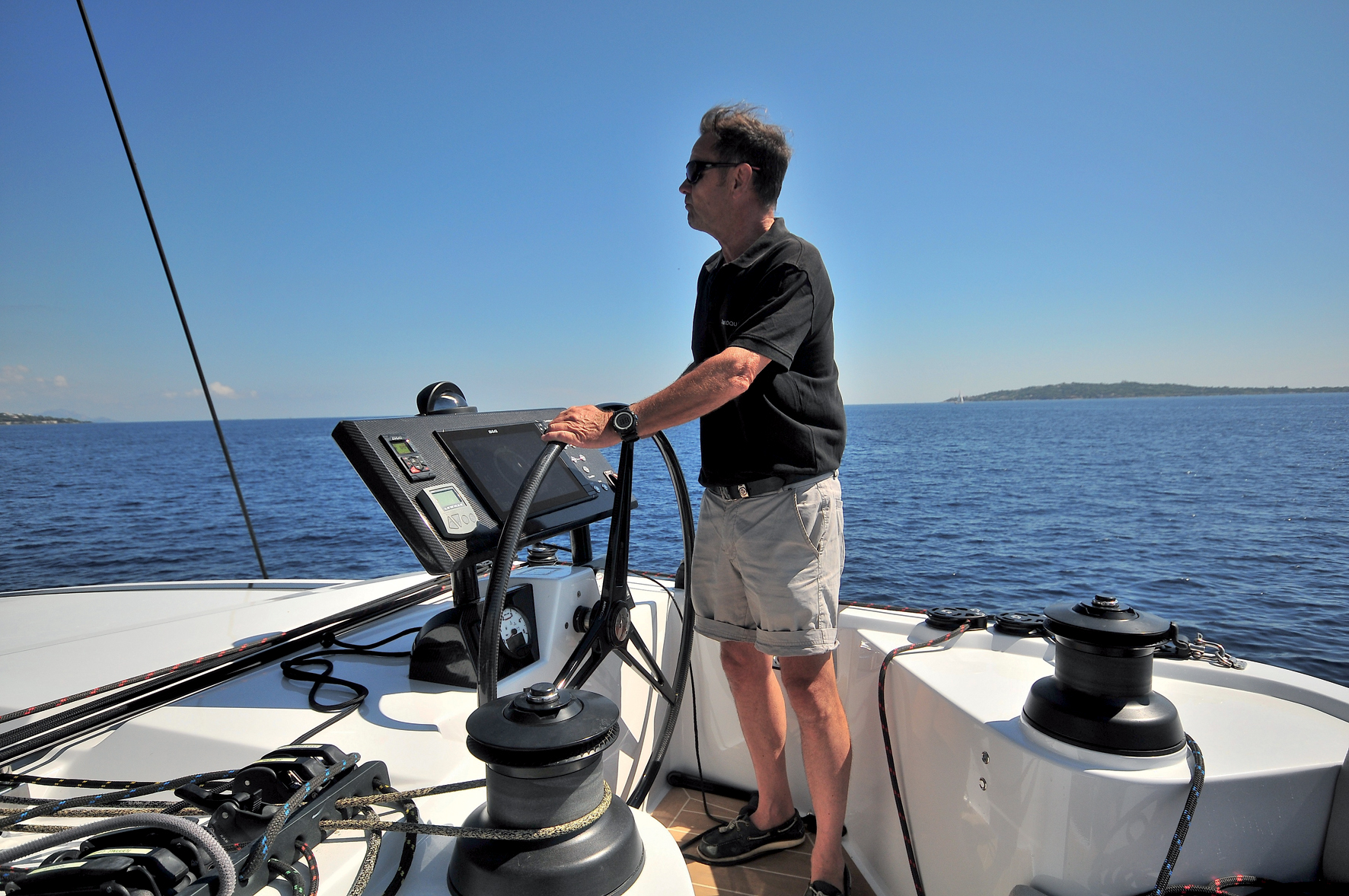
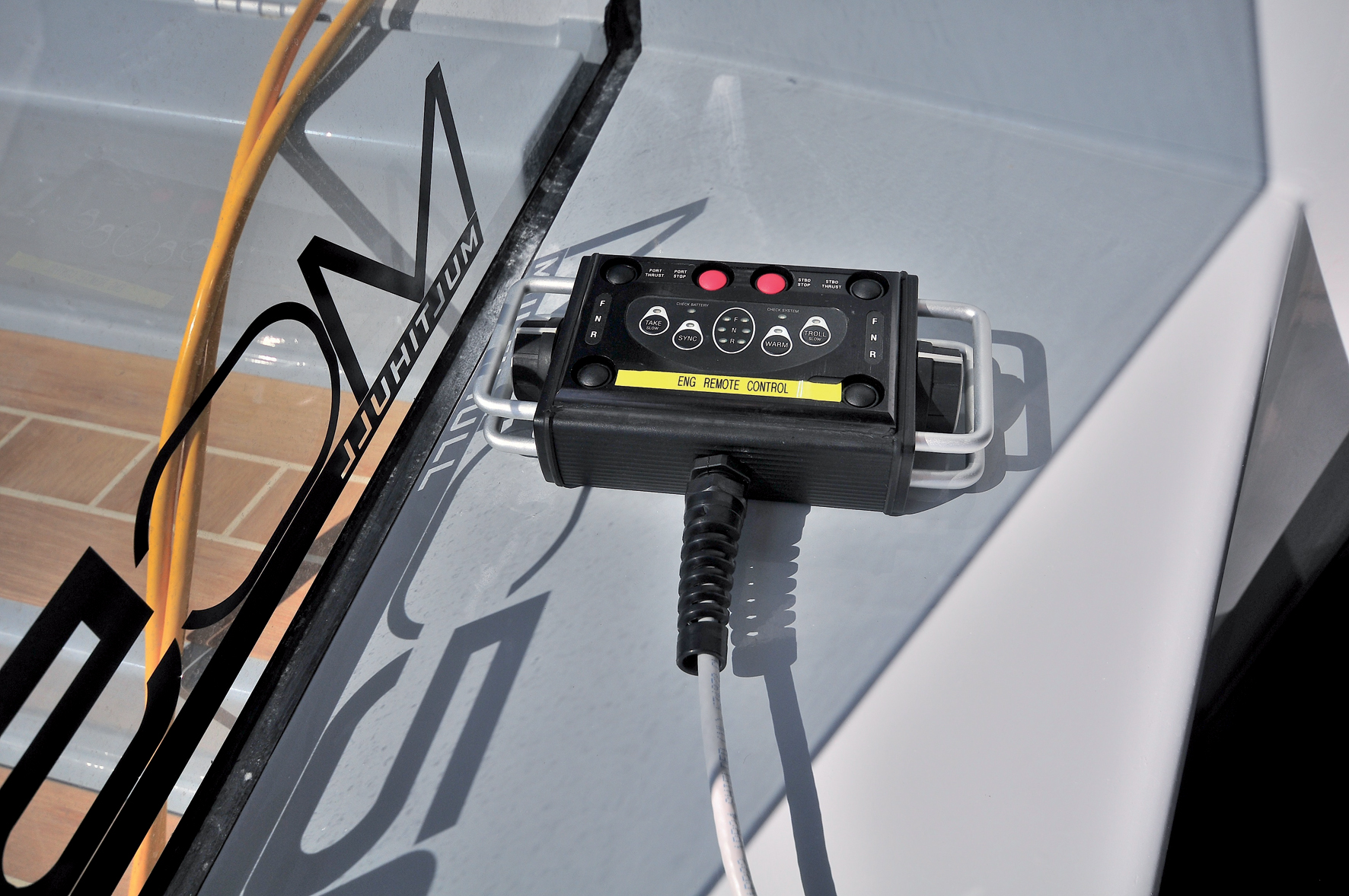
Sailing aboard the MC50 is a new experience. First of all, there is the experience of discovering different, surprising and ultimately seductive ergonomics. The boat's behavior in light airs is a pleasant surprise! This is a big boat for its length, so the contribution of the Yacht Controller (as standard!) is most welcome for maneuvering in port. This remote control allows you to operate the engines and even one or two bow thrusters if the boat is equipped with them, from the helm-station or the cockpit. With a little practice, this imposing multihull can be maneuvered in a small space! With the standard engines, the handling of the MC50 is perfectly satisfactory. These 4 cylinder, 2.2l, common-rail, direct-injection motors develop 57hp with a consumption of 4 liters at 2,200rpm and 10 liters at 2,800rpm (maximum engine speed: 3,000rpm). You can count on a cruising speed of about 7.5 knots. The question of installing the optional 2X80hp motors is raised when we learn that this engine only weighs 20kg (44 lbs) extra per engine and that they give the same performance at 200rpm less (be careful with the high speed consumption of 16l/h per engine at 3,200rpm giving about 10 knots). Against all odds, I immediately got used to the driving position which, in the end, is more traditional than it appears. The two (superb) wheels are positioned on either side of a generous deck plan assisted by 4 very large electric winches and the "all aft" position allows for an excellent view of the sails. Peripheral vision is fantastic! We were to have little wind on the day of our test, but these conditions highlighted the excellent performance of the MC50 in light airs (5-10 knots true out of the south). Thanks to the super deep and fine centerboards, performance under gennaker is remarkable: the anti-leeway system grips well and generates dynamic support which favors good performances for such a large catamaran. The hydraulic helm is surprisingly directional, with no sensitive feedback, but it’s a real pleasure to use and there’s a good directional effect. The Harken 65 electric winches are well positioned biomechanically and allow precise, powerful and fast action. Clutches, organizers, and the choice of fiber lines all contribute to the readability and efficiency of the sail trimming console. A special mention must be made for the large mainsheet traveler assisted by the Harken line driver which automates the adjustment of the mainsheet car by allowing remarkable and much-appreciated reactivity. Unfurling and furling of the self-tacking jib and Code 0 are also controllable from the helm-station. The helm position is ideal in good weather and favors attention to the settings of this superb sail plan, but what about in poor weather conditions? The aft seat is comfortable for both guests and crew. Under the light conditions of our test, the results on the water were very satisfactory: boat speed between 80 and 95% of true wind speed with a limousine such as this is testament to the care taken with every aspect of the design!
Conclusion
Jason Ker and McConaghy have put their signatures on an amazing multihull. The innovative and effective anti-leeway plan, the quality of construction, the spectacular design, the reinvented ergonomics for handling the boat, and the high-end market positioning all aim to attract a trendy and wealthy international clientele. It could work: 5 units are already in production! The equipment choices, as with the seamanship aspects, are remarkable, and the performance in light airs is more than honorable. The refined interior design is attractive and the originality of the layout offers interesting modularity. All that remains is to work on the acceptability of a product that breaks all the rules to maintain the trend and to anchor the brand and concept in a fiercely competitive market.
Technical Specifications
Naval Architect: Jason Ker (Ker Yacht Design)
Builder: McConaghy Boats
Construction: Foam-glass/carbon infused sandwich
Length: 15.80m (51’10”)
Beam: 8m (26’3”)
Draft: 1.35/3.75m (4’5”/12’4”)
Mast height above waterline: 26.20m (85’11”)
Upwind sail area: 150m² (1615 sq ft)
Light displacement: 14.5t (32,000 lbs)
Mainsail: 104m² (1120 sq ft)
Jib: 50.4m² (543 sq ft)
Code 0: 120m² (1290 sq ft)
Maximum downwind sail area: 225m² (2420 sq ft)
Standard engines: 2x57hp Yanmar or 2x80hp Yanmar option
Transmission: Saildrive
Fuel: 460l (122 US gallons)
Water: 460l (122 US gallons)
Price: $ 1,648,000 excluding tax
Extras and options
Axxon fixed carbon mast, rigging and boom: € 127,734
Sails: (Main, jib, genoa, code 0, gennaker, staysail): € 182,000
Electric Harken traveler: $ 4,800
Hydraulic platform for tender: $ 24,000
Fusion sound system in saloon + 4 exterior speakers: $ 8,000
Flybridge cushions: $ 2,800
80hp Yanmar motors: $ 5,800
Yacht Controller (remote handling system): $ 5,800
Lithium batteries: € 18,000
Mastervolt inverters: $ 8,700
Electronics pack: Raymarine $ 39,500 / Brookes & Gatehouse $ 46,300
Antifouling/delivery China: $26,000
Transport to Europe: $ 95,000
Blackout blinds and flyscreens: $9,800
Air conditioning: $25,500
12kW generator (Fischer Panda): $21,900
THE ESSENTIALS
- AN INNOVATIVE APPROACH TO THE ANTI-LEEWAY PLAN
- A BUILDER WHO HAS, REVISITED, IN-DEPTH, THE CATAMARAN CONCEPT
PLUSES
Centerboards
Rigorous and convenient deck layout
Build quality
Innovation
MINUSES
The automatic traveler (mainsheet car) is not fitted as standard
Various items of key equipment are optional
Need to be aware of draft with centerboards down
The installation of the multi-panel cockpit door
Individual securing points instead of a specific fixing for the trampolines
|
Model |
Builder |
Upwind sail area in m² |
Weight in T |
Basic ex-tax price in €, £ or $ |
|
SEAWIND 16 |
Seawind |
144.5 |
13 |
$ 859,000 |
|
PRIVILÈGE S5 |
Privilège |
141 |
16.8 |
€ 995,000 |
|
LAGOON 52S |
Lagoon |
156 |
26 |
€ 643,700 |
|
BALANCE 526 |
Balance Cats |
149 |
9.3 |
$ 1,299,000 |
|
CATANA 53 |
Catana |
154 |
14.5 |
€ 1,186,000 |
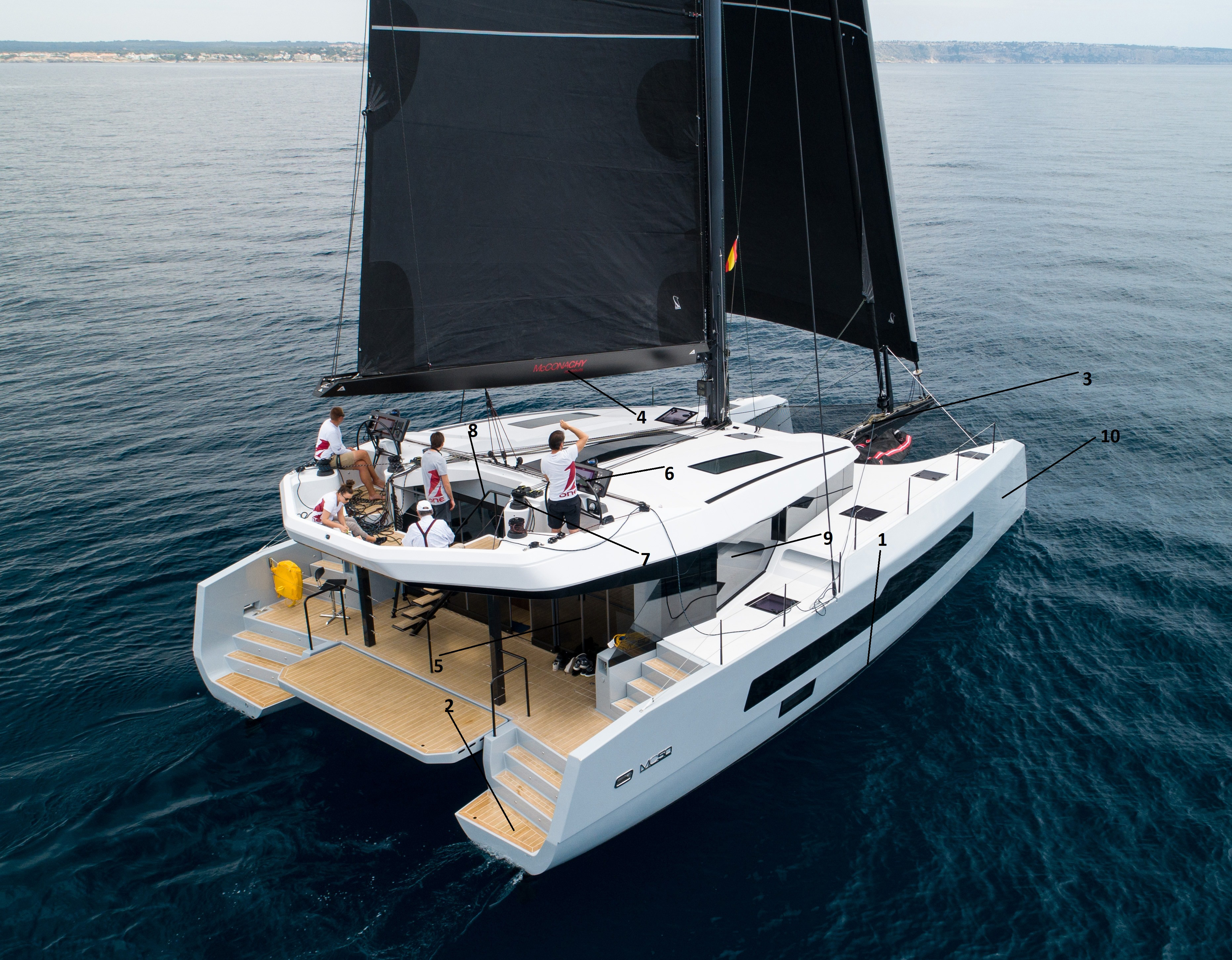
1: The MC50's centerboard system is pretty innovative: it consists of very long pivoting appendages with a fine profile.
2: The rudders are fixed; access to the engine compartments is by lifting the stairs on the side-deck.
3: Suspended bowsprit and compression beam: high-tech, minimalist and relevant architecture
4: A safe path for the boom without excessive increase in gooseneck height
5: The bay window consists of 4 bi-fold doors per side, to be reviewed!
6: The helm station, positioned high up and very far aft on the boat, offers an exceptional view forward and of the sail plan.
7: The deck layout is very ergonomic. The legibility, quality and power of the very large electric winches put this big multihull within reach of the solo sailor
8: Access to the helm-station is by a staircase with proper handrails... most welcome
9: The splendid tempered glass should be almost permanent for the life of the boat
10: Despite its elevation, the MC50 sits on fine hulls, and the 16t weight in sailing condition, combined with a powerful sailplan, provides good performance in light airs