
M for Marc, G for Guillemot, 5 for 50 feet: the story of the MG5 sounds quite simple. But when a French ocean racing legend builds his own catamaran, with the next single-handed Route du Rhum on the agenda, the simple story of the start becomes pretty interesting. In short, our curiosity finally reached its height... The result, discovered during an afternoon of sailing off Quiberon in south Brittany, was genuinely explosive.
Infos pratiques
- Le chantier : MG5
- La fiche technique
-
 Découvrez notre vidéo exclusive
- Financez votre MG5
- Assuez votre MG5
- Articles autour du MG5
- Test location: La Trinité-sur-Mer, Brittany (France)
- Conditions: 4 to 14 knots southwesterly wind, flat sea
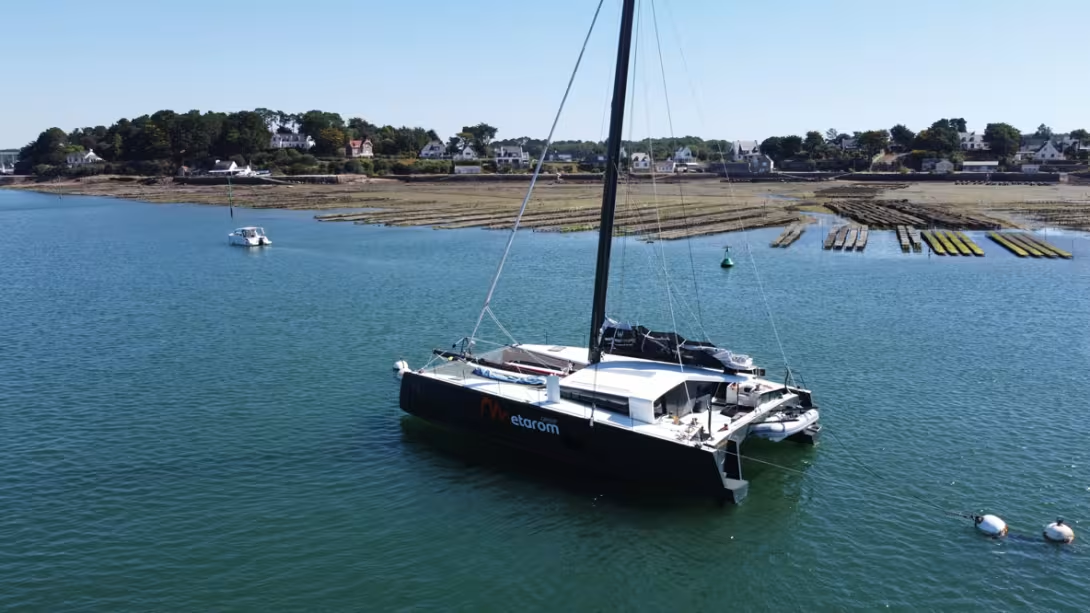
When you’ve got the chance to sail regularly on the latest multihulls launched, it’s always interesting to look at whom and for what program the said catamaran or trimaran will be most suited. Here, in this hot August that we’re seeing across large parts of the northern hemisphere, the exercise is reversed and that makes it particularly exciting. What catamaran is Marc Guillemot going to be showing us? In La Trinité-sur-Mer, everyone calls him “Marco”, so closely is he linked to this little port in southern Brittany, that has become iconic for all ocean racing enthusiasts. As the epicenter of France’s multihull history through the 1980s and 90s, La Trinité-sur-Mer has today ceded the title to Lorient, a little further up the coast. But the Ultim trimarans Idec Sport, Francis Joyon’s ride, Actual of Yves Le Blevec, and the Ocean Fifty Les P’tits Doudous of Amel Tripon, are all three moored at the famous Loïc Caradec dock, testifying that things are still in full swing here. Anchored just ahead of these three flying machines, the 52-foot catamaran designed by Christophe Barreau and Fred Neuman looks almost small. From afar, in her gray livery, the architects’ touch is reminiscent of the ORC50. But we already know that when we step aboard, the MG5 will look like no other catamaran. Of course, some might be tempted to say that you don’t design a boat like any other for the man who started out in multihulls on the famous Jet Services in the 1980s, experienced the great era of Orma trimarans aboard Biscuits La Trinitaine in the 1990s, and finished third in the 2008-2009 Vendée Globe having sailed the last 900 miles without a keel, lost off the Azores! This is only a short extract from a CV and a nautical record of achievements that’s longer than a transat without wind.
An all carbon/epoxy construction
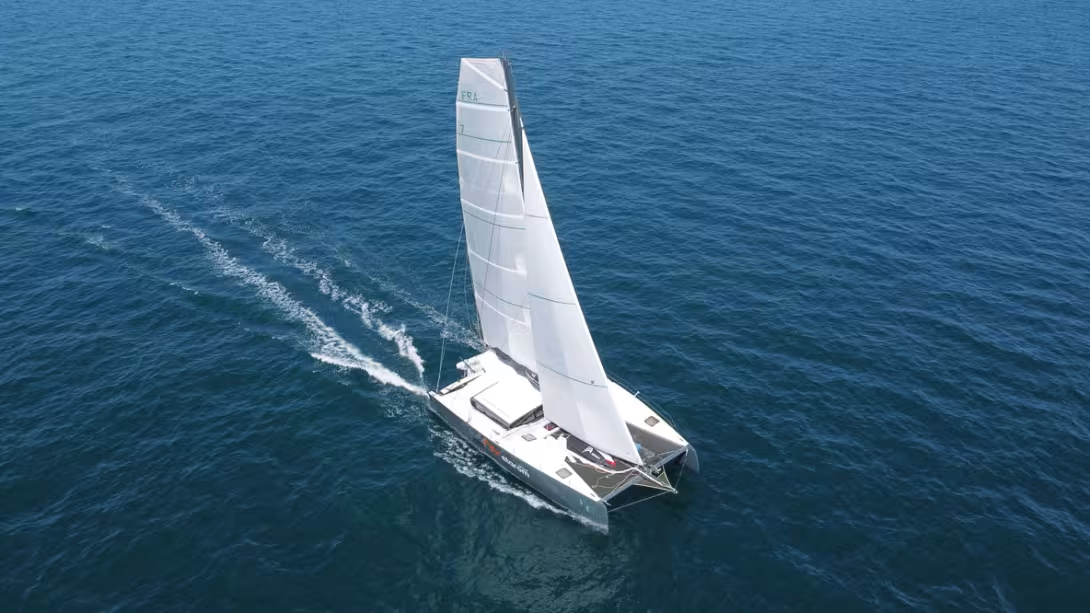
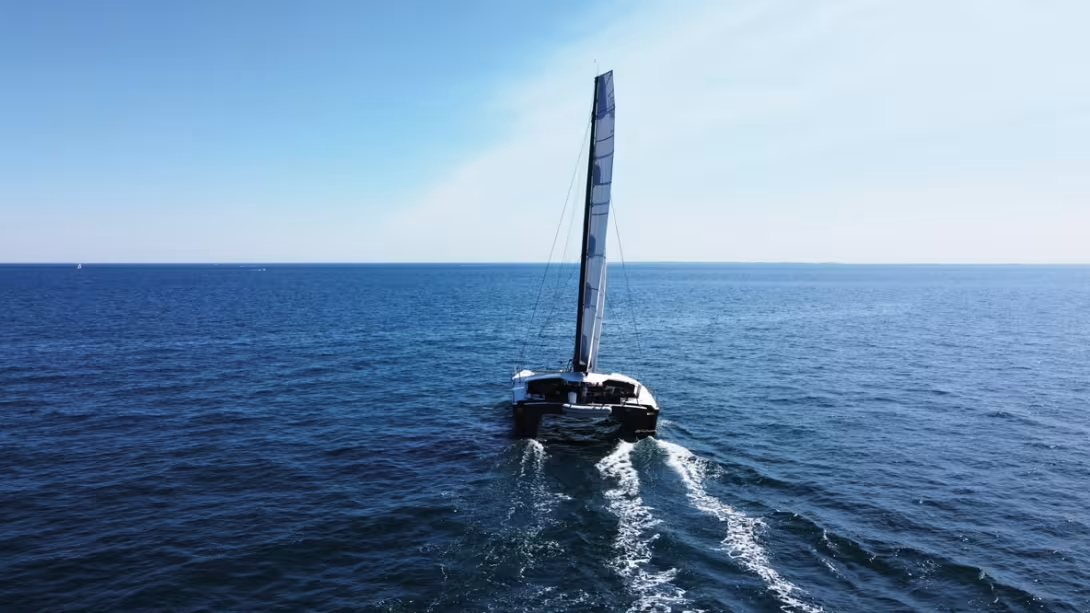
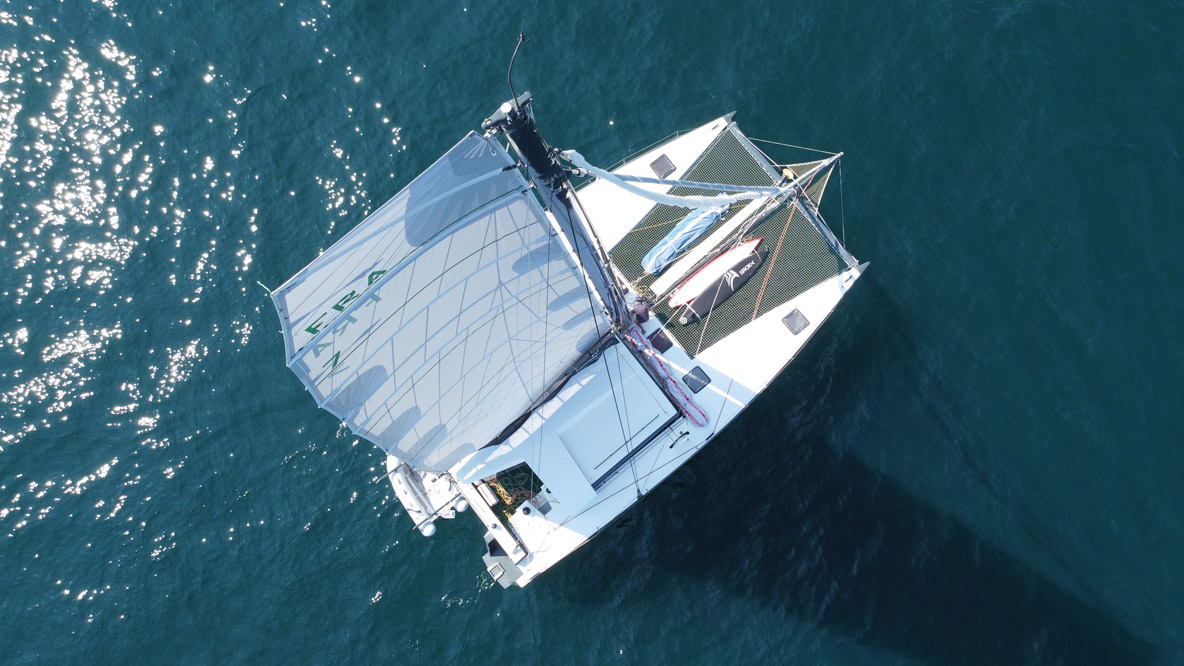
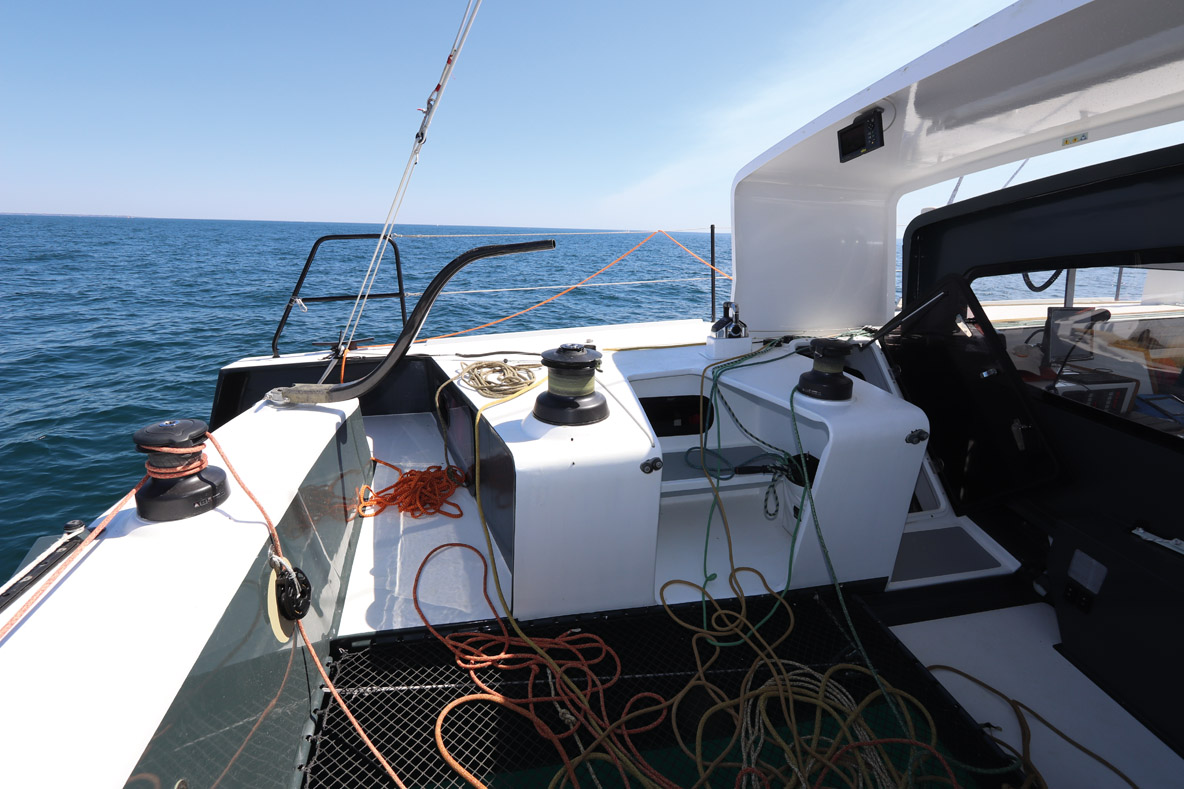
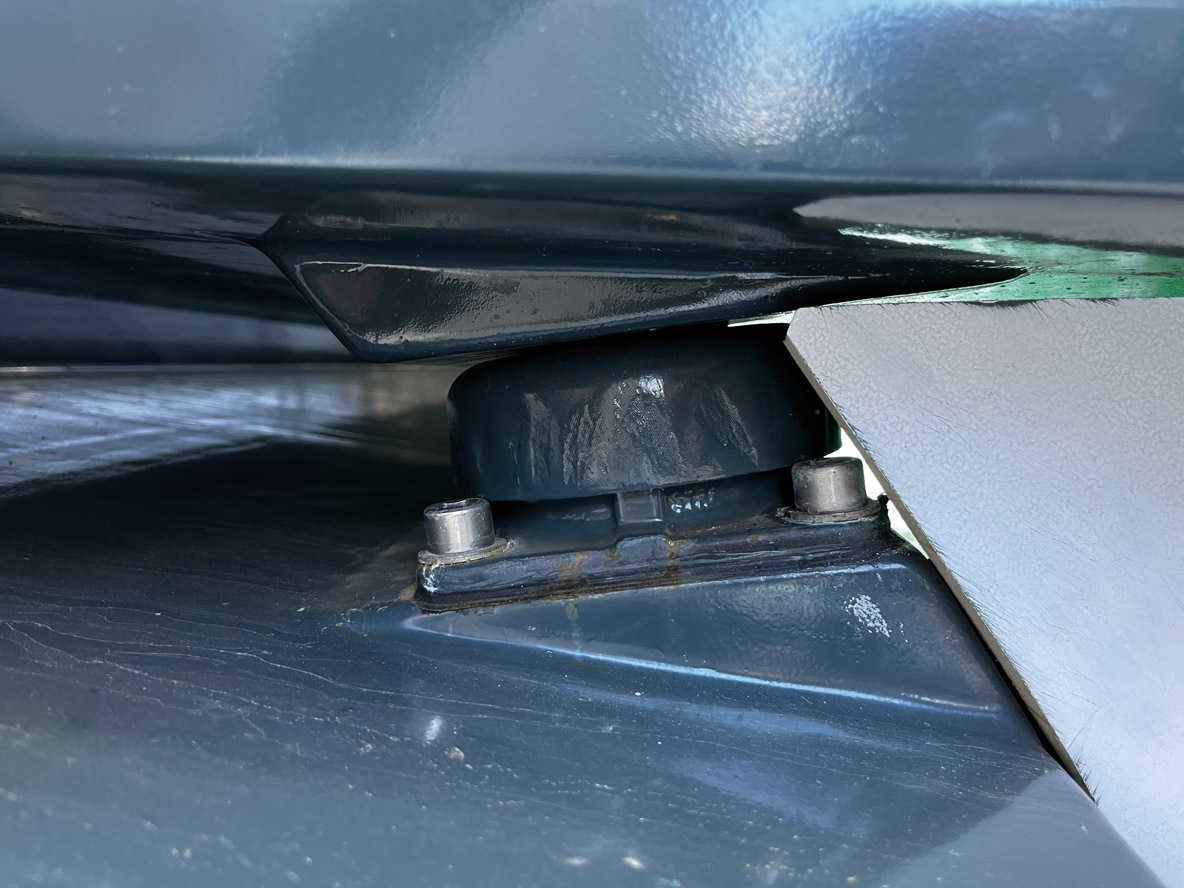
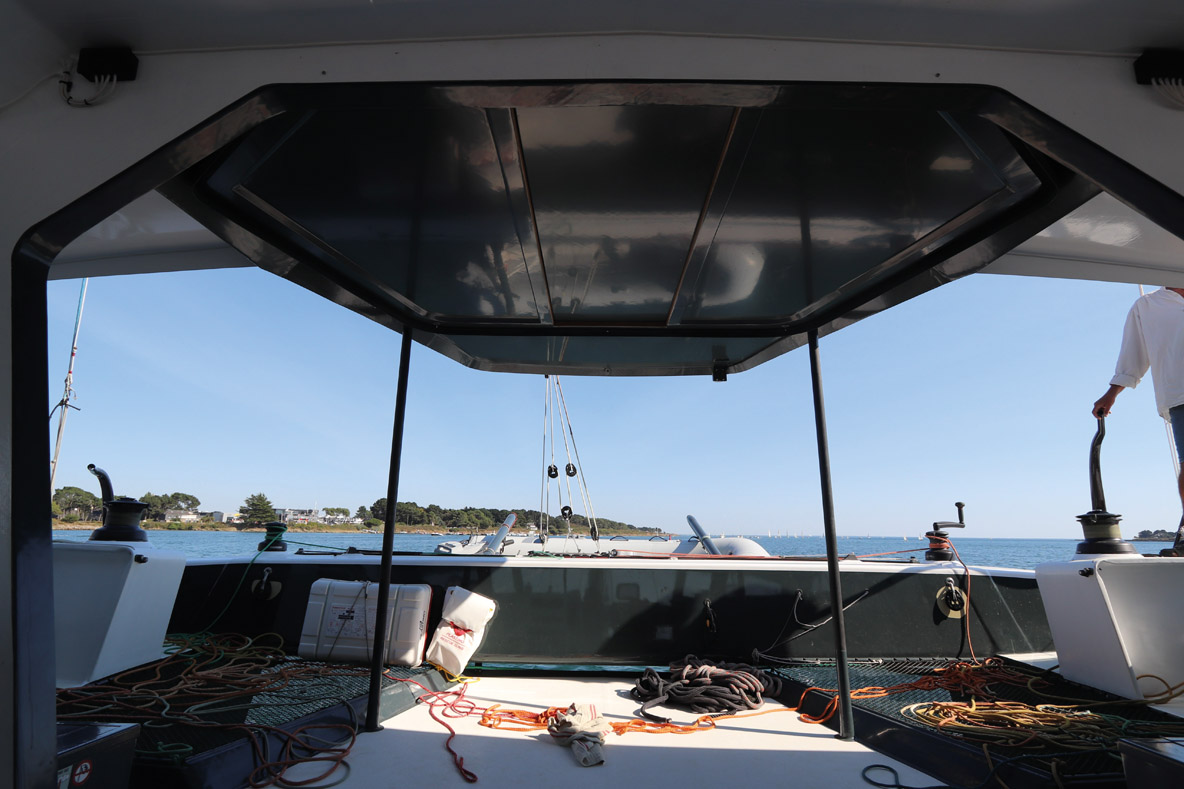
Seen from up close, the MG5 displays an obvious lightness as her bows rise out and over the surface of the water. Note that the catamaran has been built entirely in epoxy carbon - and this by experts in the field. The famous Multiplast shipyard, based in nearby Vannes, was commissioned to build the hulls. Marco’s team of composite experts built the nacelle and assembled the pieces in the skipper’s hangar in Saint-Philibert - on the river of Crac’h, just opposite. All the joining was done under vacuum, a technique that you won’t find on any production multihull. The result, while waiting to see it on the water, can already be seen on the scales: weighing in at 16,535 lbs (7.5 t) - that’s real, not “estimated”)- not bad for a catamaran 52 feet long by 30 in the beam (15.8 m x 9 m). Upstream of this very high-level construction, all design work was devoted to the quest for lightness, with great emphasis placed on simplicity. The most obvious element is the central nacelle, independent of the hulls. Literally sat on rubber mounts, it could, in absolute terms, be dismantled for an extremely performance-oriented program, as it is in no way structural and doesn’t carry any of the deck hardware. While the floats were built somewhat traditionally with two vertical half-hulls assembled together, the central living area uses the same mold for its upper and lower parts. It is therefore rigorously symmetrical in its horizontal plane. The central floor is the perfect reflection of the rigid cap that extends the coachroof. Hence the presence of two nets on the sides, light in weight, and “perfect for watching the dolphins between the hulls” says Michel Rota, the boat’s co-owner, and associate of Marc Guillemot. It should be noted that the two men’s wives are also very implicated in this true “eight-handed” adventure!
Performance and recycling fit well together
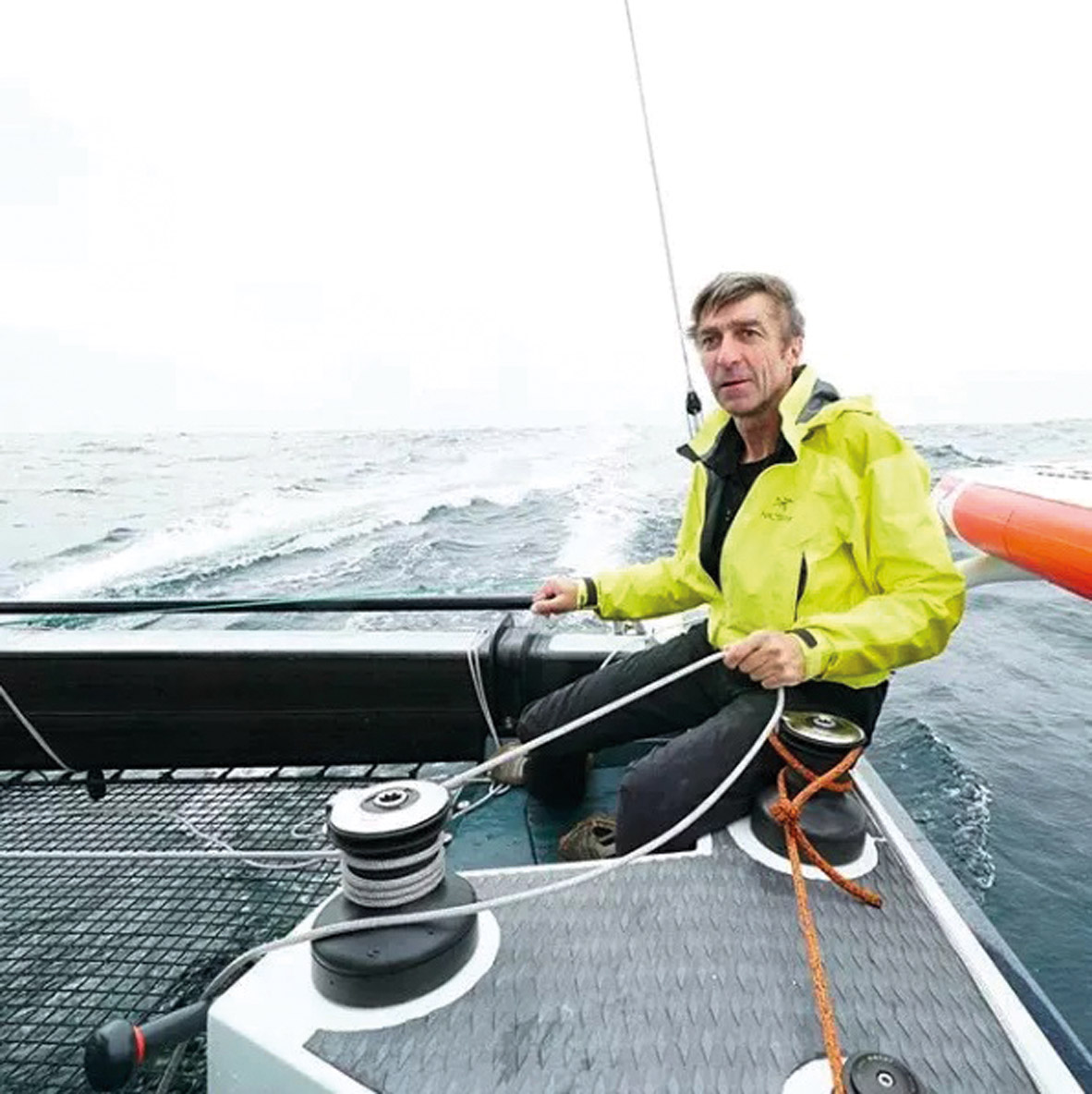
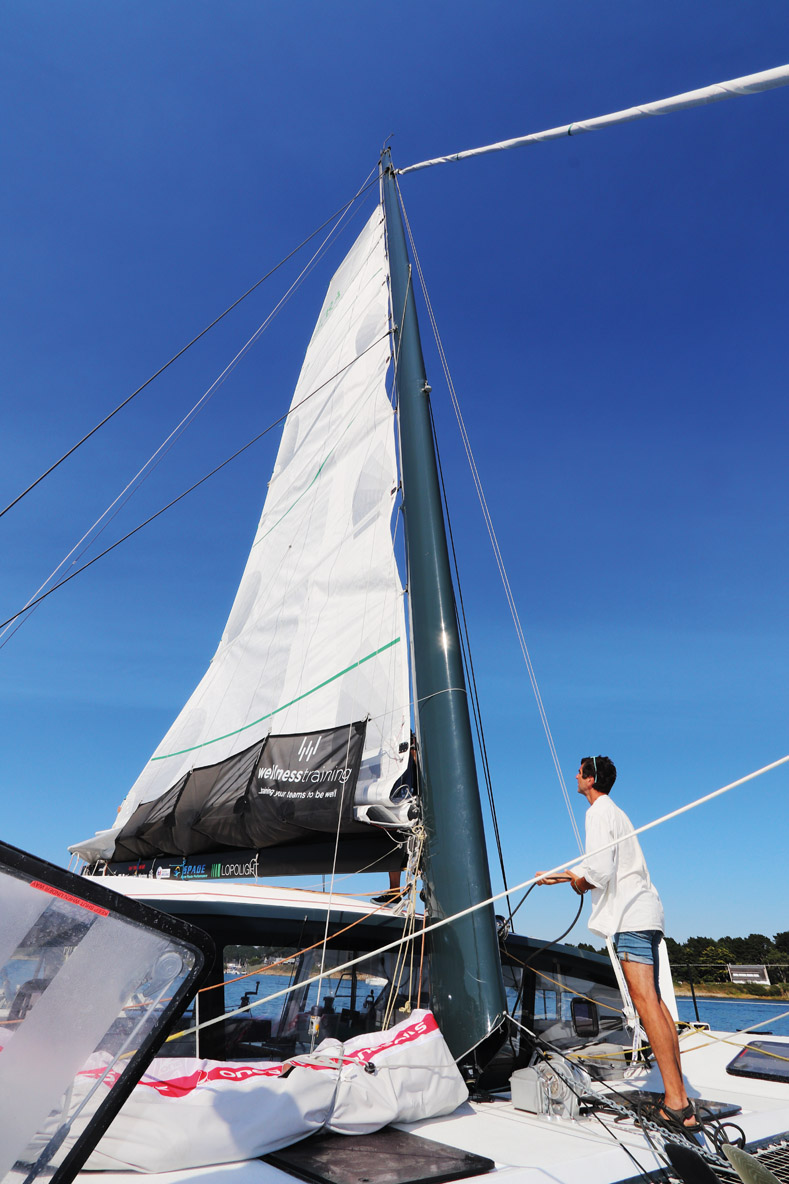
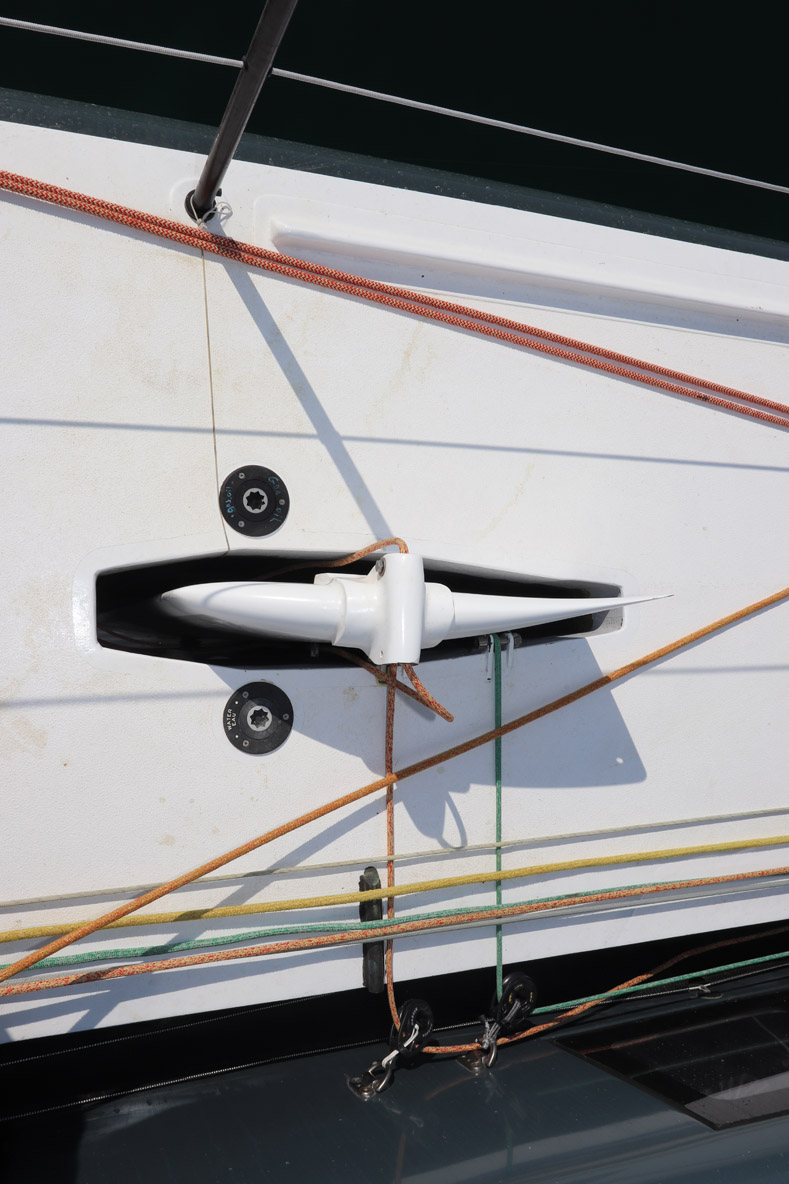
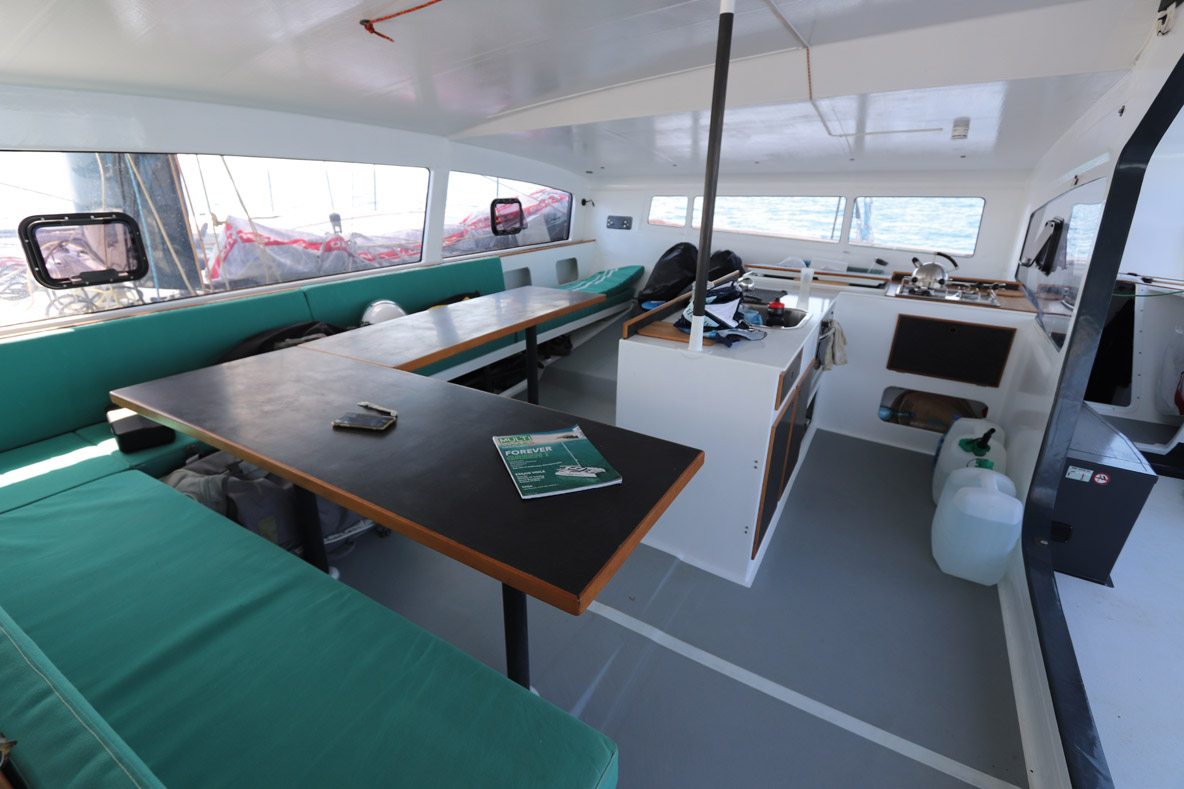
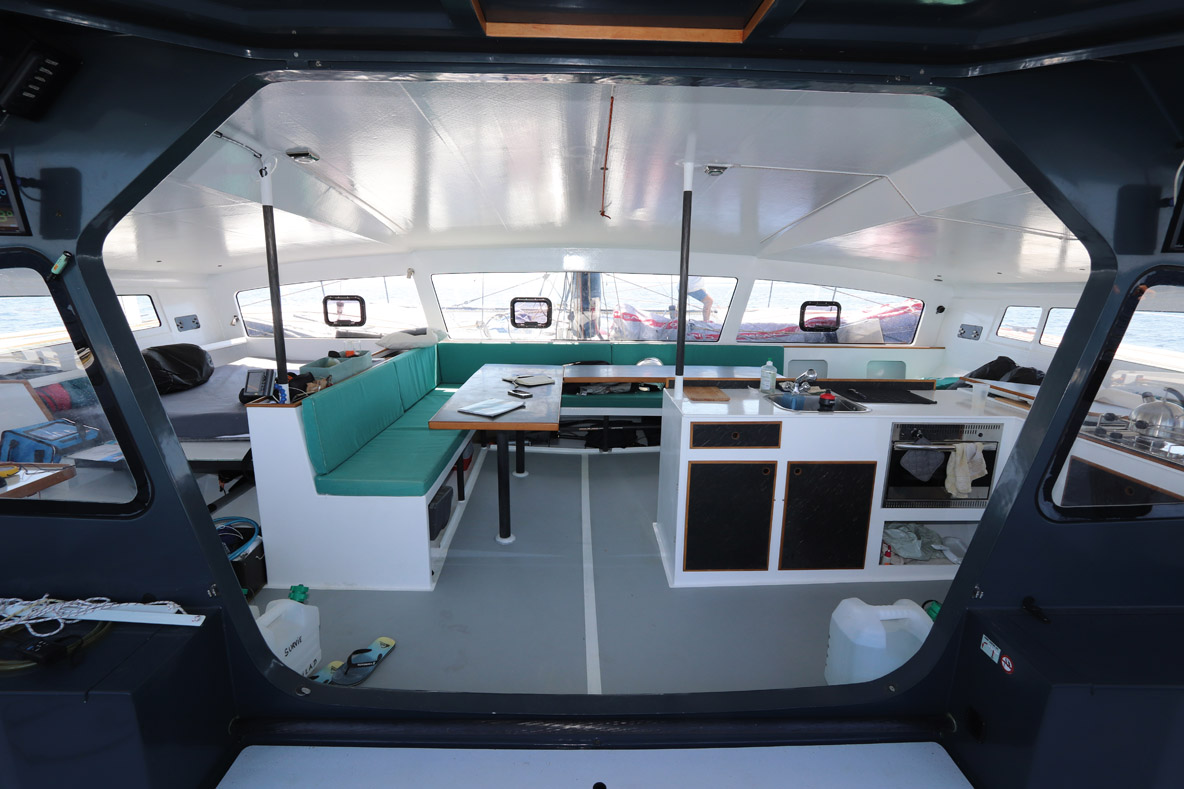
It came time to cast off the lines securing us to the two mooring balls, one forward and one aft. Using the twin 40HP Yanmars centered in the hulls and equipped with Gori three-bladed folding propellers, Marc Guillemot played with the beam wind to get us out into the dense traffic of the channel down to the sea. Many boaters were taking to the water in an attempt to escape the unusual 99°F (37°C) heat that we were experiencing in southern Brittany this summer. We needed to get a move on in this early afternoon so as not to miss what little breeze there was. With the wind coming head on down our route, we took advantage of it to hoist the mainsail from the mast foot. It seemed odd that one of the crew could just hop up on the roof without any effort, but I got out the tape measure, and sure enough, the top of the pod is only 18” (45 cm) above the deck. At the foot of the mast, the gooseneck is at 5 feet (1.5 m), a height that’s more than convenient for taking in a reef or doing something on the boom or with the batten cars. The non-overlapping solent (J1) was unfurled, and even before the sails were properly trimmed, we were already exceeding 10 knots at 31° to the apparent in just 14 knots of breeze. At the helm, Marc Guillemot’s face was locked in a smile - but the sailor wasn’t going to fail to tell us all the stories that forge the soul of this catamaran, even though she was launched only 6 months previously. So, is this MG5 brand new or used? Apart from the hulls and the nacelle already mentioned, we discovered that a lot of the elements have been given a second life on board the MG5. A choice made during the construction process that was based on economic necessity, an ecological approach and finally the proof of solid friendships made throughout a successful career as an ocean racer. The varnish on the carbon tillers had already seen a bit of damage - this is normal, as these helms came from the former Imoca Safran that Marco raced in the Vendée Globe. The rudders, in fact, come from the 60-foot Maître Coq, Jérémie Beyou’s era. The mast is the old spare spar – though shortened - from the monohulls of Jean Le Cam and Roland Jourdain. The J1 furler comes from Giovanni Soldini’s MOD70 Maserati, the running rigging from Gitana, the nets have come from the giant trimaran Spindrift, and the electronics are from Marco’s own Figaro. The spinnaker and gennaker of the skipper’s former Imoca 60-footer were quick to be used, but sometimes more ingenuity was required. The footstools in the saloon were made from the sailcloth of a really tired spinnaker, while old carbon outriggers became the lightest dinghy davits on the market. While the large saloon table, which can seat 12 people for the “incentive seminars” that will be organized on board, is made of carbon, that is not for snobbery. No, it’s to save weight of course, but also to test the use of scrap carbon fiber parts coming out of the aeronautics industry.
Objective Route du Rhum: first, get to Guadeloupe!
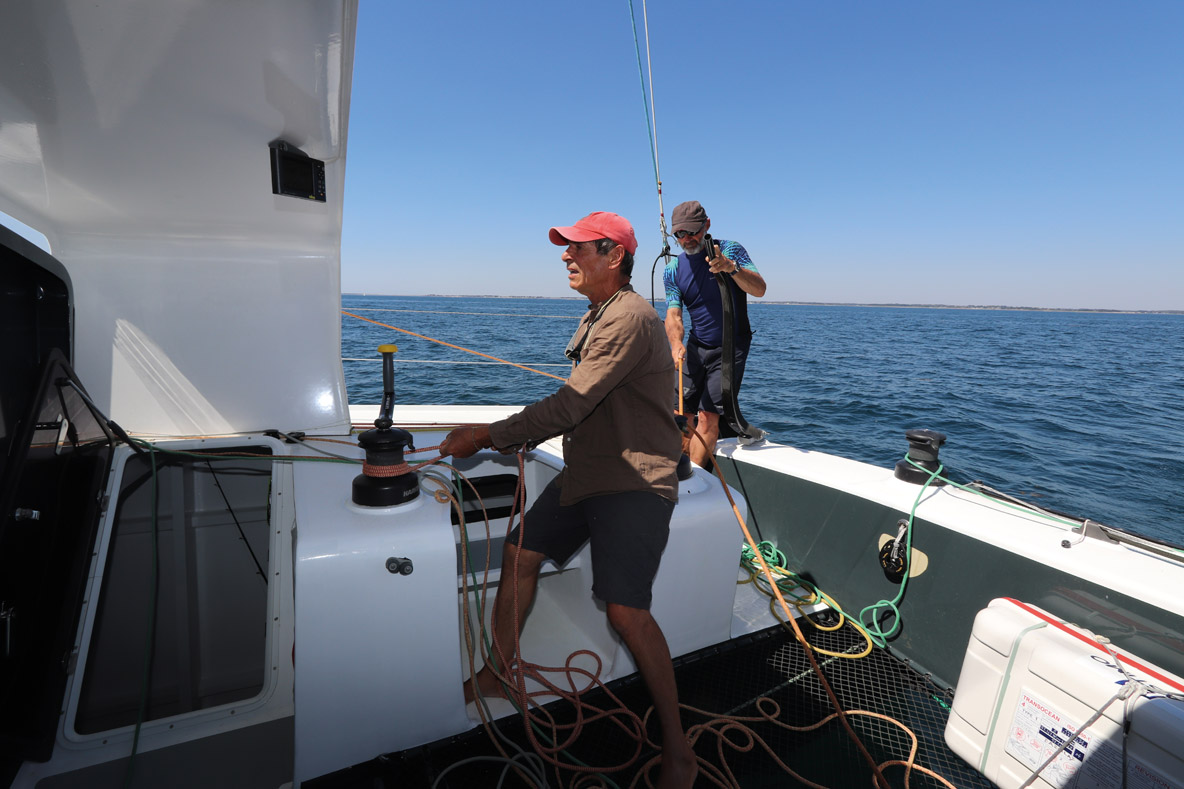
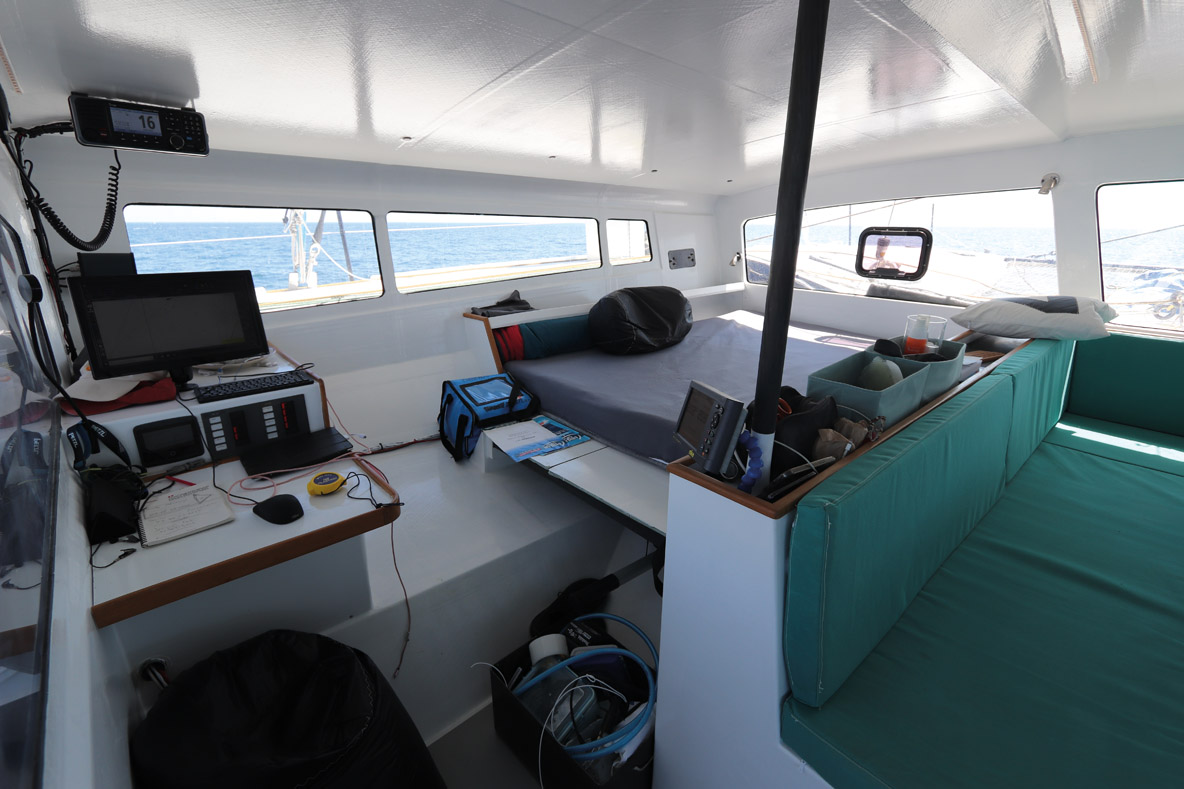
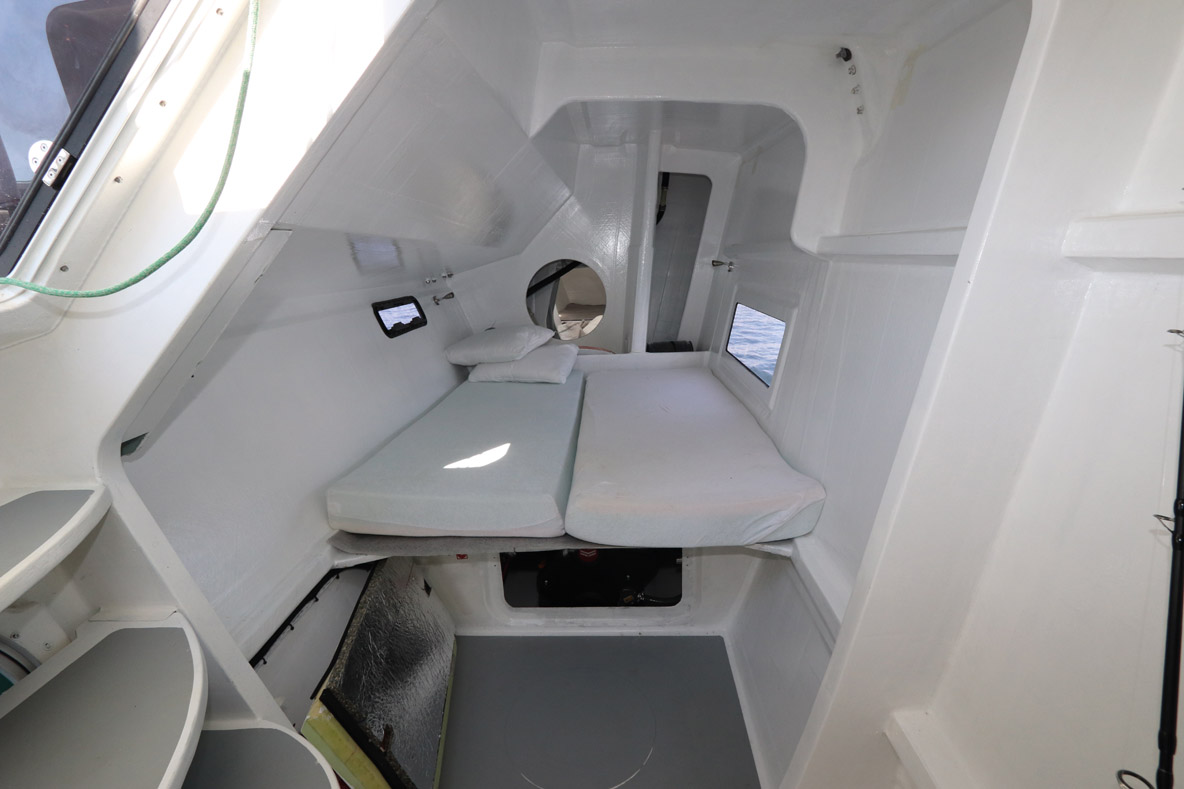
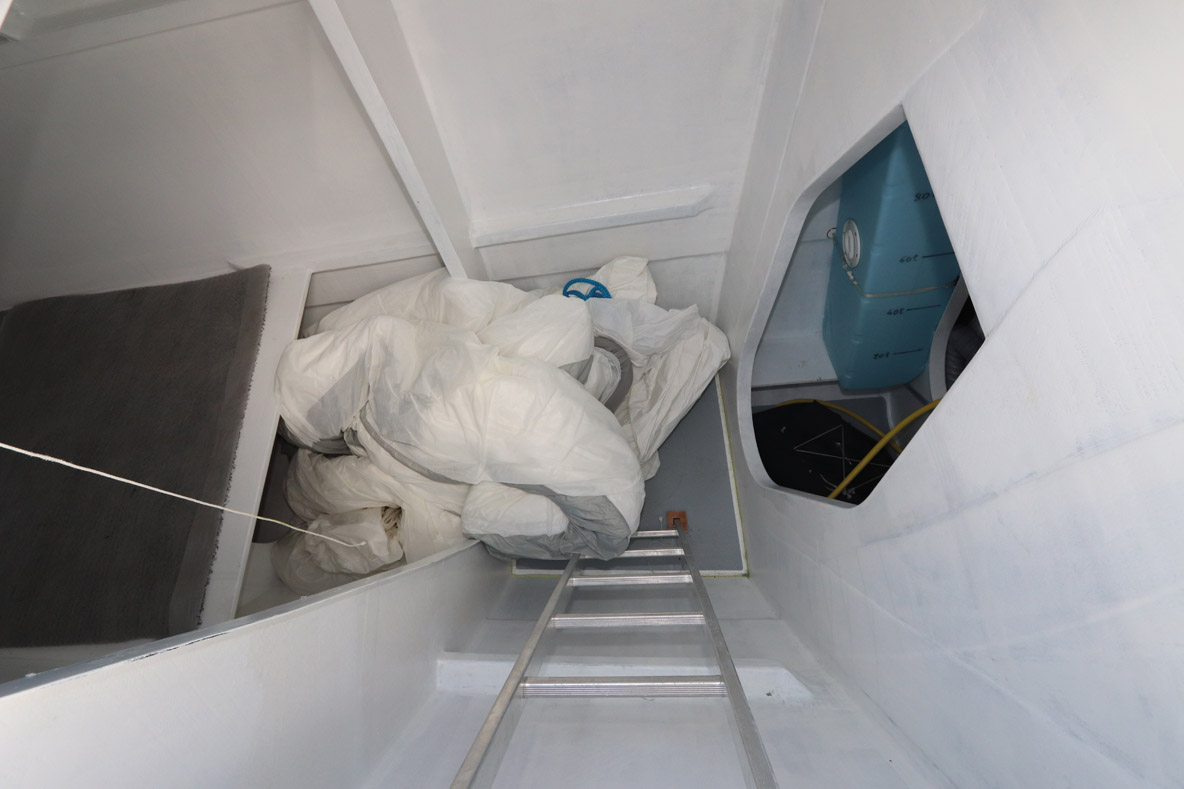
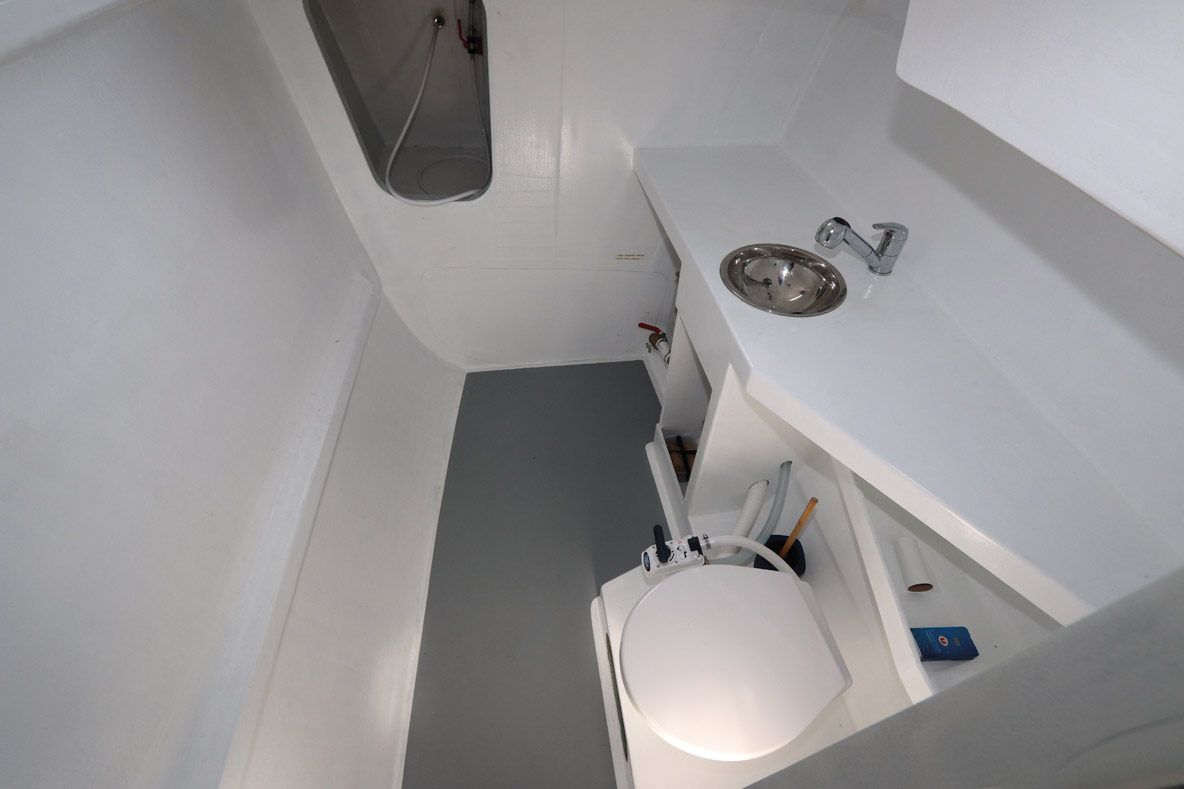
While the deck layout and its hardware are the best of what ocean racing has to offer and “make you want to trim the sails”, according to the skipper, crossing the Atlantic alone aboard this catamaran might seem ambitious to the average person, but not to Marc Guillemot. He lived through the tragedy of the capsizing of Jet Services in 1985 (with the loss of Jean Castenet) and physical injury (a fractured pelvis); he then went through the crazy era of the Orma trimarans, which were so fickle, at the helm of Biscuits La Trinitaine, without any further mishaps. With this experience, he will logically resume his good old habits: sleeping with the mainsheet in his hand. He pointed out the clam cleat just below the winch on which he will leave only two turns. The slightest degree of abnormal heel will wake him up and, from the saloon where he is lying, he will only have to stretch the sheet for it to be released instantly. The assumption here is that his sense of seamanship honed by decades of sailing will outperform the best of electromechanics. Because this Breton’s first objective is to arrive in Guadeloupe. Only then, because one cannot change one’s mind, to win in the Rhum Multi category (see article in this issue). The afternoon continued with trying all possible sail combinations in an evanescent wind. In particular, there is the famous IFS from OneSails, a sort of Code 0 on which the anti-twist cable is replaced by continuous fibers integrated into the profile of the sail. As soon as it was unfurled, the acceleration was clear and the catamaran’s speed quickly exceeded that of the wind. «“What’s important thing is to have the right chassis,” said Marc Guillemot when he saw our eyes widen looking at the numbers on the repeaters. In fact, the chassis is perfect. Not the slightest creak or squeak to be heard in the nacelle which integrates a large L-shaped table, a forward-facing galley, and, to port, a navigation area with a double berth. Access to the hulls is from the outside, with the companionways protected from the spray and rain by the roof cap. The layout in the hulls is strictly symmetrical, with a central double berth above the motors and a heads compartment aft. There is no wood, and no fittings: if you took the mattresses out, you get in there with a pressure washer! Up front, accessible only from the outside, there are berths known as “anchorage berths” that will allow for accommodating more crew for a weekend.
Conclusion
Inside as well as outside, the design of Barreau-Neuman and the implementation as careful as it is clever perfectly illustrates the philosophy of “happy simplicity” so dear to the initiator of this beautiful project. If any former professional or amateur racers are interested, all the tools are available to rent. Marc Guillemot would be the best possible project manager, and it is rumored that Lalou Multi, Lalou Roucayrol’s well-known Aquitaine shipyard, would be willing to build the boat. For our part, we would be satisfied with doing a nice race on board, like the Voiles de St. Barth or RORC Caribbean 600, for which the boat will be available next winter. But with “the most beloved man in ocean racing” at the helm, as our colleague Jean-Louis Le Touzet nicknamed him in 2009, we’d even go round the world!
A word from the architect - Three questions put to Christophe Barreau
- How did you come to be involved in the MG5 project?
- Marc Guillemot was there at the launch of the TS3 with Loïck Peyron, and he found the catamaran very appealing. So I proposed that he and Martine, his partner, take part in the first seatrials, and they fell in love with the concept. As I had a problem of harbor space, Marc suggested we could put the boat at his place, in La Trinité-sur-Mer. In the end, he was the one who sailed the most on the TS3, he even sailed it at 30 knots! So, when he launched his project, we were designing a big TS3.
- What are the key points of this boat from an architectural point of view?
- Its main difference from a TS5, for example, is that it is lighter - the pod is super-light, and wider. It has the same righting moment, but is about three tons lighter, with the same power. The other difference is that the floats are totally watertight compared to the pod, so the catamaran will be very high up on the water in case of a rollover, which for me is a key point. We also wanted to bring as much light as possible inside, like on the TS3 or the Windelo. There’s a lot of window area, giving a good view outside, something not always the case on performance multihulls. Finally, the last point, that was the guiding principle I proposed to Marc and Martine for this boat, is that they could live in the nacelle that integrates their berth/cabin. Originally, I had even included a heads compartment, but that idea has been abandoned for the moment, given the boat’s program.
- What other projects are you currently working on?
- The one I’m most excited about is a personal project, although there could be four of them very quickly. It’s a 28-foot catamaran, which can be dismantled and transported because I’m convinced that you can enjoy some really neat trips on very small multihulls. I also think that the best way to be eco-responsible is to make smaller boats that move forward under sail. So I designed the H2, the “H” coming from the French word “hirondelle”, meaning a swallow - an extremely lively, fast, aerodynamic and very adaptable migratory bird. We started building the small central pod (120 lbs / 55 kg), which is suspended like on the MG5, but on windsurfer mast feet that cost about six dollars apiece! It’s coastal camping, but I’d love to go to Greenland with this little H2 which, starting from just 1,320 lbs (600 kg) of materials, will come in at than 3,300 lbs (1.5 t) fully laden. And then I’ve also designed a 42-foot catamaran to be entirely built in epoxy at Trimarine in Lisbon, Portugal.
- Performance
- Deck plan
- Philosophy of the project
- Reserved for a professional or a highly experienced amateur
- High budget if starting from scratch
- Currently no helm seat
Technical specifications
- Builder: Multiplast/Marc Guillemot
- Naval Architects: Barreau/Neuman
- Hull length: 51’10” (15.8 m)
- Waterline length: 51’ (15.55 m)
- Beam: 29’6” (9 m)
- Draft: 4’9”/8’2” (1.45/2.5 m)
- Air draft: 72’2” (22 m)
- Displacement: 16,535 lbs (7.5 t)
- Mainsail: 969 sq ft (90 m²)
- Solent: 560 sq ft (52 m²)
- Gennaker: 1,668 sq ft (155 m²)
- Spinnaker: 2,562 sq ft (238 m²)
- Motors: 2 x 40 HP Yanmar
- Fuel: 2 x 23 US gal (2 x 90 l)
- Water: 2 x 29 US gal (2 x 110 l)
- Price: on quotation
