
The Nautitech range has long been a favourite with private owners and charter companies alike. Now Bruno Voisard has launched the latest generation : an entirely new boat, with some particularly interesting features and good performance. We fell for this attractive boat right from the start…
Infos pratiques
- Le chantier : Nautitech 40
- La fiche technique
- Découvrez notre vidéo exclusive
- Financez votre Nautitech 40
- Assuez votre Nautitech 40
- Articles autour du Nautitech 40
I have arranged to meet Sébastien, the Nautitech’s skipper, at 6 o’clock on this freezing March morning in La Rochelle’s Bassin des Chalutiers. The boat’s deck is covered with frost and very slippery, and the stars are still twinkling in the night sky, confirming the forecast of an easterly wind for our planned circumnavigation of the Ile de Ré. The footbridge swings up to let us pass, and once through the lock gates and lifting road bridge, we moor the boat on a pontoon in the town centre for just long enough to have a coffee and take some photos. The boats’s silhouette is attractive and very high off the water. At the stern, the davits are made up of two robust stainless steel tubes, and on climbing aboard via the ‘sugar scoop’ sterns, we immediately remark the twin wheels, offset to the sides and leather-covered as standard. However, only the port side wheel has the controls and instruments for the engines. Whilst not sailing, the helmsman’s seats fold into the sterns; once under way, by lifting them up and inserting the locking pins they are ready for use. The cockpit is very well protected, being completely enclosed - ideal for those sailing with children. The table is offset to starboard and opens up to accommodate eight people, or more with the addition of a few stools. At the aft end of the cockpit, a large locker swallows fenders and other cruising gear. The Nautitech 40 has a rigid bimini which is totally integrated into the prolongation of the cabin roof, and one of the original features of this boat is the sliding panel in this canopy, which gives a view of the sails whilst sailing and the sunshine when at anchor.

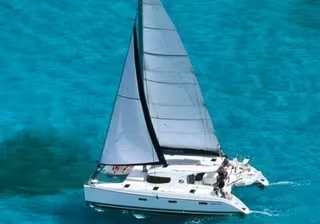
With the 40, Nautitech has designed a perfectly homogeneous catamaran
A very cold sail …
It is daybreak, and we have finished our coffee; time to go. As the boat has just been delivered from the builders, it has never been sailed. I take the controls. The high cabin roof extension and bimini obstruct the view of the opposite bow, but the problem can be resolved by standing on the coaming or using the other wheel. This is probably one of the reasons for the choice of twin wheels ; it is easy to move from one to the other, aft of the mainsheet track, completely unobstructed by others in the cockpit. We hoist the mainsail on its 2 : 1 halyard from the foot of the mast and switch off the engines; the light is splendid and we have a good weather forecast for the whole day. The breeze is dead aft at first, about 10 knots, but as soon as our route allows us to luff onto a broad reach, the boat picks up quickly to 7 knots, leaving a clean, narrow wake as a result of its relatively slim hulls and low wetted surface. The weather forecast on the VHF announces an east-north-easterly breeze, force four to five, dying away during the afternoon. With the deck still frozen and just as slippery, we are now sailing close-hauled, which does nothing to warm us up. Going about is easy enough in the flat sea conditions, but we notice that the ‘new’ genoa sheet is barely long enough to go round its winch – a niggling economy. The combination of the strong ebb current and a headwind under the Ile de Ré bridge gives us the opportunity to test the engines - they have just enough power to push us under the arches. On the early models, they were under the aft cabin berths, but this proved to be too noisy and they have now been relocated under the sugar scoop sterns. Once under the bridge, we unroll the genoa again and with 18 knots of breeze, a flat sea and beautiful sunshine, our speed picks up to 8 knots. Pure pleasure!! The hand rail proves to be very practical and is an important contribution to safety aboard ; providing something to hold on to all around the bimini. Stowage for the anchor, chain and windlass is close to the port bow, and not in the spacious mast foot locker - a surprising choice when considering weight distribution. I find the absence of a longitudinal beam equally surprising.
Under sail, the Nautitech 40 is very pleasant
Around the Ile de Ré.
With a beam wind, the slight chop causes the cockpit table leaf to swing, as nothing is provided to fasten it closed. There is now a good breeze blowing, and we are going to reduce sail by rolling up the foresail. The deck layout is simple but could be improved. Next to each wheel is a winch and a clutch, allowing control of the mainsheet from either helm position; the traveller is adjusted using the adjoining small cleats. The same winches are also used for the genoa sheets, but with no provision for freeing the winch. Rolling up the genoa does not pose a problem on port tack, but on starboard, the only way to control the sheet at the same time as the reefing line is by hand, which demands a lot of strength and is a good way of injuring oneself in a fresh breeze. A small winch just for the roller reefing line would solve the problem. The helm has good ‘feel’ at eight knots, thanks to the cable transmission system. Steering comfortably from the windward seat, well aft, it is easy to imagine myself in the trade winds, all that is missing is 30°C!… Whilst not a racing boat, the Nauticat 40 is nevertheless very pleasant to sail; we achieve 9 knots in the gusts and the boat is comfortable. A large dolphin comes to keep us company, playing alongside much to our amusement. As the rig has not been fully tensioned we do not want to overload it, so take in a reef, easily, from the foot of the mast. The weather is beautiful, the sea calm and the wind from abeam. We gybe to head towards the south of the island. Once on the new tack, we shake out the reef, in temperatures that have barely risen since we set off. When the breeze freshens again, we can feel the props starting to vibrate as the boat really starts to come to life. With around twenty knots of wind, there is just enough weather helm to ‘feel’ the boat and to make helming a real pleasure.
A welcoming interior
The saloon occupies the whole width of the bridgedeck, and gives a particularly unimpeded view of the exterior. Its ventilation is well thought out, with two opening panels in the large forward window and two more in the cabin roof. Fiddles on either side of the saloon seating mean that books etc. can be stowed securely. The galley is situated along the aft bulkhead, with a serving hatch opening directly into the cockpit and stowage above, which, whilst ample for charter use, would perhaps be insufficient on a boat used for long-distance cruising. On the other side of the entrance is the chart table, designed to be worked at standing up. The presence of wood everywhere, mainly makore, gives the interior a pleasantly warm and welcoming feel, with none of the coldness associated with interior glassfibre mouldings . The edges of the steps leading down into the hulls are covered with non-slip material. As we have already seen, the relative narrowness of the hulls is a deliberate design choice which aims to keep wetted surface to a minimum and thus performance at an acceptable level, but as a result, the gangway is not very wide. The structural bulkheads necessitate cut-out access doors to the cabins and the limited beam dominates everything. Thus the berths are raised, with access facilitated by small steps. Children will love the play space provided by the prolongation of the cabins into the forepeak. Each of the four cabins is ventilated by an opening hatch in the deckhead and a porthole in the hull. There is perhaps less volume in the hulls than found in certain other production boats, more than certain others, and we should not forget that when chartering a boat in the Tropics, the tendency is to live outside. Stowage space is sufficient and the boat is well-finished, on the whole .
The beds are fairly high, because of the hulls’ limited beam
In conclusion.
Whilst not being a pure-bred racing boat which will win regattas, the Nautitech 40 is a pleasant boat with real performance. The unladen weight of 6.6 tonnes given by the builder is perhaps a little on the optimistic side; it is probably 10 – 15% superior. At 40 ft, this boat is a good compromise for a cruising boat; a minimum size for adequate load carrying capabilities whilst remaining easy to manoeuvre. In addition, compared to similar sized boats, the price is reasonable. It is comfortable at sea, and the design of the hulls allows good performance, especially to windward, when compared to the same size boat with keels. As for all boats, the design is the result of reflection and compromise between designer and builder. It is an undoubted success.
The features are convivial thanks to the omnipresence of wood
A few dimensions :
The (athwartships) berths in the forward cabins are 190cm long where the hull is widest, 10cm less where it is narrowest, and 140cm wide. The forepeaks measure 185 cm by 120 cm. The berths in the aft cabins : 140cm by 190cm.
I liked :
The protected cockpit. The opening ‘sunroof’, very practical for viewing, sunbathing or protection. The handrail around the bimini. Pleasant steering position.
I liked less :
Economies which go a little too far, especially in the fittings (in quantity, not quality…) View of the opposite bow obstructed by the high cabin top. The ‘free’ jib sheet which jams under the cabin roof! The cockpit table leaf.
Specifications:
Overall length : 11,98m Waterline length : 11,50m Max. beam : 6,50m Draught : 1,20m Height below the bridgedeck: 0,75m Fully battened mainsail : 56m2 Roller furling genoa : 31m2 Engines : 2 x 27hp Unladen displacement : 7.4 tonnes Water capacity : 600 litres Fuel capacity: 2 x 135 litres Price : 277.500 euros, including tax, with sails and engines.
