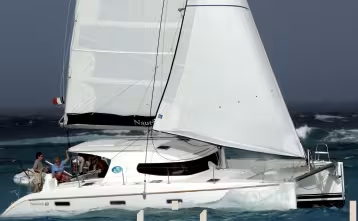
The Nautitech 40 is a compact catamaran which will give you a lot for your money. And its performance under sail, whilst not that of a racer, is a (very) nice surprise. Anatomy of a great classic.
Infos pratiques
- Le chantier : Nautitech 40
- La fiche technique
- Découvrez notre vidéo exclusive
- Financez votre Nautitech 40
- Assuez votre Nautitech 40
- Articles autour du Nautitech 40
A simple head-on glance is enough: the Nautitech 40 doesn’t prioritize volume. Its hulls, designed by Mortain/Mavrikios, are even rather slim. Vertical bows, high freeboard, they are modern, yet...they will soon be 20 years old! Because the 40’s story begins in the middle of the 90s: Dufour launched a range of catamarans called Nautitech. Bruno Voisard, the boss of the company, which has become an independent builder, remembers that the specification required four cabins for charter, of course, but also that “the catamaran must not capsize in 30 knots, under full sail.” The charter companies, even though they were offering idyllic destinations with plenty of sunshine, were actually having to cope with some specific local weather conditions: the Bora, as sudden as it is violent, in Croatia, strong venturi effects between the West Indian islands ... In short, going from 10 to 30 knots of wind in a few boat lengths is not just a theoretical point of view, it happens, and could cause problems for a very powerful catamaran whose crew is not paying attention... This explains the relatively modest sail area, compared to its competitors at the time. The Nautitech 395’s sail area/weight ratio is 12.27m /t; it is reduced to 11.76m /t for the slightly heavier 40. Ten years ago, this was one of the most sensible boats in this 40-foot category: a Privil ge 12 M claimed 12.4 m /t, the Lagoon 410, 12.36 m /t whilst performance- oriented boats were already showing their teeth on paper: 14.46 for the Catana 401 and even 21.7 for the Outremer 40… Figures to be compared with the current, even more sensible trend: 11.77 for a Lipari 41 and just 9.22 for the Lagoon 400…
The 395's slim hulls as an inheritance
In 2003, our 40 thus inherited the slim hulls – slightly lengthened – and the accommodation layout of the 395, but enjoyed a new deck mould. The coachroof was more modern – with glazed areas well protected from vertical rays – and above all was continued by the famous rigid bimini, which ensured very effective protection from the rain, the spray and…the sun. To our knowledge, it was the first multihull in Europe to be equipped with a ‘hard top’. Today, the bimini is present on over 80% of cruising catamarans… The Nautitech 40 was appreciated as much by charter companies for its seakeeping qualities as the number of berths – four double cabins and two forepeaks, giving a total of ten berths. Another remarkable innovation: the access to the nacelle from the cockpit on the same level. Of course the squat rig doesn’t guarantee brilliant performance in light weather, but the 40 comes into its own from 10 knots of wind. And once over force 4 or 5, it is capable of approaching 10 knots downwind. A professional delivery skipper even reported a top speed of 21 knots. The fittings are simple and easy to grasp: this machine is easily controlled, even singlehanded. This is the boat’s real ‘plus’ – it is accessible as a family, without being boring under sail. Although the deck plan is irreproachable – fluid movement, comfortable trampolines – certain points are however less convincing. As regards weight centring, the 40 could do better: the anchor remains in position on the bow of the port hull. Not so good for damping the pitching… During an Atlantic crossing, the anchor gear would be better stowed in a locker close to the mast, or in the cockpit. Then the famous steering positions. They are situated on each hull, with an exceptional view of the sail plan and the side you are on. But beware of the coachroof’s blind spot; you have to get used to keeping watch through the windows. Finally, the famous bimini: it is too low and will inevitably meet the skulls of distracted crew members leaving the cockpit a bit quickly…
Rigid bimini and access on the same level
The builder took this last fault into consideration: the 40 , launched in 2005, offered a few very useful steps for leaving the cockpit. And the bimini can be cut away to make the passage easier. Nautitech took advantage of its refit to launch a private owner’s version – as only ten examples were sold, it is logically in great demand on the second-hand market. Other remarkable modifications aboard the 40 : a slightly bigger galley with an integrated waste bin, the folding helmsman’s seats became fixed on the engine hatches, and finally some clever structural modifications allowed the berths to be lowered by 18cm. More comfort, and more visual space are always welcome. In 2008, the builder changed its woodwork, and opted for light coloured wood… But the boat is starting to show its age, and it is time for the builder to re-launch a new model: the Nautitech Open 40 will be presented at the end of November. The first observation by Bruno Voisard, boss/creator of the company, is that “the crew doesn’t use the saloon table.” As a result, the nacelle will house a choice between a convertible saloon and a galley at the far end, or an open living area and chart table. Just one saloon table, therefore, under the bimini. The coachroof will be widened, thanks to lateral ‘cheeks’, to ensure excellent protection of the cockpit, which can be enclosed by canvas covers with a quick fastening system. As for the hulls and the design, Nautitech is keen to surf on the wave of its new, wellreceived 542; this new 40 has therefore been designed by Marc Lombard…
The Pluses:
+ High re-sale value
+ Strong and rather well-finished boat
+ Large sleeping capacity
The Minuses:
- Dearer than its competitors of the same size
- Perfectible weight centringe
- Bimini too low
The points to be checked
We are dealing with a well-built boat: there are no structural problems to be feared. The only known fault is a problem of watertightness between the deck and the coachroof. The latter is placed on the platform and on the very first models the junction’s angle bracket proved to be insufficient. It was quickly revised and further strengthened on the mos t recent boats. Many Nautitech 40s have been used for char ter: a lot of hours at sea means that the engines and the rig have had hard use. As have the stub keels sometimes, by getting a bit too close to the coral. To be checked. The accommodation ages rather well; the cold storage has caused a few problems for the charter companies.
Technical specifications
Builder: Nautitech Catamarans
Architect: Mortain/Mavrikios
Hull length: 11.98 m
Waterline length: 11.50 m
Beam: 6.40 m
Draft: 1.2 m
Unladen weight: 7.4 t
Mainsail area: 50 m
Genoa area: 37 m
Engines: 2 x 29hp
Production: 90 examples from 2003 to 2011
Second-hand price: 150,000 euros