Since 2002, Nautitech has been getting the autumn boat show public used to a regular succession of new boats. The 40’, then the 47’ in 2004 are restyled developments of the 395 and 475. This year, the 44’ has a new design and styling, the result of more than 18 months of prior study with the Mortain-Mavrikios design office.
Infos pratiques
- Le chantier : Nautitech 44
- La fiche technique
- Découvrez notre vidéo exclusive
- Financez votre Nautitech 44’
- Assuez votre Nautitech 44’
- Articles autour du Nautitech 44’
Nautitech
Bruno Voisard began in leisure sailing in 1978 as a joiner; he later founded a charter company in Brittany and quickly started to show an interest in developments overseas. After Sea Tour, he created VPM, in partnership with Nouvelles Frontières. Since then, he has taken over the Nautitech brand, up until then the property of Dufour, and re-launched the 40’ and 47’ - completely reworked, but built in their predecessors’ moulds. The range has met with deserved success and it was time to design a brand new boat to fit into the range between the 40’ and the 47’.
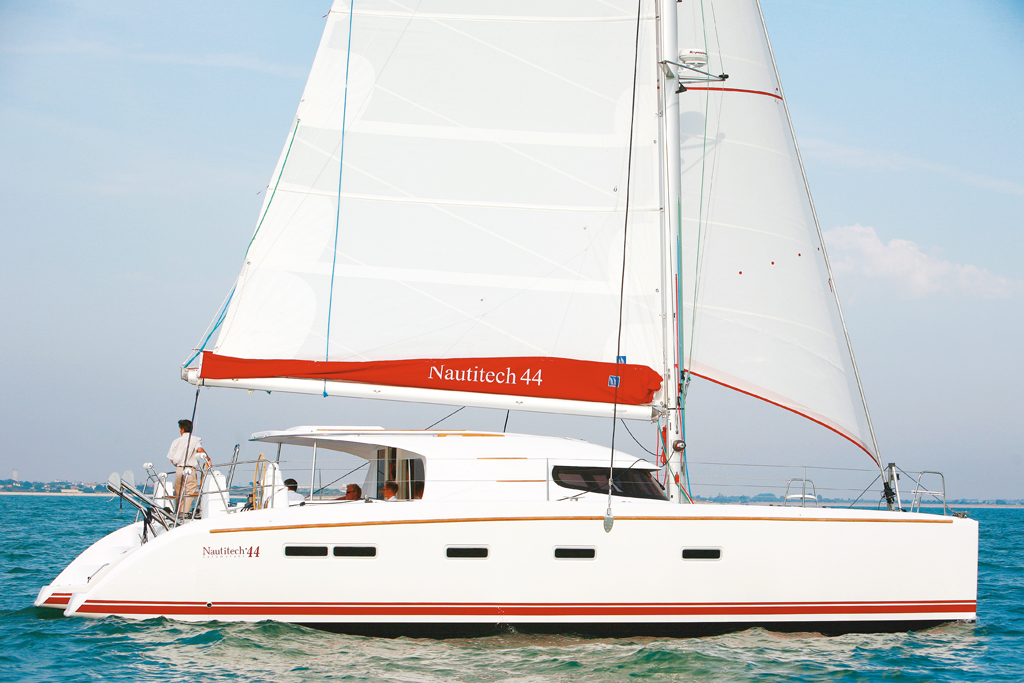
The 44 returns to the successful silhouette of the Nautitech 40 and 47. A very pretty boat!
The Nautitech 44’
The old 435 (an extension of the 395) was a good boat which could have had a second production life, but the loss of the mould led the designers to create a completely new boat. The Mortain-Mavrikios design office’s experience in this sector was to be a determining factor (moreover it reinforces the coherence of the range’s signature). They needed a ‘classically’ inspired catamaran which answered today’s expectations, as much for the regular customers as for the new charter clients or the philistines (who cast loving glances at the incredible volumes of the multihulls presented at the Boat Shows). The specifications? Lots of conviviality both in the nacelle and outside, movement between the two on the same level, privacy in the cabins and reasonable performance provided by an attractive design: all that remained was to take up the challenge!
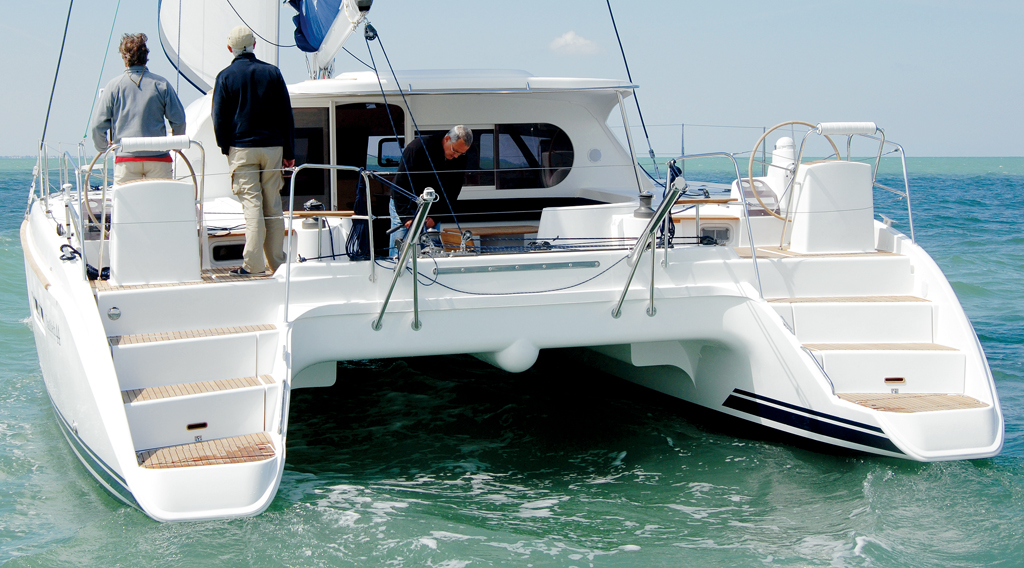
The offset steering position allows for good visibility both forward and of the sails.
Architecture and underwater lines
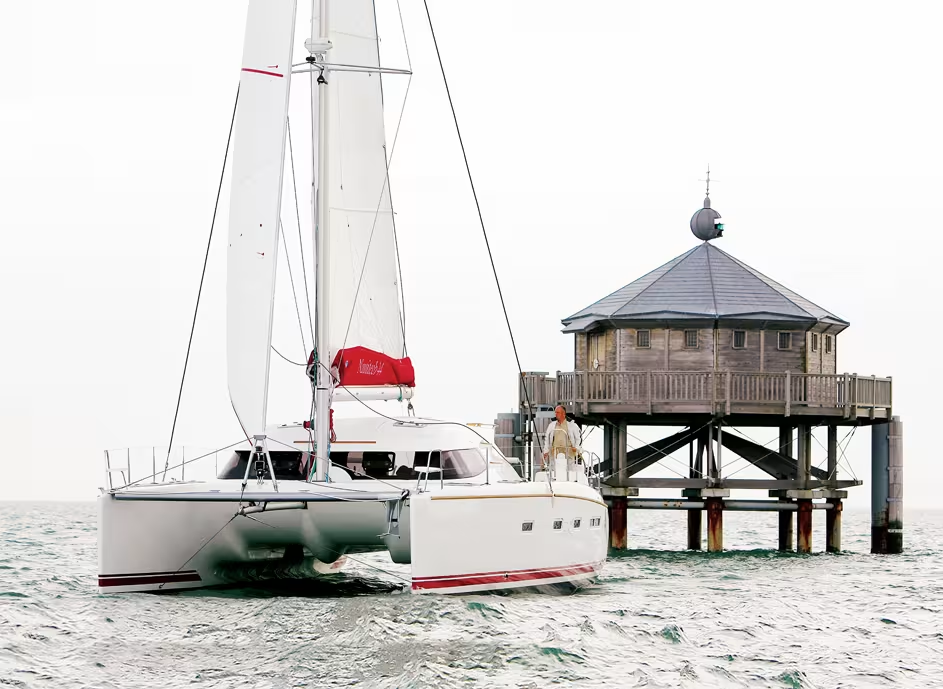
At 15 centimetres wider than those of the 435, the 44-footer’s hulls remain quite slim and the high, open bridgedeck tunnel favours the head-on aesthetic perception and plays a favourable role in progress in rough seas. The underwater lines are quite tight from forward until the beginning of the counter, where the increased volume has been specially designed to generate good support whilst motoring (2 x 40hp!) and favour the delicate flow at half-load. A pair of skegs and two elliptical rudders finish off a harmonious and balanced design, whose wetted surface area remains moderate.
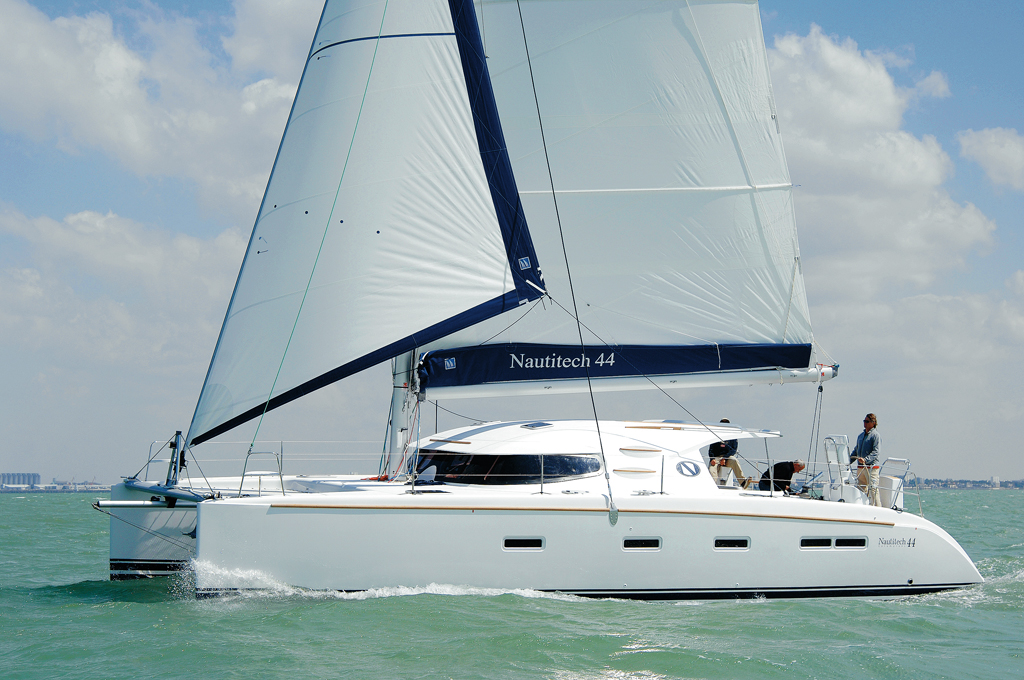
With this 44-footer, Nautitech is offering a real ocean-cruising catamaran…
A classic and successful silhouette
The 44’ is a ‘pretty’ boat: the freeboard is reasonable, the overall lines are set off by a wooden rubbing strake and five Perspex hatches, whose openings are integrated into a recess in the hull side. The decorative strips (in red or blue) emphasize the maximum waterline length and play a part in the silhouette’s acceptability. The cabin roof is elegant, with no exaggerations of any kind and the rigid bimini is not too penalising (weight and aesthetics saved by the delicate execution).
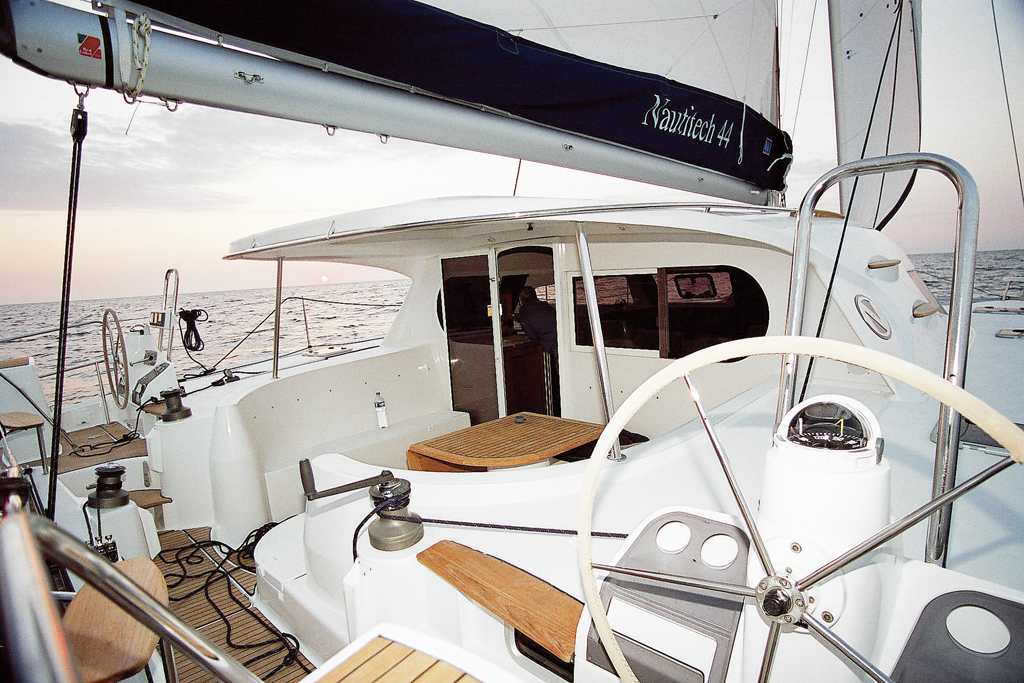
It is easy to move from one wheel to the other. A plus for safety!
Construction
Nautitech takes its inspiration from modern production methods by sub-contracting the platform, accommodation and bulkhead units. The hulls are infused: this high-tech process is now well-controlled and ensures, apart from improved hygiene an safety, better compression of the skins on the core and optimal diffusion of the resin. After delivery to a new factory at Périgny (La Rochelle), 45 technicians are responsible for laminating the ‘Multipli’ plywood bulkheads, fitting the accommodation, the engines, the networks and the deck. The builder delegates the ‘heavy’ polyester phase and can thus practice its quality control by refocusing on the assembly and finishing trades; this seems to be a judicious choice!
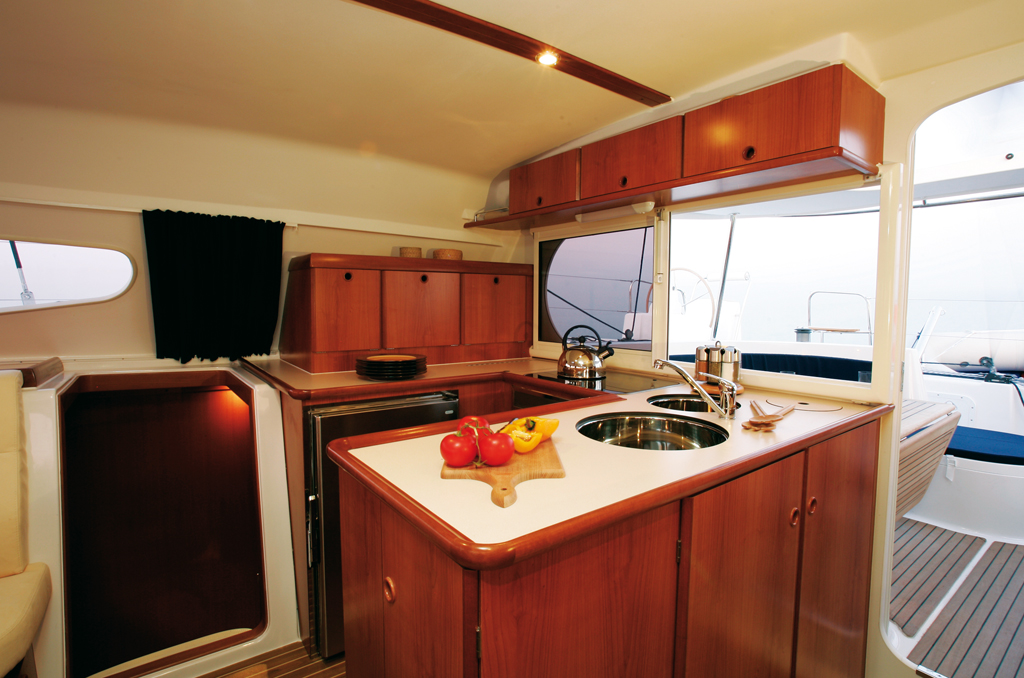
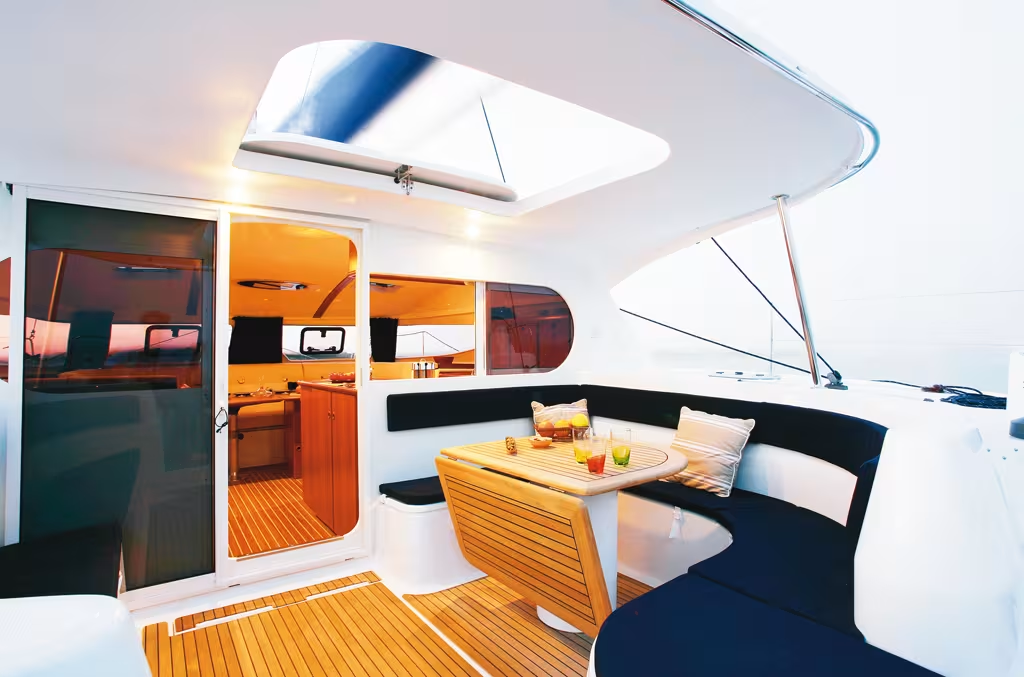
The interior is refined and offers all the conveniences that a demanding owner has the right to expect.
Deck plan
The model tested was an exclusive four-cabin version, with a flattering general appearance; the brilliance of the gel coat and the delicacy of the removal from the mould are obvious. The cockpit table and the teak decoration reinforce the perception of a quality product. The ergonomics of the deck are pleasant; movement around and access to the top of the roof are coherent. Steps and handrails are present and well-positioned; the manoeuvring area is practical, it would be possible to work there safely in big seas. Transferring from one wheel to the other, or towards the winches is carried out at ‘racing speed’ in complete safety. The fluidity makes itself felt again when entering the ‘outdoor saloon’ area; this concept will please a lot of users as it is intelligently produced: the rigid bimini is not an obstacle, it plays its protective role (from bad weather and sunshine), and this ‘outdoor saloon’s’ conviviality is exemplary.
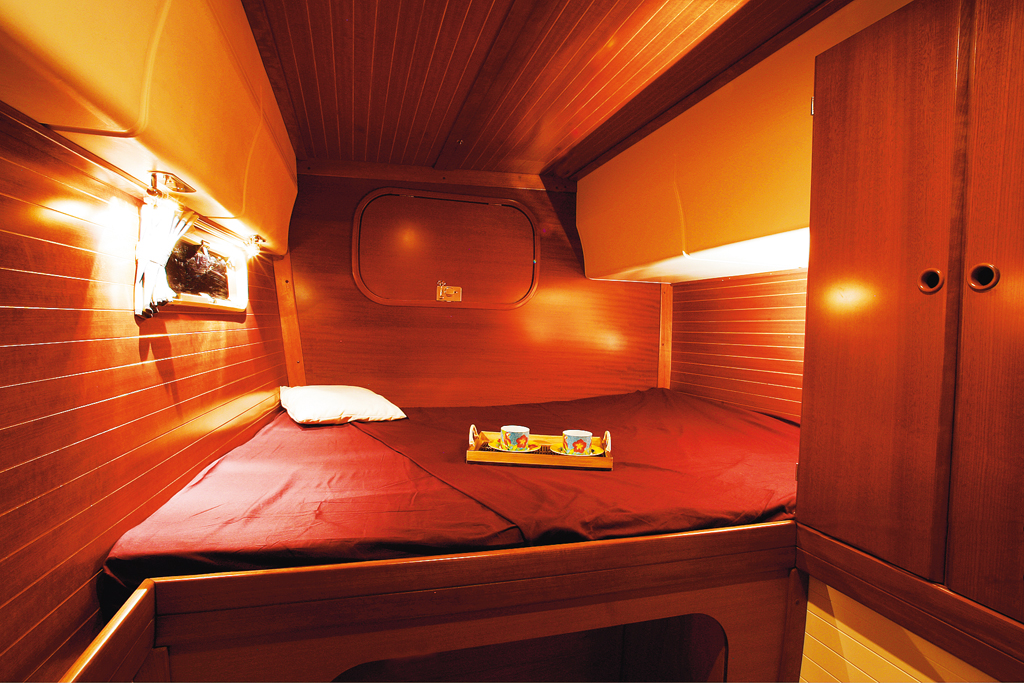
The cabins offer a good amount of space and warm accommodation.
Accommodation
With or without the traditional forward-facing seat, the chart table is of good quality; the U-shaped galley is very efficient (fast service to the saloon as well as the cockpit table and comfort in rough seas). The nacelle’s volume allows the saloon-dining area and galley-office units to work well. The companionways to the cabins are ergonomic and the feeling of being aboard a ‘beautiful object’ continues with the discovery of the gangway, which succeeds in being pleasant, preserving good operating flexibility (direct access to the bathrooms) and giving the cabins an astonishing amount of volume and a warm, private atmosphere. The comfort of the bathroom and wc in use is remarkable (thanks to the light and ventilation). The ‘classic style’ headlining (mouldings) is warm and the atmosphere created by the alternation of white panels and wood is a success. Floor areas are generous, stowage plentiful and the door openings are designed to be really functional at sea.
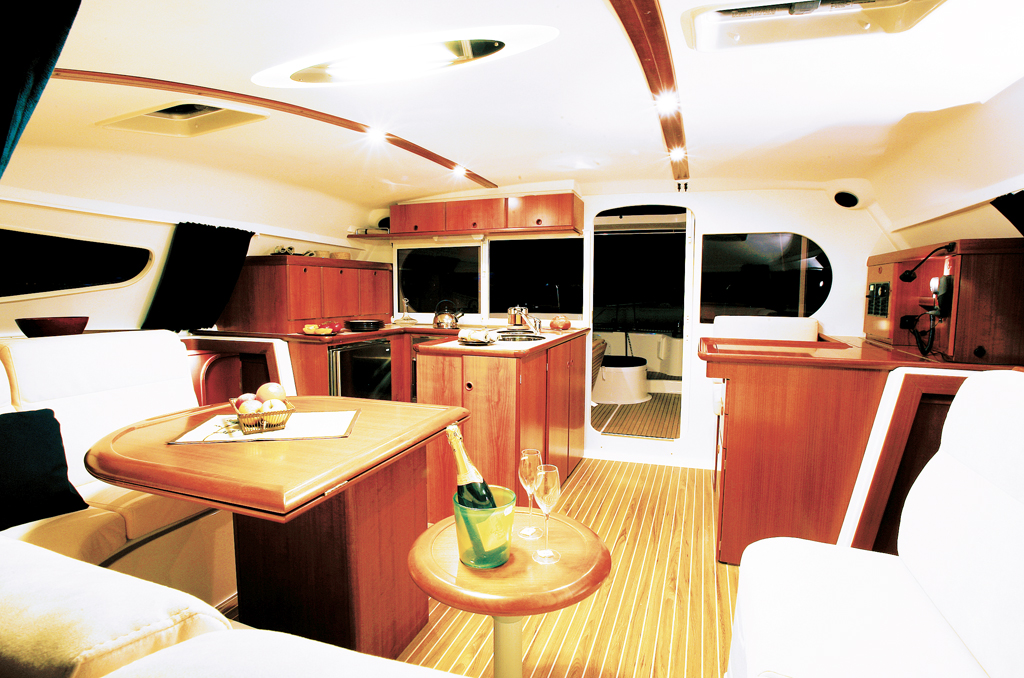
Galley, large dining area, and very nice chart table: the Nautitech offers a good example of successful saloon accommodation.
Sea test
Taking advantage of the delivery trip to the Cannes Boat Show, I threw my bag aboard at the Frioul Islands; we set off at around 19h30 under engine, two-up with Jean-Louis. At cruising revs, the boat slipped through the water at an average of 8 knots into a slight chop, and dusk between the islands was a delight that the discrete engine noise did not disturb. We ate our snack outside, either in the cockpit or at the steering positions, whose design favours observation quality and effective feel (push-pull cables linked to a rigid track rod). This long session under engine confirmed the excellent adaptation of the mechanical unit: very powerful, discrete and… high performance. After a 2-hour nap I hoisted the sails, with 8 knots of easterly wind blowing (the weather forecast had given force 5 - 6!). With a yankee cut jib (high tack, giving a more tolerant boat in strong winds and avoiding winches on the cabin roof), we were ambling along nicely at 5 knots – a little under-canvassed (a gennaker completes this system) but at around 3 o’clock in the morning, the wind started to get up progressively. It was time for the Nautitech 44’ to show us what it was capable of: a first leg saw us at 6.35 knots with 10 knots of true wind (at 45° to the apparent wind). At 4.5 miles from the coast, we found a stronger breeze (12 knots); the 44’ slipped along at 8.2 knots (at 50° to the apparent wind) on an increasingly choppy sea. Half an hour later the speed settled at 8 knots over what was now more lumpy terrain! In the strong, bracing early morning wind, we set off on starboard tack, the Nautitech easily handled the short frontal seas (with no real difficulty); it was alive and showed its real ability. The movements were gentle, the hulls sail to windward with no hesitation and in return for a compromise as far as the course is concerned, the result in terms of VMG is creditable. We progressed rapidly towards our destination, which was now about forty miles away. A leg out to sea allowed us to bear away slightly and the speed climbed to 8.7 – 8.8 knots (20 knots apparent at 50° to the true wind), against what was now a more bad-tempered sea. As on all the Nautitechs, the mainsail is predominant, but the helm was perfectly balanced and the hulls left wakes with no particular turbulence (we were lightly laden). The Nautitech is manoeuvrable; it tacks well and accelerates in a few boat lengths (without freeing the mainsail). On this point of sailing, life in the cabins remains comfortable and the acoustic insulation is good (the interior mouldings add weight, but have a positive impact on the appearance and the insulation. The production sails (Incidences) in Dacron are good-looking; it is certain that on a private owner’s version, the choice of Spectra Hydranet Radial would make the difference in terms of performance and profile stability. At 10am, we furled the sails off the Cannes jetty at the end of an easy and very pleasant delivery trip. Were we there already?
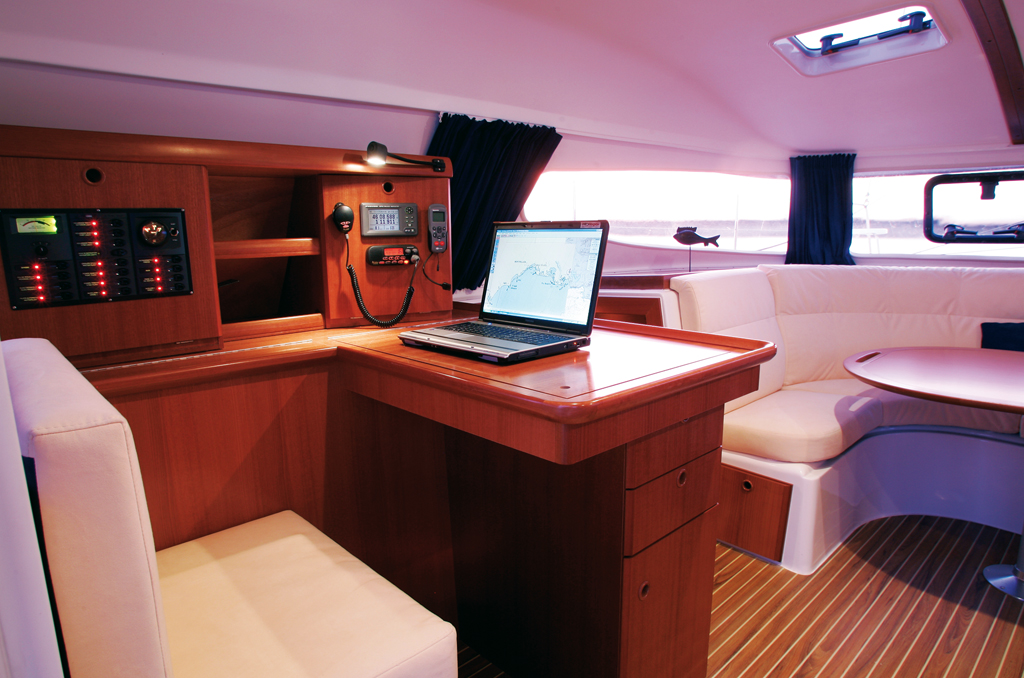
There are two versions of the chart table, with or without a seat. Owner’s choice!
CONCLUSION
In charter or private owner’s versions, the Nautitech 44’ asserts its personality in a very coveted market segment. Agile, fast and easy to use, it will suit prospective voyagers, and its size suits it to ocean crossings. The charter version is very comfortable and offers 4 cabins with ‘owner’ services, and the balance between privacy and conviviality is remarkable. With the gennaker, the sail plan adapts to all wind conditions and crews who can limit the weight embarked (watermaker?) will enjoy an excellent platform. The off-centre steering positions allow a technical view of the sail plan and contribute to the overall pleasure by separating the living aboard – leisure – manoeuvres activities.
The Competitors
Model Builder Architect Length Weight Windward sail area Price, inc. tax, in € Privilège 445 Alliaura Marine Lombard 13.45m 8.9 t 111 m2 532,220 Belize 43 Fountaine Pajot Joubert Nivelt 13 m 8.6 t 111 m2 376,740 Leopard 43 Robertson & Caine Simonis Voogd 14.13 m 8.6 t 114 m2 377,000
The plusses
- Balanced design - Good quality construction - Pleasant to sail
The minuses
- Winches and sheets a little under-sized for strong winds; absence of genoa option. - Jib sheet fouls the mastfoot winch when tacking - Engine accessibility
TECHNICAL SPECIFICATION
Architect : A. Mortain, Y. Mavrikios Builder : Nautitech catamarans Length : 13.47 m Waterline length : 12.20 m Beam : 6.8 m Draught : 1.20 m Skegs/daggerboards : fixed skegs Unladen weight : 9.2 t Bridgedeck clearance : 0.8 m Windward sail area : 96 m2 Mainsail : 65 m2 Jib : 30 m2 Water : 800 l Fuel : 2 X 200 l Engines : 2 X 40hp EC approval : Cat. A for 10 persons Construction material : infused sandwich polyester / glass /foam. Plywood bulkheads Anchoring equipment : 1200W windlass in forward locker, to port. Price : 393,900 euros Price of version tested: 436,220 euros
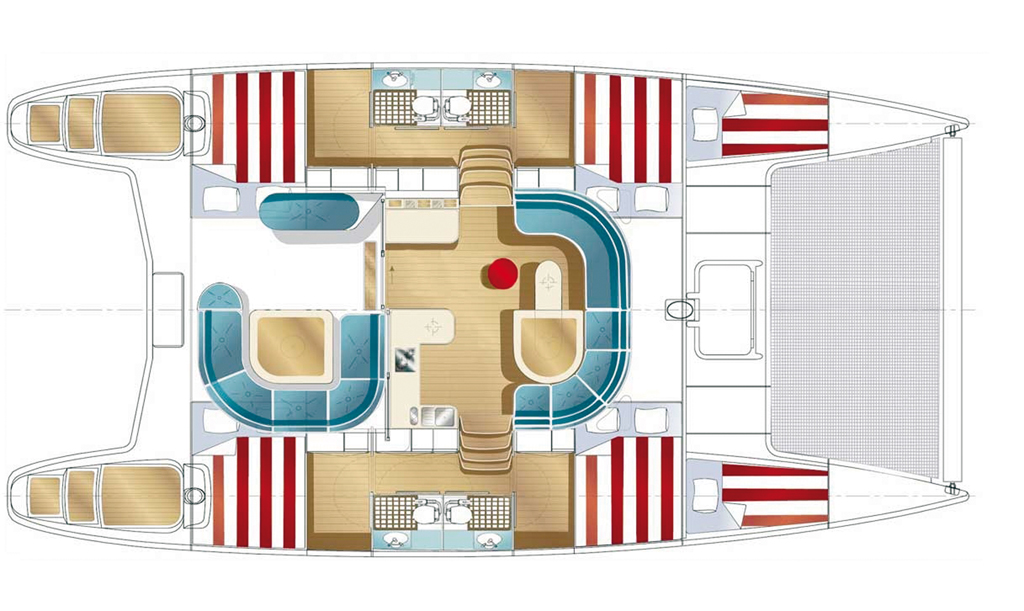
The Nautitech exists in a 4-cabin version…
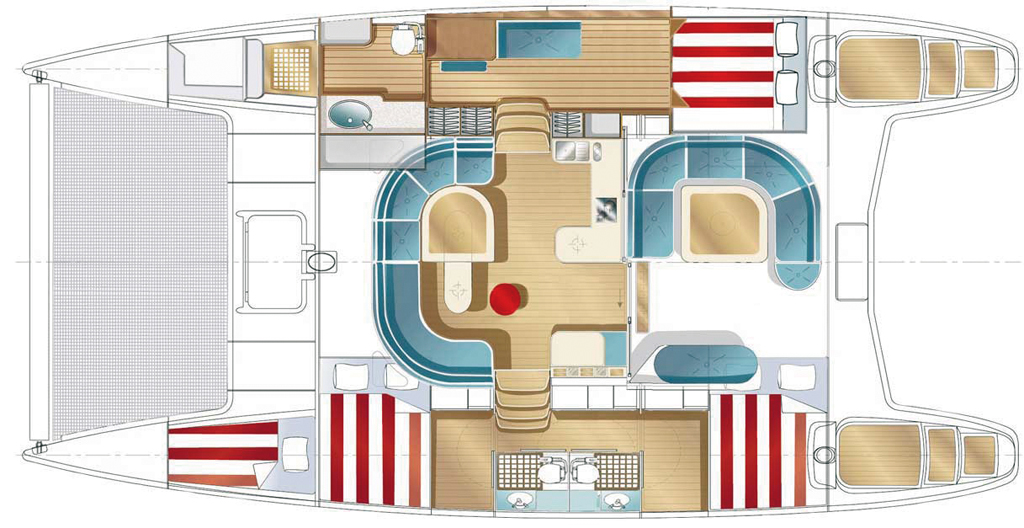
…and a 3-cabin version, for demanding private owners.