This large catamaran is a worthy successor to the Nautitech 475, designed by the La Rochelle based architects Mortain / Mavrikos. The result skilfully combines performance with ‘livability’ and is completely homogenous. We tested it for you…

Infos pratiques
- Le chantier : Nautitech 47
- La fiche technique
- Découvrez notre vidéo exclusive
- Financez votre Nautitech 47
- Assuez votre Nautitech 47
- Articles autour du Nautitech 47
Nice weather, calm sea.
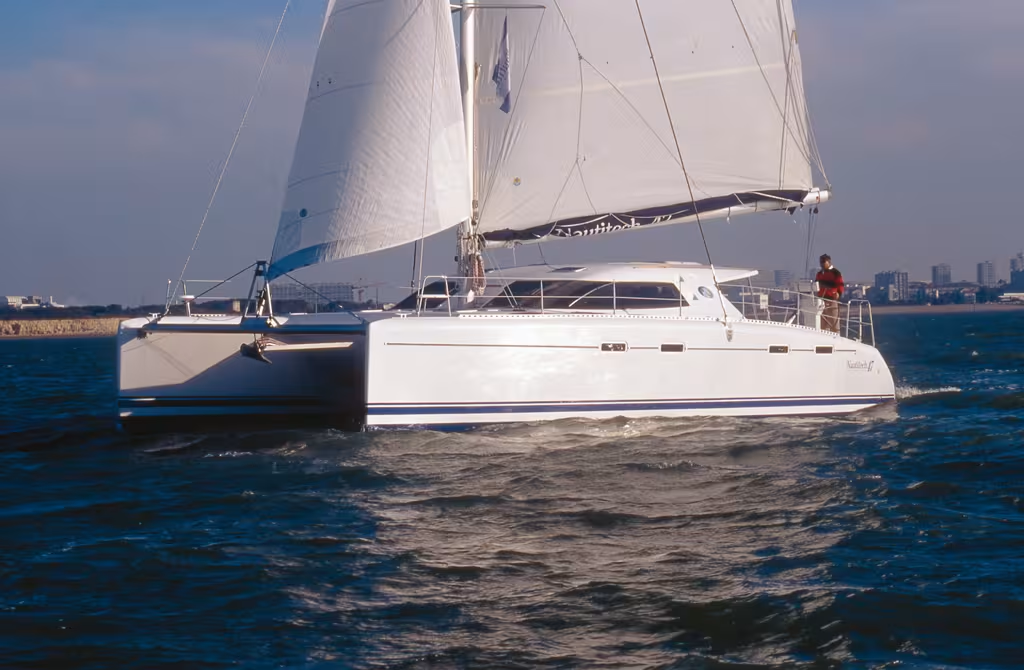
We are near La Rochelle, off the port of Les Minimes, on the sheltered waters of the Pertuis. There is a nice 15 – 20 knot breeze blowing, the Nautitech is sailing at just under ten knots and its pure lines cannot fail to impress. The wind and the sunshine together provide us with ideal test conditions and as before even climbing aboard, today’s boat appears to have, a priori, a good pedigree, it is going to be a good day! The 47 uses the same hull moulds as the late Nautitech 475; the nacelle is radically different, but there is undeniably a slight family resemblance. The 47 has the same fine forward sections as the 40, its smaller sister in the Nantes-based builder’s range. (Nantes is just where the offices are located; the 40 is built in La Rochelle whilst the 47 is assembled in Lorient). Reduced drag resulting from the low wetted surface should help progress in light winds, and the design should allow a respectable performance upwind. Once I have finished taking photographs of the boat under sail from La Rochelle port's motor launch, ‘L'Aubisque', I climb back aboard the 47. Eric, our skipper, gybes and we set a course towards the open sea. We are going to sail round the Ile de Ré, as this will allow us to test the boat on all points of sailing: to windward in the chop and the ocean swell then later, at the north end of the island, with the wind abeam, before returning downwind.
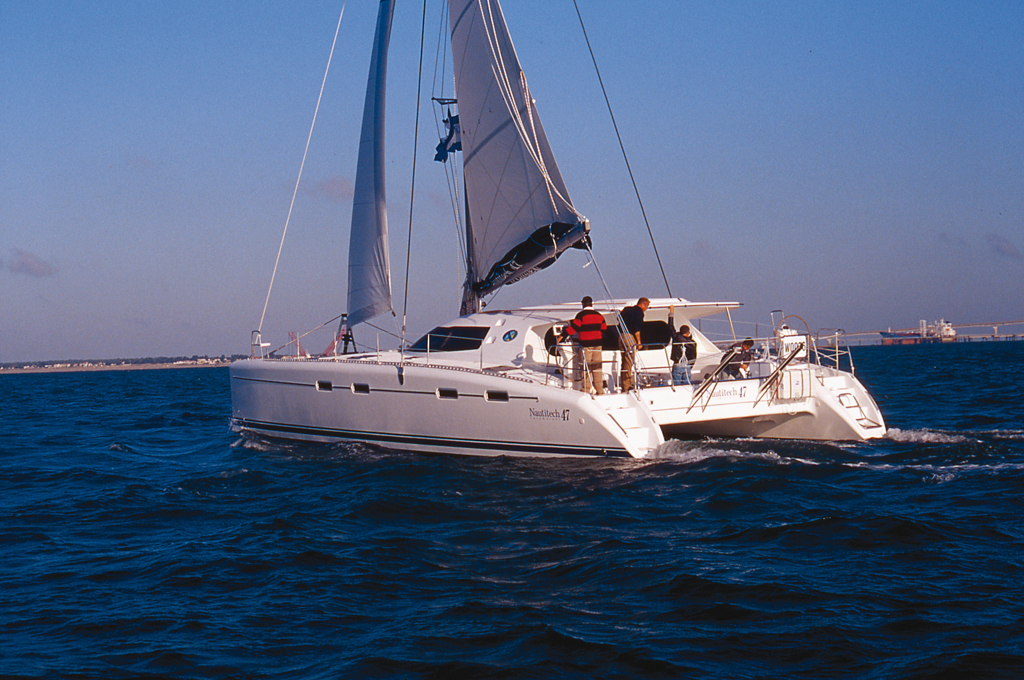
A large catamaran that astutely combines performance and livability.
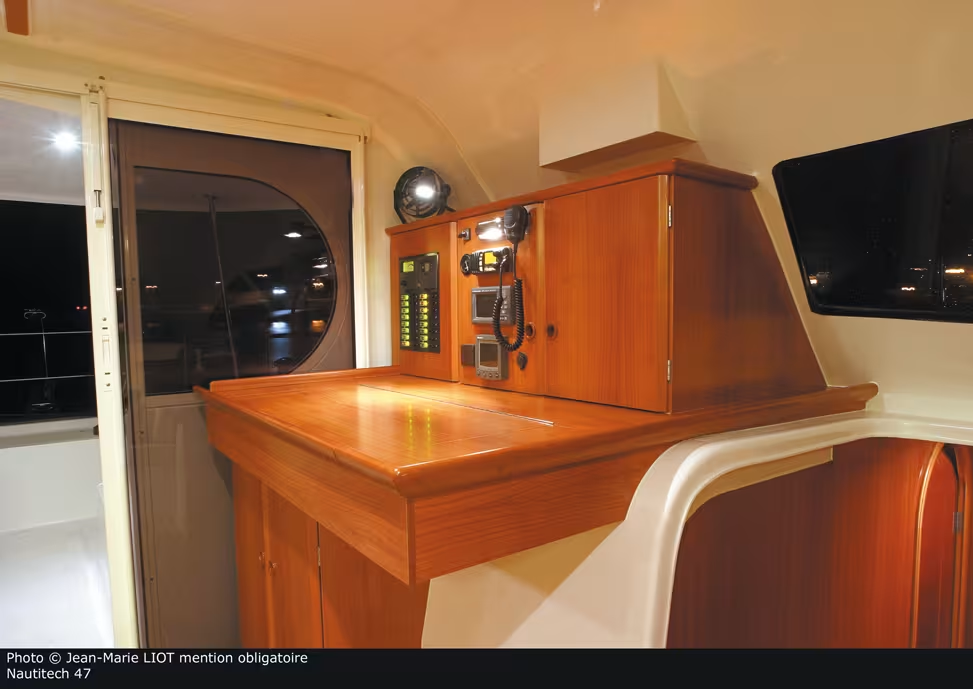
With 15 knots of wind and at 70° to the apparent wind we are sailing easily, at 8 knots, in the lee of the coast and thus on a smooth sea. The cable steering linkage means that the boat is rewarding to helm; on this point of sailing the boat can be steered with the fingertips and the position at the windward wheel, well out on the hull, is really pleasant. The port console houses the engine controls and the instruments. Despite its size and weight, the boat is very responsive; its weight is given as a little less than 14 tons, which seems plausible. We are sailing to windward fairly close to a headland and the sea is becoming unpleasantly choppy. In addition to this chop, which is coming from dead ahead and slowing us down, we are starting to feel the long Atlantic swell. Despite the relatively low slung nacelle, we are not too troubled by waves hitting its underside. As on all catamarans, once there is a bit of sea running, these impacts are quite normal. At 55° to the 18 knot true wind, we are making 8 knots. The wind is inconsistent; as soon as it drops, so does our speed and with a 15 knot breeze we are down to 6 knots. However we must put things into perspective; as mentioned earlier, the waves coming from dead ahead are slowing us down. The wind spoils us by freeing off a few points and blowing from abeam; the Nautitech 47 continues to tramp along at around 8 knots. We are then headed so badly that we have to sail a long upwind tack to round the headland on the north end of the island. Once we have tacked again, things become easier, we no longer have the waves on the nose and the Nautitech 47 accelerates. When we finally bear away, by a few degrees at first, then further and further, sailing becomes more comfortable; we ease the sheets and wish we had the extra power of a gennaker or a spinnaker. As we approach Les Minimes, we take the main down and start the engines. At 2,300 rpm we are at 8.5 knots. The engines are a pair of 53 hp Yanmars, fitted right aft in the hulls; access is by panels situated under the steering positions. From here we can also gain access to the whole interior of the aft crossbeam, and can thus check the junction of the steering gear as well as the other technical systems inside. We enter the port. Even if I do not berth the boat myself, it is easy to see that although visibility at sea is fine, during port manoeuvres the only way to see the opposite corner of the boat is through the ‘picture windows’ of the saloon.
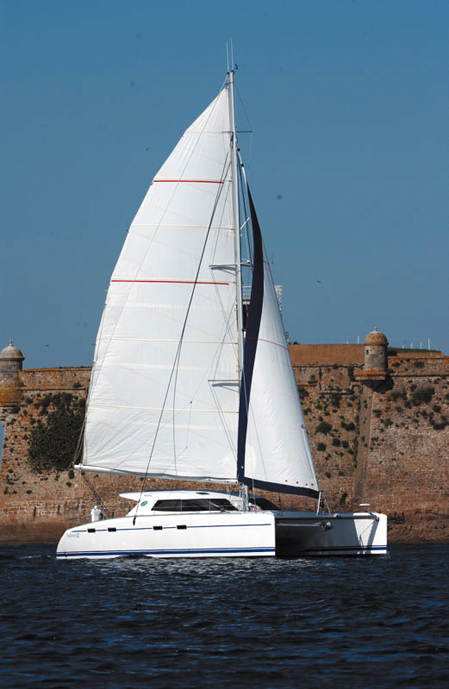
Under sail, the Nautitech 47 offers performance perfectly on a par with her agenda of cruising on the open sea (photo: Y. Zedda)
Exterior view
Yesterday evening, the Nautitech was moored head to wind and there was just a light breeze blowing through the cockpit where, in the company of several members of the Nautitech staff, I was getting to know the boat. It was dark and the cockpit lighting system diffused a very pleasant light. The exterior table has a small cool box in its centre and is surrounded by seating, consisting of a settee on two sides and folding cinema director type chairs (which can also be used inside) on the others. Besides the sliding companionway door, communication between the exterior and the interior is made easier by a very practical ‘picture window’, which also slides. Sitting comfortably in the cockpit, I glanced up at the hard top bimini with its ‘trade mark’ opening panel. At sea, this panel allows the trim of the mainsail to be checked easily, whilst in good weather or in the Tropics, it gives a direct contact with the elements and depending on conditions and the mood of the crew, protection from the sun and stargazing on night watches… Let’s have a look round the platform. The deck plan is just like the rest of the boat, simple and above all, functional. It is easy to move around and I like the aesthetics and the impression of space. A liferaft could be stowed along the aft crossbeam and two fat, well reinforced tubes between the transoms form davits for the dinghy. The main traveller is mounted on this same crossbeam and is controlled by two winches and three jammers, for the traveller and the two ends of the sheet. With this system, the sheet can be freed at any moment from either of the steering positions. Reefing lines are handled from the mast foot, as is the main halyard which, in the absence of an electric winch, not fitted on our boat, can be hoisted by leading it via a snatch block to the anchor windlass. We must be realistic, on a boat of this size, the mainsail area starts to become such that hoisting it manually demands a certain level of physical fitness! The windlass and chain are situated forward of the mast; the chain runs over an aluminium guide, underneath the longitudinal beam to the forward crossbeam, where the anchor is stowed ready for use.
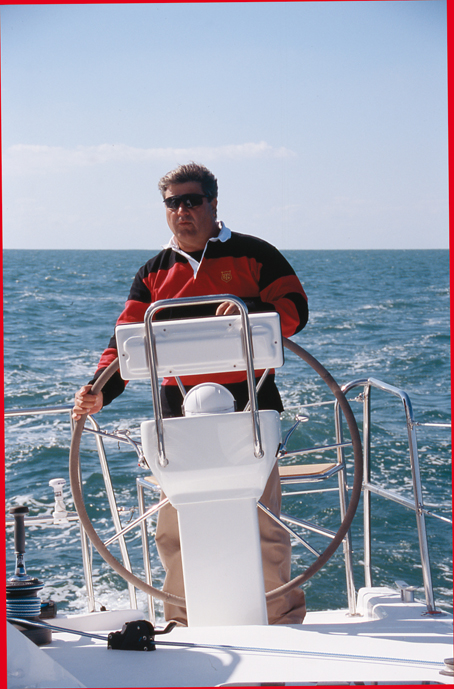
The helm station is pleasant, even if the visibility isn’t ideal for maneuvers in the harbor…
Carefully finished interior.
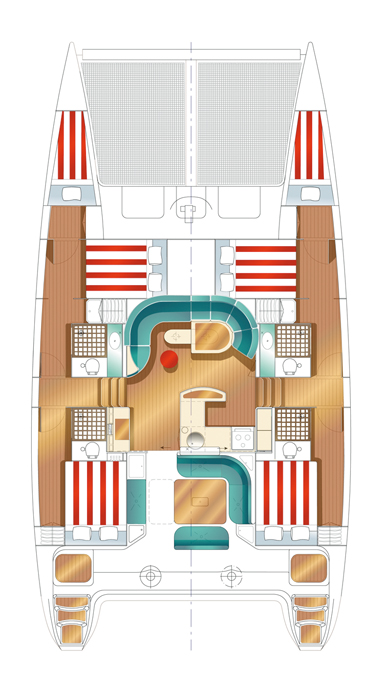
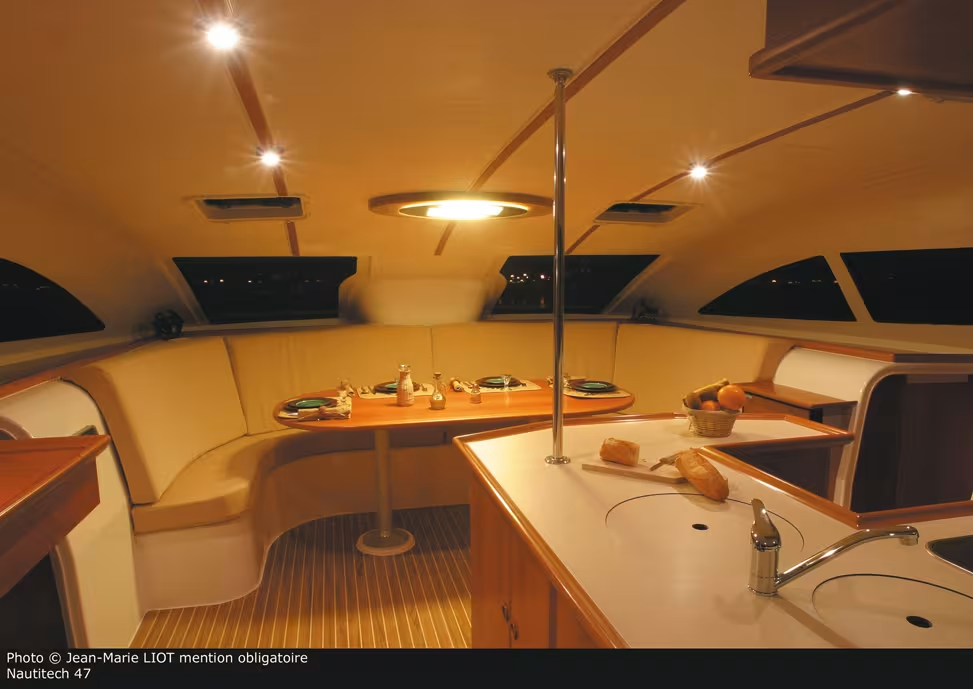
The U-shaped galley is to starboard on entering and offers lots of stowage space; the crockery can be stowed from the inside and taken out on the opposite, door side, from where access to the exterior is almost direct. This ‘just like at home’ system should prove to be very practical in use. In the nacelle, the saloon occupies the whole of the forward end and headroom is adequate throughout. The large ‘picture windows’ give a panoramic view and ventilation is adequate. The multi-purpose table is interesting: on one side there is a pedestal table whose height can be adjusted; on the other there is the dining table which can be folded out if required, to cover the small pedestal table. On our test version there are four cabins with four heads; the private owner's version, (the first of which will be built in 2005) should be more comfortable. The cabins, separated off by doors to each side of the companionways, are very private and a small gangway provides access to the heads. Ventilation here could be improved and will be on future boats, once the technical difficulties have been overcome. The headlining is in fact a polyester moulding in imitation wood, which is so perfect that I admit it fooled me. It is remarkably well done, easy to maintain and is not affected by UV. Otherwise, all woodwork is in moabi, a red hardwood; the fiddles are in solid wood and the panels are veneered. The forward cabins appear to be more spacious, they have more stowage space (a larger hanging locker) and a small seat. The berths are positioned athwartships towards the inside, actually in the body of the nacelle. Access is by climbing a step; once up there, the space and height above the berth is quite comfortable. The forepeaks can be fitted out on request, on our test boat there are two bunks. As for me, I slept in the aft cabin yesterday evening and found it to be very pleasant.
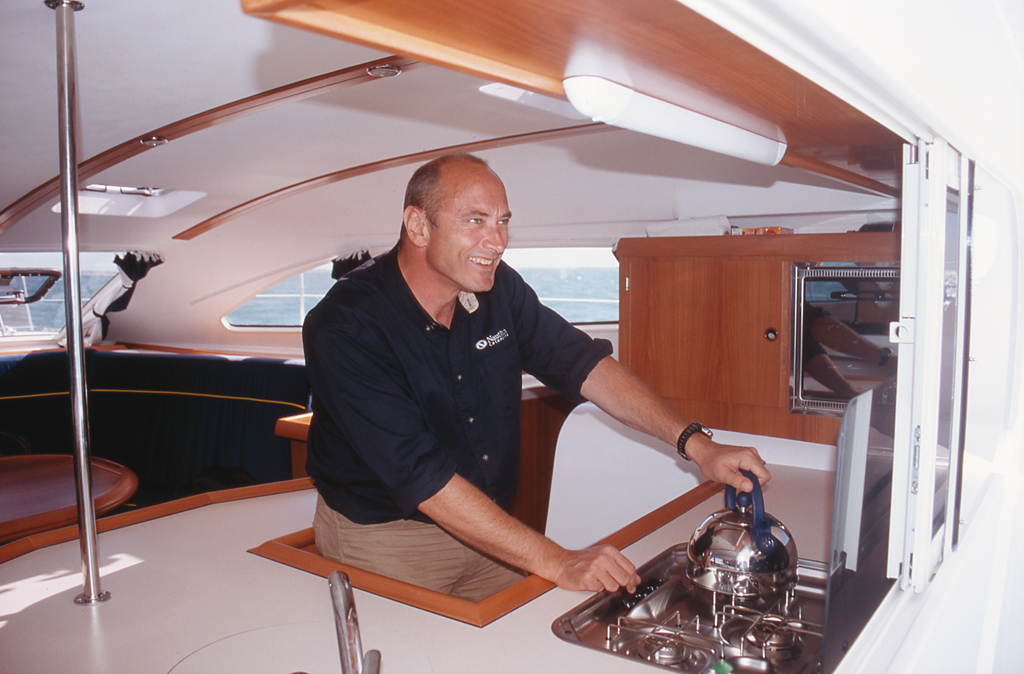
The U-shaped galley has many storage features, an advantage on the high seas!
Conclusion.
The Nautitech 47 appeals to us as much as the 40 did; it is certainly one of our favourites and if you have a large enough budget, why deprive yourself? It represents a good compromise for a cruising cat which is already on the large side. Its design combines all the elements which go to make up a coherent boat: tight control of overall weight and weight aloft, wetted surface as a function of its displacement, sail area to suit, high performance fins and good weight centralisation. Overall finish is very good; it is refined but not excessively so and I really had to look hard to find any faults in it. There are a few debatable points, such as the sharp edges in the galley, but these are details which are easy to put right. Sailing the Nautitech 47 is a very pleasant experience.
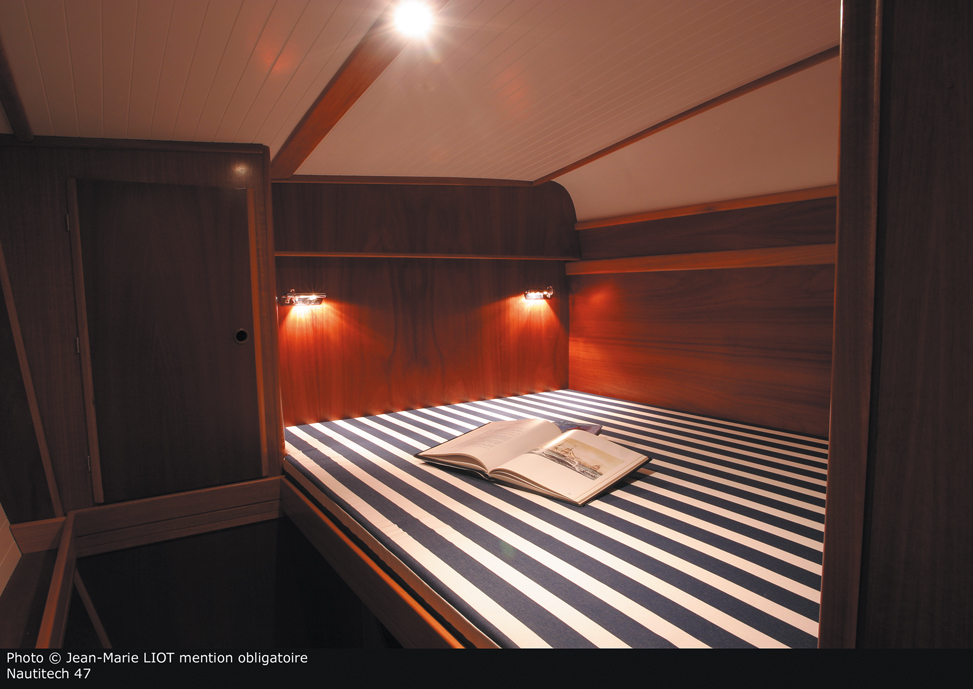
The berths in the four-cabin version are very nice. We can’t wait to discover the owner’s version of the 47 in 2005… (photo: JM Liot)
For:
- A coherent boat. - Good performance for this type of boat. - Carefully finished.
Against:
- Lack of light and ventilation in the heads. - Lack of visibility from the steering positions during port manoeuvres. - A few sharp corners to be rounded off.
Some measurements.
- Aft berths: 140 x 190 cm. Forward berths: 140 x 195
Technical specifications.
- Length: 14.50 metres - Waterline length: 14 metres - Maximum beam: 7.60 metres - Draft: 1.20 metres - Mast height: 18 metres - Nacelle height above water: 0.80 metre - Unladen displacement: 14 tonnes - Engines: 2 x 53 HP - Diesel capacity : 400 litres - Price ex Lorient: 394 789 euros