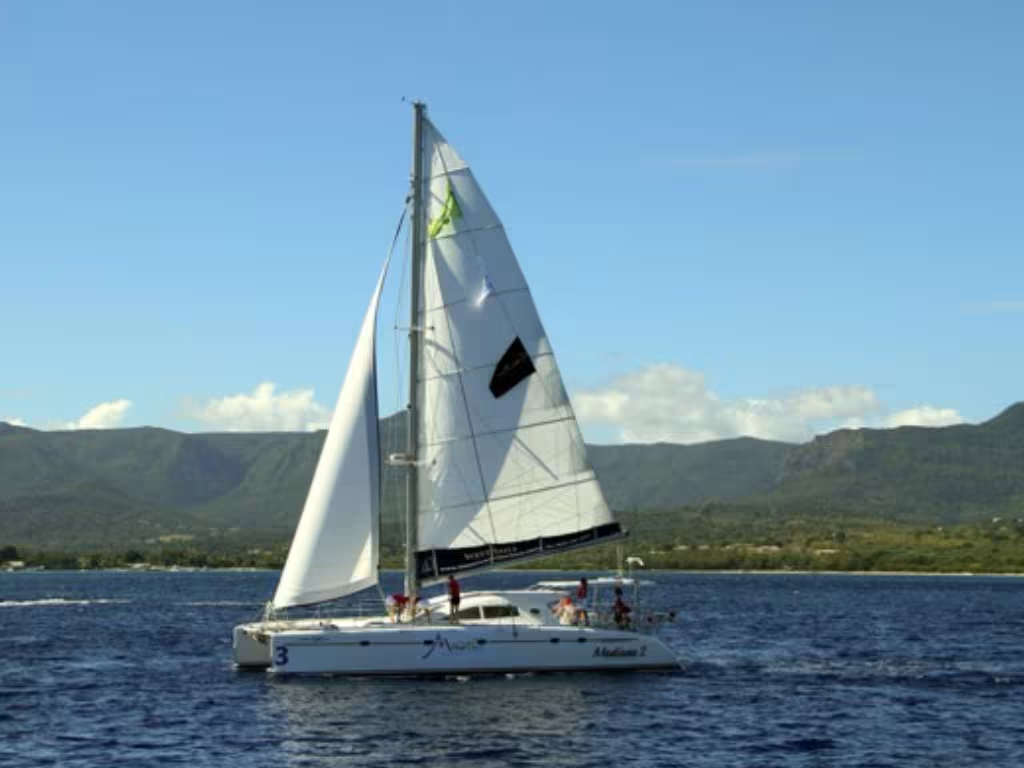
If you find it still has a youthful, modern look, nothing is more logical; the design of the 475’s hulls was retained for the 47 and the brand-new 482... In short, the hulls are the best! And the rest?
Infos pratiques
- Le chantier : Nautitech 475
- La fiche technique
- Découvrez notre vidéo exclusive
- Financez votre Nautitech 475
- Assuez votre Nautitech 475
- Articles autour du Nautitech 475
We’d better tell you straight away: there are two 475s... The original model, and the one we discovered, which had been appreciably modified. Our catamaran, 16 years old, in fact benefitted from a completely redesigned exterior table, an aft platform extending the cockpit, and above all, a rigid bimini, incorporating the mainsheet. Nothing wrong with the table; it worked well for conviviality. On the other hand, the mainsail is no longer visible from the winch dedicated to trimming it. As for the superstructure grafted onto the stern, it guarantees fluid movement by going round the cockpit, but hits the sea whenever the boat rears up on a steeper wave... And what about the weight! We can never say it often enough, kilos are the multihull’s number one enemy... Fattening them up kills their performance. In short, you’ve understood, this ‘heavily’ modified version hardly convinced us. So let’s return to the original model, which is much more healthy and appealing. It was designed in 1995, for the needs of VPM, a large charter company... The first letter is the V for Bruno Voisard, the current boss of Nautitech, who took the company over after its ‘made by Dufour’ start: “at VPM we have used around twenty 475s. Very few models have been ordered for private individuals: 10%, as against- 90% for charter.” The platform is perched relatively high on two rather slim hulls – a very healthy basis for an ocean-going catamaran. The 475 quickly proved to be a particularly seaworthy machine. “We suffered some huge storms with this boat, and it didn't bat an eyelid," Bruno remembers. We are reassured: the Atlantic is within reach of its bows!
Excellent potential in strong winds
Despite the absence of daggerboards, the close-hauled course is much better than many boats of the same size, thanks to the markedly U-shaped sections, which form an additional, particularly effective ‘anti-leeway’ surface. All these nautical qualities haven’t gone unnoticed, as the Mortain/Mavrikios hulls have been in use for almost twenty years, successively on the two models which took over from the 475 – the 47 and the 482. But: the 475 is deliberately a strong wind boat! In light weather, there is no salvation, the speedo doesn’t get overexcited. Frustrating for lovers of fast cruising. The fault of accommodation which is too heavy, and above all, the very squat sail plan, equipped with a self-tacking jib. A configuration which conforms to the boat’s specification: “we wanted the cat to be able to take the heavy gusts which surprise sailors between the islands, without reefing, with a fairly low centre of effort for real cruising comfort, and with maximum area in the mainsail. It’s true that the weight/sail area ratio is far from being amongst the best. But the 475 is fast, nevertheless!” the boss of Nautitech justifies. Our boat therefore requires a lot of wind. Although our much heavier example dragged itself through the water, confirmed by the significant wake, and had trouble getting over 8 knots downwind in a good force 4, the standard model sails at over 10 knots off the wind in the same wind strength, and top speeds of 14 knots or over are not rare under spinnaker. And it’s true that even though the anemometer was recording gusts of 30 knots, there was no need to reduce sail. The 475 is very reassuring, even in very strong winds! The deck plan reserves some nice areas for relaxing – wide side decks and trampolines. The steering positions are positioned aft. But the helm is too low on numerous models; some of them have been equipped with a ‘bowl’, to lower the helmsman’s feet to get round this. The same goes for working on the winches: you are neither standing up nor kneeling, and therefore don’t work very well...
A central island, just like at home
The accommodation plan’s main original feature is the double entrance to the bridgedeck. An arrangement which is nice when chartering, with a lot of people aboard – movement remains particularly fluid. On the other hand, the conviviality of the current designs, with a galley adjoining the cockpit, is not present here. Second distinctive feature, the central island. It acts as a refrigerator and cabinet under a pair of imposing struts and lockers, in which the glasses are stowed. No headlinings here, but a sprayed finish. The imitation wood Formica is very heavy, but it ages well and everything is very easy to maintain. There is a good impression of volume, thanks to the generous 1.96 m headroom at the entry to the bridgedeck. The saloon is at the front of the boat, under the portlights which would have to be shaded under the tropical sun, and stretches over a long half moon-shaped table, 2 m long and 0.78 wide. The cabins are of course housed in the hulls. These are quite slim, as we have already mentioned and contain relatively narrow gangways. On the other hand, the berths are comfortable, especially aft. The crew cabins, for the models so equipped, are accessible via the forward cabins, or through a deck hatch. The Nautitech 475 is a support which, almost 20 years after its launch, is perfectly suited to longterm family cruising...even though it was designed for week-long charters. Its hull lines are not very voluminous, and call for a real effort concerning weight. Lovers of rigid biminis, over-powerful generators and 30 hp dinghy motors, look for another model!
The points to check
The only fault with this series concerns the very first models, which sometimes suffered from structural weaknesses – a fault very quickly corrected by Dufour. Most 475s have been used for numerous years as charter boats, so some of the equipment, such as the engines, the pumps, the pipes, as well as the electrical installation may have suffered from intensive use... Refitted boats obviously give better guarantees. Prefer these models, with recent engines, overhauled rigging and lightly used sails, to those which still have chips in the gel coat from approximate manoeuvres!
The Pluses:
+ Proven hulls which are...still topical!
+ Easy to handle short or singlehanded.
+ The accommodation ages well.
The Minuses:
- Small sail area; the 475 doesn’t appreciate light weather.
- Uncomfortable steering position on numerous models.
- The double bridgedeck entry may put people off.
TECHNICAL SPECIFICATION
Builder: Dufour
Architects: Mortain/Mavrikios
Material: polyester sandwich
Hull length: 14.30 m
Waterline length: 13.90 m
Beam: 7.6 m
Draft: 1.2 m
Unladen weight: 11.23 t
Mainsail area: 80.60 m2
Genoa area: 30.90 m2
Number of cabins: 3 to 6
Engines: 2 x 30 to 2 x 55 hp
Water tanks: 750 l
Diesel tanks: 400 l
Production: 48 examples from 1995 to 2000
Second-hand price: 250,000 euros