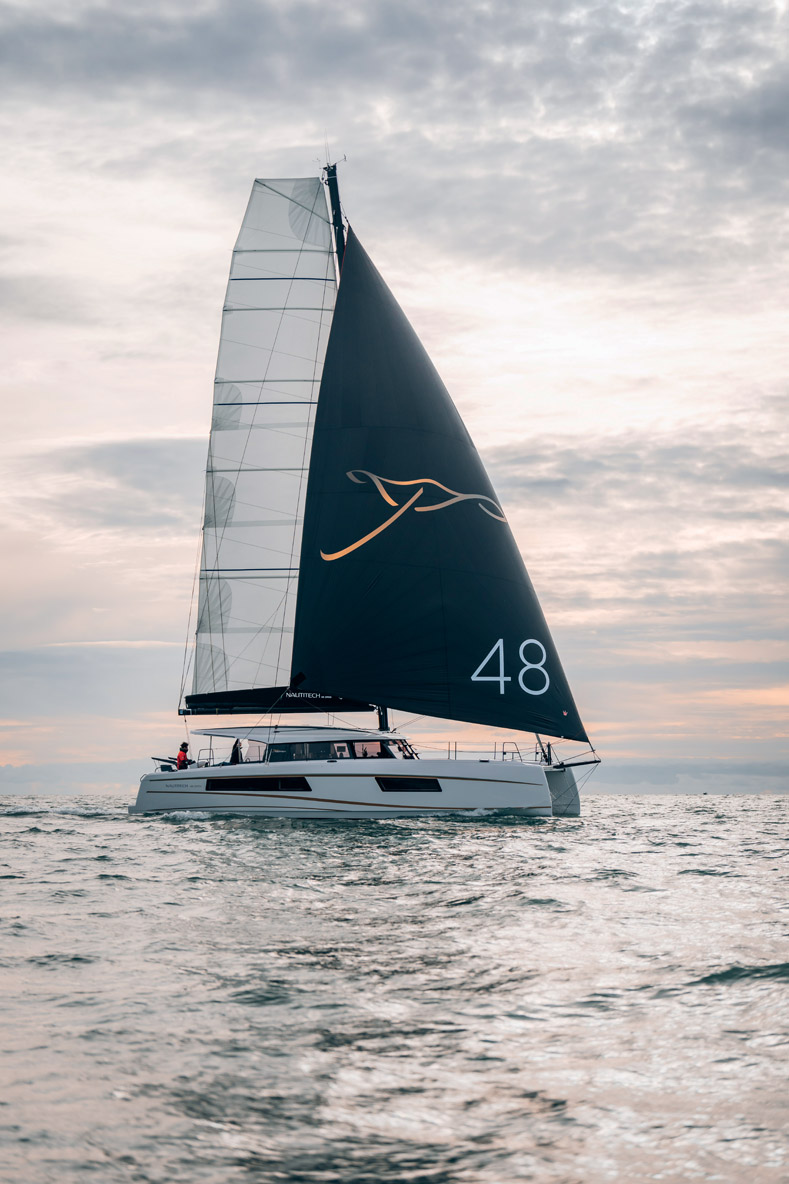
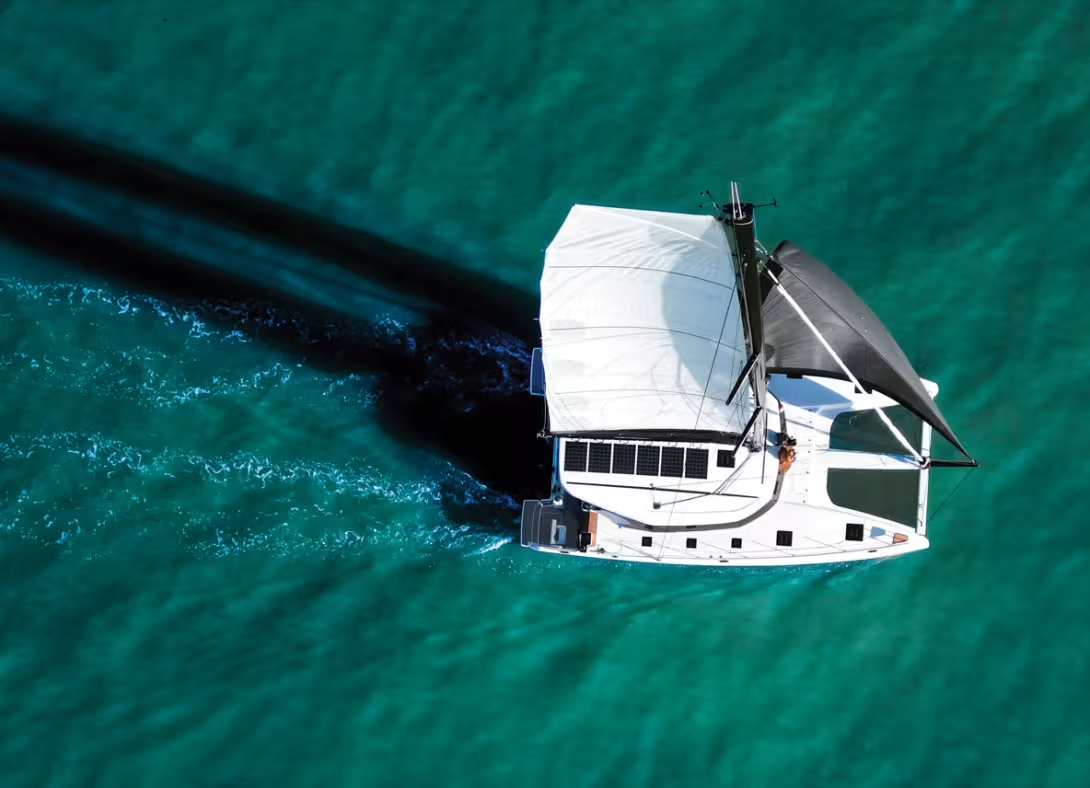
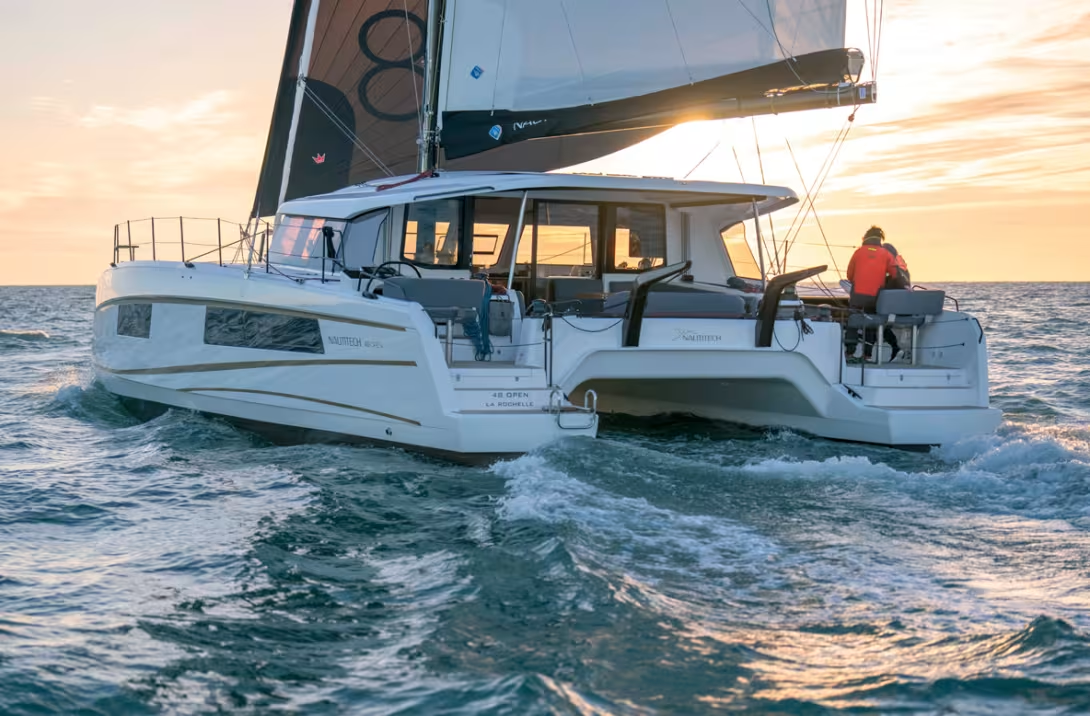
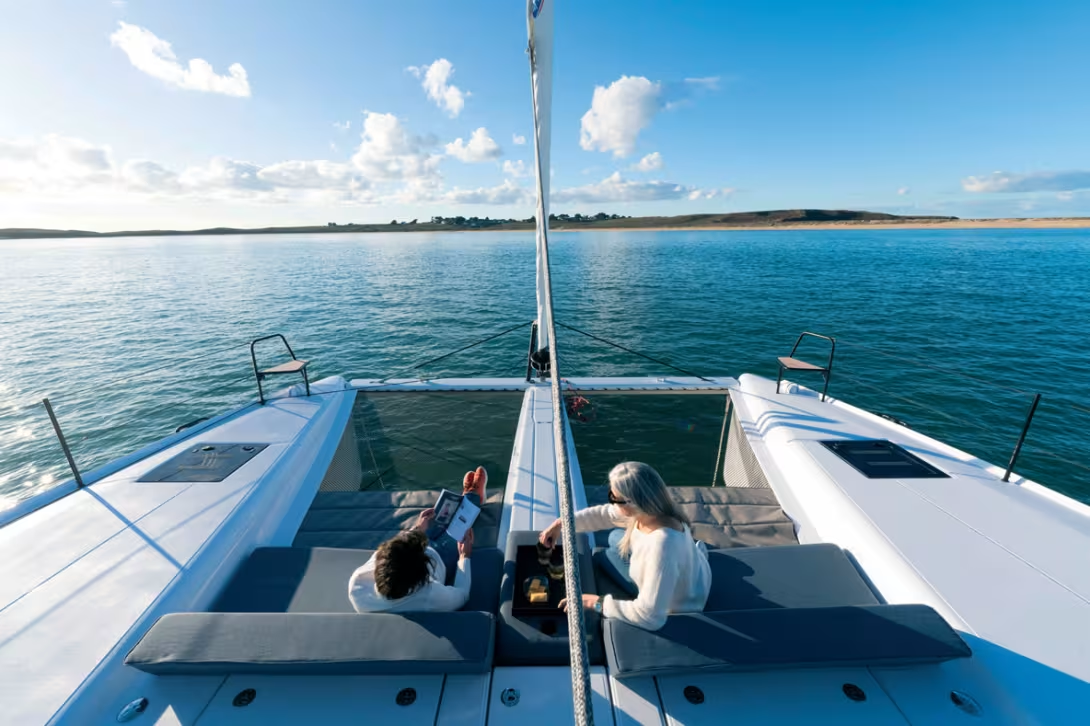
Some 30 years after the creation of the Nautitech brand, the manufacturer based in Rochefort, on France’s Atlantic coast, presents us with a brand new 48 Open. We had the privilege of testing this new flagship, a boat even more refined than its predecessors.
Infos pratiques
- Le chantier : Nautitech 48 Open
- La fiche technique
-
 Découvrez notre vidéo exclusive
- Financez votre Nautitech 48 Open
- Assuez votre Nautitech 48 Open
- Articles autour du Nautitech 48 Open
Conditions: 15 to 20 knots WNW, gusting to 25, sea state moderate to rough with westerly swell
Just over three years ago, Nautitech announced a radical change of strategy. The builder chose to abandon the charter sector and concentrate on the private owner market. It was a courageous decision to deliberately forego a large potential order volume. But above all, it was a timely decision to set themselves apart from the larger, more industrialized “mainstream” builders, against whom the price war was a foregone conclusion. In the winter of 2022, we got to see the seductive 44 Open, the first Nautitech “designed by and for owners”, in the words of Gildas Le Masson, who has headed the Rochefort-based shipyard since 2018. The 44 is a catamaran with enhanced DNA, as it were, more performance, more comfort, and a much higher level of finish than previous productions. With 43 units splashed in just two years, and a full order book for a further 12 months, the 44 has been a genuine success, confirming the relevance of this new positioning and allowing them to think bigger.
The same crew as on the 44
Given that you don’t change a winning team, the Nautitech 48 Open was designed by the same triumvirate as the 44. In addition to the shipyard team, it includes Marc Lombard Yacht Design Group for naval architecture and Christophe Chedal-Anglay for interior design. Maya Gautier coordinated the entire project with the rigor, ambition and precision that have made her a key figure in the up-and-coming generation of marine industry managers. She confirms that the new model in the Nautitech range “wants to assert its high-performance character, comfortable at sea and for living aboard”. A delicate kind of alchemy that we put to a merciless test in winter conditions.
The “Open” concept validated once again
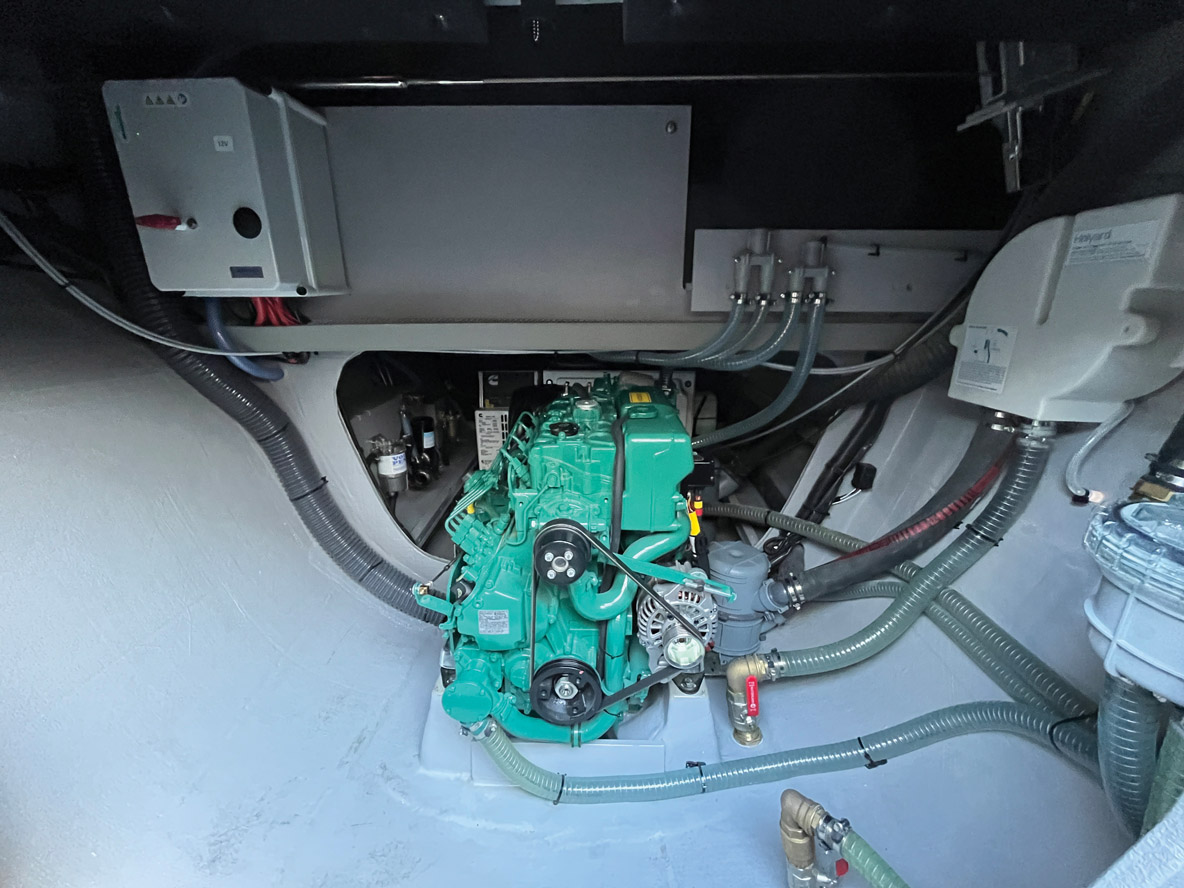
No sooner had we cast off from the pontoon in the Port des Minimes, we put the engine maneuverability to the test, threading our way between dredgers and multihulls alongside one another encroaching on the channel. Their presence is partly explained by the unfavorable December weather, which made the Bay of Biscay untenable. In fact, the swell that swept over us as soon as we cleared the harbor piers reminded us that the weather window we were enjoying was narrow - just the day before, we’d have stayed in port! With its two powerful Volvo 75 hp engines, the 48 responded perfectly, even in crosswind conditions. In fact, we recommend this choice of powertrain over the 60 HP fitted as standard. We didn’t need to push the throttles too hard in the channel, as it was precisely low tide. On this occasion, we avoided needing to test the reassuring solidity of the skeg keels which fix the draft at 5’1” (1.55m). This passage is all the more tricky as it is subject to a westerly swell, coupled with the usual chop found here in the approaches to La Rochelle. The good news is that the 48 didn’t get its crew wet and, above all, didn’t slam. This proves, among other things, that they’ve kept a consistent bridgedeck clearance. Comfortably sheltered in the cockpit with its rigid bimini, you can immediately take advantage of the Open concept. Fortunately, the continuum between saloon and cockpit that gave rise to the name (from the 40 upwards) has been preserved. It is even emphasized by the graphic continuity and finish between the saloon and cockpit ceilings. The cockpit’s clear side enclosures had been judiciously left in place for our test sail, so there was no fear of squalls or spray, and we were still on hand for maneuvers.
Outboard helm stations
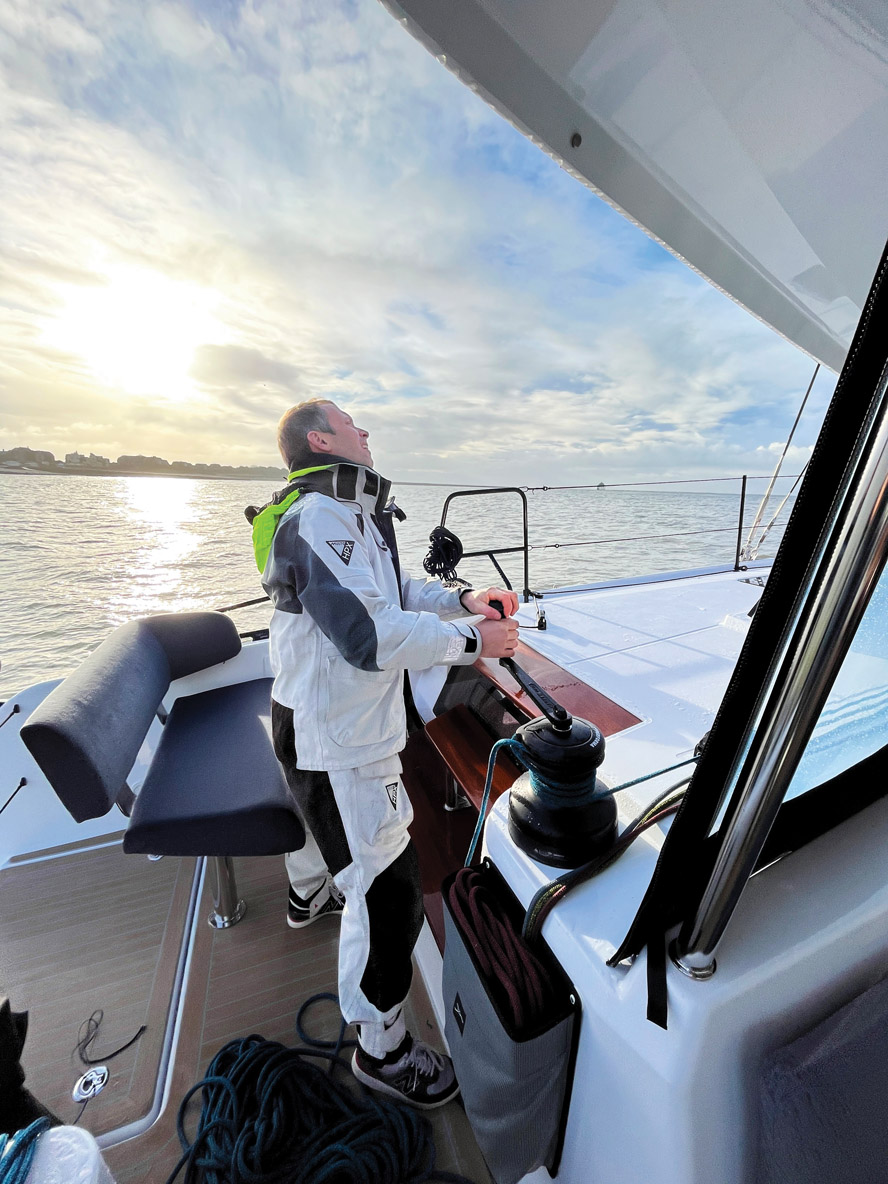
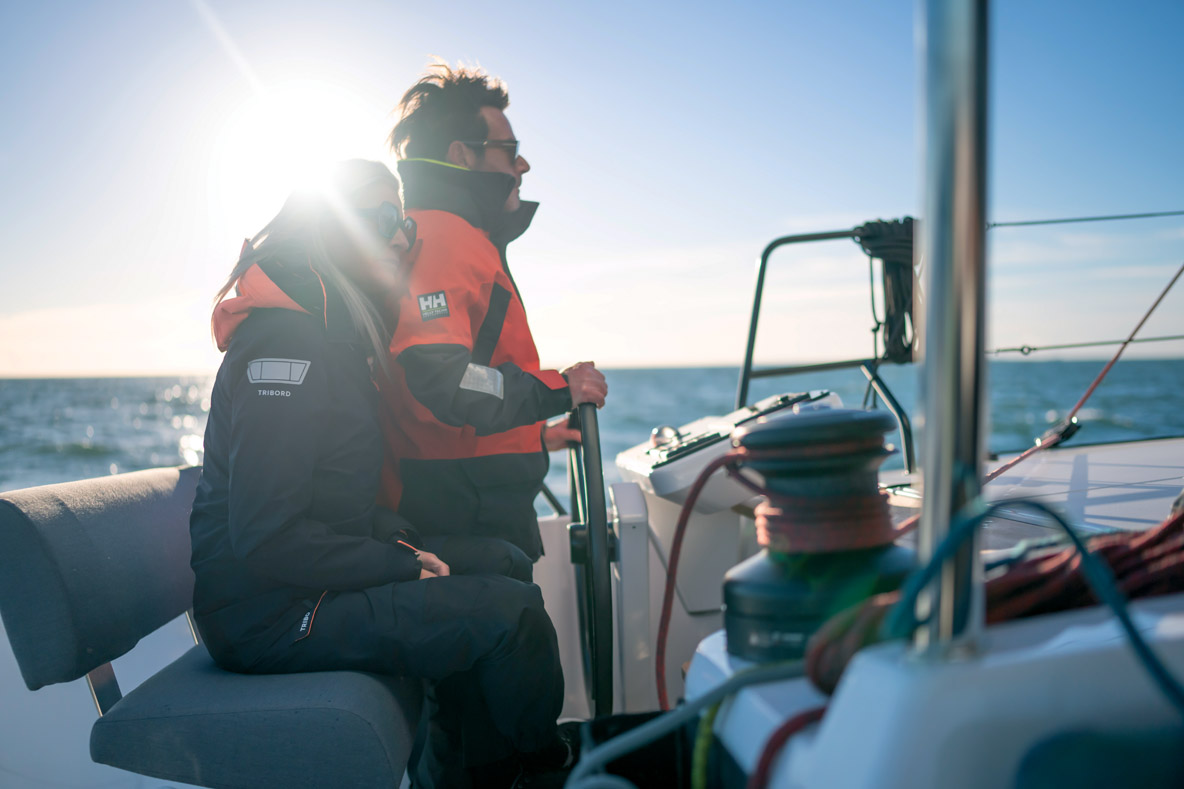
As usual with a Nautitech, the helm and maneuvering stations are offset to the outboard side, aft on each hull. The view of the sail plan is always optimal - and so is the choice whichever bow you’re looking over, windward or leeward, depending on conditions. All halyards and sheets are within easy reach. On the downside, the helmsman is somewhat exposed to the elements. While the optional helm station biminis, whose aesthetics are always questionable, provide good protection from the sun and a little rain, they do little to counter the spray and apparent wind. Fortunately, the two large helm seats are reassuring, and the quality of their upholstery, identical to that of the large cockpit bench seats, is rewarding. There are three such benches, the largest of which forms an L-shape to starboard, around two tables that can be joined together at mealtimes to form a single, large table. On the port side, the lounger is more of an invitation to take a siesta. Then there’s the bench seat, nicely inlaid into the aft beam, to keep an eye out ahead, all while putting the world to rights.
Although the Nautitech 46 was launched nearly 8 years ago, and the Nautitech 48 splashed one year ago (after the 44), the similarity in exterior lines is obvious and even asserted. On the other hand, naval architecture has evolved considerably this past decade. The carte blanche given by the shipyard allowed for totally reinventing the hull shapes, notably with a very pronounced exterior chine. This design makes the contained waterline beam all the more striking, as nothing has been sacrificed in terms of hull slenderness without precise study of its impact on performance. Every modification is subjected to the litmus test of the digital towing tank. Architects use it whenever they suspect a change in performance. So, for example, while the side-decks of the 48 have gained a few precious millimeters in width, this is solely due to proportions favored by length. It has been verified that this has no impact on the catamaran’s speed potential. There are also a number of design elements that have appeared on high-performance multihulls designed by the same architects, such as the rather voluminous bows with a forefoot clearly above the water, which provide a great deal of stability, and therefore safety, particularly when sailing downwind. This was demonstrated during our test sail, when we were clearly over-canvassed for the day’s breeze: at no time did the multihull give the impression of burying, and the helm always remained impeccably smooth. The other battle-horse of the architects, in constant contact with the shipyard’s Design Office on this subject, was of course the weight calculations. The term used by Henry-Paul reflects this constant preoccupation, referring to the model in our test as a “heavy” version, meaning an all-comfort, fully equipped version with, for example, a generator, air conditioning and a substantial battery bank, all giving a total displacement of 18 metric tons with full tanks. That’s a long way from the 13.5 t announced - and actually achieved!
Speed record of the day: 16.9 knots
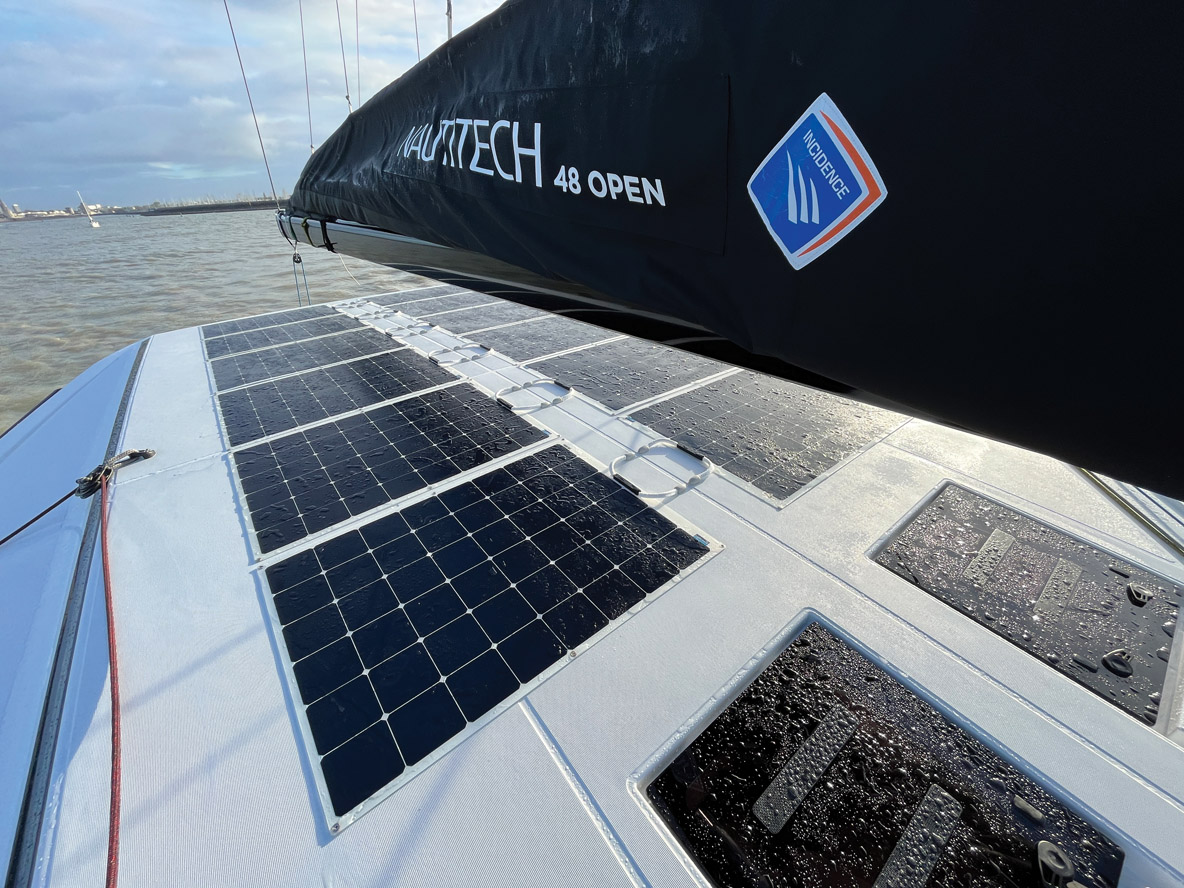
Under the “search for quality and weight savings” heading, we note the all-Harken fittings, composite davits, black anodized stanchions and pulpits... Frankly, it’s class! Whether you like or dislike the design of Goïot’s Triak Hexa steering wheels, you’d have to be extremely picky not to appreciate the precision and smoothness of the sensations transmitted by the cable steering to the helmsman on this Nautitech 48 Open. In fact, there was a succession of helmsmen throughout the half-day session, and no one thought of testing the autopilot. It was more a question of who would beat the day’s speed record, which was finally set at 16.9 knots. An excellent performance in 20-22 knots of wind. Admittedly, it was a peak, but at 120 degrees to the wind, but the log was still showing well above 14 knots. It’s also worth noting that this top speed was achieved in perfect serenity: given the schedule, we were thinking more of getting out the aperitifs rather than putting a reef in... On a more serious note, earlier in the morning we had tested the 48 Open’s ability to sail close to the wind under full main and self-tacking solent. At the time, the wind didn’t exceed 15 knots, and on an “oceanic” close reach at 47 degrees to the apparent, boatspeed oscillated between 7 and 9 knots. As an option, a genoa can replace the solent, but the combination of the latter with a code zero furling system still seems just as relevant to us. Maneuvering on this perfectly clear deck is particularly easy. The foot of the mast is perfectly accessible, thanks to the beautiful steps in front of the coachroof and the low height of the gooseneck. In fact, the coachroof only accommodates a dozen solar panels (all flat, of course), and, good news, no fittings whatsoever that would add to the weight and raise the center of gravity. As we rounded the island of Ile de Ré, the 860-square-foot (80 m²) code 0 was finally unfurled, and the 48 Open accelerated to between 11 and 12 knots, with the forefeet well clear, and at 110 degrees to a wind strengthening to nearly 20 knots. It was on the way back that, unfurling the 1,185-square-foot (110 m²) gennaker, we’ll think we’re Ultim skippers chasing a record or close to it...
The central bar unit has become a must-have feature
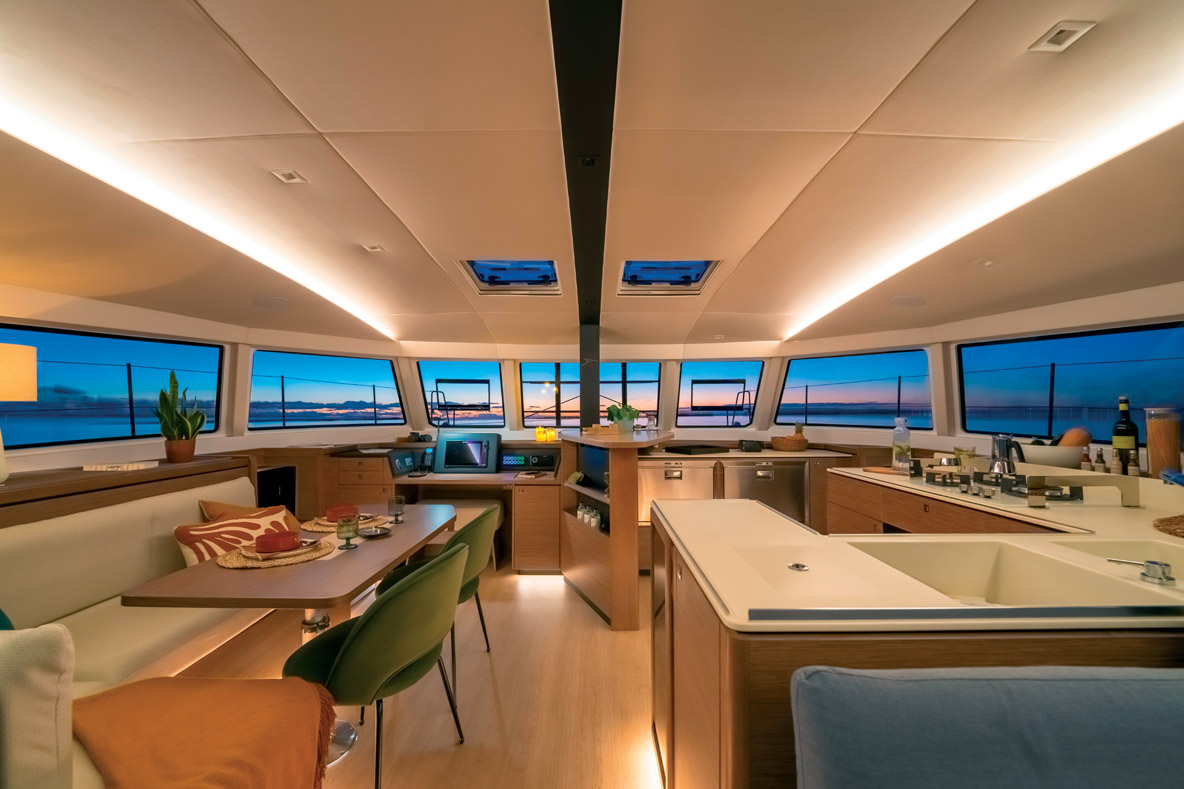
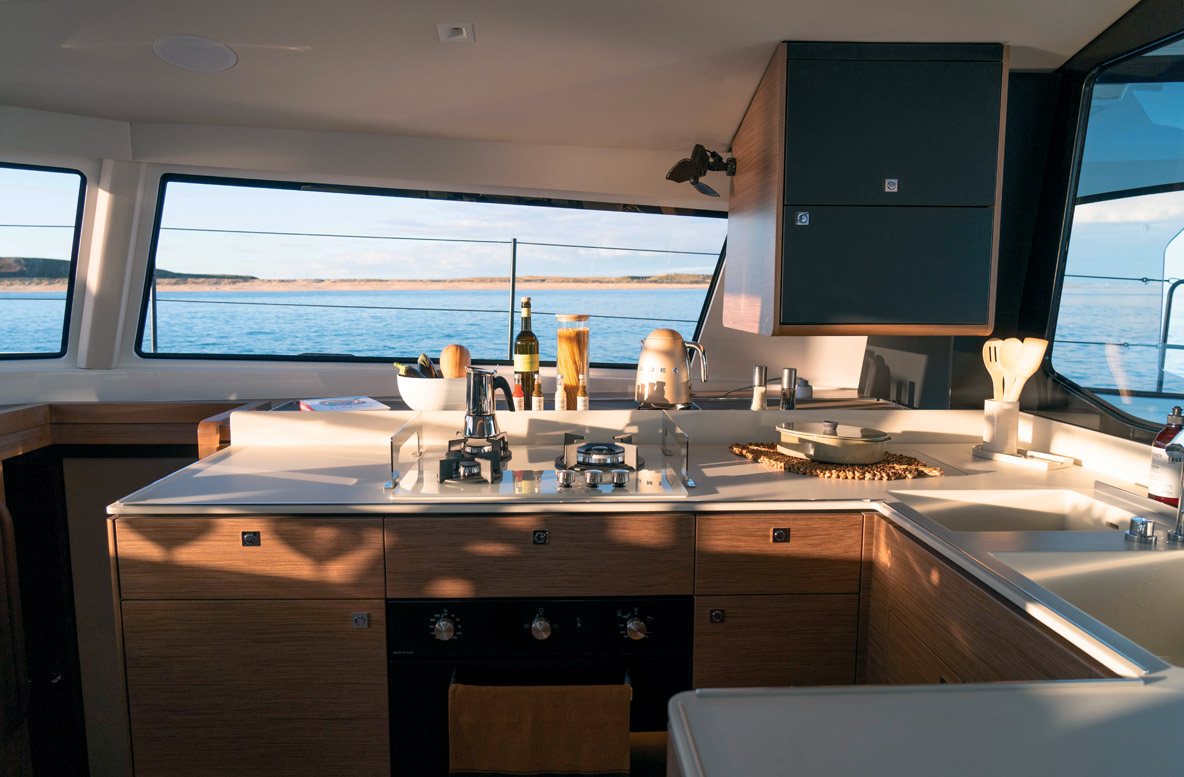
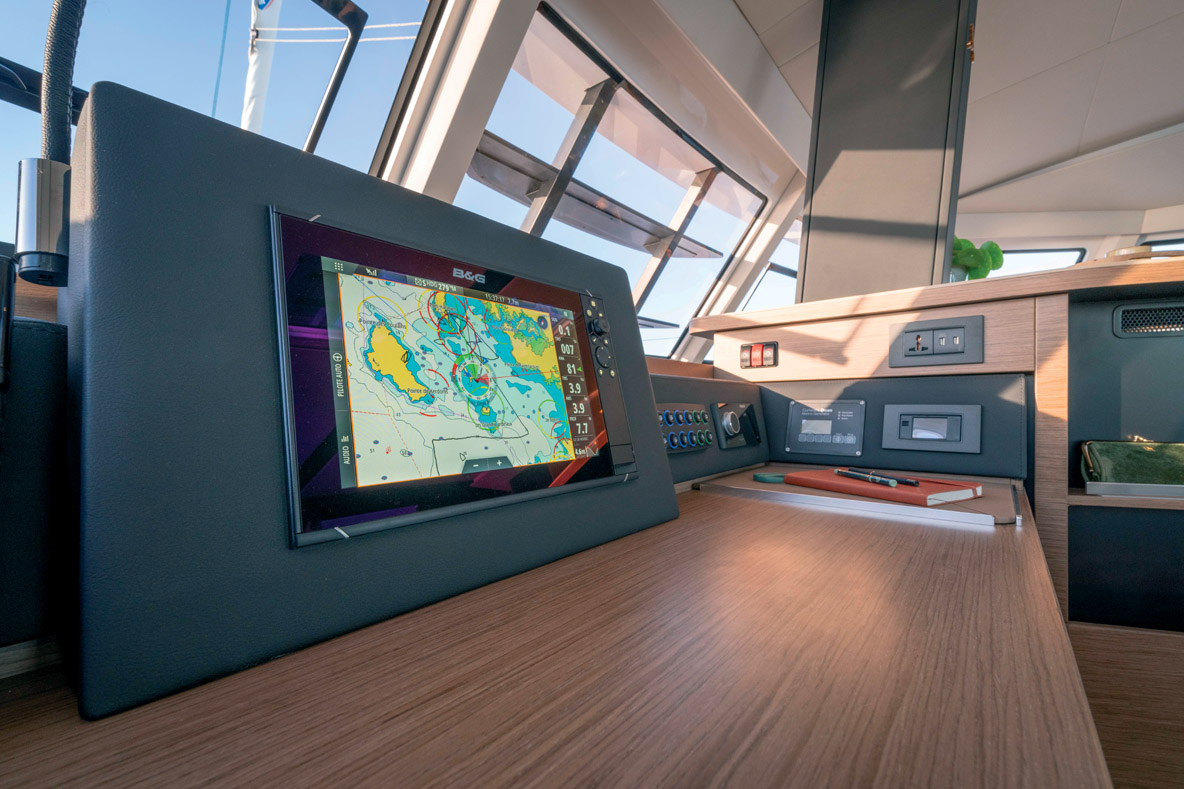
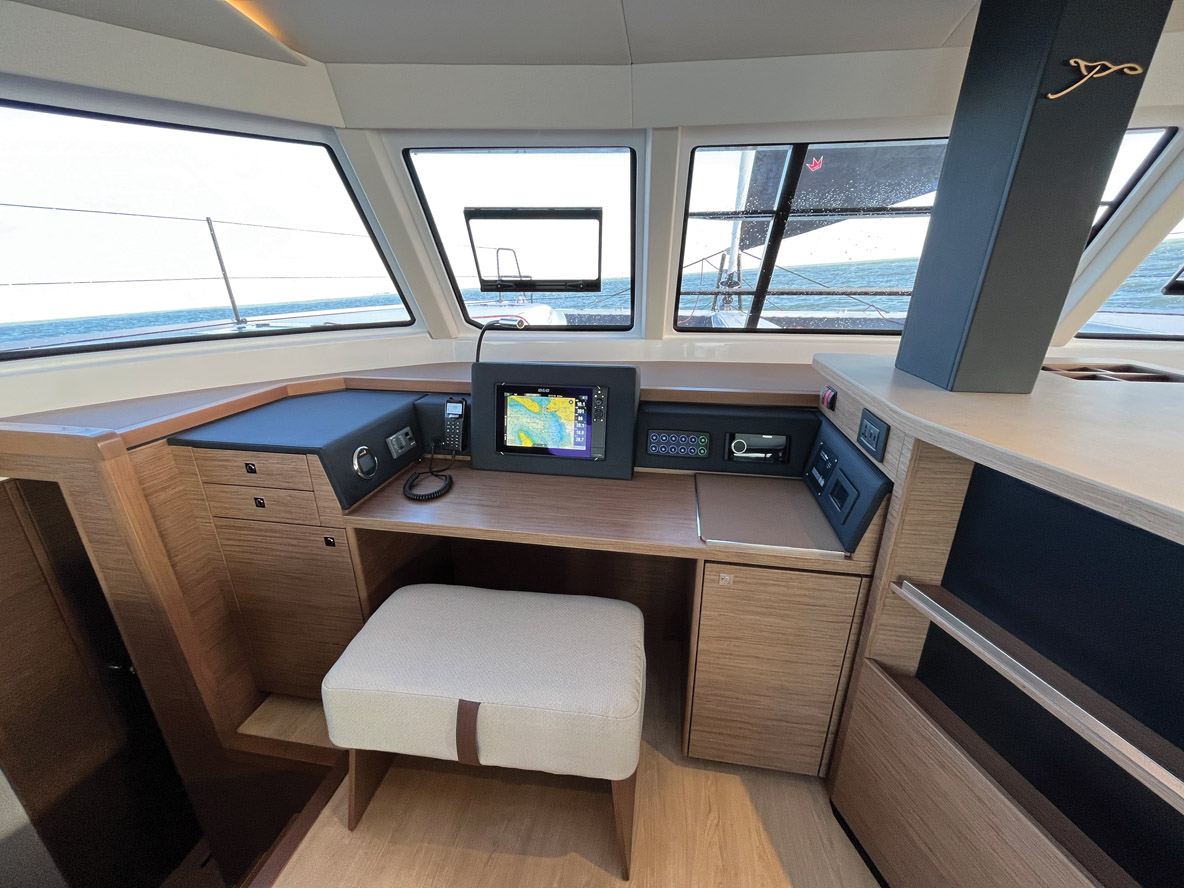
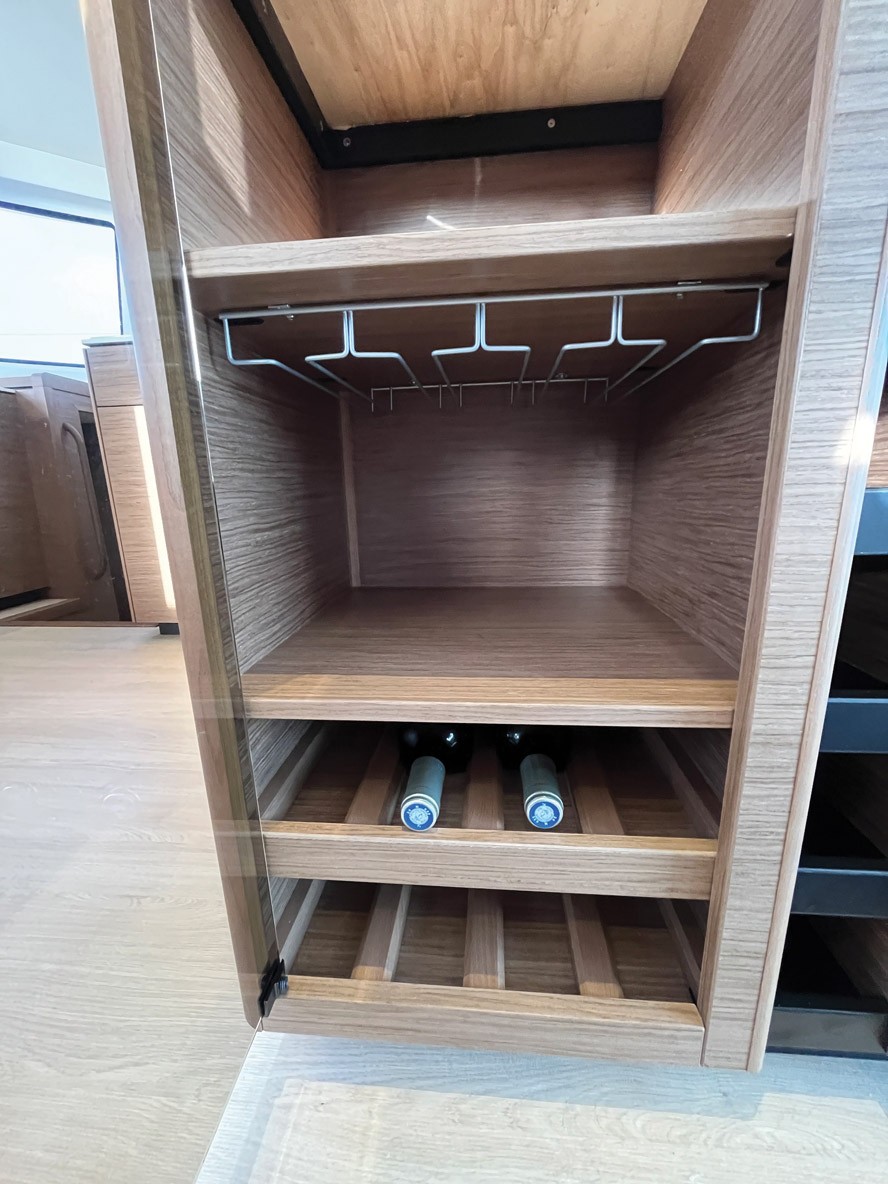
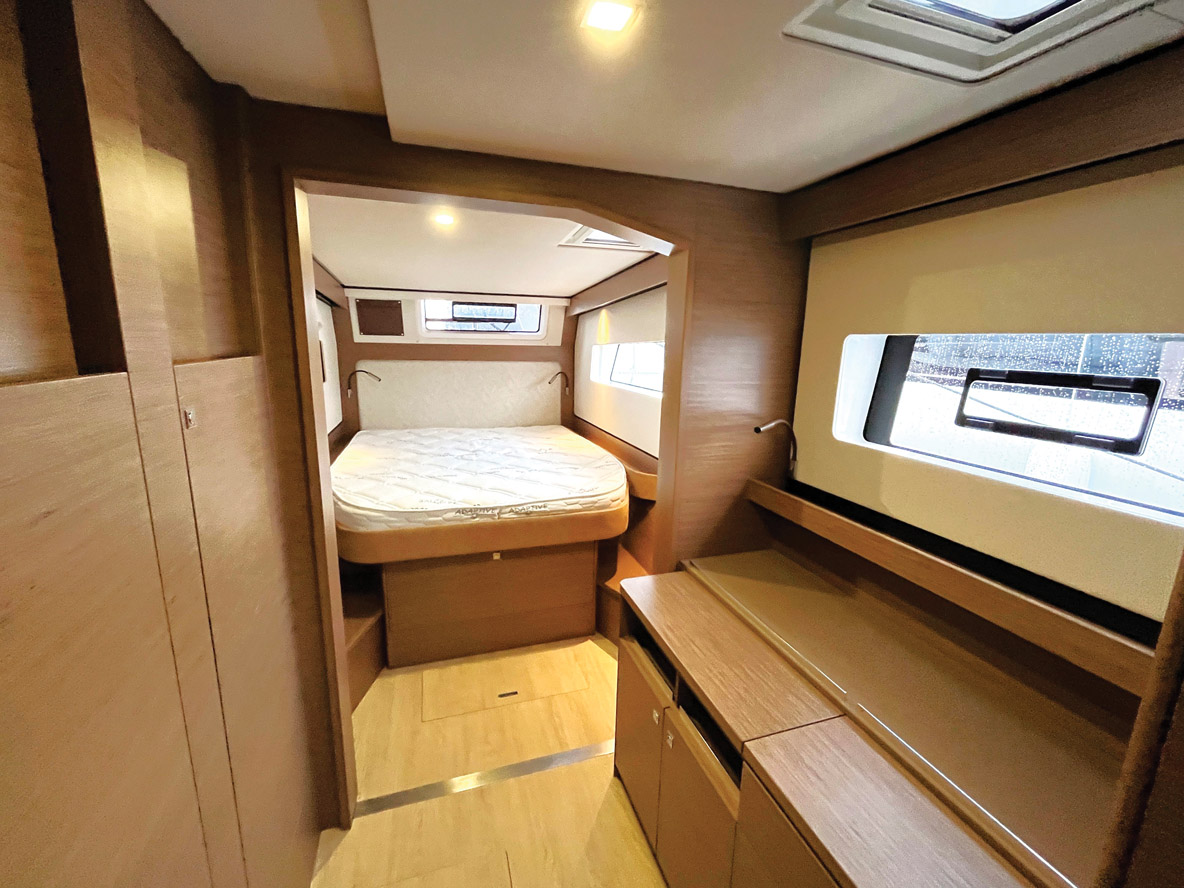
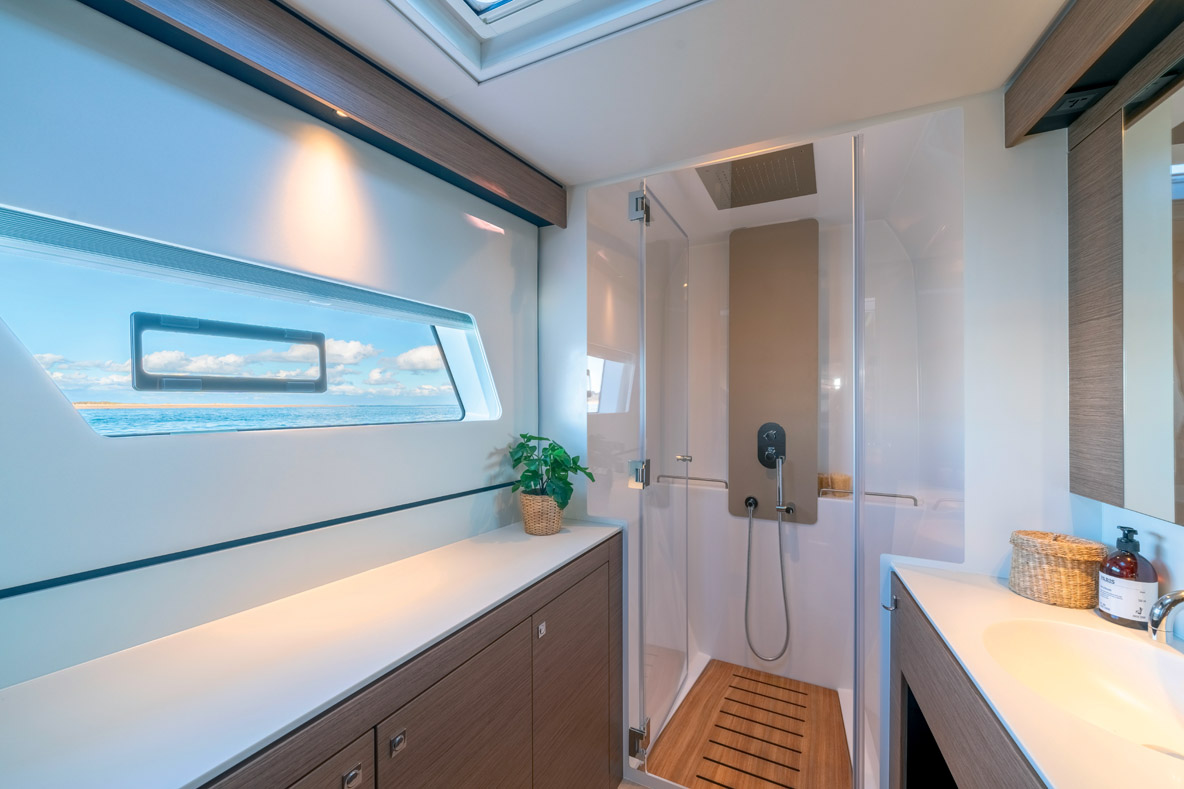
But let’s leave our boat buddies to battle it out as they sail past the Great Capes, and explore the dry interior of this new opus, promised to be a “Pullman”. In fact, as soon as we’re through the large sliding glass door, it becomes clear that the 48 goes a step further than the 44 in terms of quality and finish. Maya Gautier confirms the desire “to assert the premium side of the brand and position ourselves in a more luxury niche”. The choice of high-end materials, such as “Solid Surface” resin for the central bar unit, which only just appeared on the 44 but has become a must-have on a Nautitech, is a case in point. A closer look at the light walnut Alpi cabinet work (light oak is available too) also reveals the care taken in assembly, as in the case of the two tall units in the rear corners of the nacelle. As if levitating in this beautiful space, they have a double positive impact: their design adds value to the saloon, and their volume provides welcome extra storage space. And since they have no impact on the view outside, why do without them? The same attention to detail can be found on the instrument holder at the chart table. Its topstitched leather is a real eye-catcher. The leather-covered stainless-steel handrails, the wine cellar with stemware holders, the carefully designed lighting throughout, the illuminated closet with mirror in the owner’s hull - all these chic details add up to a truly striking impression of quality. The layout of the spaces is unsurprising, with the nacelle featuring a rather small interior saloon that reinforces its cozy feel, a forward-facing chart table - the ideal lookout point with an almost 360° view - and a large U-shaped galley to starboard. The galley, in direct contact with the cockpit when the bay window is open, extends forward with plenty of cold storage space. In the hulls, the layout chosen for this test model reflects what most Nautitech owners expect: to port, the entire hull is dedicated to them, with plenty of storage space, a toilet separate from the large forward bathroom, and, aft, a plush island-bed with quilted headboard and, above all, an unobstructed view of the sea. The starboard side features an asymmetrical layout with a pretty double cabin aft, a smartroom with multiple possibilities forward (1, 2 or 3 berths, office, workshop, storage, etc.) and a two-space bathroom: separate shower and washbasin aft, toilet and washbasin forward, ideal for cruising with friends. Many other layout variants are available (3 or 4 cabins, 3 or 4 bathrooms).
Conclusion
Having approached this boat test with no preconceived ideas, we were bowled over by the Nautitech 48 Open’s easy performance and sensations at the helm. This is a model that could well convert the last die-hard “monohullers” still reluctant to recognize all the qualities of a good multihull. The materials and equipment, the way they are used and the aesthetics of the boat as a whole bear witness to the high level of quality that owners seek, and they won’t hesitate to rack up the miles on this comfortable unit, all the more so as they’ll go by rather quickly...
Standard of finish and materials
Coherent layout
Coachroof recess less reassuring than a handrail
Exposed helm and maneuvering stations
The competition
NEEL 47
Test MW166
Length: 14,20 m
Displacement: 46’7”(14.2 m)
Price ex-tax: € 571,000
Video
Outremer 45
Test MW140
Length: 48’ (14.63 m)
Displacement: 19,180 lbs (8.7 t)
Price ex-tax: € 815,000
Video
Balance 482
Test MW182
Length: 48’3” (14.71 m)
Displacement: 29,300 lbs (13.3 t)
Price ex-tax: $ 1,492,000
Video
C-Cat 48
Test MW182
Length: 48’5” (14.75 m)
Displacement: 21,400 lbs (9.7 t)
Price ex-tax: € 998,000
Video
Catana Ocean Class
Test MW185
Length: 49’2”(14.99m)
Displacement: 29,760 lbs (13.5t)
Price ex-tax: € 1,036,700
Video
Technical specifications
Architect and exterior design: Marc Lombard Yacht Design Group
Interior design: Chedal Anglay Design
Length overall: 47’9” (14.6 m)
Beam: 26’2” (7.97 m)
Draft: 5’1” (1.55 m)
Air draft: 75’4” (22.95 m)
Light displacement: 29,768 lbs (13.5 t)
Mainsail: 915 sq ft (85 m²)
Self-tacking jib: 455 sq ft (42.5 m²)
Engines: 2 x 60/75 HP Volvo saildrive
Fuel: 2 x 79 US gal (2 x 300 l)
Water: 2 x 79 US gal (2 x 300 l)
Berths: 4 to 9
Heads compartments: 2 to 4
Price ex-tax of the Nautitech 48 Open standard:
from e€898,000
Price in e ex-tax of the main options:
Comfort version: 43,980
Explorer version: 77,300
Sport Pack: 13,400
Lithium Pack: 20,840
Navigation Pack: 19,690
75 HP engines: 5,900
Code 0 (860 sq ft/80 m²): 8,170
Gennaker (1,185 sq ft/110 m²): 6,970
Harken electric winch (per unit): 4,890
Full cockpit enclosure: 4,440
75 l Chiller cabinet: 2,860
Solar panels on coachroof (12 x 17 = 80 Wp): 16,800
Antifouling (from): 5,800
Launching, mast-stepping and delivery to La Rochelle: 9,980
Price ex-tax of the model we tested: €1,244,410