
Heading off the beaten track constitutes a risky game which boatyards don’t play without apprehension! With their new Open 40, Nautitech is bravely affirming their creative potential and determination to cleverly set themselves apart from their competitors. Late March we spent two days aboard, sailing in the approaches to La Rochelle, in fairly strong conditions to test in real life conditions this 40 footer with very open ambitions.
Infos pratiques
- Le chantier : Nautitech 40 Open
- La fiche technique
-
 Découvrez notre vidéo exclusive
- Financez votre Nautitech Open 40
- Assuez votre Nautitech Open 40
- Articles autour du Nautitech Open 40
The story of the open deck
Naval architects everywhere have been competing in inventiveness in the field of cruising catamarans without a deck cabin. It’s a question of whether to remain deliberately simple, and loyal to Polynesian lines (such as James Wharram), or to combine sporting performance, comfort and low price, innumerable prototypes (a handful of which were successful) have been crossing the water since the rediscovery of the idea in the 1950s. Several contemporary attempts are still going strong, but it seems that the taste for wild voyaging is less fashionable these days! Many of these multihulls (from the Corneel 26 by Joubert-Nivault to the Punch 1000 by Harlé or the lively creations of Malcolm Tennant and the 350 Stiletto sold in the USA) offered interesting dynamic characteristics, remarkable aerodynamic qualities and enviable weight savings. Alas the absence of a deck salon (whose appeal has spread) has killed off this idea for the majority of enthusiasts!
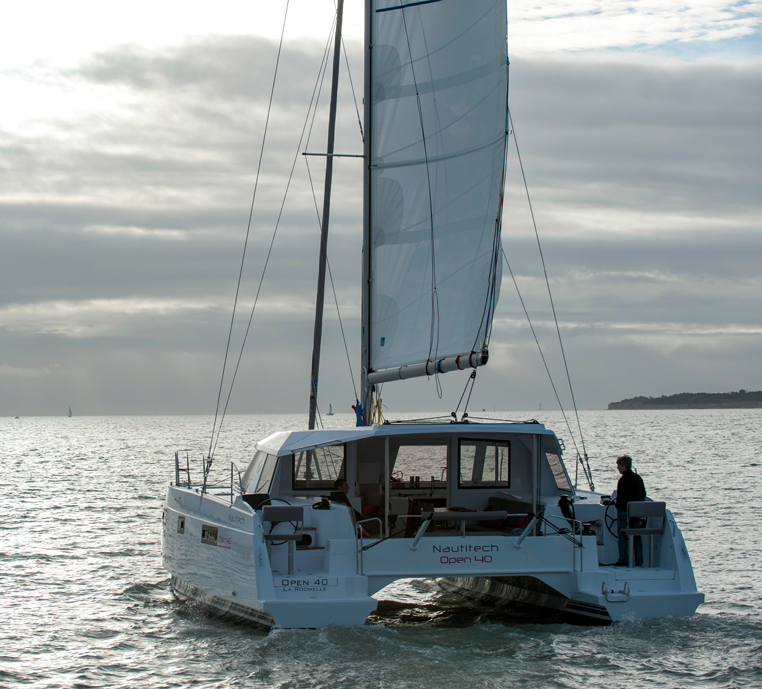
The new Nautitech’s delightful slogan "Be Open": an open-minded cat which is open to the outside world!
The concept of the Nautitech Open 40
Curious, then, some say, that this “open” Nautitech sports a cabin! This is where Bruno Voisard and Marc Lombard score the first point! As an entirely open catamaran is no longer an option, they have come up with an alternative which retains the approved qualities of the coachroof, while really opening the boat up to its environment. In practical terms of course the cabin is still there, even if it does lose part of its area, trimmed by the bulkhead having been moved by around 2 meters. With the sliding door opened, the magic takes effect in the cockpit, where the sides blend into the hardtop bimini to increase shelter. This formula transforms the whole of the living space into a spectacular convertible balcony, thanks to its easily deployed fabric screens which are integrated into the molding of the bimini.
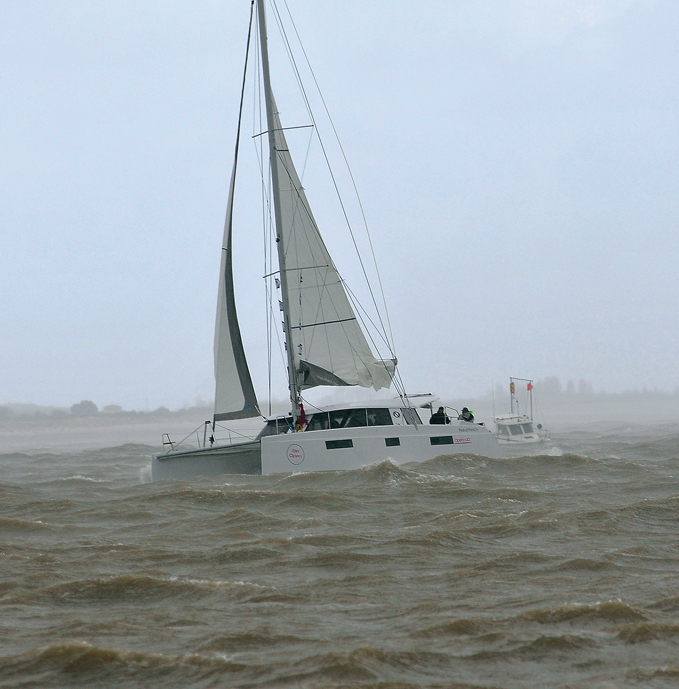
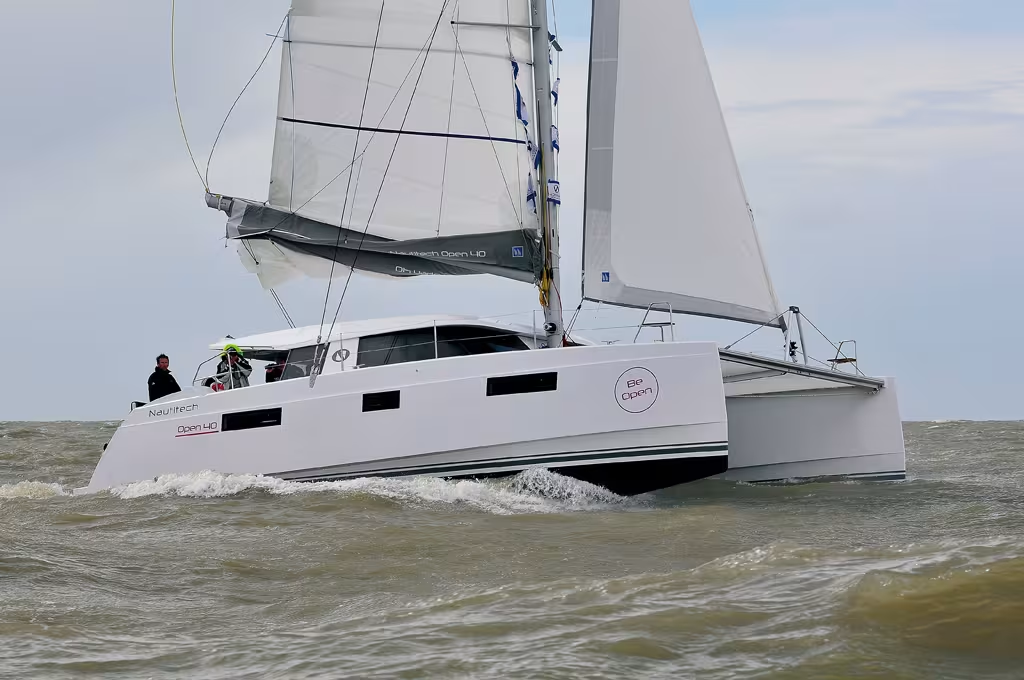
When we say that the test conditions were dynamic! However, even in 35 knots, the Open 40 remains very comfortable.
It’s definitely by Lombard!
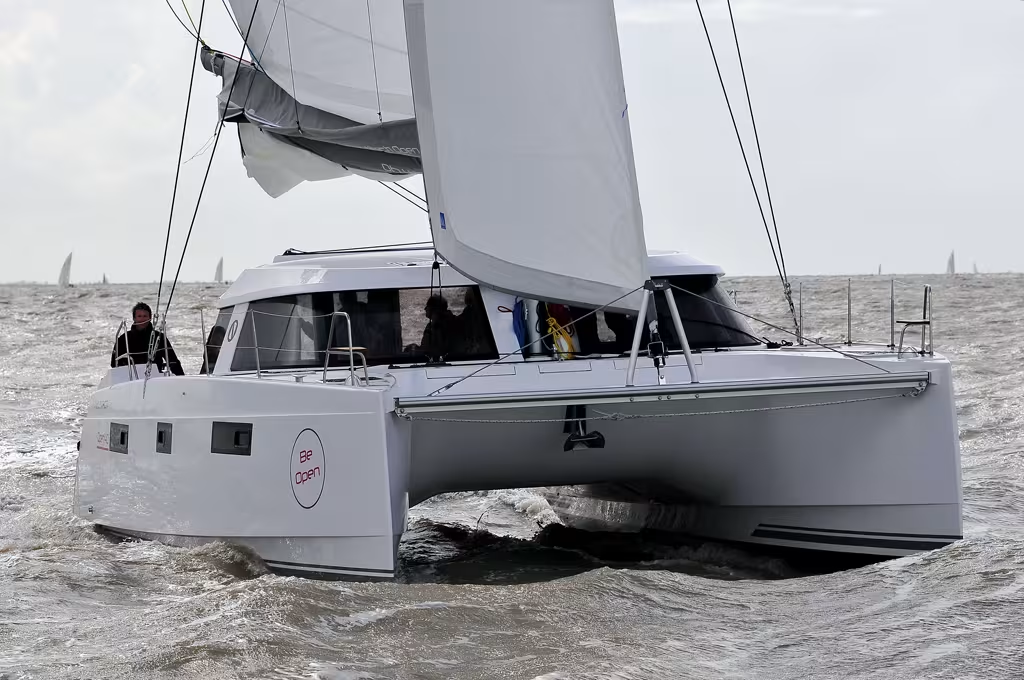
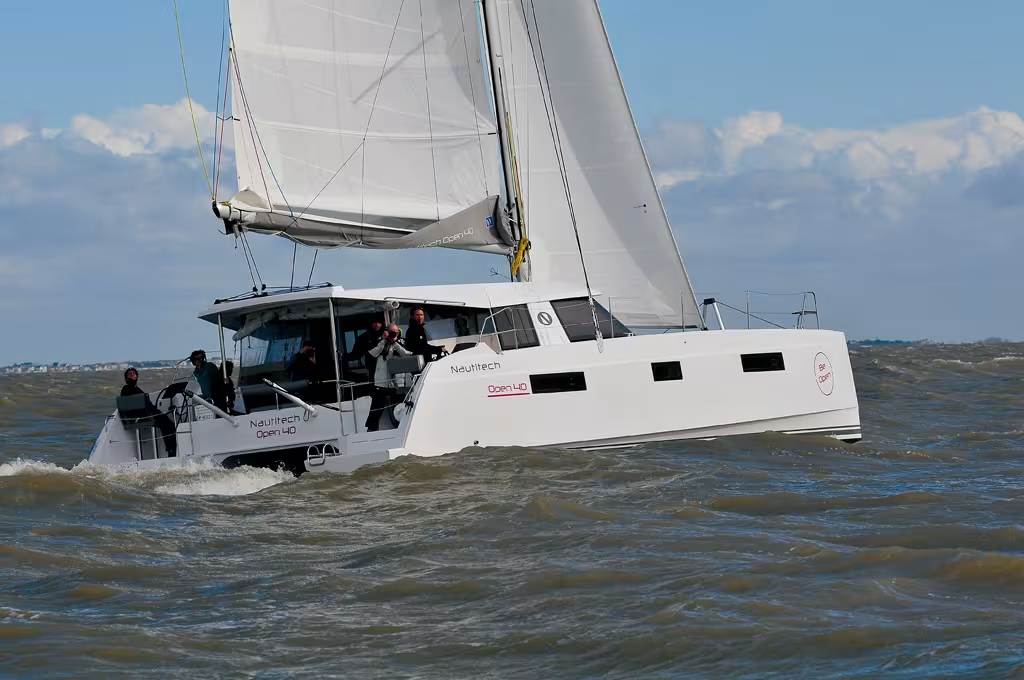
“It’s a Lombard!” says Bruno Voisard, proud of his latest creation, a well-kept secret. The design of the 40, in keeping with the 542, is typical, but remains consistent. The impression given by the lines is fairly natural and evokes very few reservations; the Open 40 is pretty on the water! The modern and willing charm of the hulls is undoubtedly the key factor in this seduction, the eyes scan the bow, finely inverted by 3°, then linger on the hulls whose high sides (remember the ground clearance!) are cleverly stretched by a longitudinal stiffener below the gunwale and a superb stepped section which creates a smooth effect at the bows. The coachroof performs a stylish feat without being flamboyant - gone is the vertical windshield, with only a visor retained. The large curved windows are carefully fitted and glued into the moldings, and the bimini is clever, appearing to be nipped up and raised at the stern (useful at the point where the deck becomes the cockpit, you don’t bang your head, and you can see the main!) The combining of these stylish elements makes it attractive, the design being firmly in touch, while keeping a genuine neoclassical side.
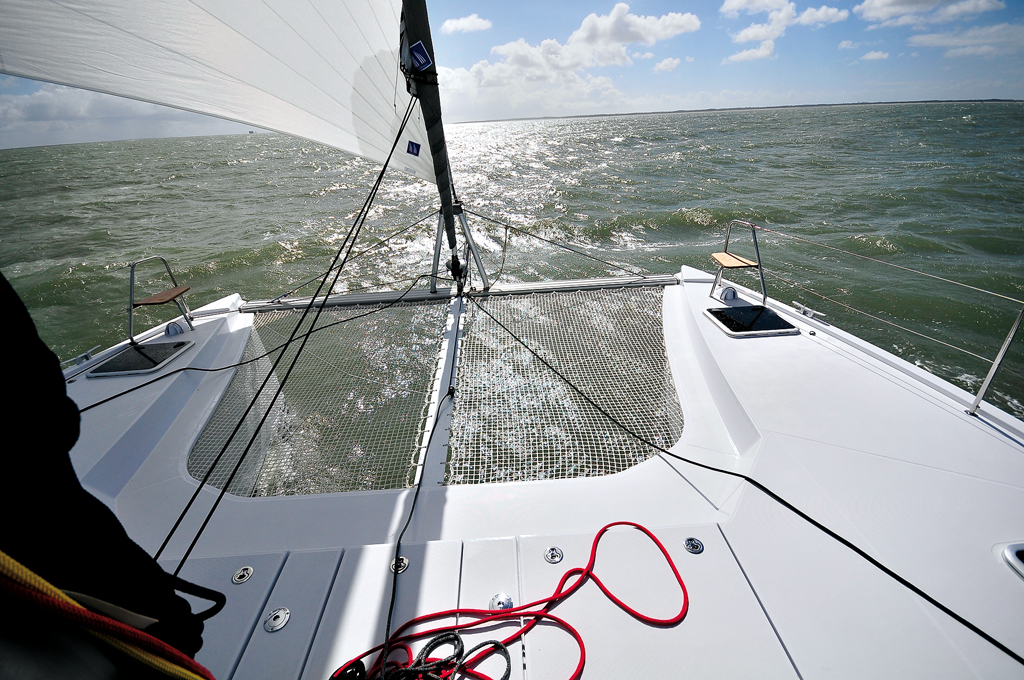
Under gennaker in 30 knots of wind, the Open 40 goes really well, with a feeling of perfect control.
A renewed dynamic approach
The Lombard-Nautitech team seem to have set themselves a challenge to reduce weight so they can launch a stiff and lightweight vessel (for a cruising boat of course) which has its sights set on high performance. The stems allow the finest possible entry through the water: the shape of the forward third of the hulls is an exemplary progression, and seems to belong to faster hulls. The deep U sections are well coordinated and the way this combines with the generous arch is elegant, to discretely house the discharge thru-hulls. The keels, which are shorter (in length) but deeper than average, produce an effective control for leeway, while reducing the wetted area. The nice elliptical rudder blades are attached as far aft as possible, removed from the disturbance originating from the saildrives (also improving the maneuverability under power). There are no protrusions from the hull under the bridgdeck, and the join between the nacelle forward and the hulls is particularly well done. The bridgedeck clearance and hydrodynamic design combine to help movement through the waves upwind as well as downwind.
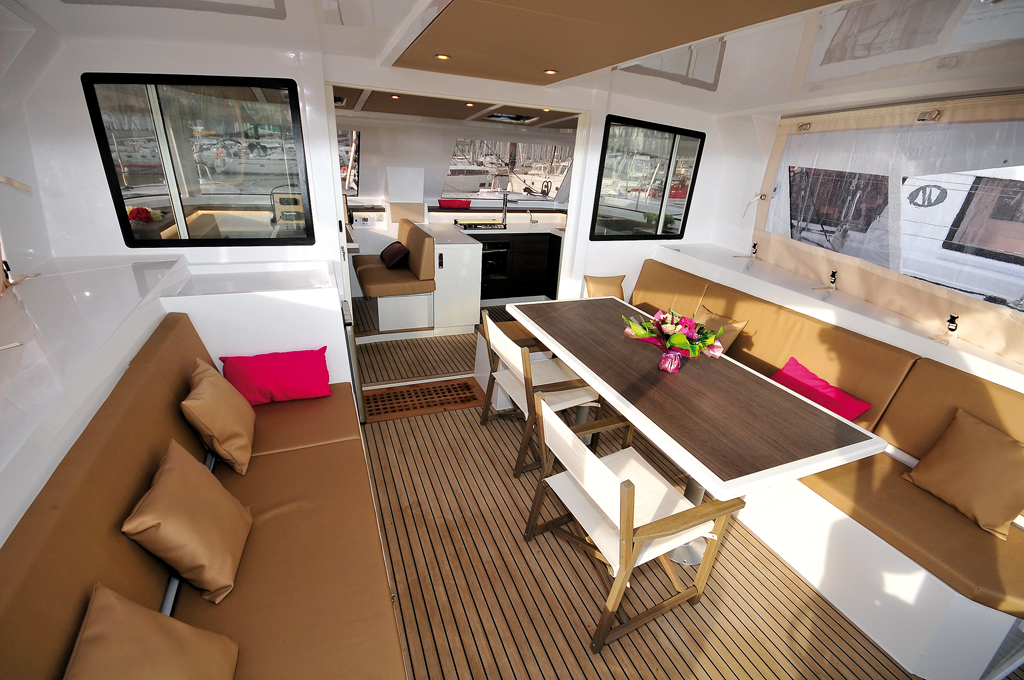
The cockpit is much larger than on most catamarans of this size: the magic of the Open 40!
An amazing open space
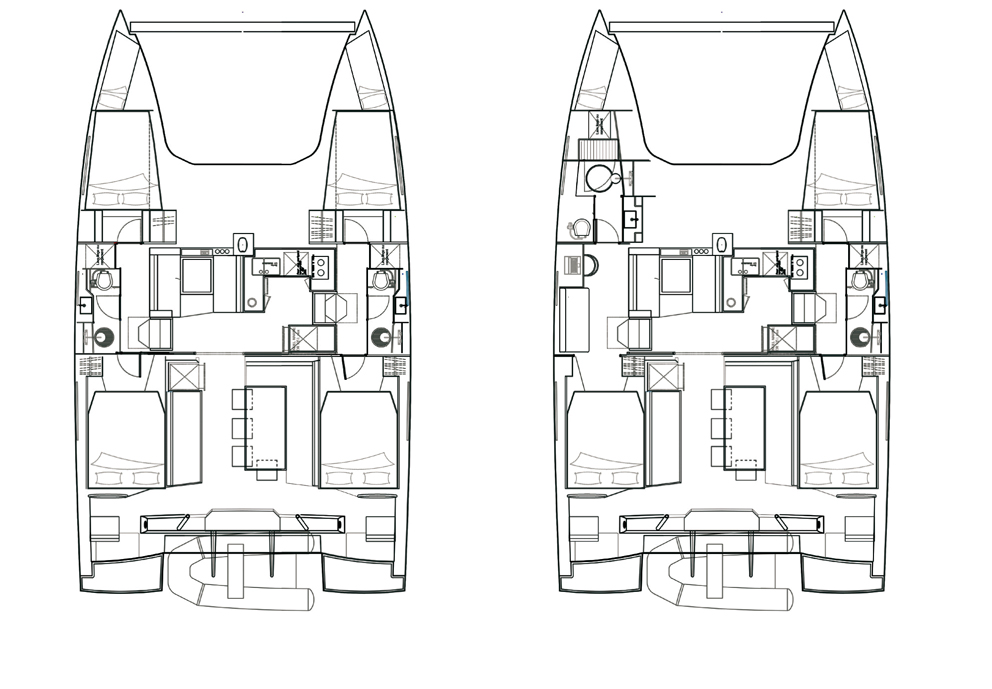
If you want to simplify your understanding of this company’s innovation with space, let’s just say that the bulkhead which supports the sliding door has been moved significantly forward by several meters, while retaining all the usual components of the cabin (galley, seating for four, chart table, etc.) Importantly this helps structurally the forward spaces and the aft beam. With the door open, the concept connects the salon and the cockpit (an unusual size for this size of boat) with the table area, and allows specific fittings such as the stovetop integrated into the corner unit. This all benefits from an all-round panoramic view! Large deflectors increase the protection from the bimini, which is able to be completely enclosed by the awning kit, designed to be used in all sea conditions.
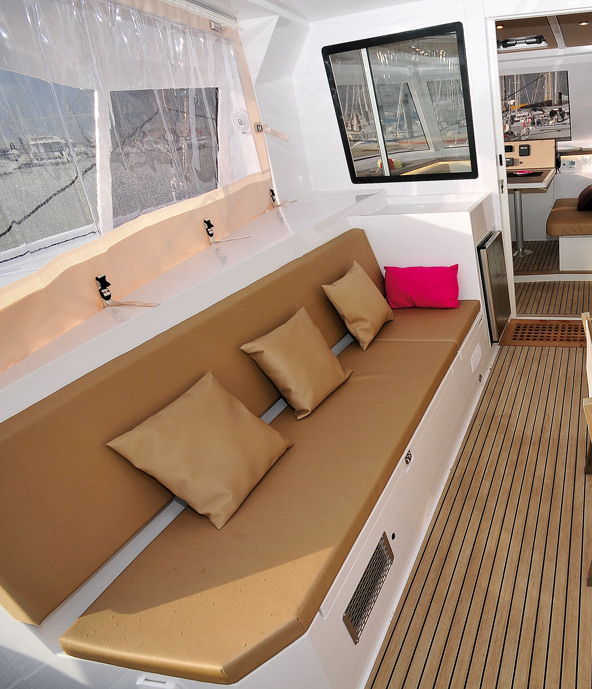
Well protected by the soft partitions, the cockpit is transformed into a genuine second salon when the weather dictates. Clever!
The space in the main cabin is still substantial
The small table area is pleasant for eating inside, where four people can sit in comfort. The instrument console is not intrusive. The central u-shaped island in the galley makes for a large work surface, with the oven and two ring burner having pride of place facing the step. There was only one sink on our test boat, but a double bowl will be available. The two stainless steel refrigerator drawers are practical and nicely done, being integrated into the cabinets by the steps down to starboard. The connection of this indoor-outdoor space is emphasized by the décor which creates a balanced harmony between the two spaces. The headlining and cushions, the balance of materials used from the teak deck (a superb synthetic imitation, available on the exclusive version), the composite Wengé-style flooring, and the white surfaces (in corian or gelcoat) bear witness to the involvement of Stéphane Roséo. Missing are fiddles on the galley tops, which will be standard. The finish of our two test boats (one four-cabin owner’s version and one charter exclusive) reinforce the successful perception of the 40, but doesn’t change them.
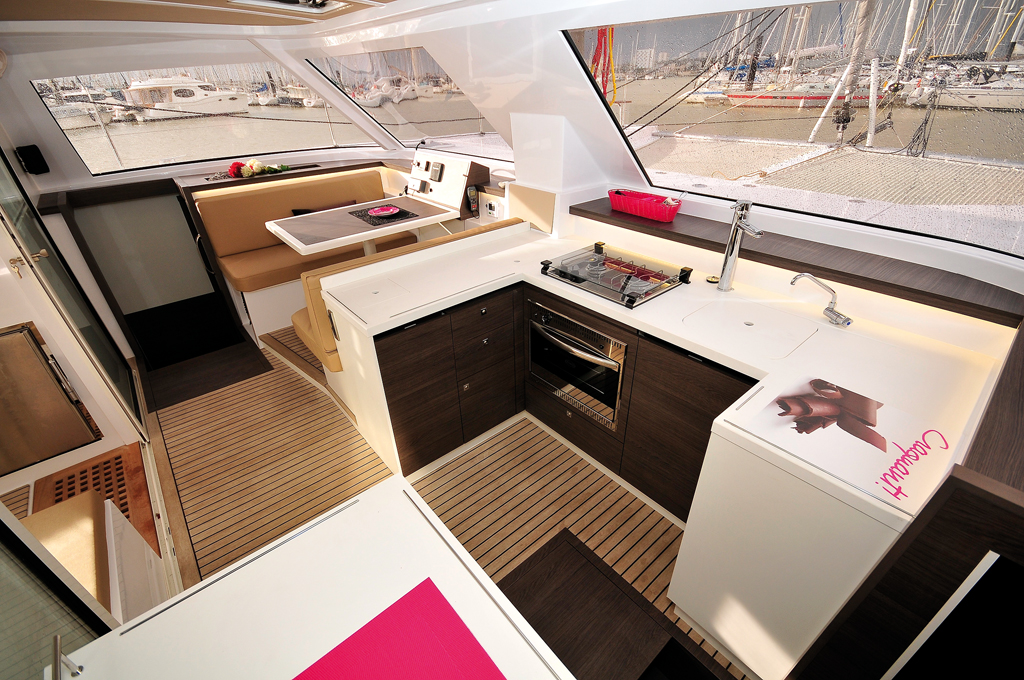
Inside the main cabin you find everything you need on a boat this size: galley, 4 seater salon, chart table…
Clever and private cabins
In the two versions available the heads / shower rooms are pleasant, not enormous, but comfortable and positioned midships in each hull facing the steps down. The cabins are cozy and equipped with practical storage (lockers under the bunks for large bags or hanging bags), nice shelving units allow you to organize all your personal stuff (bedtime reading, portable electronics, glasses, etc), a split step is fitted into one corner to make it easier to climb into bed. Ventilation, natural light and electrics have been carefully dealt with, the fit-out in the starboard hull of the owner’s version harmonizes perfectly with the Open 40 principle, and without doubt enhances it.
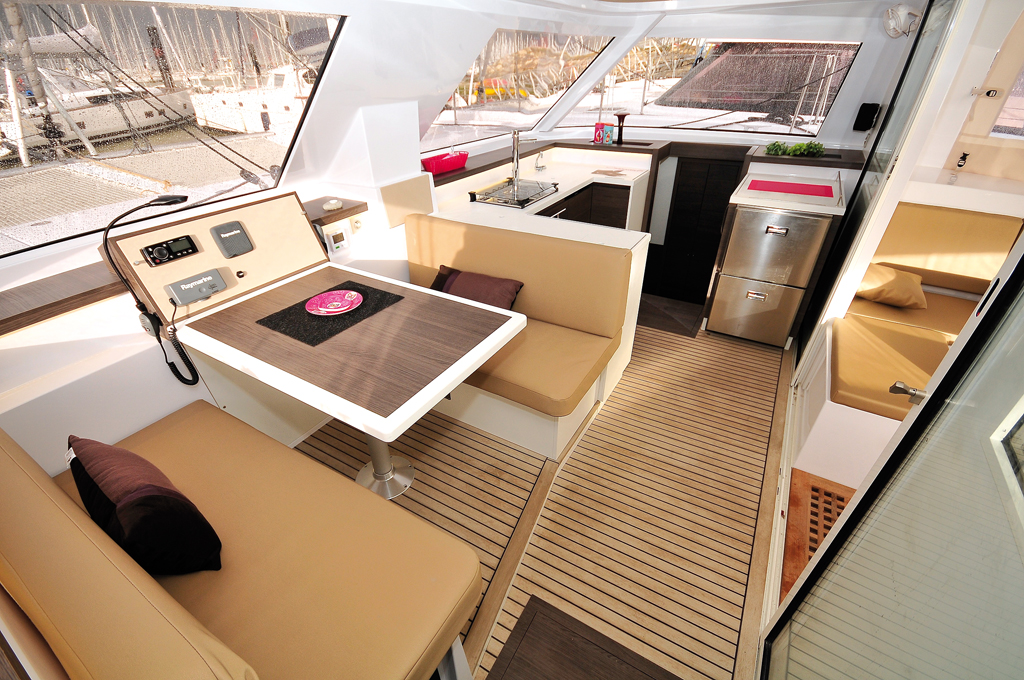
The salon table also doubles up as a chart table : a great place for your night watch.
Engine rooms: important areas
Before setting off, this is worth a look! These compartments hide a wealth of information about how the layering is implemented (in this case done by infusion), and it appears very neat, compacted with a good resin / cloth ratio, the stiffeners are carefully done. The fixing of rudder tubes and the fixing plates for the rudder pulley returns demonstrate proper examples of these essential functions. Access to mechanical parts via deck hatches is excellent, let’s just hope that watertightness (the Achilles heel of this otherwise practical arrangement) is up to the job at sea.
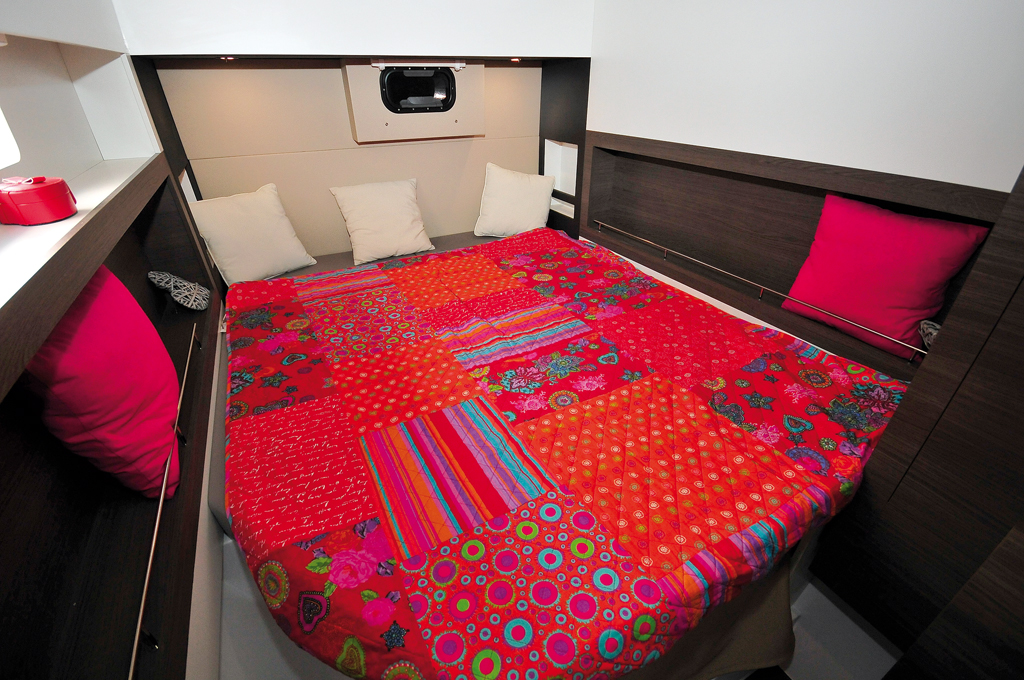
The cabins are comfortable, and equipped with practical storage and big lockers under the bunks.
A dynamic and educational two-day test!
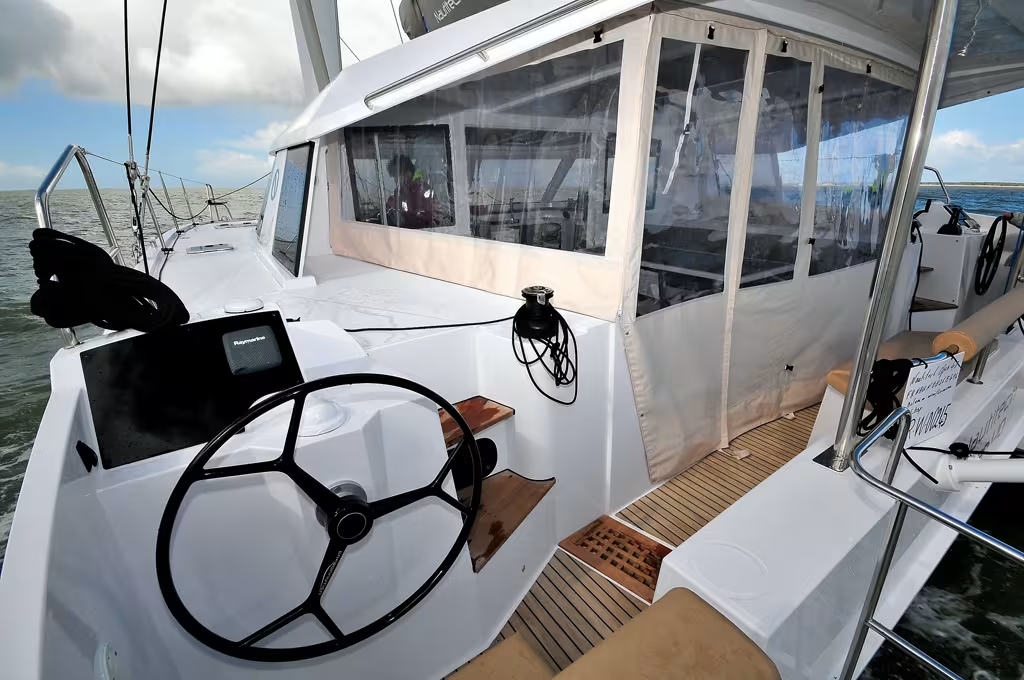
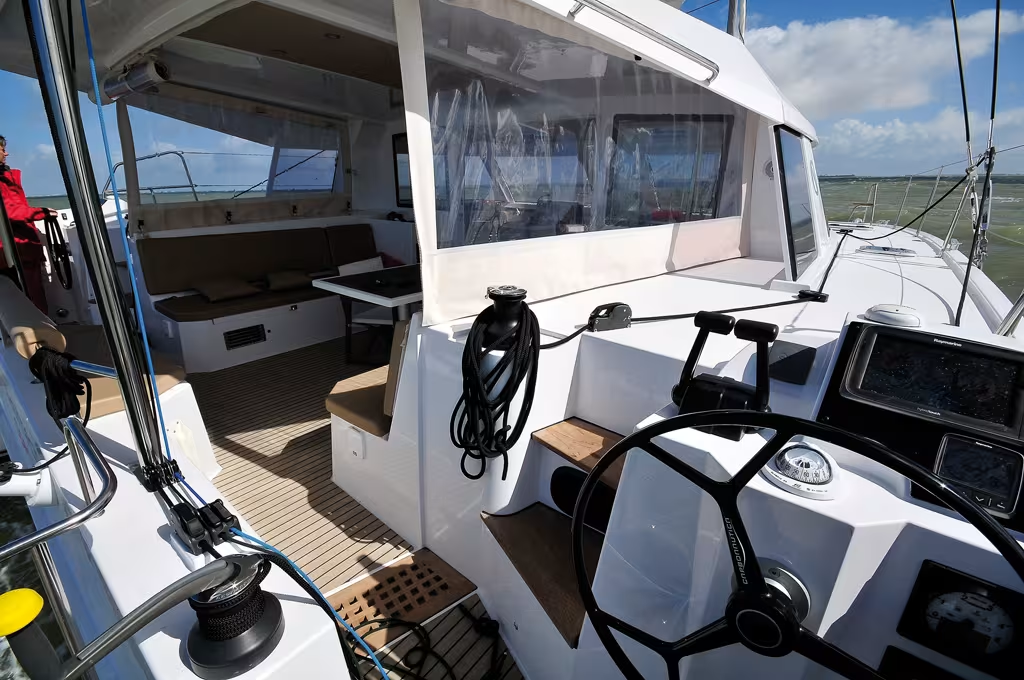
Three boats recently off the production line were available for our test, and we took trips of around twenty miles with each (one of which was with technicians from the yard on board) on the first day, and bigger trip the following day (of around forty miles). Navigating in company with two similar boats presents several advantages: above all being able to take photos in comfort, and the exterior view of the boat going along over a long period gives a mine of information on the dynamics, especially in a good blow with a big sea, and the Open 40 brilliantly passed the test! I had previously enjoyed helming the 542; the same qualities are transposed onto the 40. Taking the (optional) carbon wheel in your hands is remarkable, the perfect safety of the helmsman and the side and forward visibility are absolutely satisfying; there are hardly any blind spots, and you don’t get wet! Maneuverability under power with a 20 knot cross wind is excellent. Our test boat was equipped with two 30hp motors and the electric controls gave a little supplementary comfort, but for me, the mechanical linkages of the standard 21hp motors give much the same satisfaction (the three bladed folding propellers being obligatory!). What makes this easy to master is the low windage, good grip in the water of the keels and perfectly balanced leeway. A glance in the air before hoisting the generously sized mainsail (63m², as much as the previous 44’ from this yard); the inertia of the Soromap mast is reassuring and the specially designed rigging gives the whole an appreciable aerodynamic quality (double spreaders without awkward triangles and rollers). The effect at sea is immediate, the Open 40 is lively and enthusiastic (with one reef and full solent in 25 knots true), it’s adventurous nature is immediately apparent. It holds a course to windward with ease, even against a heavy short sea. The stability and the helm are pleasing. As soon as we’re able to open up a few degrees off the wind, we easily make ten knots! Tacking presents no difficulty and we immediately pick up speed again. This gives a sense of agility, achieved due to the bridgedeck clearance and reduced wetted area. The modest weight of the vessel, the structural rigidity and the efficiency of the rig are also part of this. The following day, downwind, we easily flew the gennaker in almost 30 knots of wind perfectly relaxed; the wheels, directional and supple, allow you to put the catamaran in the groove and to slide along. The feeling gained is that the Open 40 will be fun and safe when let loose on the open sea. Our return to Oléron was at full tilt with a heavy sea forward of the beam and a strong wind. Full solent, one reef in the main and the traveler right out, the 40 showed its astonishing capability for speed and agility. Between 11 and 14 knots continuously, it remained comfortable (we ate in the cockpit), despite a choppy sea which had been building for 48 hours. Gusts to 35 knots underlined the tolerance of this machine (the large sail area would lead to a double reef when cruising!) and above all its capacity for speed and suppleness without crashing into the waves. This trip back of a dozen miles or so highlighted the easily exploitable performance of this boat with a sporty attraction.
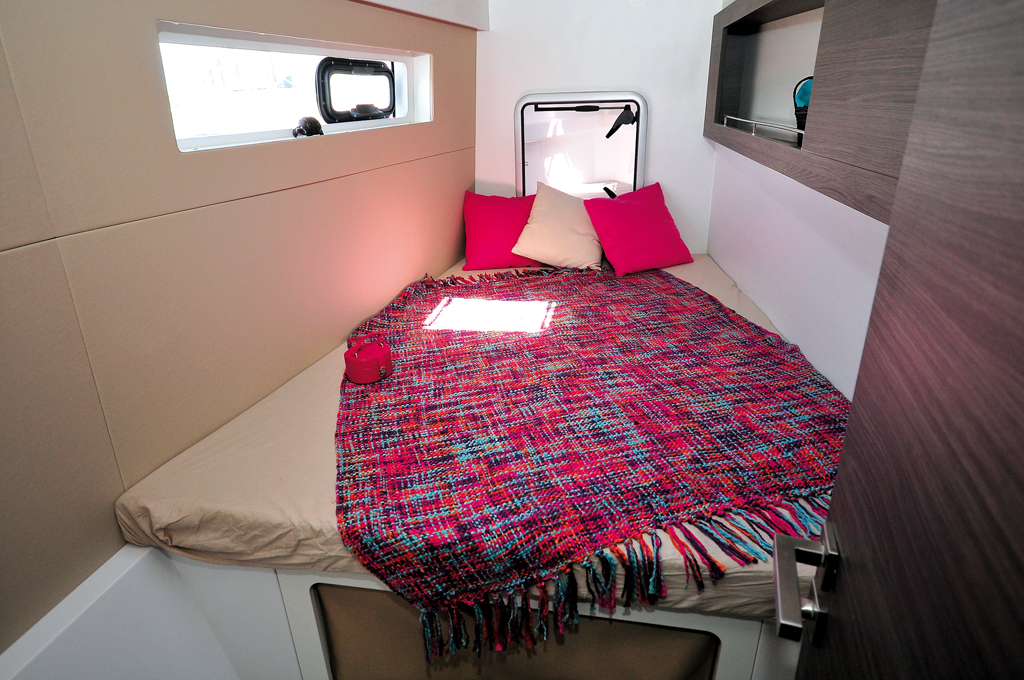
The forward cabins are smaller than the aft ones, as normal on cats of this size.
Conclusion
Elegant, lively, good sailplan, well built, the Nautitech Open 40 is an excellent modern catamaran. The concept of fitting out the bridgedeck linking the ergonomic qualities of a deck salon to those of a comfortable interior will win many votes. Easy to handle, efficient hulls, this could well appeal to certain monohull renegades. The few possible improvements noted will be incorporated into future boats.
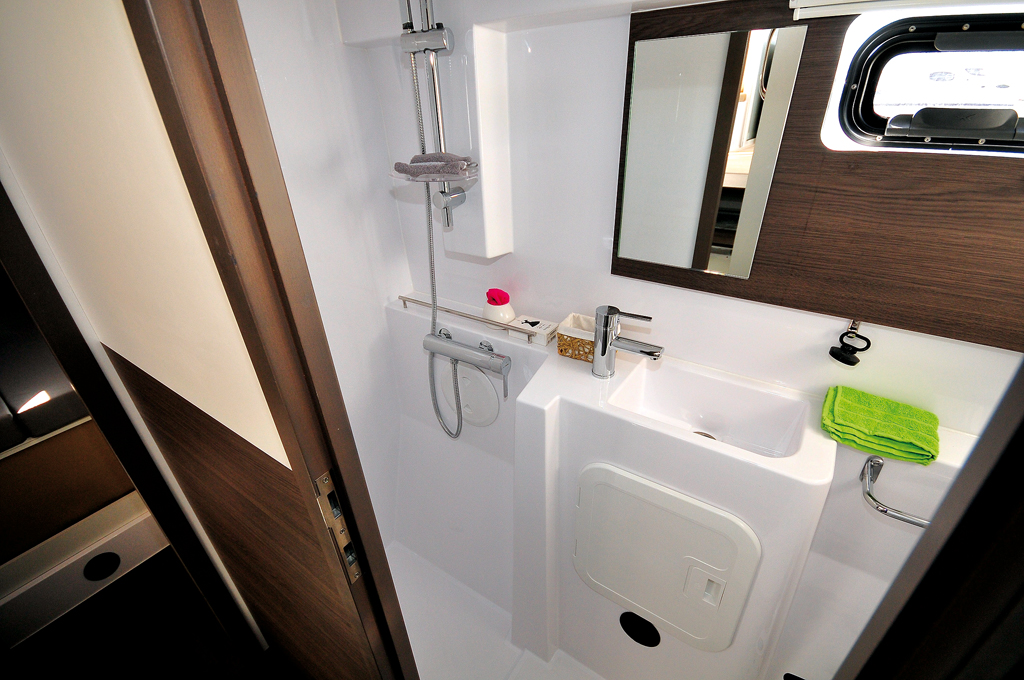
There is a heads/shower compartment in each hull in this version, these are pleasant and located in the middle of each passageway opposite the steps down.
Plusses
- Attractive fun boat
- Great performance on all points of sail
- Stiff platform, with serious weight reduction
Minuses
- Floorboard fastening needs to be reviewed
- No fiddles in the salon
- Gennaker furling system slips.
- It needs heavier end fittings and clutch
The Competitors
Model S2 Builder Tonnes 5 8.9 10,3 7.6 8 Upwind sail area in m² 115 112 80 89 85 Basic price in € N/A 373,000 259,000 256,000 N/A
| Model | Builder | Tonnes | Upwind sail area in m2 | Basic price in € |
| Dazcat d12 | Multimarine | 5 | 115 | N/A |
| Catana 42CR | Catana | 8.9 | 112 | 373,000 |
| Lagoon 400 S2 | Lagoon | 10.3 | 80 | 259,000 |
| Lipari 41’ | Fountaine Pajot | 7.6 | 89 | 256,000 |
| Seawind 12,50 | Seawind | 8 | 85 | N/A |
FACTS AND FIGURES
- Naval Architect: Marc Lombard design group
- Builder: Nautitech
- Interior design: Stéphane Roséo
- Length: 11.98m
- Beam: 6.91m
- Air draft: 18m
- Mainsail area: 63m2
- Solent: 28m2
- Gennaker: 69m2
- Asymmetric spinnaker: 110m2
- Bridgedeck clearance: 0.75m
- Light displacement: 7.8t
- Motors: 2x21hp or 2x30hp
- Transmission: Saildrive
- Fresh water: 2 x 215 liter
- Fuel: 2 x 215 liter
- Construction: Foam Sandwich /infused glass/polyester
- Basic price in Euros (ex-tax): 282,800 (4 cabin version); 296,950 owner’s version
- Principal options, in euros (ex-tax): Exclusive interior finish: 39,800 30 hp Motors: 2,000 Flexofold three blade folding propellers: 3,100 Rigging and fittings for gennaker: 3,823 Gennaker: 4,383 Electric winch: 4,400 220 Volt electric pack + inverter: 8,620 Watermaker: 12,550 Electronics pack with autopilot: 13,900 Safety equipment pack: 3,923 Epoxy treatment: 1,900 Delivery to La Rochelle, France: 8,000
Architect Marc Lombard’s View:
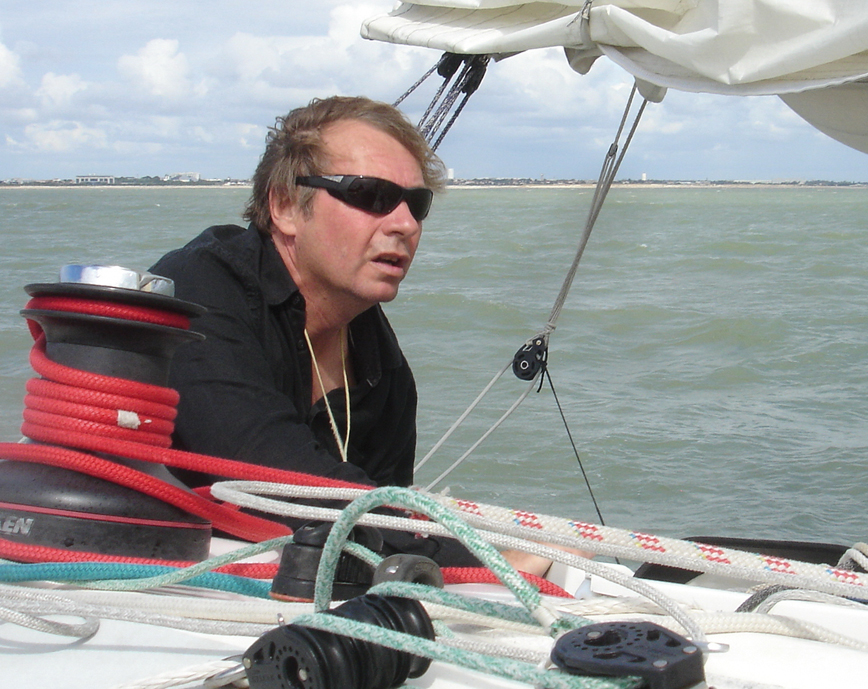
In designing the Nautitech Open 40, we wanted to achieve the ideal balance for creating a boat with general appeal, aimed for long distance cruising. The emphasis was placed on ease of use, thanks particularly to fixed keels (wrongly reputed to be inefficient!) and an incredibly simple deck layout, keeping it light. The other parameters were: a modern fit-out, spacious, equally at home on charter or for circumnavigating; an easily understood technical area, easy to maintain, all while keeping very good performance and a sensitivity at the helm not found on our competitors’ boats. Finally, an increased bridgedeck clearance to take on big seas offshore. And the result is clear: fine hulls, generous sail area, and lightweight construction allowing the 40 to perform well in light airs. With truly above average speed, the N40 goes upwind with very little leeway, which limits the amount of engine use, all too common on cats on this point of sail. The gamble on an open cockpit protected by simple screens has paid off, even in a fresh breeze in February the cockpit remains protected. No doubt that in summer conditions, the concept will show its real significance. To sum up, a catamaran with corresponding comfort and performance… right on target! At the ML Design Group office, it’s a boat we are proud of.
The rigger’s view:
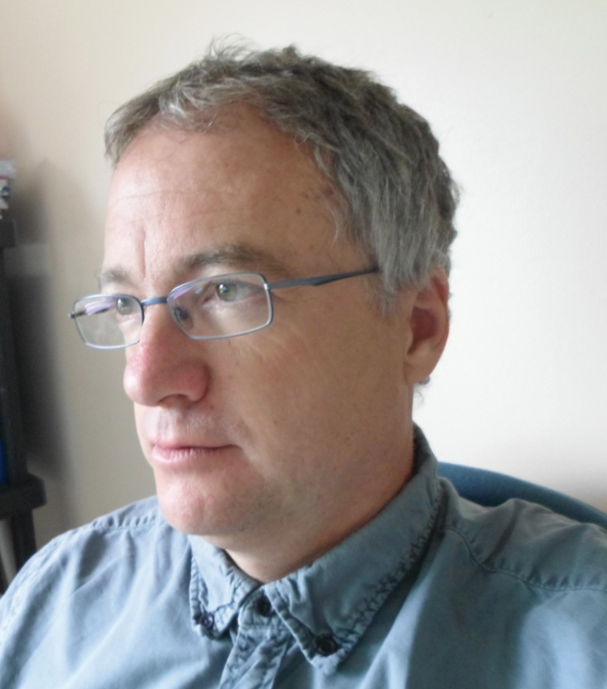
The Vmg/Soromap aluminum mast profiles have the best power-inertia ratio available, they allow access to a simplified design, rationalized compared to those with larger sections and multiple amounts of rigging fixed to ugly additional supports. Our extrusions are strengthened to give vital increased inertia via digital machining, and there are many benefits: -Reduced weight, better stability curve = safety -Lower center of gravity = better handling in choppy seas and superior comfort -Less drag = better performance -Simplified standing rigging = easier installation and upkeep -Less parts = increased reliability -Better compatibility with foresails, no wear on diamond stays -Contemporary appearance Éric Gibaud - VMG design office
Caption

- : The plexiglass shoulders reinforce the protection for the deck salon, and blend in nicely with the coachroof and the bimini.
- : The transparent fabric enclosure kit increases this protective effect, and you can continue sailing with the cockpit totally enclosed (heating is even an option)
- : The step and the superior siffener characterize a dynamic design, the small forward spatula combined with the finely inverted bows is particularly successful.
- : The Vmg/Soromap mast is elegant and reassuring, the absence of a triangular struts makes it more aerodynamic.
- : The design of the top of the coachroof is a success, it narrows aft, making it more discreet, and leaving the way into the cockpit more open.
- : The tiller positions on the 40 are really safe, thanks to the railing and lateral armrest, and the solid bench; the instrument console also forms a little wave deflector, even though this area gets little spray.
- : The agile hulls of the 40 are one its strong points, and along with the light weight of the machine, make up the key element of the boat’s great performance.
- : The trailing edges are delicate et l’assiette impeccable, the bridgedeck clearance and the absence of protrusions from the hull lead to good handling and comfort in rough seas. -
- : The convertible deck salon is one of the major themes of the boat, with the comfort level being fresh and impressive. This boat needs urgently to be tried in the tropics.
