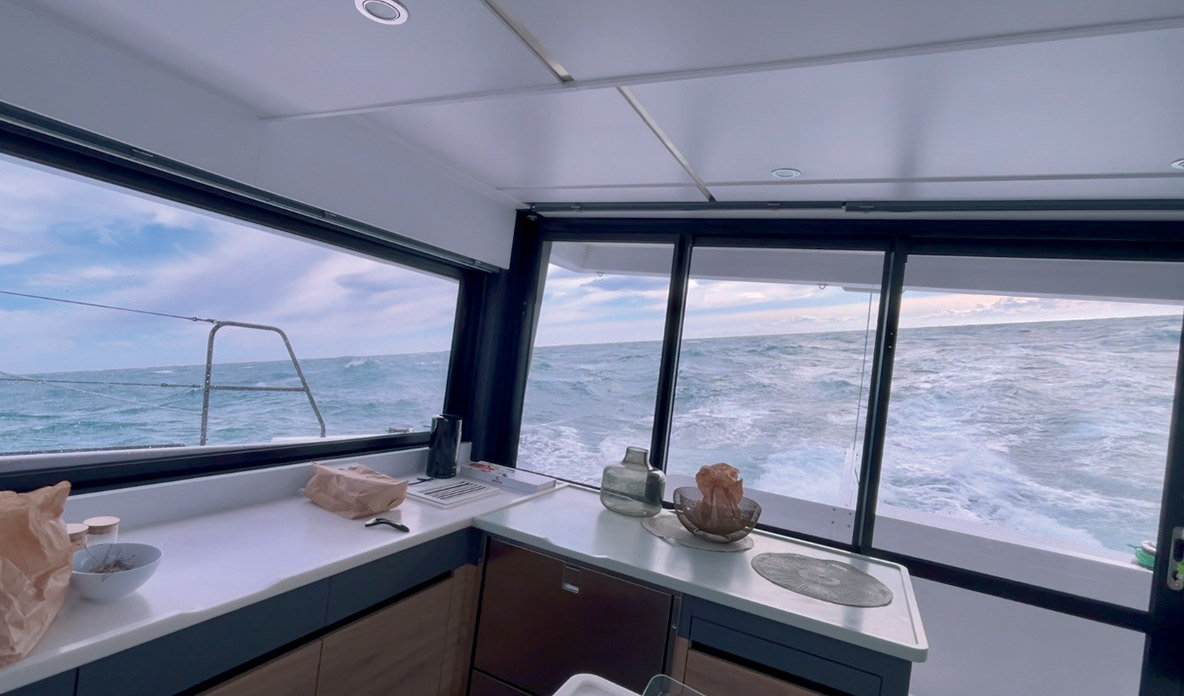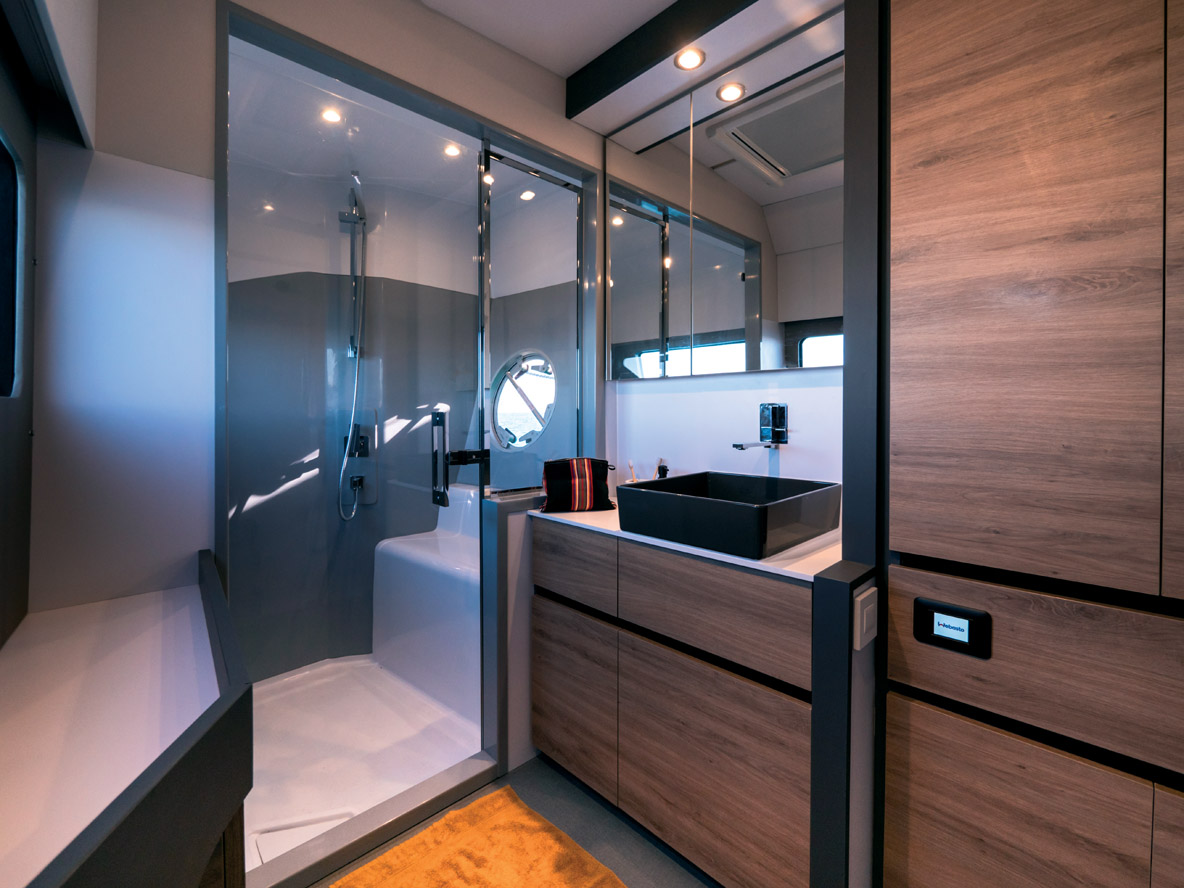
A gale warning in force, 35 knots gusting on the beam, a 2- to 3-meter wave height (6 to 10 feet) and a 3 to 4 second cross swell: these were the conditions experienced during an express delivery from Canet-en-Roussillon to La Grande-Motte. This was heavy weather, but that made it almost ideal for scrutinizing the sailing qualities and energy production sources of one of the most eco-friendly catamarans on the market... Welcome aboard the New Windelo 54, freshly awarded Multihull of The Year in the IMS Premiere category.
Infos pratiques
- Le chantier : New Windelo 54
- La fiche technique
-
 Découvrez notre vidéo exclusive
- Financez votre New Windelo 54
- Assuez votre New Windelo 54
- Articles autour du New Windelo 54
Conditions: 10 to 30 knots of wind, slight to rough sea state
“Strong gusts, strong gusts”
The weather bulletin broadcast over the VHF this spring morning leaves no doubt as to the sailing we’ll be experiencing in the next few hours: our delivery trip from Canet-en-Roussillon to La Grande-Motte to reach the International Multihull Show promises to be hectic! The “Coup de marin”, the wind that blows in from the open sea, had been blowing for a few days, leaving a strong, choppy, messy swell on the water. The wind died down overnight and hadn’t yet settled into the strong westerly forecast. For the time being, the morning was fair, and the Canet surfers were enjoying some pretty clean waves. But the weather forecast for the next few hours was as clear as the sky: we were in for some breezy sailing.
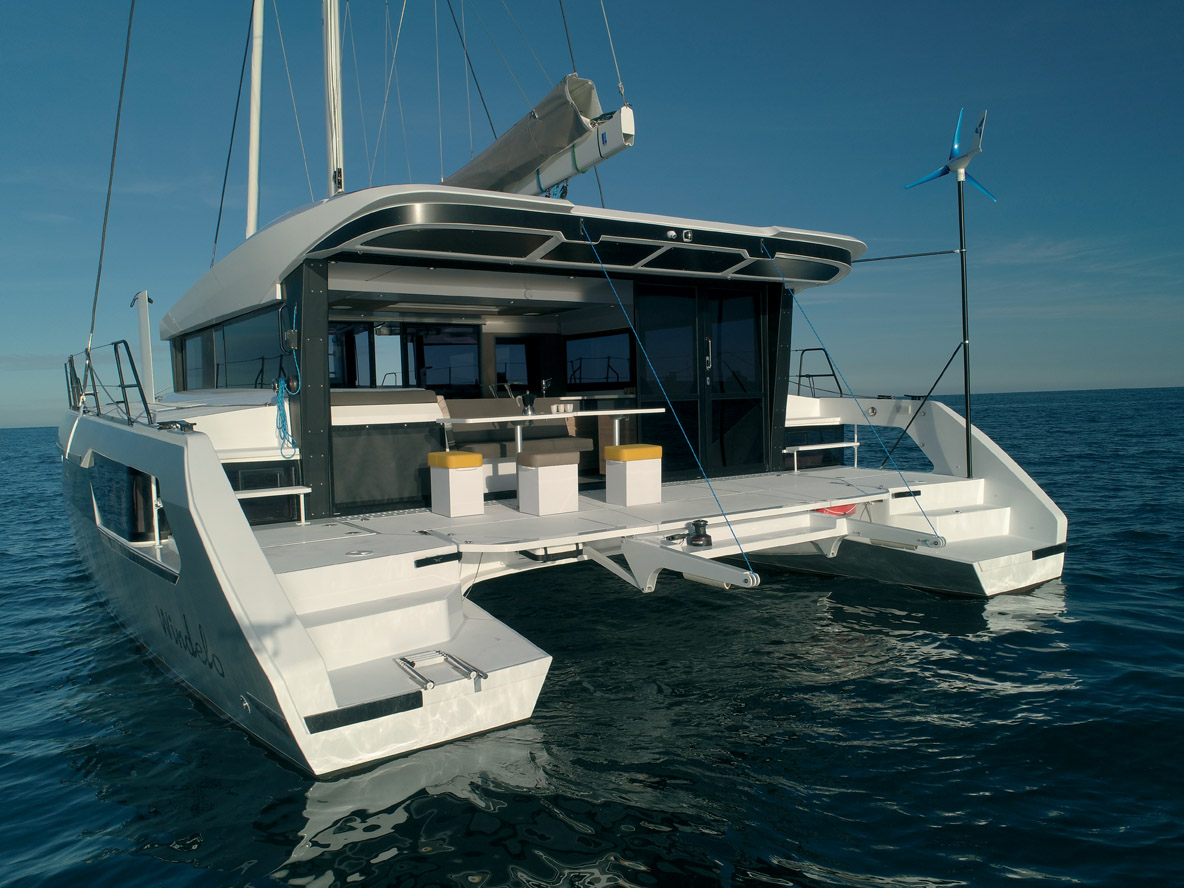
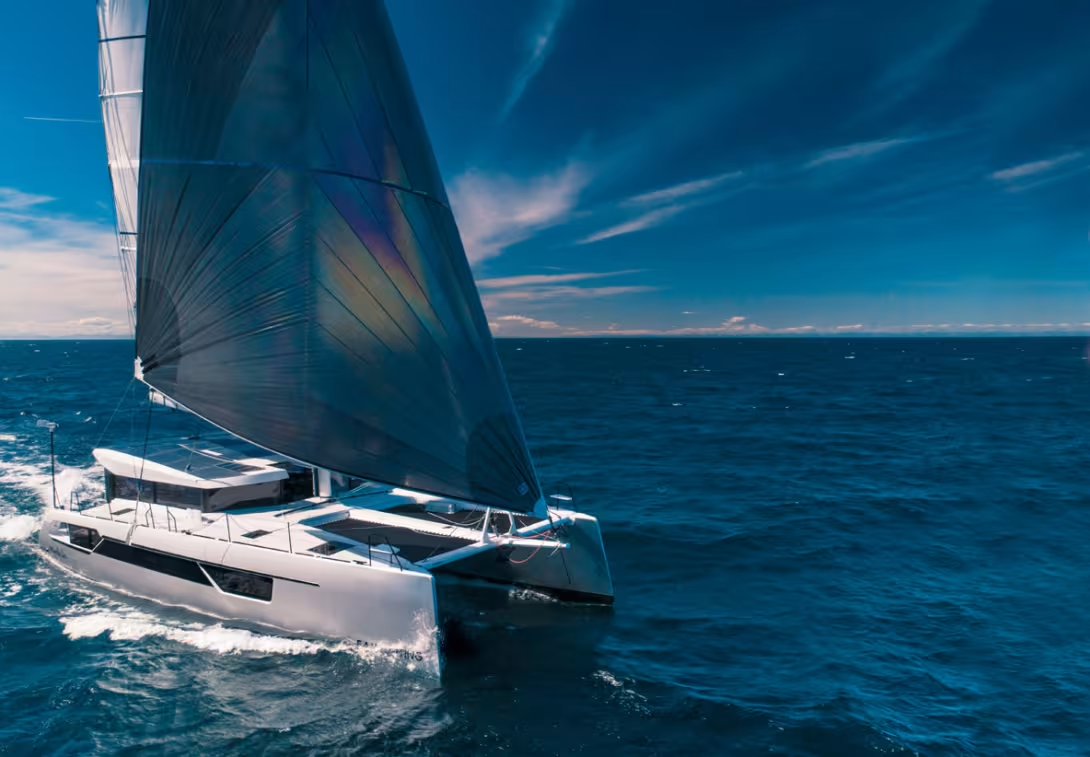
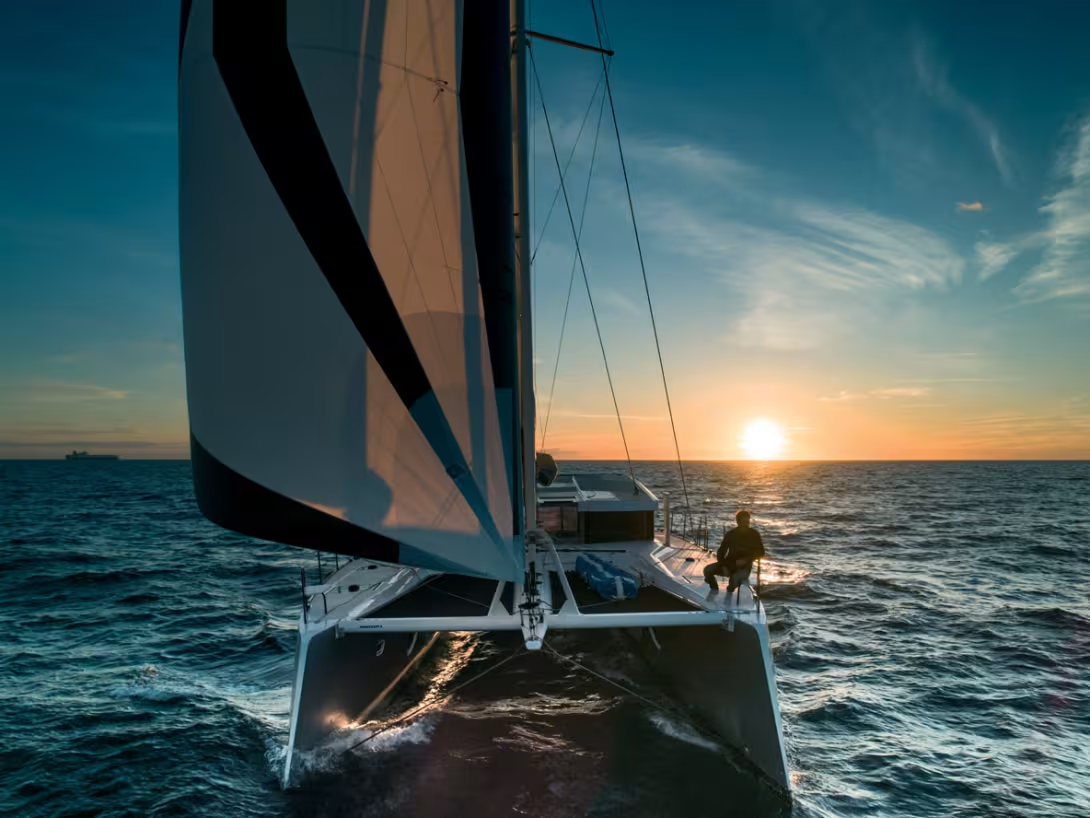
Moored up right outside the Windelo premises, just a stone’s throw from the Catana shipyard, the New 54 Yachting, which completes the Adventure and Sport versions, revealed a racy appearance. I’ll keep this first impression for the duration of the test: this catamaran is definitely attractive from every angle. Two very tapered hulls, taut deck lines and a sleek coachroof set further aft: the message is clear: this is not a multihull designed for charter, but an owner’s catamaran optimized above all for performance. A word about the new deck layout and interior design: they’ve left behind the clean-cut lines of the previous 54, and adopted a much softer, wave-inspired design.
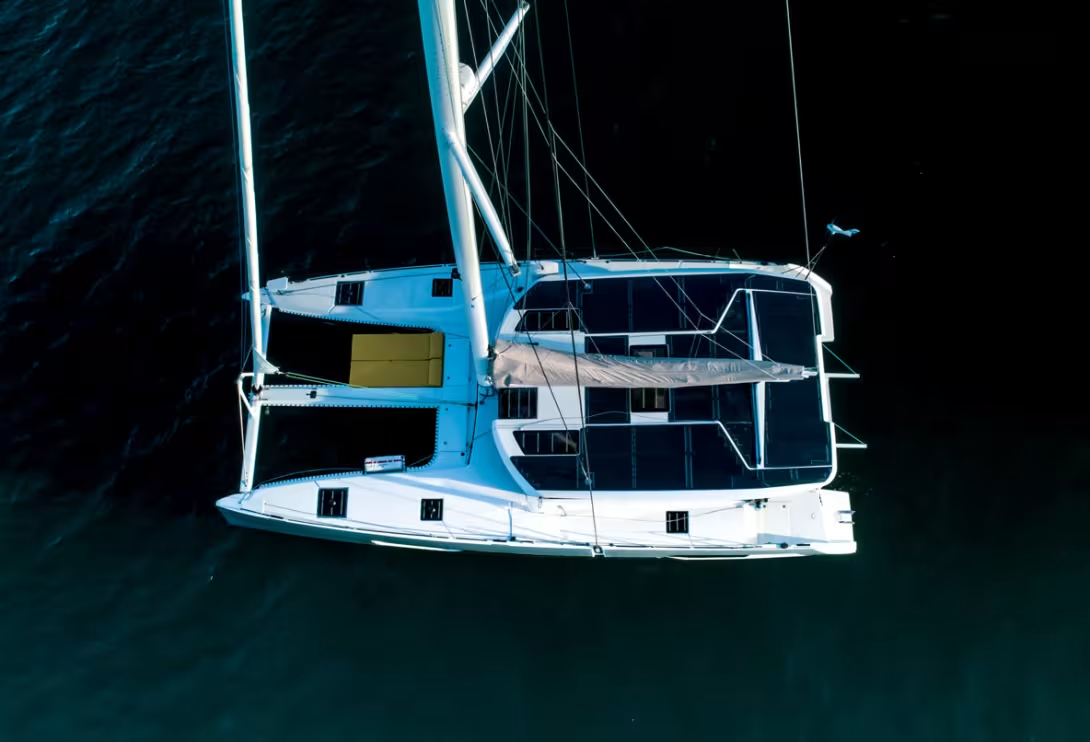
The solar panels covering almost the entire coachroof are, along with the large wind generator positioned aft of the bimini, strong indicators of Windelo’s commitment to the environment.
The young shipyard, founded in 2019, has succeeded in rallying around its catamarans a community eager to sail both high-performance multihulls and units that have a low environmental impact.
A much more environmentally friendly catamaran
According to Stéphane Groves, Windelo’s sales manager, 80% of its clientele are circumnavigators, who are above all attached to the quality of their sailing and of life on board, but who are also concerned about ecological issues. An analysis confirmed by the dynamic Italian Stefania Quaglino, most recent owner of Electtra, a New Windelo 54 awaiting departure for a Mediterranean circuit, ahead of a circumnavigation: “While comfort and the possibility of sailing maneuvers being done from inside were important factors, the ‘Green Technology’ chosen by the shipyard was undoubtedly the most important element in our choice. My husband and I are very concerned about preserving the planet, and Windelo does everything it can to ensure that sailing is as virtuous as possible.”
Windelo’s construction with recycled and bio-sourced materials is based on an eco-responsible sandwich composite. It combines basalt fiber and PET foam from recycled plastic bottles, helping to reduce the multihull’s carbon footprint. This foam accounts for 56% of the materials used in the construction of the hull and bulkheads.
Basalt fiber, also used for the hull, is a volcanic fiber that is highly resistant to vibration. It maintains a high strength-to-weight ratio and gives the hull its robustness and lightness. The icing on the cake is that basalt fiber can be entirely recycled by being remelted. Add to this an electric propulsion system, producing energy from solar panels, wind power and hydrogeneration, and you have a catamaran that is far more environmentally friendly than equivalent multihulls on the market.
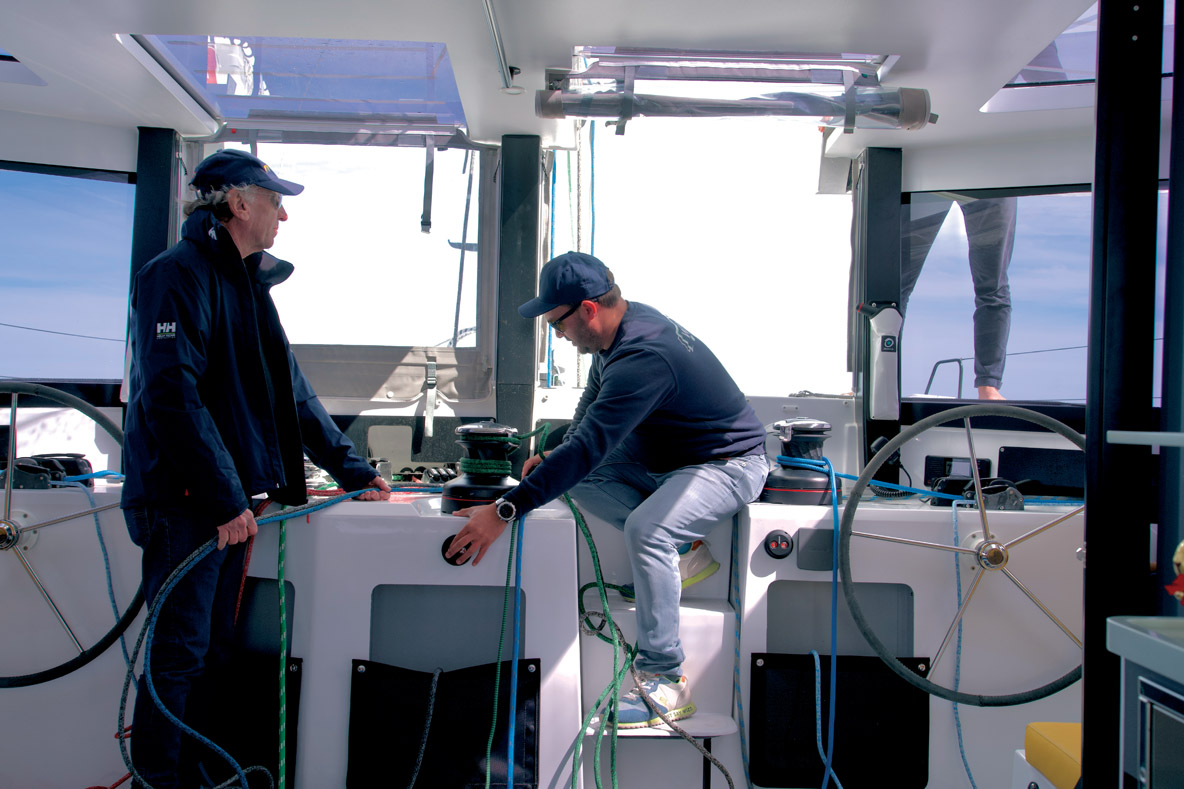
Back on board, it was time for Stéphane Groves and Pierre Leprieur to install the Code 0 furler at the end of the spar. The two Windelo employees were supported by Stuart Eichner, the brand’s North American distributor. A winch installed on the mast allows for rapid deployment. All that remained to be done was to check everything was secure inside the catamaran and check the reefing lines so we could set sail in the best possible conditions... before the wind picked up.
We were accompanied on our trip by a Windelo 50, which was also joining the big multihull congregation at La Grande-Motte.
The gale warning announcement had thinned out the boats out on water. The departure window was extremely tight, as the next few days were likely to be even more complicated in terms of weather, but the imperative of attending a show that is a must for every multihull builder was pressing us to get going.
“The American market is ready”
As we got the rig set up, Stuart Eichner reflected on Windelo’s presence on the US market and the public’s reception at the recent Miami International Boat Show: “We feel that the American market is ready, and we’ve had a huge number of people interested in the catamaran’s green sailing and propulsion qualities. The standard of construction seems to be living up to all its promises to conquer a very demanding market.”
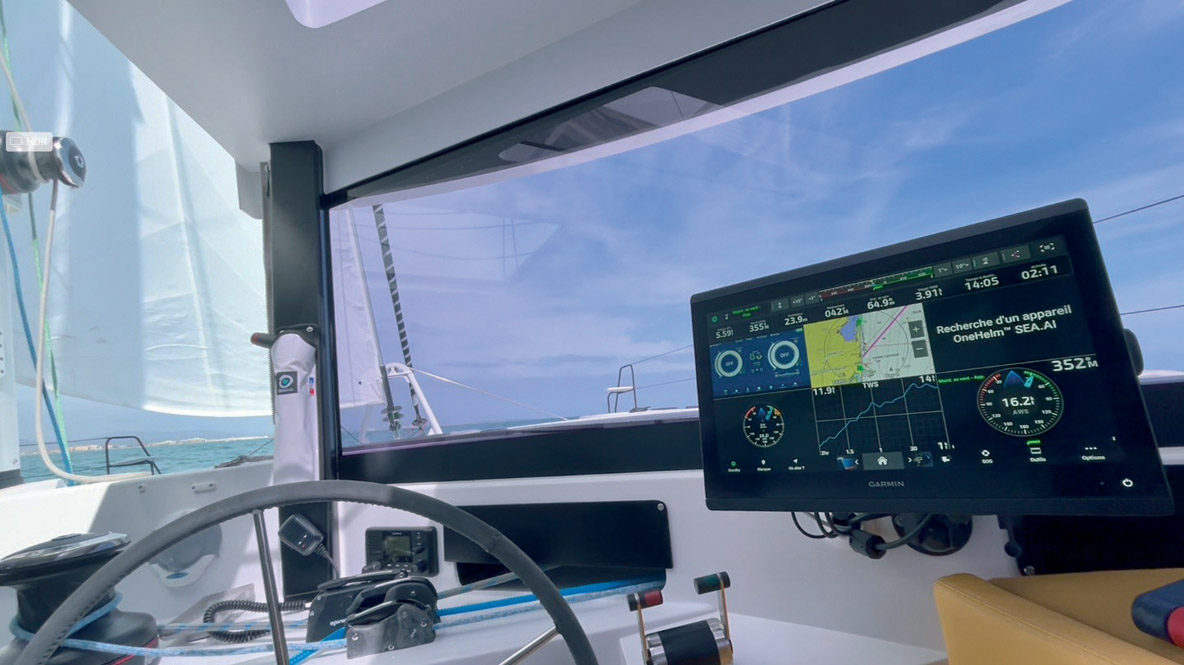
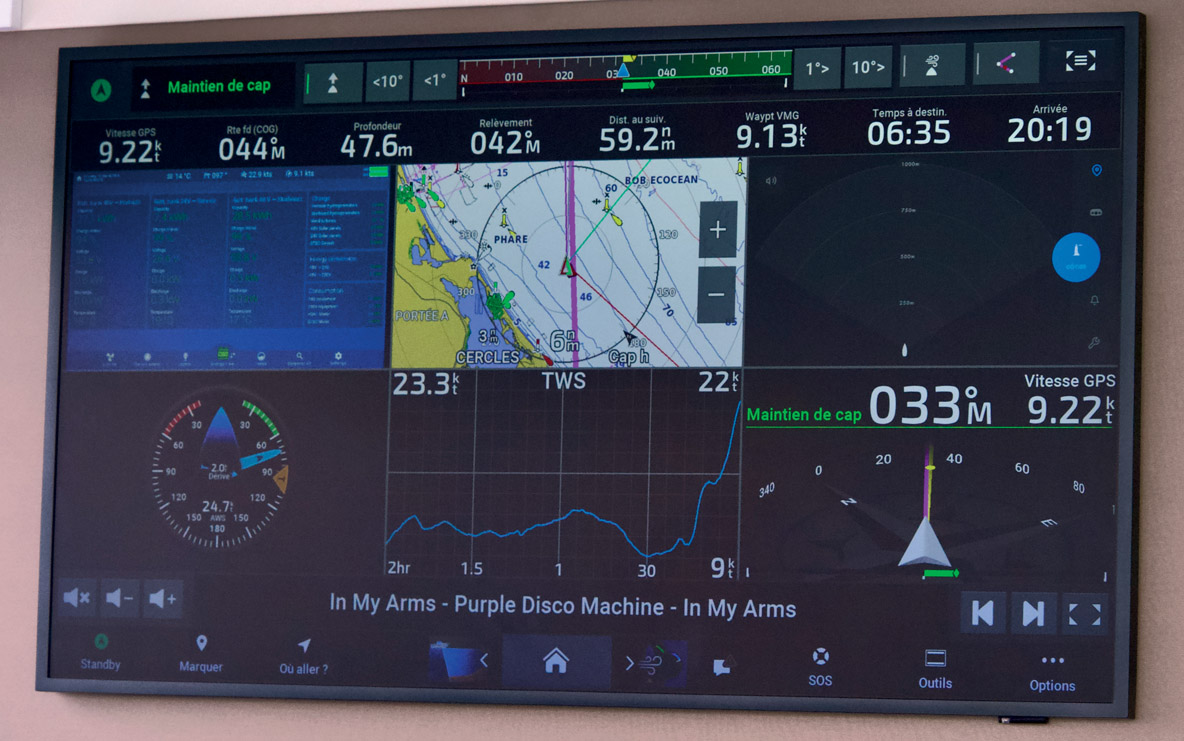
The argument could be summed up by the data displayed on the screen sent back to the interior cockpit: it’s there that we can constantly check the production of the famous green energy!
Then it was time for our in-situ readings: the battery status showed 91% on port and 96% on starboard. In the two hours we’d been on board, we had generated one ampere of wind power, i.e. 48 W with 10 knots of wind. Although no weekly or monthly history is yet available, the shipyard is working on this to ensure the best possible traceability of energy production and consumption on board. For the time being, the software developed by Windelo can be used to monitor hybrid electric propulsion and all aspects of on-board energy.
Under way, you can easily and intuitively monitor solar energy inputs and the total energy balance. The display shows solar, wind and hydro-generation. The latter is possible from 8 knots of wind, with a loss of speed of one knot. When the catamaran exceeds 11-12 knots, overall speed is virtually unaffected. Since energy production is a little less efficient upwind, with the windward hull likely to lift a little at times, it’s best to use on downwind points of sail.
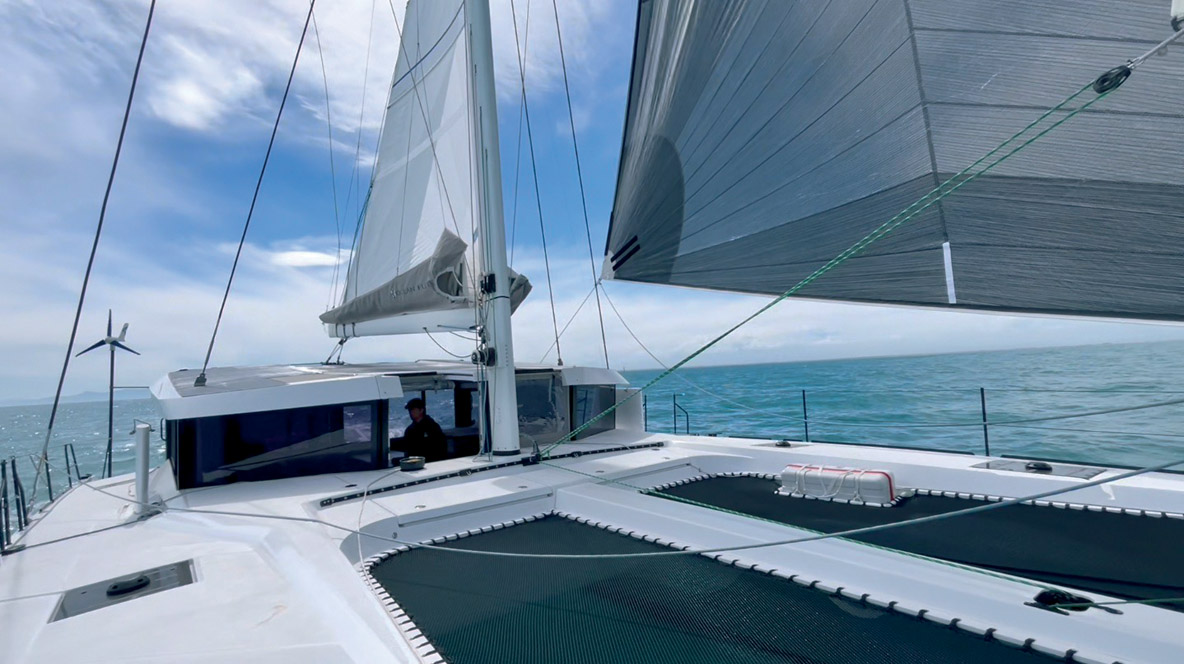
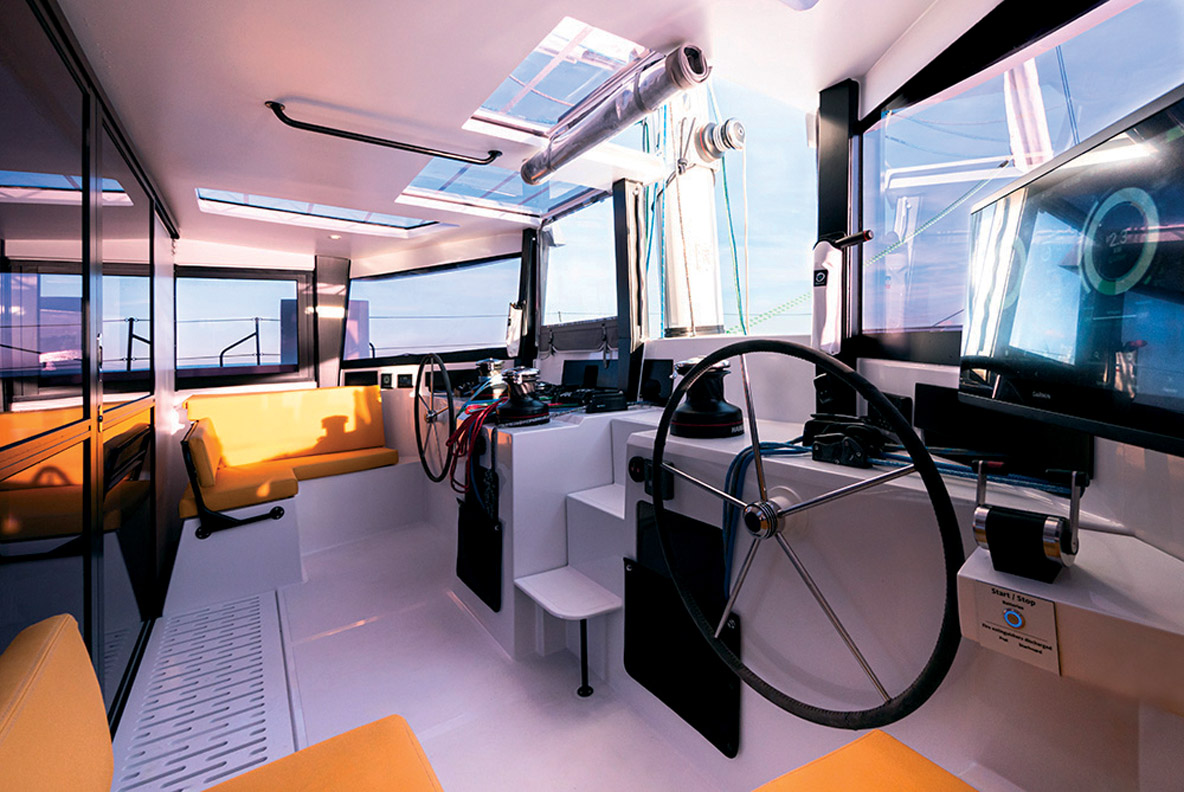
Handling the sails from the enclosed interior cockpit is remarkably easy. The halyards and two electric winches at the foot of the mast make the job easy. The flow of traffic between the exterior and interior couldn’t be smoother. Three steps provide access to the forepeak via the retractable soft plastic hatch. The foredeck area features two trampolines with a contained surface area. The track for the self-tacking headsail is discreetly integrated into the deck.
The coachroof, fitted with non-slip panels, is accessible via retractable steps at the mast foot. A certain amount of acrobatics is required to climb up. With no sunbathing area or flybridge, access to the end of the boom is quick and easy. A real plus for night-time sail maneuvers, hoisting or dropping sail.
In one hour under sail in light conditions, the batteries recharged by 3%
It was 11 am as we left the red port beacon to starboard and hoisted the mainsail, then the solent, on a course of 347° in just over 10 knots of true wind. With the sails trimmed, our close-hauled speed was 6 knots at 30° to the true wind. The Windelo’s responsiveness in light airs was self-evident, and the daggerboards play a key role in ensuring good upwind course-keeping and that the boat picks up again quickly when tacking. The daggerboard controls are returned to the inner cockpit; it is advisable to raise the appendages up at speeds of 12 knots or more, or in heavy cross seas, as was to be the case a little later. At the helm, the New 54 is very responsive. It feels more like a sport catamaran than a multihull weighing almost 13 tons. The calm before the storm was good, and the sailing was almost ideal, but it wasn’t to last...
While the fair-weather thermals on this side of the Mediterranean tend to settle in a south-easterly direction, which would make it easier for us to reach La Grande-Motte with the wind pleasantly on the beam, the low-pressure systems tend to generate an easterly pattern. This means close-hauled sailing with plenty of sea to go with it.
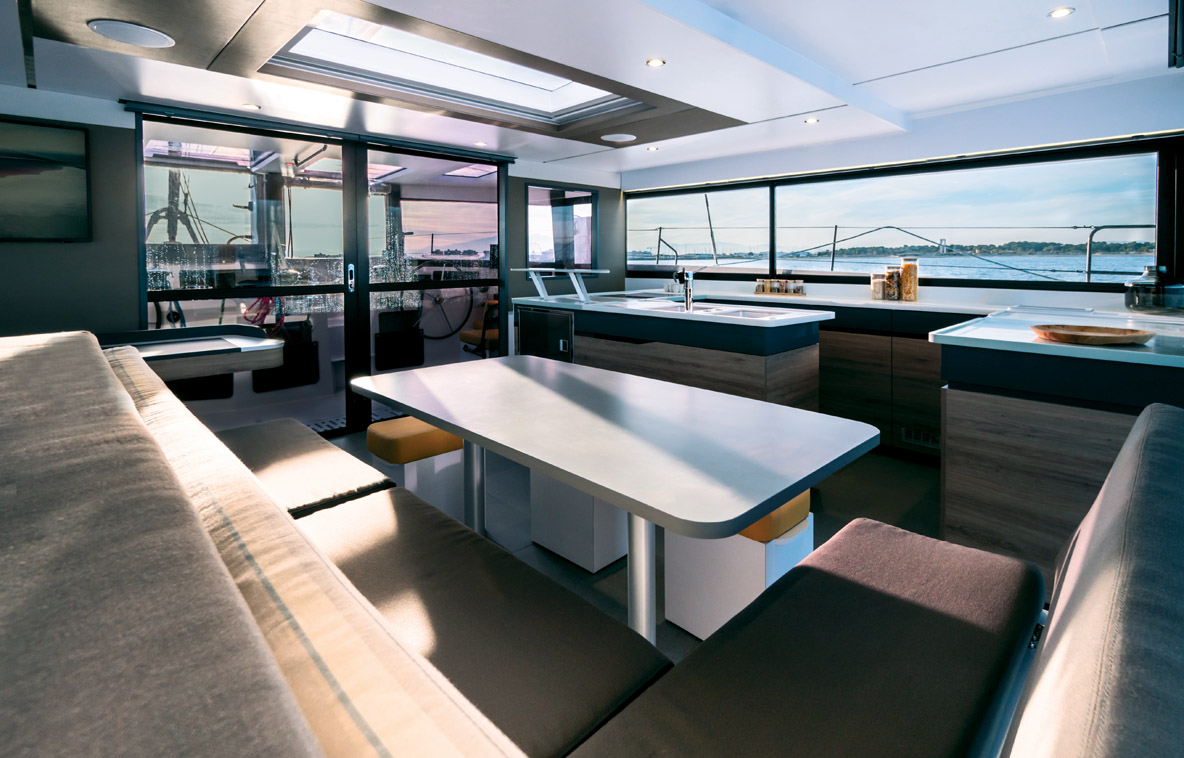
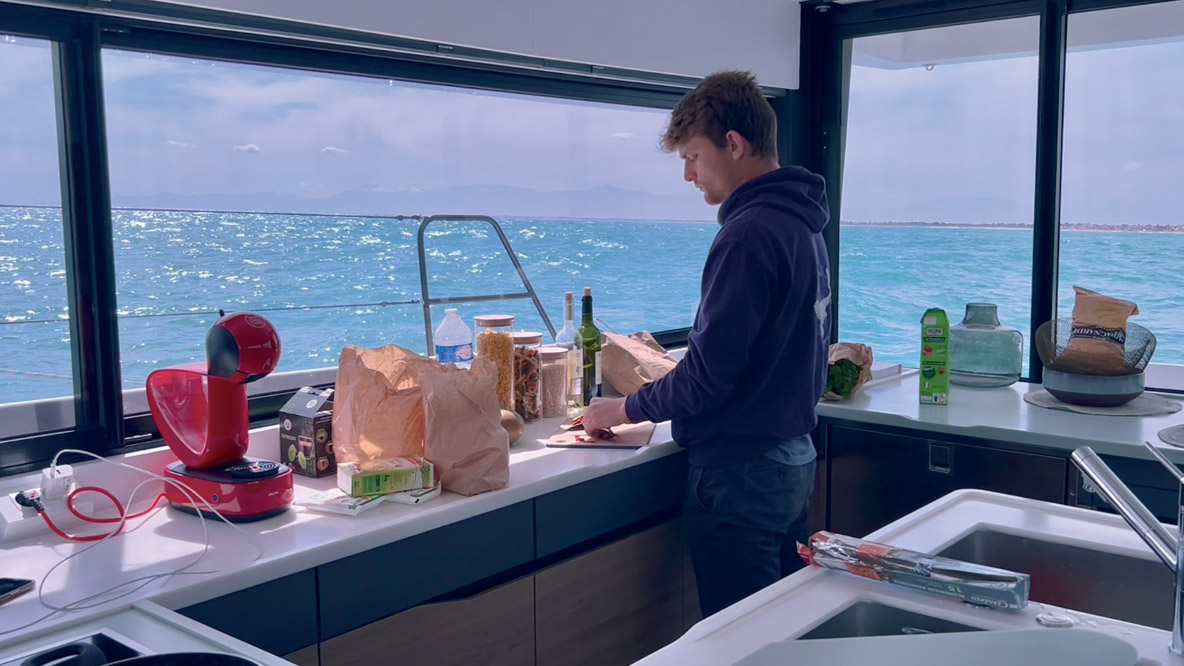
Once the upwind leg was completed, as we rounded Cape Leucate with a final tack, we could now bear away, making 7 knots with 13-14 knots of wind. The catamaran was stable, silent and nothing rattled. Time to prepare lunch. Power consumption on board was high: the autopilot, hob, oven, electronics, music and the large interior screen used to display navigation information in the saloon were all switched on. But we were also recharging: in one hour of sailing, 3% of the batteries were recharged using solar panels and wind power.
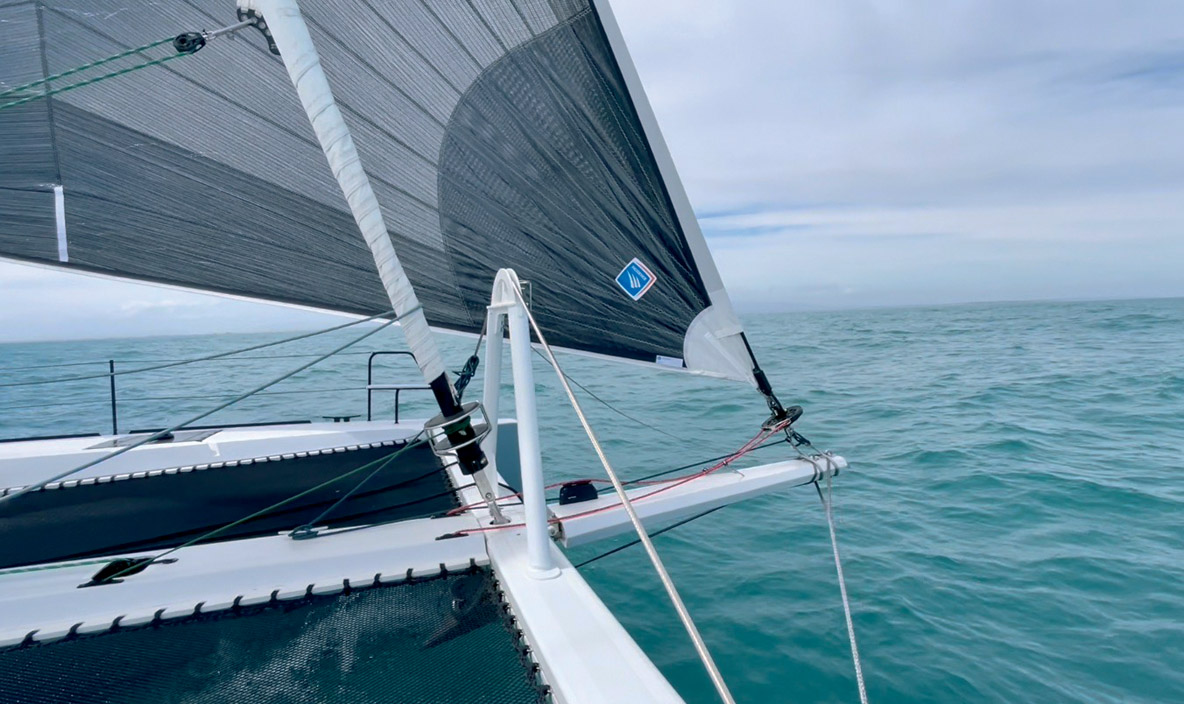
The sun was shining brightly as we left the snow-covered Canigou in our wake. At 1 pm, a quick and easy Code 0 was unfurled, enabling us to make 9 knots as a base speed. The sky was still clear, the wind steady, the sea not yet too rough and the Incidence sails well-trimmed - all was well in the best of all worlds, in this case that of blue water cruising multihulls.
Effortless sail maneuvers thanks to the electric winch
Then, as expected, the wind quickly picked up to 23 knots. Given the weather forecast, we weren’t going to enjoy flying the beautiful headsail for long, and Stéphane organized the sail reduction maneuver. Furling is effortless, thanks to the electric winch, and we took the opportunity to reef the mainsail.
A 30-knot forecast calls for caution, as we need to avoid breakage just a few hours before the start of such an important boat show.
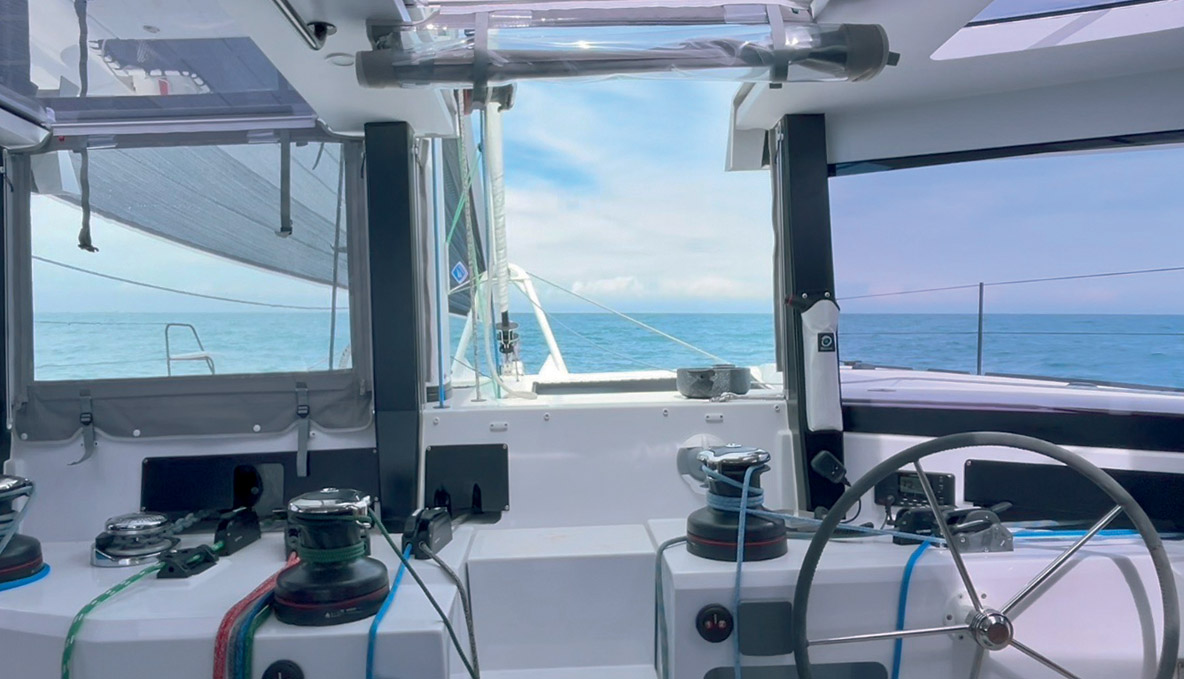
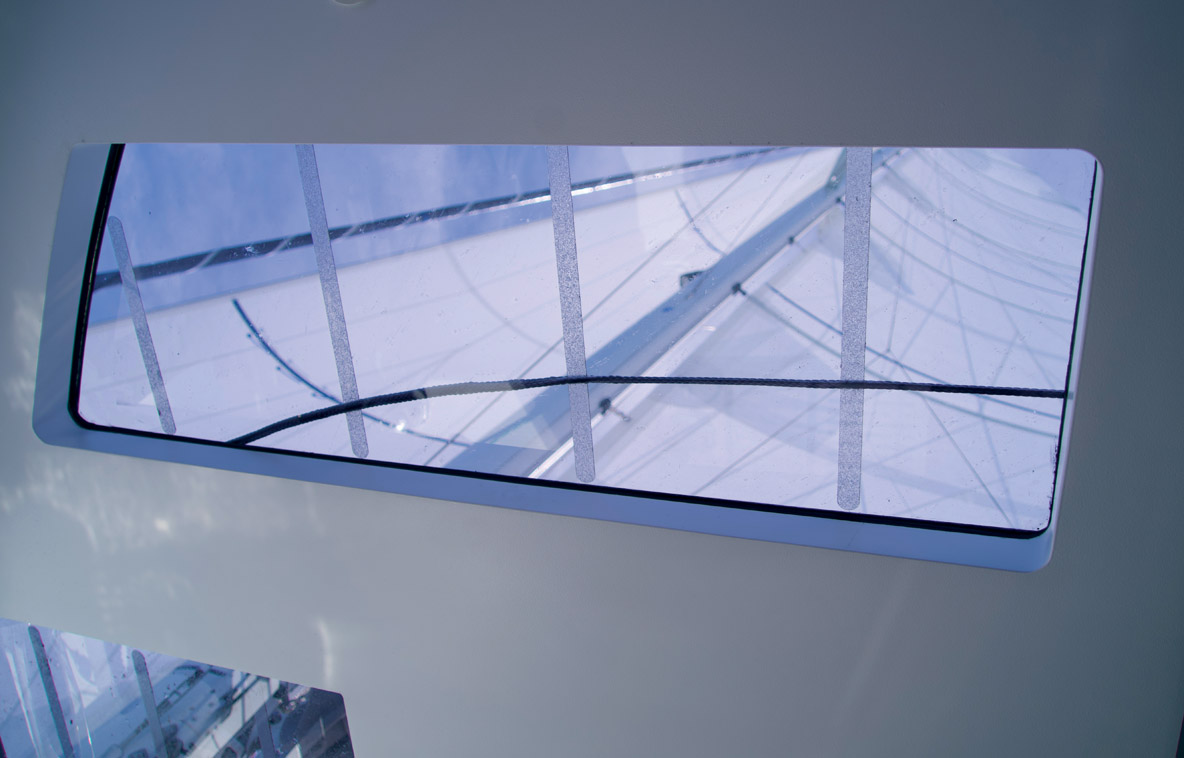
Visibility forward from the inner cockpit is optimal, and the openings in the coachroof allow you to see almost the entire mainsail. The solent was back on station, the compass heading indicated 033° and the wind instrument was continuing to pick up.
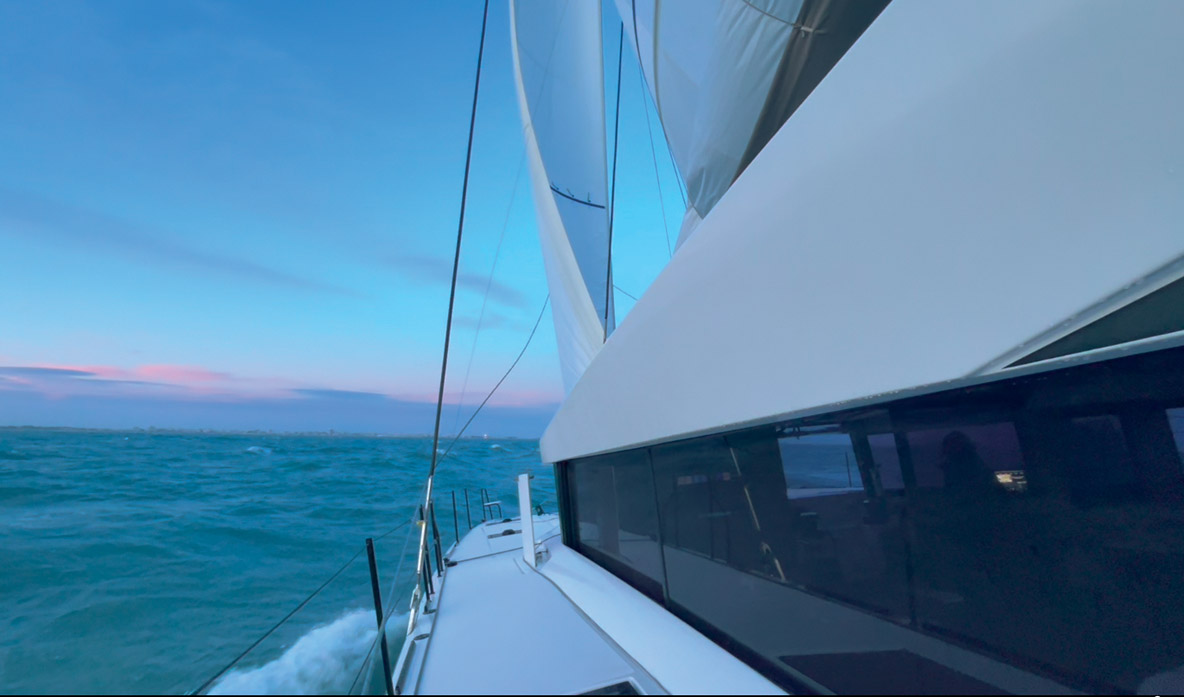
The sky began to turn from azure blue to steel gray. A sea was forming fast, cross, choppy and unpleasant on the beam. The wind was also on the beam, now relatively stable in direction and strength. With 10 knots of speed and 30 knots of consistent wind, the New Windelo 54 Yachting emitted no structure-borne noise. Stiffness is the order of the day, as is helm responsiveness, which came in very handy for countering the onslaught of misdirected swells. Despite these challenging conditions, the catamaran reacted very well and stayed on course.
Sailing with an opening to the outside world, while protected from the spray
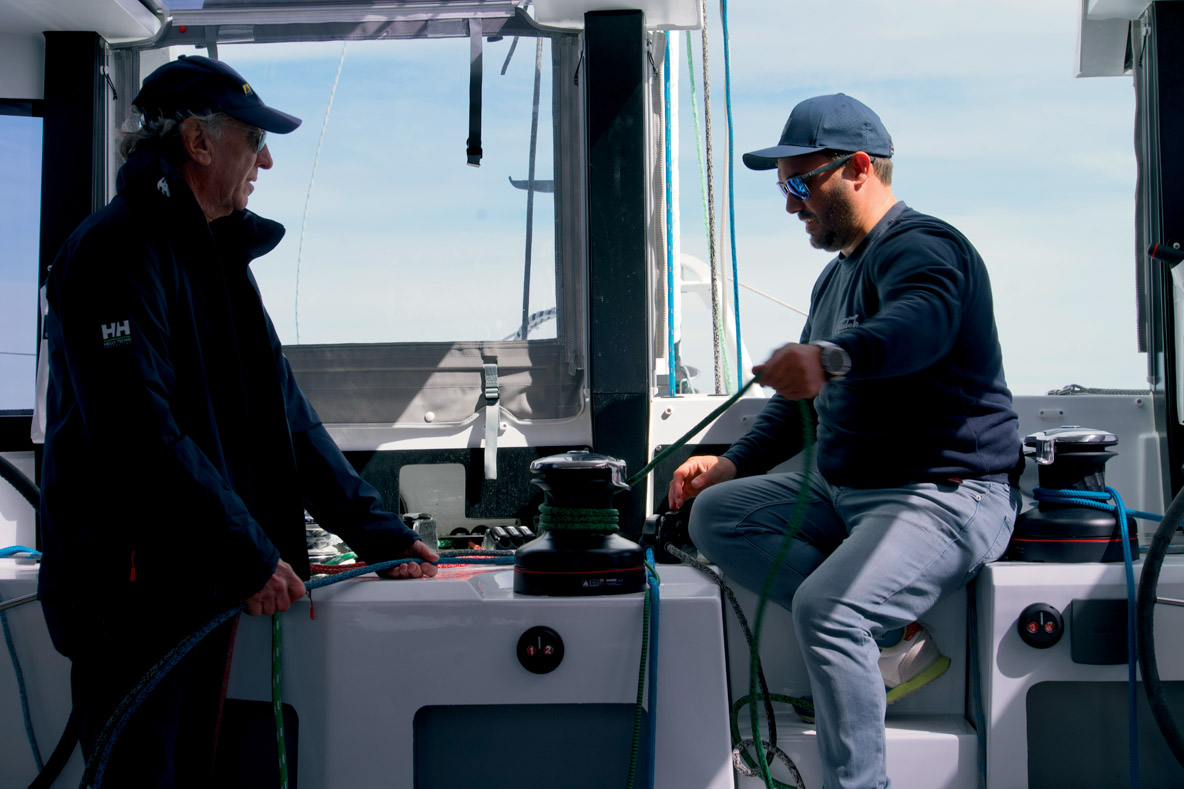
I fired up the autopilot: it reacted immediately and effectively corrected any sheer. From the helm station inside, the mood is one of lounge chat in jeans and a sweater, at a time when foul weather gear and boots would be the order of the day aboard many other multihulls. Sitting in the cockpit is optimal for controlling the catamaran’s progress, with the sheets within easy reach, sail trim visible and a constant view of the crew in the saloon.
The forward opening next to the mast and the hatches allow you to sail with an open view of the outside, while being well protected from the spray. Fresh air in the cabin is a real plus.
Battery charging was completed around 3 pm, as wind and sea conditions strengthened. With 35 knots of wind out of the east and the gusts, the waves were cresting a good meter/3 feet above the rail on the beam (the deck itself being 2.8 m/9 feet above the waterline), and the sailing was becoming a little more muscular, but this is really experienced differently from the comfortable cockpit. The Windelo’s rapid progress was not disrupted by any untimely gusts or waves, and the catamaran was making good headway at over 11 knots, with repeated peaks of 15.
The water was really bumpy, but the catamaran stayed dry, and there was no need to close the cockpit completely, despite the amount of spray that was ending up at the foot of the mast.
Our sail in heavy seas makes for the opportunity to point out a few details that would benefit from some fine-tuning. Such as the handrail integrated into the coachroof. Although visually very successful, it ends a little too early at the after end, making it difficult to move right around the boat. At the same level, the guardwire is a little too low to grip, leaving a feeling of emptiness when moving around. At the stern, an additional handrail would be welcome to enable you to move from one side to the other with a decent grip.
The interior windows let in a small amount of water through the vents at their base. A detail easily corrected, as is the absence of a solid latch to prevent the cockpit’s large sliding door from slamming shut while underway.
Electric motors effortlessly counter the windage even heading into wind
At the stern, navigation information is transmitted to the saloon screen, so you’ll quickly have all the data you need if you’re sitting on the very practical watchkeeper’s berth. There was no hiding our enjoyment as the sensation of gliding is omnipresent, and the bows fly through the cross seas without forcing things. This New Windelo 54 felt very well balanced, swallowing up the miles, as the Ferris wheel next to the entrance to the port of La Grande-Motte hove into view as the daylight was beginning to decline.
Unfortunately, a problem with the on-board computer at the end of the day prevented us from accurately tracking and recording energy consumption in real time. However, the energy production was validated, as we were at 100% charge at the end of our 70-mile passage. The system ensures that the multihull is able to sail autonomously.
Approaching the port shortly after 7 pm, the electric motors were switched on, the mainsail lowered and the solent furled. The swell pushed the Windelo along at over 7 knots between the two entry beacons. On approach, the twin 20 kW Bellmarine electric motors were in use to the full, to align the multihull with an optimal approach to the dock, despite the strong wind and the many boats already arrived for the show. The side windows were open to ensure good communication between the helm station and the deck crew. The wide spacing between the two steering wheels means that operations can be carried out calmly, with a quick glance at the hulls. Controlled from the small throttle levers, the motors handle the Windelo’s windage smoothly and without jerking, mooring it in place. Traffic on deck is fluid. You can move quickly from one side to the other to set the mooring lines. Lockers and cleats are ideally located.
Conclusion
As night fell over La Grande-Motte, our delivery trip was drawing to a close. It had highlighted the catamaran’s excellent sailing qualities, and particularly noteworthy are the practicality of the interior helm station, the comfort of the watchkeeping berth, and the ease with which sails can be hoisted and trimmed. But what really sets the New Windelo 54 apart is its more environmentally friendly cons- truction than that of almost all its competitors, and the ability to sail long distances without carbon emissions.
Eco-responsible sailing: Checklist for greener sailing
- A clean hull
Smooth hulls reduce friction on the water and make slipping through the waves easier. A simple inspection with a mask can reveal the general condition of hulls and propellers.
- Solar panels and wind generators
Dirt-free, unencumbered photovoltaic cells and optimally rotated wind generators are a good guarantee of satisfactory energy production.
- Chasing down wasted electricity
Regularly check the cabins to turn off all unnecessary lights, fans and other electrical appliances. Remember to unplug chargers and switch off power strips. There’s no such thing as a small saving: in the long term, all gains are significant! For multihulls equipped with air conditioning, remember to use it sparingly: it’s one of the biggest consumers of electricity on board.
- Take it easy in the galley and shower
Both in the galley and the bathroom, sensible consumption is easy to implement. Water catchment and flow reducers are easy to install. A refrigerator set to the minimum is often enough to keep food fresh. Let’s avoid waste and unnecessary packaging.
Deck plan Focus on the forward cockpit
Unquestionable seaworthiness
Very successful new design
Attractive forward cockpit
Safety on deck could be improved
Sealing and blocking of the forward window needs to be reviewed
No electric motor available for the tender
Technical specifications
Architect: Christophe Barreau
Material: basalt and PET/PVC foam sandwich
Length: 54’ (16.46 m)
Beam: 26’2” (7.98 m)
Displacement: 28,200 lbs (12.8 t)
Draft: 3’5”/7’9” (1.05/2.35 m)
Mainsail: 1,066 sq ft (99 m²)
Solent: 485 sq ft (45 m²)
Gennaker: 2,045 sq ft (190 m²)
Motors: 2 x 20 kW
Batteries: 1,120 Ah 48 V
Generator: 1 or 2 x 18 kW
Fuel: 132 US gal (500 l)
Water: 105 US gal (400 l)
Price: from €1,380,000 ex-tax
Price of catamaran we tested: €1,794,730 ex-tax
Main options in € ex-tax
B&G electronics package: 19,840
Three-blade folding propellers: 4,670
Bow pulpit with seat: 2,460
Square-topped mainsail and self-tacking solent in Hydranet: 16,460
Downwind sail hardware: 11,625
XRP Code 0 on furler and hardware: 11,850
Maxilite gennaker: 9,720
3 electric winches size 60: 10,530
4,500 Wp flexible solar panels: 53,900
105 l (27 Us gal)/h Watermaker: 13,750
4 stools in saloon: 1,600
Bow cockpit cushions: 3,410
10-person safety equipment: 4,510
Gala Aquaheim 330 Hypalon tender pack with 20 hp outboard and console: 13,200
Coppercoat antifouling: 14,900
Mooring kit: 2,040
Preparation, launching, commissioning: 7,870