
The fall boat shows are drawing to a close. Knowing that the new Lerouge design built in Latvia by O’Yacht would be on show at the Festival de Plaisance in Cannes, we went to southen Brittany in early August to have an exclusive look and share our first impressions with you.
Infos pratiques
- Le chantier : O Yachts Class 4 Voyager
- La fiche technique
-
 Découvrez notre vidéo exclusive
- Financez votre O Yachts Class 4
- Assuez votre O Yachts Class 4
- Articles autour du O Yachts Class 4
Building in the Baltic
After long dark days (from 1940 until the break-up of the Soviet Union), the Baltic States gained independence in 1991. Latvia joined the European Union in 2004. Close to southern Finland and Sweden, neighboring Poland, Germany and Denmark, the coastline of this small state of 2 million citizens puts it legitimately in the world of boat-building. Although multihulls have only recently been introduced in the Baltic, the history of this enclosed sea, which has both a rich past and capability, means it is able to quickly adapt and take pride in some impressive know-how (Dragonfly, Swan, Baltic Yachts, Marström…)
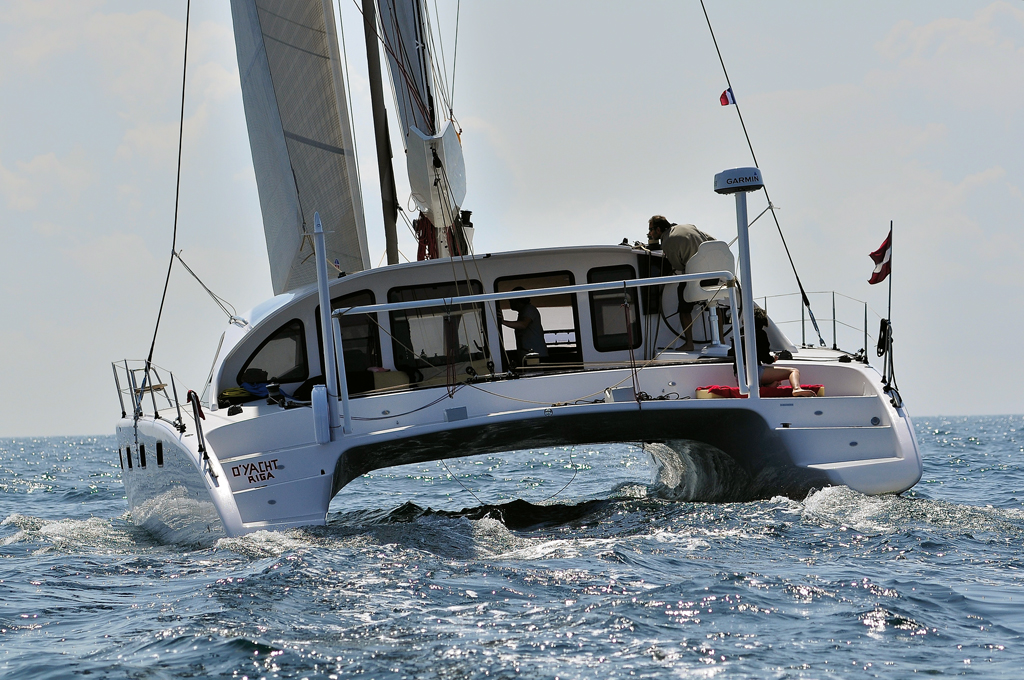
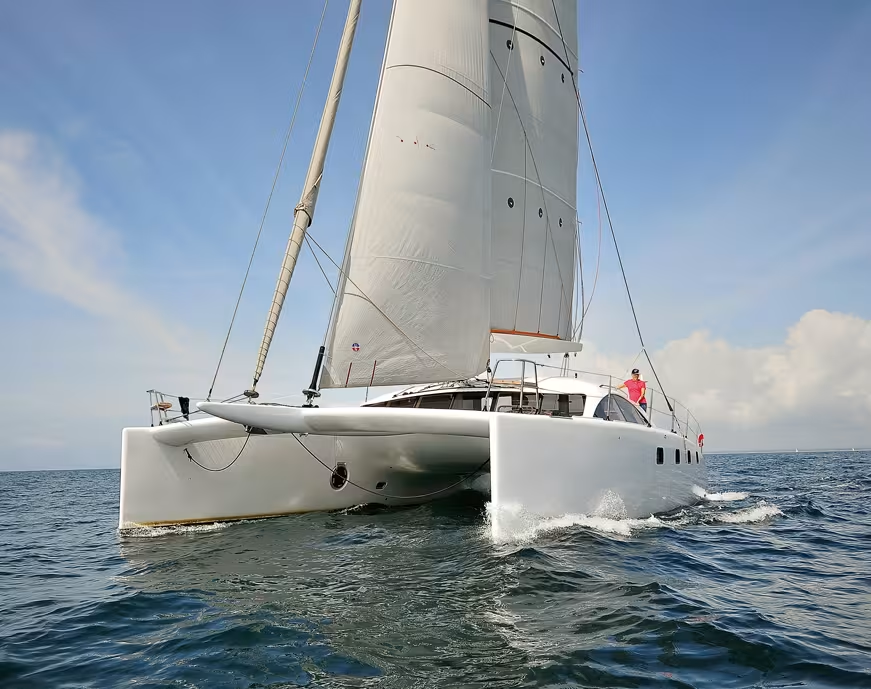
The perfectly clear “tunnel”, very aerodynamic coachroof design (note the sliding door mounted on the inside, very discreet!) and a modern, efficient, sleek sailplan are the hallmarks of the O’Yacht
O’Yacht: the Newcomer
Dan Levy, head of this small company is a defector from the IT and real estate industries. This quick-thinker gets straight down to business, and easily summarizes the complex information surrounding the operation. An avid sailor, he shamelessly admits to being a recent catamaran convert, but he is learning quickly and knows how to apply his talents in every sector. As evidence of this, it is he who determines the objective and the standard of quality to be achieved. He is involved in most of the technical decisions, and his requirements apply to even the smallest of details. The purchase in 2014 of the Angure boatyard, in association with a well-established Latvian partner, gave O’Yacht the opportunity to take over the infrastructure and new tooling of Ambercat, which exhibited a 21 meter model at the La Rochelle Boat Show in 2009. The staff of the qualified team have been kept on, under the direction of Karlis Kalviss, who had been working with composites for 18 years and infusion for 8 years. O’Yacht defines its philosophy as “advocating a real maritime culture in the Baltic backed up by flawless ethics”.
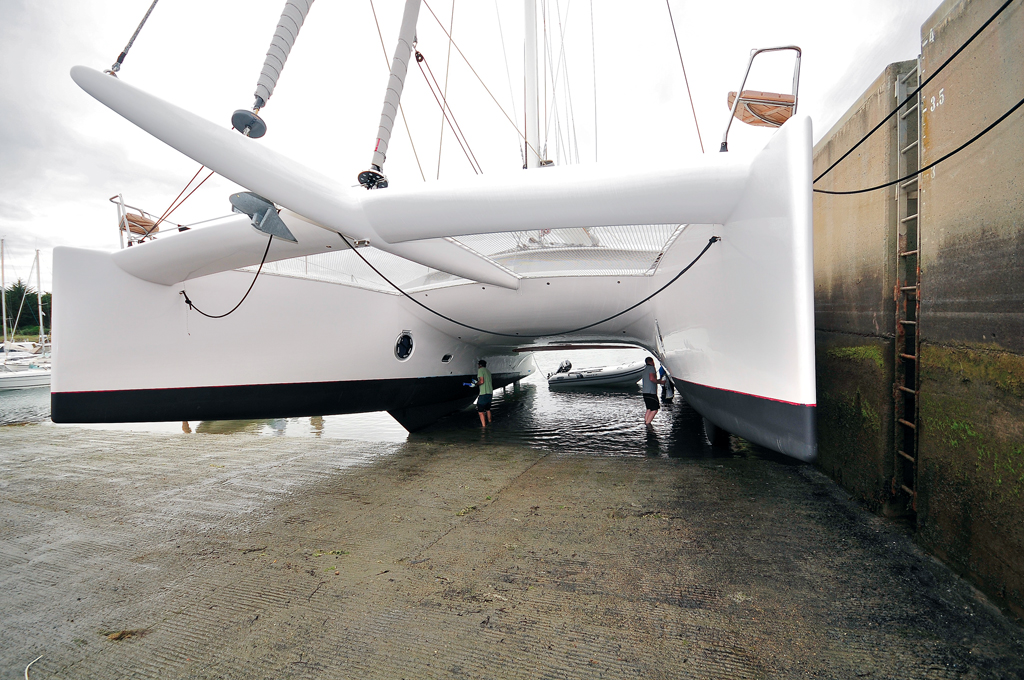
Bowsprit and forward beam in carbon, atop fine, straight bows, a very soft-shaped nacelle: who says that a catamaran with keels can’t stir things up a bit?
Érik Lerouge, multihull designer
Since finishing his studies in Southampton in 1976, Érik has been living, thinking and breathing boats, especially multihulls. His knowledge of math and physics (and hydro and aero-dynamics) is underpinned by huge sailing, racing and flying experience. With Ville Audrain in 1980, he designed a first visionary 13 metre catamaran. Inoui, which has now logged more than 100,000 nautical miles will be remembered for the Multihulls 84 Trophy (averaging 18.5 knots over 5 miles!). Cité d’Aleth built by Raymond Labbé and Philippe Tournier's Azuli and Freydis, paved the way for high-speed sailing and remain some of the best-loved boats ( remember D.Demachy’s Gifi, a production Freydis 49 which over several years caused a few shocks at the M50!)
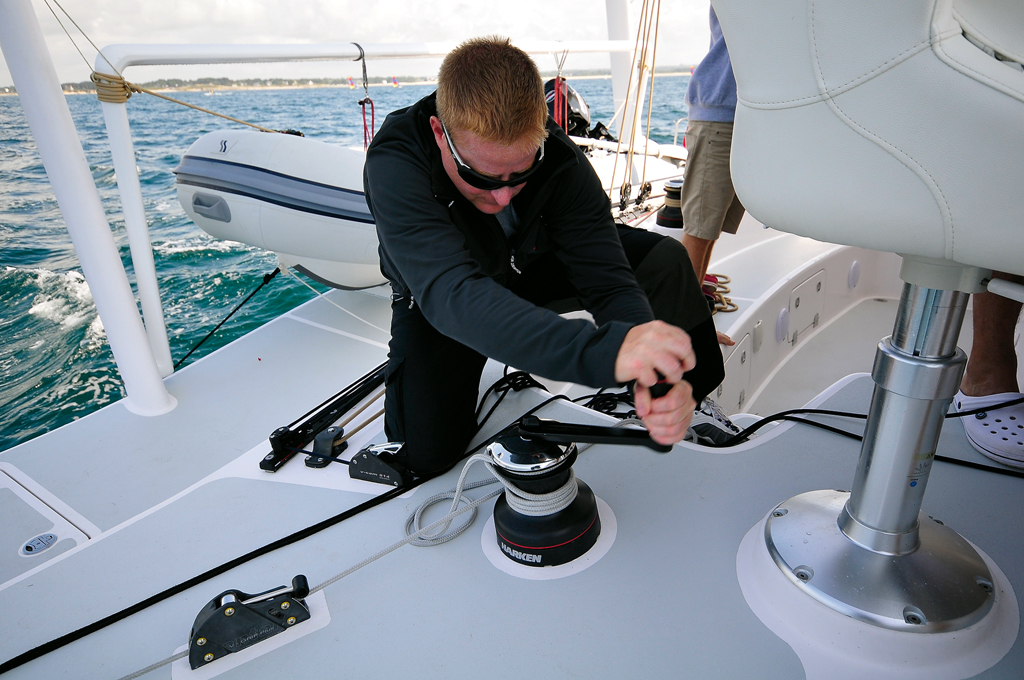
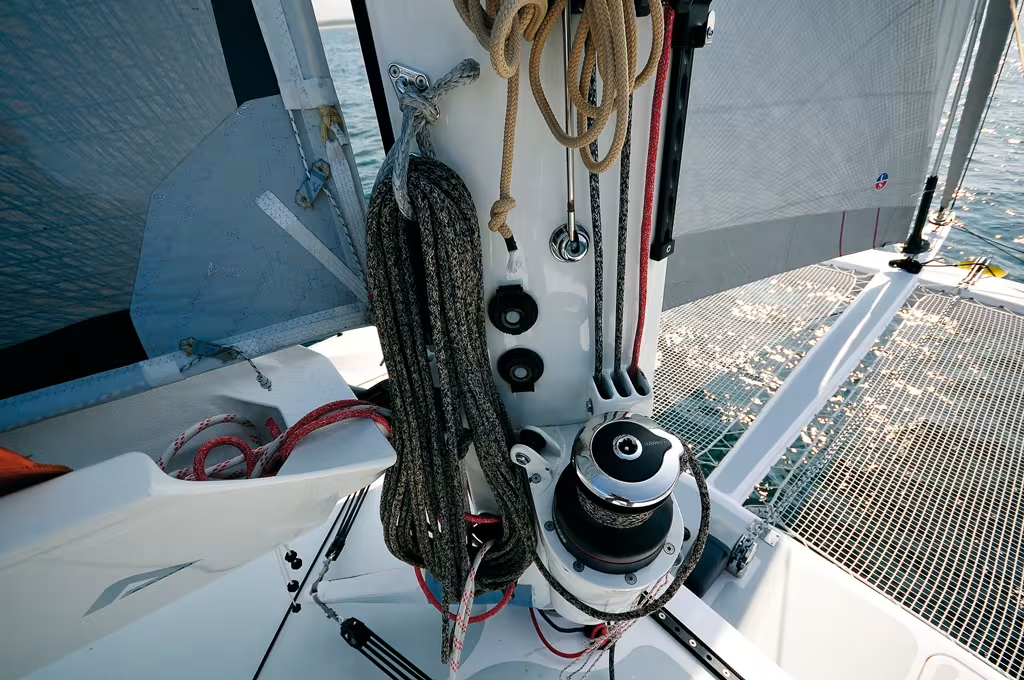
If the management of the mainsail via the central winch appears perfect, the flat position of the traveler / furler winch could do with improving
The Class 4 design and build
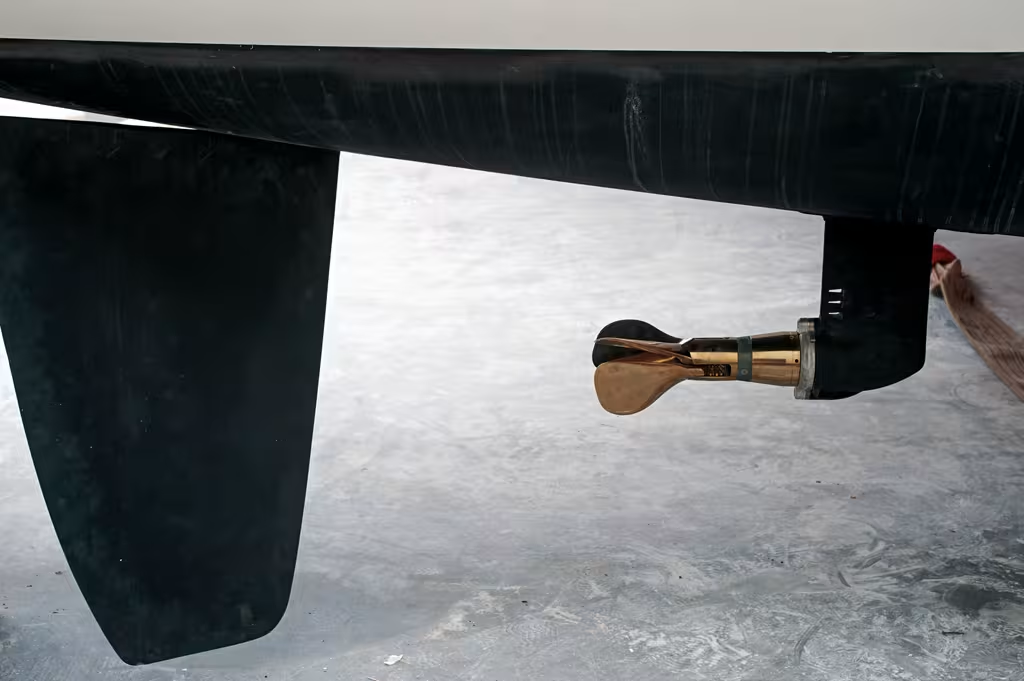
There’s no doubt that the designer is of the opinion that lifting daggerboards give better theoretical performance (less leeway upwind, and less drag ), but this advantage is offset by skegs which can take the ground. Lifting daggerboards can be fragile. Their complexity and impact on space inside the hulls (for maximum efficiency), limits them to being a racing option or for those who want an ultra-light boat. For cruising (even quickly!) the constraints (or opportunities!) for drying out, sailing in coral areas or in rivers, not to mention hauling out on the hard, lead him to recommend skegs. The O’Yacht Class 4 is available in both versions. Our test boat was the Premium version with fixed keels. Érik Lerouge has carefully developed the hydrodynamics of the hulls and Clifford Denn added his expertise in designing the coachroof and panoramic look of the deck salon; the O’Yacht design team takes charge of the 3D modeling and the implementation plan of the building of the integral structure. The main parts (the nacelle with interior half-hulls, the external half-hulls, deck and coachroof) are completely infusion-made, and solidly assembled, being laminated manually. A layer of Kevlar helps protect the underwater area. Whichever version you choose, the structural elements in carbon are non-optional: forward beam, main bulkhead, compression beam and bowsprit are all in carbon fiber, and contribute to the stiffness, keeping the weight centralized and increasing durability. From what we were able to see on board, the composite phase of the build is very well done, a compact infusion with no bubbles, as well as a good resin/cloth impregnation ratio.
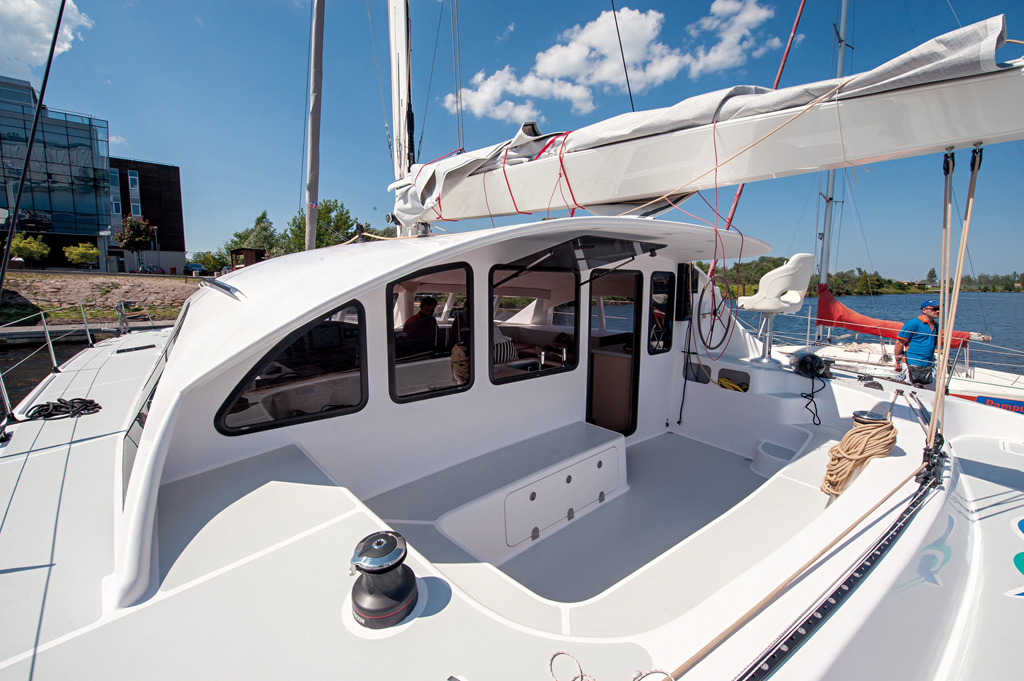
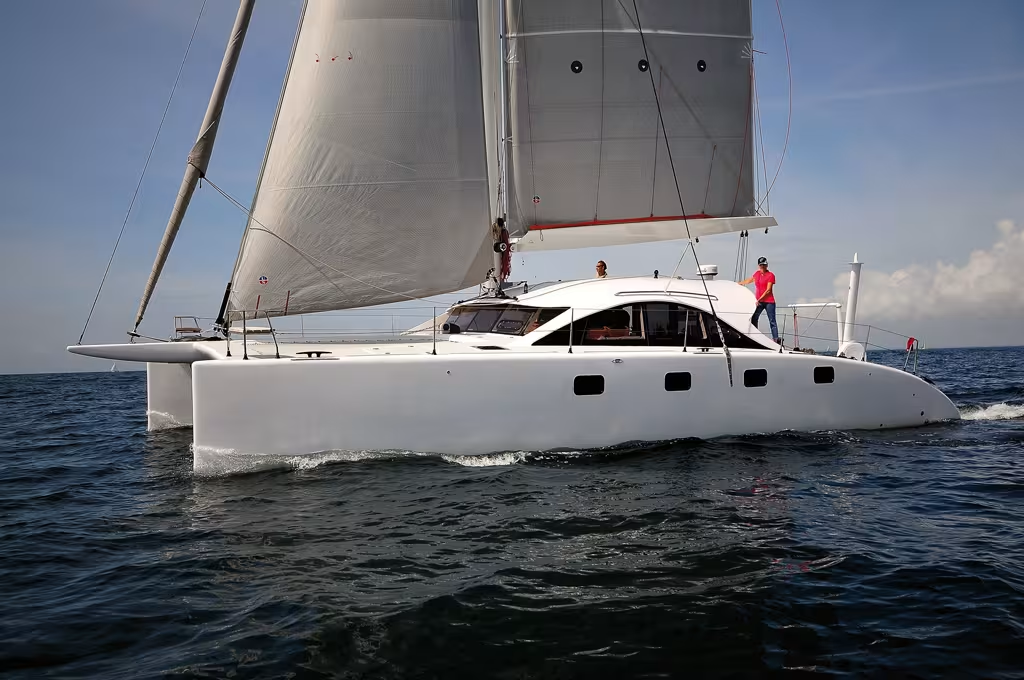
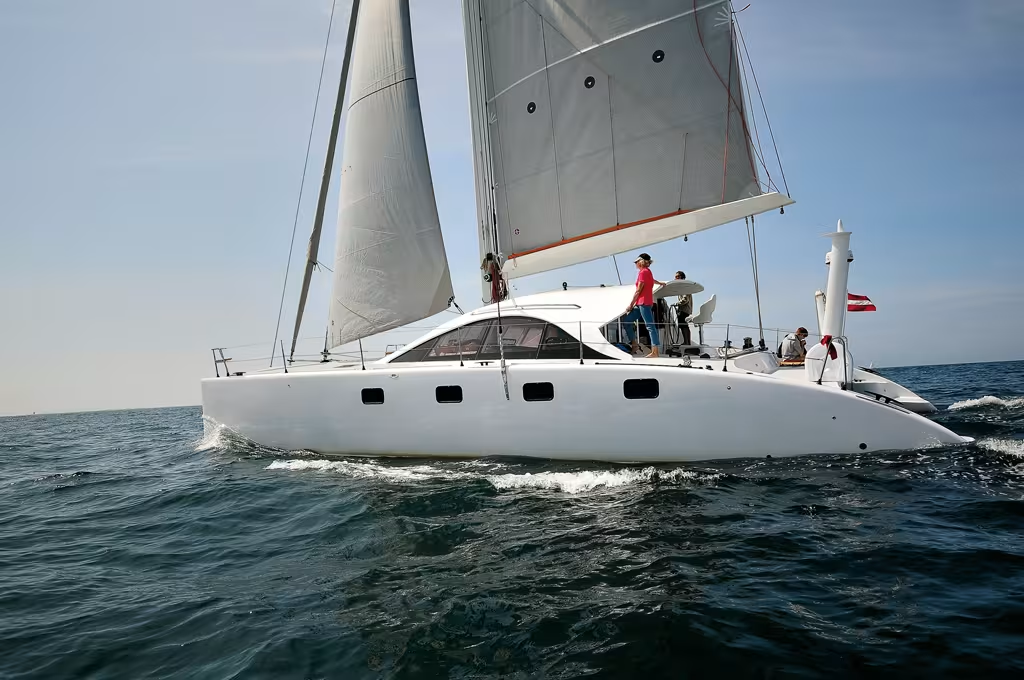
The superb coachroof is also very functional. The bimini awning is a great addition (cockpit table and upholstery removed), the design giving light and ventilation, while maintaining a sporty helm station
Interior layout
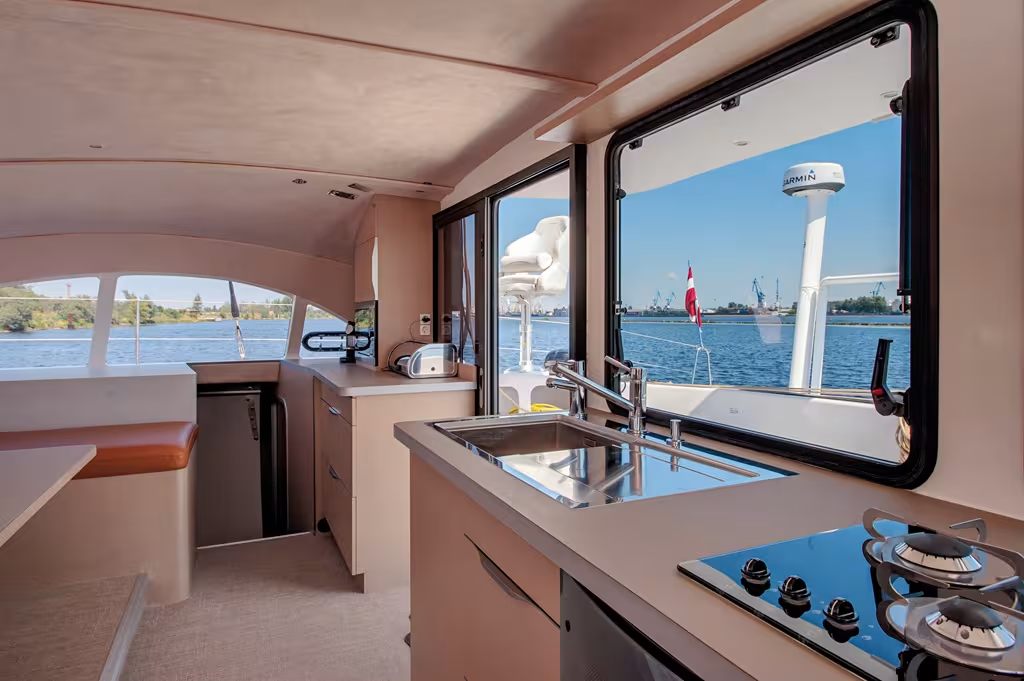
Let’s start by noting that the Class 4 has an attractive style; a consequence of precision manufacture and a refined choice of materials. Nothing ostentatious, but a luxurious simplicity inspired by Nordic style. The salon, upholstered in fawn leather, is comfortable, and the furniture and doors are all made in sandwich. Their surfaces are finely trimmed with satin aluminum profiles, with integrated handles which are light to the touch and easy on the eye. The façades (Alpi-style) are in a rich variety of woods. The galley opposite the cockpit is well designed and equipped, and benefits from large opening windows. The rot-proof and wear-resistant floors in Jacquard PVC are a fine substitute for the usual Bolon flooring. For the work surfaces and the table top, O’Yacht has produced a scratch-resistant laminate, made from nano particles, with remarkable effect. It is also used as the interior linings, bonded directly to the inside of the hulls. On the deckhead, the breathable Alcantara material is superb, and very well fitted. The desire to find aesthetic perfection is evident in the system of captive nuts and backing plates used to secure deck fittings. This illustration of industrial artwork is a real breakaway from traditional fixings. Another example is that of the sliding door of the deck salon, artistically mounted on the inside. The heads compartments are a good shape, but their size on the four-cabin version remains limited and the washbasins are small.
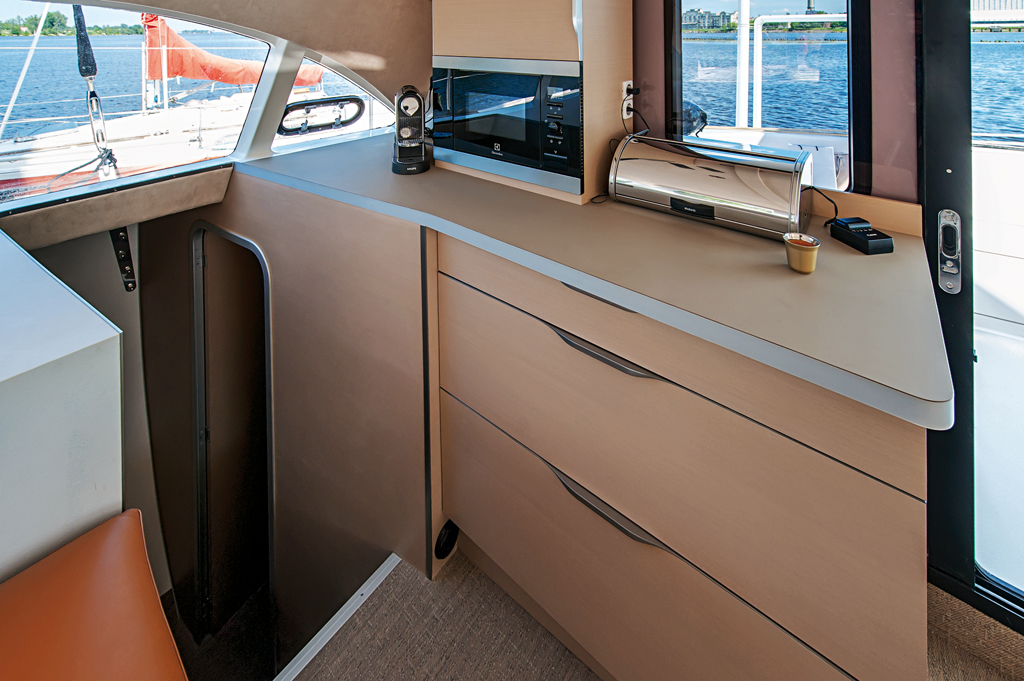
The wood veneers on the sandwich façades are superb, and the surfaces bordered with satin aluminum profiles with integrated custom handles with smooth edges
Deck layout, rigging and dynamic test
The transverse aft beam really contributes to the boat’s overall stiffness, so there can be no complaint about the lack of a cut-out down to the sugar scoops! The flush deck mounting of the mainsheet traveler winch could be improved, but a modification would be easy to design. As for the rest, leaving any emotions to one side, it’s faultless! The deck layout favors simplicity and efficiency, with the achievement of this goal being aided by an electric, multifunction #46 winch, for the genoa and solent sheets. There is no track for the genoa, just a stand-up block, a great solution in the case of an all-or-nothing sail, which requires being perfectly dimensioned and stable. The solution for taking it one side or the other has been designed for simplicity. Halyard management and mainsail reefing is done at the mast, with two winches, one of which is electric, fitted to a carbon pod which is integrated into the mast. This cunning and innovative little handling system does away with all the problems associated with rotation - brilliant! The magnificent canoe boom, in which are housed the fiber jammers for the reefing lines, contributes to clear and comfortable sail handling. The battle against friction is greatly advanced by these “short circuits”. The Harken batten cars limit the sliders from stacking up from the top. A 5 hour sail on board the Class 4 allowed us to discover the boat’s exceptional potential. Unfortunately it had to come to an end, as Bénodet was the only possible stop on their route from Riga to Cannes where we would be able to see the boat in order to bring you our first impressions in the October edition! The evening before, already wonderfully fed, I had the chance to get to know the equipment, the stiffness of the frame underfoot and how the boat lay at anchor, which all indicated some promising weight-savings. The following day in the channel leading to the open sea, I got to admire the rigging, the splendid Dracula Spars-Axon carbon mast by Éric Duchemin with its canoe boom bubbling with intelligence. The bigger sail area on the Premium version translates ambition into performance, and the division of the headsails is particularly clever. A solent for ease AND an all-or-nothing overlapping genoa, fixed on the bowsprit (furler with fiber stay) for really moving in medium conditions! When sail handling, the striking things are the ease of hoisting sails, the absence of friction and the feeling of directness at your fingertips. Once trimmed, the true nature of the boat revealed itself, and it set off like an arrow! The magnificent suit of membrane sails by Ullman Sails works wonders. The importance of trimming adjustments made us totally forget the sophistication. The “machine” seemed to be almost electrically assisted, and slid through the water with the slightest breeze (8.5 knots on the GPS, close hauled with 8 knots true and 7 of us on board and the boat fully loaded with stores!). But more than the numbers, it was the absence of rolling and pitching, the stiffness of the platform and the grip of the rudders in a choppy sea which gave it enviable performance. The precision of the helm via Jefa rod linkages was amazing, and the leverage just right - what a pleasure! The feel of the hulls on the water was subtle, the balance sensitive; this catamaran swims easily, skimming the sea. The attention of the helmsman is rewarded by an agility and movement on the water rarely found on a cruising catamaran; above all, accompanied by the feeling that it is easy to handle. An extra bonus is the way in which the headsails complement each other allowing you to maintain the same sensations in less than 10 knots of wind! In a breeze, it’s possible very early to go down to the solent and one reef and to keep control without losing any of the liveliness! After beaching the boat on the ramp at Loctudy to clean the hulls, I have to say that this all-terrain capability, combined with promising performance, has convinced me!
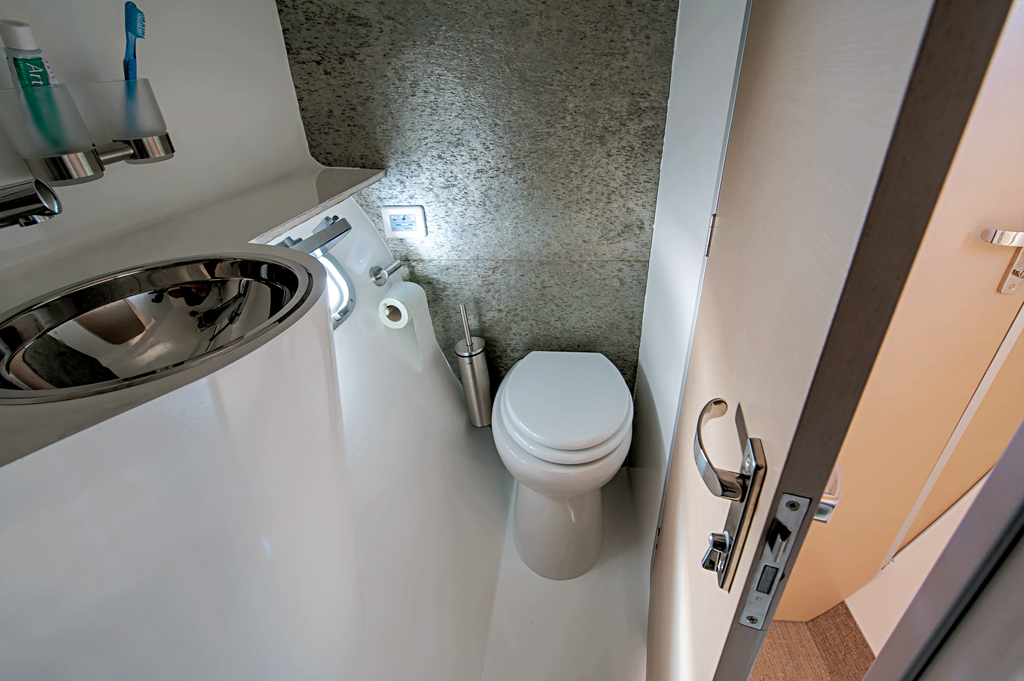
The volume of the heads compartments are a little small on the 4 cabin version, but the standard of finish and the elegance of material used is high (a fine natural stone veneer)
Conclusion
Within the confines of a test which for me was too short, discovering the Class 4 did enthuse me. Pleasure is guaranteed for daysailing, and the delivery trip around Spain has shown the boat’s offshore qualities in big seas. The overall balance of this successful multihull is a result of the effort put into the design and choice of equipment. The harmony between the “motor” and the “chassis” owes nothing to chance, it is truly the source of the fun of sailing this Class 4. The aim of 300 miles in 24 hours with good wind and sea conditions is within reach without compromising comfort!
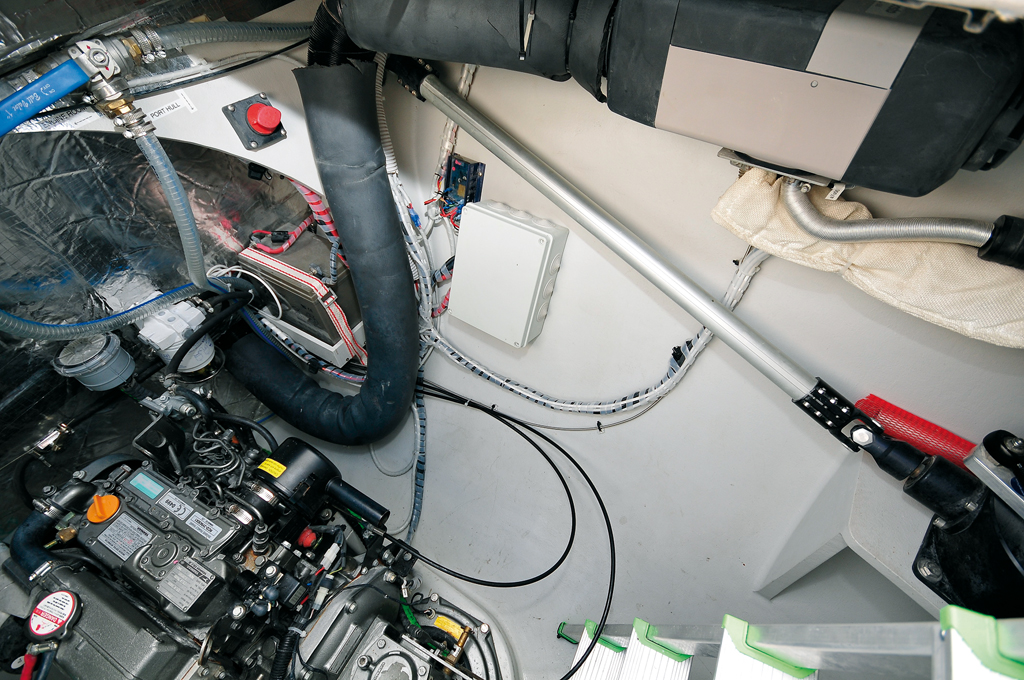
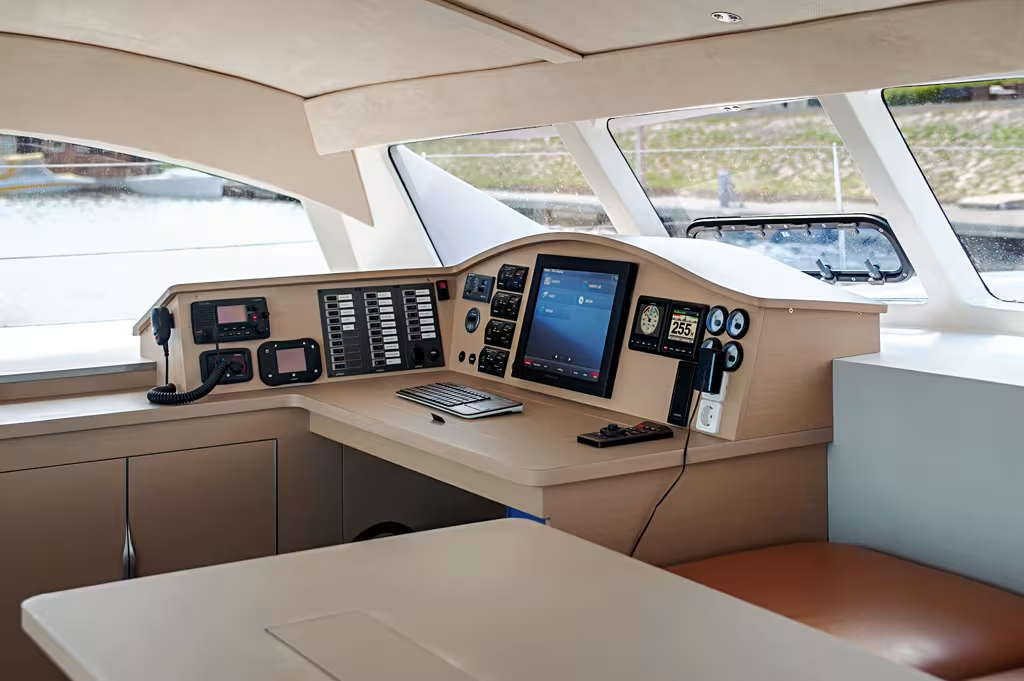
The engine rooms are well designed and the panels close up remarkably well. The linkages and joints of the Jefa steering are clearly visible, one of the key factors of the Class 4!
Technical description
Architect: Érik Lerouge Designer: Clifford Denn Builder: O’Yacht Length: 13.99 meters Beam: 7.60 meters Draft (keel version): 1.06 meters Light displacement: 7.6 tonnes Bridgedeck clearance: 85cm Mast height: Voyager Version in aluminum: 18 meters, Premium Version: 19.40 meters Mainsail area: Voyager: 71m², Premium: 80m² Genoa: 44m² Self-tacking solent: 34m² Gennaker: 84m² Code 5: 103m² Asymmetric Spinnaker: 160m² Motors: 30hp Yanmar or Volvo Transmission: Saildrive Water: 350 liters Fuel : 2x200 liters Holding tanks: 2x80 liters Version tested: Premium with keels Principal options on the version tested in € excluding tax: Axon carbon mast: 62,000 *included on the Premium Carbon canoe boom: 13,000 * Compression beam and bowsprit in carbon: 12,000 * Solar panels (5x48W) : 3,390 Jefa rod linkage steering: 6,500 H46 electric winch on the coachroof: 2,700 Watermaker 60 liters/hr: 8,000 Forced-air heating: 8,000 Luxury interior: 9,500 Electronics pack: 8,000 120A Alternator: 3,500 Flexofold three blade propellers: 2,800 Price: Basic Voyager version with aluminum mast: €490,000 ex-tax Basic Premium version with carbon mast and keels: €590,000 ex-tax Version tested - Premium with full options with keels: €690, 000 ex-tax
Plusses
- Build quality and weight savings
- Hydrodynamics, aerodynamics and weight all in sync
- Comfort / performance balance
Minuses
- Ergonomics of the cockpit winches
- No sacrificial beaching strips
- Heads compartments cramped in the 4 cabin version
Competitors
| Model | Builder | Upwind sail area m2 | Weight in Tonnes | Price in € ex-tax |
| Outremer 45’ | Outremer Yachting | 121 | 8.7 | 469,500 |
| Swiss 45’ | Swiss cat | 112 | 12 | 692,500 |
| Dazcat 13.50 | Multimarine | 150 | 6.5 | 488,750 |
| Catana 47cr | Catana | 139 | 10.9 | 609,700 |
The architect’s opinion
A cruising catamaran is an enjoyable dilemma. The laws of nature and the boundaries of the subject are thus - striving for comfort is detrimental to weight, windage and sailing performance. So everyone has to choose where they draw the line between volume and performance, according to their program and their tastes. I love performance catamarans, but what really motivates me is making a boat which is enjoyable to live on, seaworthy and easily achieves good average speeds. Speed while cruising is not just a pleasure; it’s also a safety factor and one of comfort. The design of the Class 4 allowed me to experiment with a bit more spice, a certain amount of luxury and a perfect finish. Yet this is the biggest problem with catamarans, with their big volumes! We had innumerable discussions with the developer about getting these limits in proportion. In short, it was a search for quality, but one obsessed by keeping the weight down! What the talented designer Clifford Denn brought to the project was vital, giving a timeless style to the Class 4. The hulls are a product of constant evolution - that’s one of the privileges of having designed over 200 catamarans! It’s a question of having efficient hulls, but hulls which can both tolerate weight and will work in a choppy sea. Proper keels were fitted on the first model, with daggerboards being an option. The build is in sandwich infusion, with Kevlar reinforcements below the waterline. The beams are in carbon, to save weight, to reduce weight at the extremities and to increase overall structural stiffness. The sailplan is fairly traditional, but with lots of enjoyable options of lightweight sails to set from the bowsprit. The superb Axon rotating mast in carbon contributes to the effectiveness of the square-topped mainsail. The fiber shrouds help reduce pitching. All this is aided by top of the range fittings. The deck layout is very functional and convenient for a contemporary catamaran, with an acceptable amount of windage. The interior arrangement favors space with exterior views, and the positioning of all the equipment was a constant preoccupation for keeping the weight centralized. The organizational structure of the O’Yacht yard allows for semi-custom models to be built - that’s “haute couture”: within the limits of the existing molds, we can fine tune, to resolve the eternal challenge of making the ideal catamaran. Érik Lerouge

Caption
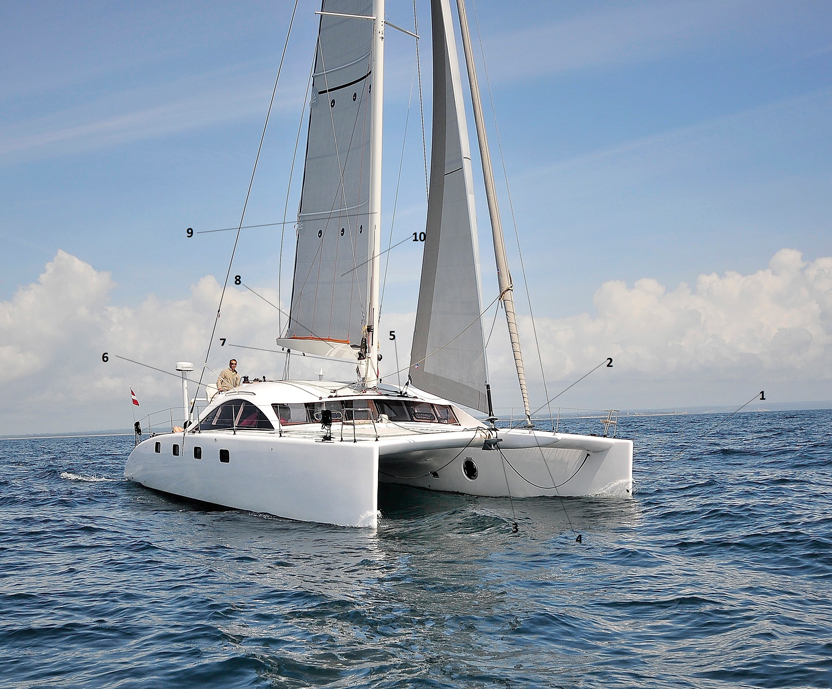
- : The bows combine both a fine entry and progressively bigger volume, helping create stability underway
- : The integral bowsprit and forward beam form a carbon cross, minimizing weight
- : The attachment of the solent furler (by webbing) crosses the beam, giving added reliability
- : The overlapping genoa aptly compliments the solent, attached far forward on the bowsprit. It’s almost like a gennaker, leaving the option for a Code 5 or a modern furling asymmetric
- : Having a self-tacking solent makes total sense on this lively and responsive boat
- : The unique helm station combines all the advantages of modern helm design, with the precision of rod linkages for an unrivalled feel
- : The famous sail-handling pod gathers together all the mainsail management (hoisting, reducing, clew outhaul) in one innovative and ergonomic spot
- : The superb carbon boom houses fiber jammers for the reefing lines and the outhaul track in an elegant, lightweight design
- : The Dracula Spars/Axon mast, with Kevlar standing rigging: an efficient choice on the Premium version
- : The suit of carbon sails by Ullman Sails, coupled with a mainsail track with Harken batten cars is just perfect
