MULTIHULLS WORLD EXCLUSIVE - This 63 feet semi-custom multihull combines speed, safety, comfort and even a bit of glamour. What’s its personal touch? It’s got to be the central hull so close to the surface that it’s hard to decide if this is a cat or a tri!
Infos pratiques
- Le chantier : O Yachts Class 6
- La fiche technique
-
 Découvrez notre vidéo exclusive
- Financez votre O Yachts Class 6
- Assuez votre O Yachts Class 6
- Articles autour du O Yachts Class 6
Test location: Rade de Toulon, South of France
Conditions: 5 to 7 knots of wind, smooth sea state
O is for Owner
The O Yachts brand made a name for itself in 2014 under the impetus of Frenchman Dan Lévy with his Class 4, a model that has since seduced several owners (See test in MW no. 138). The goal of the Latvian shipyard, based northeast of Riga, is to produce “owner’s” multihulls - as its O suggests. The model I’m discovering today is the second one; the first one, released more than a year ago, started its career as a powercat (with a big internal combustion engine in one hull and an electric motor in the other) before being fitted with a rig. The objective of the Class 6 is to appeal to yachtsmen who want to go far and for a long time, with their family (possibly short-handed), with a multihull of which they would have chosen not only for the standard finish, but also most of the technical elements of navigation and comfort. The platform is very spacious but nevertheless capable of the highest average speeds, in complete safety, whatever the sea state. That’s an ambitious program, maybe even contradictory, you might ask?
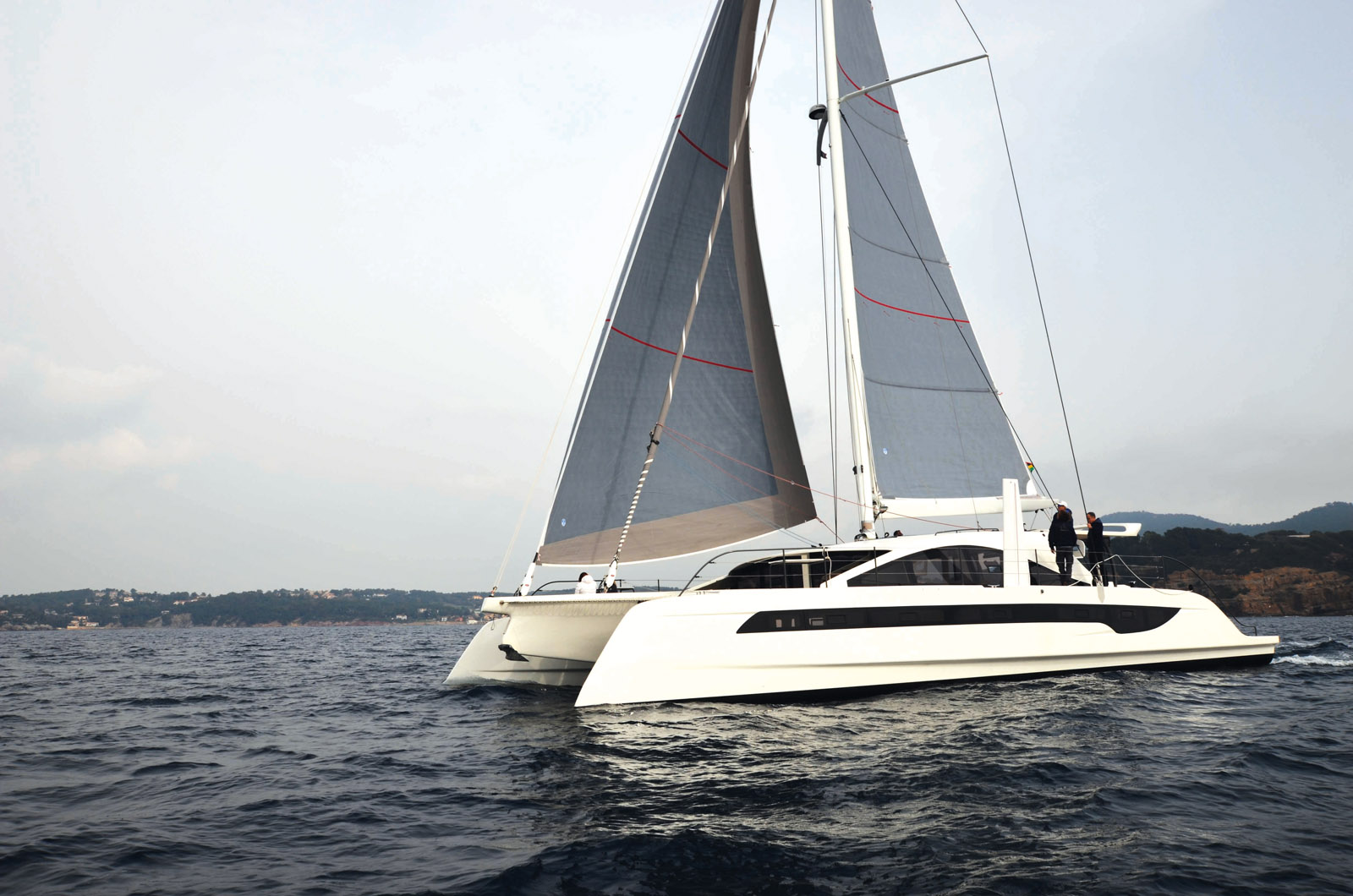
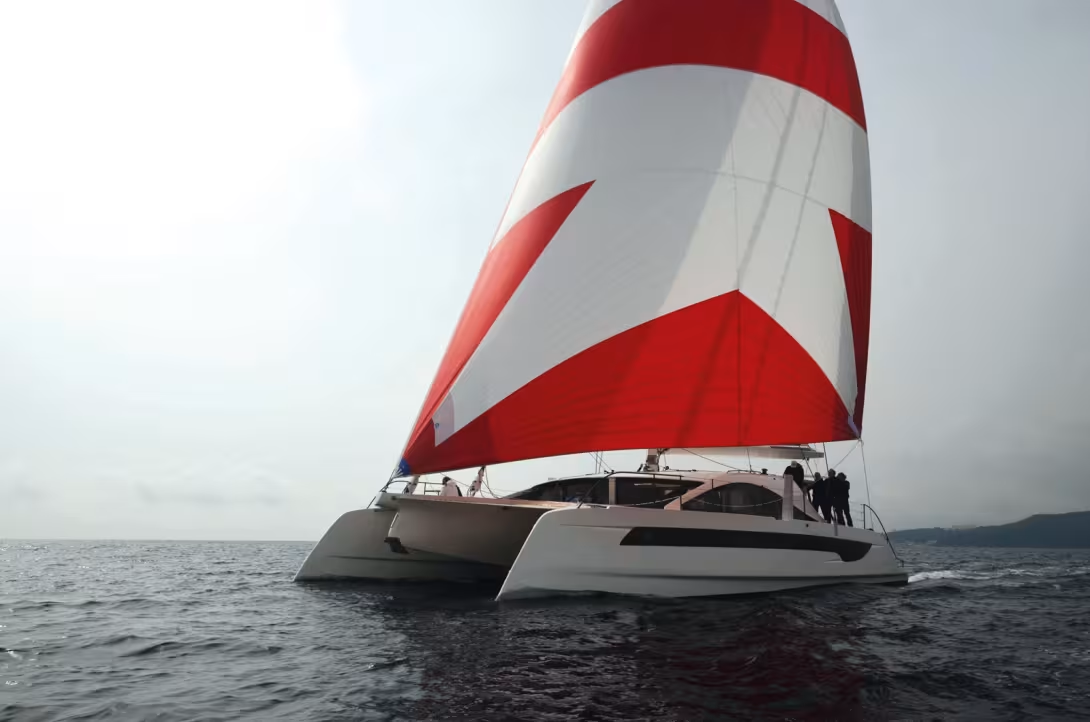
In light airs, despite a very modest sailplan for this category of luxury sport yacht, the Class 6 manages to move at wind speed.
The large, curved daggerboards plunge to 12½ feet (3.8 meters), helping to maintain an excellent upwind course.
Luxury cruiser or sport yacht?
The original design of this semi-custom multihull puts the emphasis on inventiveness and method. To achieve his goals, Dan Levy called on the famous French yachtsman Laurent Bourgnon. Prior to his unfortunate death in June 2015 in a diving accident, he had participated in the development of this new type of catamaran. The main idea was to combine the exceptional speed of a sport yacht and the comfort of a luxury cruiser with more than 645 square feet (60 m²) of nacelle space. Ultimately, O Yachts demonstrates with its Class 6 that it is still possible to find an unoccupied market sector in the multihull world.
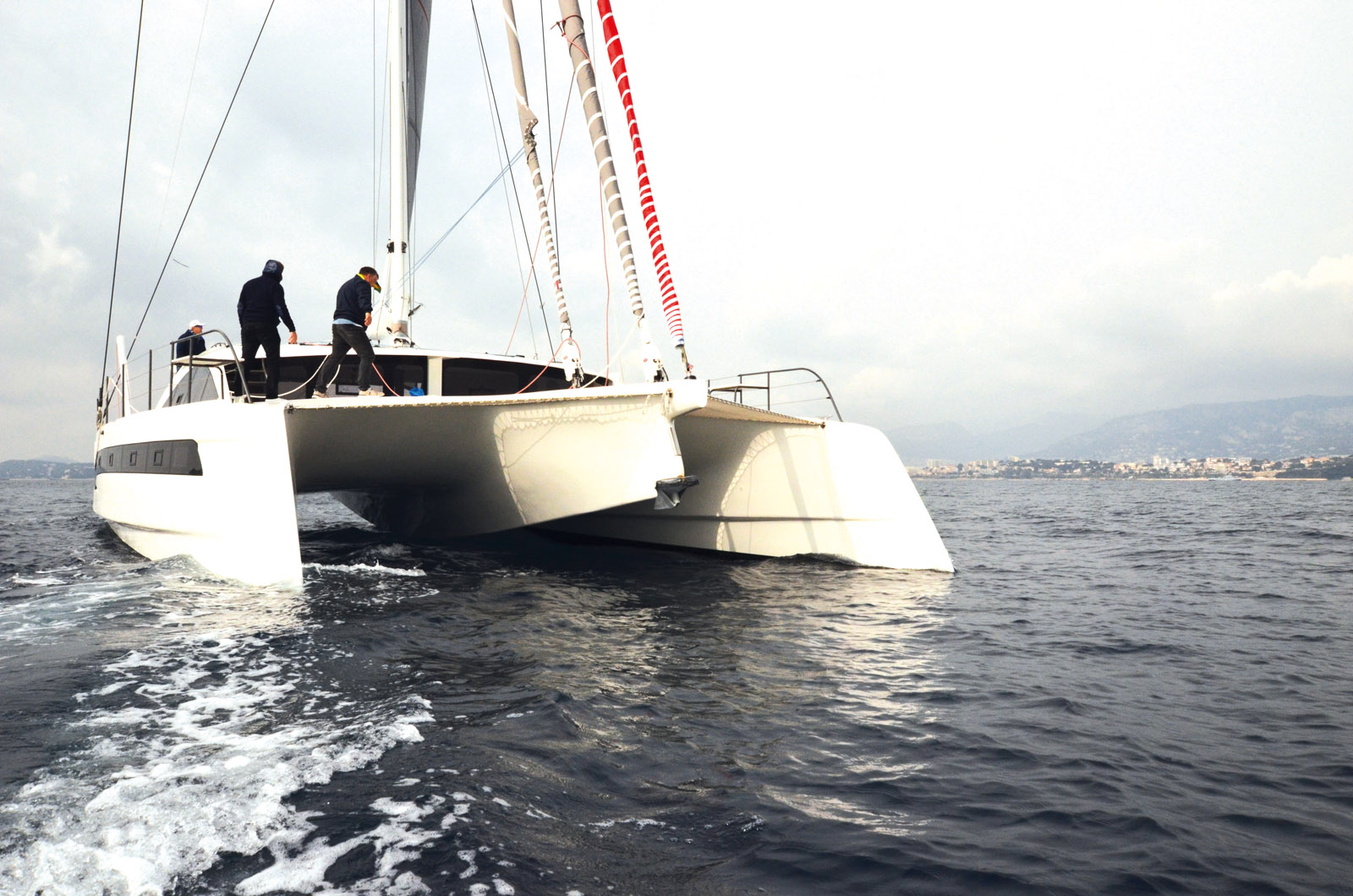
The central “spine” is the masterstroke of the design: a third hull in suspension. Molded into the nacelle, it takes up the loads from the mast. Like the other two bows, its mission is one of piercing the waves and increasing buoyancy as the water passes beneath the nacelle, thus avoiding slamming and limiting the tendency to bury the bows.
Central hull and high-tech material
In order to give this unit exceptional potential, weight control became Dan Levy’s number one obsession. To launch one of the lightest boats in production, carbon fiber is used for all the outer and inner skins. A military grade ripstop foam is inserted into this sandwich. The whole is vacuum infused with epoxy with Kevlar reinforcements on any impact and high torsion areas. A curing process is then implemented according to a cycle recommended by Sicomin, who supply the epoxy. This all-carbon construction results in a featherweight of 14 tons for the basic first Class 6. Our much more equipped model weighs in at 18 tons. The other strong and remarkable point of this construction is the famous spine, designed with Laurent Bourgnon. In the absence of a forward crossbeam, the Class 6 look like a trimaran. This central hull starts with a wave-piercing bow and is flush with the water at its midpoint. Its objective is twofold. Firstly, it is to take up the compression of the mast under the nacelle, like a martingale, centering it as much as possible. Secondly, the aim is to act as a shock absorber to minimize burying the front of the boat, by increasing the buoyancy during the passage through a wave - to avoid coming to a standstill. This central ridge and the full carbon construction also guarantee great rigidity to these very narrow hulls. The bows with their strongly inverted angles also form wavepiercers and are reinforced by a series of pronounced chines. This design aspect is by Doug Schickler, a specialist in appendages for Luna Rossa in the America’s Cup. Doug also designed curved daggerboards that dip 12½ feet (3.8 meters) below the surface, as well as lifting rudders mounted in a well. This allows the rudder blades to be lifted for part of the time when shoal draft sailing – in depths from 3 feet (90 cm). Three hull molds are used for the hulls and nacelle construction. The central mold goes back to the outer chine, allowing the early fitting of engines and technical elements in the hull. The mold can also be replaced in order to build a powercat - with the hulls being wider at the after end, above the chine. As for the 1,300 lbs (600 kg) of weight saving brought by the use of carbon cloth instead of glass, this can be replaced by the comfort equipment.
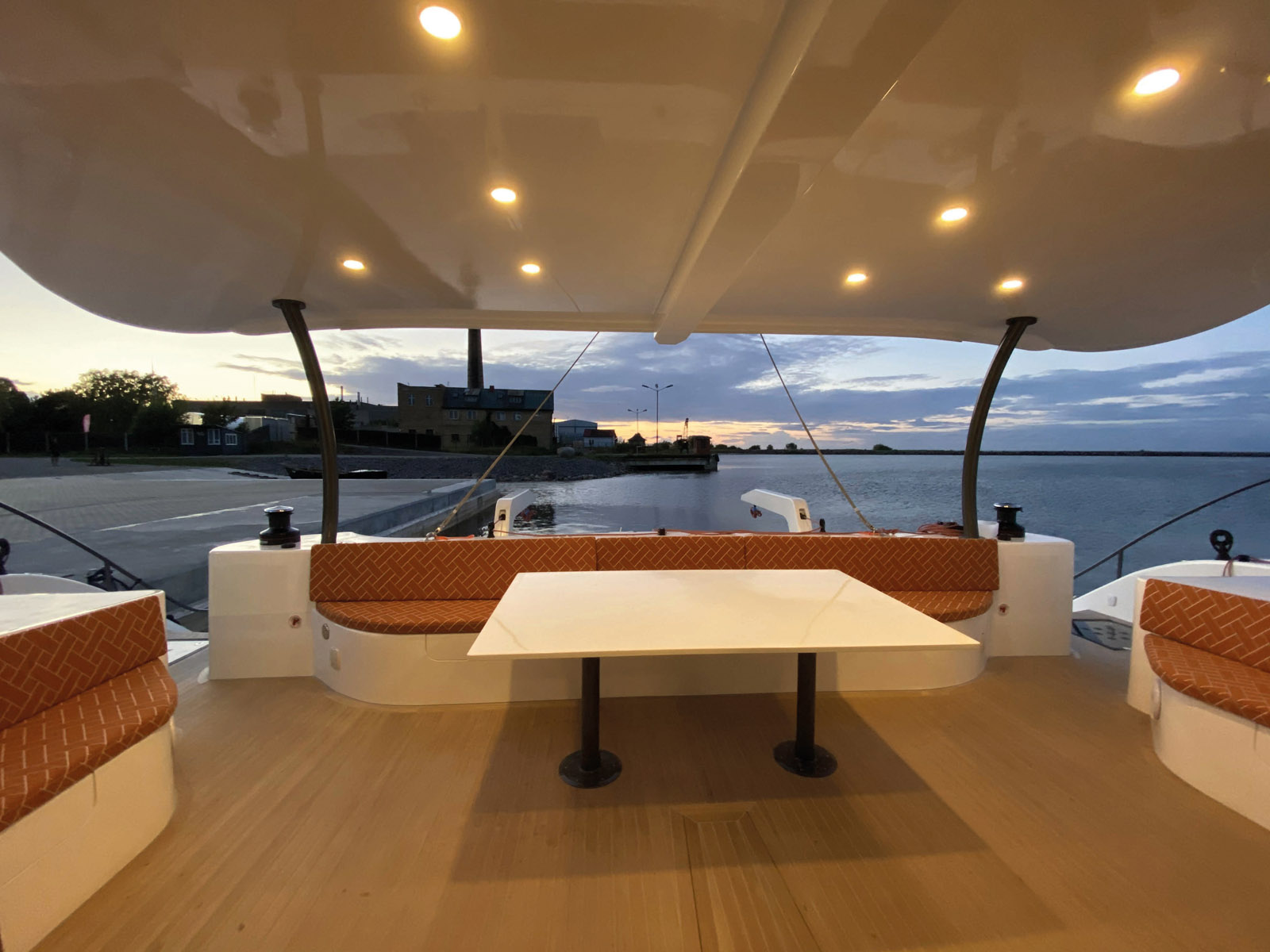
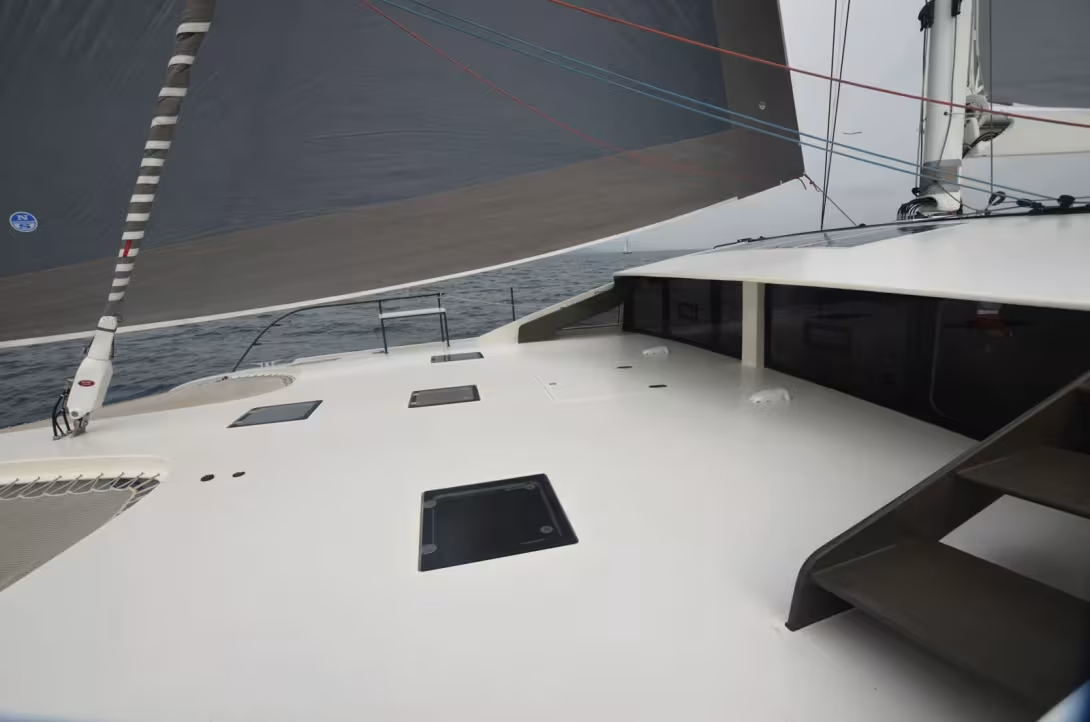
The 215 square foot (20 m²) aft cockpit is worthy of the most comfortable cruising boat. This is unheard of on such a high-performance craft of this size, putting the “6” in a new category of super livable sports yachts
Choice of rig and deck hardware
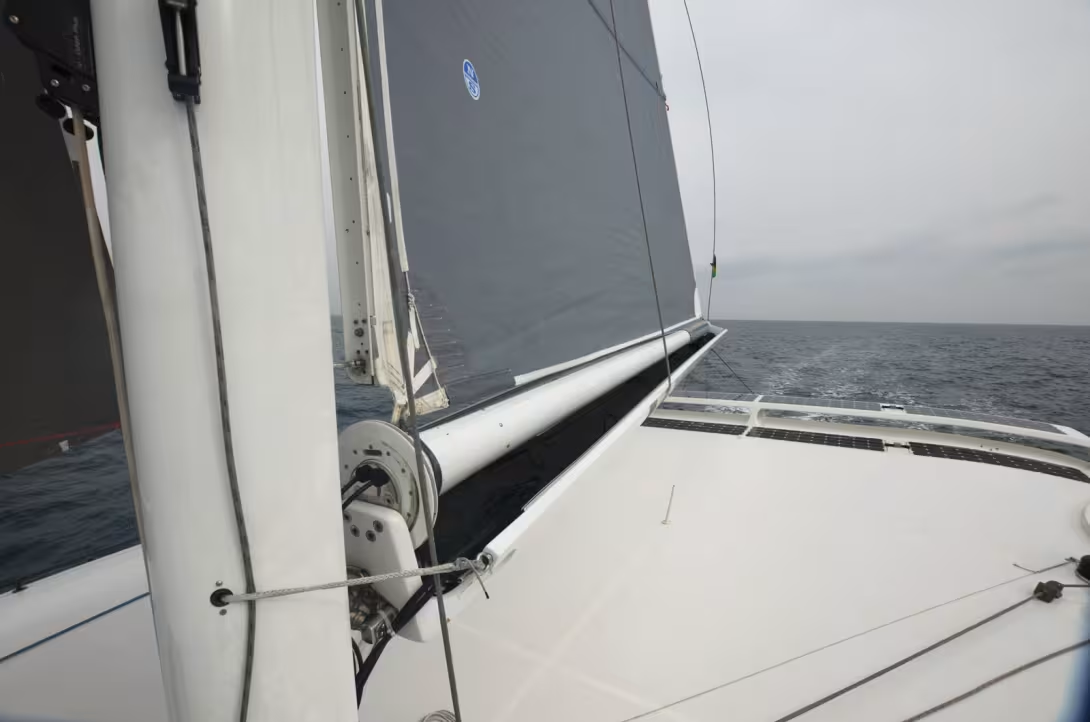
The entire rig can also be configured by the future owner. Our Class 6 has been equipped by Petitjean Composites. It is equipped with a rotating mast and a carbon boom with hydraulic furling system. The furling systems for the staysail, genoa and gennaker, also hydraulic, are from the same manufacturer, as well as the hydraulic cylinders of the mainsheet hidden in the canoe boom. All the controls are grouped on a specially developed Tenderlift system. This allows you to manage the sail plan very easily even though it is a little small for my liking. The builder listens to the client: a different mast profile or even no mast at all, as was done for the Class 6 #1, are all possibilities. The same goes for the steering systems: wheel steering (with rod or cable linkage) or tiller steering with seats.
Very spacious layouts
 |
 |
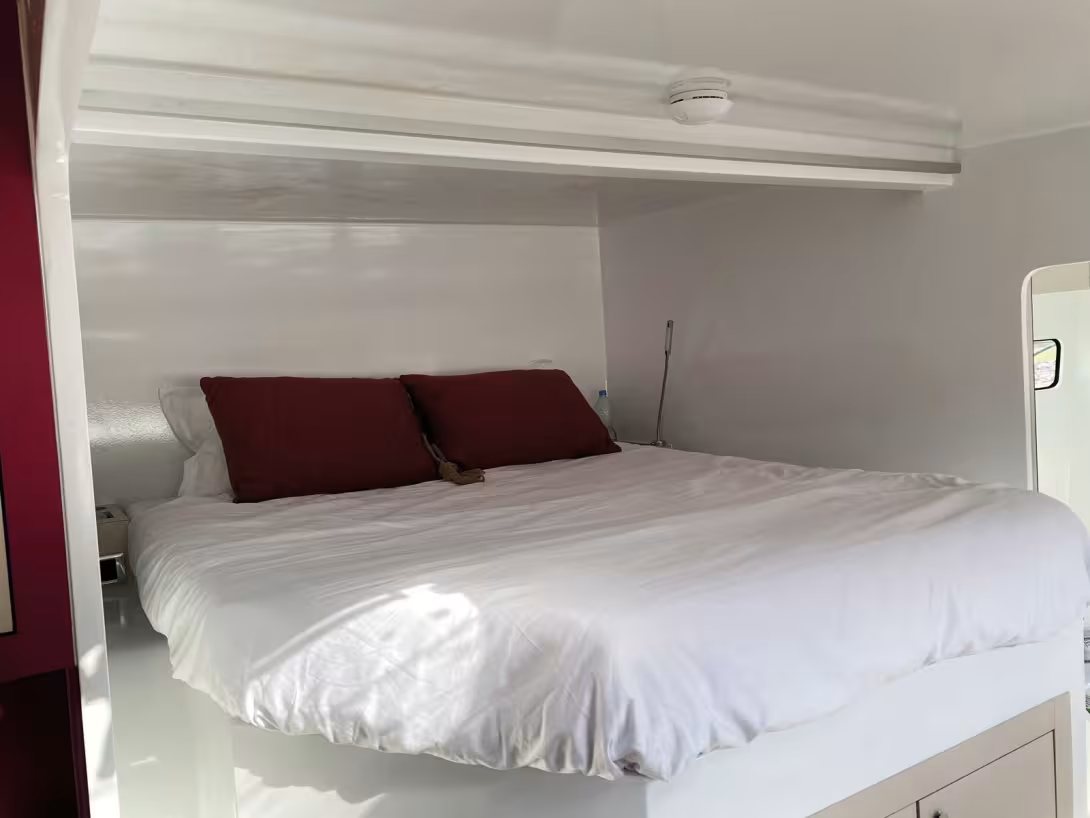
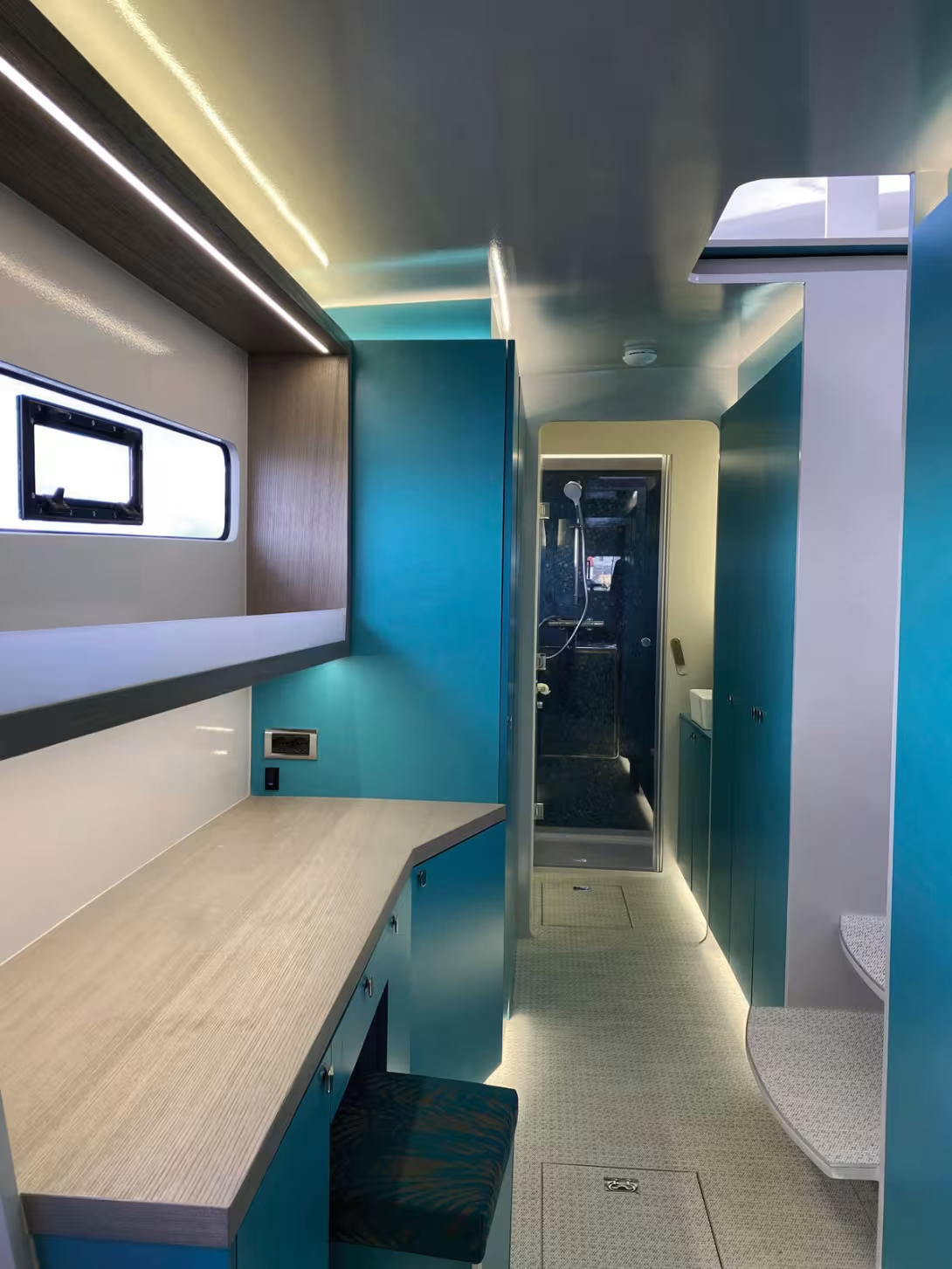
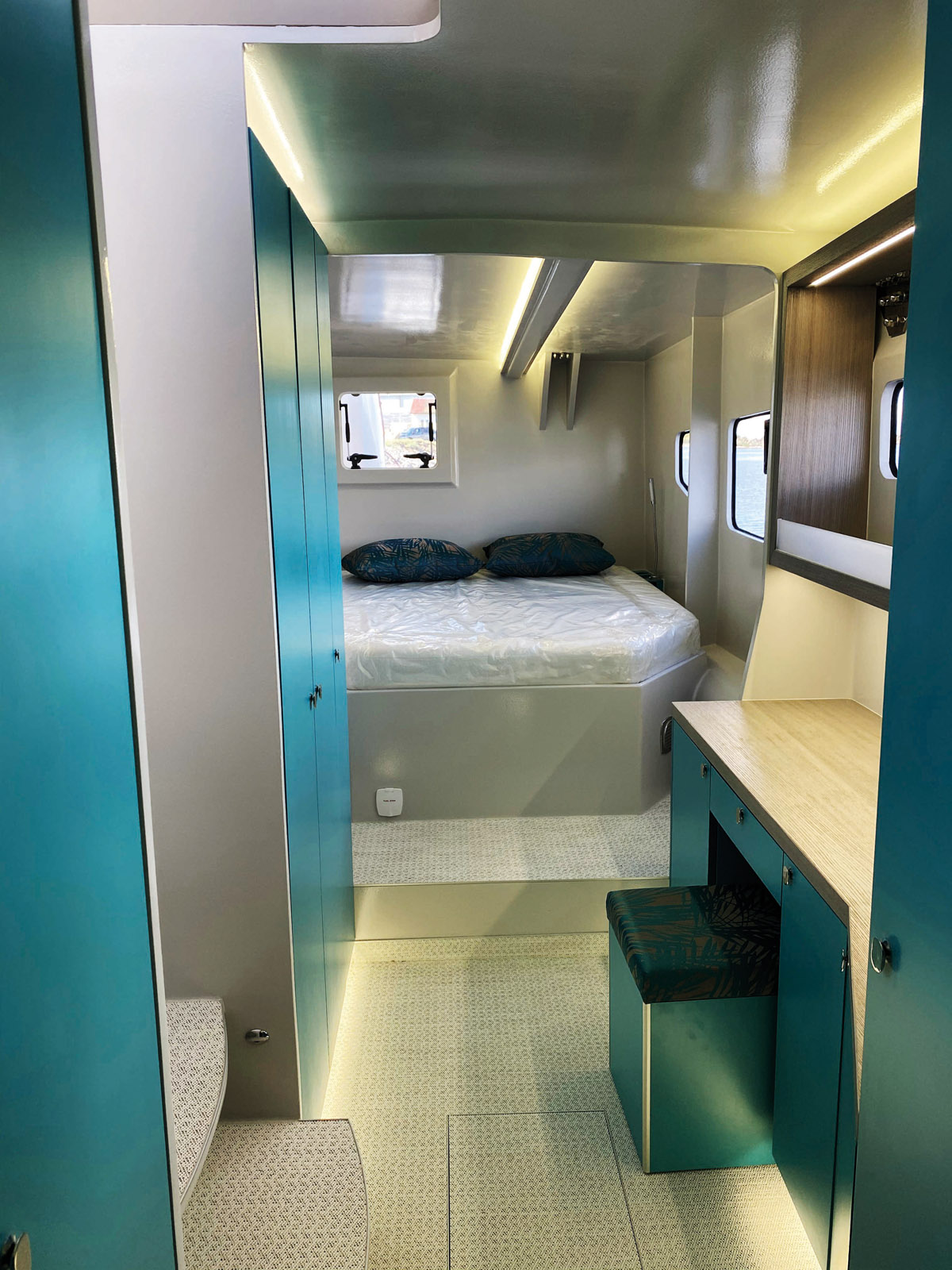
The owner’s suite occupies a good portion of the port hull, with the crew cabin at the bow. Although the narrow width comes as a consequence of the boat’s performance, the double, half-island bed is very wide.
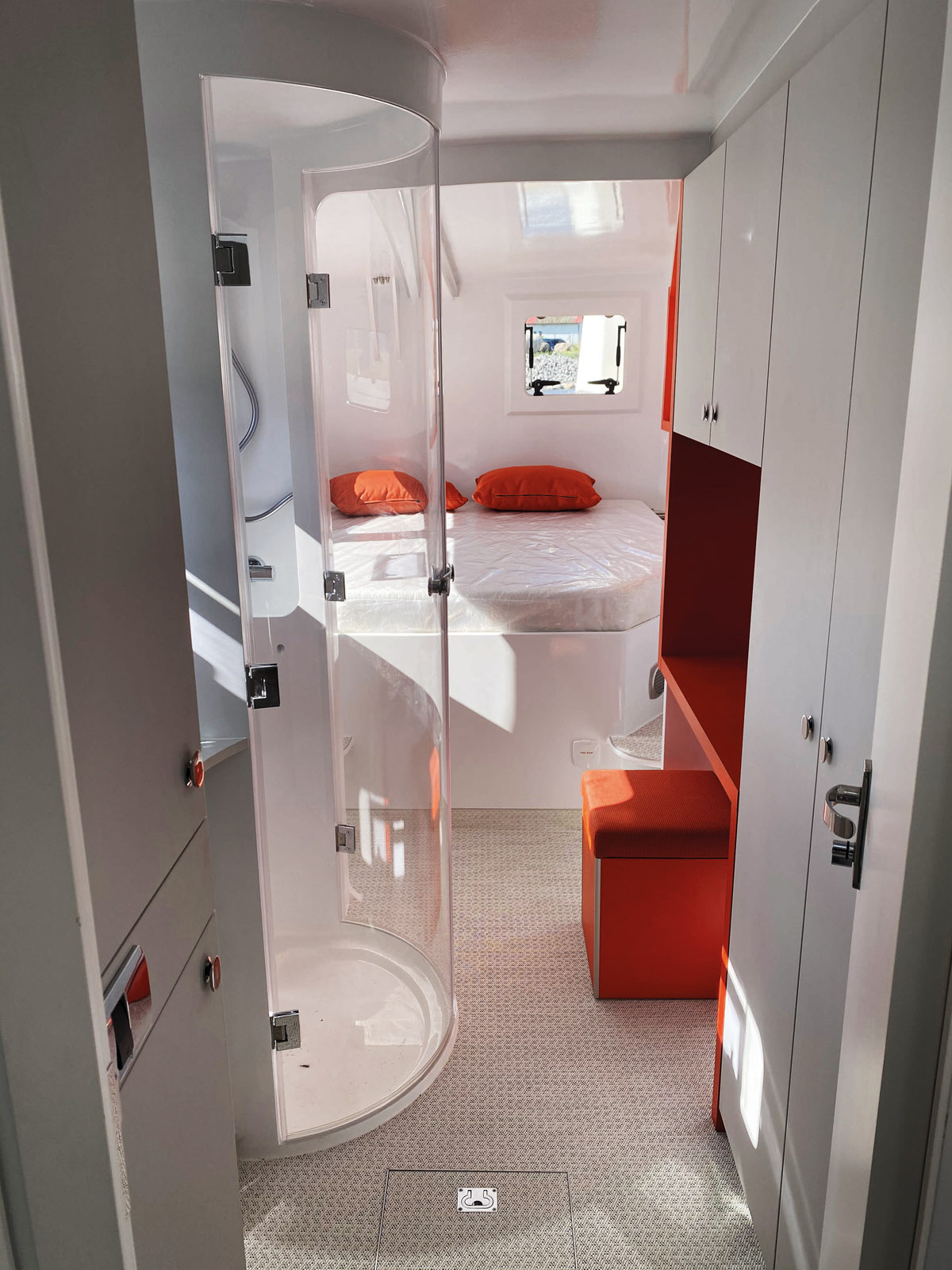
The starboard VIP cabin features a different ambiance, and that’s the beauty of custom builds: you can choose anything you want! The woodwork, on the other hand, will be made in foam sandwich: the shipyard’s prerogative is to ensure the weight is kept under control.
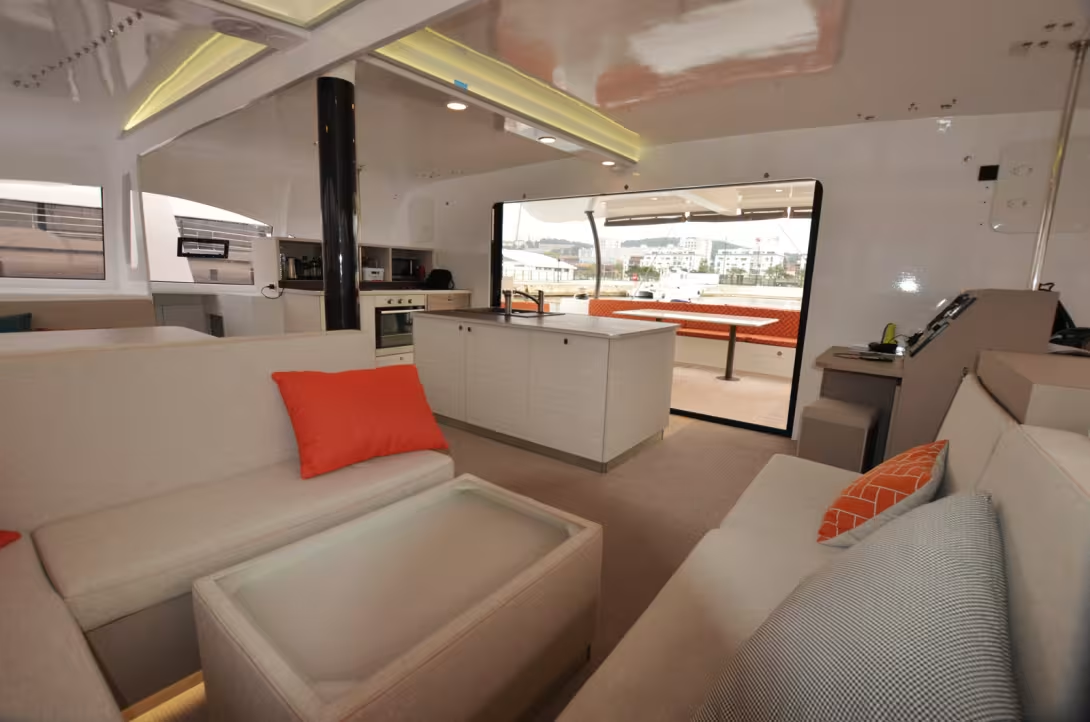
The combined saloon/cockpit area of the Class 6 totals 475 square feet (44 m²), making it comparable to volume offered by the most spacious cruisers of the same size. Not bad, considering most sport yachts of 60 feet (and over) capable of double-digit averages generally have a capacity comparable to that of a production catamaran 10 feet shorter. The efficient design by Denn Clifford, who was behind Sunreef Yachts’ double deck, doesn’t let this impressive interior volume show. On this model, the sliding window almost completely disappears, reinforcing the feeling of space - the available volume can be laid out on demand. In the hulls, very wide double beds are offered, as well as island beds in the aft cabins thanks to the very pronounced chines. Conversely, the beds in the forward cabins are placed athwartships and are high up, in order to preserve the boat’s marine qualities: the fineness of the bows. These cabins are more in line with what you’d find on 50-footers. The choice of finishes, like that of the equipment, is at the discretion of the owner. Foam sandwich materials are logically preferable, so as not to add much weight, and each option will have to be negotiated with Dan, who is very concerned about delivering a unit that corresponds with all the hard work done beforehand on saving weight. As such, the collaboration of an experienced skipper or project manager works well in order to achieve the comfort objectives without compromising the spirit of this boat - and its potential under sail. It is also the best way to ensure the best finish - which wasn’t quite the case here on some details, as the catamaran still needs a bit of fine tuning.
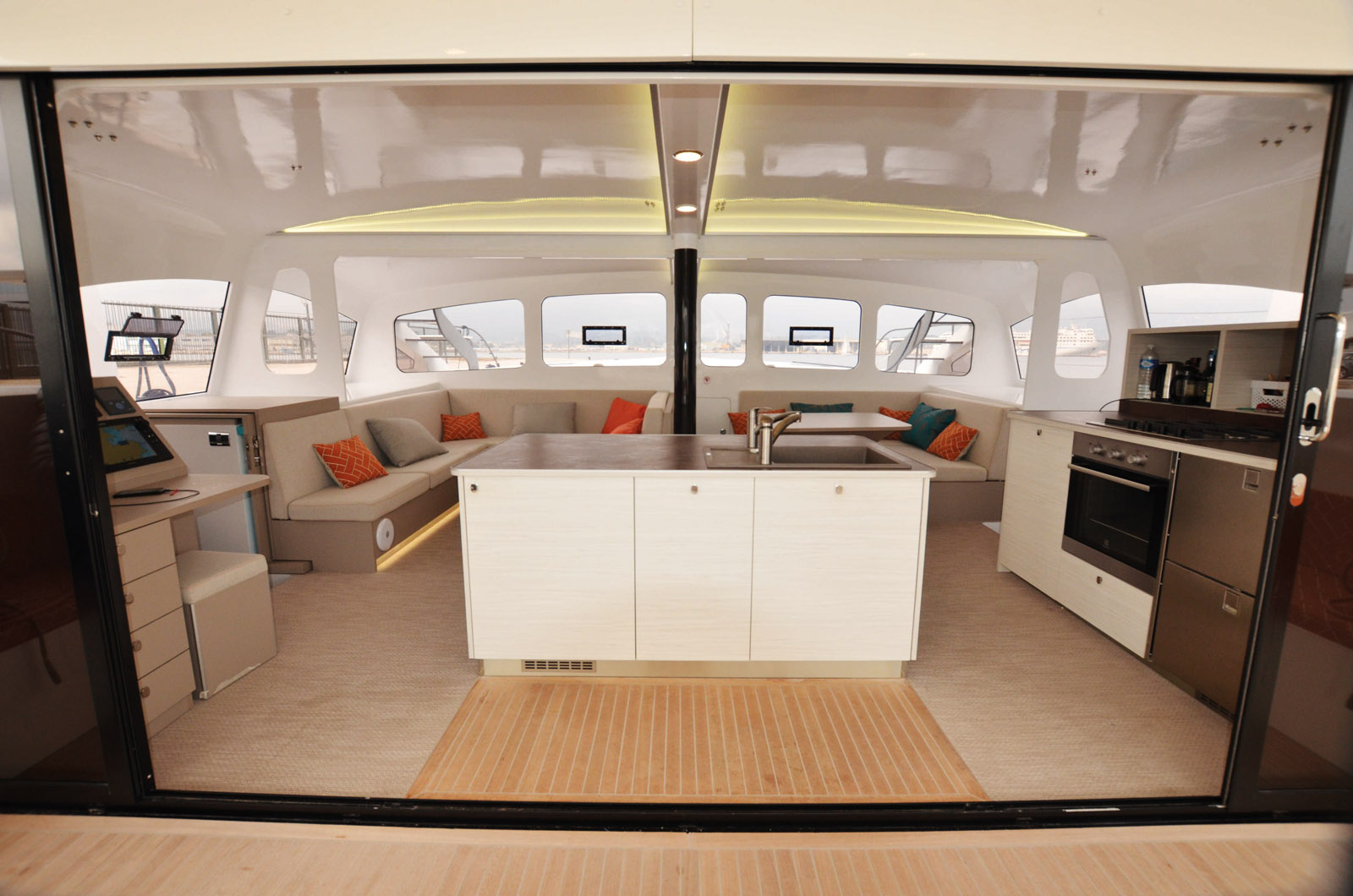
Le salon de plus de 25 m² est grandiose ; il forme avec le cockpit un espace à vivre de 45 m² particulièrement agréable.
L’aménagement est réalisé entièrement selon les desiderata du client – tant sur l’implantation du mobilier que sur le choix des matériaux.
Double figures on the GPS
The forecast for this late winter day in Toulon was giving us the morning swell typical of the region with a thermal breeze in a milky sky. By the afternoon, this was to be reinforced by a light south-westerly flow in the afternoon. In short, the wind was forecast to increase from five to ten knots over a period of two or three hours with a slight chop by the end of our trip out. At 2,500 rpm, the two 80 HP Yanmar engines propelled us at ten knots, consuming only 2.9 US gal/h (11 l/h). The speed we reached was giving us an indication of the potential of this machine. The mainsail and the North Sails 3Di Ocean genoa (see Diagnostic in this issue) were unfurled with a simple press of a button on the control panel. The first upwind tacks to get out of the harbor were very easy, with the true wind speed being quickly exceeded in the light breeze. Once we had enough water, we unfurled the 3,015 square foot (280 m²) gennaker, also on hydraulics. Bearing away, we were quickly up to ten knots in the 5 to 7 knot breeze. The famous French sailor Marc Pajot was also on board (a guest of honor), and he didn’t hesitate to show his pleasure. All the sheets are led back to hydraulic winches - it only takes ten seconds to furl the genoa ahead of the self-tacking staysail. The wind eventually picked up to almost ten knots, and we sailed under main and genoa - sometimes with the staysail in the ripples. Despite a rather modest mainsail area of 1,173 sq ft (109 m²) on our test boat, the GPS was showing us going at the same speed as the wind. The steering is direct and the course keeping is perfectly balanced, though I’d prefer the rod linkage rather than cable steering. The acceleration could actually be felt, and the bows passed through the water without a shudder, as if in cotton wool... we secretly dreamed of a 20-knot breeze and a decent sea to find out how the three bows would cut the water...
Conclusion
Unquestionably, O Yachts fills an otherwise unoccupied niche - for the moment – in the world of luxurious and ultra-fast catamarans. Its Class 6 manages to combine speed, ease of handling, and safety, in a living space previously reserved for big cruising boats. Owners who are connoisseurs looking for sensations and exclusivity will find this a superb machine for discovering the world. The Class 6 will also attract new clients who favor more coastal sailing – I’m thinking of boaters from the world of motoryachts for whom speed under sail would have seemed insufficient until now. O Yachts also has a “power” solution, with a Smart Hybrid version. Great success that Laurent Bourgnon would have been so pleased to see.
The pluses
+ Speed and XXL-sized habitability combined in the same multihull
+ Customizable level and arrangement of finish
+ Exceptional seakeeping and safety in rough seas
The minuses
- Purchase process requires experience
- Necessary assistance for finishing
- The helms could be better positioned on this model
TECHNICAL SPECIFICATIONS
Builder: O Yachts
Developer: O Yachts
Architect: Doug Shickler
Design: Clifford Denn
Overall length: 62’9” (19.12 m)
Waterline length: 62’6” (19.05 m)
Beam: 29’8” (9.05 m)
Draft (skeg keels): 4’1” (1.25 m)
Draft (daggerboards): 3’ / 12’6” (0.90 / 3.80 m)
Light displacement: 30,850 to 37,500 lbs (14 to 17 t) depending on version and equipment
Payload: 9,900 lbs (4.5 t)
Area: 1,173 to 1,540 sq ft (109 to 143m²)
Genoa: 1,130 to 1,325 sq ft (105 to 123 m²)
Self-tacking solent: 600 to 645 sq ft (56 to 60 m²)
Gennaker: 3,015 sq ft (280 m²) Engine: 2 x 80 HP Yanmar or 2 x 15 kW Oceanvolt
Fresh water: 210 to 400 US gal (800 to 1 500 l)
Fuel: 210 to 400 US gal (800 to 1 500 l)
Cabins: 3 or 4 + crew
Price before tax: From € 1,800,000
Price of the boat we tested: around € 2,500,000
O YACHTS A winning strategy in a niche market
Dan Levy has clearly understood that a new, modestly sized manufacturer can only enter a crowded marketplace with innovative products and marketing strategy. As a lover of beautiful sailing, he makes it a point of honor to build the lightest hulls available for multihulls destined for leisure boating. To achieve this, Dan has focused and specialized in the use of carbon (26 coats in the layup for the “backbone”). In order to win over a wider clientele, he’s prepared to deliver multihulls in various stages of completion, such as the very first Class 6, finished by its owner. The deck mold only integrates the purely structural elements and leaves the ergonomics of the seating to the owner’s discretion. The position and finish of the furniture are entirely custom: the fitting out work can be relocated to an approved yard, where the multihull would be delivered at an agreed stage of progress and then finished at a location chosen by the future owner. Using this platform as a base, one could create a cruiserracer version with a sleek rig, or a trawler with electric motors, or a very luxurious yacht. Almost anything is possible! Purchase process requires experience