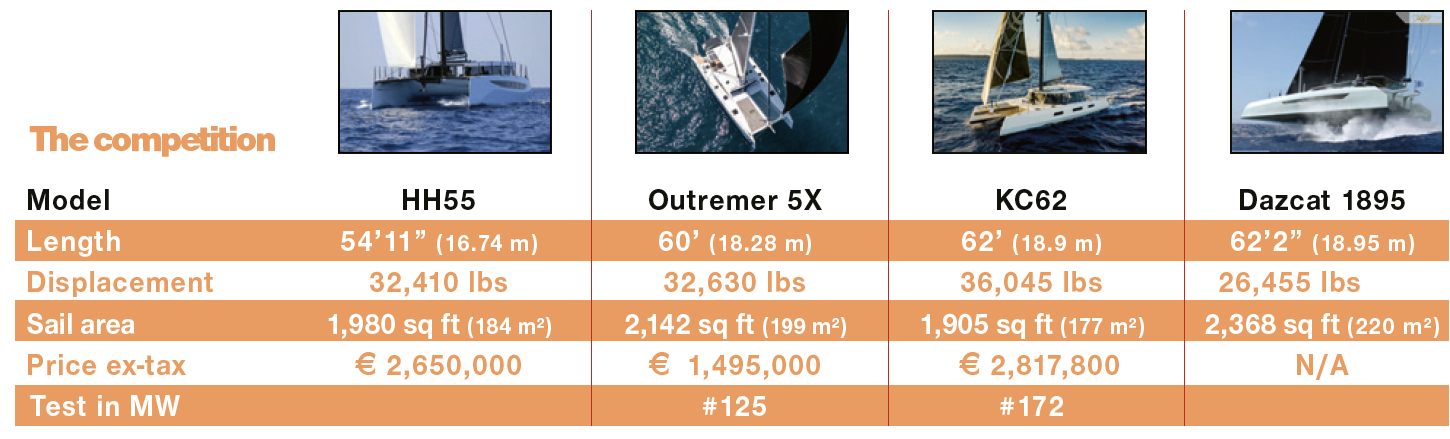
Marsaudon Composites has already built a solid reputation with two 42 and 50-foot models. Its latest model, the ORC 57, has just been unveiled, making its world premiere at La Grande-Motte in April. We’d got the chance to discover it a few weeks earlier in Lorient. Our verdict? It’s breathtaking!
Test location: Lorient, South Brittany (France)
Condition: 15 to 20 knots of wind, sea state slight with a little chop
Infos pratiques
- Le chantier : ORC 57
- La fiche technique
-
 Découvrez notre vidéo exclusive
- Financez votre ORC 57
- Assuez votre ORC 57
- Articles autour du ORC 57
In the heart of Brittany’s “Sailing Valley”, among the Ultims trimarans, there’s a boatbuilder offering different multihulls - against marketing and commercial tides, this one resists the ever-increasing trends. The shipyard, Marsaudon Composites, occupies three huge halls of the former submarine base in Lorient, in south Brittany. Out front, Damien Cailliau, the discreet big boss of the shipyard, needed no encouragement to write an adage along the lines of Colin Chapman, founder of the Lotus Formula 1 car racing team, who famously said: “Simplify, then add lightness”. While TS (Très Simple or “Very Simple” in English) swapped its acronym for the more salient and international “Ocean Rider Catamarans” (ORC), the recipe has certainly not changed. The new architectural team of the Marc Lombard Yacht Design Group (sculptors, among others, of fantastic ORMA trimarans in their heyday, such as Banque Populaire or Sopra Group), has taken on the shipyard’s DNA with relish, translated until now by their colleague Christophe Barreau on the successful 42 and 50-foot models.
 |
 |
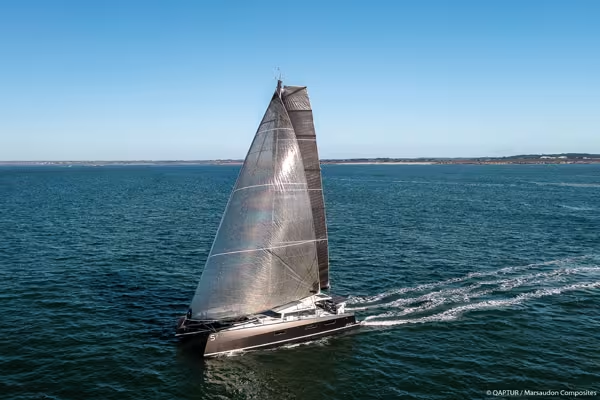
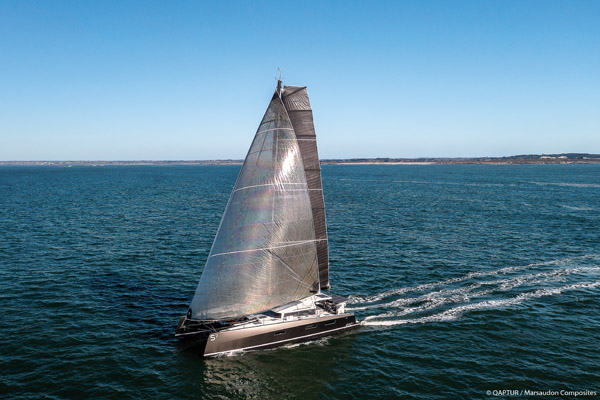
The light plays with the elegance of the lines. As for the wake, it speaks volumes about the potential of this new catamaran.
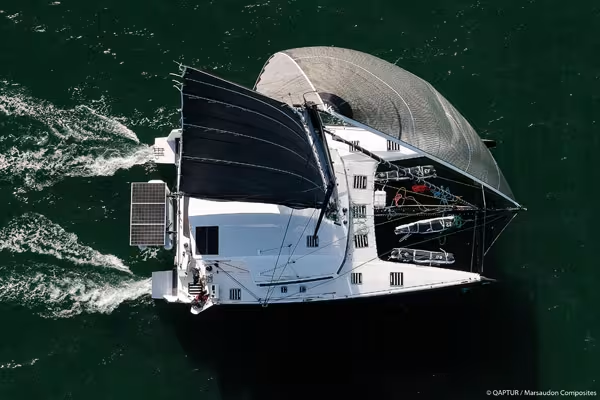
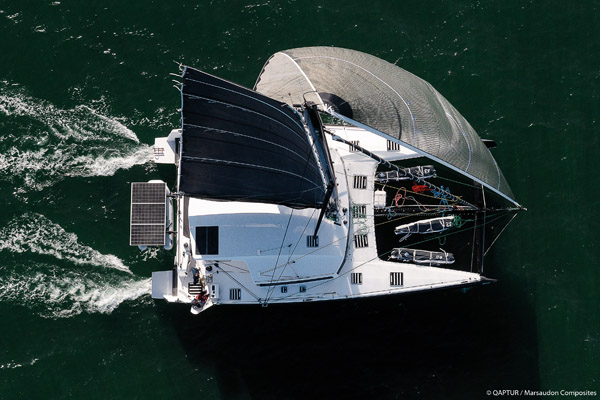
With a perfectly designed deck plan and well-tailored canvas, the ORC57 lengthens its stride.
There’s only one religion: speed!
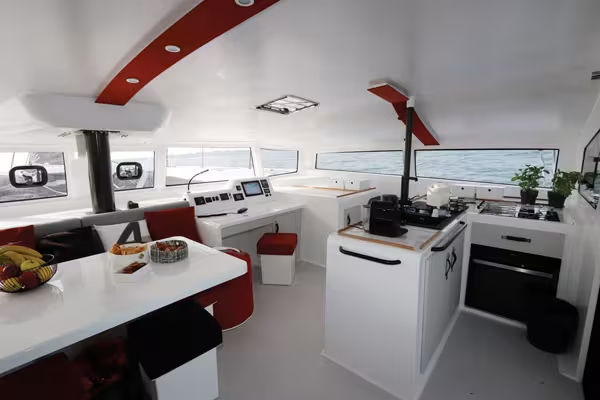
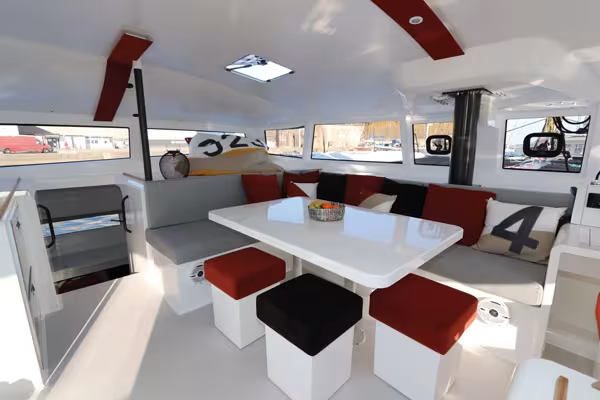
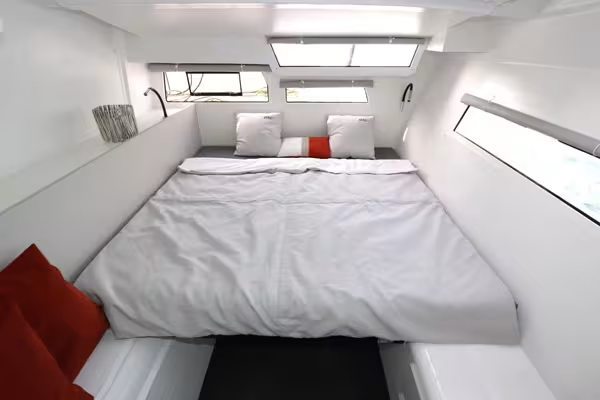
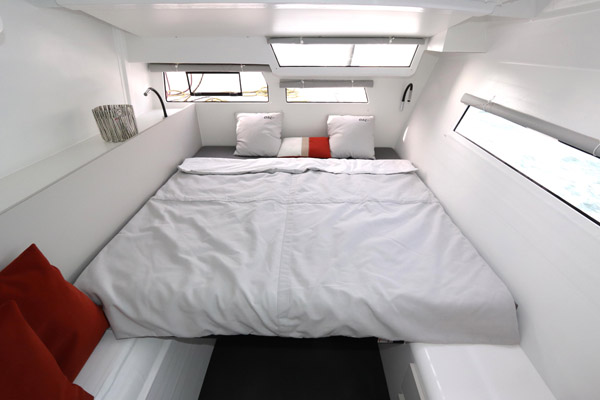
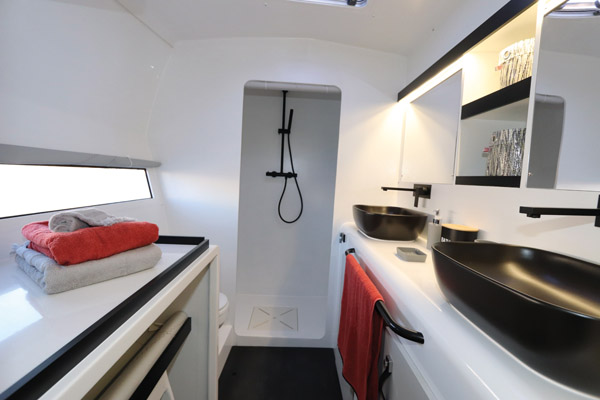
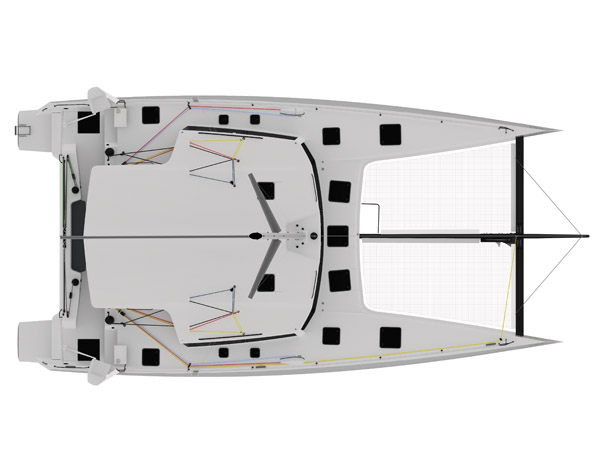
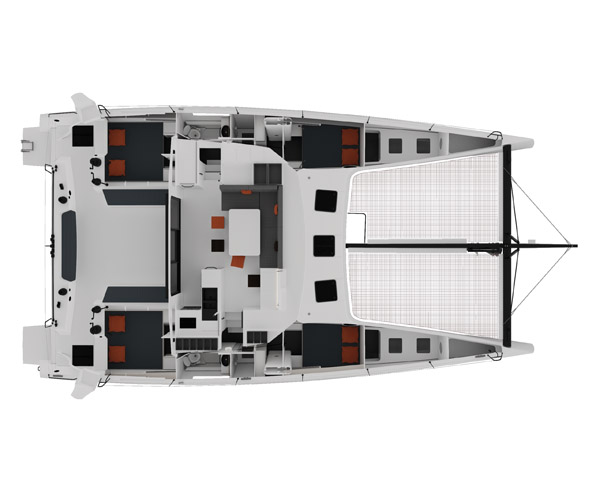
But what does this new flagship multihull bring if nothing changes? At first glance, without even having set foot aboard, there is a line. In the cinema world, they would say a “movie star face”. But it’s much more than just the simple line that starts just after the bow and runs all the way to the sugarscoop. The finished article looks simple enough, but it takes talent and hard work to get the topsides - which become a prism in the light – to immediately and elegantly reveal the platform’s dynamic character. Inside, there is room to spare; the greater length allows for a better balance between performance and comfort. But beware, this last term is to be understood in its most austere sense. Don’t try to convince the yard of the need for air conditioning or a generator. Speed is a religion and you’d be branded a heretic. No, the real new luxury here is space. The headroom varies for example from 6’10” (2.1 m) to 6’5” (1.96 m) in the nacelle and from 6’10” (2.1 m) to 5’11” (1.8 m) in the hulls. This was not always the case on its ancestors, in particular the earlier versions of the 42. The combination of a beautiful cockpit table, a large saloon, a vast galley and a magnificent chart table - a proper forward-facing navigation station, is not given to many catamarans capable of sailing faster than the wind. In the hulls, the aft cabins offer square berths, 6’5” each way (1.95 by 1.95 m) with an unobstructed view of the sea. They will allow you to always stay in the right direction, even at high speed in big seas. On the port side, the owner’s hull and its single aft cabin seem even larger, with its long bathroom all the way forward. The double sink will seem superfluous to the most rigorous weight watchers, but it must be recognized that, like the fittings, their perceived quality and aesthetics contribute to the seductive atmosphere aboard this boat. The off-center and inclined daggerboard wells are very discreet. However, it is in the passageways that the choice of high-performance hulls is most evident. But a prominent last step down, raised door sills, and beds that don’t give in to the modern trend of side access are mere details compared to the sensations provided by the overall cocktail that’s on offer.
 |
 |
 |
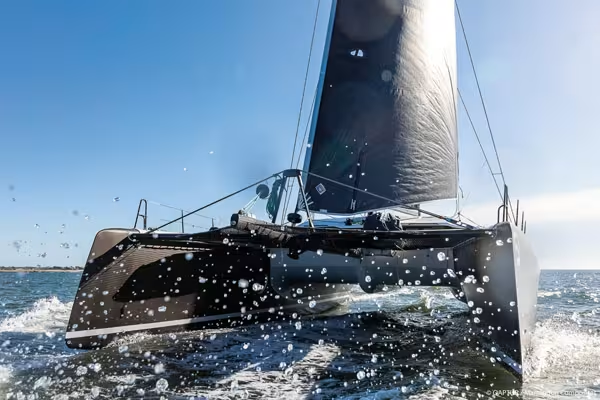
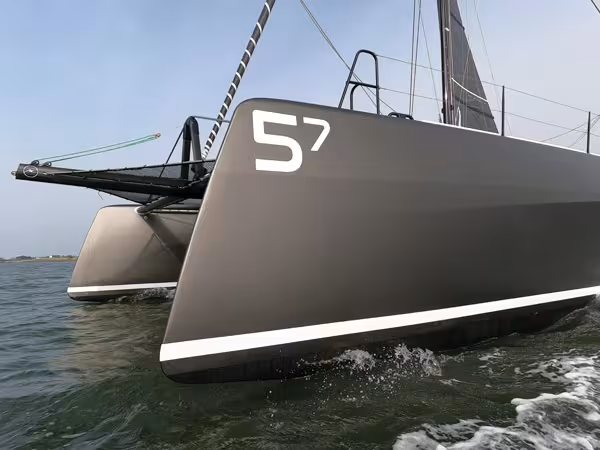
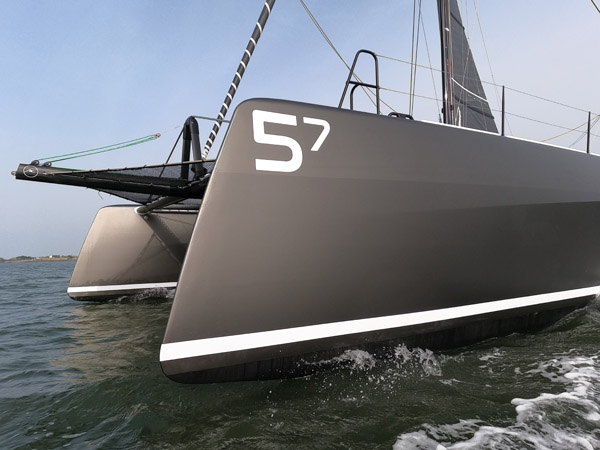
Inverted bows, sharp lines, carbon cross: the ORC 57 clearly has a sporty personality.
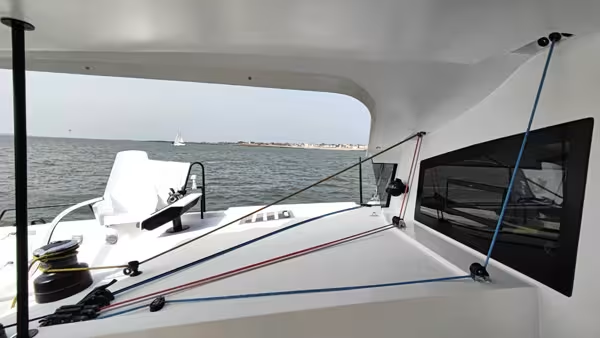
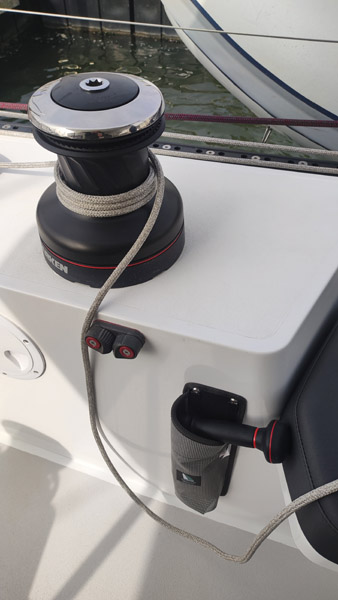
The ergonomics of the sheets and lines limit the required effort, as seen with this J1 sheet that eliminates the need for a deck organizer block.
Historical know-how
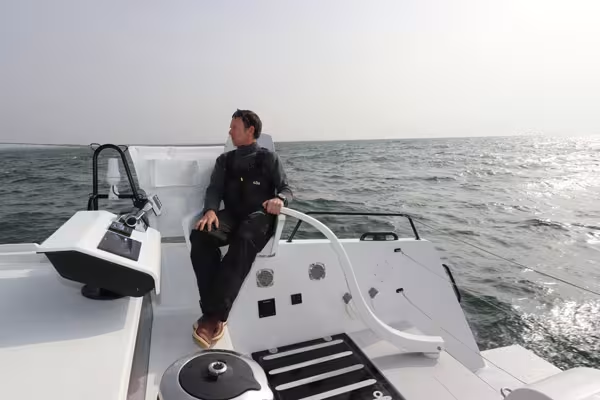
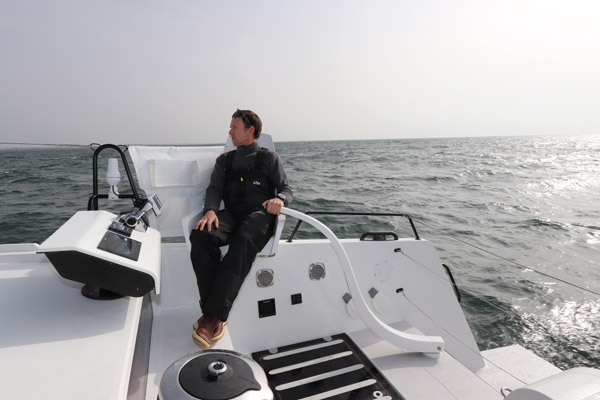
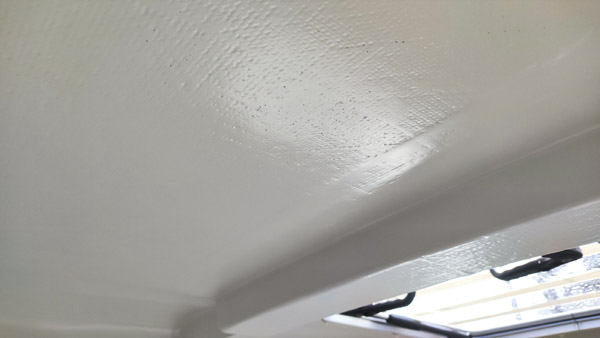
Meanwhile, on deck, the time was approaching to see the full potential of this new thoroughbred. To remain faithful to tiller-steering on a 57-footer might sound like a risky bet. But given that they feature on the new logo, they are more than a symbol, they are a true profession of faith. The two folding bucket seats go hand in hand. Their angled position in relation to the boat’s axis is just right. And if you’re built more like a table tennis player than a football player, the boss reassures us that everything is customizable. Even a tiller with a slightly smaller diameter and a narrower seat for a better fit are possible. This is one of the advantages of producing so many components in-house. The carbon floors, for example, as well as the rare panels that hide the technical kit from view that are made of foam sandwich with their integrated finish, reveal the historical know-how of the shipyard that built Francis Joyon’s first Idec, the work of a true artist. Inside, the word “refined” immediately comes to mind. Headlinings are reduced to a minimum, the white of the composite directly visible reflects the light that streams in through the large glass surfaces. The surface finish is of a quality rarely seen, only the underside of the roof has been very lightly coated to create its perfect finish. The cabins are not coated, but the maintenance is minimalist, a sponge will be enough. The durability is exceptional. The team is inexhaustible on the care taken and the multiple techniques found to achieve this perfectly smooth appearance once the infusion sheets have been removed. This is objectively one of the key points of the Lorient-based shipyard’s knowhow: being able to offer an excellent standard of finish without adding anything, achieving perfection with only a few grams of coating. Because of course weight is at the heart of all the concerns. Hulls, coachroof, deck, furniture made in-house, and even the cupboard door latches, everything is carefully designed, implemented and controlled to be as light as possible. The result is clear when you consider that this boat tips the scales at just 12 tons empty, and a mere 13.5 tons as we found it, equipped and ready to cast off. Only the carbon roof option was checked for this demonstration model. The black and expensive fiber is used as standard only where needed, where the shear stresses are the strongest, that is to say the aft and mast foot bulkheads. In keeping with the sacrosanct principles of simplicity and lightness, the mast made by neighboring Lorima has replaced the standard aluminum and is a fixed version on this inaugural model. But it can be rotating if you wish, it isn’t set in carbon…
 |
 |
 |
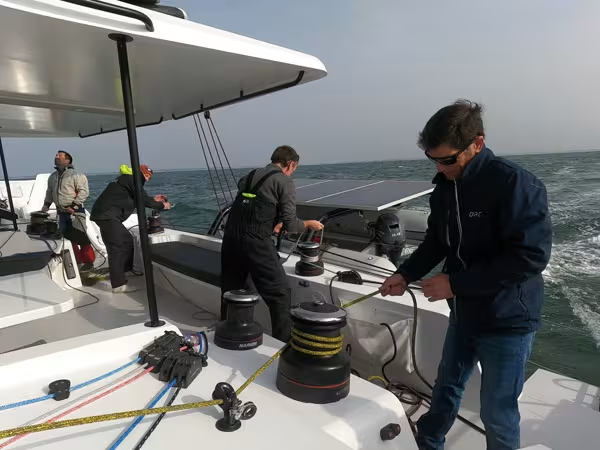
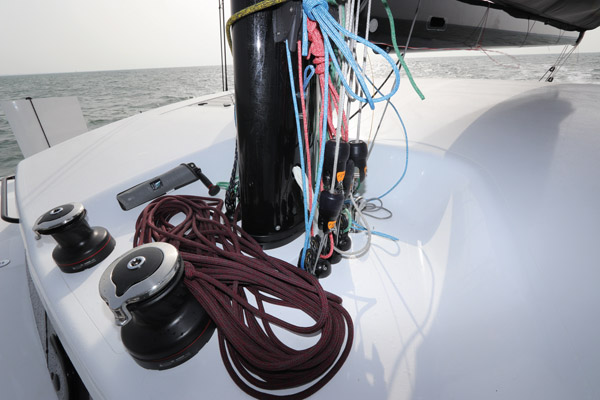
Low mast foot with Harken winches at your fingertips and Karver furlers ready to hoist.
The mainsheet winch and its quick release clam: simple, effective and safe.
The perfect helm station, hard to leave…
10 knots close-hauled
The pontoons in front of the Lorient submarine base are to the passionate sailor what a big toy store is to a child a few days before Christmas. Right now, we’re still in pre-season, and find many Formula 1 boats sheltered in the warmth, but between the Imocas and Class40s there is already something to dream about. In its charcoal gray livery, with its “57” in white script on the nicely inverted bows that are high on the water, its black cross in carbon like the mast, the ORC blends perfectly into a landscape that seems entirely dedicated to performance. Under the twin 57 HP motors, we stresslessly head out past Jeremy Beyou’s Charal, moored on the end of the pontoon. Inside Lorient harbor, the breeze is contained, but outside, we’re expecting to see 20 knots. Off Port-Louis, the ORC 57 starts to accelerate. Once past the Pointe du Gâvres, the RIB with its forty horses that we’re using as our photo boat is already having trouble keeping up. The videographer on board is not an ace rodeo performer - while the sea remains beautiful, hanging on with one hand and holding the camera in the other is already becoming a balancing act. Conversely, aboard the big catamaran, our breakfast on the saloon table does not move. Switching from one to the other with an ambitious leap (thanks to the neat sugarscoops that form a landing strip) is a bit like getting off a spirited horse to board a hovercraft. As the multihull has only been in the water for a few days, Bruno, the lucky test skipper of this inaugural unit, has chosen to be cautious: he has put a reef in the mainsail and unfurled the J1 at the front. Though the breeze was well established at 20 knots at the beginning of our test sail, it gradually dropped to around fifteen. But making 10 knots when very hard on the wind and sailing at windspeed on a reach without any extra sail area is simply a formality. Damien Cailliau even mentions the possibility of a shorter mast, for those who have a truly 100% cruising program and who wouldn’t need all that power under the hood. However, the ORC57 as it was presented to us is really a cruiser-racer, in the historical sense of the term. It could just as easily compete in the Route du Rhum come November, and then welcome the family out in the Caribbean in December for a dream vacation. It all depends on where you set the bar. Performance and cruising are not necessarily incompatible, on the contrary. Saving yourself the trouble of hoisting a gennaker or a spinnaker and the stress of not furling or lowering it early enough - while going as fast as the wind - is worth thinking about. Playing with your speed to make use of weather phenomena rather than enduring them is also a guarantee of safety.
 |
 |
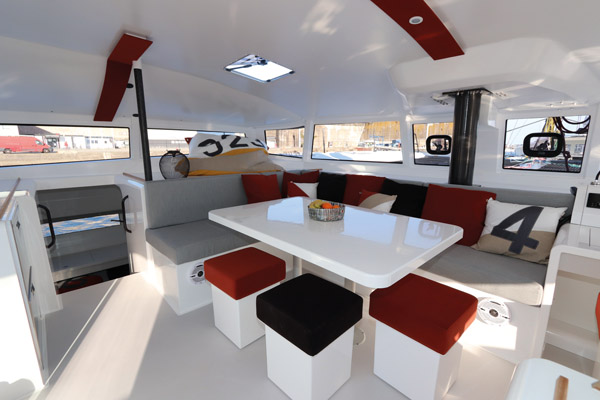
The saloon can accommodate the entire crew and more. Boots and oilskins no problem!
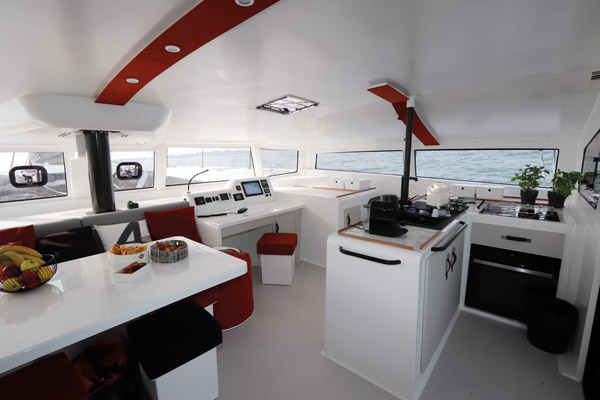
With a large, forward-facing chart table and a convivial galley, you can dream of an express transatlantic passage with family or friends.
A true cruiser-racer!
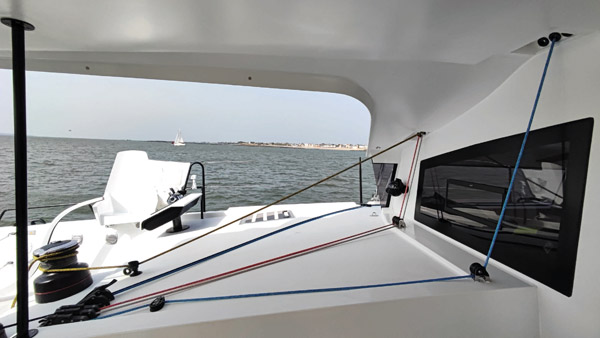
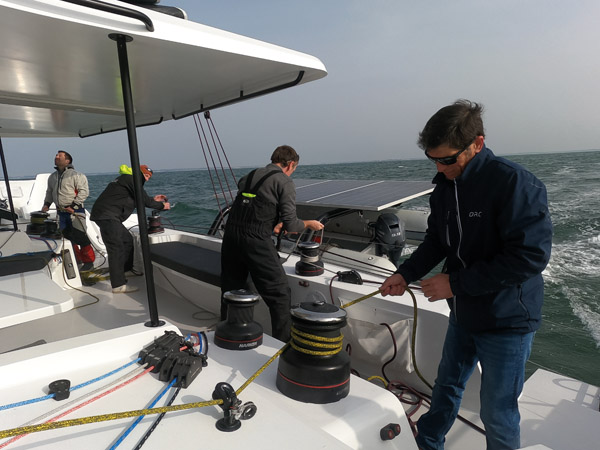
We headed upwind along the island of Groix, to give ourselves some Atlantic searoom. And we were really enjoying it, although this is not at all this boat’s program, with the daggerboards getting a bit jittery. The GPS recorded a speed of 9.85 knots in 13.5 knots of true wind. As soon as we were off the Pointe du Talus, it was time to bear away on the helm and ease sails a little. Given the speed at which this type of craft moves, the apparent wind angles are rarely very open. From the carbon bucket seat, a few degrees of difference on the tiller acts like a gas pedal. It’s a racing multihull feeling, where just 5 degrees of course angle can change the speed by several knots. But we’re not racing here, and the catamaran glides across the water without anything falling over. We feel perfectly safe in the very protected cockpit as we reach 15 knots in 20 knots of wind. And I’d have no apprehension taking on bigger seas: on deck as well as inside, there are handrails everywhere. The lowered mast step allows safe access to the boom and offers good ergonomics for sail maneuvers. The deck layout has been carefully designed. The winches are perfectly sized, and any friction has been limited by the use of topof- the-range fittings (Harken and Karver in particular) and the halyard and sheet leads are as open as possible. Only the control of the 3D genoa sheeting points requires a little learning. But it’s a very good time investment considering the infinite number of settings available. Of course, we could have shaken out the reef, hoisted the gennaker and broken records, but that wasn’t the point. And that’s the magic of the ORC 57, to be able to go very fast without pushing it. Beyond that, with a properly set-up boat and a well-trained crew, the level of performance promises to be stratospheric. Whether it’s the ARC or a RORC transatlantic race, the Caribbean or Mediterranean racing scene, or even the Route du Rhum in 2026, we won’t be surprised to see one or more ORC 57s on the start line, then taking line honors at the finish.
 |
 |
 |
Sober but spacious, bright and very well finished: what more could you ask from a cabin?
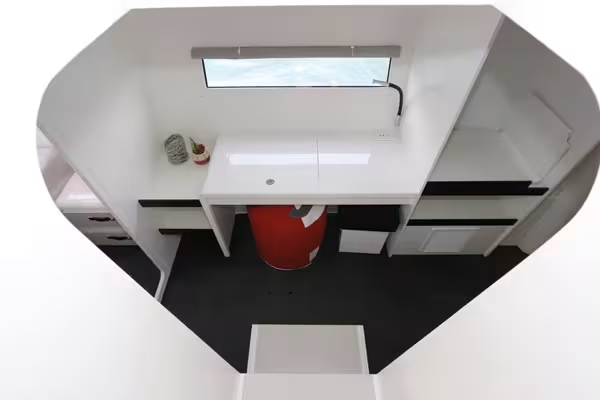
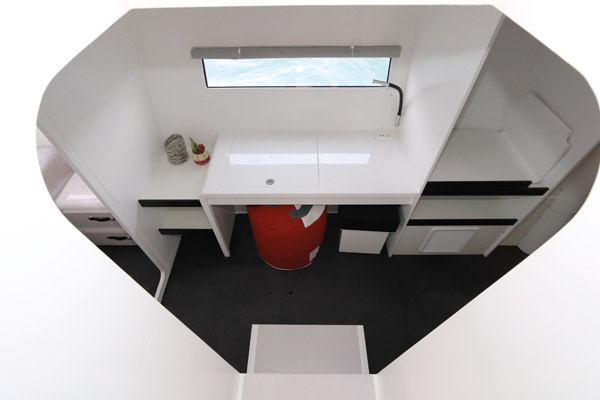
A desk at the foot of the companionway in the Owner’s hull.
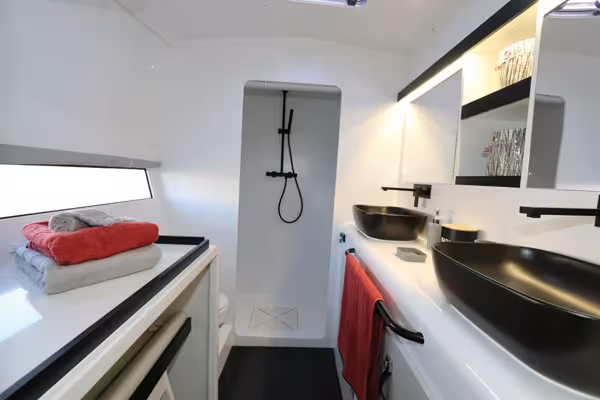
The comfort is space on board the ORC 57, as seen in the portside shower, sober and chic.
Conclusion
Racy on the outside, voluminous and sleek on the inside, with power to burn in all situations, the ORC 57 keeps its promise: it respects the shipyard’s philosophy while offering more comfort. For those who prefer their carbon to their burr walnut, natural ventilation to air conditioning, composite to marble, and who appreciate the very high level of finishing offered (mention must be given to the mast support strut, the work of an artist) Marsaudon Composites offers the ultimate weapon to arrive before the others at the finish line, or before everyone else... at anchor and for sundowners!
 |
 |
The builder offers two levels of finishes - with or without coating - which can be combined on the same model.
THE PLUSES:
+ A real cruiser/racer multihull
+ Easy high performance
+ Ergonomic sail maneuvers
+ Quality of execution
THE MINUSES:
- With daggerboards right down, beware of the open well
- Fuel filler neck in the cockpit sole
- Bulkhead sills and bars in the hulls
 |
 |
TECHNICAL SPECIFICATIONS
Builder: Marsaudon Composites
Architect: Marc Lombard Yacht Design
Overall length incl. bowsprit: 60’4” (18.40 m)
Hull length: 57’7” (17.56 m)
Platform width: 29’8” (9.05 m)
Maximum beam, helm seats in place: 30’10” (9.4 m)
Light displacement (ISO standard): 26,235 lbs (11.9 t)
Standard draft: 5’5”/10’10” (1.65 m/3.3 m)
Bridgedeck clearance: 3’6” (1.07 m)
Air draft: 84’8” (25.80 m)
Mast length: 75’ (22.85 m)
Mainsail: 1,151 sq ft (107 m²)
Overlapping Genoa (J1): 904 sq ft (84 m²)
Engines: 2 x 57 HP saildrives
Fuel: 2 x 53 US gal (2 x 200 l)
Water: 2 x 53 US gal (2 x 200 l)
Standard price: € 1,195,000 ex-tax
Included in the base price:
Construction in fiberglass/vinylester resin sandwich on PVC foam core by infusion.
Structure on carbon stringers and composite bulkheads, assembled by contact lamination.
Epoxy primer before antifouling.
Mainsail and genoa.
4 x 115 Ah AGM service batteries.
Electric engine controls at the helm stations.
Three-bladed folding propellers.
1,700 W electric windlass.
Catamaran launched in Lorient, with mast stepped, rigged and ready to sail.
Options: on request