
The ‘diesel-electric’ development is under way, the approaches are beginning to diversify and we took advantage of the launch of the first Outremer fitted with this type of propulsion to test the particularities and compare its overall performance with an identical model equipped with classic diesel engines.
Infos pratiques
- Le chantier : Outremer 42
- La fiche technique
- Découvrez notre vidéo exclusive
- Financez votre Outremer 42' électrique VS Outremer 42' diesel
- Assuez votre Outremer 42' électrique VS Outremer 42' diesel
- Articles autour du Outremer 42' électrique VS Outremer 42' diesel
CYAM’s history
Several of the make’s customers had already submitted a combined propulsion project to the R&D department at La Grand Motte, but the builder did not want to see a prototype they would not be able to perfect set off to sail around the world. It was only when they brought out the 42’ (at the end of 2005) that the conditions for a coherent installation were united: an owner ordered and was enthusiastic about the development of a diesel-electric version. The boat will be based at La Grande Motte, and will be used to teach sailing and for charter in the region; the Cyam project was launched.
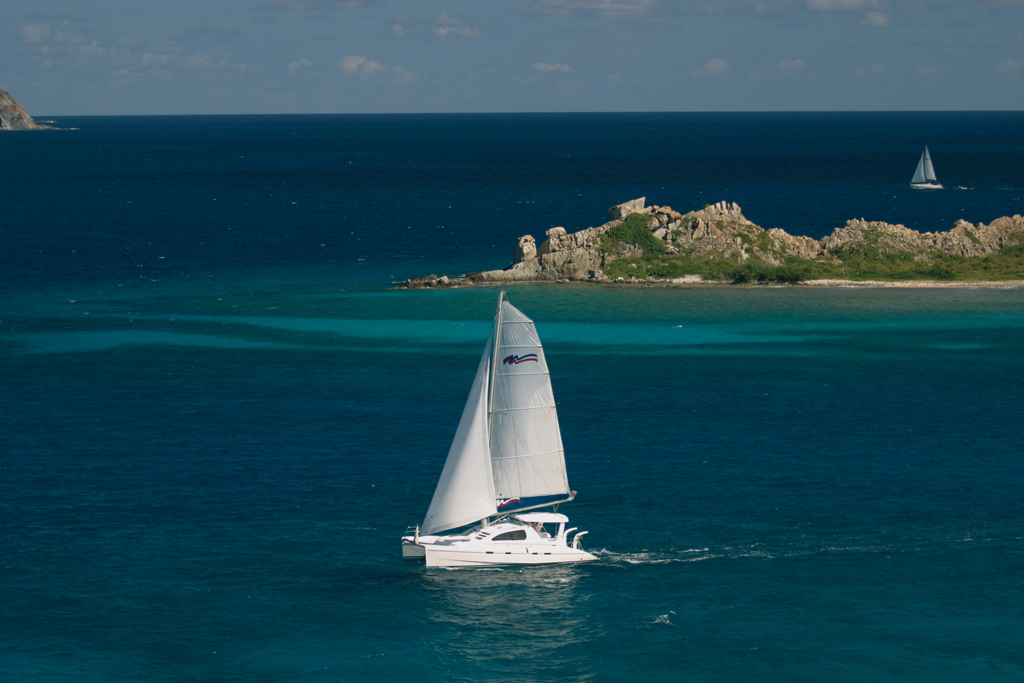
The Outremer 42’ is well known to Multihulls World readers, and is a very pleasant catamaran to sail: fast, seaworthy, it allows the family to sail in peace…
Electric propulsion and the Outremer philosophy
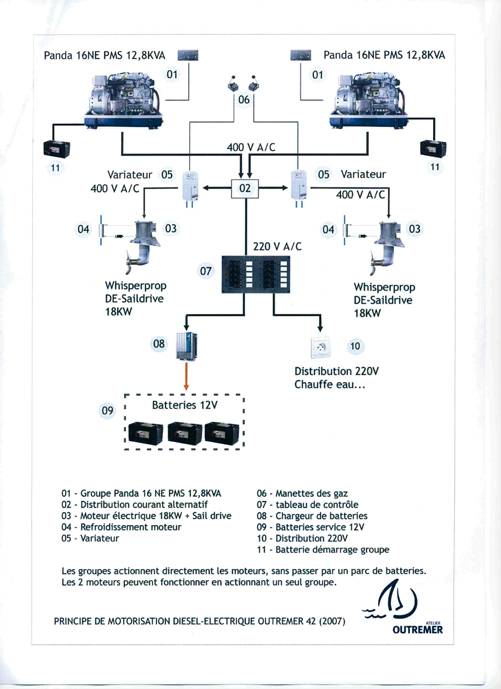
There was no question of the Languedoc-based company dedicating a specific model to this propulsion; it was rather a matter of importing combined diesel-electric-solar solutions aboard conventional catamarans, to use their advantages and deliberately adopting a development perspective. The first arbitration concerns the number of generators and their set up: two generators supply the 18kW motors directly and can operate alone (at 70% of the power of the two motors) or in tandem. Transmission to the propellers (Jprop 17/13 folding 3-blade) is entrusted to saildrive legs, electrical brakes allow the blades to be closed when the propulsion mode is switched off. Another bias is having a traditional domestic battery bank (3 x 10⁵Ah) and two starter batteries. Recharging by the propellers has not been adopted. The additional weight associated with the diesel electric system (164kg in the saildrive version and 144kg for the propshaft development), requires a trim correction: the diesel tanks (2 x 137 litres) are therefore placed in the hulls. Finally, the choice of Two Fischer Panda generators (12kW-400V) allows installation in the engine compartments in place of the diesel engines.
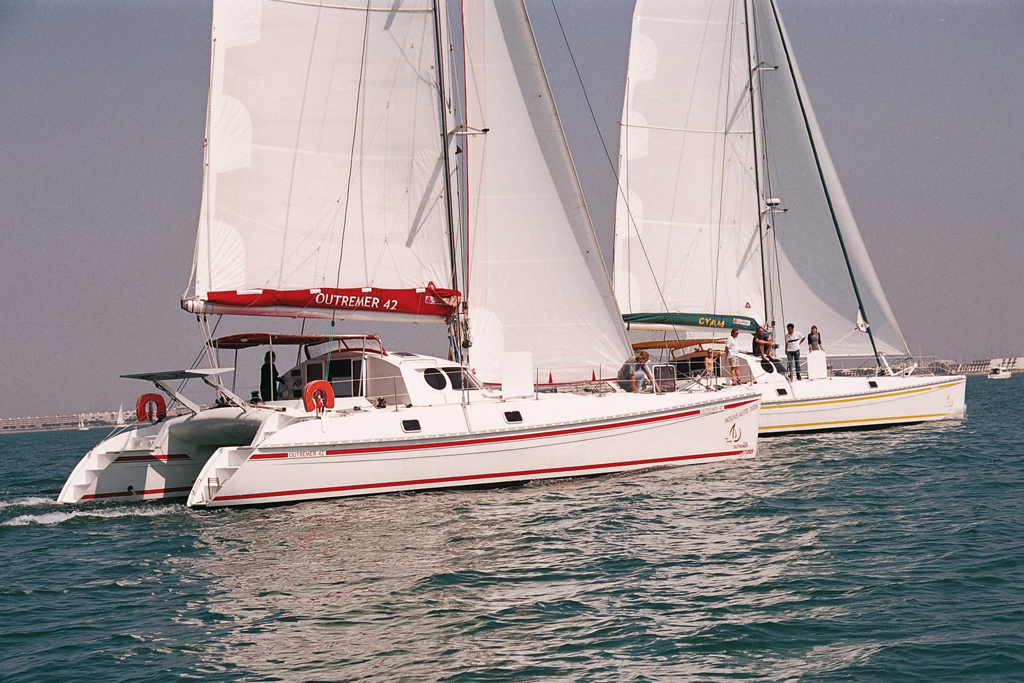
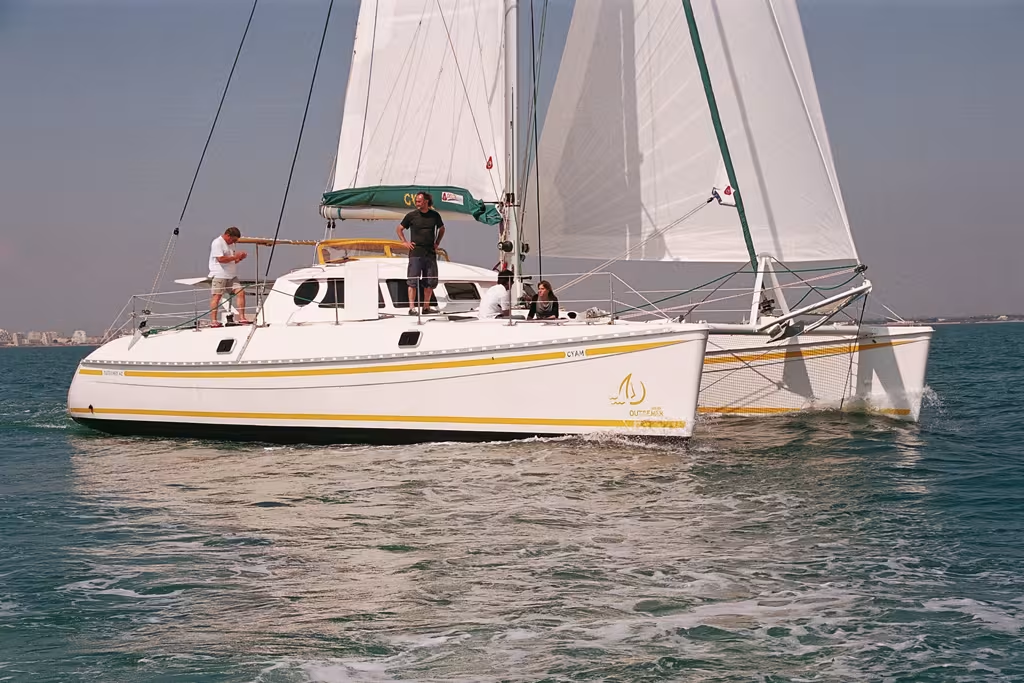
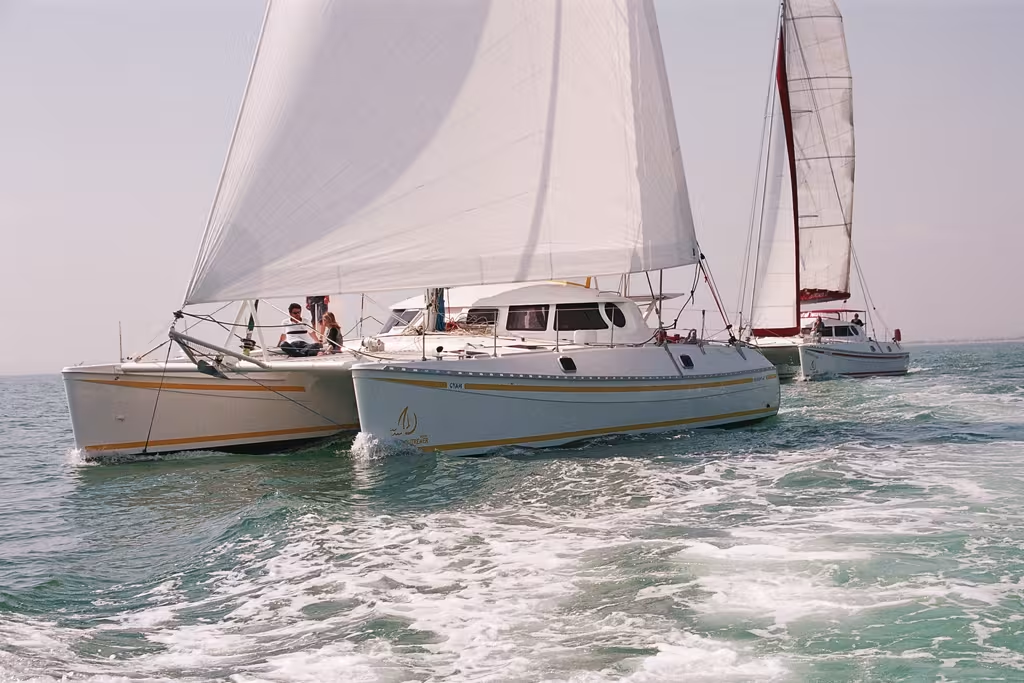
The yellow boat has the electric propulsion; the red has classic diesels. Under sail, there is no difference between the two!
System architecture
When the lockers are opened, we find the electric motors raised by the saildrive mountings, which keeps them away from possible stagnant water in the bilges. The simplicity of the supply connections is obvious, as is their reduced size, a consequence of choosing a high voltage system. The generator is placed on a laminated support and its easy accessibility assists maintenance; its cooling system is classic, but a specific heat exchanger (sea water – oil) maintains the temperature of the propeller and the variator at 37°C. A simple glance allows filter operation (water and diesel) and fluid levels to be checked. Temperature alarms permanently check that the operating parameters are respected. The variators and the connecting panels are situated under the aft berths.
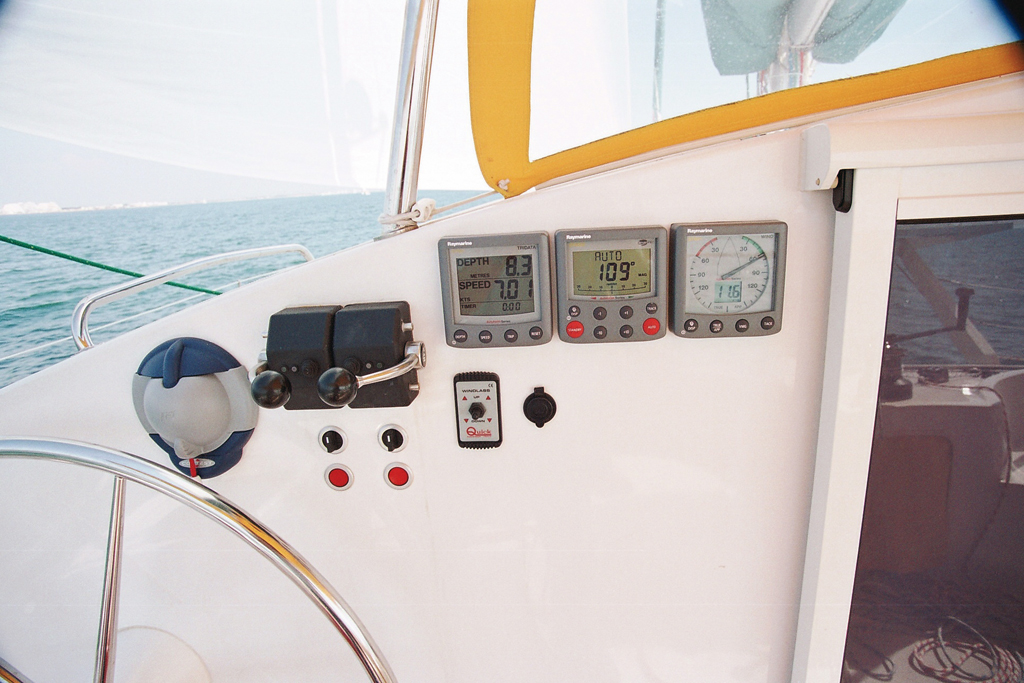
The electric version’s steering position. Classic, and above all, SIMPLE!
A neat installation
The quality of the installation work is obvious; the elements of the Fischer Panda equipment are protected by stainless steel housings. The reassuring overall clarity will make servicing easier.
One of the diesel engines on the classic version.
Consequences for life aboard
From the outside, nothing distinguishes an Outremer 42’ equipped with traditional engines from this diesel-electric version. The solar panels on the davits are there to prolong the lifespan of the battery bank, optimise the range and reduce consumption, but of course the energy potentially available is considerable. Hot water is provided by a calorifier (which no longer needs the circulation from the engine), heating could be fed from the same source and the 220V watermaker will allow the weight to be kept down (the potential gain on a 42’ is 300kg). Within reasonable limits, the other on-board consumers are guaranteed to work constantly, as will portable electric tools, the television, the DVD player or the computer! The 80A charger can also convert 2000W into 220V.
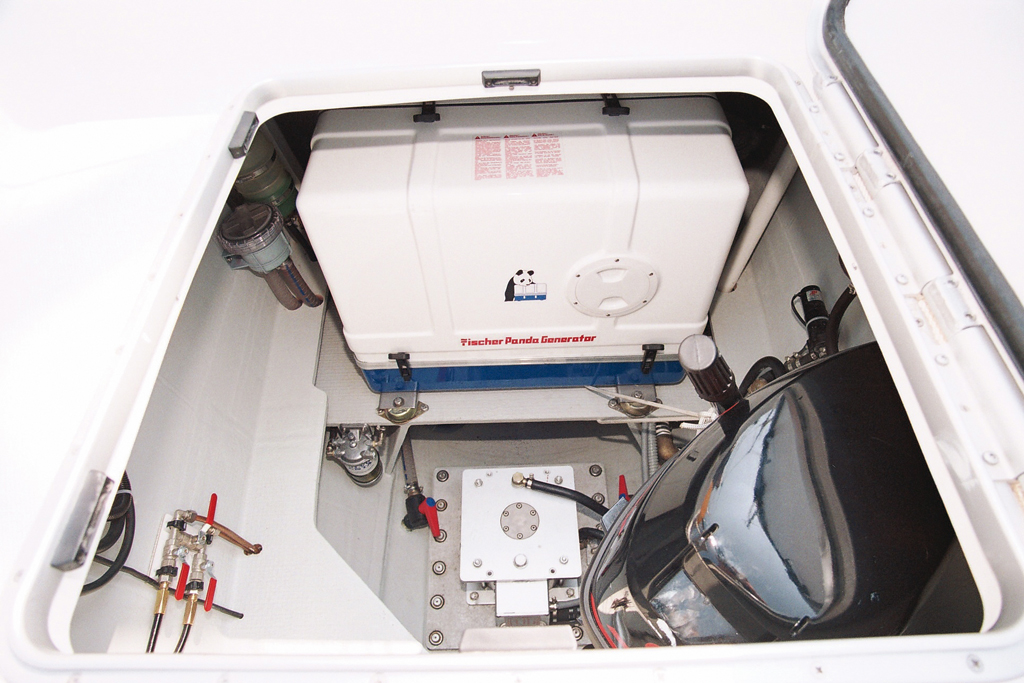
The generator and the electric motor are fitted at the rear of each hull…
Yellow versus red
We set off together in the two Outremer 42s; I first wanted to accompany the ‘fraternal twins’ in a Zodiac, to get a good look at the silhouette, the behaviour and the trim of the two catamarans and to note any possible differences. First observation: the boats’ speed is amazing. Under gennaker, with the sea breeze starting to blow, (at around 10 knots), the four hulls were slipping along at more than 7 knots on a swell left over from the previous day’s 20 knots of south-westerly. I sailed then motored aboard the thermal (red) version, alternating phases of half and full power to recall the impressions of our test last year (see Multihulls World N° 87). Finally aboard CYAM (the yellow, diesel-electric version), we headed out to sea under gennaker. The model’s qualities immediately became apparent; the 42’ purred along, (with 6 crew aboard) at between 7 and 8 knots, at 80° to a breeze which never exceeded 11 knots! Guided by Stéphane, who developed CYAM, I then moved on to the test under engine. Facing the helm, there are 2 electric change-over switches and 2 on/off switches! That’s all, and it’s enough; switching on is carried out by turning the switch a quarter of a turn, 5 seconds pre-heating and the generator(s) start up. At a constant 3,000 rpm, the velvet-smooth operation is psychologically pleasing, less present than the noise of conventional engines, the contrast is quite considerable! The efforts put into the whole of the chain (waterlock at the air intake, dry exhaust with separator, propulsor and variator cooling, additional anti-vibration stage on the sail-motor connection…) have paid off; the overall verdict is that we could maintain this speed (7.5 knots) to Minorca without suffering. The 7.8 knot maximum speed is perfect for auxiliary propulsion and the noise level descends to 64db in the middle of the saloon at 7 knots! To give you a concrete idea of what this means: sitting at the saloon table, you can’t hear the generators starting up or switching off. Remarkable! Manoeuvrability in harbours and anchorages, or to pick up a buoy, benefit from the electric motors’ usual low-speed torque qualities: with the daggerboards down, the user can do exactly what he wants to, with fingertip control and hardly using the throttles. The performance of modern propellers coupled to this kind of propulsion gives good performance and a real reserve of manoeuvrability.
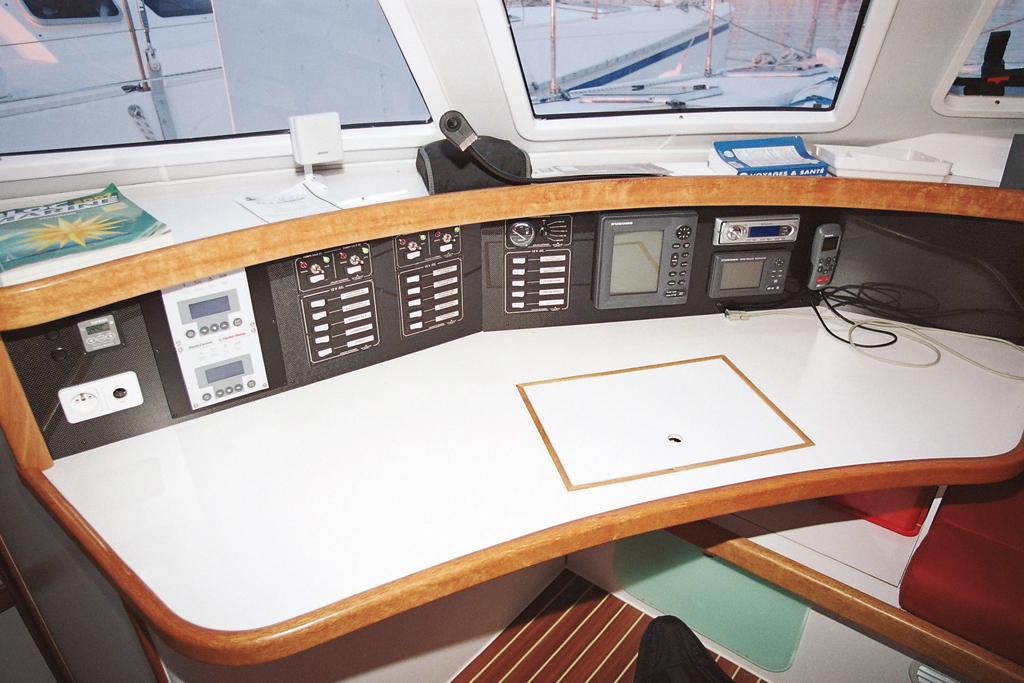
To the left, the control modules for the 2 generators, function checks using a digital display and consumption management: diesel-electric for idiots!
Conviviality in use
In a word, it is SIMPLE! At the helm: two on/off ‘keys’ and two changeover switch-accelerators. At the chart table, there are two control panels allowing start-up and control of the ‘generator-recharge’ function (without turning the changeover switches or the motors on). Everything works on the on/off principle and it is not possible to make a mistake. Personally, I appreciated the technological ‘lightness’: available if needed, discrete the rest of the time!
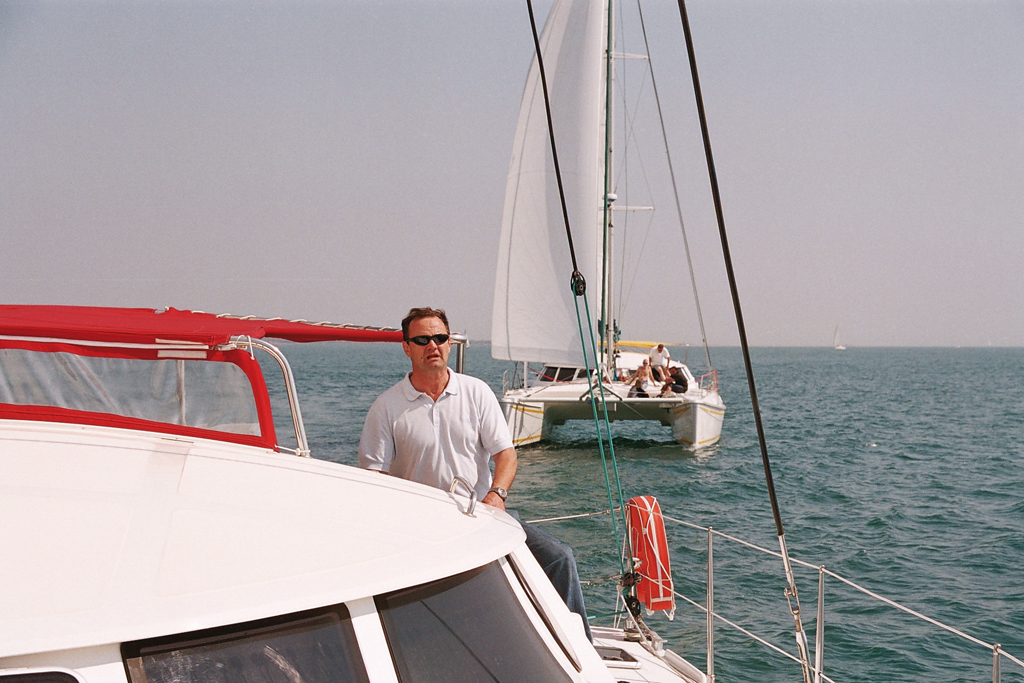
Let’s not forget that these catamarans are above all sailing boats, and that they can be enjoyed to the full on the helm, under sail…
Conclusion
The adaptation of the diesel-electric concept on the Outremer 42’ is a success; performance is unaltered, weight distribution is not adversely affected, and the quality of life aboard seems to benefit. The test on a medium-sized boat is worthwhile, as it validates the whole of the set-up and allows the number of thermal motors embarked on a catamaran to be limited: the rise in electrical consumption whilst cruising has been accompanied by a multiplication in the number of fossil fuel engines aboard, despite the progress in wind generators and solar panels…the last straw! On numerous multihulls, we have seen one or even two generators plus a diving compressor, based on a thermal engine, in addition to the two propulsion engines and the outboard for the dinghy!!! The concept developed on the 42’ can easily be adapted to the other models in the range, whatever their size.
The plusses :
-A relevant, convivial, light and silent solution - Serious implementation - Abundance of energy with no impact on seakeeping qualities.
The minuses :
- No weight and price reduction yet with respect to ‘thermal’ engines - Reliability of the components to be evaluated over time
THE COMPETITORS
Model Lagoon 420 Léopard 43' Fast Cat 435 Architect Van Peteghem /Lauriot Prévost Simonis & Voogd Lavranos / Goudsmit Builder Lagoon Robertson & Caine Length 12.61m 12.95 m 13.18 m Beam 7.50m 6.93 m 7.42 m Weight 11.7/14.4t 8.6 / 14.4 T 5.5 T Windward sail area 97m2 120 m2 125 m2 Price ex-tax 270,000 euros 305,000 euros 440,000 euros
COMBINED DIESEL-ELECTRIC PROPULSION What developments are possible?
All the links in the chain can be the subject of small or large developments: - High output generators, quieter, lighter, cheaper… - Integration of the variators in the motors (compactness, less wiring). - Aviation quality connectors – 30% less weight and greater efficiency. - Lithium batteries – lighter, much smaller. - High output solar panels. - The fuel cell appears to be a mirage for the moment, the sticking point being the quantity of energy necessary to make the hydrogen and the challenge of its storage. - Advanced thermal basis (Whispergen type): output, economy, silence. - Development of mentalities: let’s not forget that our engines are auxiliary and that the main source of energy for our sailing boats is the wind!
TECHNICAL SPECIFICATIONS
Architect: Gérard Danson Builder: Atelier Outremer Material: foam/glass/polyester sandwich and monolithic, infused. Length: 13.10m Beam: 7.00m Unladen weight: 6.4t Laden displacement: 8.9t CE approval: 10 persons coastal / 6 persons offshore Mast height: 17.80m Mainsail area: 65m2 Jib: 29m2 Gennaker: 65m2 Spinnaker: 98m2 Engines: 2 x 29 hp diesels or 18kW Generators: Fischer Panda 3000rpm, 12kW Consumption at 7 knots: diesel 4.8l/h, diesel-electric 3.25l/h Price: 435,350 euros inc. VAT. Location de CYAM: www.evoilezvous-croisieres.com
