
Gérard Danson’s fertile mind continues to mark catamaran development with its originality and inspiration; this discreet, talented architect’s designs attract praise from both his peers and enlightened amateurs – quite an achievement! The charismatic boss of the Grande-Motte based yard was a tireless amateur who prepared his team for today’s changes in technology; a creative designer who mapped out the future and left his mark on the next successful models to come from the Atelier Outremer: the 60 and the 42. Respect, and welcome aboard!
Infos pratiques
- Le chantier : Outremer 42
- La fiche technique
- Découvrez notre vidéo exclusive
- Financez votre Outremer 42
- Assuez votre Outremer 42
- Articles autour du Outremer 42
The 42’ in the Outremer family.
The Outremer saga began with the 40’, whose simple, effective and original matrix contained the fundamentals of all the future ‘Danson’ catamarans. The 38, then the 38 – 43’ and 40 – 43’ developments integrated the inboard engines, solar panels and other ‘essential’ ocean cruising equipment, the list of which grows longer every year. These catamarans, with their characteristic features and sensitivity to excess weight are today aimed at purist fans of narrow hulls and that emblem of the light displacement boat, the tiller! The rest were left to imagine the successor! Its silhouette, its performance and its character would be 100% Outremer, but the 42’ would be more tolerant to loads, have more volume and its tooling would be suited to ‘infusion’ technology. As a preview to the Paris Boat Show, we were able to sail aboard n°3 of the series.
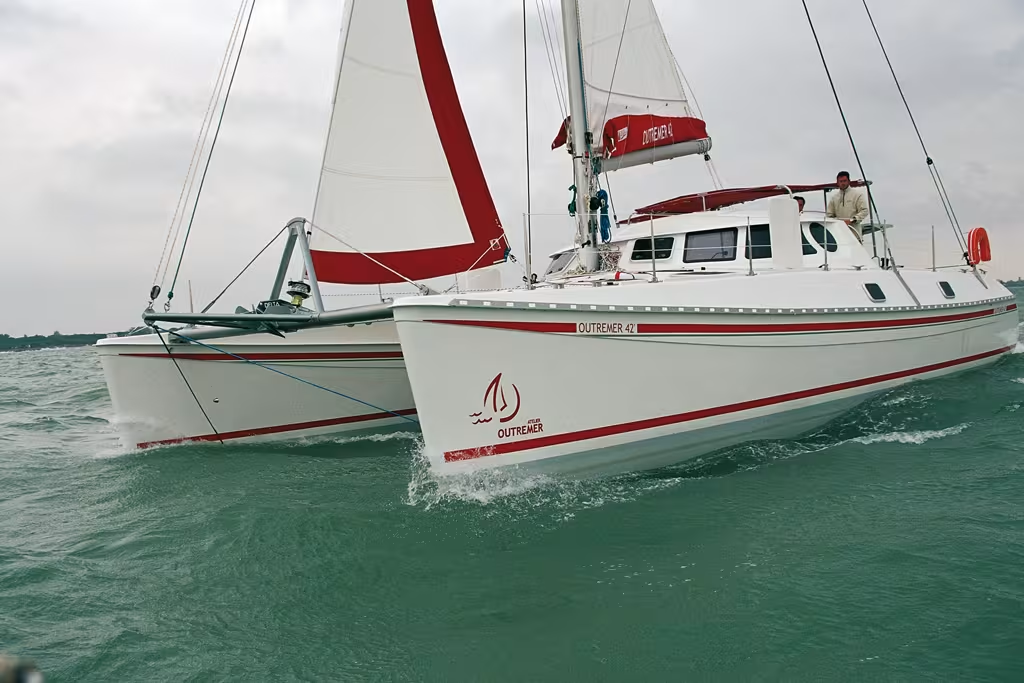
With its high nacelle, fluid superstructure and streamlined rig, the 42 asserts its ‘comfortable and determined’ personality!
Design and architecture
In 1985, Ville Audrain imposed its 42’on the Grand Pavois and its size surprised the public; twenty years later, ORANGE II surfs at 40 knots… but a 42-footer remains a good option for going to sea in all weathers. Catering for the tastes of a well-informed public is a mysterious balancing act! Designing a 13-metre catamaran which would integrate the Outremer values, offer more liveable volume and tolerate all the modern luxury equipment was a challenge Gérard Danson and the Grande-Motte research department successfully took up. The 42’is beautiful, its overall silhouette is reminiscent of the 2nd example of the 64’ and detailed examination confirms this flattering reference. Its well-balanced proportions show off quite sporty overall lines to advantage and clearly state the boat’s character: comfortable and determined. The volumes aft have become a little more corpulent, the sections are rounder, but the artist’s talent has blended all this together and the visual impact is immediately positive. The bridgedeck is well above the water, the hulls have slim, powerful bows and are overhung by a short cabin roof which maintains the 42’s style: capped by a hemispheric dome-roof (acting as a sun-shade), the panel cut-outs are superb and the pair of small round portholes give the finishing touch to a successful design.
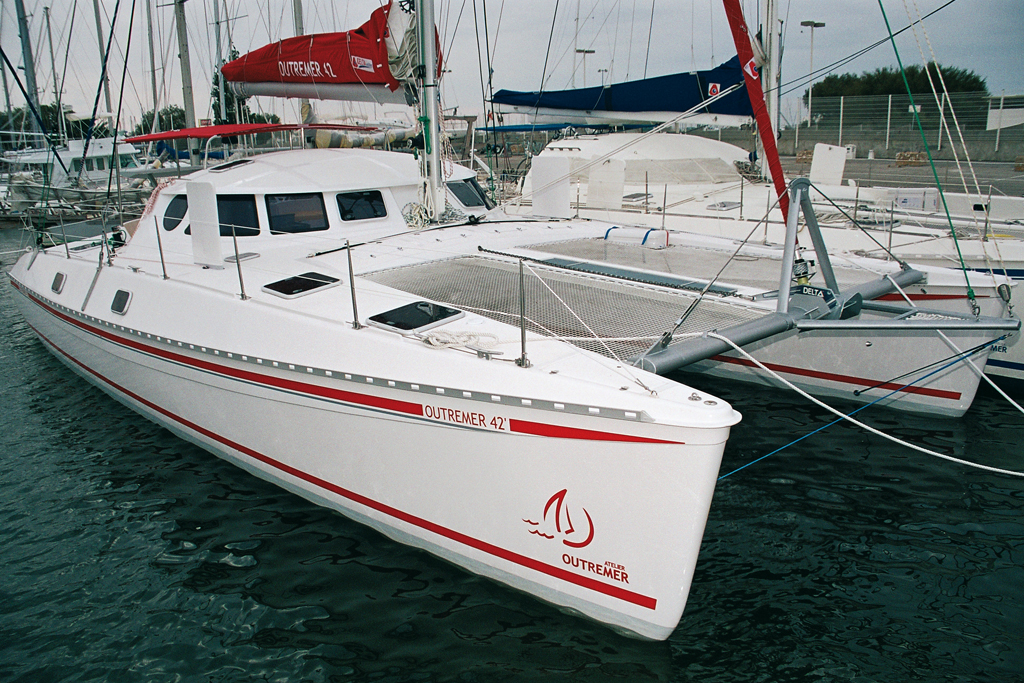
Short cabin roof, streamlined hulls, the Gérard Danson design in its 42’ version…
Construction
In progressive stages, over a little less than two years, the Atelier Outremer has carried out a major technological change, by abandoning ‘contact’ lamination (resin application by spray gun to large parts in an open environment). The 42’, as well as all the other models, is now built using infusion techniques (resin injection under vacuum). The technology transfer is complex, but the advantages are enormous: elements are prepared with extreme care, in a clean, healthy environment; the tissue and foam cut-outs are perfect. Everything is then wrapped up in a waterproof polythene film and the impregnation begins. This technique offers three major advantages: real qualitative progress for the professionals, reduced solvent (Styrene) emissions, optimised weight specifications and better mechanical homogeneity of the matrix. The 42’ benefits from this advance; the improvement in the skin compaction and the general build quality can be seen. The hull sides are now built in a PVC – glass – polyester sandwich (improved acoustic and thermal insulation) and application of a special NPG gel coat as well as use of vinylester resin below the waterline (monolithic) protect the 42 from hydrolysis.
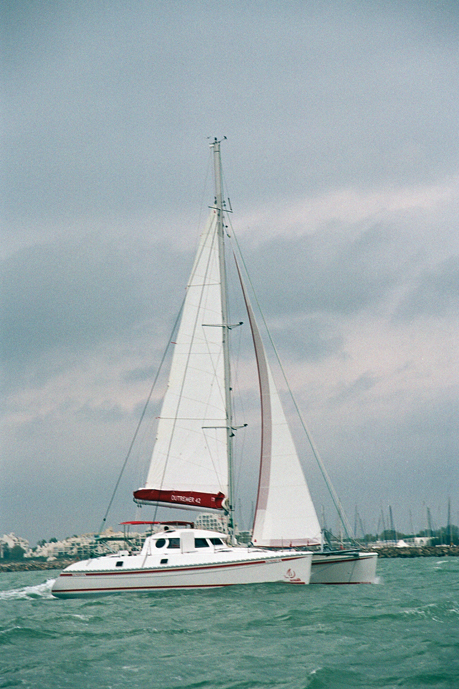
With such beautiful lines and seakeeping qualities, the Outremer 42 should be a real success!
Aboard : accommodation, deck plan, engines, rig.
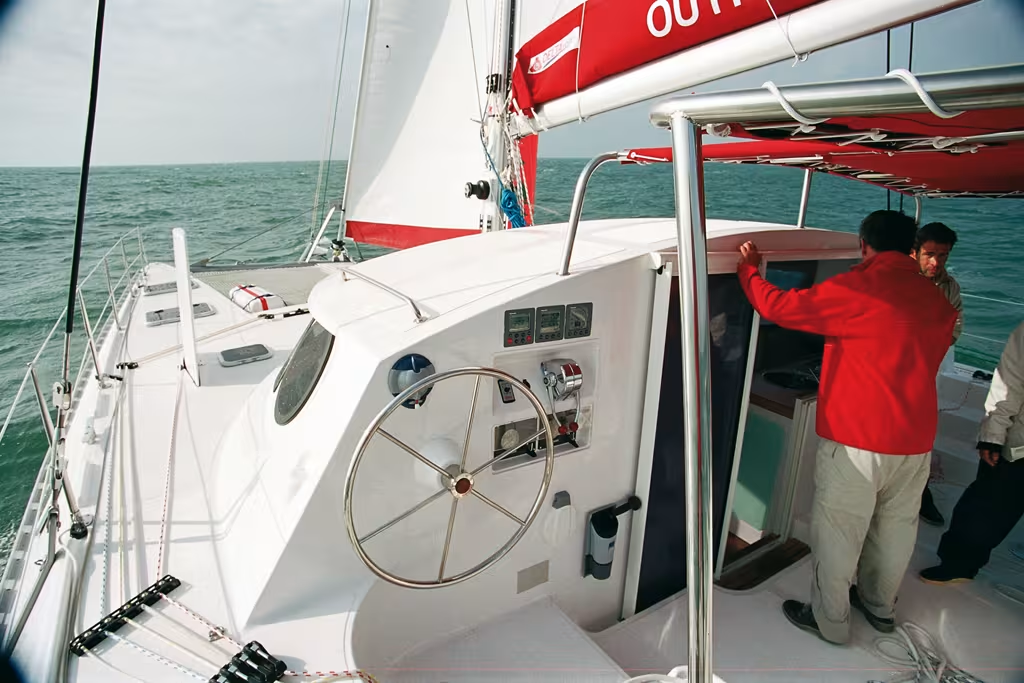
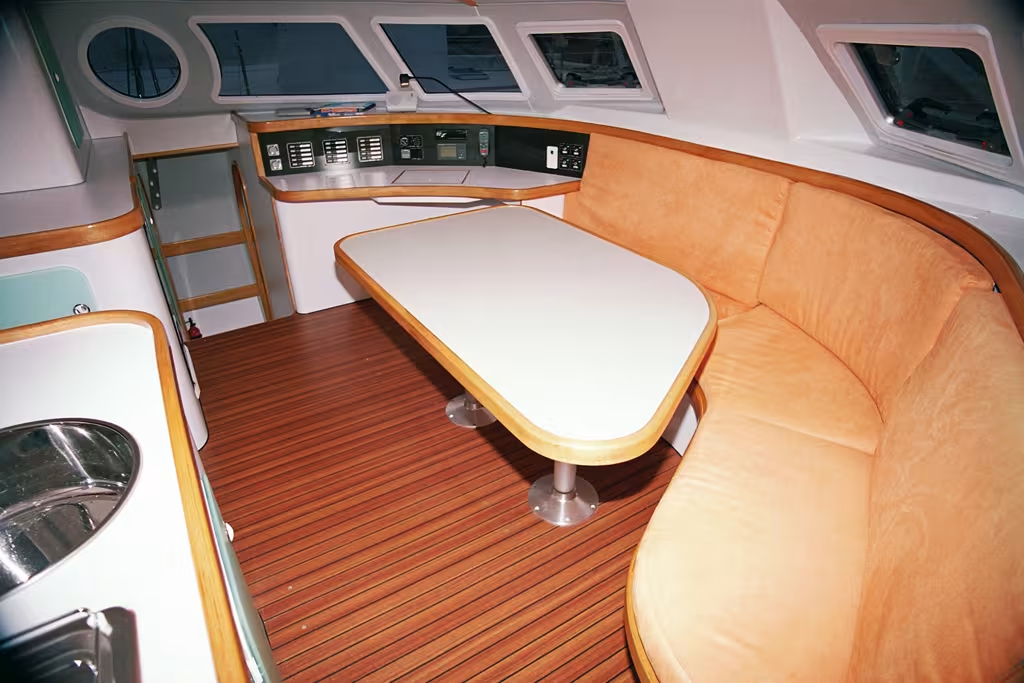
The 42’s silhouette has its own personality; it is different from the 45’, but the internal architecture is very similar and those familiar with Outremers will immediately feel at home. The effective galley, saloon, chart table and hull layout which proved itself on the 45’ has been retained; build and finishing quality is very good. The technical architecture remains simple, clear and easy to understand: the battery bank and its connections (under the saloon floor) are a model of reliability and work carried out to a high standard (even after long passages, there have been few problems in this delicate area). The same can be said for the engine lockers and peripheral fittings; they are accessible, carefully fitted and all secondary systems are intuitive (sea water filter, diesel filter, cooling water tank, starting battery, steering hydraulics, watertight electrical cabinets, etc…). In bad weather, it only takes a couple of seconds in the engine room to ensure that there are no problems! The standard 9kg/m, Z-Spars or Sparcraft mast is 17.7m long and seems to be suited to the platform’s power; its overall dimensions, the double triangulation and the jumpers inspire confidence. Fittings are high-quality, but the excellent Harken winches need to be a size bigger. The davits, the forward crossbeam and its rigging as well as the bowsprit’s triangular structure reflect the seriousness of the construction. The windlass (integrated in the forward crossbeam) and its roller show that the designer really has taken into account the forces acting on this equipment. Recessing the crossbeam locker lids is a good idea, both aesthetically and ergonomically.
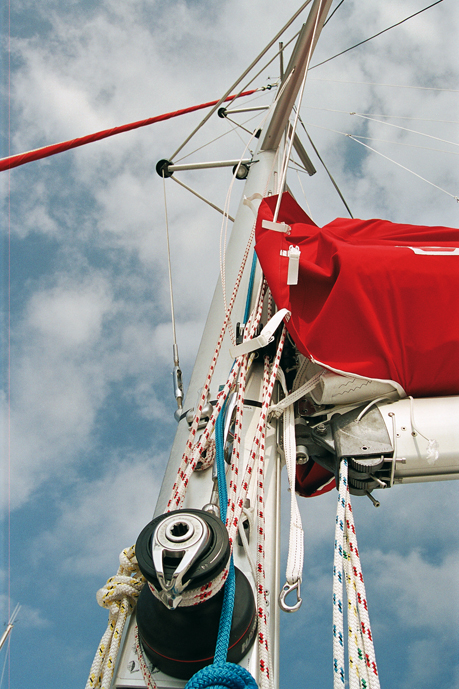
The fittings are well made; the davits, the forward crossbeam with its rigging, and the triangular bowsprit structure reflect the seriousness of the construction…
Test at sea
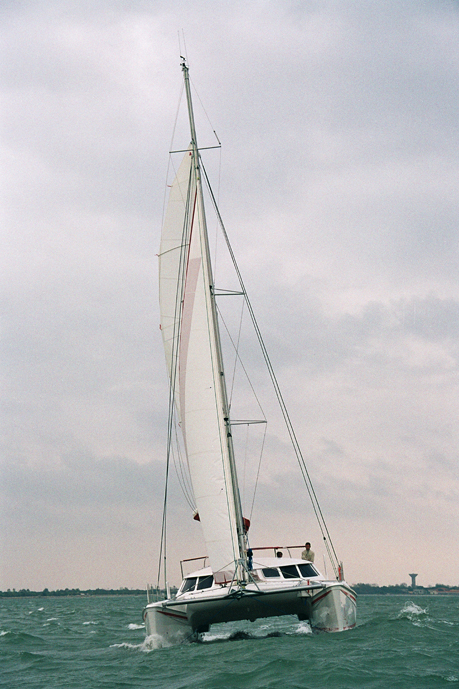
At the end of October in Aigues-Mortes bay, we were lucky enough to have a slightly grey but nonetheless pleasant day, typical of the south to south-easterly winds: 15 to 20 knots blowing from the sea and kicking up a lively chop (in 15 to 20m of water). After the traditional photo session, we set course offshore with one reef and the whole of the jib: first impressions were immediately positive, at 50° to the true wind we were not quite as close-hauled as we could have been and the 42’ set off at 9 knots. The general feeling aboard was that we could optimistically envisage sailing directly to Minorca, which gives an idea of the 42’s natural ability to windward. Uncluttered hulls and a short, high bridgedeck help the catamaran punch through a choppy sea; the Outremer is agile, dry and sails easily and comfortably to windward, the boat ‘swims’ through the water without slamming or slowing down in the troughs. Comfort in the saloon was excellent (it wasn’t blowing a gale outside, but on a less able boat this point of sailing could have been laborious), no vibration, no cracking noises; a discrete structure perfect for resting or preparing food. The only slight criticisms were the diameter of the wheel, which is too small, and its reduction ratio, which is too large. The directional effect of the rudders was clearly perceptible and overall balance was excellent. A good mark for mainsail handling ergonomics - the winch and the jammers on the console allowed our muscles to work more easily (essential when gybing). The boat tacks easily and we sailed legs to windward, broad reaches then beam reaches. The absence of a gennaker and the care with which a new boat must be treated (especially the model to be exhibited at the Paris Boat Show) meant we could not push the 42’ as hard as we might have liked to, but our good average (10-12 knots on a reach with one reef) was enough to lead us to hope for more than 15 knots in the same conditions under mainsail and gennaker.
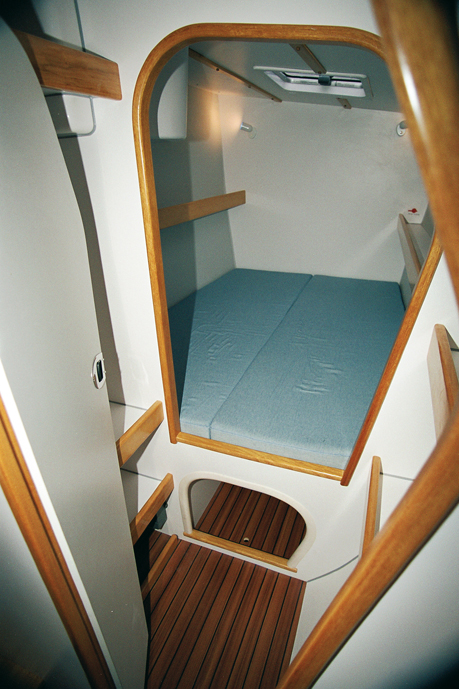
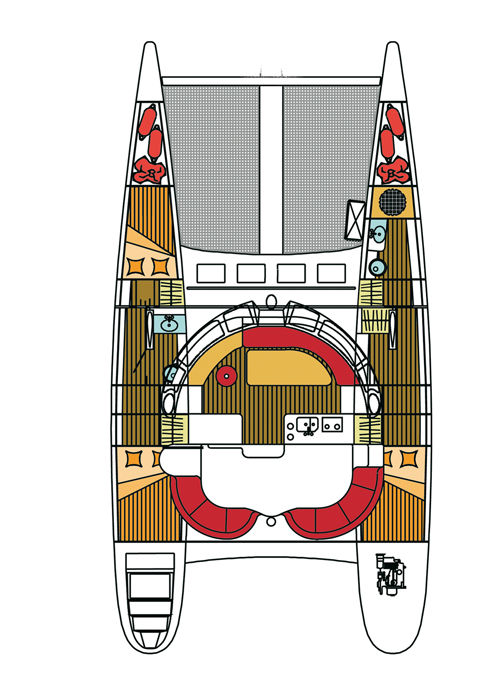
The 42’s accommodation is simple and functional but with excellent finishing (at last), and is perfect for cruising.
Conclusion
I had the feeling of having sailed aboard a catamaran which is comfortable, has good performance, a gentle movement and slips through the water remarkably (half laden), allowing ocean swells to be tackled in comfort. In its owner’s version (dedicated starboard hull) or with 4 double cabins, living aboard the 42’ would be pleasant; the overall space, the way the volumes have been arranged, and the functional nature of the accommodation are successful and do not disturb the boat’s dynamic qualities. The 42’ opens the doors to ocean cruising, whilst remaining more agile than the 45’ in crowded anchorages and ports; it is also cheaper to buy and to maintain.
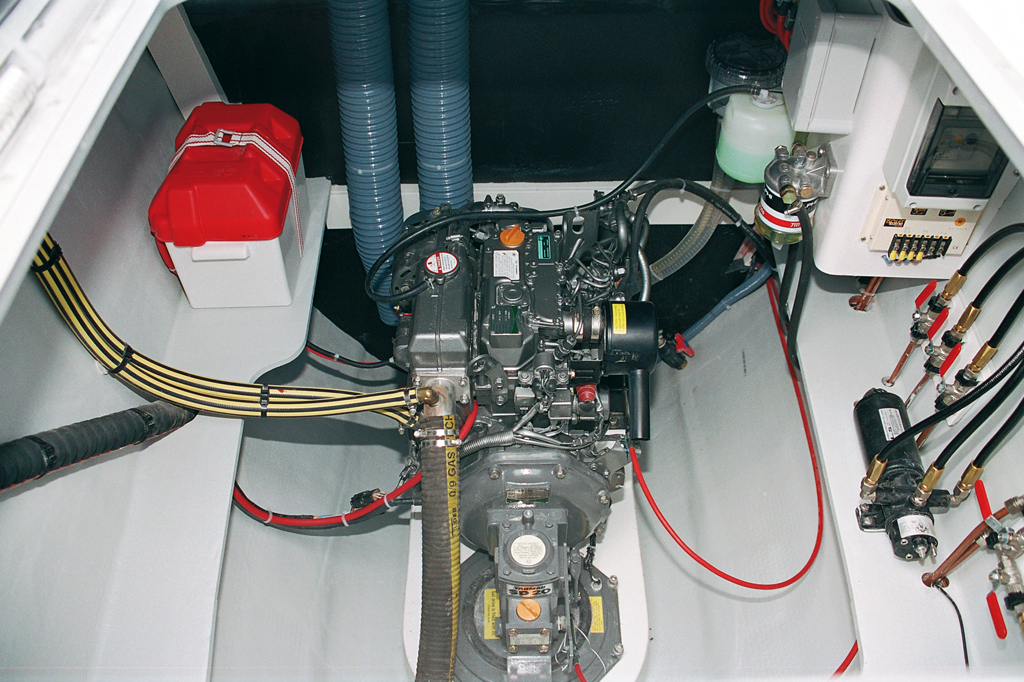
A rational and comfortable engine installation that whoever does the maintenance will appreciate…
The plusses
Successful catamaran Overall lines Performance
The minuses
Hydraulic reduction ratio Steering wheel too small Sheet winches a bit small
TECHNICAL SPECIFICATIONS
Builder : Atelier Outremer Architect : Gérard Danson Length : 13 m Beam : 7 m Waterline length : 12.40 m Unladen weight : 6.4 t Displacement, loaded : 8.9 t Draft : 0.70/2.30 m Mast height : 17.80 m Mainsail area : 65 m2 Jib area : 29 m2 Gennaker area : 65 m2 (option) Spinnaker area : 98 m2 (option) Air draft : 21.30 m Engines : 2 X 29 hp Diesel Price of basic version : 394,680 euros incl.VAT
The competition
Model Builder Length (m) Beam (m) Weight (t) Windward sail area (m²) Price, incl VAT (euros) Belize 43 FountainePajot 13 7 7 111 365,378 Catana 43 Catana 13 7.3 9.5 114 609,594 Privilège 435 Alliaura 13.45 7.07 8.9 111 464,048 Freydis 39 Tournier Marine 11.99 6.43 6 102 356,570
