
By the time you’re reading this, the Outremer 4.Zero and her crew will most likely be mid-Atlantic, in the wake of Magellan and his faithful second mate Elcano. Though Jimmy Cornell has presented in person, and in detail, his technical and historical challenge, we couldn’t miss the opportunity to test ELCANO 500, this Outremer of the future also known as Aventura Zero. As soon as the catamaran was launched, we took advantage of a short weather window in early October to test this prototype for you. We were able to take part in one of the very first sea trials, before the boat cast off for Seville, Magellan’s port of departure some 500 years ago.
Infos pratiques
- Le chantier : Outremer 4.Zero
- La fiche technique
- Découvrez notre vidéo exclusive
- Financez votre Outremer 4.Zero
- Assuez votre Outremer 4.Zero
- Articles autour du Outremer 4.Zero
Test location: La Grande Motte, France
Wind: 8 to 12 knots southeasterly
Sea state: smooth to slight
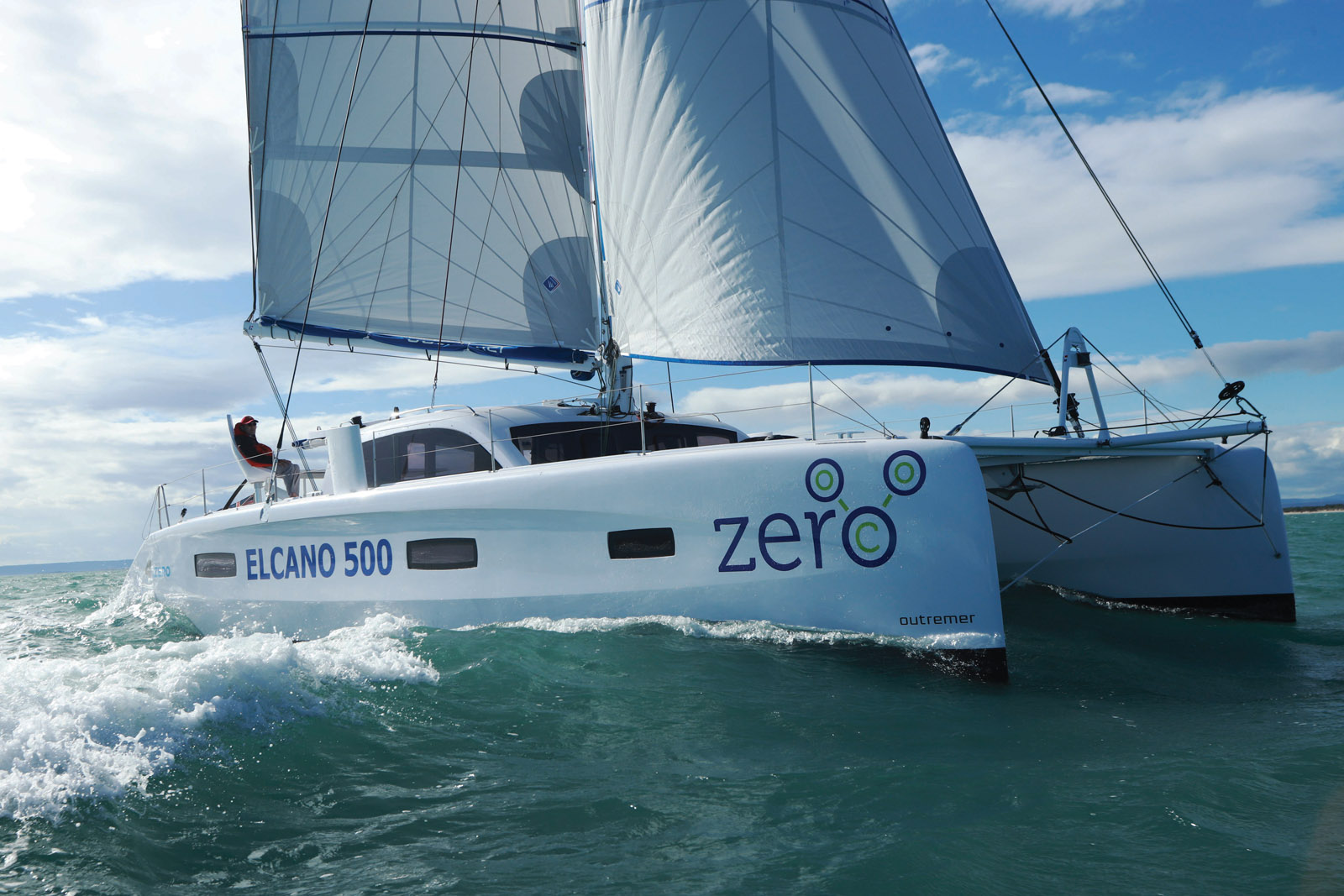
This Outremer 4X is not equipped with internal combustion engines nor a generator - everything is electric!
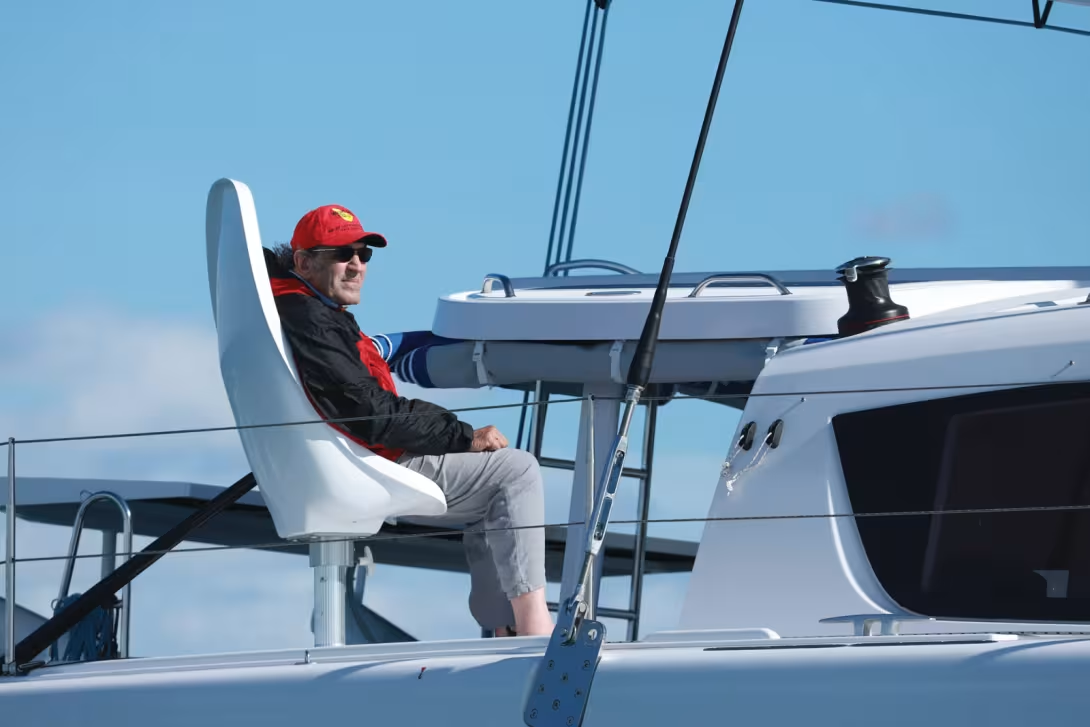
For any multihull and cruising enthusiast, this 100% electric 4.Zero Outremer is a double surprise. The first is to find Jimmy Cornell at the helm of a composite multihull that’s fairly performance-oriented. Trailblazer of four round-theworld voyages aboard monohulls and champion of the aluminum centerboarder, Jimmy was back from the Northwest Passage on his Exploration 45 - twice as heavy as his new two-hulled vessel, yet of the same length. The promise had been made to Gwenda, his stainless-steel crew/ spouse, that this time he would retire from the sea. We imagined him pruning his roses in the beautiful house in the South of France that he uses as his base camp. Yes, but then Jimmy had a new idea. And Gwenda gave in, aware that the happiness of her sailor husband cannot be satiated without cruising plans to implement (see MW173).
Test pilot for an all-electric boat
The second surprise in all of this is to find Outremer Yachting as part of the project. Above all, the French manufacturer promises their customers reliability to make their blue water cruising dreams come true in complete serenity. Yet here they are, launching themselves into the fledgling all-electric technology? When it comes to innovation, Outremer historically could be seen to be more of a “follower”. Leaving the major shipyards to clear the ground and make them more reliable, the Outremer teams prefer to see their owners go to the most remote places on the planet with proven solutions. But the shipyard is committed to an ambitious CSR (Corporate Social Responsibility) approach: eco-designing the boats in cooperation with the “11th hour” association and the objective of producing energypositive boats within three years. So, Jimmy Cornell’s project was seen as an opportunity to move forward on a subject that is increasingly in the minds of customers. Who could say no to such an experienced test pilot? But initially, this is a prototype not yet intended for sale. No doubt it will be in the near future, because according to Outremer, 80% of a boat’s carbon footprint is linked to its use.
Almost empty engine compartments!
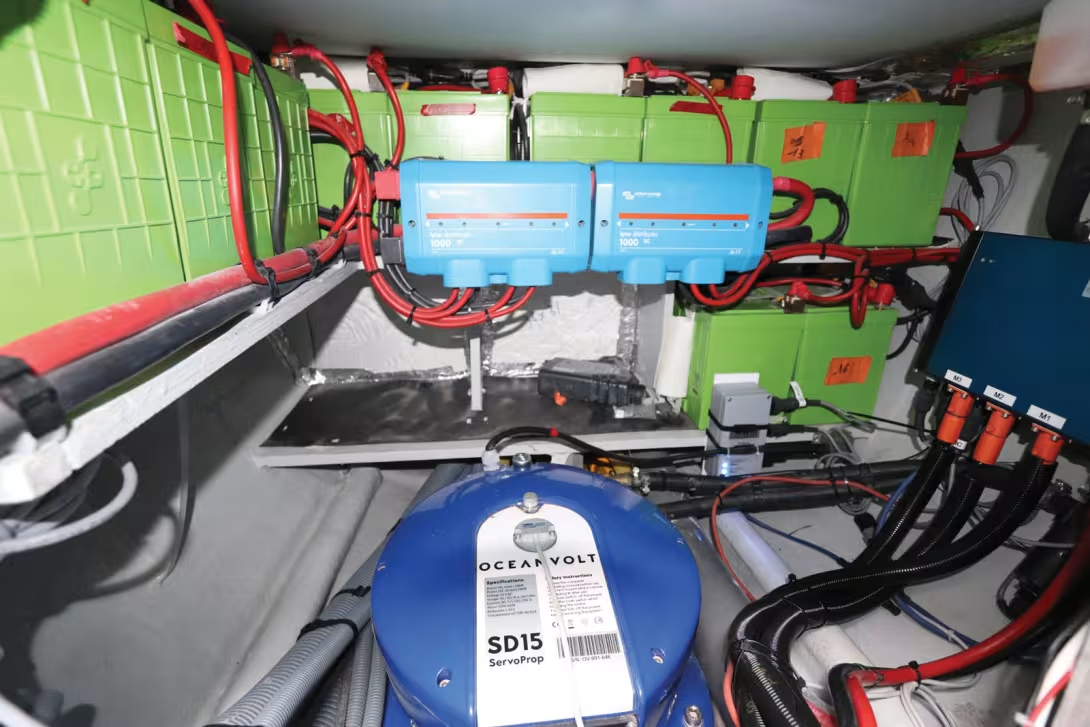
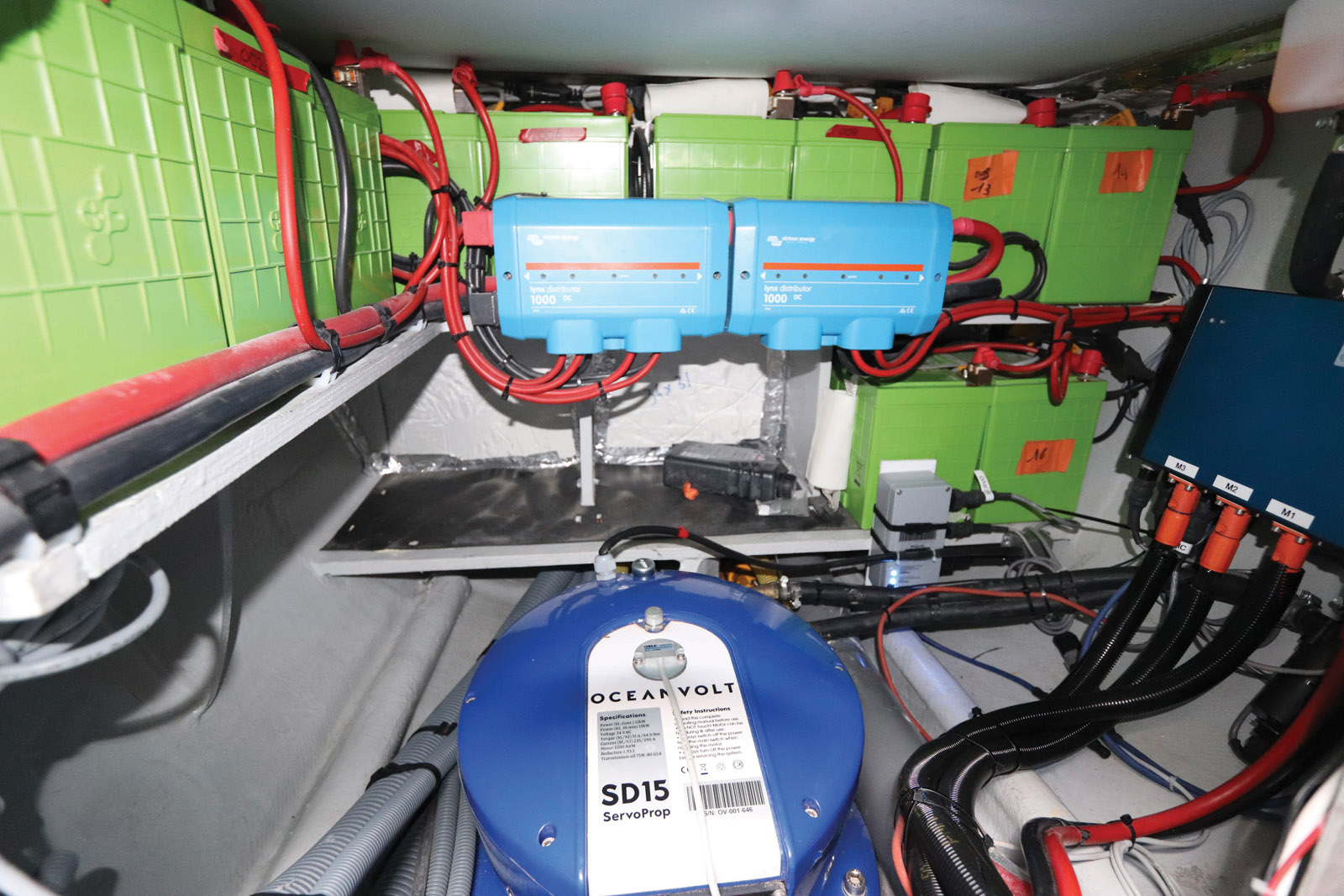
From the outside, there is nothing to distinguish the Outremer 4.Zero from an Outremer 45, or rather 4X, since it is indeed the “chassis” of the latter that serves as the basis for the aptly named Aventura Zero, as in zero emissions, and not Aventura 5, as tradition and chronology would have it. Inside, too, it is impossible to distinguish the production model from this prototype. The saloon, the owner’s hull to starboard, two double cabins to port, the interior signed by Darnet Design is strictly identical to the production models. So, since the difference lies in the motorization, let’s open the engine compartments. They are empty! Well, certainly in a line from the watertight hatch that gives access between the sugarscoop and the cockpit. Indeed, the Outremer 45 has the particularity of having engine compartments straddling the structural bulkhead of the aft beam. A part of the enginerooms are therefore located under the aft berths. The compactness of this 100% electric version allows saildrives and batteries to be housed in the forward half of the two engine compartments. Invisible at first glance, and above all extremely well protected.
 |
 |
 |
An OceanVolt Servoprop motor is installed on the starboard side, coupled to a propeller whose variable pitch is controlled by the system. The result is more efficient hydrogeneration and better engine performance. To port, a standard SD15 has been installed with a single folding propeller.
Two motors, two systems
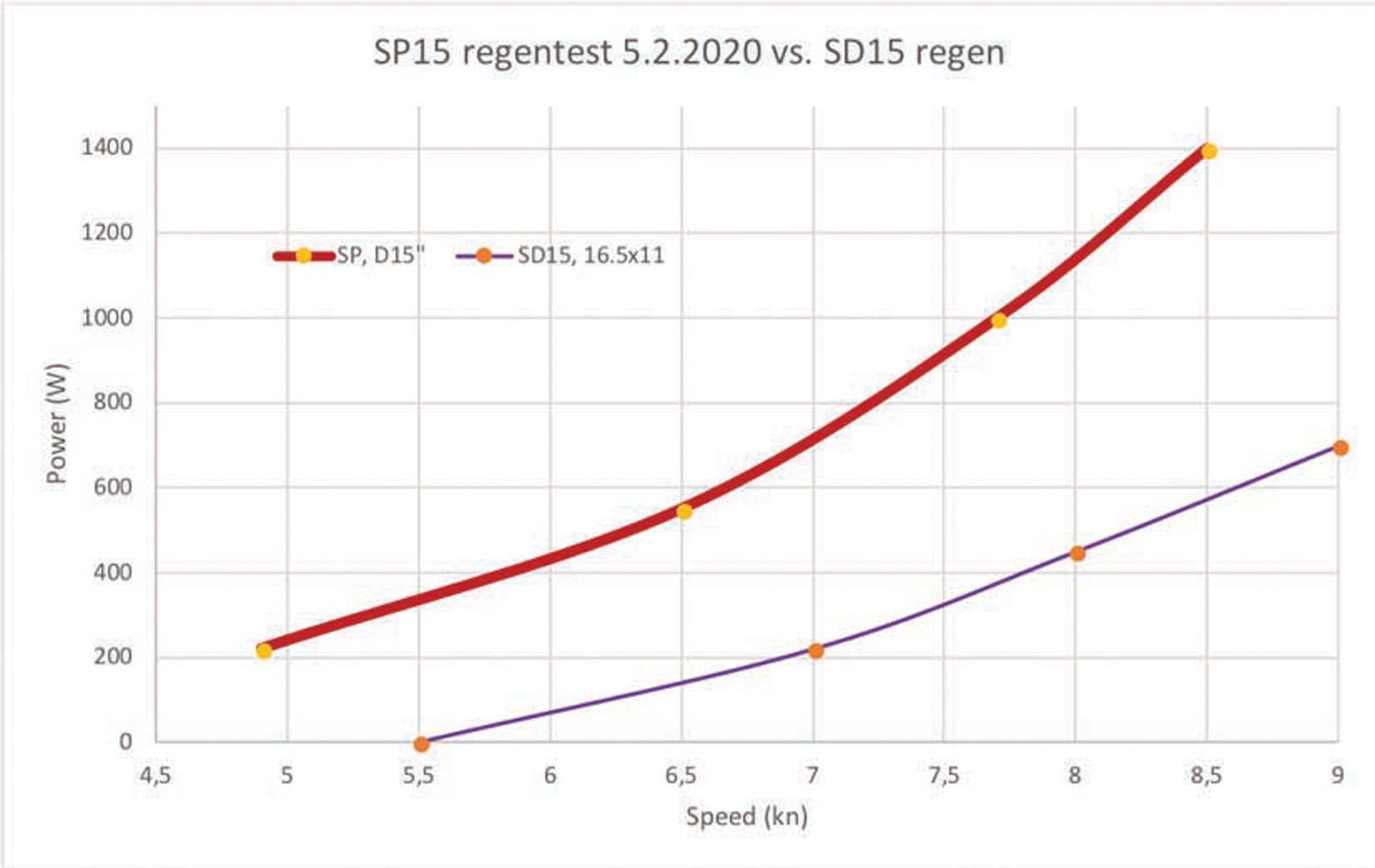
On this prototype, an OceanVolt Servoprop engine is installed on the starboard side, coupled to a propeller whose variable pitch is controlled by the system, allowing efficient hydrogeneration. On port side, for simplicity and perhaps also to ensure a little more reliability, a “standard” SD15 is fitted, equipped with a normal folding propeller. The unit also allows the batteries to be recharged under sail, but, under the same conditions, it produces half as many Watts as its counterpart. What’s the difference with its alter-ego for those of us less comfortable in physics? “It’s like a bicycle with only one speed,” explains Michel Nave, president of e-NAV Systems, OceanVolt’s distributor in France, who was on board during our test. More intuitive for us sailors bred in an environment of diesel and breeze, the drag is also greater, of the order of half a knot. Far from being negligible at low speeds, up to 5-6 knots, but quite acceptable when sailing at 15 knots. To the point of convincing the most de - manding offshore racers in terms of performance, such as one parti - cipant in the current Vendée Globe, Conrad Coleman, whose boat is equipped with this system.
Impressive torque, but limited range
But, regardless of the theory, it is time to leave the pontoon. This is only the third sea trip for ELCANO 500, and on board, everyone is surprised by the silence. New re - ferences have to be taken, because the throttles, or rather, power controls, I should say, are very sensitive. And it’s not the noise of the engines that will alert you, but rather the catamaran’s leap forward - or backward - if you don’t measure the pressure on the levers correctly. Over-reactivity during delicate port maneuvers could be problematic: you must be careful not to lean on them accidentally. The torque is impressive and therefore reassuring, but you must learn to measure out the right amount. Then you find yourself handling these little joys - ticks - and thus this 48-foot catamaran - with your fingertips. Once the clear of the port, heading into 12 knots of true wind, the motors are running at 2,200 rpm. ELCANO 500 is making a decent 6.7 knots. But the announced range is less than two hours. So, we are testing other configurations, less energy-consu - ming. On a single motor, the Servo - Prop version proves its technological superiority. At the same rotation speed, we’re going faster - 5 knots versus 4.6 knots - and the consump - tion is lower: 12.5 kWh versus 13.2 kWh. Jimmy insisted on using absolutely no fossil fuels during his circumnavigation of the world, so he didn’t want to install a generator. This was a consistent choice that led to oversizing the battery bank. While the “standard” recommendation for such a unit equipped with a generator would be 25 to 30 kWh, ELCANO 500 carries 56 kWh on board, evenly distributed on both sides, which is the same amount as a Tesla. By keeping this level of available by using a generator, we would obtain a lighter unit than an equivalent diesel-powered craft. But here, the batteries present on this prototype weigh 1,000 lbs (450 kg). The whole system thus exceeds the diesel figure by just a little. But the future is promising, because the weight of these lithium-iron-phosphate batteries will continue to decrease by 30% per year, predicts Michel Nave.
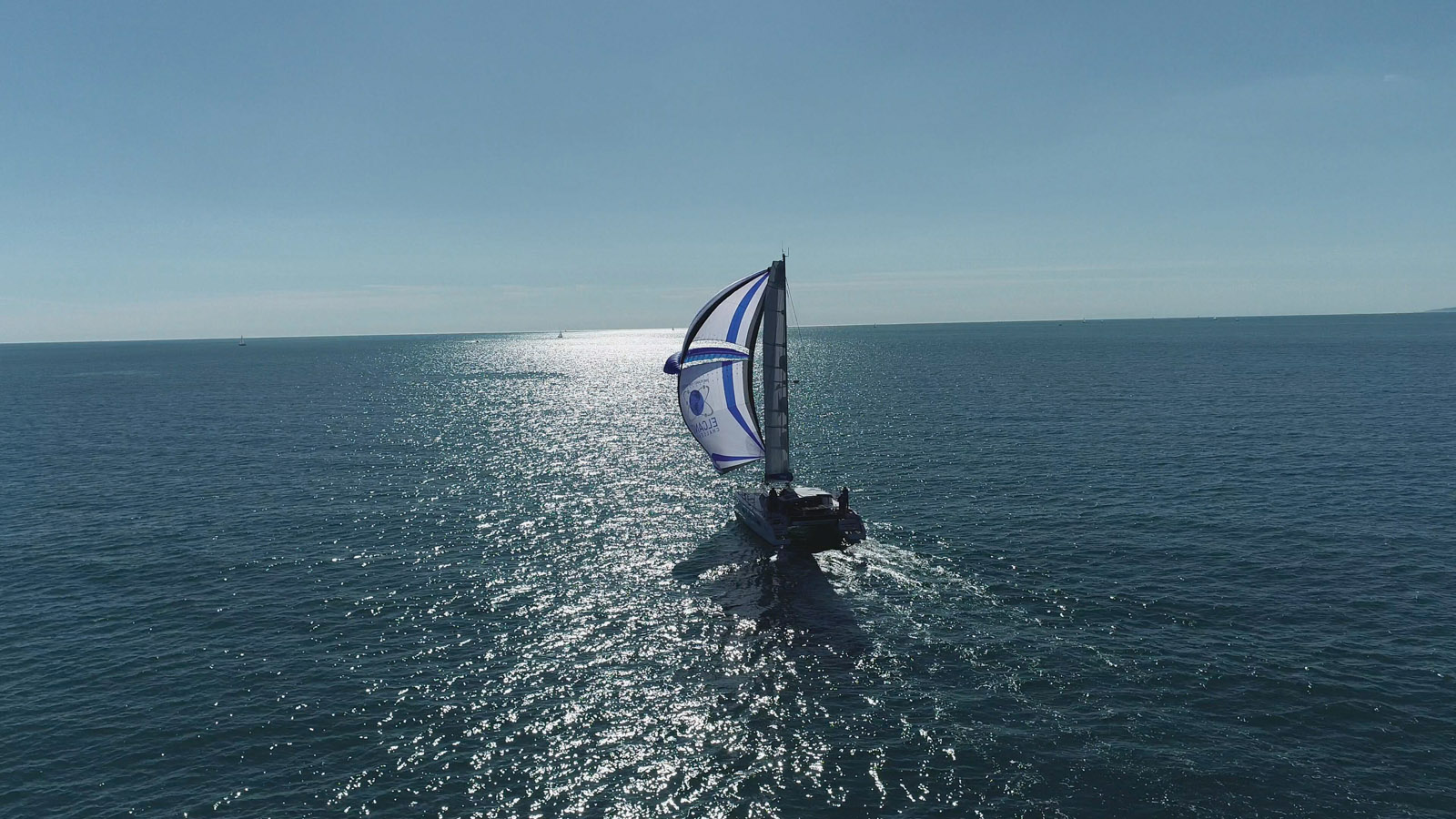
On ELCANO 500‘s program: a 33,000-mile circumnavigation of the world identical or almost identical to the route Magellan took 500 years ago.
Three independent electrical circuits for better lightning protection
As the motors are supplied with 48 V, a 12 V service battery known as a “buffer” has been installed at the output of the ad hoc inverter. With the battery bank on board converted to 220 V, the consumption of the so-called “comfort” equipment seems very reasonable compared to the propulsion system. The choice was therefore made to do without gas and its constraints (changing bottles on long passages, differences in standards between countries, etc.). The galley is equipped with an induction hob. A surprising option at first glance for us sailors still rooted in the 20th century, but which, after reflection and analysis, proves to be very logical. To ensure maximum reliability, three independent electrical circuits coexist on board. The first is dedicated to propulsion. A second supplies power to the service equipment. Finally, a third, so-called “emergency” circuit is reserved for a second autopilot, a VHF and navigation lights. This third circuit contains all the wisdom of the old sage. ELCANO 500 is indeed equipped with a very nice rotating Axxon rig built in Romania - a nice nod to the Captain’s origins, by the way. But carbon masts have a higher accident rate than aluminum when it comes to lightning and thunderstorms. This precaution therefore seems well in line with the overall level of reliability sought for such a program. Paradoxically, all these technical developments - or even this flurry of innovations - do not necessarily imply the headlong rush that might have been feared. Already for cost reasons, the design of this catamaran required an extremely thorough optimization of all the elements. Better still, since electricity is going to make all the difference with this boat, its daily use will impose a return to the source of pure, simple sailing, in search of efficiency, simplicity, where time will make less of a difference.
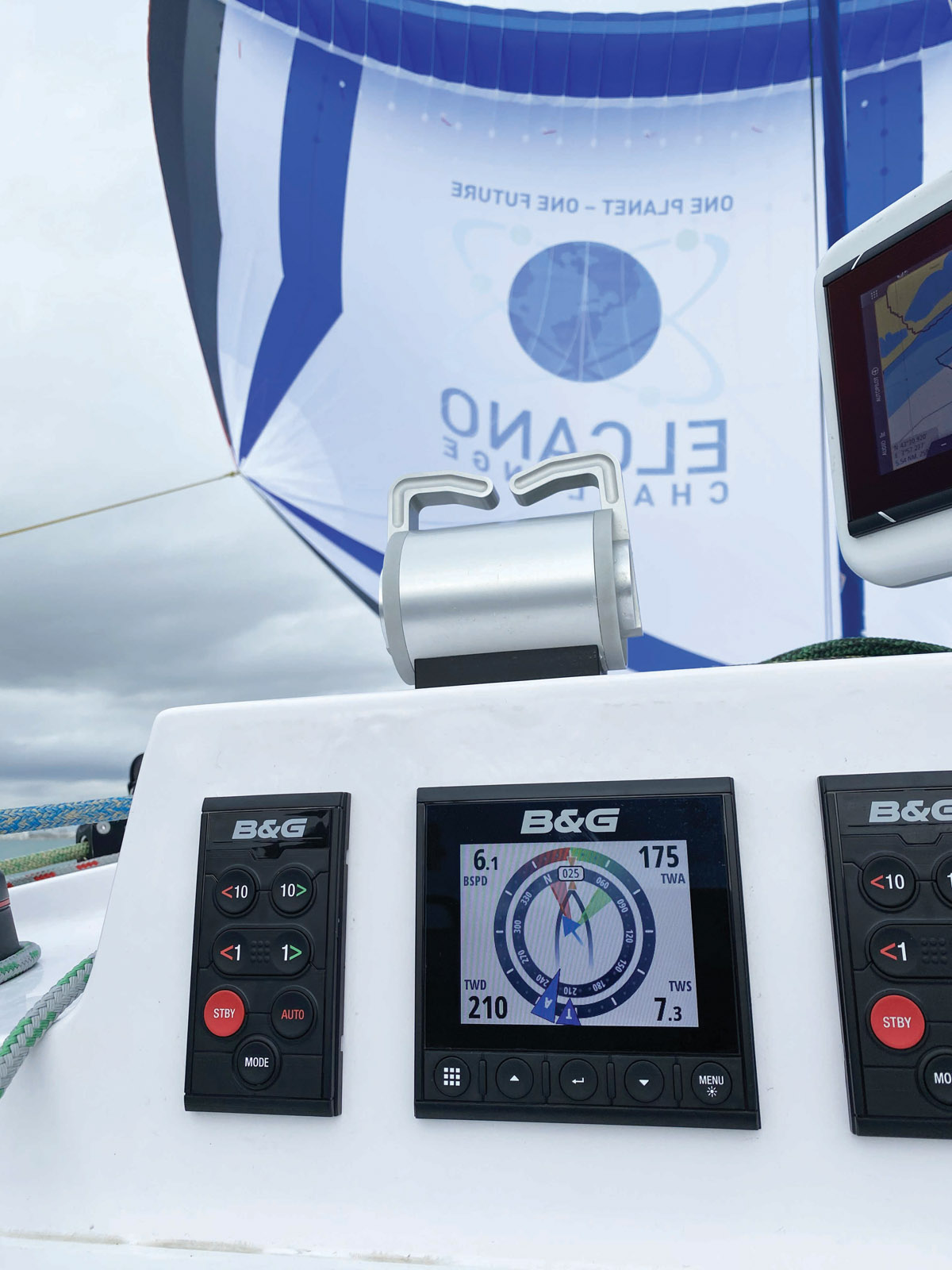
The control levers are particularly sensitive - be careful not to inadvertently lean on them at an inadvertent moment…
Surfing at 14 knots
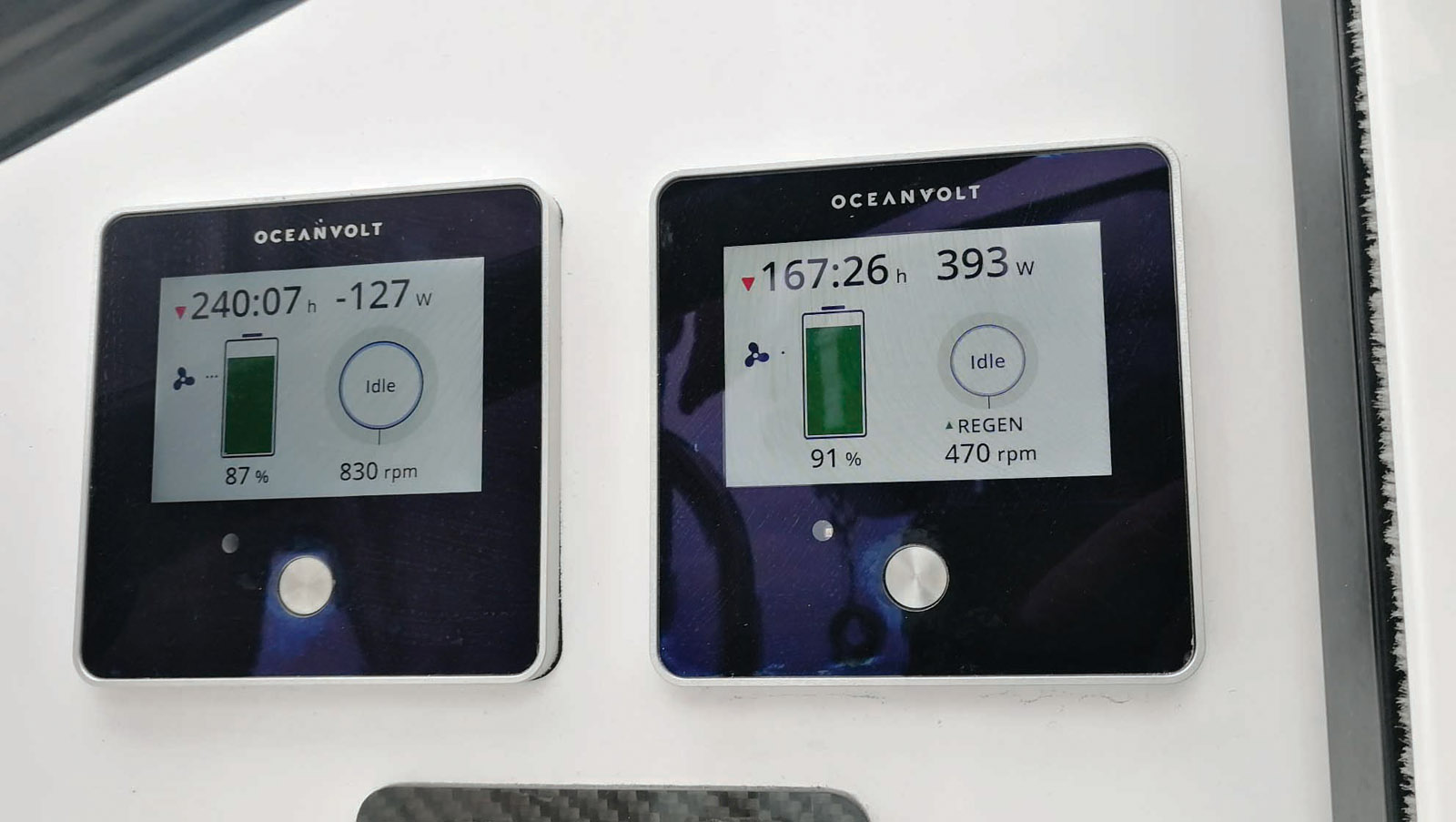
We’re under sail, this is what it’s all about! And the Outremer 4.Zero has nothing to envy of her 45 and 4X counterparts in terms of performance. Upwind in the bay of Aigues-Mortes, the log is flirting with 7 knots at 50° off a true wind that rarely exceeds 11 knots. It is in these conditions that the choice of a light catamaran makes all the more sense in this electric version. Where a heavier catamaran would have to be powered by the engines, here we are under sail from just 5 knots of wind. In this still very moderate wind, we’re charging between 400 W on port (SD15) and 600 on starboard (Servoprop). We learn, with photographic evidence, that the production of the Servoprop quickly reaches 1,500 W at 9 knots, and even 2,000 W as soon as the log is into double-digit speeds. The maximum recorded during the tests is 7 kW of recharge in a 14-knot surf! This is more than the maximum set at 5kW for safety reasons. But time was short, there was no danger, the propeller blades did not even have time to adapt their pitch to regulate. At this rate, the 95% load was quickly recovered, and it was the 1,300 W of solar panels on the davits that took over. This is because lithium batteries require a “softer” end of charge than hydrogenation. Additional solar panels were considered on the bimini and on the coachroof, but they were judged too slippery, and their cost prohibitive by the owner/ captain. It must be said that the cost of this prototype is already close to one million euros. For a 45-footer, even if she is actually 48 feet long, there is still a long way to go before reaching an acceptable production price.
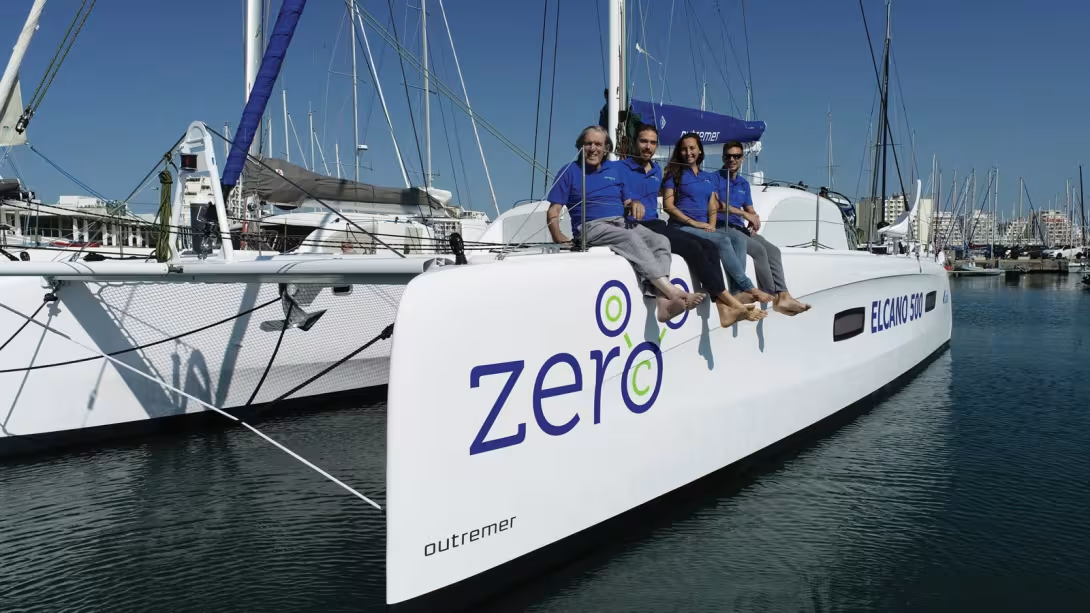
A young and motivated crew
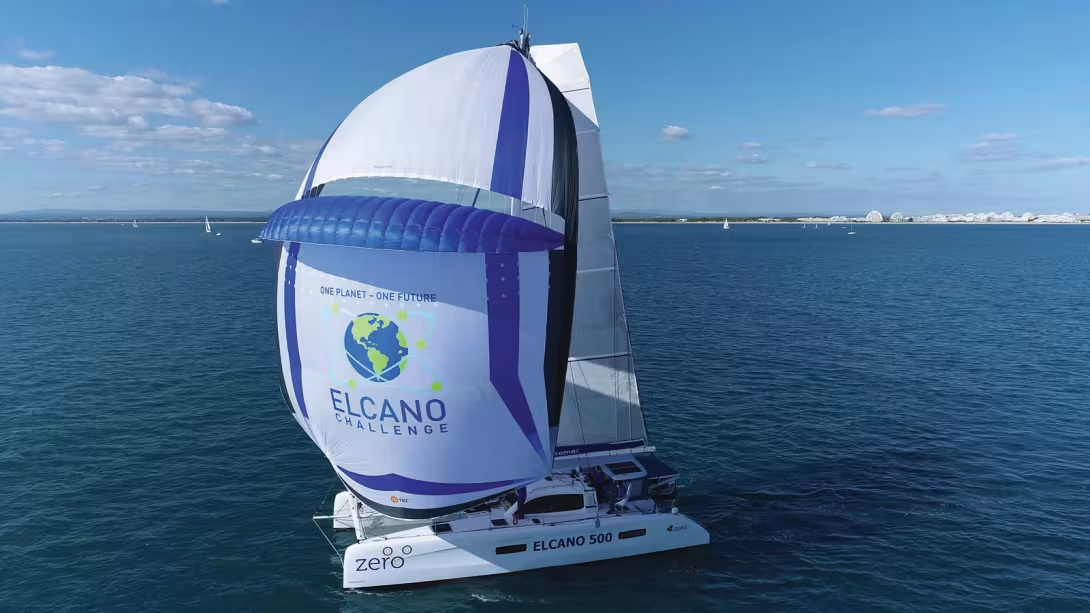
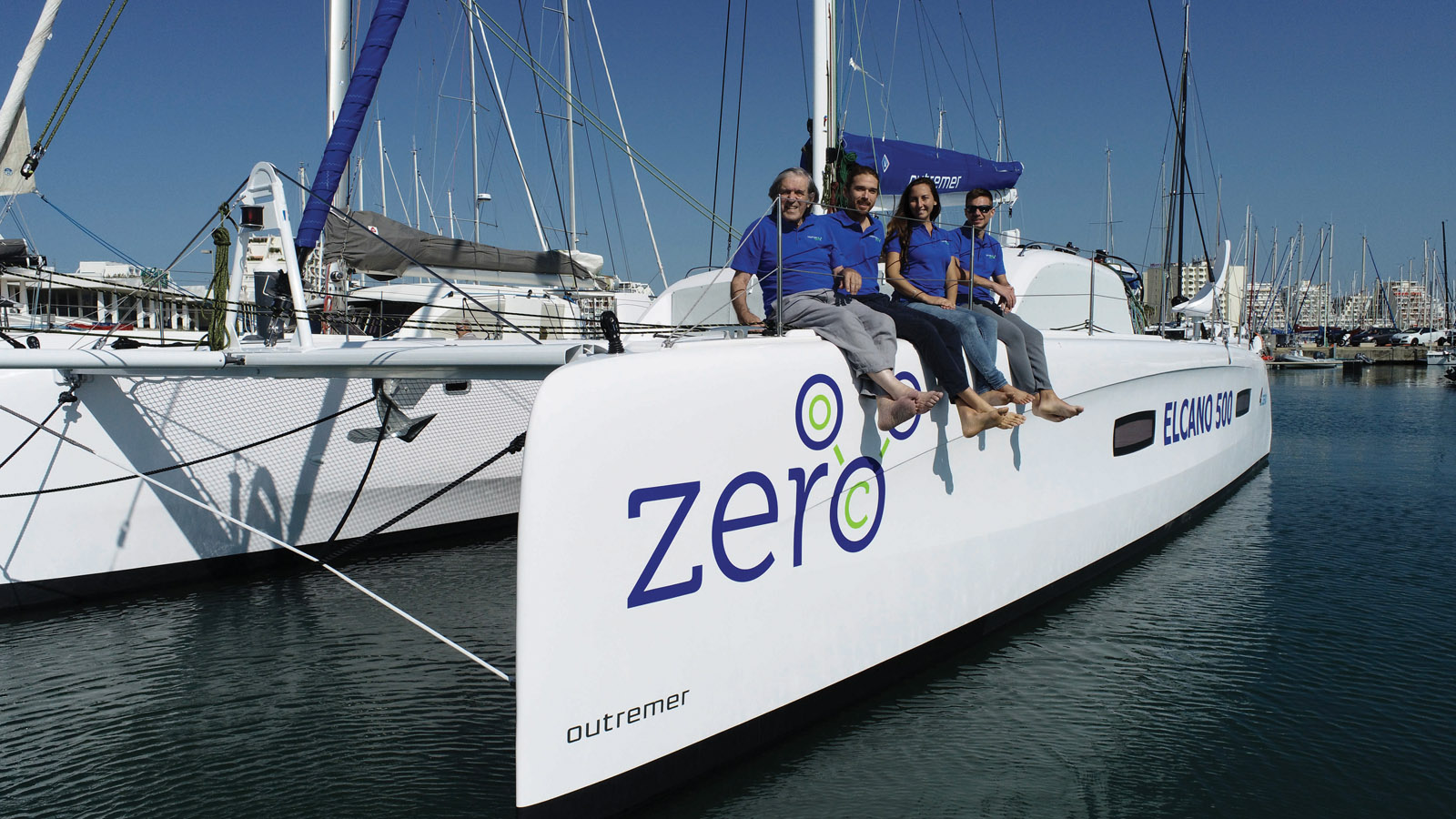
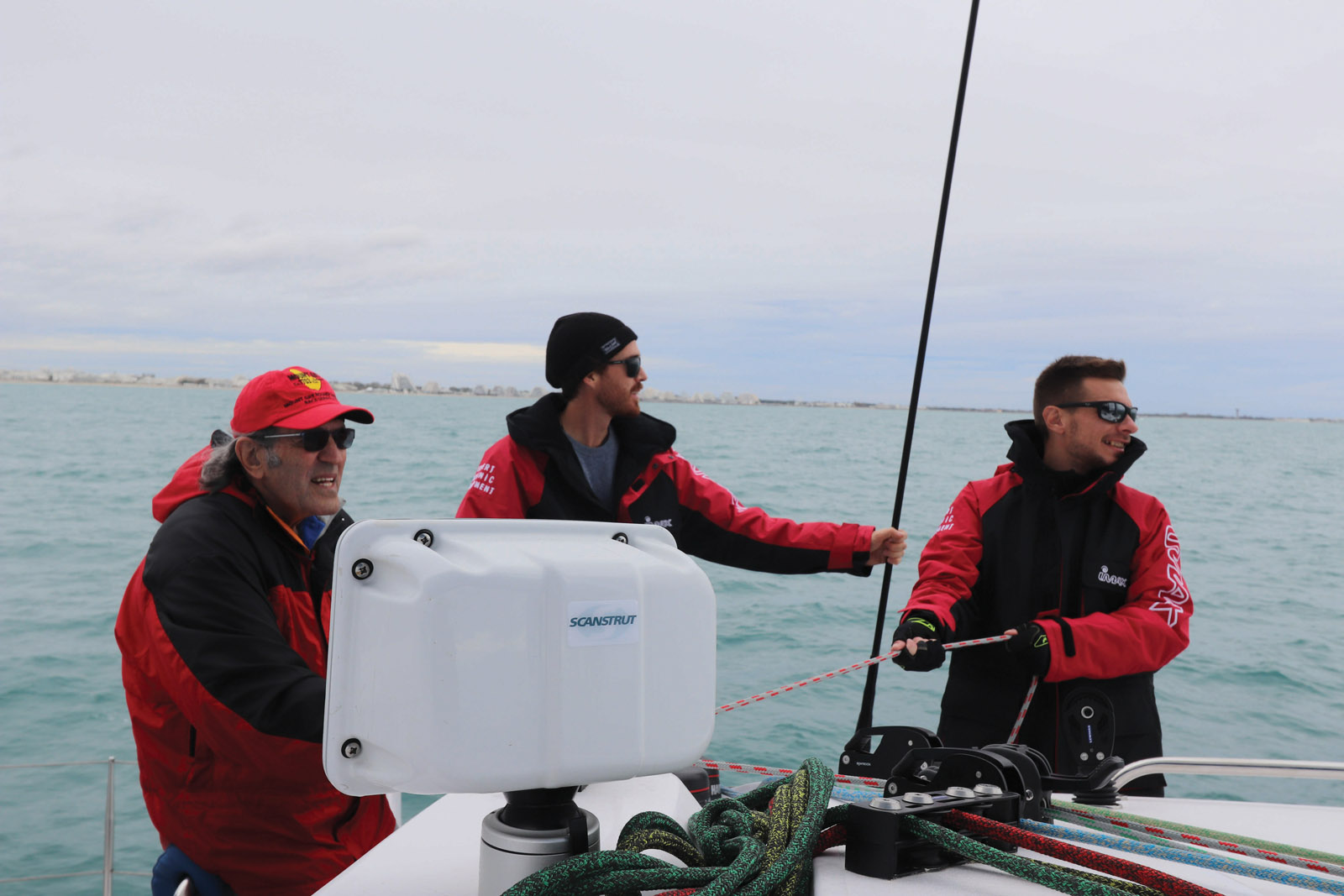
Time to head back in, fully downwind. It’s not the favorite point of sail for our multihulls, but Jimmy absolutely wants to hoist his huge 1,600-square foot (150 m²) Parasailor. With only 11 knots of wind, yet at 178°, we also reach 7 knots of speed. His young international crew (30 years old on average) who will accompany him on this round-the-world trip has not yet fully got their bearings on board, and the operation is taking a little time for this first hoist. I note in passing that Conor (USA), Taylor (USA) and Michalis (Greece) are collectively three years older than their valiant octogenarian skipper. All four of them are approaching this epic journey with the same enthusiasm. But Jimmy has a disarming side when he evokes a distance to cover of “just” 33,000 nautical miles. He envisions it as most of us do when it comes to summer cruising. With the exception that we are talking about 9 months of navigation here by opting for a very cautious average speed of 6 knots. For health reasons, they will not stop in Brazil, but will sail directly to Argentina and will therefore very quickly enter the aptly-named Strait of Magellan. Faced with the dreaded katabatic winds that hurtle down from the summits without warning, it will take all the dynamic qualities of the Outremer, Jimmy’s seafaring sense and the reliability of the innovations on board to succeed. As with a future production car sent to test drive in the middle of the desert or in cold climates, Jimmy and his crew will more than ever take on their roles as test pilots... all in the name of science!
 |
 |
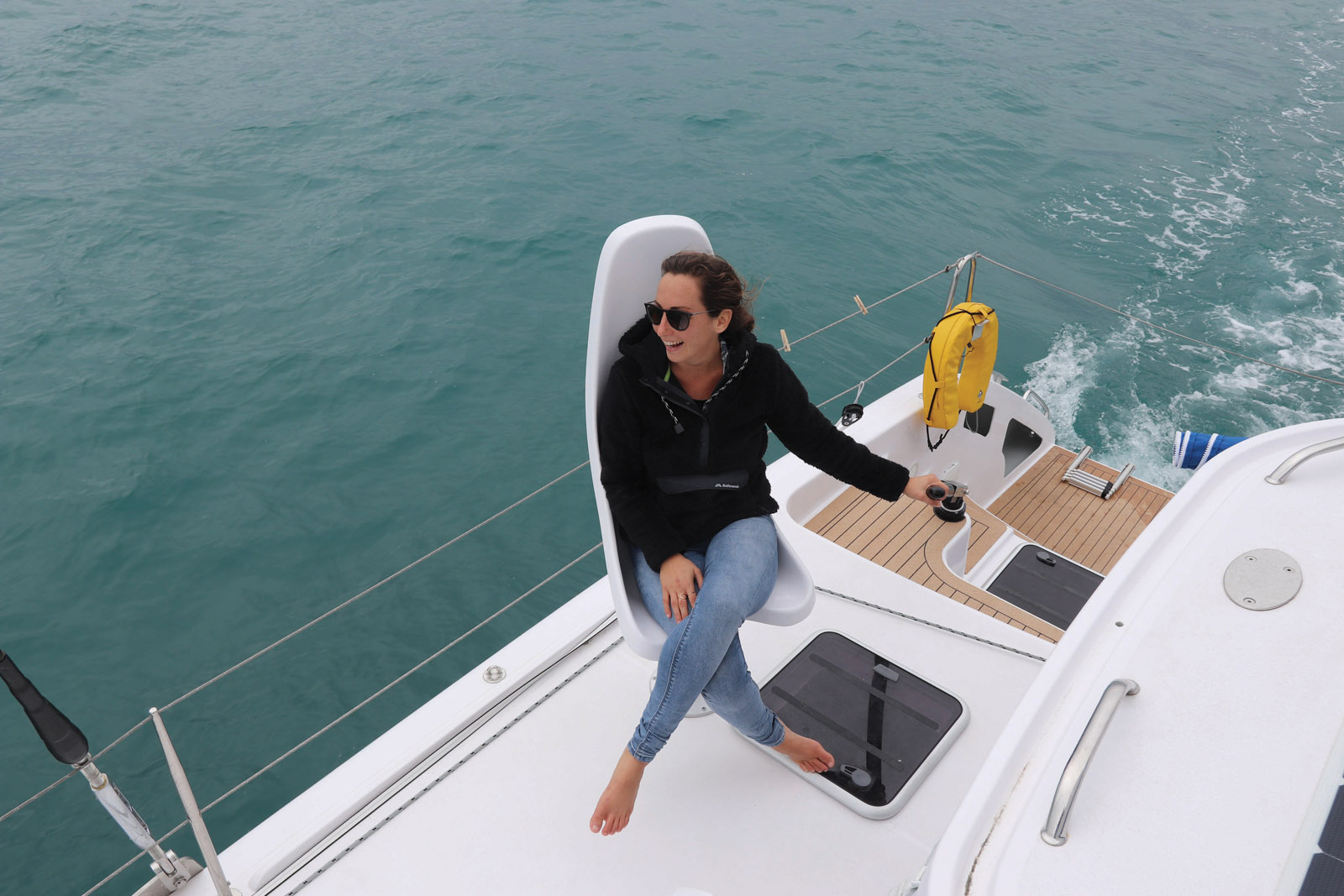 |
For his ambitious challenge, the famous sailor has surrounded himself with a very young crew - 30 years old on average.
TECHNICAL SPECIFICATIONS
Architects: Barreau/Neuman
Designer: Patrick Le Quément / Darnet Design
Length: 48’ (14.62 m)
Width: 23’6” (7.15 m)
Draft: 3’/7’ (0.9/ 2.15 m)
Displacement: 18,000 lbs / 24,470 lbs (8.2/11.1 t)
Mainsail: 721 sq ft (67 m²)
Solent: 592 sq ft (55 m²)
Gennaker: 1,184 sq ft (110 m²)
Spinnaker: 1,722 sq ft (160 m²)
CE certification: 8/16 persons
Motors: 2 x 15 kW Oceanvolt (1 x SD15 + 1 x Servoprop)
Batteries: 56 kWh
Price of the tested prototype: approx € e 1,000,000 ex-tax
The Pluses
+ Performance and comfort of use
+ Silent operation
+ Hydrogenation by Servoprop
The Minuses
- Limited range
- Overly sensitive “throttles”
- Price not yet competitive